We go from the ground to the mountain, baby! Without walking!
August 25, 2009 8:29 PM Subscribe
The funicular railway is a kind of cable-based railway that gives me great joy because of its peculiar shape and its uselessness for doing anything other than what it does. A funicular carriage is generally stairstepped or terraced, so you can't repurpose these cars for other uses. They generally work in a particular way, too, as pairs: one goes up the mountain, one comes down the mountain! Maybe this kind of glee is why they seem to be especially popular in Japan today, where they can be taken to many popular sightseeing areas--but a fair number of funicular railway riders are probably there for the journey, not the destination.
You can go on a pilgrimage to the numinous group of peaks called Kōyasan (here's a video of the trip there) via the Kōyasan Cable, which even accepts payment by smart card. You can take the Mitake Tozan Mountain Railway not too far from Tokyo and do some fine hiking in the Chichibu Tama Kai National Park (video trip). In the famous sightseeing region of Hakone, you can start your journey on the modern-looking Hakone Tozan Cable Car, defying the generally old-fashioned vibe (you complete your trip up to Lake Ashi on a ropeway, and once you get to the lake you can hop on a replica of the HMS Victory or 17th-century French warship Soleil Royal no I am not even kidding). Then there's the Kintetsu Ikoma Cable Line. The dog car, named Bull, and the cat car, named Mike, are on the Hōzanji line to the Buddhist temple Hōzanji. (Another Flickr user notes that some people use these trains as part of their normal commute.) The music-themed Do-Re-Mi car and the cake-themed Sweet car go to the amusement park Skyland Ikoma on the Ikoma line. Compared to these four, the two cars on Hōzanji Line 2 look positively normal. There are probably a couple dozen funiculars in Japan, so...more where those came from! (They even have cool looking tickets--more here.)
In the videos above you can see the "passing track" style, where a single track is used for most of the course but there's a kind of "mouth" area where the two cars pass each other on two tracks. Other systems may use parallel tracks. For zillions more strangely hypnotic Japanese funicular railway videos, see this Youtube search results page. (Yes, those katakana spell "cable car", basically. Although they're two somewhat different things in English, they're the same thing in Japanese. There's a note about this on the Japanese Wikipedia entry, and another link is provided for San Francisco cable car seekers.)
There's not enough space to address funiculars all over the world, but I'll add a few general notes: The name comes from Latin for "rope." Many of the now-closed ones in the US (where they're often called inclines or incline railroads) and elsewhere were used to get into mines, but they've also been used to move ships. The steepest passenger railway in the world, the Katoomba Scenic Railway in Blue Mountains, Australia, is a funicular railway, as is supposedly-the-shortest and supposedly-soon-to-return-to-operation, Angels Flight in Los Angeles, USA. There's also a funicular that may be the oldest railway in the world, the Reiszug in Austria, which dates to the 1500s and is now run by motor--a lot older than this 1920s one from Japan! They're found in many other places in the world. There are many in South America (most notably Valparaiso, Chile), some in other parts of Asia (though not Korea for some reason, as far as I can tell), and particularly in Switzerland, Italy, and other hilly and mountainous areas of Europe, where Michel has blogged his photos for you. Apparently they were pretty popular in the Soviet Union, too. For details on how they operate, you can read the nitty-gritty of funicular function at the Sweden-based funiculars.net.
You may even know a song about funiculars! The 1880 song "Funiculì, Funiculà," is about the opening of the funicular on Mount Vesuvius (no, really!) which had to be shut down in 1944 after repeated eruptions caused problems. And yes, that's where the headline on this post comes from. Here, for no apparent reason, is a children's chorus, Luciano Pavarotti, and Aqua (yes, THAT Aqua) performing "Funiculì, Funiculà."
You can go on a pilgrimage to the numinous group of peaks called Kōyasan (here's a video of the trip there) via the Kōyasan Cable, which even accepts payment by smart card. You can take the Mitake Tozan Mountain Railway not too far from Tokyo and do some fine hiking in the Chichibu Tama Kai National Park (video trip). In the famous sightseeing region of Hakone, you can start your journey on the modern-looking Hakone Tozan Cable Car, defying the generally old-fashioned vibe (you complete your trip up to Lake Ashi on a ropeway, and once you get to the lake you can hop on a replica of the HMS Victory or 17th-century French warship Soleil Royal no I am not even kidding). Then there's the Kintetsu Ikoma Cable Line. The dog car, named Bull, and the cat car, named Mike, are on the Hōzanji line to the Buddhist temple Hōzanji. (Another Flickr user notes that some people use these trains as part of their normal commute.) The music-themed Do-Re-Mi car and the cake-themed Sweet car go to the amusement park Skyland Ikoma on the Ikoma line. Compared to these four, the two cars on Hōzanji Line 2 look positively normal. There are probably a couple dozen funiculars in Japan, so...more where those came from! (They even have cool looking tickets--more here.)
In the videos above you can see the "passing track" style, where a single track is used for most of the course but there's a kind of "mouth" area where the two cars pass each other on two tracks. Other systems may use parallel tracks. For zillions more strangely hypnotic Japanese funicular railway videos, see this Youtube search results page. (Yes, those katakana spell "cable car", basically. Although they're two somewhat different things in English, they're the same thing in Japanese. There's a note about this on the Japanese Wikipedia entry, and another link is provided for San Francisco cable car seekers.)
There's not enough space to address funiculars all over the world, but I'll add a few general notes: The name comes from Latin for "rope." Many of the now-closed ones in the US (where they're often called inclines or incline railroads) and elsewhere were used to get into mines, but they've also been used to move ships. The steepest passenger railway in the world, the Katoomba Scenic Railway in Blue Mountains, Australia, is a funicular railway, as is supposedly-the-shortest and supposedly-soon-to-return-to-operation, Angels Flight in Los Angeles, USA. There's also a funicular that may be the oldest railway in the world, the Reiszug in Austria, which dates to the 1500s and is now run by motor--a lot older than this 1920s one from Japan! They're found in many other places in the world. There are many in South America (most notably Valparaiso, Chile), some in other parts of Asia (though not Korea for some reason, as far as I can tell), and particularly in Switzerland, Italy, and other hilly and mountainous areas of Europe, where Michel has blogged his photos for you. Apparently they were pretty popular in the Soviet Union, too. For details on how they operate, you can read the nitty-gritty of funicular function at the Sweden-based funiculars.net.
You may even know a song about funiculars! The 1880 song "Funiculì, Funiculà," is about the opening of the funicular on Mount Vesuvius (no, really!) which had to be shut down in 1944 after repeated eruptions caused problems. And yes, that's where the headline on this post comes from. Here, for no apparent reason, is a children's chorus, Luciano Pavarotti, and Aqua (yes, THAT Aqua) performing "Funiculì, Funiculà."
Great post. I'll play for North America.
posted by Morrigan at 8:43 PM on August 25, 2009 [1 favorite]
posted by Morrigan at 8:43 PM on August 25, 2009 [1 favorite]
Allow me to add Hong Kong's Peak Tram which is really nice.
posted by awfurby at 8:45 PM on August 25, 2009 [3 favorites]
posted by awfurby at 8:45 PM on August 25, 2009 [3 favorites]
Nice. My hometown of Wiesbaden, Germany has the Nerobergbahn.
posted by muckster at 8:54 PM on August 25, 2009 [1 favorite]
posted by muckster at 8:54 PM on August 25, 2009 [1 favorite]
Admit it. You just like saying the word 'funicular'. Funicular, funicular, funicular ... what a great word.
posted by feckless at 8:59 PM on August 25, 2009 [2 favorites]
posted by feckless at 8:59 PM on August 25, 2009 [2 favorites]
No visit to Hong Kong is complete without a ride on the Victoria Peak Tram, from which you get great overhead views of Hong Kong Island.
posted by eye of newt at 9:03 PM on August 25, 2009 [1 favorite]
posted by eye of newt at 9:03 PM on August 25, 2009 [1 favorite]
awfurby looks up links faster than I do
posted by eye of newt at 9:04 PM on August 25, 2009
posted by eye of newt at 9:04 PM on August 25, 2009
Interesting to learn that Angels Flight is a funicular railway. I walked past it a few months ago without realizing its, uh, funicularity. The whole thing is only about 2 blocks long and the hill isn't even all that steep - seems like a funicular railway is a bit of overkill for that spot. I'm pretty sure I've been on escalators that were longer!
Those wacky Japanese dog and cat cars go to a temple? They seem more suited to an amusement park, but I'm delighted by the mental image of serene Buddhist monks riding this cartoon train. Thanks for a fun post, wintersweet.
posted by Quietgal at 9:11 PM on August 25, 2009
Those wacky Japanese dog and cat cars go to a temple? They seem more suited to an amusement park, but I'm delighted by the mental image of serene Buddhist monks riding this cartoon train. Thanks for a fun post, wintersweet.
posted by Quietgal at 9:11 PM on August 25, 2009
Looking up my first funicular encounter in Spain, and reading the funimag website makes me glad that the web exists to cull all this obscure transportation knowledge. (since 1996!)
Yes, great post, and helps explain that line in the decemberists' song for myla goldberg...
posted by NikitaNikita at 9:13 PM on August 25, 2009 [1 favorite]
Yes, great post, and helps explain that line in the decemberists' song for myla goldberg...
posted by NikitaNikita at 9:13 PM on August 25, 2009 [1 favorite]
Horseshoe Curve near Altoona, PA has one as well. A railroad museum with its own railroad, so to speak.
posted by pjern at 9:22 PM on August 25, 2009 [1 favorite]
posted by pjern at 9:22 PM on August 25, 2009 [1 favorite]
The Hakone Tozan funicular is fun because there's only a single set of tracks, with a split in the middle to allow the ascending and descending trains to pass each other. It looks kind of freaky as the two approach.
posted by adamrice at 9:26 PM on August 25, 2009
posted by adamrice at 9:26 PM on August 25, 2009
There is a shoot out on a funicular railway in the Jeff Bridges/Rosanna Arquette film 8 Million Ways To Die
posted by vronsky at 9:27 PM on August 25, 2009
posted by vronsky at 9:27 PM on August 25, 2009
Logging railroads used "inclines" to get logs out of the hills. You can see an example here, and here (which comes from this page). Funiculars like this were an advanced alternative over switchbacks, requiring less rail and cutting of grades, but given the haphazard "engineering" of logging railroads, I wouldn't want to be standing anywhere near the bottom of the incline when a load of logs was headed down.
posted by maxwelton at 9:28 PM on August 25, 2009 [1 favorite]

posted by maxwelton at 9:28 PM on August 25, 2009 [1 favorite]
Those wacky Japanese dog and cat cars go to a temple? They seem more suited to an amusement park, but I'm delighted by the mental image of serene Buddhist monks riding this cartoon train.
Yep! This guy claims they bark and meow at each other when they pass! I don't know...I didn't hear anything but it's hard to hear over all the kids.
When we stayed overnight on Koyasan in a monastery, one of the young monks from our monastery came back down the mountain at the same time as us (going to see his family). Just a normally-shaped funicular, though. (I asked him in bad Japanese what his favorite Japanese food was, and he said "ピザ -- pizza!)
I'm enjoying checking out everyone's local funiculars!
posted by wintersweet at 9:38 PM on August 25, 2009
Yep! This guy claims they bark and meow at each other when they pass! I don't know...I didn't hear anything but it's hard to hear over all the kids.
When we stayed overnight on Koyasan in a monastery, one of the young monks from our monastery came back down the mountain at the same time as us (going to see his family). Just a normally-shaped funicular, though. (I asked him in bad Japanese what his favorite Japanese food was, and he said "ピザ -- pizza!)
I'm enjoying checking out everyone's local funiculars!
posted by wintersweet at 9:38 PM on August 25, 2009
A few shots of Quebec City's Funicular.
posted by DaddyNewt at 10:19 PM on August 25, 2009 [1 favorite]
posted by DaddyNewt at 10:19 PM on August 25, 2009 [1 favorite]
wow.very nice.
if there was a 'best post ever' voting booth you'd be in it and i'd push your button.
cool name also.you're excellent &smart!!
posted by minimalmark at 10:21 PM on August 25, 2009
if there was a 'best post ever' voting booth you'd be in it and i'd push your button.
cool name also.you're excellent &smart!!
posted by minimalmark at 10:21 PM on August 25, 2009
We used to refer to the Quebec Funiculair as the "jibby-jobby".
posted by furtive at 10:25 PM on August 25, 2009
posted by furtive at 10:25 PM on August 25, 2009
There's one of these in Edmonton, inside the convention centre. It's tiny and runs directly alongside two sets of stairs and a pair of escalators. Nice way to blow some cash!
There have been proposals for funiculars descending into the North Saskatchewan river valley, but they've been met with some criticism and opposition. Apparently a funicular is only beneficial to Edmontonians if it's utterly redundant and merely for show.
posted by Sys Rq at 10:29 PM on August 25, 2009 [1 favorite]
There have been proposals for funiculars descending into the North Saskatchewan river valley, but they've been met with some criticism and opposition. Apparently a funicular is only beneficial to Edmontonians if it's utterly redundant and merely for show.
posted by Sys Rq at 10:29 PM on August 25, 2009 [1 favorite]
Oh my God what an awesome post. We here at hurdy gurdy headquarters make it a point to ride any funicular encountered on our travels. Most recently: the funicular going up to Mount Tibidabo in Barcelona, and the Wiesbaden funicular (Nerobergbahn), which was built in 1888 and is one of the last funiculars in the world to use a water-ballast system (pollution free and silent--way ahead of its time).
posted by hurdy gurdy girl at 10:32 PM on August 25, 2009 [1 favorite]
posted by hurdy gurdy girl at 10:32 PM on August 25, 2009 [1 favorite]
no local funiculars.unfortunately i live in flat.
posted by minimalmark at 10:34 PM on August 25, 2009
posted by minimalmark at 10:34 PM on August 25, 2009
Not quite the same, but still amazing is the Montegalletto elevator (link in Italian) in Genoa. Video here. There are several other public elevators in Genoa, all operated by the city's public transit administration.
And then there's the Getty Center in L.A.
posted by clorox at 10:34 PM on August 25, 2009 [1 favorite]
And then there's the Getty Center in L.A.
posted by clorox at 10:34 PM on August 25, 2009 [1 favorite]
The Hakone Tozan funicular is fun because there's only a single set of tracks
same with the funicular in prague (0:10). an elegant conservation of both energy (the counterweight) and materials (the single track).
posted by ioesf at 10:44 PM on August 25, 2009
same with the funicular in prague (0:10). an elegant conservation of both energy (the counterweight) and materials (the single track).
posted by ioesf at 10:44 PM on August 25, 2009
You can spot a few funiculars on private properties along the Medina, WA side of Lake Washington (here's a shot of one). It's oh so handy for getting to your beach house from your mansion.
posted by girlhacker at 10:52 PM on August 25, 2009 [1 favorite]
posted by girlhacker at 10:52 PM on August 25, 2009 [1 favorite]
The single-track funiculars are really fascinating. I was watching the Prague video and one thing I can't tell is whether it uses a central pinion for traction? Or does it get its traction using just the normal rails? I can see something in the center of the rails but it's not clear whether it's just a power cable or electrical third rail rather than a load-bearing one.
Designing the bypass if you had a central pinion seems like it would be quite the trick.
posted by Kadin2048 at 10:53 PM on August 25, 2009
Designing the bypass if you had a central pinion seems like it would be quite the trick.
posted by Kadin2048 at 10:53 PM on August 25, 2009
And the amazing Chemosphere house in LA, designed by John Lautner, is accessed solely by funicular. You can see it in this bird's eye view to the right of the main structure. I had the amazing fortune of visiting the house and the funicular ride was almost the best part. Almost.
posted by otherwordlyglow at 11:20 PM on August 25, 2009 [1 favorite]
posted by otherwordlyglow at 11:20 PM on August 25, 2009 [1 favorite]
I used to drive the Wellington Cable Car (see here). I did not realise that funicular railways were so widespread in Japan. It makes the decision to shoot an Asimo commercial in New Zealand all the stranger.
Funiculars do not need a pinion, as they don't have an engine inside. They are being hauled up by the cable in the middle of the track. The cars have a flanged wheel on one side and a flat wheel on the other, so they will always take the correct track around the passing loop, and the cable runs through gaps in the rails.
(If you need to kill the drivers soul a little, just mention that the job must have "a lot of ups and downs". That one never fails.)
posted by WhackyparseThis at 11:30 PM on August 25, 2009 [1 favorite]
Funiculars do not need a pinion, as they don't have an engine inside. They are being hauled up by the cable in the middle of the track. The cars have a flanged wheel on one side and a flat wheel on the other, so they will always take the correct track around the passing loop, and the cable runs through gaps in the rails.
(If you need to kill the drivers soul a little, just mention that the job must have "a lot of ups and downs". That one never fails.)
posted by WhackyparseThis at 11:30 PM on August 25, 2009 [1 favorite]
Royal Gorge Incline Railway 100% grade/45 degree angle, claims to be the steepest in the world.
posted by hortense at 11:32 PM on August 25, 2009 [1 favorite]
posted by hortense at 11:32 PM on August 25, 2009 [1 favorite]
> I was watching the Prague video and one thing I can't tell is whether it uses a central pinion for traction? Or does it get its traction using just the normal rails?
I think those are just the cable guides, in theory the wheels are meant to be tractionless, and just guide the cars up and down the hill (and more importantly, away from each other on a single track). The cars themselves have no source of locomotion, it is just gravity pulling one car down which pulls the other car up (since they are connected by the same cable). There pulling and braking systems on the cable itself which is what controls the cars, and I assume some sort of emergency brake, but I believe that is about it.
posted by mrzarquon at 11:40 PM on August 25, 2009
I think those are just the cable guides, in theory the wheels are meant to be tractionless, and just guide the cars up and down the hill (and more importantly, away from each other on a single track). The cars themselves have no source of locomotion, it is just gravity pulling one car down which pulls the other car up (since they are connected by the same cable). There pulling and braking systems on the cable itself which is what controls the cars, and I assume some sort of emergency brake, but I believe that is about it.
posted by mrzarquon at 11:40 PM on August 25, 2009
Or what Whackyparsethis said.
Here is another video in better resolution of the Prague track, where you can see that it is just cables down there.
posted by mrzarquon at 11:42 PM on August 25, 2009 [1 favorite]
Here is another video in better resolution of the Prague track, where you can see that it is just cables down there.
posted by mrzarquon at 11:42 PM on August 25, 2009 [1 favorite]
(also, I want one in my house owned by my future self)
posted by mrzarquon at 11:43 PM on August 25, 2009
posted by mrzarquon at 11:43 PM on August 25, 2009
Great post.
I think the main reason for funiculars (known as "cable cars" in Japanese) being so "popular" is that back in the late 19th and early 20th centuries, trains were the only way to get around. There were few cars and roads were awful -- that includes mountain roads. In addition, many large temples, shrines, and other sightseeing spots were located atop mountains, which required a way to quickly move large numbers of people. Funiculars were the perfect solution, and even with the advent of motorization, still are, in my opinion.
I'd say this one has the best view.
posted by armage at 12:04 AM on August 26, 2009 [1 favorite]
I think the main reason for funiculars (known as "cable cars" in Japanese) being so "popular" is that back in the late 19th and early 20th centuries, trains were the only way to get around. There were few cars and roads were awful -- that includes mountain roads. In addition, many large temples, shrines, and other sightseeing spots were located atop mountains, which required a way to quickly move large numbers of people. Funiculars were the perfect solution, and even with the advent of motorization, still are, in my opinion.
I'd say this one has the best view.
posted by armage at 12:04 AM on August 26, 2009 [1 favorite]
The first funicular I ever rode was in Vieux Lyon (France): Funiculars of Lyon, the one that goes up to Fourvière. I loved its stepped design, old wooden seats and There's also a funiculaire that goes from Chamonix to Montenvers (by the Mer de Glace glacier next to Mont Blanc), but it's only called a funiculaire by French people who know it — it's not a true funicular, even if it does make an impressive climb.
posted by fraula at 12:20 AM on August 26, 2009 [2 favorites]
posted by fraula at 12:20 AM on August 26, 2009 [2 favorites]
(err, that sentence fragment should read "...old wooden seats and beautiful views.")
posted by fraula at 12:21 AM on August 26, 2009
posted by fraula at 12:21 AM on August 26, 2009
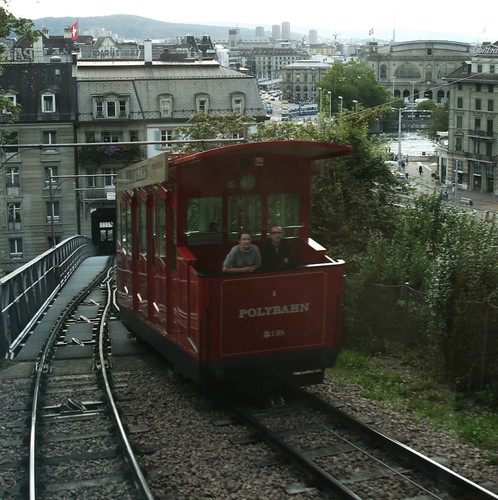
the Polybahn in Zürich is part of my daily commute. It's short and not particularly scenic, so doesn't seem to attract many tourists aside from railfans. It's also a single track funicular with a curving track, so when the left descending car is in the lower station, it hangs one "step" higher than the right descending car.
Zürich also has the Seilbahn (funicular) Rigiblick; both are tied into the city public transit network (i.e., free transfers with the buses, trams, and trains).
(great post, thanks!)
posted by Vetinari at 12:31 AM on August 26, 2009 [1 favorite]
Zürich also has the Seilbahn (funicular) Rigiblick; both are tied into the city public transit network (i.e., free transfers with the buses, trams, and trains).
(great post, thanks!)
posted by Vetinari at 12:31 AM on August 26, 2009 [1 favorite]
Nice post. I've ridden the one in Hakone, as well as the Mitake and Hong Kong ones. You can't go to Hong Kong and not ride the funicular, especially as getting to the peak without a car makes it rather hellish to not use it.
The one in Mitake is great, even better that it gets you to Mt Mitake, which is one of my favorite places in Tokyo. The only problem with the Hakone funicular is that it's the beginning of a progression that involves cable cars, which are unpleasant and evil.
posted by Ghidorah at 1:11 AM on August 26, 2009
The one in Mitake is great, even better that it gets you to Mt Mitake, which is one of my favorite places in Tokyo. The only problem with the Hakone funicular is that it's the beginning of a progression that involves cable cars, which are unpleasant and evil.
posted by Ghidorah at 1:11 AM on August 26, 2009
The single-track funiculars are really fascinating. I was watching the Prague video and one thing I can't tell is whether it uses a central pinion for traction? Or does it get its traction using just the normal rails? I can see something in the center of the rails but it's not clear whether it's just a power cable or electrical third rail rather than a load-bearing one.
All funiculars are hauled by rope, usually (if not always) from a static engine at the top. Since the cars are linked together by rope, they should always pass in exactly the right spot.
One thing I've just learned from Wikipedia is that the cars on single track system have double-flanged wheels on one side and no flanges on the other, meaning one car always follows the leftmost rail and one car always follows the rightmost rail. This ensures the cars always go to the appropriate side at the passing point.
posted by cillit bang at 1:15 AM on August 26, 2009
All funiculars are hauled by rope, usually (if not always) from a static engine at the top. Since the cars are linked together by rope, they should always pass in exactly the right spot.
One thing I've just learned from Wikipedia is that the cars on single track system have double-flanged wheels on one side and no flanges on the other, meaning one car always follows the leftmost rail and one car always follows the rightmost rail. This ensures the cars always go to the appropriate side at the passing point.
posted by cillit bang at 1:15 AM on August 26, 2009
And to answer your question the thing along the middle of both sides in the Prague video is the safety cable, which is what the emergency brakes on the car act against (friction brakes against the rails would be useless). On the left there are two cables visible - the second one is the traction cable pulling up the car the video's being filmed from. On the right you can the empty pulleys that the other car's traction cable will be spooled onto as it passes.
posted by cillit bang at 1:21 AM on August 26, 2009
posted by cillit bang at 1:21 AM on August 26, 2009
Hong Kong's Peak Tram hits fairly steep rises on the way up, which is why everyone must sit facing backward on the way down.
posted by bwg at 1:26 AM on August 26, 2009
posted by bwg at 1:26 AM on August 26, 2009
Okay, I'll play... Wellington Cable Car (lots on Flickr).
Interesting museum at the top of the hill which I found very interesting when I was there a couple of months ago.
posted by sycophant at 1:39 AM on August 26, 2009 [1 favorite]
Interesting museum at the top of the hill which I found very interesting when I was there a couple of months ago.
posted by sycophant at 1:39 AM on August 26, 2009 [1 favorite]
the thing along the middle of both sides in the Prague video is the safety cable, which is what the emergency brakes on the car act against (friction brakes against the rails would be useless)
That seems like an odd thing to add. The Wellington Cable Car has a brake that clamps onto the rail if the hauling line fails. I can attest that it brings the vehicle to a complete stop very well. I'm curious as to what benefit another static line would give.
posted by WhackyparseThis at 2:58 AM on August 26, 2009
That seems like an odd thing to add. The Wellington Cable Car has a brake that clamps onto the rail if the hauling line fails. I can attest that it brings the vehicle to a complete stop very well. I'm curious as to what benefit another static line would give.
posted by WhackyparseThis at 2:58 AM on August 26, 2009
saw but did not take one last week in Capri, the one going to Anacapri....figured passengers better off without my great show of fear.
posted by Postroad at 3:45 AM on August 26, 2009
posted by Postroad at 3:45 AM on August 26, 2009
While living in Zürich I loved taking the Polybahn, which was built in 1886 and was beautifully maintained. It drops you off inside a regular city building at the bottom.
posted by molecicco at 3:52 AM on August 26, 2009

posted by molecicco at 3:52 AM on August 26, 2009
Ah yes... as mentioned upthread by Vetinari. Should read all comments first.
posted by molecicco at 3:54 AM on August 26, 2009
posted by molecicco at 3:54 AM on August 26, 2009
That seems like an odd thing to add. The Wellington Cable Car has a brake that clamps onto the rail if the hauling line fails. I can attest that it brings the vehicle to a complete stop very well.
You're right of course - I was thinking of brakes on the wheels, which would definitely be useless.
I'm curious as to what benefit another static line would give.
I've being an idiot again - it moves with the cars and the emergency brake is in the machine room, which makes it easier to activate, especially if the cars are unstaffed.
(although there do seem to be some systems that have a static safety cable and emergency brakes on the cars, which as you say, would appear a less than optimum solution)
posted by cillit bang at 3:55 AM on August 26, 2009
You're right of course - I was thinking of brakes on the wheels, which would definitely be useless.
I'm curious as to what benefit another static line would give.
I've being an idiot again - it moves with the cars and the emergency brake is in the machine room, which makes it easier to activate, especially if the cars are unstaffed.
(although there do seem to be some systems that have a static safety cable and emergency brakes on the cars, which as you say, would appear a less than optimum solution)
posted by cillit bang at 3:55 AM on August 26, 2009
How to get from the few blocks by the river to the rest of town on the bluff? As Exogenous mentioned above, Pittsburgh solved that issue with funiculars. Oregon City uses a slightly different solution.
posted by pernoctalian at 5:22 AM on August 26, 2009
posted by pernoctalian at 5:22 AM on August 26, 2009
You can't spell 'funicular' without F-U-N!!!
I had never been on a funicular until I went to France in 2001. There I rode the Pic du Jer funicular in Lourdes, and the Montmartre funicular. I love them even though I am afraid of heights.
posted by candyland at 5:53 AM on August 26, 2009 [1 favorite]
I had never been on a funicular until I went to France in 2001. There I rode the Pic du Jer funicular in Lourdes, and the Montmartre funicular. I love them even though I am afraid of heights.
posted by candyland at 5:53 AM on August 26, 2009 [1 favorite]
Great post. Despite being slightly transit nerdy, I'd never heard of funiculars until I went to Lisbon a few years ago. They've got three there, plus an elevator. The Wellington funicular is pretty cool and I think the museum there noted that there are some private funiculars in that area too.
On the elevator tangent, there's a transit elevator from Hoboken to the Jersey City Heights, connecting the Heights to the light rail & PATH. We should get some funicular action on the Palisades, that would be awesome.
Oh, wait, I guess there was one for a little while.
posted by yarrow at 6:50 AM on August 26, 2009 [1 favorite]
On the elevator tangent, there's a transit elevator from Hoboken to the Jersey City Heights, connecting the Heights to the light rail & PATH. We should get some funicular action on the Palisades, that would be awesome.
Oh, wait, I guess there was one for a little while.
posted by yarrow at 6:50 AM on August 26, 2009 [1 favorite]
Neat Post. It's worth mentioning that the two remaining Pittsburgh inclines are just the survivors out of over a dozen around the city, many of them built for freight and not just people. The bigger ones could carry two loaded carts with horses at once.
Also it's worth pointing out that the Mon Incline isn't just for sight-seeing, it's still used for day to day commuting from the neighborhoods at the top by people who work in the downtown business district.
posted by octothorpe at 7:09 AM on August 26, 2009 [1 favorite]
Also it's worth pointing out that the Mon Incline isn't just for sight-seeing, it's still used for day to day commuting from the neighborhoods at the top by people who work in the downtown business district.
posted by octothorpe at 7:09 AM on August 26, 2009 [1 favorite]
Speaking of the sub-topic of transit elevators, I was once hiking on a road in Monaco and was next to this enormous rock at the bottom of a cliff. At closer look, I couldn't believe my eyes when I saw an elevator door in the middle of the rock.
It turns out Monaco has seven transit elevators around the tiny country. Considering the great views in Monaco, it seems they've missed a great opportunity to install funiculars!
Someone please forward this to Prince Albert II.
posted by eye of newt at 7:20 AM on August 26, 2009 [1 favorite]
It turns out Monaco has seven transit elevators around the tiny country. Considering the great views in Monaco, it seems they've missed a great opportunity to install funiculars!
Someone please forward this to Prince Albert II.
posted by eye of newt at 7:20 AM on August 26, 2009 [1 favorite]
Some funicular photos from around the world, including one with a great view in Tennessee.
posted by eye of newt at 7:57 AM on August 26, 2009 [1 favorite]
posted by eye of newt at 7:57 AM on August 26, 2009 [1 favorite]
weird, i was just thinking that my neighborhood in san francisco, potrero hill, needs ascensors. i'm gonna write an op ed to that effect in the local pAper. not that it will ever happen, what with planning codes regulations NIMBYism etc... but a man can dream
posted by jcruelty at 8:40 AM on August 26, 2009
posted by jcruelty at 8:40 AM on August 26, 2009
Don't forget Pittsburgh!
Ooh! I rode that one! I don't remember it being called a funicular, but that didn't detract from the experience at all.
posted by orme at 9:15 AM on August 26, 2009
Ooh! I rode that one! I don't remember it being called a funicular, but that didn't detract from the experience at all.
posted by orme at 9:15 AM on August 26, 2009
> cable cars, which are unpleasant and evil
To a San Franciscan, them's fightin' words. I assume you're talking about this. Otherwise you are sadly misguided, my friend, and you must come to this fair city and ride the world's only remaining permanently operating manual cable car system.
posted by Quietgal at 9:35 AM on August 26, 2009
To a San Franciscan, them's fightin' words. I assume you're talking about this. Otherwise you are sadly misguided, my friend, and you must come to this fair city and ride the world's only remaining permanently operating manual cable car system.
posted by Quietgal at 9:35 AM on August 26, 2009
Great post! I've ridden the Qubec one a few times and always thought of it as a strange quirk of that city. I had no idea there were so many around the world!
posted by lumpenprole at 9:38 AM on August 26, 2009
posted by lumpenprole at 9:38 AM on August 26, 2009
Remember on your birthday to check out the funicular goats!
Also, the mustard-off pools are essential.
posted by GuyZero at 10:50 AM on August 26, 2009
Also, the mustard-off pools are essential.
posted by GuyZero at 10:50 AM on August 26, 2009
Gratuitous self-YTL from inside Certaldo, Tuscany, Italy's small freebie. Livorno, up the road has a really charming one that runs on solar power. Shoulda taken something more than photos of San Moritz's ride up the slopes which one is forced into with near Disney-like queue management.
posted by Ogre Lawless at 11:02 AM on August 26, 2009 [1 favorite]
posted by Ogre Lawless at 11:02 AM on August 26, 2009 [1 favorite]
As someone who took Angels Flight every day, rode it the morning of the 2001 accident, and would have taken it within +/- an hour of the accident had I not blown off lunch that day...I still think this is pretty damn cool.
but the accident certainly reinforced my "what-if-the-cable-breaks" fear
posted by davejay at 11:38 AM on August 26, 2009
but the accident certainly reinforced my "what-if-the-cable-breaks" fear
posted by davejay at 11:38 AM on August 26, 2009
The Center for Alternative Technology in Wales has a water powered one.
posted by nestor_makhno at 2:13 PM on August 26, 2009 [1 favorite]
posted by nestor_makhno at 2:13 PM on August 26, 2009 [1 favorite]
« Older Exploring Ingenuity in Iron ... | Goodbye, Teddy Newer »
This thread has been archived and is closed to new comments
posted by netbros at 8:33 PM on August 25, 2009