They shoot bunnies, don't they?
October 21, 2009 12:26 PM Subscribe
There is contention in Sweden over the use of rabbit cadavers as bioenergy to provide heat in Värmland. The rabbits are invasive species, initially pets that were released into the parks in the city of Stockholm. Lacking any natural predators, the rabbits thrive on vegetation, eating their way through the city's central parks. The culling last year set a local record with nearly 6,000 rabbits removed from Stockholm's parks, mostly from Kungsholmen. Some concerned citizens have formed a group, Vilda kaniners värn (Society for the Protection of Wild Rabbits, Google translation). They speak out against the culling and provide alternatives to killing the rabbits, citing methods used in Helsinki (including plant protection) as more humane alternatives. (Biofuel details and more after the break.)
Helsinki has had invasive rabbits since 1995, where the first appeared in Arabianranta and Kyläsaari, according to a 2005 article. The rabbits largely die out over winter, only to flourish in the spring. In 2005, they weren't reported as a nuisance, but the population increased in 2006 and 2007, to the point of costing hundreds of thousands of euros for the replacement of thousands of individual plants suffering from damage caused by rabbits, even eating holes in Olympic Stadium football nets. In 2008, the tactic was to catch rabbits in nets and humanely put down after being anaesthetised using carbon dioxide, and they were then given to researchers for further studies. The stable rise of the rabbit population introduced predators into Helsinki, such as lynxes and foxes, though there is not enough suitable habitat for these larger predators to keep the rabbits in check. Last winter, 500 rabbits were culled by the city's rabbit control program, and more recently captured rabbits have become food for large birds, big cats, wolverines, and bears at the Helsinki Zoo. (Helsinki's rabbits are the source of many more stories at Helsingin Sanomat.)
As noted in the BBC article on the topic, Kovex (Google translation), a subsidiary of Danish group Daka Biodiesel, has worked on making animal waste into biofuels through the Biomal program, which followed from the mass disposals BSE-related animal waste.
Helsinki has had invasive rabbits since 1995, where the first appeared in Arabianranta and Kyläsaari, according to a 2005 article. The rabbits largely die out over winter, only to flourish in the spring. In 2005, they weren't reported as a nuisance, but the population increased in 2006 and 2007, to the point of costing hundreds of thousands of euros for the replacement of thousands of individual plants suffering from damage caused by rabbits, even eating holes in Olympic Stadium football nets. In 2008, the tactic was to catch rabbits in nets and humanely put down after being anaesthetised using carbon dioxide, and they were then given to researchers for further studies. The stable rise of the rabbit population introduced predators into Helsinki, such as lynxes and foxes, though there is not enough suitable habitat for these larger predators to keep the rabbits in check. Last winter, 500 rabbits were culled by the city's rabbit control program, and more recently captured rabbits have become food for large birds, big cats, wolverines, and bears at the Helsinki Zoo. (Helsinki's rabbits are the source of many more stories at Helsingin Sanomat.)
As noted in the BBC article on the topic, Kovex (Google translation), a subsidiary of Danish group Daka Biodiesel, has worked on making animal waste into biofuels through the Biomal program, which followed from the mass disposals BSE-related animal waste.
Populate the parks with foxes and let them dine on the bunnies.
posted by caddis at 12:28 PM on October 21, 2009
posted by caddis at 12:28 PM on October 21, 2009
Also: a very recent previously on invasive species.
After all this, I really want to beat up some bunnies. Er, rabbids.
posted by filthy light thief at 12:29 PM on October 21, 2009
After all this, I really want to beat up some bunnies. Er, rabbids.
posted by filthy light thief at 12:29 PM on October 21, 2009
I'm torn on this. On the one hand, if they're overpopulating and need to be killed anyway, their bodies might as well be used for a helpful purpose instead of ending up in a landfill somewhere. On the other hand, though, IT'S A BUNNY FURNACE.
posted by EarBucket at 12:39 PM on October 21, 2009 [9 favorites]
posted by EarBucket at 12:39 PM on October 21, 2009 [9 favorites]
Hasenpfeffer?
posted by mr_crash_davis mark II: Jazz Odyssey at 12:39 PM on October 21, 2009 [1 favorite]
posted by mr_crash_davis mark II: Jazz Odyssey at 12:39 PM on October 21, 2009 [1 favorite]
OK, somebody had to do the calculation:
(6000 rabbits) * (.4 kg/rabbit) * (517/.453 calories/kg) * (1/860420 kilowatt hours/calorie) = 3.183 kWh, or enough to run a space heater for about an hour.
posted by albrecht at 12:42 PM on October 21, 2009 [1 favorite]
(6000 rabbits) * (.4 kg/rabbit) * (517/.453 calories/kg) * (1/860420 kilowatt hours/calorie) = 3.183 kWh, or enough to run a space heater for about an hour.
posted by albrecht at 12:42 PM on October 21, 2009 [1 favorite]
But it feels like they’re trying to turn the animals into an industry rather than look at the main problem,” Anna Johannesson of Vilda kaniners värn (‘Society for the Protection of Wild Rabbits’) told the local Vårt Kungsholmen newspaper.
Lady, when there's an actual industry nearby ... trust me ... you'll know.
posted by Cool Papa Bell at 12:44 PM on October 21, 2009 [1 favorite]
Lady, when there's an actual industry nearby ... trust me ... you'll know.
posted by Cool Papa Bell at 12:44 PM on October 21, 2009 [1 favorite]
Is it possible to use their bodies as betteries, while hooking them up to a computer simulation that has them believing they are dressed in shiny black leather and being chased by Hugo weaving? I think that would be an acceptable compromise.
posted by Astro Zombie at 12:44 PM on October 21, 2009 [8 favorites]
posted by Astro Zombie at 12:44 PM on October 21, 2009 [8 favorites]
a computer simulation that has them believing they are dressed in shiny black leather and being chased by Hugo Weaving?
Or just one endless field of grass.
posted by Cool Papa Bell at 12:46 PM on October 21, 2009 [3 favorites]
Or just one endless field of grass.
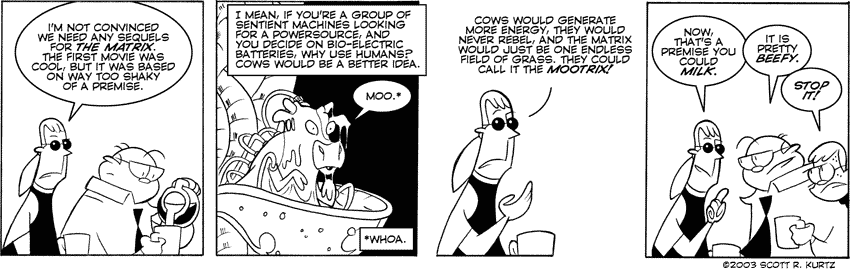
posted by Cool Papa Bell at 12:46 PM on October 21, 2009 [3 favorites]
Whoops, I may have been off by a factor of 1000. Damn "Calories" vs. "calories"!
posted by albrecht at 12:49 PM on October 21, 2009
posted by albrecht at 12:49 PM on October 21, 2009
Ah that's the beauty of the thing, come winter the gorillas will freeze to death.
posted by Lazlo Hollyfeld at 12:52 PM on October 21, 2009 [4 favorites]
posted by Lazlo Hollyfeld at 12:52 PM on October 21, 2009 [4 favorites]
How do you make a rabbit go woof?
posted by biffa at 12:54 PM on October 21, 2009 [1 favorite]
posted by biffa at 12:54 PM on October 21, 2009 [1 favorite]
Kill the rabbits, you only get a limited energy source. Employ them on treadmills with carrots dangling ahead... it's free energy for their lifetime!
posted by deezil at 12:55 PM on October 21, 2009 [1 favorite]
posted by deezil at 12:55 PM on October 21, 2009 [1 favorite]
OK, somebody had to do the calculation:
(6000 rabbits) * (.4 kg/rabbit) * (517/.453 calories/kg) * (1/860420 kilowatt hours/calorie) = 3.183 kWh, or enough to run a space heater for about an hour.
Glad you did the math. Wolfram Alpha had no idea what to do with the query: "6000 rabbits calories." Once again it fails to live up to the hype.
posted by Thoughtcrime at 12:58 PM on October 21, 2009 [4 favorites]
(6000 rabbits) * (.4 kg/rabbit) * (517/.453 calories/kg) * (1/860420 kilowatt hours/calorie) = 3.183 kWh, or enough to run a space heater for about an hour.
Glad you did the math. Wolfram Alpha had no idea what to do with the query: "6000 rabbits calories." Once again it fails to live up to the hype.
posted by Thoughtcrime at 12:58 PM on October 21, 2009 [4 favorites]
Värmlandship Down
posted by ...possums at 1:02 PM on October 21, 2009 [1 favorite]
posted by ...possums at 1:02 PM on October 21, 2009 [1 favorite]
That would provide 6000 delicious meals for a Poirot.
Simply add mustard.
posted by jan murray at 1:14 PM on October 21, 2009
Simply add mustard.
posted by jan murray at 1:14 PM on October 21, 2009
The only way to survive Helsinki menace is to try to stay excited and not let yourself to get used to them. Every time you see one, you have to point it, smile, and exclaim "Bunnies!". Stay safe, point, smile, shout.
posted by Free word order! at 1:16 PM on October 21, 2009
posted by Free word order! at 1:16 PM on October 21, 2009
OK, somebody had to do the calculation
and then someone had to pick it apart
(a) as you note, dietary calories are actually kilocalories
(b) Wikipedia lists .4 kg as the minimum size for rabbits--this reference indicates 1.3-2.2 kg as the average weight of the European rabbit, which I believe is the ancestor of most varieties of domestic bun-buns.
(c) Finally, a typical space hear consumes 1.5 kW at its highest setting.
So more realistically, taking a still-conservative rabbit weight of 1.6 kg, it'd be about 15,000 space heaters for an hour. I don't have a really strong opinion on whether that's a reasonable amount of energy output from rabbit carcasses or not. It seems that rabbit meat could more productively be put to use for...you know...eating, and leave the fuel source part for the inedible bits, but perhaps there are so few low-income or needy people in Sweden that no one is willing to stoop to the level of free gov'mint rabbit meat.
posted by drlith at 1:21 PM on October 21, 2009 [2 favorites]
and then someone had to pick it apart
(a) as you note, dietary calories are actually kilocalories
(b) Wikipedia lists .4 kg as the minimum size for rabbits--this reference indicates 1.3-2.2 kg as the average weight of the European rabbit, which I believe is the ancestor of most varieties of domestic bun-buns.
(c) Finally, a typical space hear consumes 1.5 kW at its highest setting.
So more realistically, taking a still-conservative rabbit weight of 1.6 kg, it'd be about 15,000 space heaters for an hour. I don't have a really strong opinion on whether that's a reasonable amount of energy output from rabbit carcasses or not. It seems that rabbit meat could more productively be put to use for...you know...eating, and leave the fuel source part for the inedible bits, but perhaps there are so few low-income or needy people in Sweden that no one is willing to stoop to the level of free gov'mint rabbit meat.
posted by drlith at 1:21 PM on October 21, 2009 [2 favorites]
The opponents' objection seems to be more focussed on the killing of the rabbits, but highlights the use of the corpses to generate heat energy in order to gain publicity. If that's right, then it's a little dishonest, and probably won't get them anywhere. If the costs of killing and transporting them is already being borne by somebody, then recouping some costs by selling them for fuel seems logical. If they're not burned, they would just be landfilled, or even compacted into bunny bricks and dumped at the bottom of the sea as carbon sinks.
posted by Sova at 1:24 PM on October 21, 2009
posted by Sova at 1:24 PM on October 21, 2009
Whoops, I may have been off by a factor of 1000. Damn "Calories" vs. "calories"!
Plus you used the smallest bunny size in the range, the large end being "more than 2 kg," and that's assuming there are none of the German mega-bunnies running amok in Swedish gardens. Also, there's the effort of crushing, grinding and then pumping the remains into a boiler where they are burned together with wood chips.
That would provide 6000 delicious meals ...
And 6,000 pelts for coats, socially acceptable or not.
posted by filthy light thief at 1:26 PM on October 21, 2009
Plus you used the smallest bunny size in the range, the large end being "more than 2 kg," and that's assuming there are none of the German mega-bunnies running amok in Swedish gardens. Also, there's the effort of crushing, grinding and then pumping the remains into a boiler where they are burned together with wood chips.
That would provide 6000 delicious meals ...
And 6,000 pelts for coats, socially acceptable or not.
posted by filthy light thief at 1:26 PM on October 21, 2009
Can't we just eat them? Rabbit is delicious.
posted by mek at 1:28 PM on October 21, 2009 [1 favorite]
posted by mek at 1:28 PM on October 21, 2009 [1 favorite]
Why would you burn a rabbit for heat when you could eat its delicious body and wear its soft, luxurious skin?
posted by Nelson at 1:29 PM on October 21, 2009 [1 favorite]
posted by Nelson at 1:29 PM on October 21, 2009 [1 favorite]
Mmmm. Bunnies. Could they not export them? "Danish chicken" could become the Next Big Thing.
posted by emjaybee at 1:31 PM on October 21, 2009
posted by emjaybee at 1:31 PM on October 21, 2009
And it's almost certainly a better use of energy to just burn the grass and let the rabbits starve to death.
posted by albrecht at 1:33 PM on October 21, 2009
posted by albrecht at 1:33 PM on October 21, 2009
And what's with all those carrots, what do they need such good eyesight for, anyway?
posted by entropicamericana at 1:59 PM on October 21, 2009 [2 favorites]
posted by entropicamericana at 1:59 PM on October 21, 2009 [2 favorites]
LN, yes. Dangit. Don't know why I had to drag the Danes into this.
Swedish chicken could be sold at IKEA cafeterias worldwide.
posted by emjaybee at 2:04 PM on October 21, 2009
Swedish chicken could be sold at IKEA cafeterias worldwide.
posted by emjaybee at 2:04 PM on October 21, 2009
And 6,000 pelts for coats
A friend of mine from New Zealand had a very cozy-looking fur-lined hat that I commented on one unpleasantly cold day. "Ah, yes" he said, "these are possum fur hats sold by an environmental organization back home." It must've been obvious that the equation "fur-lined accessory" + "environmental organization" added up to "Whaaaaaa?" for me, as he quickly went on to explain that possums are an invasive species hungrily occupied in eating New Zealand's forests and thereby endangering native species. Hence, the birth of "eco-fur", which was shortly followed by environmental organizations selling eco-fur products to fund possum hunting and other habitat-preservation measures.
On topic, I wonder if anyone in Australia has considered acquiring this technology?
posted by EvaDestruction at 2:05 PM on October 21, 2009 [1 favorite]
A friend of mine from New Zealand had a very cozy-looking fur-lined hat that I commented on one unpleasantly cold day. "Ah, yes" he said, "these are possum fur hats sold by an environmental organization back home." It must've been obvious that the equation "fur-lined accessory" + "environmental organization" added up to "Whaaaaaa?" for me, as he quickly went on to explain that possums are an invasive species hungrily occupied in eating New Zealand's forests and thereby endangering native species. Hence, the birth of "eco-fur", which was shortly followed by environmental organizations selling eco-fur products to fund possum hunting and other habitat-preservation measures.
On topic, I wonder if anyone in Australia has considered acquiring this technology?
posted by EvaDestruction at 2:05 PM on October 21, 2009 [1 favorite]
OK, somebody had to do the calculation
and then someone had to pick it apart
and then the pedantry just kept multiplying
Your calculation doesn't include any conversion efficiency estimates; I don't think it's quite realistic to go straight from calories to kWh. Unless they've found some way to transform bunny-mass into electricity directly, of course, but the article does state they're just burning them.
Additionally, they're burning the carcasses in "a heating plant" - so my guess is there's no electricity involved at all (other than in the frozen storage stage, of course); it sounds more like it's a district steam plant, so output ought to be measured in either pounds of steam or in BTU.
There are 3,412 BTU/kWh, so using the figure of 3,184 kWh above, we're looking at 10,860,396 BTU (or 108 therms) - here in Minnesota, that's a little over 10 percent of the average residential customer's annual natural gas consumption.
Hm. Burn 6,000 bunny carcasses, heat your home for a month? That sounds about right, depending on how cold it is and how good your insulation is.
posted by nickmark at 2:05 PM on October 21, 2009
and then someone had to pick it apart
and then the pedantry just kept multiplying
Your calculation doesn't include any conversion efficiency estimates; I don't think it's quite realistic to go straight from calories to kWh. Unless they've found some way to transform bunny-mass into electricity directly, of course, but the article does state they're just burning them.
Additionally, they're burning the carcasses in "a heating plant" - so my guess is there's no electricity involved at all (other than in the frozen storage stage, of course); it sounds more like it's a district steam plant, so output ought to be measured in either pounds of steam or in BTU.
There are 3,412 BTU/kWh, so using the figure of 3,184 kWh above, we're looking at 10,860,396 BTU (or 108 therms) - here in Minnesota, that's a little over 10 percent of the average residential customer's annual natural gas consumption.
Hm. Burn 6,000 bunny carcasses, heat your home for a month? That sounds about right, depending on how cold it is and how good your insulation is.
posted by nickmark at 2:05 PM on October 21, 2009
They are having the same debate in Kelowna BC where tame rabbits released into parks flourish and not only cause significant damage to the parks but also provide a source pool for invasive feral rabbits to damage crops in the surrounding area. They had a farmer on CBC radio this spring who reported killing hundreds of rabbits coming onto his farm from the direction of town in the span of a couple of weeks.
If the rabbits were Australian Swamp Rats instead there would be a lot less debate about killing them.
Nelson writes "Why would you burn a rabbit for heat when you could eat its delicious body"
Generally speaking eating feral urban animals is risky because you don't know what they've been eating.
posted by Mitheral at 2:19 PM on October 21, 2009 [1 favorite]
If the rabbits were Australian Swamp Rats instead there would be a lot less debate about killing them.
Nelson writes "Why would you burn a rabbit for heat when you could eat its delicious body"
Generally speaking eating feral urban animals is risky because you don't know what they've been eating.
posted by Mitheral at 2:19 PM on October 21, 2009 [1 favorite]
"Rabbit Cadavers" -- I just found the name for my band!
posted by mattholomew at 2:55 PM on October 21, 2009 [1 favorite]
posted by mattholomew at 2:55 PM on October 21, 2009 [1 favorite]
Is it possible to use their bodies as betteries, while hooking them up to a computer simulation that has them believing they are dressed in shiny black leather and being chased by Hugo weaving? I think that would be an acceptable compromise.
I think that was called Watership Down.
posted by Blazecock Pileon at 3:39 PM on October 21, 2009 [2 favorites]
I think that was called Watership Down.
posted by Blazecock Pileon at 3:39 PM on October 21, 2009 [2 favorites]
If they're not burned, they would just be landfilled, or even compacted into bunny bricks and dumped at the bottom of the sea as carbon sinks.
...Conveniently forgetting that the technology of bunny bricks has not yet been tested outside of a laboratory and many suspect that bunny leachate would have a sissifying effect on predatory fish, eventually leading to the downfall of the whole ecosystem. I expected more of you Sova.
posted by JeNeSaisQuoi at 4:44 PM on October 21, 2009
...Conveniently forgetting that the technology of bunny bricks has not yet been tested outside of a laboratory and many suspect that bunny leachate would have a sissifying effect on predatory fish, eventually leading to the downfall of the whole ecosystem. I expected more of you Sova.
posted by JeNeSaisQuoi at 4:44 PM on October 21, 2009
This post is gold just for the pedants wondering how much energy exactly does the burning of 6000 bunnies provide.
posted by WalterMitty at 4:46 PM on October 21, 2009
posted by WalterMitty at 4:46 PM on October 21, 2009
For those prosposing eating the rabbits, we now get to the great divide between farmed and wild animals; the parasite divide.
Thumper might look tasty but he's no doubt riddled with worms like knots in cheap pine. A little extra protein might be okay, but be careful - the eggs won't necessarily perish when you cook em, and pooping out a three foot intestinal worm - that's made your liver look like loofah sponge - a year after the fricassee isn't quite so appealing.
posted by smoke at 4:59 PM on October 21, 2009 [1 favorite]
Thumper might look tasty but he's no doubt riddled with worms like knots in cheap pine. A little extra protein might be okay, but be careful - the eggs won't necessarily perish when you cook em, and pooping out a three foot intestinal worm - that's made your liver look like loofah sponge - a year after the fricassee isn't quite so appealing.
posted by smoke at 4:59 PM on October 21, 2009 [1 favorite]
This post is gold just for the pedants wondering how much energy exactly does the burning of 6000 bunnies provide.
I'm much more interested in the SNUGS being buried in a pile of 60 bunnies would provide.
posted by robocop is bleeding at 5:45 PM on October 21, 2009 [1 favorite]
I'm much more interested in the SNUGS being buried in a pile of 60 bunnies would provide.
posted by robocop is bleeding at 5:45 PM on October 21, 2009 [1 favorite]
Wow! It's completely baffling to me that Sweeden and Finland don't have native rabbits. I mean, not even arctic hares or something? I suppose they don't have squirrels, centipedes, or dandelions either? It's no wonder people over there are so happy.
posted by gueneverey at 7:07 PM on October 21, 2009
posted by gueneverey at 7:07 PM on October 21, 2009
At some point in any argument in the internet you HAVE to throw down the Hitler card... This is a sort of cuniculan holocaust.
posted by jcworth at 7:12 PM on October 21, 2009
posted by jcworth at 7:12 PM on October 21, 2009
(6000 bunnies) * (1.75 kg/bunny) * (3*10^8 m/s)^2 = 945 exajoules = approximately two years of energy for all of humanity
posted by Flunkie at 8:16 PM on October 21, 2009 [1 favorite]
posted by Flunkie at 8:16 PM on October 21, 2009 [1 favorite]
gueneverey:
The growing population of non-indigenous rabbits is being felt in the balance of urban wildlife. The growth in the rabbit population has led to a decline in the number of hares.
“A rabbit is an animal that stakes out its own territory. Sometimes a rabbit will run at full speed toward a hare to force it out of its territory
- Helsinki’s rabbit control official is no Elmer Fudd
At some point in any argument in the internet you HAVE to throw down the Hitler card.
No, you don't really. It's worth saving it for discussion of genocide. I mean, sure, we can just chant well-worn memes at each other, but that's a bit more making noise and a bit less interesting than other things we can talk about.
posted by sebastienbailard at 11:40 PM on October 21, 2009
The growing population of non-indigenous rabbits is being felt in the balance of urban wildlife. The growth in the rabbit population has led to a decline in the number of hares.
“A rabbit is an animal that stakes out its own territory. Sometimes a rabbit will run at full speed toward a hare to force it out of its territory
- Helsinki’s rabbit control official is no Elmer Fudd
At some point in any argument in the internet you HAVE to throw down the Hitler card.
No, you don't really. It's worth saving it for discussion of genocide. I mean, sure, we can just chant well-worn memes at each other, but that's a bit more making noise and a bit less interesting than other things we can talk about.
posted by sebastienbailard at 11:40 PM on October 21, 2009
gueneverey:
Natives are mountain hare (lepus timidus) and european hare (lepus europeanus). These devious rabbits, they are european rabbits (oryctolagus cuniculus).
posted by Free word order! at 3:26 AM on October 22, 2009
Natives are mountain hare (lepus timidus) and european hare (lepus europeanus). These devious rabbits, they are european rabbits (oryctolagus cuniculus).
posted by Free word order! at 3:26 AM on October 22, 2009
"It's completely baffling to me that Sweeden and Finland don't have native rabbits. I mean, not even arctic hares or something"
Hares aren't rabbits. And while they fill a similar ecological niche and are very closely related rabbits are much more destructive than hares because they burrow. The burrowing can damage buildings by undermining foundations.
posted by Mitheral at 6:56 AM on October 22, 2009
Hares aren't rabbits. And while they fill a similar ecological niche and are very closely related rabbits are much more destructive than hares because they burrow. The burrowing can damage buildings by undermining foundations.
posted by Mitheral at 6:56 AM on October 22, 2009
Wow. So they're burning bunnies for fuel.
Sounds like Sweden wants to compete with those baby-seal bashers in Canada for the title of "nation most confusingly ruthless and nice at the same time."
posted by rokusan at 8:15 AM on October 22, 2009
Sounds like Sweden wants to compete with those baby-seal bashers in Canada for the title of "nation most confusingly ruthless and nice at the same time."
posted by rokusan at 8:15 AM on October 22, 2009
Whacking a baby seal dead with a blow to the head is not nearly as ruthless as factory-farmed meat.
posted by five fresh fish at 9:15 AM on October 22, 2009
posted by five fresh fish at 9:15 AM on October 22, 2009
Yes, but they've been doing this with people for some time now.
posted by alexei at 9:49 AM on October 22, 2009
posted by alexei at 9:49 AM on October 22, 2009
« Older It's very fancy on old Delancey Street, you know. | Chuck Klosterman's New Book Out This Week Newer »
This thread has been archived and is closed to new comments
posted by dov3 at 12:28 PM on October 21, 2009 [2 favorites]