Police raid home of Gizmodo editor Jason Chen
April 26, 2010 7:48 PM Subscribe
California police have raided the home of Gizmodo editor Jason Chen, and seized his computers. Chen posted Gizmodo's review of Apple's next-generation iPhone, which had been left in a bar by a staff member (previously). Media reports say that police are considering criminal charges against the person who sold the phone to Gizmodo. Assuming that the police were not investigating Chen himself for breaking the law, the case raises the question of whether bloggers such as Chen are journalists under the law.
This post was deleted for the following reason: Poster's Request -- travelingthyme
And I refuse to touch those Gizmodo links, by the way. Sorry. Those bastards aren't getting my clickthroughs.
posted by koeselitz at 7:53 PM on April 26, 2010 [25 favorites]
posted by koeselitz at 7:53 PM on April 26, 2010 [25 favorites]
if nothing, this is what they get for gizmodo had coming to them for outing the poor dude who left the phone in the first place.
posted by seagull.apollo at 7:58 PM on April 26, 2010 [5 favorites]
posted by seagull.apollo at 7:58 PM on April 26, 2010 [5 favorites]
wow...
posted by seagull.apollo at 7:59 PM on April 26, 2010 [1 favorite]
posted by seagull.apollo at 7:59 PM on April 26, 2010 [1 favorite]
I'll expect this kind of action when I report my cellphone stolen.
posted by Crabby Appleton at 7:59 PM on April 26, 2010 [99 favorites]
posted by Crabby Appleton at 7:59 PM on April 26, 2010 [99 favorites]
Fuck them for trying to hide behind journalism. There's nothing journalistic about dismantling (and bragging about) stolen property.
posted by graventy at 8:00 PM on April 26, 2010 [14 favorites]
posted by graventy at 8:00 PM on April 26, 2010 [14 favorites]
Yeah. I won't touch those links either. Gizmodo did a Bad Thing™, and I highly doubt that I well ever go there again, but the raid doesn't sound entirely legal.
posted by Cat Pie Hurts at 8:01 PM on April 26, 2010 [5 favorites]
posted by Cat Pie Hurts at 8:01 PM on April 26, 2010 [5 favorites]
In the U.K., I believe, there's a legal duty to turn over found objects to the owner or the police if the owner isn't known. Does California have a similar duty?
Gizmodo reported that the seller made several attempts to return the phone to Apple, but wasn't taken seriously. Gizmodo confirmed with an Apple support employee that the seller contacted them and wasn't taken seriously:
posted by fatbird at 8:01 PM on April 26, 2010 [23 favorites]
Gizmodo reported that the seller made several attempts to return the phone to Apple, but wasn't taken seriously. Gizmodo confirmed with an Apple support employee that the seller contacted them and wasn't taken seriously:
I work for AppleCare as a tier 2 agent and before the whole thing about a leak hit the Internet the guy working next to me got the call from the guy looking to return the phone. From our point of view it seemed as a hoax or that the guy had a knockoff, internally apple doesn't tell us anything and we haven't gotten any notices or anything about a lost phone, much less anything stating we are making a new one.If that's true, that would seem to absolve the seller of any real wrongdoing. This seems more like a heavyhanded attempt by Apple to intimidate media outlets from accepting a leak like this.
posted by fatbird at 8:01 PM on April 26, 2010 [23 favorites]
I'll expect this kind of action when I report my cellphone stolen.
No one will pay attention to you or I, Crabby Appleton. We don't own a multi-million dollar business.
.... Or.. do you?
posted by Malice at 8:01 PM on April 26, 2010 [2 favorites]
No one will pay attention to you or I, Crabby Appleton. We don't own a multi-million dollar business.
.... Or.. do you?
posted by Malice at 8:01 PM on April 26, 2010 [2 favorites]
You can't pull stunts like this and still expect anyone to consider you a journalist.
posted by gyc at 8:02 PM on April 26, 2010 [3 favorites]
posted by gyc at 8:02 PM on April 26, 2010 [3 favorites]
Man, is anyone ever going to like Gizmodo again?
posted by mccarty.tim at 8:02 PM on April 26, 2010
posted by mccarty.tim at 8:02 PM on April 26, 2010
This should probably have been posted in the open thread. The police search is newsworthy, but the legal issues are all extremely speculative at this point. In my opinion, neither the California constitutional shield provision nor the reporter's privilege apply, but it may well take substantial litigation to determine that.
But if we're going to speculate: the California constitutional provision plainly applies only to contempt, not crimes generally. Furthermore, it plainly only applies to information, not tangible property.
The reporter's privilege doesn't apply because it's an evidentiary privilege related to identifying sources; it doesn't provide immunity to prosecution.
posted by jedicus at 8:04 PM on April 26, 2010 [1 favorite]
But if we're going to speculate: the California constitutional provision plainly applies only to contempt, not crimes generally. Furthermore, it plainly only applies to information, not tangible property.
The reporter's privilege doesn't apply because it's an evidentiary privilege related to identifying sources; it doesn't provide immunity to prosecution.
posted by jedicus at 8:04 PM on April 26, 2010 [1 favorite]
If you were on a desert island and needed to deem either James O'Keefe or Gizmodo a journalist to leave, who would you rather choose?
posted by mccarty.tim at 8:04 PM on April 26, 2010 [2 favorites]
posted by mccarty.tim at 8:04 PM on April 26, 2010 [2 favorites]
<Nelson>Ha Ha!</Nelson>
posted by octobersurprise at 8:04 PM on April 26, 2010 [1 favorite]
posted by octobersurprise at 8:04 PM on April 26, 2010 [1 favorite]
Assuming that the police were not investigating Chen himself for breaking the law, the case raises the question of whether bloggers such as Chen are journalists under the law.
Why, are journalists allowed to receive stolen property to get a story about a hot new product?
posted by furiousxgeorge at 8:04 PM on April 26, 2010
Why, are journalists allowed to receive stolen property to get a story about a hot new product?
posted by furiousxgeorge at 8:04 PM on April 26, 2010
Mordechai Vanunu 2.0.
posted by stammer at 8:04 PM on April 26, 2010 [1 favorite]
posted by stammer at 8:04 PM on April 26, 2010 [1 favorite]
Receipt of stolen property is illegal. Being journalists won't protect them. Journalistic privilege, where it exists, applies to information. Not to stuff.
posted by 1adam12 at 8:05 PM on April 26, 2010 [2 favorites]
posted by 1adam12 at 8:05 PM on April 26, 2010 [2 favorites]
I wonder what the dollar impact of Gizmodo's leak is... all of Apple's (European, Japanese, Chinese and Canadian) competitors now have a head start in designing iPhone knock-offs.
posted by anthill at 8:05 PM on April 26, 2010 [3 favorites]
posted by anthill at 8:05 PM on April 26, 2010 [3 favorites]
are journalists allowed to receive stolen property to get a story about a hot new product?
Can you cite a specific law that says otherwise?
posted by HP LaserJet P10006 at 8:06 PM on April 26, 2010
Can you cite a specific law that says otherwise?
posted by HP LaserJet P10006 at 8:06 PM on April 26, 2010
What is Apple Inc.'s role in task force investigating iPhone case?
posted by homunculus at 8:07 PM on April 26, 2010 [3 favorites]
posted by homunculus at 8:07 PM on April 26, 2010 [3 favorites]
As I understand it, if Gizmodo had simply received and published information about the new iPhone, they would be fine. When they got their hands dirty by actually exchanging money for stolen property, they got involved past the protection of journalistic shield laws.
In addition, it should be noted (as I think Gruber has already done) that this is not Apple wading into a civil suit; this is a criminal investigation.
posted by MadamM at 8:09 PM on April 26, 2010 [5 favorites]
In addition, it should be noted (as I think Gruber has already done) that this is not Apple wading into a civil suit; this is a criminal investigation.
posted by MadamM at 8:09 PM on April 26, 2010 [5 favorites]
I'm still having trouble wrapping my head around Gizmodo/Gawker's defense here. This is what I understand:
When Gizmodo received the phone, it didn't work. They couldn't get past the startup screen. So, the only way they knew about that Apple employee, and his facebook page, must have come from the person who sold them the phone, right? So, the seller tells them that the phone belongs to this other guy, and instead of tracking down that guy through his facebook page, or any other reasonable manner, he decides to sell it to Gizmodo. They buy it and yet, somehow, claim that they didn't know the phone was stolen? Even though they KNOW, and publish, the rightful owner's name?
What am I missing?
Assuming that the police were not investigating Chen himself for breaking the law...
I see no reason to assume that at all. Buying stolen merchandise is a crime, in and of itself.
posted by exclaim at 8:09 PM on April 26, 2010 [6 favorites]
When Gizmodo received the phone, it didn't work. They couldn't get past the startup screen. So, the only way they knew about that Apple employee, and his facebook page, must have come from the person who sold them the phone, right? So, the seller tells them that the phone belongs to this other guy, and instead of tracking down that guy through his facebook page, or any other reasonable manner, he decides to sell it to Gizmodo. They buy it and yet, somehow, claim that they didn't know the phone was stolen? Even though they KNOW, and publish, the rightful owner's name?
What am I missing?
Assuming that the police were not investigating Chen himself for breaking the law...
I see no reason to assume that at all. Buying stolen merchandise is a crime, in and of itself.
posted by exclaim at 8:09 PM on April 26, 2010 [6 favorites]
I had Giz in my RSS reader along with Engadget for a few years. I always loved to compare the two in their style of reporting. Giz fellated Apple too much for my pleasure but like most of the Gawker properties the comments usually made visiting the site worth it. After this debacle (and trickle of faux "news" posts to drag out the millions of page hits) I finally removed them from my RSS. It's been a happier place since then. Now the only Gawker property I still visit regularly is Lifehacker. The remainder have turned far too demanding of pageviews and publishing sensational crap to make it worth it.
posted by msbutah at 8:12 PM on April 26, 2010
posted by msbutah at 8:12 PM on April 26, 2010
gyc: "You can't pull stunts like this and still expect anyone to consider you a journalist."
Man. What dicks.
The worst thing we ever did at CES was point and laugh at MC Hammer at the XM Radio launch party. And that was as we were walking out. We didn't wanna get hurt.
posted by Kskomsvold at 8:12 PM on April 26, 2010 [4 favorites]
Man. What dicks.
The worst thing we ever did at CES was point and laugh at MC Hammer at the XM Radio launch party. And that was as we were walking out. We didn't wanna get hurt.
posted by Kskomsvold at 8:12 PM on April 26, 2010 [4 favorites]
It's an utter farce. Certainly, the case does raise the question of bloggers' standing as journalists.
On the other hand, most bloggers don't admit to - nay, brag about - handing over thousands of dollars for goods which they have reason to believe belong to someone else, which also makes them party to a misappropriation of trade secrets, something they were warned against back in January by Apple's outside counsel.
Gawker COO and legal representative, Gaby Derbyshire, is a UK barrister but not licensed to practice law in the US. she does not seem very familiar with California law; in her complaint to the police, she objects that the warrant forbids a night search, and claims they violated this condition by being present at the house when Chen returned at 9:45pm. California law does not consider 'night' to have fallen until 10pm; in any case Chen's statement reports police officers telling him they had arrived a few hours earlier.
Bah, I have been talking to people about it all day and now I am sick of it. I am not a lawyer, but for the truly curious a reasonably informed discussion can be found here.
posted by anigbrowl at 8:13 PM on April 26, 2010 [4 favorites]
On the other hand, most bloggers don't admit to - nay, brag about - handing over thousands of dollars for goods which they have reason to believe belong to someone else, which also makes them party to a misappropriation of trade secrets, something they were warned against back in January by Apple's outside counsel.
Gawker COO and legal representative, Gaby Derbyshire, is a UK barrister but not licensed to practice law in the US. she does not seem very familiar with California law; in her complaint to the police, she objects that the warrant forbids a night search, and claims they violated this condition by being present at the house when Chen returned at 9:45pm. California law does not consider 'night' to have fallen until 10pm; in any case Chen's statement reports police officers telling him they had arrived a few hours earlier.
Bah, I have been talking to people about it all day and now I am sick of it. I am not a lawyer, but for the truly curious a reasonably informed discussion can be found here.
posted by anigbrowl at 8:13 PM on April 26, 2010 [4 favorites]
I think there is no question that bloggers doing original reporting are journalists. The problem is that the "source" in this case did not provide information, but sold stolen property. Chen's job may be as a journalist, but acquiring the phone was not an act of journalism, which is probably why the judge issued the warrant despite California's shield law. (IANAL, journalist, or Californian.)
posted by domnit at 8:13 PM on April 26, 2010
posted by domnit at 8:13 PM on April 26, 2010
Can you cite a specific law that says otherwise?
Laws that ban receiving stolen property.
posted by Mister_A at 8:13 PM on April 26, 2010 [7 favorites]
Laws that ban receiving stolen property.
posted by Mister_A at 8:13 PM on April 26, 2010 [7 favorites]
As I understand it, if Gizmodo had simply received and published information about the new iPhone, they would be fine.
Probably depends quite a bit on wording, too. Had Gizmodo said "an anonymous insider leaked these pics/specs of the upcoming 4G" the reception would have been quite a bit different than what they did do -- "Haha some dumbass from Apple left his phone in the bar and we bought it!" followed by "Haha this specific dumbass watch us taunt him!"
posted by graventy at 8:13 PM on April 26, 2010
Probably depends quite a bit on wording, too. Had Gizmodo said "an anonymous insider leaked these pics/specs of the upcoming 4G" the reception would have been quite a bit different than what they did do -- "Haha some dumbass from Apple left his phone in the bar and we bought it!" followed by "Haha this specific dumbass watch us taunt him!"
posted by graventy at 8:13 PM on April 26, 2010
Yeah.... I mean, dunno about all the legal implications, but who didn't see this coming?
posted by ph00dz at 8:13 PM on April 26, 2010
posted by ph00dz at 8:13 PM on April 26, 2010
I don't really know what the law is. And I haven't decided yet whether this is a highly illegal search and seizure or a due process of proper law.
But I do know this: it's rich that Gizmodo is frantically trying to protect its sources, claiming journalistic license and all that, when they apparently had no compunction whatsoever about plastering Gray Powell's name, picture and Facebook details all over their web site for all the world to see. And it seems made to order for their PR machine that they've gotten a chance to play the victims at the precise moment when a lot of us around the internet have realized that we despise them.
posted by koeselitz at 8:13 PM on April 26, 2010 [5 favorites]
But I do know this: it's rich that Gizmodo is frantically trying to protect its sources, claiming journalistic license and all that, when they apparently had no compunction whatsoever about plastering Gray Powell's name, picture and Facebook details all over their web site for all the world to see. And it seems made to order for their PR machine that they've gotten a chance to play the victims at the precise moment when a lot of us around the internet have realized that we despise them.
posted by koeselitz at 8:13 PM on April 26, 2010 [5 favorites]
Can you cite a specific law that says otherwise?
Sure, California Penal Code § 496(a): "Every person who buys or receives any property that has been stolen or that has been obtained in any manner constituting theft or extortion, knowing the property to be so stolen or obtained, or who conceals, sells, withholds, or aids in concealing, selling, or withholding any property from the owner, knowing the property to be so stolen or obtained, shall be punished by imprisonment in a state prison, or in a county jail for not more than one year."
Theft is defined thusly: "Every person who shall feloniously steal, take, carry, lead, or drive away the personal property of another...is guilty of theft."
The taker of the iPhone knew it was not his and carried it away. Therefore, he almost certainly committed theft. Generally speaking, attempts to restore the property to the owner after taking it are not a defense to the crime. Gizmodo bought the iPhone knowing that it had been obtained in a manner constituting theft and furthermore withheld it from Apple, the owner, until Apple formally requested its return.
So, given that the law defining the crime contains no defense for journalists, the burden is upon the journalist to show a defense. The two defenses offered so far are, in my opinion, not credible.
posted by jedicus at 8:16 PM on April 26, 2010 [15 favorites]
Sure, California Penal Code § 496(a): "Every person who buys or receives any property that has been stolen or that has been obtained in any manner constituting theft or extortion, knowing the property to be so stolen or obtained, or who conceals, sells, withholds, or aids in concealing, selling, or withholding any property from the owner, knowing the property to be so stolen or obtained, shall be punished by imprisonment in a state prison, or in a county jail for not more than one year."
Theft is defined thusly: "Every person who shall feloniously steal, take, carry, lead, or drive away the personal property of another...is guilty of theft."
The taker of the iPhone knew it was not his and carried it away. Therefore, he almost certainly committed theft. Generally speaking, attempts to restore the property to the owner after taking it are not a defense to the crime. Gizmodo bought the iPhone knowing that it had been obtained in a manner constituting theft and furthermore withheld it from Apple, the owner, until Apple formally requested its return.
So, given that the law defining the crime contains no defense for journalists, the burden is upon the journalist to show a defense. The two defenses offered so far are, in my opinion, not credible.
posted by jedicus at 8:16 PM on April 26, 2010 [15 favorites]
If that's true, that would seem to absolve the seller of any real wrongdoing.
From previous coverage, the person who "found" the phone poked around in it enough to find out the identity -- even browsing around in the guy's Facebook account, for God's sake -- of the Apple employee who brought it to the bar. Which means he had several very easy options:
1. Get in touch with the guy and return the phone to him.
2. Go back to the bar to see if the guy called about his lost phone, and hand it over to the bar owner, who's used to dealing with lost stuff.
3. Hand it over to the police, who are also adept at this.
Instead he chose:
4. Call a customer-support line and tell a bizarre, fake-sounding story to people who couldn't possibly be expected to know anything about this, call it a day, and sell the thing to a tabloid for $5k.
Which, um, yeah, that's some wrongdoing right there.
posted by ubernostrum at 8:18 PM on April 26, 2010 [17 favorites]
From previous coverage, the person who "found" the phone poked around in it enough to find out the identity -- even browsing around in the guy's Facebook account, for God's sake -- of the Apple employee who brought it to the bar. Which means he had several very easy options:
1. Get in touch with the guy and return the phone to him.
2. Go back to the bar to see if the guy called about his lost phone, and hand it over to the bar owner, who's used to dealing with lost stuff.
3. Hand it over to the police, who are also adept at this.
Instead he chose:
4. Call a customer-support line and tell a bizarre, fake-sounding story to people who couldn't possibly be expected to know anything about this, call it a day, and sell the thing to a tabloid for $5k.
Which, um, yeah, that's some wrongdoing right there.
posted by ubernostrum at 8:18 PM on April 26, 2010 [17 favorites]
In the U.K., I believe, there's a legal duty to turn over found objects to the owner or the police if the owner isn't known.
I'm for it.
posted by nola at 8:18 PM on April 26, 2010 [2 favorites]
I'm for it.
posted by nola at 8:18 PM on April 26, 2010 [2 favorites]
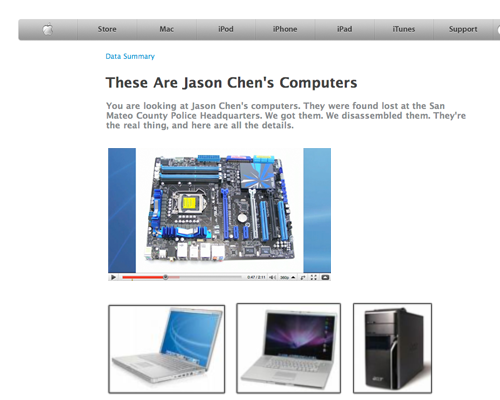
Exclusive: These are Jason Chen's Computers.
posted by cgomez at 8:19 PM on April 26, 2010 [25 favorites]
posted by cgomez at 8:19 PM on April 26, 2010 [25 favorites]
I know you can't actually look at the law this way for a variety of reasons, but I feel like the shield laws are there for protecting journalists from retribution over IMPORTANT stories. If someone had stolen/found this phone and it revealed financial fraud at Apple or use of slave labor, that would be one thing.
"This new toy is shaped slightly differently and has some more buttons" doesn't quite do it for me.
posted by furiousxgeorge at 8:19 PM on April 26, 2010 [1 favorite]
"This new toy is shaped slightly differently and has some more buttons" doesn't quite do it for me.
posted by furiousxgeorge at 8:19 PM on April 26, 2010 [1 favorite]
> What is Apple Inc.'s role in task force investigating iPhone case?
As noted elsewhere, the author of that article was a Gizmodo employee earlier this month, which might or might not influence his reportage. It doesn't sound like Cook and Denton were on best terms, but Cook may still feel differently towards former colleagues.
That said, I'm flagging this post; there's still an open thread about Gizmodo and Apple.
posted by ardgedee at 8:19 PM on April 26, 2010 [1 favorite]
As noted elsewhere, the author of that article was a Gizmodo employee earlier this month, which might or might not influence his reportage. It doesn't sound like Cook and Denton were on best terms, but Cook may still feel differently towards former colleagues.
That said, I'm flagging this post; there's still an open thread about Gizmodo and Apple.
posted by ardgedee at 8:19 PM on April 26, 2010 [1 favorite]
heh, I'm just waiting to see how long before someone at Gawker Media says "Pentagon Papers".
posted by mlis at 8:20 PM on April 26, 2010
posted by mlis at 8:20 PM on April 26, 2010
There's also the additional dick move of taking it apart after they got it.
posted by electroboy at 8:22 PM on April 26, 2010 [1 favorite]
posted by electroboy at 8:22 PM on April 26, 2010 [1 favorite]
.... Or.. do you?
It's a big fuckin sekrit, Malice. I can has you arrested just for talkin about it!
posted by Crabby Appleton at 8:22 PM on April 26, 2010
It's a big fuckin sekrit, Malice. I can has you arrested just for talkin about it!
posted by Crabby Appleton at 8:22 PM on April 26, 2010
Gidzomo is entitled to any protections and privileges that the law allows journalists; they may not be very good at it, but, then, neither is FOX.
By the way, newspapers take stolen stuff all the time. Whistleblowers often turn stolen evidence over to newspapers. The Pentagon Papers were stolen.
Yes, I think taking the phone, opening it, and publishing what they found was crummy and did not serve the public good. This was not the Pentagon Papers. But laws that protect journalists are not based around the quality of their journalism, or the importance of their story.
That being said, I am not sure there are any laws that would protect an old media journalist who had done the same thing Gidzomo did. Unless their are, this discussion is misplaced.
posted by Astro Zombie at 8:25 PM on April 26, 2010 [11 favorites]
By the way, newspapers take stolen stuff all the time. Whistleblowers often turn stolen evidence over to newspapers. The Pentagon Papers were stolen.
Yes, I think taking the phone, opening it, and publishing what they found was crummy and did not serve the public good. This was not the Pentagon Papers. But laws that protect journalists are not based around the quality of their journalism, or the importance of their story.
That being said, I am not sure there are any laws that would protect an old media journalist who had done the same thing Gidzomo did. Unless their are, this discussion is misplaced.
posted by Astro Zombie at 8:25 PM on April 26, 2010 [11 favorites]
heh, I'm just waiting to see how long before someone at Gawker Media says "Pentagon Papers".
I guess I beat them to the punch.
posted by Astro Zombie at 8:26 PM on April 26, 2010
I guess I beat them to the punch.
posted by Astro Zombie at 8:26 PM on April 26, 2010
Sure, California Penal Code § 496(a): "Every person who buys or receives any property that has been stolen or that has been obtained in any manner constituting theft or extortion, knowing the property to be so stolen or obtained, or who conceals, sells, withholds, or aids in concealing, selling, or withholding any property from the owner, knowing the property to be so stolen or obtained, shall be punished by imprisonment in a state prison, or in a county jail for not more than one year."
Theft is defined thusly: "Every person who shall feloniously steal, take, carry, lead, or drive away the personal property of another...is guilty of theft."
That's not the relevant definition of theft. California specifically addresses the issue of finding someone's lost property.
California Penal Code § 485: "One who finds lost property under circumstances which give him knowledge of or means of inquiry as to the true owner, and who appropriates such property to his own use, or to the use of another person not entitled thereto, without first making reasonable and just efforts to find the owner and to restore the property to him, is guilty of theft."
Attempts to restore the property to the owner after taking it, in the instance of finding lost property, specifically are a defense to the crime. As mentioned above, and on Gizmodo, the person who found the phone made repeated attempts to contact Apple and Powell to return the phone to them, and only contacted the media after weeks of being ignored and dismissed as a crank by Apple. While arguable, three weeks of calling most likely constitutes "reasonable and just efforts to find the owner and to restore the property to him", which would mean that the finder did not commit theft by selling the phone to Gizmodo.
In any case, the specifics of whether or not selling the phone to Gizmodo constituted theft by the finder is immaterial. Gizmodo's guilty of receiving stolen property if and only if they knew the property to be stolen. The statute requires actual knowledge, which given the facts of the sale, they didn't have. No crime here.
posted by kafziel at 8:30 PM on April 26, 2010 [20 favorites]
Theft is defined thusly: "Every person who shall feloniously steal, take, carry, lead, or drive away the personal property of another...is guilty of theft."
That's not the relevant definition of theft. California specifically addresses the issue of finding someone's lost property.
California Penal Code § 485: "One who finds lost property under circumstances which give him knowledge of or means of inquiry as to the true owner, and who appropriates such property to his own use, or to the use of another person not entitled thereto, without first making reasonable and just efforts to find the owner and to restore the property to him, is guilty of theft."
Attempts to restore the property to the owner after taking it, in the instance of finding lost property, specifically are a defense to the crime. As mentioned above, and on Gizmodo, the person who found the phone made repeated attempts to contact Apple and Powell to return the phone to them, and only contacted the media after weeks of being ignored and dismissed as a crank by Apple. While arguable, three weeks of calling most likely constitutes "reasonable and just efforts to find the owner and to restore the property to him", which would mean that the finder did not commit theft by selling the phone to Gizmodo.
In any case, the specifics of whether or not selling the phone to Gizmodo constituted theft by the finder is immaterial. Gizmodo's guilty of receiving stolen property if and only if they knew the property to be stolen. The statute requires actual knowledge, which given the facts of the sale, they didn't have. No crime here.
posted by kafziel at 8:30 PM on April 26, 2010 [20 favorites]
I'm surprised by the relative one-sidedness of this thread so far. This whole situation is surprisingly nuanced, and I'm having a hard time coming up with an opinion either way:
- Legal question: Did 'the source' sufficiently try to return the phone to Apple, for the purposes of making his possession/sale of the phone legal?
- Legal question: Did Gizmodo receive stolen property (or, did Gizmodo know they were receiving stolen property)?
- Legal question: Did 'the source' or Gizmodo break any relevant trade secret laws?
- Legal question: Does the California or Federal journalist shield law apply?
- Legal question: Are bloggers, in general, journalists? If so, what constitutes their newsroom?
- Legal question: Does Gizmodo, in particular, employ journalists? See the CES prank they played where they disabled all the TV's. See also the fact that they bragged about paying money for their information, which is dubious.
- Ethical question: Is it right for journalists to pay money for information? (Possibly a legal question as well)
- Ethical question: Should Gizmodo have posted Gray Powell's name and information?
- Questions for further thoughts: Assume that Gizmodo didn't pay for the information (I know this isn't the case) -- does that change any of the above? What role does Apple play in this?
My gut tells me to side with the rights of the journalist/public over the rights of corporations, but not at the cost of any evidence that a crime has been committed. I have been following this all week and am looking forward to hearing more people's opinions.
I love intrigue! And honestly, despite their wacky antics, I like Gizmodo. Regardless of the answer to any of the above, all the Gawker blogs are entertaining and (somewhat) informative.
posted by negative1 at 8:31 PM on April 26, 2010 [14 favorites]
- Legal question: Did 'the source' sufficiently try to return the phone to Apple, for the purposes of making his possession/sale of the phone legal?
- Legal question: Did Gizmodo receive stolen property (or, did Gizmodo know they were receiving stolen property)?
- Legal question: Did 'the source' or Gizmodo break any relevant trade secret laws?
- Legal question: Does the California or Federal journalist shield law apply?
- Legal question: Are bloggers, in general, journalists? If so, what constitutes their newsroom?
- Legal question: Does Gizmodo, in particular, employ journalists? See the CES prank they played where they disabled all the TV's. See also the fact that they bragged about paying money for their information, which is dubious.
- Ethical question: Is it right for journalists to pay money for information? (Possibly a legal question as well)
- Ethical question: Should Gizmodo have posted Gray Powell's name and information?
- Questions for further thoughts: Assume that Gizmodo didn't pay for the information (I know this isn't the case) -- does that change any of the above? What role does Apple play in this?
My gut tells me to side with the rights of the journalist/public over the rights of corporations, but not at the cost of any evidence that a crime has been committed. I have been following this all week and am looking forward to hearing more people's opinions.
I love intrigue! And honestly, despite their wacky antics, I like Gizmodo. Regardless of the answer to any of the above, all the Gawker blogs are entertaining and (somewhat) informative.
posted by negative1 at 8:31 PM on April 26, 2010 [14 favorites]
Attempts to restore the property to the owner after taking it, in the instance of finding lost property, specifically are a defense to the crime. ... While arguable, three weeks of calling most likely constitutes "reasonable and just efforts to find the owner and to restore the property to him"
The thing I don't buy is that the bar was within walking distance of Apple HQ, why didn't the guy just walk it down and hand it in person?
posted by hellojed at 8:35 PM on April 26, 2010 [2 favorites]
The thing I don't buy is that the bar was within walking distance of Apple HQ, why didn't the guy just walk it down and hand it in person?
posted by hellojed at 8:35 PM on April 26, 2010 [2 favorites]
Seems that one bone of contention is the "reasonable and just efforts to find the owner and to restore the property to him" clause. So far I've only heard Gizmodo's side of the story (finder made calls to Apple, got a ticket number).
Has there been any verification of this effort? Number of calls, to whom, for how long, etc?
posted by m@f at 8:37 PM on April 26, 2010
Has there been any verification of this effort? Number of calls, to whom, for how long, etc?
posted by m@f at 8:37 PM on April 26, 2010
negative1: “Ethical question: Should Gizmodo have posted Gray Powell's name and information?”
Er - have you actually thought about this for more than three seconds? What possible harm could it have done not to mention his name and information and print his picture? What possible good did it do? None. You can picture a story about a leaked iPhone, which would be a scoop in itself - pretty big deal, lots of hype, blah blah blah - without any mention of the way they got it or the poor guy who lost it. They talked about Gray Powell in that story solely so that they could have a chance to gloat a bit more and earn pagehits while doing so. And knowing Apple's incredibly stringent security, it was almost like they were daring them to fire him. How ethical is that?
“And honestly, despite their wacky antics, I like Gizmodo. Regardless of the answer to any of the above, all the Gawker blogs are entertaining and (somewhat) informative.”
Ah, those wacky antics! Ruining people's lives just for fun! What will they think of next?
posted by koeselitz at 8:40 PM on April 26, 2010 [6 favorites]
Er - have you actually thought about this for more than three seconds? What possible harm could it have done not to mention his name and information and print his picture? What possible good did it do? None. You can picture a story about a leaked iPhone, which would be a scoop in itself - pretty big deal, lots of hype, blah blah blah - without any mention of the way they got it or the poor guy who lost it. They talked about Gray Powell in that story solely so that they could have a chance to gloat a bit more and earn pagehits while doing so. And knowing Apple's incredibly stringent security, it was almost like they were daring them to fire him. How ethical is that?
“And honestly, despite their wacky antics, I like Gizmodo. Regardless of the answer to any of the above, all the Gawker blogs are entertaining and (somewhat) informative.”
Ah, those wacky antics! Ruining people's lives just for fun! What will they think of next?
posted by koeselitz at 8:40 PM on April 26, 2010 [6 favorites]
hellojed: The thing I don't buy is that the bar was within walking distance of Apple HQ, why didn't the guy just walk it down and hand it in person?
I suppose you could argue that the bar might just turn around and do exactly the same thing he did, sell it to the highest bidder. Alternately, you could argue that someone with an Apple engineering prototype, which Apple claims to lack knowledge of, might not have been in lawful possession of it to begin with.
Not that there's any ethical excuse for selling it to the highest bidder yourself... but I'd argue that it makes a lot of sense to try to give it back to Apple before bringing it back to the bar.
posted by Mitrovarr at 8:41 PM on April 26, 2010
I suppose you could argue that the bar might just turn around and do exactly the same thing he did, sell it to the highest bidder. Alternately, you could argue that someone with an Apple engineering prototype, which Apple claims to lack knowledge of, might not have been in lawful possession of it to begin with.
Not that there's any ethical excuse for selling it to the highest bidder yourself... but I'd argue that it makes a lot of sense to try to give it back to Apple before bringing it back to the bar.
posted by Mitrovarr at 8:41 PM on April 26, 2010
If the owner is unknown or has not claimed the
property, the person saving or finding the property shall, if the
property is of the value of one hundred dollars ($100) or more,
within a reasonable time turn the property over to the police
department of the city or city and county, if found therein, or to
the sheriff's department of the county if found outside of city
limits, and shall make an affidavit, stating when and where he or she
found or saved the property, particularly describing it.
posted by furiousxgeorge at 8:42 PM on April 26, 2010
property, the person saving or finding the property shall, if the
property is of the value of one hundred dollars ($100) or more,
within a reasonable time turn the property over to the police
department of the city or city and county, if found therein, or to
the sheriff's department of the county if found outside of city
limits, and shall make an affidavit, stating when and where he or she
found or saved the property, particularly describing it.
posted by furiousxgeorge at 8:42 PM on April 26, 2010
If Apple was going to fire Gray Powell, they would have done it in the month between him losing a prototype iPhone and the story breaking. He's not getting fired. Given what Apple will fire people for, the whole narrative stinks.
posted by kafziel at 8:44 PM on April 26, 2010
posted by kafziel at 8:44 PM on April 26, 2010
Really? I'm finding it hard to believe no one in here thought that Gizmodo's dissection of the new generation iPhone wasn't kind of cool. I mean, to learn insidery details about how Apple camouflaged it, changed its features? I'm not even an iPhone owner or gadgetry nerd, and I thought the whole thing was fascinating.
I'm kind of squicked out by Gizmodo paying for it, but getting information from unscrupulous sources or unsavory means is pretty much how interesting journalism is done, unless you just like reading re-written press releases.
posted by M.C. Lo-Carb! at 8:48 PM on April 26, 2010 [5 favorites]
I'm kind of squicked out by Gizmodo paying for it, but getting information from unscrupulous sources or unsavory means is pretty much how interesting journalism is done, unless you just like reading re-written press releases.
posted by M.C. Lo-Carb! at 8:48 PM on April 26, 2010 [5 favorites]
The thing I don't buy is that the bar was within walking distance of Apple HQ, why didn't the guy just walk it down and hand it in person?
Redwood City is 25 minutes north of Cupertino by car; Google tells me it's 18.6 miles to One Infinite Loop from Gourmet Haus Stadt.
Not walking distance. Eminently drivable the next morning, though.
posted by fairytale of los angeles at 8:48 PM on April 26, 2010 [2 favorites]
Redwood City is 25 minutes north of Cupertino by car; Google tells me it's 18.6 miles to One Infinite Loop from Gourmet Haus Stadt.
Not walking distance. Eminently drivable the next morning, though.
posted by fairytale of los angeles at 8:48 PM on April 26, 2010 [2 favorites]
EFF Lawyer: Seizure of Gizmodo Editor’s Computers Violates State and Federal Law
posted by homunculus at 8:56 PM on April 26, 2010 [2 favorites]
posted by homunculus at 8:56 PM on April 26, 2010 [2 favorites]
The statute requires actual knowledge
I'm not a lawyer and not familiar with the law in California, but I would bet a small amount of money that Californian law requires only constructive knowledge. Even conceding the facts to be as Gizmodo claim, that could be hard for them to show.
posted by GeckoDundee at 8:56 PM on April 26, 2010
I'm not a lawyer and not familiar with the law in California, but I would bet a small amount of money that Californian law requires only constructive knowledge. Even conceding the facts to be as Gizmodo claim, that could be hard for them to show.
posted by GeckoDundee at 8:56 PM on April 26, 2010
I'd say that Apple remotely "bricking" the phone via MobileMe might have persuaded the guy who found the it to think that the company probably didn't want it back. After all, there's more than one of these phones, right?
Just because Apple doesn't want this information made public and it may cause the company to lose out financially, doesn't mean this is some kind of "industrial espionage". The mistake Gizmodo made is letting the public think they paid for the phone instead of paying for photos of the phone.
posted by tapeguy at 8:59 PM on April 26, 2010 [3 favorites]
Just because Apple doesn't want this information made public and it may cause the company to lose out financially, doesn't mean this is some kind of "industrial espionage". The mistake Gizmodo made is letting the public think they paid for the phone instead of paying for photos of the phone.
posted by tapeguy at 8:59 PM on April 26, 2010 [3 favorites]
"You can't pull stunts like this and still expect anyone to consider you a journalist."
I thought it was pretty funny. I didn't know there was a journalist rulebook that said "No stunts." Jurnalizm is seriuz bizniz pipls!
posted by HopperFan at 9:01 PM on April 26, 2010 [2 favorites]
I thought it was pretty funny. I didn't know there was a journalist rulebook that said "No stunts." Jurnalizm is seriuz bizniz pipls!
posted by HopperFan at 9:01 PM on April 26, 2010 [2 favorites]
Does anyone have any suggestions for tech blogs that aren't gizmodo or engadget? I've slowly become tired of gizmodo's coverage, and this is just the straw that broke the camel's back. Maybe i should just stop reading tech blogs.
posted by azarbayejani at 9:01 PM on April 26, 2010
posted by azarbayejani at 9:01 PM on April 26, 2010
Not walking distance. Eminently drivable the next morning, though.
ah, for some reason I thought it was down the block.
I live in the midwest, can you tell!?
posted by hellojed at 9:02 PM on April 26, 2010
ah, for some reason I thought it was down the block.
I live in the midwest, can you tell!?
posted by hellojed at 9:02 PM on April 26, 2010
Yeah, I'm not really following the EFF here:
“There’s a prohibition that says the government may not seize work product or documentary materials that are possessed in connection with news reporting and then it says that protection does not apply if there’s probable cause to believe the reporter is committing a crime, but then it says that exception to the exception doesn’t apply if the crime that the reporter is being investigated for is receipt of the information...The crime that you’re investigating cannot be receipt of that information or materials.”
So, if I hacked into the Apple corporate network to get information for a news story, they could not confiscate my computer?
posted by furiousxgeorge at 9:02 PM on April 26, 2010
“There’s a prohibition that says the government may not seize work product or documentary materials that are possessed in connection with news reporting and then it says that protection does not apply if there’s probable cause to believe the reporter is committing a crime, but then it says that exception to the exception doesn’t apply if the crime that the reporter is being investigated for is receipt of the information...The crime that you’re investigating cannot be receipt of that information or materials.”
So, if I hacked into the Apple corporate network to get information for a news story, they could not confiscate my computer?
posted by furiousxgeorge at 9:02 PM on April 26, 2010
Could the police be looking for evidence that Gizmodo was actually first approached earlier than they say, and that they coached the finder to make it appear that he made an effort to return the phone and then contact them again? It seems like his effort creates just enough of an illusion of trying to contact the owner (and document the attempt) while almost guaranteeing that the efforts would be unsuccessful.
posted by Slack-a-gogo at 9:03 PM on April 26, 2010 [1 favorite]
posted by Slack-a-gogo at 9:03 PM on April 26, 2010 [1 favorite]
Paying someone for a scoop is ethically questionable, but certainly not illegal, and in fact fairly commonplace with tabloids like People and The Enquirer. The John Edwards story certainly wouldn't have broken were it not for paid sources.
As for this case, I think the source should be protected, but I don't think that the new iPhone prototype is of the same newsworthiness as the pentagon papers. There is no tangible benefit to leaking information about it other than to bring traffic to your website. At the same time, if chen guaranteed his source protection, I think he owes his source that protection. But i gess since his computers were cofiscated, that's kind of out of his hands now.
posted by orville sash at 9:05 PM on April 26, 2010 [1 favorite]
As for this case, I think the source should be protected, but I don't think that the new iPhone prototype is of the same newsworthiness as the pentagon papers. There is no tangible benefit to leaking information about it other than to bring traffic to your website. At the same time, if chen guaranteed his source protection, I think he owes his source that protection. But i gess since his computers were cofiscated, that's kind of out of his hands now.
posted by orville sash at 9:05 PM on April 26, 2010 [1 favorite]
Can you cite a specific law that says otherwise?
Laws that ban receiving stolen property.
posted by Mister_A at 8:13 PM on April 26 [4 favorites +] [!]
I appreciate your effort, but that's not really a specific law is it? Furthermore, as others have pointed out, certain key legal questions remain ambiguous, not least of which is whether the object in question was considered by the parties involved to be lost or stolen. It's not even clear to me whether or not Apple is pressing charges, and if they are who their target is.
posted by HP LaserJet P10006 at 9:06 PM on April 26, 2010
Laws that ban receiving stolen property.
posted by Mister_A at 8:13 PM on April 26 [4 favorites +] [!]
I appreciate your effort, but that's not really a specific law is it? Furthermore, as others have pointed out, certain key legal questions remain ambiguous, not least of which is whether the object in question was considered by the parties involved to be lost or stolen. It's not even clear to me whether or not Apple is pressing charges, and if they are who their target is.
posted by HP LaserJet P10006 at 9:06 PM on April 26, 2010
I am hard-pressed to believe that Apple - known for their paranoid secrecy surrounding product releases - would allow a prototype to walk out the front door! - and then be conveniently left in a bar. This is simply unbelievable.
That iPhone has received tons of press coverage - all of it free advertising - and Apple's criminal complaint is just doubling down.
There are a lot of things that don't smell right about this and most it is smells like rotting apple.
posted by three blind mice at 9:07 PM on April 26, 2010 [4 favorites]
That iPhone has received tons of press coverage - all of it free advertising - and Apple's criminal complaint is just doubling down.
There are a lot of things that don't smell right about this and most it is smells like rotting apple.
posted by three blind mice at 9:07 PM on April 26, 2010 [4 favorites]
Oh, ps-there's plenty of discussion on the Internet of paying sources if you
google 'checkbook journalism'
posted by orville sash at 9:09 PM on April 26, 2010
google 'checkbook journalism'
posted by orville sash at 9:09 PM on April 26, 2010
I'm willing to bet it was a sting from the get-go.
Spoiler Alert: SLUGWORTH WORKS FOR WONKA!
posted by Sys Rq at 9:10 PM on April 26, 2010
Spoiler Alert: SLUGWORTH WORKS FOR WONKA!
posted by Sys Rq at 9:10 PM on April 26, 2010
um, no. i'm not just "some blogger". i'm a journalist.
posted by the aloha at 9:10 PM on April 26, 2010
posted by the aloha at 9:10 PM on April 26, 2010
TBM: You think apple called in law enforcement over a hoax marketing stunt?
Apple doesn't need a stunt like this for publicity, they do stage managed traditional advertising that works flawlessly.
The new iPhone doesn't even have any cool features to get anyone excited about, the only thing we know now is that there is another version with slightly different features coming out at some point, which was obviously going to happen anyway.
If anything, that undercuts Apple's advertising methods since they want to whip up a fancy presentation to explain why three buttons instead of one and an extra camera are the greatest and most innovative features of all time.
posted by furiousxgeorge at 9:13 PM on April 26, 2010
Apple doesn't need a stunt like this for publicity, they do stage managed traditional advertising that works flawlessly.
The new iPhone doesn't even have any cool features to get anyone excited about, the only thing we know now is that there is another version with slightly different features coming out at some point, which was obviously going to happen anyway.
If anything, that undercuts Apple's advertising methods since they want to whip up a fancy presentation to explain why three buttons instead of one and an extra camera are the greatest and most innovative features of all time.
posted by furiousxgeorge at 9:13 PM on April 26, 2010
Scott Addams of Dilbert's take on the situation.
posted by idiopath at 9:13 PM on April 26, 2010 [13 favorites]
posted by idiopath at 9:13 PM on April 26, 2010 [13 favorites]
"You run a technology blog? That's a coincidence because I sell other people's belongings"
posted by idiopath at 9:14 PM on April 26, 2010 [17 favorites]
posted by idiopath at 9:14 PM on April 26, 2010 [17 favorites]
The statute imposing a duty to turn valuable found property over to the police is part of the civil code. It's primarily relevant to the civil action of conversion, not the criminal charge of theft. I did find one case suggesting that failure to comply with the statutory duty could give rise to criminal liability for theft, however. For the curious, the case is Burlington Motor Carriers v. Tucker, 2002 Cal. App. Unpub. LEXIS 8901, 28 (2002). An excerpt:
"Thus, upon discovering the wire in the trailer, Tucker had two options. First, he could hold it for Burlington and turn it over to Burlington... The second option was for Tucker to turn over the wire to the police department....By retaining the property and refusing to turn it over upon demand by Burlington, Tucker made himself potentially liable for conversion. Indeed, Tucker, by retaining lost property without making efforts to find the owner became subject to possible prosecution for criminal theft [under Penal Code § 485]."
I'll agree the facts are not analogous, and there is only the implication that failure to comply with the statutory duty gives rise to criminal liability, but the prosecuting attorney could probably at least make the argument that it does. I would argue that where the law imposes a duty upon the finders of lost property that complying with that duty is the "reasonable and just effort to find the owner and to restore the property to him" required by the California Penal Code.
It's not even clear to me whether or not Apple is pressing charges
It's a common (but mistaken) assumption that the victim must press charges in order for criminal charges to be filed or that if the victim does not press charges that charges cannot or will not be filed. In fact, the prosecuting attorney has incredibly wide discretion in deciding whether or not to file criminal charges and is free to ignore the wishes of the victim.
This is not to say that Apple isn't pressing charges. I have no idea if they are or not, though it would be odd to me if the prosecuting attorney charged anyone without Apple's consent.
posted by jedicus at 9:17 PM on April 26, 2010
"Thus, upon discovering the wire in the trailer, Tucker had two options. First, he could hold it for Burlington and turn it over to Burlington... The second option was for Tucker to turn over the wire to the police department....By retaining the property and refusing to turn it over upon demand by Burlington, Tucker made himself potentially liable for conversion. Indeed, Tucker, by retaining lost property without making efforts to find the owner became subject to possible prosecution for criminal theft [under Penal Code § 485]."
I'll agree the facts are not analogous, and there is only the implication that failure to comply with the statutory duty gives rise to criminal liability, but the prosecuting attorney could probably at least make the argument that it does. I would argue that where the law imposes a duty upon the finders of lost property that complying with that duty is the "reasonable and just effort to find the owner and to restore the property to him" required by the California Penal Code.
It's not even clear to me whether or not Apple is pressing charges
It's a common (but mistaken) assumption that the victim must press charges in order for criminal charges to be filed or that if the victim does not press charges that charges cannot or will not be filed. In fact, the prosecuting attorney has incredibly wide discretion in deciding whether or not to file criminal charges and is free to ignore the wishes of the victim.
This is not to say that Apple isn't pressing charges. I have no idea if they are or not, though it would be odd to me if the prosecuting attorney charged anyone without Apple's consent.
posted by jedicus at 9:17 PM on April 26, 2010
Concerning the debate over whether this was journalism: If you consider HST a journalist, then the people at Gizmodo count as journalists.
posted by QuarterlyProphet at 9:18 PM on April 26, 2010 [3 favorites]
posted by QuarterlyProphet at 9:18 PM on April 26, 2010 [3 favorites]
So what we have here is a crap test case because the subject is unsympathetic?
posted by toodleydoodley at 9:21 PM on April 26, 2010 [1 favorite]
posted by toodleydoodley at 9:21 PM on April 26, 2010 [1 favorite]
If you consider HST a journalist, then the people at Gizmodo count as journalists.
That doesn't do too much fairness to HST's writing.
posted by Blazecock Pileon at 9:21 PM on April 26, 2010 [2 favorites]
That doesn't do too much fairness to HST's writing.
posted by Blazecock Pileon at 9:21 PM on April 26, 2010 [2 favorites]
I'm also not following the EFF.
“There’s a prohibition that says the government may not seize work product or documentary materials that are possessed in connection with news reporting and then it says that protection does not apply if there’s probable cause to believe the reporter is committing a crime, but then it says that exception to the exception doesn’t apply if the crime that the reporter is being investigated for is receipt of the information...The crime that you’re investigating cannot be receipt of that information or materials.”
An iPhone is obviously not "information". "Documentary materials" sounds like books or papers, the value of which is in the information they store. An iPhone can store information, but it's not a "documentary material" because it is quite valuable even when it isn't storing any information. (As for firmware, etc., that shouldn't matter--a modern automobile isn't "documentary material" just because it can't operate with wiped firmware.)
In any event, the California statute (Evidence Code 1070) just refers to "information", and calling an iPhone "information" is a huge stretch.
posted by planet at 9:23 PM on April 26, 2010
“There’s a prohibition that says the government may not seize work product or documentary materials that are possessed in connection with news reporting and then it says that protection does not apply if there’s probable cause to believe the reporter is committing a crime, but then it says that exception to the exception doesn’t apply if the crime that the reporter is being investigated for is receipt of the information...The crime that you’re investigating cannot be receipt of that information or materials.”
An iPhone is obviously not "information". "Documentary materials" sounds like books or papers, the value of which is in the information they store. An iPhone can store information, but it's not a "documentary material" because it is quite valuable even when it isn't storing any information. (As for firmware, etc., that shouldn't matter--a modern automobile isn't "documentary material" just because it can't operate with wiped firmware.)
In any event, the California statute (Evidence Code 1070) just refers to "information", and calling an iPhone "information" is a huge stretch.
posted by planet at 9:23 PM on April 26, 2010
Hubble Space Telescope?
posted by orville sash at 9:23 PM on April 26, 2010 [5 favorites]
posted by orville sash at 9:23 PM on April 26, 2010 [5 favorites]
tapeguy: I'd say that Apple remotely "bricking" the phone via MobileMe might have persuaded the guy who found the it to think that the company probably didn't want it back. After all, there's more than one of these phones, right?
Actually, one could argue that since it had been remotely bricked and denied by the one company that could fix it from that state, it was totally worthless, and thus didn't need to be turned in to the police.
posted by Mitrovarr at 9:26 PM on April 26, 2010 [1 favorite]
Actually, one could argue that since it had been remotely bricked and denied by the one company that could fix it from that state, it was totally worthless, and thus didn't need to be turned in to the police.
posted by Mitrovarr at 9:26 PM on April 26, 2010 [1 favorite]
Actually, one could argue that since it had been remotely bricked and denied by the one company that could fix it from that state, it was totally worthless, and thus didn't need to be turned in to the police.
One would then explain why something so worthless was sold for so much cash, I guess.
posted by furiousxgeorge at 9:29 PM on April 26, 2010 [5 favorites]
By the way, newspapers take stolen stuff all the time. Whistleblowers often turn stolen evidence over to newspapers. The Pentagon Papers were stolen.
Yeah, but in this case the story WAS the stolen thing, and not evidence of a larger wrongdoing. I can't go steal a Lamborghini to review it for my blog and not expect it to be treated as anything but garden-variety theft.
posted by jimmythefish at 9:29 PM on April 26, 2010 [11 favorites]
Yeah, but in this case the story WAS the stolen thing, and not evidence of a larger wrongdoing. I can't go steal a Lamborghini to review it for my blog and not expect it to be treated as anything but garden-variety theft.
posted by jimmythefish at 9:29 PM on April 26, 2010 [11 favorites]
Actually, one could argue that since it had been remotely bricked and denied by the one company that could fix it from that state, it was totally worthless, and thus didn't need to be turned in to the police.Arguing that something you actually sold for $5000 was totally worthless immediately before the sale won't be easy.
posted by planet at 9:29 PM on April 26, 2010 [1 favorite]
It's a common (but mistaken) assumption that the victim must press charges
Agreed; that's why I didn't make it.
This is not to say that Apple isn't pressing charges. I have no idea if they are or not, though it would be odd to me if the prosecuting attorney charged anyone without Apple's consent.
We're in agreement, though I think "odd" is an understatement here.
posted by HP LaserJet P10006 at 9:31 PM on April 26, 2010
Agreed; that's why I didn't make it.
This is not to say that Apple isn't pressing charges. I have no idea if they are or not, though it would be odd to me if the prosecuting attorney charged anyone without Apple's consent.
We're in agreement, though I think "odd" is an understatement here.
posted by HP LaserJet P10006 at 9:31 PM on April 26, 2010
orville sash: "Hubble Space Telescope?"
Fear and Loathing in Low Earth Orbit
posted by idiopath at 9:31 PM on April 26, 2010 [4 favorites]
Fear and Loathing in Low Earth Orbit
posted by idiopath at 9:31 PM on April 26, 2010 [4 favorites]
By the way, newspapers take stolen stuff all the time. Whistleblowers often turn stolen evidence over to newspapers. The Pentagon Papers were stolen.I don't know how accurate it is, but Wikipedia states that the NYT received copies made by the person who leaked them. It's possible not even the paper was stolen, and even if it was, the physical theft was of a few dollars' worth of ordinary paper.
posted by planet at 9:33 PM on April 26, 2010
Given that the warrant has a box ticked next to the "it was used as the means of comitting a felony", I doubt the police are interested in the receiving stolen goods charge (I don't think this is a felony but could be wrong). It is possible they are going after a trade secret/industrial espionage charge.
posted by scodger at 9:35 PM on April 26, 2010
posted by scodger at 9:35 PM on April 26, 2010
Furthermore, as others have pointed out, certain key legal questions remain ambiguous, not least of which is whether the object in question was considered by the parties involved to be lost or stolen.
The Chen warrant specifically refers to the phone as "stolen" (Appendix B, Section 4), and to Chen's property as being involved in the commission of a felony (first page of the warrant).
posted by Lazlo at 9:37 PM on April 26, 2010
The Chen warrant specifically refers to the phone as "stolen" (Appendix B, Section 4), and to Chen's property as being involved in the commission of a felony (first page of the warrant).
posted by Lazlo at 9:37 PM on April 26, 2010
I assume the authorities were simply escorting the Gizmodo goons to Jobs' house to pick up their check for the bazillion dollars of free advertising Apple got outta this.
posted by HyperBlue at 9:37 PM on April 26, 2010
posted by HyperBlue at 9:37 PM on April 26, 2010
Given that the warrant has a box ticked next to the "it was used as the means of comitting a felony", I doubt the police are interested in the receiving stolen goods charge (I don't think this is a felony but could be wrong).Scroll down to section 496. It's apparently a felony.
posted by planet at 9:39 PM on April 26, 2010
Actually, one could argue that since it had been remotely bricked and denied by the one company that could fix it from that state, it was totally worthless, and thus didn't need to be turned in to the police.
If a hypothetical burglar drops a TV on the ground on escaping from a burglary, I'd be surprised if the broken state of the TV would cause charges to be dropped or changed.
posted by Blazecock Pileon at 9:40 PM on April 26, 2010 [4 favorites]
If a hypothetical burglar drops a TV on the ground on escaping from a burglary, I'd be surprised if the broken state of the TV would cause charges to be dropped or changed.
posted by Blazecock Pileon at 9:40 PM on April 26, 2010 [4 favorites]
I assume the authorities were simply escorting the Gizmodo goons to Jobs' house to pick up their check for the bazillion dollars of free advertising Apple got outta this.
Yes, because Apple is having a hard time generating publicity of late and this is exactly how they like their products unveiled.
posted by mazola at 9:49 PM on April 26, 2010 [4 favorites]
Yes, because Apple is having a hard time generating publicity of late and this is exactly how they like their products unveiled.
posted by mazola at 9:49 PM on April 26, 2010 [4 favorites]
negative1, I'll offer some quick (albeit unprofessional) answers to your questions.
Did 'the source' sufficiently try to return the phone to Apple...
No. At best he made a really half-assed attempt. S/he supposedly called Apple's iPhone customer care line...considering their corporate phone # is on the same page at their website, this doesn't sound very diligent.
Did Gizmodo receive stolen property (or, did Gizmodo know they were receiving stolen property)?
Almost certainly, and if they were unsure it was their responsibility to check. But in any case, do you think they paid $5000 because they wanted to help a guy out, or because they thought they were getting their hands on a prototype of a very popular consumer product? Say I told you I had the manuscript of a new and unpublished Tom Clancy novel, and would sell it to you, editor of spythrillers.com - does that sound legit?
Did 'the source' or Gizmodo break any relevant trade secret laws?
source maybe, gizmodo for sure. California has adopted the Uniform Trade Secrets Act (link in my post above) which prohibits the selling, purchase, sharing or other use of a trade secret obtained from someone who got it 'by accident or mistake'.
Does the California or Federal journalist shield law apply?
Only to the extent that Gizmodo want to protect the identity of the guy who sold them the phone. How noble of them. Unfortunately, as they are experts on the tech industry, had already been warned by Apple lawyers that they were inviting violations of CA law by offering bounties for misappropriated info, and then bragged about buying it, neither the DA nor Apple's lawyers really need the original finder to show up and testify what happened, as Gizmodo and gawker media have publicly incriminated themselves iin multiple public statements.
Are bloggers, in general, journalists?
No. Most of them are just commentators on articles published in other media, which is an editorial function. Precedent is murky and inconsistent.
Does Gizmodo, in particular, employ journalists?
I don't know. I would guess yes, on the basis that TMZ also employs 'journalists'.
Is it right for journalists to pay money for information?
Legally, I don't know. Ethically, no (in my personal opinion). Whenever you offer money in exchange for information you're encouraging someone to break confidence. I think most tabloid journalists operate on the basis that they'll pay someone for the privilege of an interview, but not for specific information that person might have: they'll leave it up to the interviewee to decide how much information to share, along with any legal responsibility that might arise out of revealing it.
Assume that Gizmodo didn't pay for the information (I know this isn't the case) -- does that change any of the above?
Somewhat, but I think they still had a responsibility to contact Apple - for which they definitely know the phone # - the minute they had their hands on it. to me it's not so much about the $5000. It's about not making a serious effort to return the device ('Oh, we couldn't find the engineer...' - GMAFB, like you thought it was his personal property and it might get lost Apple HQ?), and about dismantling it and throwing 20 pics of the innards on the net, complete with identifiable component parts.
Any competitor or manufacturer of knockoff devices must have pissed themselves in excitement, even if they couldn't see the actual circuit board. Engineers and product designers would be able to infer a great deal of information about the device which they would normally have had to wait until release for. The US customs service confiscates batches of fake iPhones on a regular basis; I would guess the value of that trade runs into the millions of dollars. It's not precisely an equivalent loss to Apple, as imitation only increases the cachet of the real thing, but I expect they spend considerable resources trying to keep fakes out of the market, so as not to suggest they are abandoning or relaxing their copyrights, trademarks, and patents (some intellectual property is considered abandoned if not vigorously defended).
Oh, and then there was the ultimate dick move of naming and shaming the poor engineer who lost the device. Who nobody bothered to contact until after the story had blown, even though the finder of the phone supposedly learned his name from playing with the phone the night s/he found it. So the phone was bricked the next morning....well I bet you could find another internet-capable device allowing one to log onto Facebook and search for his name in fucking Silicon Valley. Like, maybe the same device used to email Gizmodo with an offer of a hot prototype, or maybe the same device used to upload and publish the many, many photographs that were taken of said prototype. Oh, it wasn't possible to get in touch with him until after publishing a story that got ~10 million cumulative hits? And when contact was finally established, the only rational course of action was to publicize his name, face, birthdate and susceptibility to excess alcohol consumption on his birthday, for global consumption and amusement?
Fuck Gawker. Fuck Nick Denton, CEO of Gawker media, who thinks reputation and integrity are things you purchase with a check. Fuck Gaby Derbyshire, their stunningly incompetent COO and legal representative, whose disregard for ethics, legal process, or the safety of her employer or her subordinates seems fraudulent to me - and I may not be a lawyer, but over here neither is she; I am at least making efforts to double-check all the facts before writing anything - fuck Brian Lam, Gizmodo editor-in-chief, whose response to an extremely restrained letter from Apple's general counsel was to verbally moon the guy - and then dump the entire problem in the lap of his staffer, and mange the return of Apple's property via the guy's home, instead of at Gizmodo's editorial office; fuck Jesus Diaz, for needlessly humiliating a careless hardware tester in front of a global audience; and finally, fuck all the ignorant little blogtards wanking furiously over this travesty of legitimate reporting. And fuck me too, for the time I wasted today analyzing it when I could have been one day closer to getting paid by the hour for explaining this.
Fuck.
What role does Apple play in this?
IMHO, injured party. Their security policy failed, but they did have a security policy and the phone was disguised for its trip into the wild. Customer care line missed an opportunity to nip the situation in the bud, but I hardly think his Steveness invites call center staff to strategy meetings about trade secret issues. Indeed, having such low level staff know about prototypes would obviate the idea of trade secrecy.
I do not and never have owned anything Apple - no equipment, no shares, no software. I do not really like their products or policies. I just ask myself how I would feel if this was my hot tamale, and the answer is very very upset, and worried about my secret recipe.
posted by anigbrowl at 9:52 PM on April 26, 2010 [72 favorites]
Did 'the source' sufficiently try to return the phone to Apple...
No. At best he made a really half-assed attempt. S/he supposedly called Apple's iPhone customer care line...considering their corporate phone # is on the same page at their website, this doesn't sound very diligent.
Did Gizmodo receive stolen property (or, did Gizmodo know they were receiving stolen property)?
Almost certainly, and if they were unsure it was their responsibility to check. But in any case, do you think they paid $5000 because they wanted to help a guy out, or because they thought they were getting their hands on a prototype of a very popular consumer product? Say I told you I had the manuscript of a new and unpublished Tom Clancy novel, and would sell it to you, editor of spythrillers.com - does that sound legit?
Did 'the source' or Gizmodo break any relevant trade secret laws?
source maybe, gizmodo for sure. California has adopted the Uniform Trade Secrets Act (link in my post above) which prohibits the selling, purchase, sharing or other use of a trade secret obtained from someone who got it 'by accident or mistake'.
Does the California or Federal journalist shield law apply?
Only to the extent that Gizmodo want to protect the identity of the guy who sold them the phone. How noble of them. Unfortunately, as they are experts on the tech industry, had already been warned by Apple lawyers that they were inviting violations of CA law by offering bounties for misappropriated info, and then bragged about buying it, neither the DA nor Apple's lawyers really need the original finder to show up and testify what happened, as Gizmodo and gawker media have publicly incriminated themselves iin multiple public statements.
Are bloggers, in general, journalists?
No. Most of them are just commentators on articles published in other media, which is an editorial function. Precedent is murky and inconsistent.
Does Gizmodo, in particular, employ journalists?
I don't know. I would guess yes, on the basis that TMZ also employs 'journalists'.
Is it right for journalists to pay money for information?
Legally, I don't know. Ethically, no (in my personal opinion). Whenever you offer money in exchange for information you're encouraging someone to break confidence. I think most tabloid journalists operate on the basis that they'll pay someone for the privilege of an interview, but not for specific information that person might have: they'll leave it up to the interviewee to decide how much information to share, along with any legal responsibility that might arise out of revealing it.
Assume that Gizmodo didn't pay for the information (I know this isn't the case) -- does that change any of the above?
Somewhat, but I think they still had a responsibility to contact Apple - for which they definitely know the phone # - the minute they had their hands on it. to me it's not so much about the $5000. It's about not making a serious effort to return the device ('Oh, we couldn't find the engineer...' - GMAFB, like you thought it was his personal property and it might get lost Apple HQ?), and about dismantling it and throwing 20 pics of the innards on the net, complete with identifiable component parts.
Any competitor or manufacturer of knockoff devices must have pissed themselves in excitement, even if they couldn't see the actual circuit board. Engineers and product designers would be able to infer a great deal of information about the device which they would normally have had to wait until release for. The US customs service confiscates batches of fake iPhones on a regular basis; I would guess the value of that trade runs into the millions of dollars. It's not precisely an equivalent loss to Apple, as imitation only increases the cachet of the real thing, but I expect they spend considerable resources trying to keep fakes out of the market, so as not to suggest they are abandoning or relaxing their copyrights, trademarks, and patents (some intellectual property is considered abandoned if not vigorously defended).
Oh, and then there was the ultimate dick move of naming and shaming the poor engineer who lost the device. Who nobody bothered to contact until after the story had blown, even though the finder of the phone supposedly learned his name from playing with the phone the night s/he found it. So the phone was bricked the next morning....well I bet you could find another internet-capable device allowing one to log onto Facebook and search for his name in fucking Silicon Valley. Like, maybe the same device used to email Gizmodo with an offer of a hot prototype, or maybe the same device used to upload and publish the many, many photographs that were taken of said prototype. Oh, it wasn't possible to get in touch with him until after publishing a story that got ~10 million cumulative hits? And when contact was finally established, the only rational course of action was to publicize his name, face, birthdate and susceptibility to excess alcohol consumption on his birthday, for global consumption and amusement?
Fuck Gawker. Fuck Nick Denton, CEO of Gawker media, who thinks reputation and integrity are things you purchase with a check. Fuck Gaby Derbyshire, their stunningly incompetent COO and legal representative, whose disregard for ethics, legal process, or the safety of her employer or her subordinates seems fraudulent to me - and I may not be a lawyer, but over here neither is she; I am at least making efforts to double-check all the facts before writing anything - fuck Brian Lam, Gizmodo editor-in-chief, whose response to an extremely restrained letter from Apple's general counsel was to verbally moon the guy - and then dump the entire problem in the lap of his staffer, and mange the return of Apple's property via the guy's home, instead of at Gizmodo's editorial office; fuck Jesus Diaz, for needlessly humiliating a careless hardware tester in front of a global audience; and finally, fuck all the ignorant little blogtards wanking furiously over this travesty of legitimate reporting. And fuck me too, for the time I wasted today analyzing it when I could have been one day closer to getting paid by the hour for explaining this.
Fuck.
What role does Apple play in this?
IMHO, injured party. Their security policy failed, but they did have a security policy and the phone was disguised for its trip into the wild. Customer care line missed an opportunity to nip the situation in the bud, but I hardly think his Steveness invites call center staff to strategy meetings about trade secret issues. Indeed, having such low level staff know about prototypes would obviate the idea of trade secrecy.
I do not and never have owned anything Apple - no equipment, no shares, no software. I do not really like their products or policies. I just ask myself how I would feel if this was my hot tamale, and the answer is very very upset, and worried about my secret recipe.
posted by anigbrowl at 9:52 PM on April 26, 2010 [72 favorites]
"Assuming that the police were not investigating Chen himself for breaking the law, the case raises the question of whether bloggers such as Chen are journalists under the law."
Journalists? I wouldn't even consider Gizmodo bloggers. I think the correct term is Digg spammers.
Journalists and bloggers research and write stories. Gizmodo just links to their stories with an excerpt. Journalists and bloggers do all the work but somehow Gizmodo gets a lot (if not most) of the traffic, Diggs, incoming links, PageRank boost and/or profit.
After their childish TV-B-Gone clicker prank at CES, Gizmodo had the nerve to write an article entitled "Giz Banned For Life and Loving It: On Pranks and Civil Disobedience at CES" in which they defend themselves by saying:
Consumer electronics tech journalism is very tricky. Those who strictly cover commercial CE depend on a powerful handful of companies for the very lifeblood of their content. That's a dangerous position. A "favor" by a company can turn into the laziest kind of "scoop" imaginable, a scrap from the dinner table for the dogs of journalism.
...and...
Our prank pays homage to the notion of independence and independent reporting. And no matter how much access the companies give us, we won't ever stop being irreverent. That's what this prank was about and what the press should understand.
(emphasis mine)
Civil Disobedience at CES?
Civil disobedience is active refusal to obey certain laws or demands of a government (or occupying force) using no violence. Remotely switching off a TV like a churlish junior high school kid is not called civil disobedience. It's called being a dick.
Laziest kind of "scoop" imaginable?
No. By far, the laziest kind of scoop imaginable is the Gizmodo Scoop:
1) Click, Ctrl-C, Click, Ctrl-V, Click and Click.
2) Post to Digg.
3) ...
4) Profit!
Pays homage to independent reporting?
Please. If you want to pay homage to independent reporting, try independently researching and writing original content for a change.
Digg spamming, turning conference TVs off, dealing in stolen property or acting like dicks toward a guy who just had his iPhone prototype stolen do not fall under the profession of journalism.
Gidzomo is entitled to any protections and privileges that the law allows journalists; they may not be very good at it, but, then, neither is FOX.
Since when is FOX News journalism?
posted by stringbean at 9:58 PM on April 26, 2010 [12 favorites]
Journalists? I wouldn't even consider Gizmodo bloggers. I think the correct term is Digg spammers.
Journalists and bloggers research and write stories. Gizmodo just links to their stories with an excerpt. Journalists and bloggers do all the work but somehow Gizmodo gets a lot (if not most) of the traffic, Diggs, incoming links, PageRank boost and/or profit.
After their childish TV-B-Gone clicker prank at CES, Gizmodo had the nerve to write an article entitled "Giz Banned For Life and Loving It: On Pranks and Civil Disobedience at CES" in which they defend themselves by saying:
Consumer electronics tech journalism is very tricky. Those who strictly cover commercial CE depend on a powerful handful of companies for the very lifeblood of their content. That's a dangerous position. A "favor" by a company can turn into the laziest kind of "scoop" imaginable, a scrap from the dinner table for the dogs of journalism.
...and...
Our prank pays homage to the notion of independence and independent reporting. And no matter how much access the companies give us, we won't ever stop being irreverent. That's what this prank was about and what the press should understand.
(emphasis mine)
Civil Disobedience at CES?
Civil disobedience is active refusal to obey certain laws or demands of a government (or occupying force) using no violence. Remotely switching off a TV like a churlish junior high school kid is not called civil disobedience. It's called being a dick.
Laziest kind of "scoop" imaginable?
No. By far, the laziest kind of scoop imaginable is the Gizmodo Scoop:
1) Click, Ctrl-C, Click, Ctrl-V, Click and Click.
2) Post to Digg.
3) ...
4) Profit!
Pays homage to independent reporting?
Please. If you want to pay homage to independent reporting, try independently researching and writing original content for a change.
Digg spamming, turning conference TVs off, dealing in stolen property or acting like dicks toward a guy who just had his iPhone prototype stolen do not fall under the profession of journalism.
Gidzomo is entitled to any protections and privileges that the law allows journalists; they may not be very good at it, but, then, neither is FOX.
Since when is FOX News journalism?
posted by stringbean at 9:58 PM on April 26, 2010 [12 favorites]
Blazecock Pileon: If a hypothetical burglar drops a TV on the ground on escaping from a burglary, I'd be surprised if the broken state of the TV would cause charges to be dropped or changed.
Yes, but it was remotely destroyed by the owner - after the 'burglar' had repeatedly called them and tried to get them to take it back. That's a fair bit of difference.
posted by Mitrovarr at 9:58 PM on April 26, 2010
Yes, but it was remotely destroyed by the owner - after the 'burglar' had repeatedly called them and tried to get them to take it back. That's a fair bit of difference.
posted by Mitrovarr at 9:58 PM on April 26, 2010
I think another issue to consider is whether the SEC is going to get into this. It's my understanding that Gizmodo was sitting on this thing for a month - an unreleased product that will have a material impact on Apple's future business. You could make the argument that the Gizmodo guys - and Jason Chen in particular - are people with insider information on Apple. God help them if any of them traded and in Apple stock and profited from their possession of the new phone.
posted by helmutdog at 10:01 PM on April 26, 2010 [4 favorites]
posted by helmutdog at 10:01 PM on April 26, 2010 [4 favorites]
and then dump the entire problem in the lap of his staffer, and mange the return of Apple's property via the guy's home, instead of at Gizmodo's editorial office
That's a great point I hadn't thought of before.
posted by mediareport at 10:01 PM on April 26, 2010 [1 favorite]
That's a great point I hadn't thought of before.
posted by mediareport at 10:01 PM on April 26, 2010 [1 favorite]
The Chen warrant specifically refers to the phone as "stolen" (Appendix B, Section 4), and to Chen's property as being involved in the commission of a felony (first page of the warrant).
Well, it would, wouldn't it? Once you've gone down the avenue of investigating a felony, you don't undercut your warrant by saying "the iPhone that, at the time, we considered remotely disabled and thus worthless..." The legal question is whether the seller, holding a bricked iPhone that Apple was refusing to accept or retrieve at the time, considered it stolen. He's got an argument (maybe a lousy one, depending upon the real details of his attempts to return it to Apple) that it was a lost item the loser wasn't interested in getting back.
If a hypothetical burglar drops a TV on the ground on escaping from a burglary, I'd be surprised if the broken state of the TV would cause charges to be dropped or changed.
If you left your portable DVD player in the bar, and I took it home, and later called you and you said "whatever, Dude, quit bothering me", what are my legal obligations then with regards to returning it to you or turning it in the police?
posted by fatbird at 10:02 PM on April 26, 2010
Well, it would, wouldn't it? Once you've gone down the avenue of investigating a felony, you don't undercut your warrant by saying "the iPhone that, at the time, we considered remotely disabled and thus worthless..." The legal question is whether the seller, holding a bricked iPhone that Apple was refusing to accept or retrieve at the time, considered it stolen. He's got an argument (maybe a lousy one, depending upon the real details of his attempts to return it to Apple) that it was a lost item the loser wasn't interested in getting back.
If a hypothetical burglar drops a TV on the ground on escaping from a burglary, I'd be surprised if the broken state of the TV would cause charges to be dropped or changed.
If you left your portable DVD player in the bar, and I took it home, and later called you and you said "whatever, Dude, quit bothering me", what are my legal obligations then with regards to returning it to you or turning it in the police?
posted by fatbird at 10:02 PM on April 26, 2010
Yeah.... I mean, dunno about all the legal implications, but who didn't see this coming?
Not me! I'm completely gobsmacked. I'm utterly shocked, surprised, flummoxed and otherwise wholly startled and confused!
I was expecting Apple's secret army of deadly IP ninjas would have nabbed him first, stuffed him into a tasteful black canvas sack and dragged him to Steve Jobs' tastefully appointed volcano lair for a stern talking to long ago. I hear he keeps a couple of Pippins and Newtons around just for the purposes of tormenting fanboys. "Yeah, no, I don't expect you to die. I expect you to check your email on this. There's a phone jack for the modem on my desk. Use the pen."
More seriously, my main complaint is that Gizmodo's reporting in all of this has been the most uninteresting, lackluster pile of crap journalism I've seen in a long, long time. "So, uh, here's the new fourth-gen iPhone. It has some extra buttons. We took it apart and poked at it with our fingers but it didn't do anything. Hell, we threw some bananas at it and it just sat there, but that's probably because they bricked it remotely. Anyway, we're awesome! Lates!"
They could have taken it to Chipworks and had a teardown done on it like they did to the iPad. They could have x-rayed it, found out many more interesting things, turned it over to someone with more tools than a cheap set of Torx drivers -- but, no, what we get is basically no deeper than a sneak peak at a pair of shoes.
It was more of a fashion review than a technology review. "Hey guys, it looks like this! It's stylish and sleek, no? Look, more buttons! Even though they were trying to get rid of most of the buttons! Now it has more buttons! Anyway, we're awesome!"
Granted, I'm not expecting much of Gizmodo at all. They've been iffy in my mind long before they were officially a Gawker product. It's just clear they don't actually give a flying fuck about real journalism, because if they did they would have gone about all of this in a much more rewarding and interesting way instead of, well, this.
They had a huge scoop and they basically took turns crapping in it and tried to pass it off as journalism.
posted by loquacious at 10:05 PM on April 26, 2010 [11 favorites]
Not me! I'm completely gobsmacked. I'm utterly shocked, surprised, flummoxed and otherwise wholly startled and confused!
I was expecting Apple's secret army of deadly IP ninjas would have nabbed him first, stuffed him into a tasteful black canvas sack and dragged him to Steve Jobs' tastefully appointed volcano lair for a stern talking to long ago. I hear he keeps a couple of Pippins and Newtons around just for the purposes of tormenting fanboys. "Yeah, no, I don't expect you to die. I expect you to check your email on this. There's a phone jack for the modem on my desk. Use the pen."
More seriously, my main complaint is that Gizmodo's reporting in all of this has been the most uninteresting, lackluster pile of crap journalism I've seen in a long, long time. "So, uh, here's the new fourth-gen iPhone. It has some extra buttons. We took it apart and poked at it with our fingers but it didn't do anything. Hell, we threw some bananas at it and it just sat there, but that's probably because they bricked it remotely. Anyway, we're awesome! Lates!"
They could have taken it to Chipworks and had a teardown done on it like they did to the iPad. They could have x-rayed it, found out many more interesting things, turned it over to someone with more tools than a cheap set of Torx drivers -- but, no, what we get is basically no deeper than a sneak peak at a pair of shoes.
It was more of a fashion review than a technology review. "Hey guys, it looks like this! It's stylish and sleek, no? Look, more buttons! Even though they were trying to get rid of most of the buttons! Now it has more buttons! Anyway, we're awesome!"
Granted, I'm not expecting much of Gizmodo at all. They've been iffy in my mind long before they were officially a Gawker product. It's just clear they don't actually give a flying fuck about real journalism, because if they did they would have gone about all of this in a much more rewarding and interesting way instead of, well, this.
They had a huge scoop and they basically took turns crapping in it and tried to pass it off as journalism.
posted by loquacious at 10:05 PM on April 26, 2010 [11 favorites]
Sounds like a great way to get people to talk about the new iPhone...
posted by CarlRossi at 10:14 PM on April 26, 2010
posted by CarlRossi at 10:14 PM on April 26, 2010
I will believe Apple had a hand in the execution of this sordid tale if and only if it turns out the leaked 4G is a red herring that permits Steve Jobs to do The Big Reveal™ with an amplified 'wow' factor.
posted by mazola at 10:16 PM on April 26, 2010
posted by mazola at 10:16 PM on April 26, 2010
I hate to say I cracked the case on this... but if they had Powell's name and facebook page information, how could they POSSIBLY plead that they made a good faith effort to return it to him? I mean, if they had his name, pleace of work and Facebook page, they definitely managed to get ahold of him. Which only leaves open the option that he didn't want his phone back. So.. I call bullshit.
posted by kernel_sander at 10:19 PM on April 26, 2010 [1 favorite]
posted by kernel_sander at 10:19 PM on April 26, 2010 [1 favorite]
Fuck them for trying to hide behind journalism. There's nothing journalistic about dismantling (and bragging about) stolen property.Oh come on. The person who ultimately sold them the phone tried to give it back. If that's true, how was it 'stolen'?
Yeah. I won't touch those links either. Gizmodo did a Bad Thing™, and I highly doubt that I well ever go there again, but the raid doesn't sound entirely legal.Jayzus. What a bunch of preening moralistic scolds in this thread. This wasn't someone's personal phone with all their contacts. No one had to go through the hassle of replacing a cellphone, as they would if this were just stolen from an individual.
And "bad thing"? This is something people are legitimately interested in, what's bad about informing the world about stuff they're curious about? Gizmodo isn't the one exploiting cheap labor conditions and building millions of phones in locked down factory compounds in china, for fuck sake. They're just reporting on it. Do you people seriously give a crap about this huge corporations privacy? Seriously?
The moralizing in this thread is just unreal
This should probably have been posted in the open thread. The police search is newsworthyWHAT? I'm sorry, police raiding the home of a tech journalist is actually a lot more newsworthy then the leak itself.
Receipt of stolen property is illegal. Being journalists won't protect them. Journalistic privilege, where it exists, applies to information. Not to stuff.Again, how was it stolen?
That being said, I am not sure there are any laws that would protect an old media journalist who had done the same thing Gidzomo did. Unless their are, this discussion is misplaced.California has journalist shield law. Unless this is going to become a federal case, they should qualify Assuming gizmodo counts as a "periodical publication"
Anyway, maybe they are guilty of receipt of stolen property, maybe not. But the moralizing and winging about "stolen property" is just absurd. Apple is a multibillion-dollar corporation. The physical object in question is worth far less then the information that could be extracted, that apple wanted to keep secret. If gizmodo had found an employee phone that had already been released, would anyone at apple care?
So the only real question is whether or not Gizmodo was morally in the wrong to reveal Apple's secrets. Obviously they weren't. The value of the device itself is largely immaterial.
Ah, those wacky antics! Ruining people's lives just for fun! What will they think of next?How was his life ruined? My impression was that they thought by publicizing his name, they would prevent him from getting fired, maybe that was misguided. (The article that outed him literally said he shouldn't be fired)
Or maybe it was just for lulz. Either way, that's not what got Chen's house raided.
---
Also, I don't see what the problem is in pay sources. If the journalists make money off stories, why shouldn't the sources? It seems like an "ethical" rule designed to keep profits in the hands of the journalists to me. If a source is paid, you know what his motivation is. If he's not, then you don't.
I mean how many millions did Woodward and Bernstein make off Deep Throat while didn't make a penny?
posted by delmoi at 10:19 PM on April 26, 2010 [8 favorites]
I wonder how many techs were fired as a result of Giz's CES TV stunt.
Now that Pareene's gone, there really is no reason to read any of Gawker.
OK, I still read Deadspin, but I'm not proud of it.
posted by dirigibleman at 10:21 PM on April 26, 2010
Now that Pareene's gone, there really is no reason to read any of Gawker.
OK, I still read Deadspin, but I'm not proud of it.
posted by dirigibleman at 10:21 PM on April 26, 2010
Oh come on. The person who ultimately sold them the phone tried to give it back. If that's true, how was it 'stolen'?
The thing that gets me is that this person had the contact info for Powell. That's the only way that Gizmodo could have gotten Powell's contact info, since the phone arrived at Gawker, Inc. bricked. So why didn't anyone contact Powell at any point prior to the Great Shaming that Gizmodo gave him? Seems like that would have been a good faith effort, and the fact that it didn't occur indicates a lack of good faith....
posted by mr_roboto at 10:24 PM on April 26, 2010 [2 favorites]
The thing that gets me is that this person had the contact info for Powell. That's the only way that Gizmodo could have gotten Powell's contact info, since the phone arrived at Gawker, Inc. bricked. So why didn't anyone contact Powell at any point prior to the Great Shaming that Gizmodo gave him? Seems like that would have been a good faith effort, and the fact that it didn't occur indicates a lack of good faith....
posted by mr_roboto at 10:24 PM on April 26, 2010 [2 favorites]
I feel like people would feel differently about the legal issues if the offending news outlet was something like Wikileaks and the "victim" was some seedy Blackwater-esque company.
To the extent that the legal case is cut and dry, fine, go after Gizmodo and the dimwit who stole the phone. But if this case results in any new legal precedents, I feel like knee jerk reactions against Gizmodo or in favor of Apple are a little bit shortsighted.
If the price of decent protections for important journalism is letting marginal outfits like Gizmodo operate in grey areas, that's a price I'd be willing to pay.
posted by depth first search at 10:25 PM on April 26, 2010 [8 favorites]
To the extent that the legal case is cut and dry, fine, go after Gizmodo and the dimwit who stole the phone. But if this case results in any new legal precedents, I feel like knee jerk reactions against Gizmodo or in favor of Apple are a little bit shortsighted.
If the price of decent protections for important journalism is letting marginal outfits like Gizmodo operate in grey areas, that's a price I'd be willing to pay.
posted by depth first search at 10:25 PM on April 26, 2010 [8 favorites]
Again, how was it stolen?"One who finds lost property under circumstances which give him knowledge of or means of inquiry as to the true owner, and who appropriates such property to his own use, or to the use of another person not entitled thereto, without first making reasonable and just efforts to find the owner and to restore the property to him, is guilty of theft."
There are obviously factual questions regarding the efforts actually taken and legal questions about what efforts would be "reasonable and just", but it looks like there could easily be enough here to support a warrant.
posted by planet at 10:26 PM on April 26, 2010
delmoi: “How was his life ruined? My impression was that they thought by publicizing his name, they would prevent him from getting fired, maybe that was misguided. (The article that outed him literally said he shouldn't be fired)”
I know. That article was clearly posturing. The fact is, saying "oh, poor guy, he shouldn't get fired, by the way HERE'S HIS NAME AND PICTURE AND EVERYTHING" is more than a little disingenuous. They can say they don't want him fired, but the picture and name virtually guarantees that he'll never get another job in tech again. Not a very nice thing to have on one's resume.
Like I say: they were daring Apple to fire him.
posted by koeselitz at 10:29 PM on April 26, 2010 [1 favorite]
I know. That article was clearly posturing. The fact is, saying "oh, poor guy, he shouldn't get fired, by the way HERE'S HIS NAME AND PICTURE AND EVERYTHING" is more than a little disingenuous. They can say they don't want him fired, but the picture and name virtually guarantees that he'll never get another job in tech again. Not a very nice thing to have on one's resume.
Like I say: they were daring Apple to fire him.
posted by koeselitz at 10:29 PM on April 26, 2010 [1 favorite]
Here's a different case which is relevant to the blogger/journalist distinction: Would-Be News Blogger Must Disclose Sources, Court Rules
posted by homunculus at 10:29 PM on April 26, 2010
posted by homunculus at 10:29 PM on April 26, 2010
The thing that gets me is that this person had the contact info for Powell. That's the only way that Gizmodo could have gotten Powell's contact info, since the phone arrived at Gawker, Inc. bricked. So why didn't anyone contact Powell at any point prior to the Great Shaming that Gizmodo gave him? Seems like that would have been a good faith effort, and the fact that it didn't occur indicates a lack of good faith....
This is speculation, but the phone being bricked early the next morning after it was lost indicates that Powell told Apple, so they knew. It's possible that he was instructed not to speak to anyone contacting him about a lost prototype, to either confirm or deny it. After all, if you were a ne'er-do-well and wanted to confirm that the phone was real, what better way than to call the guy who lost it and say "Hey, I think I have your phone..."
"You do?! Thank God! Do you know how much trouble I'm in? Man, if that got sold to Gizmodo..."
"Thanks for confirming that it's real. Bye."
posted by fatbird at 10:29 PM on April 26, 2010 [2 favorites]
This is speculation, but the phone being bricked early the next morning after it was lost indicates that Powell told Apple, so they knew. It's possible that he was instructed not to speak to anyone contacting him about a lost prototype, to either confirm or deny it. After all, if you were a ne'er-do-well and wanted to confirm that the phone was real, what better way than to call the guy who lost it and say "Hey, I think I have your phone..."
"You do?! Thank God! Do you know how much trouble I'm in? Man, if that got sold to Gizmodo..."
"Thanks for confirming that it's real. Bye."
posted by fatbird at 10:29 PM on April 26, 2010 [2 favorites]
So why didn't anyone contact Powell at any point prior to the Great Shaming that Gizmodo gave him?
They did.
They did.
Gray Powell: Hello?posted by delmoi at 10:31 PM on April 26, 2010
John Herrman: Is this Gray?
G: Yeah.
J: Hi, this is John Herrman from Gizmodo.com.
G: Hey!
J: You work at Apple, right?
G: Um, I mean I can't really talk too much right now.
J: I understand. We have a device, and we think that maybe you misplaced it at a bar, and we would like to give it back.
G: Yeah, I forwarded your email [asking him if it was his iPhone], someone should be contacting you.
J: OK.
G: Can I send this phone number along?
J: [Contact information]
If you left your portable DVD player in the bar, and I took it home, and later called you and you said "whatever, Dude, quit bothering me", what are my legal obligations then with regards to returning it to you or turning it in the police?
As previously noted, at that point your legal obligation is to turn it in to the police.
(Also, all of this is moot if the seller actually stole the phone from Powell rather than "finding" it, which isn't beyond the realm of possibility.)
posted by Lazlo at 10:32 PM on April 26, 2010
As previously noted, at that point your legal obligation is to turn it in to the police.
(Also, all of this is moot if the seller actually stole the phone from Powell rather than "finding" it, which isn't beyond the realm of possibility.)
posted by Lazlo at 10:32 PM on April 26, 2010
Sounds like a great way to get people to talk about the new iPhone...
Ahh, finally Apple has discovered a way to generate pre-release buzz, the lack of which was sinking all their previous products.
posted by furiousxgeorge at 10:32 PM on April 26, 2010 [4 favorites]
To the extent that the legal case is cut and dry, fine, go after Gizmodo and the dimwit who stole the phone. But if this case results in any new legal precedents, I feel like knee jerk reactions against Gizmodo or in favor of Apple are a little bit shortsighted.
Yeah, I meant to include something about that in my mock-rant above.
If this results in unsavory, unhelpful legal precedent because of this incredibly shallow stunt-journalism, then I'll actually be pissed off about it.
posted by loquacious at 10:37 PM on April 26, 2010
Yeah, I meant to include something about that in my mock-rant above.
If this results in unsavory, unhelpful legal precedent because of this incredibly shallow stunt-journalism, then I'll actually be pissed off about it.
posted by loquacious at 10:37 PM on April 26, 2010
Yeah, I don't believe that ridiculous purported phone conversation for a minute. Sorry. Nor the claim the person who found the phone made that they'd called Apple and gotten nothing but dead air. For a whole month? Right. Apple, one of the most high-profile tech companies in the world, a company with a founder that's notoriously good at image management, just waited for a month before Gizmodo went to press on this? Bullshit. Sorry. I don't believe it.
They may even believe themselves that they're telling the truth. Anybody who was ever a kid who discovered a dollar sitting on the pavement knows how these kinds of things go once a person starts to smell money. You tell your mom that you tried to return it, and that they said you could keep it; but really you went to the man at the desk and asked if anybody was missing a dollar, and when he said no, you ran away. This is probably the same; he spent a few minutes on the phone with some lowly customer service rep, mentioned the iPhone casually before getting off the phone, and when they didn't come down on him like a ton of bricks he giddily assumed he'd gotten off scot-free.
posted by koeselitz at 10:45 PM on April 26, 2010 [5 favorites]
They may even believe themselves that they're telling the truth. Anybody who was ever a kid who discovered a dollar sitting on the pavement knows how these kinds of things go once a person starts to smell money. You tell your mom that you tried to return it, and that they said you could keep it; but really you went to the man at the desk and asked if anybody was missing a dollar, and when he said no, you ran away. This is probably the same; he spent a few minutes on the phone with some lowly customer service rep, mentioned the iPhone casually before getting off the phone, and when they didn't come down on him like a ton of bricks he giddily assumed he'd gotten off scot-free.
posted by koeselitz at 10:45 PM on April 26, 2010 [5 favorites]
If something like this can happen to a person like Apple, it could happen to any of us!
posted by finite at 10:48 PM on April 26, 2010
posted by finite at 10:48 PM on April 26, 2010
So why didn't anyone contact Powell at any point prior to the Great Shaming that Gizmodo gave him?
They did.
Well, Gizmodo says that they didn't know for sure it was Powell's phone until today [that is, the day the posted the story], when we contacted him via his phone.. They posted the new Apple phone story in the morning and the Powell story in the evening. Which means it's quite likely that they only called him after they had broken the big news.
posted by daniel_charms at 10:49 PM on April 26, 2010 [2 favorites]
They did.
Well, Gizmodo says that they didn't know for sure it was Powell's phone until today [that is, the day the posted the story], when we contacted him via his phone.. They posted the new Apple phone story in the morning and the Powell story in the evening. Which means it's quite likely that they only called him after they had broken the big news.
posted by daniel_charms at 10:49 PM on April 26, 2010 [2 favorites]
So why didn't anyone contact Powell at any point prior to the Great Shaming that Gizmodo gave him?
They did.
The point is the original finder of the phone made no effort contact Powell before he sold the phone even though he knew that it was Powell that left the phone at the bar. Thus, it seems pretty clear the finder did not make reasonable efforts to return the phone. Gizmodo then IIRC had the phone for at least a week and only contacted Powell after making a flurry of posts about the device.
posted by gyc at 10:49 PM on April 26, 2010
They did.
The point is the original finder of the phone made no effort contact Powell before he sold the phone even though he knew that it was Powell that left the phone at the bar. Thus, it seems pretty clear the finder did not make reasonable efforts to return the phone. Gizmodo then IIRC had the phone for at least a week and only contacted Powell after making a flurry of posts about the device.
posted by gyc at 10:49 PM on April 26, 2010
the original finder of the phone made no effort contact Powell
How do you know this?
posted by fatbird at 10:51 PM on April 26, 2010
How do you know this?
posted by fatbird at 10:51 PM on April 26, 2010
If this results in unsavory, unhelpful legal precedent because of this incredibly shallow stunt-journalism, then I'll actually be pissed off about it.
That's ridiculous. If this creates some bad precedent, it's the fault of the prosecutors/Apple.
Anyway, I don't even understand what's supposed to be so unsavory about this. Obviously stealing cellphones from individuals is bad, but this was a prototype owned by apple. Why should anyone care?
Also, the news that the iPhone will have a front facing camera is a pretty big deal. They're common overseas, but carriers have prevented them from being added to phones in the U.S. So obviously apple negotiated this with AT&T. And that actually is news, at least for people who would like to do video conferencing on their mobile phones.
Having this leaked will give other companies an opportunity to add cameras to their phones in advance. So this is obviously big news for people who work at other companies. And anyone who ever wanted a front facing camera on their phone.
Seriously, can anyone explain why they thing what Gizmodo did here is morally objectionable? Obviously I'm opposed to stealing people's cellphones, but this didn't belong to a person, it was a secret prototype owned by Apple. I don't think the device itself was worth much compared to the value of keeping it's secrets.
And how on earth is keeping other people's corporate secrets a moral obligation?
--
Also as far as "stunt" journalism as opposed to some kind of platonic ideal journalism, uh, I say who cares?
posted by delmoi at 10:51 PM on April 26, 2010 [7 favorites]
That's ridiculous. If this creates some bad precedent, it's the fault of the prosecutors/Apple.
Anyway, I don't even understand what's supposed to be so unsavory about this. Obviously stealing cellphones from individuals is bad, but this was a prototype owned by apple. Why should anyone care?
Also, the news that the iPhone will have a front facing camera is a pretty big deal. They're common overseas, but carriers have prevented them from being added to phones in the U.S. So obviously apple negotiated this with AT&T. And that actually is news, at least for people who would like to do video conferencing on their mobile phones.
Having this leaked will give other companies an opportunity to add cameras to their phones in advance. So this is obviously big news for people who work at other companies. And anyone who ever wanted a front facing camera on their phone.
Seriously, can anyone explain why they thing what Gizmodo did here is morally objectionable? Obviously I'm opposed to stealing people's cellphones, but this didn't belong to a person, it was a secret prototype owned by Apple. I don't think the device itself was worth much compared to the value of keeping it's secrets.
And how on earth is keeping other people's corporate secrets a moral obligation?
--
Also as far as "stunt" journalism as opposed to some kind of platonic ideal journalism, uh, I say who cares?
posted by delmoi at 10:51 PM on April 26, 2010 [7 favorites]
Well, it would, wouldn't it? Once you've gone down the avenue of investigating a felony, you don't undercut your warrant by saying "the iPhone that, at the time, we considered remotely disabled and thus worthless..."Imagine someone finds an abandoned car on the side of the road, with the keys tucked into the visor. They drive the car away, rifle through the glove box, and call the 800 number in the service manual to report that it was found. Hours later, the car's engine is stopped via a remote security device -- and the person sells the car to a chop shop for five grand, where it is disassembled into its component parts.
You're arguing that the remote engine cutoff constituted 'abandonment' of the car rather than an attempt to prevent further mischief. That seems rather odd. 'Bricking' a phone remotely is not some sort of diabolical James Bond self-destruct sequence. It simply wipes the software stored on the phone so that the information can't be used by a thief if it's stolen. Arguing that it's equivalent to abandoning the phone seems absurd.
If you left your portable DVD player in the bar, and I took it home, and later called you and you said "whatever, Dude, quit bothering me", what are my legal obligations then with regards to returning it to you or turning it in the police?The source claims to have called Apple's customer service line. That is not equivalent to "calling the owner of stolen property" any more than getting the signature of the Genius Bar dude at the local Apple Store constitutes "signing a contract with Apple." As others have noted, the proper approach to returning the device was perhaps murky -- turn it in to police? Contact the original owner? Call Apple's corporate offices? "Sell it to a tech tabloid for five grand" is not one of those possible paths, and "I called tech support but they thought I was joking" is weaksauce.
posted by verb at 10:52 PM on April 26, 2010 [9 favorites]
Of course, Jesus Diaz is punishing Gray Powell (in the comments section:)
And as for the "hapless soul who lost his iPhone", I have no pity for that Paul Finch-looking punk (American Pie). Anyone who gets wasted enough to lose their phone, and on a Wednesday night no less, probably isn't going anywhere in life. What kind of irresponsible drunken frat boy are you, Mr. Paul Finch Powell? Certainly not one who deserves to work at Apple. Replyposted by boo_radley at 10:53 PM on April 26, 2010 [1 favorite]
Jesus Diaz promoted this comment
Kaila Hale-Stern approved this comment
Obviously stealing cellphones from individuals is bad, but this was a prototype owned by apple. Why should anyone care?
I look forward to testing out your novel new "who-it's-okay-to-steal-from" theory at my local Ferrari dealership.
posted by Lazlo at 10:55 PM on April 26, 2010 [6 favorites]
I look forward to testing out your novel new "who-it's-okay-to-steal-from" theory at my local Ferrari dealership.
posted by Lazlo at 10:55 PM on April 26, 2010 [6 favorites]
he original finder of the phone made no effort contact Powell
How do you know this?
Because we know that Powell made repeated frantic phone calls to the bar asking whether anyone had turned in his phone. It seems that if he was that desperate to get the device back he'd certainly respond in a timely manner to any effort to contact him to return the device. And because Gizmodo specifically did not say that the finder tried to reach Powell while stating that the finder contacted Apple in their CYA article trying to convince us that they did not in fact steal the phone.
posted by gyc at 10:57 PM on April 26, 2010
How do you know this?
Because we know that Powell made repeated frantic phone calls to the bar asking whether anyone had turned in his phone. It seems that if he was that desperate to get the device back he'd certainly respond in a timely manner to any effort to contact him to return the device. And because Gizmodo specifically did not say that the finder tried to reach Powell while stating that the finder contacted Apple in their CYA article trying to convince us that they did not in fact steal the phone.
posted by gyc at 10:57 PM on April 26, 2010
Even if a phone is bricked, it can be X-rayed and otherwise disassembled to discover specific component types, vendors, design, etc. (Bricked objects can often be unbricked, as well, in the hands of a sufficiently competent technician or hardware-tinkerer type; since I don't know the specifics of Apple's kill switch, I can't really say whether or not that would have been possible in this case.) That makes a stolen prototype in bricked condition not precisely "worthless;" "dormant," maybe.
posted by fairytale of los angeles at 10:58 PM on April 26, 2010
posted by fairytale of los angeles at 10:58 PM on April 26, 2010
Jesus Diaz promoted this comment
I won't give Gizmodo the hits to confirm, but all that is required for a comment to get promoted is for a starred commenter to reply to it. IOW, promoting a comment does not indicate agreement.
posted by dirigibleman at 10:59 PM on April 26, 2010 [1 favorite]
I won't give Gizmodo the hits to confirm, but all that is required for a comment to get promoted is for a starred commenter to reply to it. IOW, promoting a comment does not indicate agreement.
posted by dirigibleman at 10:59 PM on April 26, 2010 [1 favorite]
delmoi: “Seriously, can anyone explain why they thing what Gizmodo did here is morally objectionable? Obviously I'm opposed to stealing people's cellphones, but this didn't belong to a person, it was a secret prototype owned by Apple. I don't think the device itself was worth much compared to the value of keeping it's secrets.”
I don't give a fuck about the iPhone. I don't care about it being stolen. I wouldn't give too much of a hoot if they'd broken the window at Apple, climbed in, grabbed the phone off a desk, and then left with it. Sure, that would be a bit more obviously against the law, but it would just be silly corporate theft, and corporations commit theft every day.
What did Gizmodo do wrong? They made it personal. They dragged the software engineer into it. And then, as detailed nicely above, they pulled the standard tabloid stunt of calling him on the day the story ran to 'give it one last try to return the phone' that they'd already completely disassembled and photographed - and oh, by the way, we're printing a story, would you care to comment? This kind of weird personal manipulation in the name of bagging the biggest story possible is not cool at all. And it doesn't make it okay to tack a little "oh, by the way, we don't think he should get fired" notice on the bottom. There are a lot of different sorts of people out there, and some are more attached to their jobs than others, but personally I'd almost rather get fired than go through what Gray's been through. It's pretty damned embarrassing.
posted by koeselitz at 10:59 PM on April 26, 2010 [7 favorites]
I don't give a fuck about the iPhone. I don't care about it being stolen. I wouldn't give too much of a hoot if they'd broken the window at Apple, climbed in, grabbed the phone off a desk, and then left with it. Sure, that would be a bit more obviously against the law, but it would just be silly corporate theft, and corporations commit theft every day.
What did Gizmodo do wrong? They made it personal. They dragged the software engineer into it. And then, as detailed nicely above, they pulled the standard tabloid stunt of calling him on the day the story ran to 'give it one last try to return the phone' that they'd already completely disassembled and photographed - and oh, by the way, we're printing a story, would you care to comment? This kind of weird personal manipulation in the name of bagging the biggest story possible is not cool at all. And it doesn't make it okay to tack a little "oh, by the way, we don't think he should get fired" notice on the bottom. There are a lot of different sorts of people out there, and some are more attached to their jobs than others, but personally I'd almost rather get fired than go through what Gray's been through. It's pretty damned embarrassing.
posted by koeselitz at 10:59 PM on April 26, 2010 [7 favorites]
The source claims to have called Apple's customer service line.
The source did call Apple's customer service line, as confirmed by someone at Apple. And if you believe Gizmodo (okay, stop laughing, and pretend for the sake of argument that you do), he didn't just call once and have a pro forma conversation, he called multiple numbers ("our source started dialing Apple contact and support numbers"). That sounds more like making a somewhat serious attempt to return the phone.
You're arguing that the remote engine cutoff constituted 'abandonment' of the car rather than an attempt to prevent further mischief.
I'm arguing that remote cutoff plus Apple's refusal to take the phone back might add up to a reasonable belief on the part of the seller that it was abandoned, and that he wasn't stealing it. By cite above, he should have then turned it over to the police, but I don't know how many people know that, so it's not crazy for him to think that he wasn't stealing-by-finding-and-keeping.
posted by fatbird at 11:02 PM on April 26, 2010
The source did call Apple's customer service line, as confirmed by someone at Apple. And if you believe Gizmodo (okay, stop laughing, and pretend for the sake of argument that you do), he didn't just call once and have a pro forma conversation, he called multiple numbers ("our source started dialing Apple contact and support numbers"). That sounds more like making a somewhat serious attempt to return the phone.
You're arguing that the remote engine cutoff constituted 'abandonment' of the car rather than an attempt to prevent further mischief.
I'm arguing that remote cutoff plus Apple's refusal to take the phone back might add up to a reasonable belief on the part of the seller that it was abandoned, and that he wasn't stealing it. By cite above, he should have then turned it over to the police, but I don't know how many people know that, so it's not crazy for him to think that he wasn't stealing-by-finding-and-keeping.
posted by fatbird at 11:02 PM on April 26, 2010
Yeah, I don't believe that ridiculous purported phone conversation for a minute. Sorry. Nor the claim the person who found the phone made that they'd called Apple and gotten nothing but dead air. For a whole month? Right. Apple, one of the most high-profile tech companies in the world, a company with a founder that's notoriously good at image management, just waited for a month before Gizmodo went to press on this? Bullshit. Sorry. I don't believe it.Why not? If they are that secretive do you think they would tell every single phone rep at AppleCare about the missing prototype and to be on the lookout for it? Seriously?
Gizmodo actually talked to someone at applecare who claimed to hear about the origional call from a coworker:
I work for AppleCare as a tier 2 agent and before the whole thing about a leak hit the Internet the guy working next to me got the call from the guy looking to return the phone. From our point of view it seemed as a hoax or that the guy had a knockoff, internally apple doesn't tell us anything and we haven't gotten any notices or anything about a lost phone, much less anything stating we are making a new one. When the guy called us he gave us a vague description and couldn't provide pics, so like I mentioned previously, we thought it was a china knockoff the guy found.Obviously, we don't know what really happened. But I think it's a stretch to say that every single person who works at apple would be on the lookout for this prototype. Remember, the prototype had actually been leaked on the Internet months before on some Chinese twitter stream, but no one picked up on it.
The point is the original finder of the phone made no effort contact Powell before he sold the phone even though he knew that it was Powell that left the phone at the bar. Thus, it seems pretty clear the finder did not make reasonable efforts to return the phone. Gizmodo then IIRC had the phone for at least a week and only contacted Powell after making a flurry of posts about the device.Yeah, the question was why they didn't contact him before running his information, and the answer was they did. Publishing his name wasn't a good thing to do, IMO, but that's not really relevant to whether or not Chen had done anything illegal in taking possession of the phone.
What did Gizmodo do wrong? They made it personal. They dragged the software engineer into it. And then, as detailed nicely above, they pulled the standard tabloid stunt of calling him on the day the story ran to 'give it one last try to return the phone' that they'd already completely disassembled and photographed - and oh, by the way, we're printing a story, would you care to comment?Yeah, like I said. I don't think that was cool. But again, that's really beside the point in terms of whether or not anyone at Gizmodo broke the law.
posted by delmoi at 11:02 PM on April 26, 2010 [1 favorite]
Because we know that Powell made repeated frantic phone calls to the bar asking whether anyone had turned in his phone.
Why didn't Powell just call the lost phone? Not that it matters legally, but it's a curious omission on his part. If I lost my phone, that's the first number I think to call.
posted by fatbird at 11:04 PM on April 26, 2010
Why didn't Powell just call the lost phone? Not that it matters legally, but it's a curious omission on his part. If I lost my phone, that's the first number I think to call.
posted by fatbird at 11:04 PM on April 26, 2010
Is this the thread where we all masturbate furiously like we're John Gruber or something? Because ever since the guy said it was a fake, he's been spooging all over his copy of BBEdit while denouncing Gizmodo.
posted by littleredspiders at 11:04 PM on April 26, 2010 [4 favorites]
posted by littleredspiders at 11:04 PM on April 26, 2010 [4 favorites]
dirigibleman: "I won't give Gizmodo the hits to confirm, but all that is required for a comment to get promoted is for a starred commenter to reply to it. IOW, promoting a comment does not indicate agreement."
I did not know that, and I went back and double checked. There are no replies to that particular comment.
posted by boo_radley at 11:04 PM on April 26, 2010
I did not know that, and I went back and double checked. There are no replies to that particular comment.
posted by boo_radley at 11:04 PM on April 26, 2010
Could the police be looking for evidence that Gizmodo was actually first approached earlier than they say, and that they coached the finder to make it appear that he made an effort to return the phone and then contact them again? It seems like his effort creates just enough of an illusion of trying to contact the owner (and document the attempt) while almost guaranteeing that the efforts would be unsuccessful.
posted by Slack-a-gogo at 12:03 AM on April 27 [+] [!]
I like this theory.
posted by empath at 11:05 PM on April 26, 2010 [1 favorite]
posted by Slack-a-gogo at 12:03 AM on April 27 [+] [!]
I like this theory.
posted by empath at 11:05 PM on April 26, 2010 [1 favorite]
delmoi: "Yeah, like I said. I don't think that was cool. But again, that's really beside the point in terms of whether or not anyone at Gizmodo broke the law."
Conversely, whether or not they broke they law is really beside the point that they treated this engineer like a total bitch. Both points still equally valid.
posted by boo_radley at 11:07 PM on April 26, 2010
Conversely, whether or not they broke they law is really beside the point that they treated this engineer like a total bitch. Both points still equally valid.
posted by boo_radley at 11:07 PM on April 26, 2010
Another possibility is that the original source actually did steal the phone, and the raid was just to try to find out who he was.
posted by delmoi at 11:08 PM on April 26, 2010 [1 favorite]
posted by delmoi at 11:08 PM on April 26, 2010 [1 favorite]
Is this the thread where we all masturbate furiously like we're John Gruber or something?
Is this the thread where we make juvenile sexual analogies?
posted by empath at 11:08 PM on April 26, 2010 [2 favorites]
Is this the thread where we make juvenile sexual analogies?
posted by empath at 11:08 PM on April 26, 2010 [2 favorites]
Or that it was just to get the phone back. Presumably if the cops found it, they would have taken it.
posted by delmoi at 11:09 PM on April 26, 2010
posted by delmoi at 11:09 PM on April 26, 2010
I'm arguing that remote cutoff plus Apple's refusal to take the phone back might add up to a reasonable belief on the part of the seller that it was abandoned, and that he wasn't stealing it.This is where we come back to the second point in my comment -- a random Apple CSR is not 'Apple Computer Inc.' for the purposes of property discussions. "I called their CSR line, and they dismissed me as a crank" is, as I said, pretty weak -- especially given the fact that Powell was trying to find the phone and was not contacted until after it had been sold and the article about it was published.
It'll be up to the judges and the lawyers to decide the details, but I still think it will be pretty hard to mount a defense on the basis on the "Good faith effort to return it" front. Even attempting to contact Apple, rather than the original owner, suggests that the finder realized it was a valuable prototype even if the CSR rep didn't believe him.
posted by verb at 11:10 PM on April 26, 2010
Yes, but it was remotely destroyed by the owner
The prototype iPhone has substantial monetary value to its thief, even if the operating system is remotely deactivated. This is evidenced by Gizmodo paying the thief to publish photographs of and written details about the device and its innards, which were physically intact. The thief did not sell Gizmodo a phone in order for Gizmodo to make phone calls, and Gizmodo did not buy the stolen phone to make phone calls.
If the stolen phone had been sold Google or Nokia, they could have reverse engineered its components and learned its construction before release, giving those companies the time and opportunity to build and release products with similar features before Apple. That said, Gizmodo already facilitated Apple's competitors making efforts in that direction.
I'm no lawyer, but it doesn't seem like it would to be difficult for Apple to argue to a judge that the act of theft, sale of the stolen property, and publication of information about the stolen device were damaging in themselves, and that a working operating system does not constitute most of the value of the device in itself (especially since working beta versions of iPhone OS are already available to developers).
posted by Blazecock Pileon at 11:12 PM on April 26, 2010 [1 favorite]
The prototype iPhone has substantial monetary value to its thief, even if the operating system is remotely deactivated. This is evidenced by Gizmodo paying the thief to publish photographs of and written details about the device and its innards, which were physically intact. The thief did not sell Gizmodo a phone in order for Gizmodo to make phone calls, and Gizmodo did not buy the stolen phone to make phone calls.
If the stolen phone had been sold Google or Nokia, they could have reverse engineered its components and learned its construction before release, giving those companies the time and opportunity to build and release products with similar features before Apple. That said, Gizmodo already facilitated Apple's competitors making efforts in that direction.
I'm no lawyer, but it doesn't seem like it would to be difficult for Apple to argue to a judge that the act of theft, sale of the stolen property, and publication of information about the stolen device were damaging in themselves, and that a working operating system does not constitute most of the value of the device in itself (especially since working beta versions of iPhone OS are already available to developers).
posted by Blazecock Pileon at 11:12 PM on April 26, 2010 [1 favorite]
The source did call Apple's customer service line, as confirmed by someone at Apple.
When was this confirmed by Apple? Are you referring to the tier 2 agent" who says ""the guy working next to me got the call from the guy looking to return the phone"? I don't believe that constitutes anything as definitive as confirmation from Apple.
I ask in all sincerity because as far as I'm concerned we have no good reason to believe that the alleged finders of this phone ever contacted Apple in an effort to return it.
posted by eggplantplacebo at 11:14 PM on April 26, 2010
When was this confirmed by Apple? Are you referring to the tier 2 agent" who says ""the guy working next to me got the call from the guy looking to return the phone"? I don't believe that constitutes anything as definitive as confirmation from Apple.
I ask in all sincerity because as far as I'm concerned we have no good reason to believe that the alleged finders of this phone ever contacted Apple in an effort to return it.
posted by eggplantplacebo at 11:14 PM on April 26, 2010
This is where we come back to the second point in my comment -- a random Apple CSR is not 'Apple Computer Inc.' for the purposes of property discussions.
Maybe, maybe not. We don't know that the seller knew it was an iPhone prototype--maybe he thought it might be a knockoff, but that Apple would have a standard protocol for handling "hey, I think I have a lost prototype" calls that involved some minimal checking to see if it is. I'm a bit surprised they didn't, actually.
posted by fatbird at 11:15 PM on April 26, 2010
Maybe, maybe not. We don't know that the seller knew it was an iPhone prototype--maybe he thought it might be a knockoff, but that Apple would have a standard protocol for handling "hey, I think I have a lost prototype" calls that involved some minimal checking to see if it is. I'm a bit surprised they didn't, actually.
posted by fatbird at 11:15 PM on April 26, 2010
delmoi: "Or that it was just to get the phone back. Presumably if the cops found it, they would have taken it."
Well, that makes little sense: Apple asked in writing for their phone on the 19th, and the warrant was ordered on the 23rd. So they already had it.
posted by boo_radley at 11:15 PM on April 26, 2010
Well, that makes little sense: Apple asked in writing for their phone on the 19th, and the warrant was ordered on the 23rd. So they already had it.
posted by boo_radley at 11:15 PM on April 26, 2010
Gizmodo's guilty of receiving stolen property if and only if they knew the property to be stolen. The statute requires actual knowledge, which given the facts of the sale, they didn't have. No crime here.
it wasn't exactly a secret, especially to gizmodo, that the phone had not been released yet, and they bragged this story as insider information; so they would have had a higher suspicion that the phone was stolen than that it wasn't; without verification directly from apple that it wasn't stolen, i don't see how gizmodo could get away with saying that they didn't know it was stolen. and it wasn't like they just gave $5000 to some guy who said he had an iphone prototype; they did some kind of verification.
i'm wondering if apple is/was able to track the thief by tracing calls made into its customer service line, if those calls happened.
i wonder, too, if next time around apple throws out some fake prototypes to make it all more interesting.
posted by fallacy of the beard at 11:16 PM on April 26, 2010
it wasn't exactly a secret, especially to gizmodo, that the phone had not been released yet, and they bragged this story as insider information; so they would have had a higher suspicion that the phone was stolen than that it wasn't; without verification directly from apple that it wasn't stolen, i don't see how gizmodo could get away with saying that they didn't know it was stolen. and it wasn't like they just gave $5000 to some guy who said he had an iphone prototype; they did some kind of verification.
i'm wondering if apple is/was able to track the thief by tracing calls made into its customer service line, if those calls happened.
i wonder, too, if next time around apple throws out some fake prototypes to make it all more interesting.
posted by fallacy of the beard at 11:16 PM on April 26, 2010
I ask in all sincerity because as far as I'm concerned we have no good reason to believe that the alleged finders of this phone ever contacted Apple in an effort to return it.
A lot of the details are subject to "assuming this is true..." qualifications. I tend to believe this point because Gizmodo wouldn't assert they have a support ticket number if they couldn't produce it. That's too specific a detail, too easily demonstrated a lie if Apple disputes it.
posted by fatbird at 11:19 PM on April 26, 2010
A lot of the details are subject to "assuming this is true..." qualifications. I tend to believe this point because Gizmodo wouldn't assert they have a support ticket number if they couldn't produce it. That's too specific a detail, too easily demonstrated a lie if Apple disputes it.
posted by fatbird at 11:19 PM on April 26, 2010
without verification directly from apple that it wasn't stolen, i don't see how gizmodo could get away with saying that they didn't know it was stolen. and it wasn't like they just gave $5000 to some guy who said he had an iphone prototype; they did some kind of verification.
There's a ton of wiggle room in there for Gizmodo. "We thought it likely it was a real prototype, and were satisfied by the circumstances that it was found, not directly stolen, and that the seller had made good faith efforts to return it to Apple only to be rebuffed (here's the support ticket number, your honor). We purchased it with the intent of verifying it with Apple and returning it if they verified it, as we did."
posted by fatbird at 11:22 PM on April 26, 2010
There's a ton of wiggle room in there for Gizmodo. "We thought it likely it was a real prototype, and were satisfied by the circumstances that it was found, not directly stolen, and that the seller had made good faith efforts to return it to Apple only to be rebuffed (here's the support ticket number, your honor). We purchased it with the intent of verifying it with Apple and returning it if they verified it, as we did."
posted by fatbird at 11:22 PM on April 26, 2010
I tend to believe this point because Gizmodo wouldn't assert they have a support ticket number if they couldn't produce it.
I actually find the "support ticket" angle to be quite confounding. Gizmodo mentions it at least twice, but they do not, so far as I can tell, state that they followed up on the number or confirmed the existence of a support case. It's hard to be sure because of the way Giz obfuscates their reporting, but it looks to me like the only source for that detail is the alleged finder himself.
posted by eggplantplacebo at 11:31 PM on April 26, 2010
I actually find the "support ticket" angle to be quite confounding. Gizmodo mentions it at least twice, but they do not, so far as I can tell, state that they followed up on the number or confirmed the existence of a support case. It's hard to be sure because of the way Giz obfuscates their reporting, but it looks to me like the only source for that detail is the alleged finder himself.
posted by eggplantplacebo at 11:31 PM on April 26, 2010
i would think apple could make an argument that gizmodo, in that it is a tech site that is well familiar with the industry, likely have other contacts within apple besides a customer service line. in fact, i wonder if part of the seizing of evidence might have to do with the possibility that gizmodo actually did use another source within apple to verify that the device was a true prototype--how likely is it that they would risk $5000 and reputation on something they didn't verify?
posted by fallacy of the beard at 11:33 PM on April 26, 2010
posted by fallacy of the beard at 11:33 PM on April 26, 2010
What I don't get is all the people (here and elsewhere) insisting a good faith effort was made to return the phone to its owner. If I find an unusual phone of a type I have never seen before --let's say it's a Nokia-- after poking through the information on it I have a name, city, and Facebook page which identifies the person who was using it, why would calling Nokia customer service be any kind of good faith effort to return it to its owner?
Yes, in this case, it's a prototype phone, but the person who "found" it wouldn't have known that had he not broken off it's disguising case. As far as that person knew when he first found it, it was just a normal iPhone belonging to a person named Powell. The normal course of action would be to contact that person to return the phone.
For that matter, not even taking it home in the first place and just turning it in at the bar would have been the most reasonable and normal course of action, since most people who lose things of worth tend to retrace their steps and call the places they have been to see if it has been found and turned in.
Sorry, but I don't think calling an Apple customer support line to return the phone was any sort of good faith effort to return the thing. Apple has other phone numbers, which may have been more responsive, as well as offices right there in the area, and the original finder (as well as Gizmodo) knew the name and contact information for the person who had been using the phone.
Of course the people at the support line didn't know what the guy was talking about. They are support people. They (hopefully) know about the products currently out in the market, but they wouldn't have any reason at all to know anything about a prototype phone, missing or not. The guy calling that number just feels like him trying to cover his butt with "Well I tried to return it!" without really trying too hard to really return it.
posted by Orb at 11:33 PM on April 26, 2010 [4 favorites]
Yes, in this case, it's a prototype phone, but the person who "found" it wouldn't have known that had he not broken off it's disguising case. As far as that person knew when he first found it, it was just a normal iPhone belonging to a person named Powell. The normal course of action would be to contact that person to return the phone.
For that matter, not even taking it home in the first place and just turning it in at the bar would have been the most reasonable and normal course of action, since most people who lose things of worth tend to retrace their steps and call the places they have been to see if it has been found and turned in.
Sorry, but I don't think calling an Apple customer support line to return the phone was any sort of good faith effort to return the thing. Apple has other phone numbers, which may have been more responsive, as well as offices right there in the area, and the original finder (as well as Gizmodo) knew the name and contact information for the person who had been using the phone.
Of course the people at the support line didn't know what the guy was talking about. They are support people. They (hopefully) know about the products currently out in the market, but they wouldn't have any reason at all to know anything about a prototype phone, missing or not. The guy calling that number just feels like him trying to cover his butt with "Well I tried to return it!" without really trying too hard to really return it.
posted by Orb at 11:33 PM on April 26, 2010 [4 favorites]
"We purchased it with the intent of verifying it with Apple and returning it if they verified it, as we did."I can't imagine a judge would would take that statement seriously "...And tearing it apart and posting photos of it on the Internet" is a rather important bit to insert in there.
posted by verb at 11:34 PM on April 26, 2010 [2 favorites]
Orb: Yes, in this case, it's a prototype phone, but the person who "found" it wouldn't have known that had he not broken off it's disguising case.
It had a camera in the front. That would be a dead giveaway to anyone who's familiar with iPhones that it was something very, very unusual.
posted by Mitrovarr at 11:41 PM on April 26, 2010
It had a camera in the front. That would be a dead giveaway to anyone who's familiar with iPhones that it was something very, very unusual.
posted by Mitrovarr at 11:41 PM on April 26, 2010
I'm not arguing that either Gizmodo or the seller did the right thing here. I just don't think the legal angle is nearly as clear cut as a lot of people are assuming, with the implication that Apple is a righteously aggrieved party here. I think raiding Chen's office was about sending a signal to journalists, not about legal redress--and that should give people a bit of pause, when a large company flexes police muscle to control stories.
I actually find the "support ticket" angle to be quite confounding. Gizmodo mentions it at least twice, but they do not, so far as I can tell, state that they followed up on the number or confirmed the existence of a support case.
I assumed that the tier 2 person Gizmodo spoke to was reached by calling the same help line and saying "here's my ticket number... got it? Good, I'm from Gizmodo..."
posted by fatbird at 11:42 PM on April 26, 2010
I actually find the "support ticket" angle to be quite confounding. Gizmodo mentions it at least twice, but they do not, so far as I can tell, state that they followed up on the number or confirmed the existence of a support case.
I assumed that the tier 2 person Gizmodo spoke to was reached by calling the same help line and saying "here's my ticket number... got it? Good, I'm from Gizmodo..."
posted by fatbird at 11:42 PM on April 26, 2010
a cool aspect, though: the guy who stole the phone is probably about now thinking the $5000 wasn't worth it; if his name is revealed, the legal costs will likely bury him.
posted by fallacy of the beard at 11:44 PM on April 26, 2010 [2 favorites]
posted by fallacy of the beard at 11:44 PM on April 26, 2010 [2 favorites]
I think raiding Chen's office was about sending a signal to journalists, not about legal redress--and that should give people a bit of pause, when a large company flexes police muscle to control stories.
Yeah, the message is: "Don't buy stolen property." I don't mind that.
posted by empath at 11:46 PM on April 26, 2010 [4 favorites]
Yeah, the message is: "Don't buy stolen property." I don't mind that.
posted by empath at 11:46 PM on April 26, 2010 [4 favorites]
Yeah, the message is: "Don't buy stolen property." I don't mind that.
No, the message is "stay away from publishing leaked Apple information." Apple only gives a shit about people buying stolen property when doing so leads to their legendary secrecy being blown.
posted by fatbird at 11:49 PM on April 26, 2010
No, the message is "stay away from publishing leaked Apple information." Apple only gives a shit about people buying stolen property when doing so leads to their legendary secrecy being blown.
posted by fatbird at 11:49 PM on April 26, 2010
Apple only gives a shit about people buying stolen property when doing so leads to their legendary secrecy being blown.
i don't get this. are you saying that we could go rob apple of some non-secret stuff and they wouldn't do something about it? or are you saying that they're all selfish for only worrying about their own stolen property and not my cousin's laptop that was stolen last week?
posted by fallacy of the beard at 11:53 PM on April 26, 2010 [7 favorites]
i don't get this. are you saying that we could go rob apple of some non-secret stuff and they wouldn't do something about it? or are you saying that they're all selfish for only worrying about their own stolen property and not my cousin's laptop that was stolen last week?
posted by fallacy of the beard at 11:53 PM on April 26, 2010 [7 favorites]
I assumed that the tier 2 person Gizmodo spoke to was reached by calling the same help line and saying "here's my ticket number... got it? Good, I'm from Gizmodo..."
Right, that's clearly the impression that Gizmodo is trying to create. And for all I know that might be exactly how it went down. But for the record, this is how Gizmodo frames that interaction:
"Here's how it went down, allegedly, from the perspective of the Apple reps who got the call:" *
That just seems totally squirrely to me. Call it a bias for old-fashioned sourcing, but I kind of need for them to say "we called the Apple support line and gave them the ticket number provided by our source" for me to even consider taking them at their word. And their use of "allegedly" in that quote, one of the very few hedges used by Giz in any of these stories, makes me wish for a little clarity in their reporting if nothing else.
posted by eggplantplacebo at 11:56 PM on April 26, 2010
Right, that's clearly the impression that Gizmodo is trying to create. And for all I know that might be exactly how it went down. But for the record, this is how Gizmodo frames that interaction:
"Here's how it went down, allegedly, from the perspective of the Apple reps who got the call:" *
That just seems totally squirrely to me. Call it a bias for old-fashioned sourcing, but I kind of need for them to say "we called the Apple support line and gave them the ticket number provided by our source" for me to even consider taking them at their word. And their use of "allegedly" in that quote, one of the very few hedges used by Giz in any of these stories, makes me wish for a little clarity in their reporting if nothing else.
posted by eggplantplacebo at 11:56 PM on April 26, 2010
fatbird: No, the message is "stay away from publishing leaked Apple information." Apple only gives a shit about people buying stolen property when doing so leads to their legendary secrecy being blown.
Yeah, no kidding. Apple is known to be completely unhelpful in the case that someone else steals / finds your iPhone and you know they have it - they won't brick it for you or report the location to police. If you can somehow find out where it is, sometimes they police care and sometimes they don't. I've heard from people who've had both results. So, if it was just some random dude's iPhone, they might have acted... but after they sent it back? No way - they're going to consider that case resolved.
This is probably about Apple's insider info, with just a small side possibility of being about Gizmodo's cheerful flaunting of the rules irritating some prosecutor somewhere.
posted by Mitrovarr at 11:56 PM on April 26, 2010 [3 favorites]
Yeah, no kidding. Apple is known to be completely unhelpful in the case that someone else steals / finds your iPhone and you know they have it - they won't brick it for you or report the location to police. If you can somehow find out where it is, sometimes they police care and sometimes they don't. I've heard from people who've had both results. So, if it was just some random dude's iPhone, they might have acted... but after they sent it back? No way - they're going to consider that case resolved.
This is probably about Apple's insider info, with just a small side possibility of being about Gizmodo's cheerful flaunting of the rules irritating some prosecutor somewhere.
posted by Mitrovarr at 11:56 PM on April 26, 2010 [3 favorites]
i don't get this. are you saying that we could go rob apple of some non-secret stuff and they wouldn't do something about it? or are you saying that they're all selfish for only worrying about their own stolen property and not my cousin's laptop that was stolen last week?
If you stole a regular iPhone off someone's desk in their office, I doubt they'd send REACT with a search warrant, if they bothered to track it down to you. Raiding Chen's home was about intimidating journalists. They had the phone back already, and the damage of the leak was done. Putting the seller in jail does nothing to make Apple whole for the damage they've suffered. This is about raking Gizmodo over the coals for what they did, and making sure every other tech blog out there sees what happens. There's nothing left for Apple to gain but the example they hope to make, and that's entirely about preventing the next leak.
posted by fatbird at 11:59 PM on April 26, 2010 [4 favorites]
If you stole a regular iPhone off someone's desk in their office, I doubt they'd send REACT with a search warrant, if they bothered to track it down to you. Raiding Chen's home was about intimidating journalists. They had the phone back already, and the damage of the leak was done. Putting the seller in jail does nothing to make Apple whole for the damage they've suffered. This is about raking Gizmodo over the coals for what they did, and making sure every other tech blog out there sees what happens. There's nothing left for Apple to gain but the example they hope to make, and that's entirely about preventing the next leak.
posted by fatbird at 11:59 PM on April 26, 2010 [4 favorites]
Well, that makes little sense: Apple asked in writing for their phone on the 19th, and the warrant was ordered on the 23rd. So they already had it.Did gizmodo actually return the phone?
I'm no lawyer,Uh, no.
but it doesn't seem like it would to be difficult for Apple to argue to a judge that the act of theft, sale of the stolen property, and publication of information about the stolen device were damaging in themselves, and that a working operating system does not constitute most of the value of the device in itselfSo what? Since when do corporations have a legal right to protect their secrets? (other then with people sign an NDA). If there's a conviction, though, it might come up sentencing.
Anyway, there are two separate legal questions: one is whether or not the finder is guilty of theft, and whether or not Gizmodo is guilty of receiving property they knew was stolen. Even if the finder did actually steal the phone, it's possible that Gizmodo bought his story, in which case I don't think its all that clear anything they did was illegal.
posted by delmoi at 12:00 AM on April 27, 2010 [1 favorite]
I am not a big fan of Apple and am more than a little tired of every iFart being treated like the second coming on front page of the blue for months on end, but in this case: good. I hope the fuckers at Giz get nailed.
posted by rodgerd at 12:00 AM on April 27, 2010
posted by rodgerd at 12:00 AM on April 27, 2010
No, the message is "stay away from publishing leaked Apple information."
Obtained by buying stolen property.
posted by dirigibleman at 12:04 AM on April 27, 2010 [1 favorite]
Obtained by buying stolen property.
posted by dirigibleman at 12:04 AM on April 27, 2010 [1 favorite]
No, the message is "stay away from publishing leaked Apple information." Apple only gives a shit about people buying stolen property when doing so leads to their legendary secrecy being blown.
Let's pretend that someone in the product development team at Nokia had bought the phone, disassembled it, took pictures and then mailed at back to Apple, how would you feel about it then? Would you be against prosecuting in that case? How about if Nokia followed it up by posting the pics on their corporate blog?
posted by empath at 12:05 AM on April 27, 2010
Let's pretend that someone in the product development team at Nokia had bought the phone, disassembled it, took pictures and then mailed at back to Apple, how would you feel about it then? Would you be against prosecuting in that case? How about if Nokia followed it up by posting the pics on their corporate blog?
posted by empath at 12:05 AM on April 27, 2010
Since when do corporations have a legal right to protect their secrets?
Since the passage of Trade Secrets legislation.
posted by empath at 12:07 AM on April 27, 2010 [3 favorites]
Since the passage of Trade Secrets legislation.
posted by empath at 12:07 AM on April 27, 2010 [3 favorites]
Obtained by buying stolen property.
Right, because Apple has, in the past, been totally indifferent to breaches of their security wall that didn't involve stolen property.
posted by fatbird at 12:09 AM on April 27, 2010
Right, because Apple has, in the past, been totally indifferent to breaches of their security wall that didn't involve stolen property.
posted by fatbird at 12:09 AM on April 27, 2010
Right, because Apple has, in the past, been totally indifferent to breaches of their security wall that didn't involve stolen property.
Which would be relevant if a.) Apple, not the CA district attorney, were prosecuting this criminal case, and b.) this story wasn't brought about by the purchase of stolen property.
posted by dirigibleman at 12:14 AM on April 27, 2010
Which would be relevant if a.) Apple, not the CA district attorney, were prosecuting this criminal case, and b.) this story wasn't brought about by the purchase of stolen property.
posted by dirigibleman at 12:14 AM on April 27, 2010
So, if it was just some random dude's iPhone, they might have acted... but after they sent it back? No way - they're going to consider that case resolved.
i'm not sure how it falls out legally--is the information about the phone considered a separate entity from the phone itself?--but there's an argument that the theft resulted in a loss to apple much higher than the property value of the phone itself. the fact that gizmodo paid $5000 for it and also promoted it as super-secret insider info--plus their experience, as a tech blog, with the costs to a company for leaked secrets--indicate that they were well aware of the losses apple would incur, in terms of reducing the value of their promotion by beating them on the announcement, and the leak of information to their competitors. what i think is interesting is that these things might not be actionable on the part of apple were it simply information, without the phone itself and the circumstances of its acquisition. if the interpretations of california law here are correct, and gizmodo knew the phone was found, and they themselves placed a value on it higher than the $100 cited as the threshold for turning a found item over to police, then they ostensibly would have known it would be considered stolen property.
also interesting: had gizmodo simply told the guy who found it to take it apart and take pictures of it, and had told him what to do to document it--or even if they had gone to him and done this themselves without taking possession of the phone--and paid him all the same, would they be in this legal predicament at all? they would be only paying for the information, not the device itself. for how they have handled this, i think it would be rather neat if they incur all kinds of legal expense just for the sake of telling their readers that they had the phone itself as opposed to saying they had information about the phone. it's like the ultimate payback for trying to create apple envy.
posted by fallacy of the beard at 12:15 AM on April 27, 2010 [1 favorite]
i'm not sure how it falls out legally--is the information about the phone considered a separate entity from the phone itself?--but there's an argument that the theft resulted in a loss to apple much higher than the property value of the phone itself. the fact that gizmodo paid $5000 for it and also promoted it as super-secret insider info--plus their experience, as a tech blog, with the costs to a company for leaked secrets--indicate that they were well aware of the losses apple would incur, in terms of reducing the value of their promotion by beating them on the announcement, and the leak of information to their competitors. what i think is interesting is that these things might not be actionable on the part of apple were it simply information, without the phone itself and the circumstances of its acquisition. if the interpretations of california law here are correct, and gizmodo knew the phone was found, and they themselves placed a value on it higher than the $100 cited as the threshold for turning a found item over to police, then they ostensibly would have known it would be considered stolen property.
also interesting: had gizmodo simply told the guy who found it to take it apart and take pictures of it, and had told him what to do to document it--or even if they had gone to him and done this themselves without taking possession of the phone--and paid him all the same, would they be in this legal predicament at all? they would be only paying for the information, not the device itself. for how they have handled this, i think it would be rather neat if they incur all kinds of legal expense just for the sake of telling their readers that they had the phone itself as opposed to saying they had information about the phone. it's like the ultimate payback for trying to create apple envy.
posted by fallacy of the beard at 12:15 AM on April 27, 2010 [1 favorite]
The test for a cause of action for breach of confidence in the common law world is set out in the case of Coco v. A.N. Clark (Engineers) Ltd, (1969) R.P.C. 41 at 47:How does that apply to finding a prototype phone on a bar stool? Not to mention buying it from a source. I was talking about in general not in the specific case of having privileged information that you then leak (which is why I mentioned NDAs. I didn't mean to imply that NDAs were the only way that you could be bound to secrecy. But it's certainly not the case that corporations have a right to demand that everyone in the world keep their secrets if they find out about them.)
* the information itself must have the necessary quality of confidence about it;
*that information must have been imparted in circumstances imparting an obligation of confidence;
* there must be an unauthorized use of that information to the detriment of the party communicating it.
posted by delmoi at 12:16 AM on April 27, 2010
Let's pretend that someone in the product development team at Nokia had bought the phone, disassembled it, took pictures and then mailed at back to Apple, how would you feel about it then? Would you be against prosecuting in that case? How about if Nokia followed it up by posting the pics on their corporate blog?
If you're imagining that I have an axe to grind against Apple, I don't. I'm a dedicated MacBook user now. I sometimes wander into the Apple store nearby just to fondle their products. Thus, I'm no longer allowed in the Apple store nearby.
However, I don't confuse my enjoyment of their products with a love of the company itself. I'm not actually against prosecuting the crime. But you're all so anxious to piss all over Gizmodo for being a shitty Nick Denton property that you're excusing Apple for the sort of egregious corporate behaviour that would be obviously bad if it were, say, Monsanto or Exxon.
posted by fatbird at 12:17 AM on April 27, 2010 [2 favorites]
If you're imagining that I have an axe to grind against Apple, I don't. I'm a dedicated MacBook user now. I sometimes wander into the Apple store nearby just to fondle their products. Thus, I'm no longer allowed in the Apple store nearby.
However, I don't confuse my enjoyment of their products with a love of the company itself. I'm not actually against prosecuting the crime. But you're all so anxious to piss all over Gizmodo for being a shitty Nick Denton property that you're excusing Apple for the sort of egregious corporate behaviour that would be obviously bad if it were, say, Monsanto or Exxon.
posted by fatbird at 12:17 AM on April 27, 2010 [2 favorites]
If I went into your house and stole your diary and bank information to post on my news site, what is your legal recourse?
posted by furiousxgeorge at 12:18 AM on April 27, 2010 [2 favorites]
posted by furiousxgeorge at 12:18 AM on April 27, 2010 [2 favorites]
Right, because Apple has, in the past, been totally indifferent to breaches of their security wall that didn't involve stolen property.
I don't get your point. They have a right and an obligation to. The operate in a competitive environment and they are creating products that largely succeed based on innovative design. Other corporations can and do knock off apple clones almost as soon as they're released. If they had sufficient advance notice of Apple designs, clones could hit the market before Apple even releases their product.
Look, we're talking about phones here, not evidence that Apple committed wrong doing of some kind. If Gizmodo was going to engage in legally shady practices to divulge proof of iPhones being made from the skins of dead babies or something of the sort, I'd back them 100%. They just stole and published Apple trade secrets which could negatively impact Apple's revenue down the line, due to impact on their marketing strategy and competitors having advance knowledge of their plans -- to what end? What public good was served here?
posted by empath at 12:19 AM on April 27, 2010 [4 favorites]
I don't get your point. They have a right and an obligation to. The operate in a competitive environment and they are creating products that largely succeed based on innovative design. Other corporations can and do knock off apple clones almost as soon as they're released. If they had sufficient advance notice of Apple designs, clones could hit the market before Apple even releases their product.
Look, we're talking about phones here, not evidence that Apple committed wrong doing of some kind. If Gizmodo was going to engage in legally shady practices to divulge proof of iPhones being made from the skins of dead babies or something of the sort, I'd back them 100%. They just stole and published Apple trade secrets which could negatively impact Apple's revenue down the line, due to impact on their marketing strategy and competitors having advance knowledge of their plans -- to what end? What public good was served here?
posted by empath at 12:19 AM on April 27, 2010 [4 favorites]
So the "finder" got the name of Apple engineer from the Facebook app on the phone before it was remote wiped and instead of emailing, calling, contacting him through Facebook, or dropping it off at the Apple campus 18 miles away, they call the outsourced Apple tech support line of a mega-corporation briefly make a claim about finding a prototype and give up before selling the phone for $5000 with a story about finding the phone at a bar, any portion of which may not match the truth?
And Gizmodo, not sure if it's a fake, pays $5000 for this phone, are told the name of the Apple engineer beforehand (it was bricked so the information wasn't discovered after the fact) and instead of emailing, calling, contacting him through Facebook, or dropping it off at the Apple campus, they take it apart... just to make sure it's not fake? Because Apple engineers usually carry fake phones and people usually pay $5000 on the remote chance things aren't fake?
I'm not a lawyer but you're going to have a hard time convincing me all parties made an honest effort to return the phone to the owner, especially with the amount of detail they provide on the Apple engineer that was all gleaned before it was bricked.
posted by sharkfu at 12:20 AM on April 27, 2010 [1 favorite]
And Gizmodo, not sure if it's a fake, pays $5000 for this phone, are told the name of the Apple engineer beforehand (it was bricked so the information wasn't discovered after the fact) and instead of emailing, calling, contacting him through Facebook, or dropping it off at the Apple campus, they take it apart... just to make sure it's not fake? Because Apple engineers usually carry fake phones and people usually pay $5000 on the remote chance things aren't fake?
I'm not a lawyer but you're going to have a hard time convincing me all parties made an honest effort to return the phone to the owner, especially with the amount of detail they provide on the Apple engineer that was all gleaned before it was bricked.
posted by sharkfu at 12:20 AM on April 27, 2010 [1 favorite]
But you're all so anxious to piss all over Gizmodo for being a shitty Nick Denton property
I hate when people do this. Don't ascribe motivations to people, when you don't know them.
posted by empath at 12:21 AM on April 27, 2010 [2 favorites]
I hate when people do this. Don't ascribe motivations to people, when you don't know them.
posted by empath at 12:21 AM on April 27, 2010 [2 favorites]
How does that apply to finding a prototype phone on a bar stool?
You didn't read the next paragraph.
With sufficient effort or through illegal acts (such as break and enter), competitors can usually obtain trade secrets. However, so long as the owner of the trade secret can prove that reasonable efforts have been made to keep the information confidential, the information remains a trade secret and generally remains legally protected.
posted by empath at 12:23 AM on April 27, 2010 [1 favorite]
You didn't read the next paragraph.
With sufficient effort or through illegal acts (such as break and enter), competitors can usually obtain trade secrets. However, so long as the owner of the trade secret can prove that reasonable efforts have been made to keep the information confidential, the information remains a trade secret and generally remains legally protected.
posted by empath at 12:23 AM on April 27, 2010 [1 favorite]
Which would be relevant if a.) Apple, not the CA district attorney, were prosecuting this criminal case, and b.) this story wasn't brought about by the purchase of stolen property.
The agents who searched Chen's home were from REACT; Apple sits on their steering committee.
posted by fatbird at 12:23 AM on April 27, 2010 [2 favorites]
The agents who searched Chen's home were from REACT; Apple sits on their steering committee.
posted by fatbird at 12:23 AM on April 27, 2010 [2 favorites]
What public good was served here?
None, really.
posted by fatbird at 12:26 AM on April 27, 2010 [1 favorite]
None, really.
posted by fatbird at 12:26 AM on April 27, 2010 [1 favorite]
an interesting angle to the journalism thing, if not already pointed out:
One possible hitch: newsroom search laws are intended to protect only journalists. And as the Village Voice's blog pointed out, [Gawker]'s editors have previously said: "We may inadvertently commit journalism. That is not the institutional intention." (original quote source)
posted by fallacy of the beard at 12:26 AM on April 27, 2010
One possible hitch: newsroom search laws are intended to protect only journalists. And as the Village Voice's blog pointed out, [Gawker]'s editors have previously said: "We may inadvertently commit journalism. That is not the institutional intention." (original quote source)
posted by fallacy of the beard at 12:26 AM on April 27, 2010
(doh! that quote was in the last link of the FPP already!)
posted by fallacy of the beard at 12:30 AM on April 27, 2010
posted by fallacy of the beard at 12:30 AM on April 27, 2010
Hey everybody, there's no need to fight. Gizmodo knowingly paid for Apple's stolen property because they're massive Apple fanboiz. They could have just gotten pictures or info, but they would have literally done anything to be the first to fondle the new toy. So nobody has to take a side. No matter how you look at it, Gizmodo are a sad pile of douchebags.
posted by zota at 12:31 AM on April 27, 2010 [2 favorites]
posted by zota at 12:31 AM on April 27, 2010 [2 favorites]
Let's think for a moment of the consequences if Gizmodo's offense is allowed to stand.
Anybody who works for any high tech company and has access to corporate prototypes or anything of the sort would have an air-tight method of fencing the goods if they decided to steal them. Just sell them to a blogger who calls it 'news'. Gizmodo has essentially said that if anybody has a piece of stolen kit they need to unload, they are the place to go.
posted by empath at 12:38 AM on April 27, 2010 [1 favorite]
Anybody who works for any high tech company and has access to corporate prototypes or anything of the sort would have an air-tight method of fencing the goods if they decided to steal them. Just sell them to a blogger who calls it 'news'. Gizmodo has essentially said that if anybody has a piece of stolen kit they need to unload, they are the place to go.
posted by empath at 12:38 AM on April 27, 2010 [1 favorite]
If I went into your house and stole your diary and bank information to post on my news site, what is your legal recourse?Are corporations people? Is information about a new product analogous to an individual's financial documents? If so, why?
Because I don't consider them morally equivalent.
Look, we're talking about phones here, not evidence that Apple committed wrong doing of some kind.So what? It simply makes it morally neutral, as opposed to morally good. Who cares?
Anybody who works for any high tech company and has access to corporate prototypes or anything of the sort would have an air-tight method of fencing the goods if they decided to steal them.So? Why is this a concern? Do you own apple stock or something? Why would you care?
posted by delmoi at 12:42 AM on April 27, 2010 [1 favorite]
Anybody who works for any high tech company and has access to corporate prototypes or anything of the sort would have an air-tight method of fencing the goods if they decided to steal them.
You're really overstating the danger here, I think. First, it wasn't the guy who lost it who sold it, so you'd need an accomplice because you can't claim you lost something when you're holding a cheque for it (and if you don't claim to have lost it, you're going to be guilty of theft itself, regardless of the protections for the blogger). Second, anyone who tried this after it happened once in a very high profile case would be fired, at least. Third, $5,000 really isn't enough, especially if you have to split it two ways, to be worth screwing up your career.
posted by fatbird at 12:44 AM on April 27, 2010
You're really overstating the danger here, I think. First, it wasn't the guy who lost it who sold it, so you'd need an accomplice because you can't claim you lost something when you're holding a cheque for it (and if you don't claim to have lost it, you're going to be guilty of theft itself, regardless of the protections for the blogger). Second, anyone who tried this after it happened once in a very high profile case would be fired, at least. Third, $5,000 really isn't enough, especially if you have to split it two ways, to be worth screwing up your career.
posted by fatbird at 12:44 AM on April 27, 2010
i don't care so much for the cost to apple on this; my thing has always been that apple has made a pretty penny off lost and stolen iphones, and their engineer who lost the phone is only guilty of accurately modeling customer use, which is ostensibly why he had the phone in the first place. but with the way gizmodo handled it and screwed over the engineer, basically cannibalizing its own fanbase, i don't mind at all apple seeking legal recourse here.
posted by fallacy of the beard at 12:48 AM on April 27, 2010
posted by fallacy of the beard at 12:48 AM on April 27, 2010
Are corporations people?
For purposes of looking at a theft? I mean, what does that have to do with anything?
Is information about a new product analogous to an individual's financial documents? If so, why?
Because I don't consider them morally equivalent.
It wasn't just information, it was a physical object, and even if it was just ones and zeroes, so what? If I hacked Apple to get the information to sell is that okay because it is just information?
posted by furiousxgeorge at 12:48 AM on April 27, 2010
For purposes of looking at a theft? I mean, what does that have to do with anything?
Is information about a new product analogous to an individual's financial documents? If so, why?
Because I don't consider them morally equivalent.
It wasn't just information, it was a physical object, and even if it was just ones and zeroes, so what? If I hacked Apple to get the information to sell is that okay because it is just information?
posted by furiousxgeorge at 12:48 AM on April 27, 2010
Are corporations people?
Legally? Yes. Morally? People work for and own stock in corporations, and they are financially damaged when the corporations they work for are.
Is information about a new product analogous to an individual's financial documents? If so, why?
Because publishing either would cause the victim financial losses.
So what? It simply makes it morally neutral, as opposed to morally good. Who cares?
I don't think 'receipt of stolen goods' is morally neutral.
So? Why is this a concern? Do you own apple stock or something? Why would you care?
What kind of morally bankrupt concept of law are you working under? I care for the same reason I'd care if somebody robs a bank I don't have a deposit in. Apple is a large American corporation that employs a lot of people and pays a lot of taxes. Also, if you don't enforce the law for Apple, then why should we enforce the law when it happens to you? A friend of mine had $5000 worth of DJ gear stolen from him a few months ago. The guy that ended up buying it is just as culpable of the crime as the guy that smashed his window and took it. But I guess I shouldn't care cause it wasn't my stuff.
posted by empath at 12:51 AM on April 27, 2010 [6 favorites]
Legally? Yes. Morally? People work for and own stock in corporations, and they are financially damaged when the corporations they work for are.
Is information about a new product analogous to an individual's financial documents? If so, why?
Because publishing either would cause the victim financial losses.
So what? It simply makes it morally neutral, as opposed to morally good. Who cares?
I don't think 'receipt of stolen goods' is morally neutral.
So? Why is this a concern? Do you own apple stock or something? Why would you care?
What kind of morally bankrupt concept of law are you working under? I care for the same reason I'd care if somebody robs a bank I don't have a deposit in. Apple is a large American corporation that employs a lot of people and pays a lot of taxes. Also, if you don't enforce the law for Apple, then why should we enforce the law when it happens to you? A friend of mine had $5000 worth of DJ gear stolen from him a few months ago. The guy that ended up buying it is just as culpable of the crime as the guy that smashed his window and took it. But I guess I shouldn't care cause it wasn't my stuff.
posted by empath at 12:51 AM on April 27, 2010 [6 favorites]
So what? It simply makes it morally neutral, as opposed to morally good. Who cares?It really looks like Gizmodo broke California law in a fairly egregious way. It looks like a DA and at least one judge think there's pretty strong evidence of this. If Gizmodo broke the law for some common good, then it would justify their actions as a noble sacrifice. Genuine whistleblowers who expose wrongdoing are willing to make that sacrifice, take the risk that their technically illegal actions will be justified by the greater good they are doing for society. Such acts are selfless and heroic.
Gizmodo did this for page hits.
No mercy.
posted by zota at 12:52 AM on April 27, 2010 [11 favorites]
First, it wasn't the guy who lost it who sold it, so you'd need an accomplice because you can't claim you lost something when you're holding a cheque for it (and if you don't claim to have lost it, you're going to be guilty of theft itself, regardless of the protections for the blogger).
You're not being imaginative enough. First, the phone was stolen. At no point under California law do you ever have the right to sell or make use of something you found. Either you find the owner or you turn it over to the police.
So that the phone was 'lost' doesn't enter into the legal calculus here. It was stolen.
You just need to know how to get access to a prototype or trade secrets of any kind, whether it's through breaking and entering or pick pocketing, or whatever. It used to be that you needed a buyer, and half the time the other company would just turn you in. Now you can launder it through a blogger middle man.
So Corporation A wants info on Corporation B's new widget. They tell blogger C that they'll pay them $10,000 for info on it. Blogger makes a post about being interested in some product. Someone steals it, sells it to the blogger for $5,000. Blogger makes a blog post, gets paid by Corporation A and makes a tidy profit. Journalism accomplished! And the police can't do anything about it because of journalistic privilege.
posted by empath at 1:00 AM on April 27, 2010
You're not being imaginative enough. First, the phone was stolen. At no point under California law do you ever have the right to sell or make use of something you found. Either you find the owner or you turn it over to the police.
So that the phone was 'lost' doesn't enter into the legal calculus here. It was stolen.
You just need to know how to get access to a prototype or trade secrets of any kind, whether it's through breaking and entering or pick pocketing, or whatever. It used to be that you needed a buyer, and half the time the other company would just turn you in. Now you can launder it through a blogger middle man.
So Corporation A wants info on Corporation B's new widget. They tell blogger C that they'll pay them $10,000 for info on it. Blogger makes a post about being interested in some product. Someone steals it, sells it to the blogger for $5,000. Blogger makes a blog post, gets paid by Corporation A and makes a tidy profit. Journalism accomplished! And the police can't do anything about it because of journalistic privilege.
posted by empath at 1:00 AM on April 27, 2010
I don't understand how phoning Apple support could possible constitue "reasonable and just efforts to find the owner and to restore the property to him." If you knew for certain you were in possession of a lost Toyota would you call Toyota HQ to return it to its rightful owner? If you found a Samsung computer monitor on the street would you call up Samsung to return it? If you found a Nokia cell phone at the bar would you call up Nokia to return it?
No, no and no.
The person who took the phone home from the bar had four very good options.
1. Leave the phone at the bar before going home for the night.
2. Phone the bar the next day to find out if anyone was looking for it
3. Contact the person whose facebook account was linked to the phone
4. Give the phone to the police
None of these things were done and therefore there was no reasonable or just attempt to find the owner and restore his property.
posted by talkingmuffin at 1:11 AM on April 27, 2010 [1 favorite]
No, no and no.
The person who took the phone home from the bar had four very good options.
1. Leave the phone at the bar before going home for the night.
2. Phone the bar the next day to find out if anyone was looking for it
3. Contact the person whose facebook account was linked to the phone
4. Give the phone to the police
None of these things were done and therefore there was no reasonable or just attempt to find the owner and restore his property.
posted by talkingmuffin at 1:11 AM on April 27, 2010 [1 favorite]
Journalism accomplished! And the police can't do anything about it because of journalistic privilege.
that's why i'm interested to see how journalists in general will respond to this--but also in the sense that it seems to me some media outlets have taking on blogging to replace paid journalism but also to allow them to publish stuff that doesn't necessarily follow the same ethical standards. (sfgate, for instance, has bloggers who often publish stuff that is pure rumor, represented as fact, and the site will even promote it with a top headline; when the site is called on it, they state that they do not censor or fact-check their bloggers.) it seems they're a little too flexible about the definition of 'journalist' according to the situation.
posted by fallacy of the beard at 1:14 AM on April 27, 2010
that's why i'm interested to see how journalists in general will respond to this--but also in the sense that it seems to me some media outlets have taking on blogging to replace paid journalism but also to allow them to publish stuff that doesn't necessarily follow the same ethical standards. (sfgate, for instance, has bloggers who often publish stuff that is pure rumor, represented as fact, and the site will even promote it with a top headline; when the site is called on it, they state that they do not censor or fact-check their bloggers.) it seems they're a little too flexible about the definition of 'journalist' according to the situation.
posted by fallacy of the beard at 1:14 AM on April 27, 2010
So? Why is this a concern? Do you own apple stock or something? Why would you care?
I'm guessing the same reason you seem to.
I'm no lawyer,
Uh, no.
Oh. Sorry. Forgot you were a lawyer delmoi. Carry on.
posted by eyeballkid at 1:17 AM on April 27, 2010
I'm guessing the same reason you seem to.
I'm no lawyer,
Uh, no.
Oh. Sorry. Forgot you were a lawyer delmoi. Carry on.
posted by eyeballkid at 1:17 AM on April 27, 2010
Wow! You guys are a bunch of jack booted thugs.
Yes, a journalist should largely have immunity from the charge of receipt of stolen property, provided the property was highly relevant to a story. Imagine the thief smuggled out chemical samples that were being disposed of inappropriately and the journalist showed they were hazardous.
I'd agree that Apple's next phone isn't exactly public interest, but that's why the thief doesn't get a pass, the journalist ought be protected.
posted by jeffburdges at 1:25 AM on April 27, 2010
Yes, a journalist should largely have immunity from the charge of receipt of stolen property, provided the property was highly relevant to a story. Imagine the thief smuggled out chemical samples that were being disposed of inappropriately and the journalist showed they were hazardous.
I'd agree that Apple's next phone isn't exactly public interest, but that's why the thief doesn't get a pass, the journalist ought be protected.
posted by jeffburdges at 1:25 AM on April 27, 2010
Yes, a journalist should largely have immunity from the charge of receipt of stolen property, provided the property was highly relevant to a story.
perhaps, but the journalist here hasn't yet been charged with receiving stolen property; that doesn't mean the journalist has a right not to be investigated for it--how else would the police determine if that 'largely' standard applies?
posted by fallacy of the beard at 1:35 AM on April 27, 2010
perhaps, but the journalist here hasn't yet been charged with receiving stolen property; that doesn't mean the journalist has a right not to be investigated for it--how else would the police determine if that 'largely' standard applies?
posted by fallacy of the beard at 1:35 AM on April 27, 2010
Imagine the thief smuggled out chemical samples that were being disposed of inappropriately and the journalist showed they were hazardous.
That would be a more interesting case. A) Most DA's wouldn't prosecute that, B) if a DA were to prosecute, I still think the journalist shouldn't have a 'get out of jail free' card. If the story is worth getting into legally shady territory to get, it better be a story worth going to jail over.
With the internet EVERYONE is potentially a journalist. If we're going to have a society of laws, then we need to have laws be applicable to journalists.
posted by empath at 1:40 AM on April 27, 2010
That would be a more interesting case. A) Most DA's wouldn't prosecute that, B) if a DA were to prosecute, I still think the journalist shouldn't have a 'get out of jail free' card. If the story is worth getting into legally shady territory to get, it better be a story worth going to jail over.
With the internet EVERYONE is potentially a journalist. If we're going to have a society of laws, then we need to have laws be applicable to journalists.
posted by empath at 1:40 AM on April 27, 2010
but also: their story did not require that gizmodo actually receive the stolen property; i don't know where trade-secret law stands on it, but in terms of the property, they could have received the information about it and published that without having the phone. it seems where they went wrong was in trying to be badass and saying that they had the phone itself. i think it is more their bragging that got them into trouble here.
posted by fallacy of the beard at 1:47 AM on April 27, 2010
posted by fallacy of the beard at 1:47 AM on April 27, 2010
How many comments on this are we up to on this, now?
Sometime earlier today, someone stole someone else's 1986 Corolla, wrote it off and dumped it. The owner didn't have insurance, and is, right now, looking at bus timetables and is wondering how they're doing to pick up the shopping, get to work, and afford a new car.
These events are completely hypothetical, but I think we should care a hell of a lot more about them than a missing phone prototype. Time for some growing up, by all involved.
posted by Jimbob at 1:49 AM on April 27, 2010 [4 favorites]
Sometime earlier today, someone stole someone else's 1986 Corolla, wrote it off and dumped it. The owner didn't have insurance, and is, right now, looking at bus timetables and is wondering how they're doing to pick up the shopping, get to work, and afford a new car.
These events are completely hypothetical, but I think we should care a hell of a lot more about them than a missing phone prototype. Time for some growing up, by all involved.
posted by Jimbob at 1:49 AM on April 27, 2010 [4 favorites]
Supposing the judicial system determines that a good faith effort was made to return the prototype, and Apple's tier one customer service botched the return, which would be greater: the lulz enjoyed by the seller, or the money he made from dishing out libel lawsuits at everyone calling him a thief?
posted by mullingitover at 1:50 AM on April 27, 2010
posted by mullingitover at 1:50 AM on April 27, 2010
Wow! You guys are a bunch of jack booted thugs.
Note: Help maintain a healthy, respectful discussion by focusing comments on the
issues, topics, and facts at hand—not at other members of the site.
Since you missed it the first time.
posted by rodgerd at 2:01 AM on April 27, 2010
Note: Help maintain a healthy, respectful discussion by focusing comments on the
issues, topics, and facts at hand—not at other members of the site.
Since you missed it the first time.
posted by rodgerd at 2:01 AM on April 27, 2010
Sometime earlier today, someone stole someone else's 1986 Corolla, wrote it off and dumped it.
If someone stole a concept car, it would be news.
posted by empath at 2:02 AM on April 27, 2010 [2 favorites]
If someone stole a concept car, it would be news.
posted by empath at 2:02 AM on April 27, 2010 [2 favorites]
These events are completely hypothetical, but I think we should care a hell of a lot more about them than a missing phone prototype.
as the story has developed, i think it is all the legal and ethical angles--journalism vs. blogging, definition if theft, public shaming of an engineer to get clicks--that people care about more than the prototype itself.
posted by fallacy of the beard at 2:02 AM on April 27, 2010 [1 favorite]
as the story has developed, i think it is all the legal and ethical angles--journalism vs. blogging, definition if theft, public shaming of an engineer to get clicks--that people care about more than the prototype itself.
posted by fallacy of the beard at 2:02 AM on April 27, 2010 [1 favorite]
I respectfully disagree, Jimbob. I feel that in not-so-clear-cut cases of moral bankruptcy, we need to pay just as much attention as we would to a direct action/consequence narrative. We can learn a lot from both; one is ill will out on display, which is in fact fairly honest in it's cruelty and intent to harm. The other is obfuscated in deception, and indirectly chips away at notions of trust and cooperation in society. The latter is just as damaging, and covertly so. Since humans are capable of both evils and every shade in between, it does little good to be selective about which moral and ethical wrongdoings we want to acknowledge & hold people responsible for...when what's inside is the same soul-crushing shitpile in either case.
posted by iamkimiam at 2:11 AM on April 27, 2010 [2 favorites]
posted by iamkimiam at 2:11 AM on April 27, 2010 [2 favorites]
These events are completely hypothetical, but I think we should care a hell of a lot more about them than a missing phone prototype. Time for some growing up, by all involved.
BUT ITS AN IPHONE!!1
posted by cmonkey at 2:25 AM on April 27, 2010
BUT ITS AN IPHONE!!1
posted by cmonkey at 2:25 AM on April 27, 2010
how likely is it that [Gizmodo] would risk $5000 and reputation on something they didn't verify?
Reputation?!?
posted by fairmettle at 2:33 AM on April 27, 2010 [1 favorite]
Reputation?!?
posted by fairmettle at 2:33 AM on April 27, 2010 [1 favorite]
empath: What public good was served here?
This is an important question that I've been looking for an answer to. Gizmodo's counsel could argue that Gizmodo was providing a public service by informing smartphone consumers about features that would potentially be included in the the next generation IPhone. This is a public service because consumers can now make a more informed choice when considering whether to buy a smartphone that's currently on the market, or waiting until the next generation comes out. A consumer who really wants a phone with a front-facing camera, for instance, may decide to hold out until the 4G is released, knowing that there's a good chance that phone will have a front-facing camera on board. I think the barrier for "providing a public service" is and should be quite low for journalists.
It's a fascinating case. It's fascinating because it's difficult to come up with any appropriate analogies to the case. I've been trying to come up with an analogous scenario, but not having much luck.
If Gizmodo has competent counsel, I think they'll avoid a conviction here. Had they been really smart about it, they'd have bought the story from the source, taken their videos and pictures of the phone, written their articles, then returned the phone to Apple before publishing said picture, videos and articles.
Of course, that brings up another point. After the prototype reached Gizmodo, but before Gizmodo published any information about it, Apple had very little reason to acknowledge that the prototype was legitimate. Apple negotiating the return of the prototype with Gizmodo would have given Gizmodo the 'proof' that the device was, indeed, an IPhone prototype. So, if I'm Apple, I put up a wall of 'no comment' and simply don't acknowledge Gizmodo's attempts to contact me. Plausible deniability. Let Gizmodo decide whether they want to run with the story, without any official proof that the device is Apple property.
An interesting legal question: Can someone be convicted of taking possession of stolen property if they attempt to return that property to its original owner before 'taking possession' charges are filed?
One thing is abundantly clear here: we don't have enough details to know exactly what happened, or in what order it happened. It's going to be fun to watch this case unfold.
posted by syzygy at 2:38 AM on April 27, 2010 [2 favorites]
This is an important question that I've been looking for an answer to. Gizmodo's counsel could argue that Gizmodo was providing a public service by informing smartphone consumers about features that would potentially be included in the the next generation IPhone. This is a public service because consumers can now make a more informed choice when considering whether to buy a smartphone that's currently on the market, or waiting until the next generation comes out. A consumer who really wants a phone with a front-facing camera, for instance, may decide to hold out until the 4G is released, knowing that there's a good chance that phone will have a front-facing camera on board. I think the barrier for "providing a public service" is and should be quite low for journalists.
It's a fascinating case. It's fascinating because it's difficult to come up with any appropriate analogies to the case. I've been trying to come up with an analogous scenario, but not having much luck.
If Gizmodo has competent counsel, I think they'll avoid a conviction here. Had they been really smart about it, they'd have bought the story from the source, taken their videos and pictures of the phone, written their articles, then returned the phone to Apple before publishing said picture, videos and articles.
Of course, that brings up another point. After the prototype reached Gizmodo, but before Gizmodo published any information about it, Apple had very little reason to acknowledge that the prototype was legitimate. Apple negotiating the return of the prototype with Gizmodo would have given Gizmodo the 'proof' that the device was, indeed, an IPhone prototype. So, if I'm Apple, I put up a wall of 'no comment' and simply don't acknowledge Gizmodo's attempts to contact me. Plausible deniability. Let Gizmodo decide whether they want to run with the story, without any official proof that the device is Apple property.
An interesting legal question: Can someone be convicted of taking possession of stolen property if they attempt to return that property to its original owner before 'taking possession' charges are filed?
One thing is abundantly clear here: we don't have enough details to know exactly what happened, or in what order it happened. It's going to be fun to watch this case unfold.
posted by syzygy at 2:38 AM on April 27, 2010 [2 favorites]
empath: Anybody who works for any high tech company and has access to corporate prototypes or anything of the sort would have an air-tight method of fencing the goods if they decided to steal them. Just sell them to a blogger who calls it 'news'. Gizmodo has essentially said that if anybody has a piece of stolen kit they need to unload, they are the place to go.
This is dangerous reasoning and does not jibe with the prevailing legal interpretations regarding press freedom.
It is not the responsibility of a journalist to ensure that information provided to him by a source was obtained legally. The journalist may publicize information received from a source, even if he knows or suspects that the information was obtained illegally, and I'd argue that that's a good thing.
posted by syzygy at 3:03 AM on April 27, 2010 [5 favorites]
This is dangerous reasoning and does not jibe with the prevailing legal interpretations regarding press freedom.
It is not the responsibility of a journalist to ensure that information provided to him by a source was obtained legally. The journalist may publicize information received from a source, even if he knows or suspects that the information was obtained illegally, and I'd argue that that's a good thing.
posted by syzygy at 3:03 AM on April 27, 2010 [5 favorites]
It is not the responsibility of a journalist to ensure that information provided to him by a source was obtained legally. The journalist may publicize information received from a source, even if he knows or suspects that the information was obtained illegally, and I'd argue that that's a good thing.
this is different from saying that the journalist may, without consequence, directly engage in illegal activity to obtain the information, which appears to be the case here. they didn't simply obtain information from a source; they engaged in an illegal transaction by purchasing what they would reasonably suspect was stolen property.
Can someone be convicted of taking possession of stolen property if they attempt to return that property to its original owner before 'taking possession' charges are filed?
so we get unlimited 'borrowing' privileges from our out-of-town neighbors?
posted by fallacy of the beard at 3:13 AM on April 27, 2010
this is different from saying that the journalist may, without consequence, directly engage in illegal activity to obtain the information, which appears to be the case here. they didn't simply obtain information from a source; they engaged in an illegal transaction by purchasing what they would reasonably suspect was stolen property.
Can someone be convicted of taking possession of stolen property if they attempt to return that property to its original owner before 'taking possession' charges are filed?
so we get unlimited 'borrowing' privileges from our out-of-town neighbors?
posted by fallacy of the beard at 3:13 AM on April 27, 2010
Uh oh boys, look like what you thought was going to be a simple exercise in astroturfing has just become a whole lot more serious.
posted by Joe Chip at 3:14 AM on April 27, 2010 [1 favorite]
posted by Joe Chip at 3:14 AM on April 27, 2010 [1 favorite]
An interesting article on the legalities of publishing illegally-obtained information.
A summary of one relevant case:
Boehner v. McDermott (PDF): The media outlet distributed material it may have known was illegally obtained but it did not advise or participate in its acquisition. There was a crime committed by the person who actually obtained the materials illegally. However, no media liability was found in this case.
The three part test defined in another case, Bartnicki v. Vopper (PDF): The court set out three criteria for legitimate first amendment protection: (1) the media outlet played no role in the illegal interception; (2) media received the information lawfully; (3) the issue was a matter of public concern.
I think the pertinent question in this case will be whether the device is considered "information" or "property" (point #2 in the three-part test mentioned above), but I'd like to point out that publishing information that was illegally obtained by a third party is widely protected under current interpretations of First Amendment freedom of the press.
posted by syzygy at 3:17 AM on April 27, 2010 [3 favorites]
A summary of one relevant case:
Boehner v. McDermott (PDF): The media outlet distributed material it may have known was illegally obtained but it did not advise or participate in its acquisition. There was a crime committed by the person who actually obtained the materials illegally. However, no media liability was found in this case.
The three part test defined in another case, Bartnicki v. Vopper (PDF): The court set out three criteria for legitimate first amendment protection: (1) the media outlet played no role in the illegal interception; (2) media received the information lawfully; (3) the issue was a matter of public concern.
I think the pertinent question in this case will be whether the device is considered "information" or "property" (point #2 in the three-part test mentioned above), but I'd like to point out that publishing information that was illegally obtained by a third party is widely protected under current interpretations of First Amendment freedom of the press.
posted by syzygy at 3:17 AM on April 27, 2010 [3 favorites]
fallacy of the beard: this is different from saying that the journalist may, without consequence, directly engage in illegal activity to obtain the information, which appears to be the case here. they didn't simply obtain information from a source; they engaged in an illegal transaction by purchasing what they would reasonably suspect was stolen property.
This is true. As I noted above, point #2 of the 3 part test will be the interesting part here. For an analogy, if I steal original documents from my company and pass them to a news outlet, can the original owner of the documents claim that the news outlet took possession of stolen property (the paper and ink that constituted the documents), and therefore obtained the information illegally? Again, the interesting question here will be whether the prototype is considered to be stolen PROPERTY or a piece of information-bearing media. Rather, since the prototype is both of those things at once, the interesting question will be which one of those two equally valid definitions of the prototype the court finds to be more relevant in this case.
fallacy of the beard: so we get unlimited 'borrowing' privileges from our out-of-town neighbors?
Less snark more case law, please. I said it's an interesting legal question, one that I'm sure has an actual answer based on law and case history. I don't know the answer, and it seems that you don't, either.
posted by syzygy at 3:29 AM on April 27, 2010
This is true. As I noted above, point #2 of the 3 part test will be the interesting part here. For an analogy, if I steal original documents from my company and pass them to a news outlet, can the original owner of the documents claim that the news outlet took possession of stolen property (the paper and ink that constituted the documents), and therefore obtained the information illegally? Again, the interesting question here will be whether the prototype is considered to be stolen PROPERTY or a piece of information-bearing media. Rather, since the prototype is both of those things at once, the interesting question will be which one of those two equally valid definitions of the prototype the court finds to be more relevant in this case.
fallacy of the beard: so we get unlimited 'borrowing' privileges from our out-of-town neighbors?
Less snark more case law, please. I said it's an interesting legal question, one that I'm sure has an actual answer based on law and case history. I don't know the answer, and it seems that you don't, either.
posted by syzygy at 3:29 AM on April 27, 2010
I'd say my hypothetical scenario is actually less interesting empath, meaning clearly both the thief who smuggled out chemical samples and the journalist that showed they were hazardous did nothing wrong. In that case, the chemical sample would constitute stolen property just like the iPhone here, and the journalist themselves obtains the information by doing chemical experiments much like Chen here.
We should all therefore hope the courts deems the stolen property question irrelevant, and any convictions will rest entirely upon iPhones wankery not being a matter of public concern. Ideally, the court or grand jury would simply decide the prosecution cannot establish beyond a reasonable doubt that iPhone wankery is not a matter of public concern.
posted by jeffburdges at 3:39 AM on April 27, 2010
We should all therefore hope the courts deems the stolen property question irrelevant, and any convictions will rest entirely upon iPhones wankery not being a matter of public concern. Ideally, the court or grand jury would simply decide the prosecution cannot establish beyond a reasonable doubt that iPhone wankery is not a matter of public concern.
posted by jeffburdges at 3:39 AM on April 27, 2010
jeffburdges: Ideally, the court or grand jury would simply decide the prosecution cannot establish beyond a reasonable doubt that iPhone wankery is not a matter of public concern.
If the court deems the stolen property question irrelevant, it would seem almost certain that they would rule that "IPhone wankery" is a matter of public concern.
From the article I linked above:
The third criterion of “public concern” or “newsworthiness” is given broad range in interpretation. One California Supreme Court case, Shulman v. Group W Productions, Inc., determined that “a publication is newsworthy if some reasonable members of the community could entertain a legitimate interest in it.” That court granted “considerable deference to reporters and editors, avoiding the likelihood of unconstitutional interference with the freedom of the press to report truthfully on matters of legitimate public interest.”
posted by syzygy at 3:44 AM on April 27, 2010 [1 favorite]
If the court deems the stolen property question irrelevant, it would seem almost certain that they would rule that "IPhone wankery" is a matter of public concern.
From the article I linked above:
The third criterion of “public concern” or “newsworthiness” is given broad range in interpretation. One California Supreme Court case, Shulman v. Group W Productions, Inc., determined that “a publication is newsworthy if some reasonable members of the community could entertain a legitimate interest in it.” That court granted “considerable deference to reporters and editors, avoiding the likelihood of unconstitutional interference with the freedom of the press to report truthfully on matters of legitimate public interest.”
posted by syzygy at 3:44 AM on April 27, 2010 [1 favorite]
wow, some real apple fanboi congregation in this thread. oh noes, apple got hurt, destroy chen and giz for hurting poor little apple.
posted by marienbad at 3:50 AM on April 27, 2010 [3 favorites]
posted by marienbad at 3:50 AM on April 27, 2010 [3 favorites]
Yeah, I also reached that conclusion after slightly more consideration, i.e. the story clearly helps consumers. Thanks.
As I said, it's clear that any convictions turning on the stolen property question alone would be extremely bad precedent, so they'll need some hybrid version of the Bartnicki v. Vopper test that weighs (2) and (3) together not separately, concluding the news story wasn't important enough for the illegal activity.
posted by jeffburdges at 3:52 AM on April 27, 2010
As I said, it's clear that any convictions turning on the stolen property question alone would be extremely bad precedent, so they'll need some hybrid version of the Bartnicki v. Vopper test that weighs (2) and (3) together not separately, concluding the news story wasn't important enough for the illegal activity.
posted by jeffburdges at 3:52 AM on April 27, 2010
Blah blah blah
Well, empath, the guy has been a complete tool about this whole thing from day one, like it was stolen from him or something (after his cries of FAKE! were proven wrong). He's just acting pissy because he didn't get the exclusive he thinks he deserves for having his tongue so far around 1 Infinite Loop/Jobs' colon/whatever.
I can't begin to count the amount of popcorn I've gone through since this whole thing kicked off; it's very, very funny.
posted by littleredspiders at 3:53 AM on April 27, 2010
Well, empath, the guy has been a complete tool about this whole thing from day one, like it was stolen from him or something (after his cries of FAKE! were proven wrong). He's just acting pissy because he didn't get the exclusive he thinks he deserves for having his tongue so far around 1 Infinite Loop/Jobs' colon/whatever.
I can't begin to count the amount of popcorn I've gone through since this whole thing kicked off; it's very, very funny.
posted by littleredspiders at 3:53 AM on April 27, 2010
"With respect to the removal of Chen’s property, [Stephen] Wagstaffe, Chief Deputy at San Mateo County District Attorney’s Office] says that the prosecutor on the case felt that the shield protection laws did not apply, so the raid was executed. However, after Gizmodo’s attorneys suggested some reasons why they believe Chen should be protected, the investigation has come to a bit of a pause. The DA will now reevaluate whether those shield laws do apply, and will not begin going through Chen’s possessions until they’ve reached a decision in the next few days (he says they’re in no hurry)." *posted by ericb at 4:03 AM on April 27, 2010 [1 favorite]
Columbia Journalism Review: Apple’s Aggression Against the Press.
posted by ericb at 4:06 AM on April 27, 2010 [4 favorites]
posted by ericb at 4:06 AM on April 27, 2010 [4 favorites]
yeah well anyway thanks to that Gizmodo story I won't be buying an iPhone until after the new one comes out. Thanks Gizmodo!
posted by awfurby at 4:22 AM on April 27, 2010 [1 favorite]
posted by awfurby at 4:22 AM on April 27, 2010 [1 favorite]
I wonder what the dollar impact of Gizmodo's leak is... all of Apple's (European, Japanese, Chinese and Canadian) competitors now have a head start in designing iPhone knock-offs.
Apple will have to kill this design and go back to the drawing board, given that the market will be flooded with crappy knockoffs which look exactly like the Gizmodo photos even before it comes out.
But, hey, in a month or two, you'll be able to buy a really nifty-looking touchscreen phone which has dual SIM cards and a built-in FM radio and almost works well.
posted by acb at 4:24 AM on April 27, 2010 [1 favorite]
Apple will have to kill this design and go back to the drawing board, given that the market will be flooded with crappy knockoffs which look exactly like the Gizmodo photos even before it comes out.
But, hey, in a month or two, you'll be able to buy a really nifty-looking touchscreen phone which has dual SIM cards and a built-in FM radio and almost works well.
posted by acb at 4:24 AM on April 27, 2010 [1 favorite]
Calling what Gizmodo does journalism only makes sense if they do things like check sources of information (instead of waiting for Apple to verify their story), identify sources whenever possible (instead of protecting a thief), avoid staged "news" events (such as, well, every report out of Gizmodo on this subject), distinguish between advocacy and fact reporting (such as indirectly promoting a public shame campaign waged against Powell), and not mistake news for advertising ("checkbook journalism", turning a $5000 into a investment in web hits).
Because they do not do these things, whatever else it does, speaking qualitatively, Gizmodo does not do journalism. Arguments in defense of Jason Chen that are based on notions of freedom of press are substantially weakened by their staff often doing things inconsistent with the ethical practices of real, professional journalists.
posted by Blazecock Pileon at 4:38 AM on April 27, 2010 [2 favorites]
Because they do not do these things, whatever else it does, speaking qualitatively, Gizmodo does not do journalism. Arguments in defense of Jason Chen that are based on notions of freedom of press are substantially weakened by their staff often doing things inconsistent with the ethical practices of real, professional journalists.
posted by Blazecock Pileon at 4:38 AM on April 27, 2010 [2 favorites]
Given that Steve Jobs seems to enjoy personally responding to random questions via e-mail these days, it doesn't seem to be too difficult to get in touch with someone important at Apple. That Gizmodo called a few low-level CSRs at Apple doesn't seem to me to be evidence of that much effort to return the iPhone prototype. How seriously are we meant to take Gizmodo as tech journalists if the only Apple numbers in their Rolodex are to some call center?
posted by emelenjr at 4:39 AM on April 27, 2010 [1 favorite]
posted by emelenjr at 4:39 AM on April 27, 2010 [1 favorite]
Apple can get the police to essentially drop everything and do this for a stupid new version of a cellphone and people argue about it as though Gizmodo was holding into some kind of nuclear secrets or something extremely important or vital to our existence. Pretty grim that a corporate entity, which lost its own property, has this kind of pull, and this kind of support.
posted by anniecat at 5:11 AM on April 27, 2010 [3 favorites]
posted by anniecat at 5:11 AM on April 27, 2010 [3 favorites]
A corporate entity that makes GOOD computers and GOOD cellphones.
I imagine if the delicious KFC Tripple Down were out in the wild, similar things would occur.
posted by mccarty.tim at 5:46 AM on April 27, 2010
I imagine if the delicious KFC Tripple Down were out in the wild, similar things would occur.
posted by mccarty.tim at 5:46 AM on April 27, 2010
Given the delay between the finding and the purchasing and the publishing, and now the LE involvement, I'm beginning to wonder if the tech blogs were really the first people offered the phone and if perhaps we're actually talking about violating the Economic Espionage Act of 1996, which is fairly serious business.
A few months isn't nearly enough time for a competitor to ramp up or retool their supply chain and manufacturing processes to produce a similarly speced competing device, but it is enough time to re-position whatever you've got in the pipline to better compete with the 4g iPhone.
posted by digitalprimate at 5:48 AM on April 27, 2010
A few months isn't nearly enough time for a competitor to ramp up or retool their supply chain and manufacturing processes to produce a similarly speced competing device, but it is enough time to re-position whatever you've got in the pipline to better compete with the 4g iPhone.
posted by digitalprimate at 5:48 AM on April 27, 2010
This is insane. Had it been a Microsoft cell phone, or an Exxon laptop loaded up with maps of a of a new oil well or something, there's no way they'd get any Metafilter sympathy. Jesus, they're claiming trade secret protection on an item found in a bar!
posted by miyabo at 5:53 AM on April 27, 2010 [6 favorites]
posted by miyabo at 5:53 AM on April 27, 2010 [6 favorites]
Had it been a Microsoft cell phone, or an Exxon laptop loaded up with maps of a of a new oil well or something, there's no way they'd get any Metafilter sympathy.
Apparently, Gizmodo could make even Microsoft or Exxon seem deserving of sympathy.
posted by octobersurprise at 6:11 AM on April 27, 2010 [1 favorite]
Apparently, Gizmodo could make even Microsoft or Exxon seem deserving of sympathy.
posted by octobersurprise at 6:11 AM on April 27, 2010 [1 favorite]
For goodness sakes.
Whether or not Gizmodo are a pack of syphilitic, damply flatulent hyenas who would pimp out their grandparents to a mob of donkeys a for nickel bags of seeds and stems is completely beside the point.
The California cops and DA are doing what they are supposed to do. They are investigating a probable crime. Gizmodo claimed something on their public blog that is likely a felony according to the California code, and so the police are investigating. And that makes me happy, just the way I'm happy when bum-roller and joyride videos show up on YouTube and the cops investigate.
Let the cops do the cop thing and let the judge do the judge thing and then we can find out if a crime was committed, and then we can all figure out if it would be possible to dredge up any more loathing for that craven troop of pretentious assholes who do nothing more than piss off a bridge labeled "journalism" and cackle gleefully when they manage to spritz someone with their effluent.
posted by seanmpuckett at 6:13 AM on April 27, 2010 [13 favorites]
Whether or not Gizmodo are a pack of syphilitic, damply flatulent hyenas who would pimp out their grandparents to a mob of donkeys a for nickel bags of seeds and stems is completely beside the point.
The California cops and DA are doing what they are supposed to do. They are investigating a probable crime. Gizmodo claimed something on their public blog that is likely a felony according to the California code, and so the police are investigating. And that makes me happy, just the way I'm happy when bum-roller and joyride videos show up on YouTube and the cops investigate.
Let the cops do the cop thing and let the judge do the judge thing and then we can find out if a crime was committed, and then we can all figure out if it would be possible to dredge up any more loathing for that craven troop of pretentious assholes who do nothing more than piss off a bridge labeled "journalism" and cackle gleefully when they manage to spritz someone with their effluent.
posted by seanmpuckett at 6:13 AM on April 27, 2010 [13 favorites]
Had it been a Microsoft cell phone, or an Exxon laptop loaded up with maps of a of a new oil well or something, there's no way they'd get any Metafilter sympathy.Sure they would. Theft is theft, and the Exxon Laptop scenario is different -- as others have noted, the laptop in that situation is an information-bearing device, not something that a blog would have any reason to disassemble and post pics of even after it became non-functional.
But, yes. I would feel exactly the same way if a Microsoft phone or a Nokia prototype was stolen and blogged about by Gizmodo under similar circumstances.
posted by verb at 6:34 AM on April 27, 2010 [1 favorite]
"Given that Steve Jobs seems to enjoy personally responding to random questions via e-mail these days, it doesn't seem to be too difficult to get in touch with someone important at Apple."
I'm not sure about the latter, since I don't own a single Apple product, but I don't see why you think that A. (Steve Jobs gets a bazillion emails daily at his public email address and responds to a few of them) equals B.
posted by HopperFan at 6:37 AM on April 27, 2010
I'm not sure about the latter, since I don't own a single Apple product, but I don't see why you think that A. (Steve Jobs gets a bazillion emails daily at his public email address and responds to a few of them) equals B.
posted by HopperFan at 6:37 AM on April 27, 2010
Gizmodo, perhaps in subtle retaliation, has highlighted a post from Steve Wozniak, about an engineer who showed him an iPad for two minutes and was fired.
posted by Hoenikker at 6:38 AM on April 27, 2010
posted by Hoenikker at 6:38 AM on April 27, 2010
Whether you get a reply or not, how difficult does Apple make it to contact Steve Jobs personally? How hard would it be to contact anyone at Apple, knowing firstinitiallastname@apple.com is the address format? And Gizmodo called customer service instead? That's all I'm saying.
posted by emelenjr at 6:57 AM on April 27, 2010
posted by emelenjr at 6:57 AM on April 27, 2010
Apple can get the police to essentially drop everything and do this for a stupid new version of a cellphone and people argue about it as though Gizmodo was holding into some kind of nuclear secrets or something extremely important or vital to our existence. Pretty grim that a corporate entity, which lost its own property, has this kind of pull, and this kind of support.
considering this is being investigated by a task force set up specifically to work with this type of crime, what 'everything' do you think they dropped to carry this out? the police are doing what they are there to do. and considering this an area from which emerges a good deal of tech innovation, it doesn't seem unreasonable, in the interest of the continued prosperity of that industry, in support of that region, that they would want to nip in the bud any possible trends of dicks 'finding' a work product they didn't fund and selling for a nice price to websites that have similarly not funded such work for the profit of all except those who funded the work. i'm not friend to the corporation-as-person trend, and i don't think apple is perfect, but they make stuff that tends to be at a higher price than the competition and still maintain high customer loyalty and satisfaction. if they have 'this kind of pull' in their part of the world, it is likely because those who live there--amongst whom are many of those who make a nice living creating and marketing a 'stupid new version of a cellphone'--have well benefited from their innovation and presence. if you have evidence that the police are ignoring some other crime in favor of investigating this one, or that apple has inherently less right to have crime against them investigated, then offer it.
posted by fallacy of the beard at 7:07 AM on April 27, 2010 [1 favorite]
considering this is being investigated by a task force set up specifically to work with this type of crime, what 'everything' do you think they dropped to carry this out? the police are doing what they are there to do. and considering this an area from which emerges a good deal of tech innovation, it doesn't seem unreasonable, in the interest of the continued prosperity of that industry, in support of that region, that they would want to nip in the bud any possible trends of dicks 'finding' a work product they didn't fund and selling for a nice price to websites that have similarly not funded such work for the profit of all except those who funded the work. i'm not friend to the corporation-as-person trend, and i don't think apple is perfect, but they make stuff that tends to be at a higher price than the competition and still maintain high customer loyalty and satisfaction. if they have 'this kind of pull' in their part of the world, it is likely because those who live there--amongst whom are many of those who make a nice living creating and marketing a 'stupid new version of a cellphone'--have well benefited from their innovation and presence. if you have evidence that the police are ignoring some other crime in favor of investigating this one, or that apple has inherently less right to have crime against them investigated, then offer it.
posted by fallacy of the beard at 7:07 AM on April 27, 2010 [1 favorite]
"Whether you get a reply or not, how difficult does Apple make it to contact Steve Jobs personally?"
Sure, but that's not what you implied. You could contact anyone you wanted via email, but there's no guarantee of a response, which "get in touch with" suggests.
I'm not defending Gizmodo here - I probably would have called and emailed, among other things.
posted by HopperFan at 7:10 AM on April 27, 2010
Sure, but that's not what you implied. You could contact anyone you wanted via email, but there's no guarantee of a response, which "get in touch with" suggests.
I'm not defending Gizmodo here - I probably would have called and emailed, among other things.
posted by HopperFan at 7:10 AM on April 27, 2010
Every day I hate Apple a little bit more.
posted by caddis at 7:12 AM on April 27, 2010 [4 favorites]
posted by caddis at 7:12 AM on April 27, 2010 [4 favorites]
An iPhone is obviously not "information". "Documentary materials" sounds like books or papers, the value of which is in the information they store. An iPhone can store information, but it's not a "documentary material" because it is quite valuable even when it isn't storing any information. (As for firmware, etc., that shouldn't matter--a modern automobile isn't "documentary material" just because it can't operate with wiped firmware.)
In any event, the California statute (Evidence Code 1070) just refers to "information", and calling an iPhone "information" is a huge stretch.
It's also a particularly worrying argument coming from the EFF, the "information should be free" people. So, my phone is "information", so it should be free? What about my car? My TV? My home? Chen's computers?
I'm used to Stallman's Disciples not being particularly coherent, but here they surprise even me.
posted by Skeptic at 7:12 AM on April 27, 2010 [1 favorite]
In any event, the California statute (Evidence Code 1070) just refers to "information", and calling an iPhone "information" is a huge stretch.
It's also a particularly worrying argument coming from the EFF, the "information should be free" people. So, my phone is "information", so it should be free? What about my car? My TV? My home? Chen's computers?
I'm used to Stallman's Disciples not being particularly coherent, but here they surprise even me.
posted by Skeptic at 7:12 AM on April 27, 2010 [1 favorite]
Had it been a Microsoft cell phone, or an Exxon laptop loaded up with maps of a of a new oil well or something, there's no way they'd get any Metafilter sympathy.
I don't see why not. Anyway, take the "Exxon laptop" example: somebody finds the laptop. He's hardly going to make thousands by dismantling it and posting the pictures on a blog. However, he could make a killing by selling it to Exxon's competitors, or by doing a spot of insider trading, much as Gizmodo has made a killing in pageviews thanks to this. Would it be right, or legal?
You may argue about the protection of journalistic sources and freedom of speech. However, profiting from information obtained through illegitimate means is in principle wrong, and IMHO publishing that information could only be justified if it uncovered illegal or at least unethical behaviour. Unless the dismantling of the iPhone could show that it was made from the entrails of innocent pixies (or at least by underage Chinese slave labour), I don't see how this could apply here.
Conclusion: Gizmodo should have given the phone back to Apple, at the very last when they got a letter from Apple's lawyers. Not doing it, and bragging publicly about not doing it, was possibly criminal and certainly greedy and stupid.
(One may also wonder whether the reason both Gizmodo and Apple initially went so leisurely about this was that Gizmodo tried to blackmail Apple into giving them privileged access, or simply a lot of money, in exchange for the safe return of the phone. I could understand neither party wanting the detail of those negotiations leaked, least of all to the police.)
posted by Skeptic at 7:28 AM on April 27, 2010
I don't see why not. Anyway, take the "Exxon laptop" example: somebody finds the laptop. He's hardly going to make thousands by dismantling it and posting the pictures on a blog. However, he could make a killing by selling it to Exxon's competitors, or by doing a spot of insider trading, much as Gizmodo has made a killing in pageviews thanks to this. Would it be right, or legal?
You may argue about the protection of journalistic sources and freedom of speech. However, profiting from information obtained through illegitimate means is in principle wrong, and IMHO publishing that information could only be justified if it uncovered illegal or at least unethical behaviour. Unless the dismantling of the iPhone could show that it was made from the entrails of innocent pixies (or at least by underage Chinese slave labour), I don't see how this could apply here.
Conclusion: Gizmodo should have given the phone back to Apple, at the very last when they got a letter from Apple's lawyers. Not doing it, and bragging publicly about not doing it, was possibly criminal and certainly greedy and stupid.
(One may also wonder whether the reason both Gizmodo and Apple initially went so leisurely about this was that Gizmodo tried to blackmail Apple into giving them privileged access, or simply a lot of money, in exchange for the safe return of the phone. I could understand neither party wanting the detail of those negotiations leaked, least of all to the police.)
posted by Skeptic at 7:28 AM on April 27, 2010
I'm not a lawyer, and I actually do like Gizmodo, but it seems pretty clear to me that Gizmodo was in the wrong here. And I have a feeling that the penalty is going to be harsh.
posted by spilon at 7:43 AM on April 27, 2010
posted by spilon at 7:43 AM on April 27, 2010
You know what really piques my curiosity here? That a person can be named "Gray." Why would someone name their baby "Gray"? It's the same name as the WASP-y lady lawyer had in "Curly Sue" and when I first heard it, I had to rewind the tape to made sure I'd heard it correctly. Gray. Though I guess being named "Gray" is better than being named "Yellow." The hidden lesson in all this is that if you're going to name someone after a color, pick "Red."
posted by anniecat at 7:49 AM on April 27, 2010 [1 favorite]
posted by anniecat at 7:49 AM on April 27, 2010 [1 favorite]
I should hope the authorities are planning charges beyond that of mere theft--otherwise hauling off Chen's computers in search for a physical item of stolen property seems like it should be unreasonable search and seizure, unless the officers had cause to believe the phone had been hidden inside one of the cases.
posted by Zalzidrax at 7:53 AM on April 27, 2010
posted by Zalzidrax at 7:53 AM on April 27, 2010
Is this the thread where we all masturbate furiously
Nope.
posted by jessamyn at 7:57 AM on April 27, 2010 [4 favorites]
Nope.
posted by jessamyn at 7:57 AM on April 27, 2010 [4 favorites]
perhaps, but the journalist here hasn't yet been charged with receiving stolen property; that doesn't mean the journalist has a right not to be investigated for it--how else would the police determine if that 'largely' standard applies? -- fallacy of the beardUh what? How is it even remotely appropriate to investigate specific people for things they can't be charged with? That doesn't mean the police shouldn't be able to search the home of someone they're not planning to charge, but it should be for investigating a crime they think did happen.
It's one thing to say that there shouldn't be journalist shield laws, if you want too. But if there are, there should be then they should apply regardless of your, or a prosecutors view of how important the information is. Otherwise prosecutors would have cart blanch to censor journalists that published information they didn't like (Hey, who needs to know about prosecutorial misconduct?Imagine the thief smuggled out chemical samples that were being disposed of inappropriately and the journalist showed they were hazardous.That would be a more interesting case. A) Most DA's wouldn't prosecute that, B) if a DA were to prosecute, I still think the journalist shouldn't have a 'get out of jail free' card. -- empath
With the internet EVERYONE is potentially a journalist. If we're going to have a society of laws, then we need to have laws be applicable to journalists. -- empathI think it's pretty obvious that the guys at Gizmodo were acting as journalists. I think it should be fairly obvious if someone is engaged in journalism at the time, not "Oh, I bought this pound of coke so I could write about what it's like to be a drug trafficker on my livejournal" or whatever.
Look. If this had been Gawker or defamer or something buying a cellphone owned by a celebrity in order to read and publish their text messages and pictures. That would be pretty bad. But this wasn't the property of a person. It was the property of a huge corporation. The cost of the device itself, as opposed to the secrets it contained, is minute. It's the value of the secrets they want to keep.
And why, as a society should we be interested in keeping corporate secrets? Trade secret law generally covers people who work with the information, not everyone in society.
If someone stole a concept car, it would be news. -- empathFirst of all, a prototype car is probably a lot more expensive then a prototype phone. If the source had, instead of finding a single iPhone, had interdicted an entire shipping container full on the high seas, and then sold one to Gizmodo, I think it would pretty clear that the person who took them was a thief.
I'm not at all saying it should be open season on corporate property. But what I am saying is that in this instance the cost of the device itself
so we get unlimited 'borrowing' privileges from our out-of-town neighbors? -- fallacy of the beardWell, did they get drunk and leave the items at your house? Obviously breaking and entering their home to take the items would be breaking and entering. If you took it out of their yard it would still be theft. Here you have a situation where you have possession of something you think might belong to someone, but aren't sure, and you have no way to verify that it belongs to them.
---
Also, If Gizmodo bought this with the intention to return it to apple for free if they officially requested it, I don't see how it can be a crime. If apple refused to claim ownership of the phone before they published the story, then how can they possibly be at fault?
Yeah, there are certainly a lot of candidates.The King of Metafilter Preening calls out people for... preening. That's funny.you should name who you're talking about because its really hard to pick out.
Perhaps this could be an official mefi title, like mod or something, just to make things easier. -- sgt.serenity
The California cops and DA are doing what they are supposed to do. They are investigating a probable crime. Gizmodo claimed something on their public blog that is likely a felony according to the California code, and so the police are investigating. And that makes me happy, just the way I'm happy when bum-roller and joyride videos show up on YouTube and the cops investigate. -- seanmpuckettThat's not even a remotely reasonable claim, especially given the fact they returned it when they were formally asked for it. The idea that gizmodo did something illegal isn't that clear at all. It sounds like they tried to confirm with apple that the phone was theirs, and apple refused to do it.
It's also a particularly worrying argument coming from the EFF, the "information should be free" people. So, my phone is "information", so it should be free? What about my car? My TV? My home? Chen's computers?Oh please. That's not what anyone is saying. If someone found your phone on a park bench, and you refused to say if it was yours when they asked you if it was and then after you did say it was, they gave it back to you for free, how is that theft? No one is saying people have a right to your property, all they are saying is that it's not illegal to write a blog post saying "Look at this cool phone I found" and take a picture of it. We're not even talking about personal information on the phone like pictures and text messages, just information about the phone itself.
I'm used to Stallman's Disciples not being particularly coherent, but here they surprise even me. -- Skeptic
posted by delmoi at 8:14 AM on April 27, 2010
Nope
You could have fooled me, because there is an awful lot of Apple fanwank going on here.
posted by littleredspiders at 8:19 AM on April 27, 2010
You could have fooled me, because there is an awful lot of Apple fanwank going on here.
posted by littleredspiders at 8:19 AM on April 27, 2010
There is actually nothing wrong with wanking. Feel free to check out many of MetaFilter's other offerings if this one isn't to your liking. Or contribute something constructive to the discussion, not all of which is favorable to Apple.
posted by jessamyn at 8:25 AM on April 27, 2010 [5 favorites]
posted by jessamyn at 8:25 AM on April 27, 2010 [5 favorites]
Aside from the immediate legal question of trade secrets and theft, more and more it seems Apple is following the path of Toyota. Good product, good reputation --- but explosive growth plus poor corporate ethics has created ideal conditions for consumer backlash. (Also, how the hinges on a $2k Mac Air wobble more than the 5 year old Dell.)
posted by acro at 8:26 AM on April 27, 2010
posted by acro at 8:26 AM on April 27, 2010
perhaps, but the journalist here hasn't yet been charged with receiving stolen property; that doesn't mean the journalist has a right not to be investigated for it--how else would the police determine if that 'largely' standard applies? -- fallacy of the beard
Uh what? How is it even remotely appropriate to investigate specific people for things they can't be charged with?
didn't say they couldn't be charged with it; said they haven't yet been charged with it. the investigation is (i'm guessing) based on suspicion that they might appropriately be charged for it. but they have to investigate before they make the charge. perhaps it will be determined (if it is a viable legal standard) that, as i responded to, 'the property was highly relevant to a story'. but perhaps not. they've got to investigate to figure that out. can't just guess. it's why it's called an investigation. not all investigations lead to charges. you don't know til they investigate. probably not a good idea to charge somebody before they investigate. they don't know what to charge them with until they investigate. gizmodo's big bragging mouth probably provided quite a few suspicions of what to investigate for. but suspicions aren't investigation; they just inform it somewhat.
First of all, a prototype car is probably a lot more expensive then a prototype phone. If the source had, instead of finding a single iPhone, had interdicted an entire shipping container full on the high seas, and then sold one to Gizmodo, I think it would pretty clear that the person who took them was a thief.
from where do you derive what appears to be an arbitrary standard based on the value and/or size and/or land-versus-sea status for what constitutes theft?
Also, If Gizmodo bought this with the intention to return it to apple for free if they officially requested it, I don't see how it can be a crime.
they paid for something they knew belonged to someone else and not the person they were buying it from. there is a reasonable expectation here that the attempt to return it was not in good faith, considering gizmodo (1) should be well familiar with the fact that customer service departments tend not to handle r&d functions within a company, and (2) probably knew of any number of other people to call within the company to return the device, were they so inclined, as opposed to just gauzily covering their ass as instructed by their attorneys. of course, the only way to find this out is to have one of those investigations that you apparently think should not be allowed to happen.
posted by fallacy of the beard at 8:41 AM on April 27, 2010
Uh what? How is it even remotely appropriate to investigate specific people for things they can't be charged with?
didn't say they couldn't be charged with it; said they haven't yet been charged with it. the investigation is (i'm guessing) based on suspicion that they might appropriately be charged for it. but they have to investigate before they make the charge. perhaps it will be determined (if it is a viable legal standard) that, as i responded to, 'the property was highly relevant to a story'. but perhaps not. they've got to investigate to figure that out. can't just guess. it's why it's called an investigation. not all investigations lead to charges. you don't know til they investigate. probably not a good idea to charge somebody before they investigate. they don't know what to charge them with until they investigate. gizmodo's big bragging mouth probably provided quite a few suspicions of what to investigate for. but suspicions aren't investigation; they just inform it somewhat.
First of all, a prototype car is probably a lot more expensive then a prototype phone. If the source had, instead of finding a single iPhone, had interdicted an entire shipping container full on the high seas, and then sold one to Gizmodo, I think it would pretty clear that the person who took them was a thief.
from where do you derive what appears to be an arbitrary standard based on the value and/or size and/or land-versus-sea status for what constitutes theft?
Also, If Gizmodo bought this with the intention to return it to apple for free if they officially requested it, I don't see how it can be a crime.
they paid for something they knew belonged to someone else and not the person they were buying it from. there is a reasonable expectation here that the attempt to return it was not in good faith, considering gizmodo (1) should be well familiar with the fact that customer service departments tend not to handle r&d functions within a company, and (2) probably knew of any number of other people to call within the company to return the device, were they so inclined, as opposed to just gauzily covering their ass as instructed by their attorneys. of course, the only way to find this out is to have one of those investigations that you apparently think should not be allowed to happen.
posted by fallacy of the beard at 8:41 AM on April 27, 2010
You could have fooled me, because there is an awful lot of Apple fanwank going on here.
you're apparently easy to fool, because in this thread i don't see fanwank; i see people discussing specific ethical and legal issues around this case--a good many renderings of which happen to come down on apple's side, but none of which seem to do so specifically because they are apple fans--interspersed with people coming in reflexively complaining about fanwank that they are sure exists here somewhere amongst the postings they aren't going to bother to read, because they just know.
posted by fallacy of the beard at 8:44 AM on April 27, 2010 [6 favorites]
you're apparently easy to fool, because in this thread i don't see fanwank; i see people discussing specific ethical and legal issues around this case--a good many renderings of which happen to come down on apple's side, but none of which seem to do so specifically because they are apple fans--interspersed with people coming in reflexively complaining about fanwank that they are sure exists here somewhere amongst the postings they aren't going to bother to read, because they just know.
posted by fallacy of the beard at 8:44 AM on April 27, 2010 [6 favorites]
Wait a sec, dude who found the phone called Apple support, got a support ticket number, and that was his due diligence? Oh cool, good thing some random teenager sitting in a call centre in Canada was informed of the situation.
posted by 1UP at 8:46 AM on April 27, 2010
posted by 1UP at 8:46 AM on April 27, 2010
Creepy Steve Jobs May Not Want You to Read This (or Will Break Down Your Door)
posted by homunculus at 8:49 AM on April 27, 2010 [1 favorite]
posted by homunculus at 8:49 AM on April 27, 2010 [1 favorite]
delmoi: "If someone found your phone on a park bench, and you refused to say if it was yours when they asked you if it was and then after you did say it was, they gave it back to you for free, how is that theft?"
But you can't say Gizmodo contacted the owner of the phone except in the broadest possible and least relevant sense. I put it to you that it is not reasonable to expect the Apple CSR to know about Apple's experimental or prototypical products. It would have been more reasonable for Gizmodo to have contacted even Apple PR or media relations. I'm pretty sure others have made this point. Does it not resonate with you, delmoi?
Here's an experiment for you to try. Ask one of your coworkers (for the sake of example we'll call this person Abe) if some other coworker (Carl) lost his phone. Did Abe answer positively, that is, with certainty? Without checking in some fashion with Carl?
posted by boo_radley at 8:54 AM on April 27, 2010
But you can't say Gizmodo contacted the owner of the phone except in the broadest possible and least relevant sense. I put it to you that it is not reasonable to expect the Apple CSR to know about Apple's experimental or prototypical products. It would have been more reasonable for Gizmodo to have contacted even Apple PR or media relations. I'm pretty sure others have made this point. Does it not resonate with you, delmoi?
Here's an experiment for you to try. Ask one of your coworkers (for the sake of example we'll call this person Abe) if some other coworker (Carl) lost his phone. Did Abe answer positively, that is, with certainty? Without checking in some fashion with Carl?
posted by boo_radley at 8:54 AM on April 27, 2010
homunculus: "Creepy Steve Jobs May Not Want You to Read This (or Will Break Down Your Door)"
Well, that added... nothing to the discussion. It appears to be a guy who is disgruntled an app version of his column was rejected by the iPhone app store. Not sure why he thinks Steve Jobs is personally rejecting his app or why he thinks this lumps himself in with the lost iPhone story.
posted by sharkfu at 9:00 AM on April 27, 2010
Well, that added... nothing to the discussion. It appears to be a guy who is disgruntled an app version of his column was rejected by the iPhone app store. Not sure why he thinks Steve Jobs is personally rejecting his app or why he thinks this lumps himself in with the lost iPhone story.
posted by sharkfu at 9:00 AM on April 27, 2010
and that the seller had made good faith efforts to return it to Apple only to be rebuffed (here's the support ticket number, your honor).
You know, I think Gizmodo and the original seller have a solid defense here, assuming they have a record of calling Apple (and a support ticket is a solid record).
Why? Well, none of us would be arguing about whether they had notified Apple if the original finder had sent a letter, certified, to Apple HQ saying "I have this phone, is it yours, and do you want it back?"
All of the other arguments - well, they didn't contact the right person, or they didn't try hard enough - would apply, but we all know that if you write someone at their primary address, you've officially contacted them. It's on the recipient to do the right thing with the information received.
I don't like what Gizmodo did, but I think that the original finder and Gizmodo, by contacting Apple, did the legally, if not morally, right thing.
posted by zippy at 9:01 AM on April 27, 2010
You know, I think Gizmodo and the original seller have a solid defense here, assuming they have a record of calling Apple (and a support ticket is a solid record).
Why? Well, none of us would be arguing about whether they had notified Apple if the original finder had sent a letter, certified, to Apple HQ saying "I have this phone, is it yours, and do you want it back?"
All of the other arguments - well, they didn't contact the right person, or they didn't try hard enough - would apply, but we all know that if you write someone at their primary address, you've officially contacted them. It's on the recipient to do the right thing with the information received.
I don't like what Gizmodo did, but I think that the original finder and Gizmodo, by contacting Apple, did the legally, if not morally, right thing.
posted by zippy at 9:01 AM on April 27, 2010
Metafilter: a pack of syphilitic, damply flatulent hyenas who would pimp out their grandparents to a mob of donkeys a for nickel bags of seeds and stems.
posted by misha at 9:03 AM on April 27, 2010
posted by misha at 9:03 AM on April 27, 2010
littleredspiders: “You could have fooled me, because there is an awful lot of Apple fanwank going on here.”
Excuse me? I hate Apple. I'm on the record as saying that Apple are worse than Microsoft when it comes to software freedom and openness, and I will never in my lifetime buy an Apple product because I think Steve Jobs is a heartless goon.
And I hate Gizmodo because they bent over backwards to fuck over the software engineer. That's not cool.
posted by koeselitz at 9:05 AM on April 27, 2010 [5 favorites]
Excuse me? I hate Apple. I'm on the record as saying that Apple are worse than Microsoft when it comes to software freedom and openness, and I will never in my lifetime buy an Apple product because I think Steve Jobs is a heartless goon.
And I hate Gizmodo because they bent over backwards to fuck over the software engineer. That's not cool.
posted by koeselitz at 9:05 AM on April 27, 2010 [5 favorites]
zippy: "You know, I think Gizmodo and the original seller have a solid defense here, assuming they have a record of calling Apple (and a support ticket is a solid record)."
Here are some ways they could've contacted Apple that would've been infinitely better than calling Apple Tech Support:
Calling the bar to see if anyone's asked about it
Contacting the local police department
Leaving it with a manager at an Apple store
Calling one of Gizmodo's many contacts in Apple Public Relations
Contacting Gray Powell via Facebook
Contacting Gray Powell via email
Contacting Gray Powell via phone
Dropping it off at Apple HQ 18 miles away in an manilla envelope with Gray Powell's name on it
Emailing Steve Jobs, which he (or his office) seems to actually respond to
Honestly, I don't see how any reasonable person would think calling Apple tech support, which is an outsourced company and based in the midwest, is in any way a good faith effort when there are so many options that were better.
posted by sharkfu at 9:14 AM on April 27, 2010 [2 favorites]
Here are some ways they could've contacted Apple that would've been infinitely better than calling Apple Tech Support:
Calling the bar to see if anyone's asked about it
Contacting the local police department
Leaving it with a manager at an Apple store
Calling one of Gizmodo's many contacts in Apple Public Relations
Contacting Gray Powell via Facebook
Contacting Gray Powell via email
Contacting Gray Powell via phone
Dropping it off at Apple HQ 18 miles away in an manilla envelope with Gray Powell's name on it
Emailing Steve Jobs, which he (or his office) seems to actually respond to
Honestly, I don't see how any reasonable person would think calling Apple tech support, which is an outsourced company and based in the midwest, is in any way a good faith effort when there are so many options that were better.
posted by sharkfu at 9:14 AM on April 27, 2010 [2 favorites]
Understanding the legal issues that are clouding the Gizmodo iPhone raid
posted by homunculus at 9:18 AM on April 27, 2010 [2 favorites]
posted by homunculus at 9:18 AM on April 27, 2010 [2 favorites]
"Also, the news that the iPhone will have a front facing camera is a pretty big deal. They're common overseas, but carriers have prevented them from being added to phones in the U.S. So obviously apple negotiated this with AT&T. And that actually is news, at least for people who would like to do video conferencing on their mobile phones. "
Why have carriers prevented this in the States?
"This is where we come back to the second point in my comment -- a random Apple CSR is not 'Apple Computer Inc.' for the purposes of property discussions. "I called their CSR line, and they dismissed me as a crank" is, as I said, pretty weak -- especially given the fact that Powell was trying to find the phone and was not contacted until after it had been sold and the article about it was published."
I wonder how this is going to fly in a trial. The savvy computer users all know that Customer Service Lines are really complaints firewalls but that only works because the companies insist they are for customer service. Someone shouldn't have to perform an EECB to return a piece of stolen property.
posted by Mitheral at 9:18 AM on April 27, 2010 [1 favorite]
Why have carriers prevented this in the States?
"This is where we come back to the second point in my comment -- a random Apple CSR is not 'Apple Computer Inc.' for the purposes of property discussions. "I called their CSR line, and they dismissed me as a crank" is, as I said, pretty weak -- especially given the fact that Powell was trying to find the phone and was not contacted until after it had been sold and the article about it was published."
I wonder how this is going to fly in a trial. The savvy computer users all know that Customer Service Lines are really complaints firewalls but that only works because the companies insist they are for customer service. Someone shouldn't have to perform an EECB to return a piece of stolen property.
posted by Mitheral at 9:18 AM on April 27, 2010 [1 favorite]
I try never to be furious when I masturbate. Or angry at all.
posted by Astro Zombie at 9:20 AM on April 27, 2010
posted by Astro Zombie at 9:20 AM on April 27, 2010
You know, I think Gizmodo and the original seller have a solid defense here, assuming they have a record of calling Apple (and a support ticket is a solid record).
As others have said above, if someone finds a (in my case) Samsung-brand phone, their first and best effort at finding the owner would be to contact Samsung tech support? What?
posted by rtha at 9:29 AM on April 27, 2010
As others have said above, if someone finds a (in my case) Samsung-brand phone, their first and best effort at finding the owner would be to contact Samsung tech support? What?
posted by rtha at 9:29 AM on April 27, 2010
"hey dude, sorry i didn't return that $5000 i found in your wallet. i tried to call your ophthalmologist to get it back to you, but he didn't return my calls."
posted by fallacy of the beard at 9:34 AM on April 27, 2010 [4 favorites]
posted by fallacy of the beard at 9:34 AM on April 27, 2010 [4 favorites]
Someone shouldn't have to perform an EECB to return a piece of stolen property.
They don't. They merely have to give it to the police (as required by law), or contact the caretaker through his Facebook page. Contacting customer service (and we're still assuming he actually did -- the only "confirmation" is a CSR who overheard a conversation that may or may not have been related to the phone in question) seems like the equivalent of sneaking up to the owner's door, tapping lightly, and whispering "I have your phone. Do you want it back?" while the guy is asleep.
posted by dirigibleman at 9:38 AM on April 27, 2010 [1 favorite]
They don't. They merely have to give it to the police (as required by law), or contact the caretaker through his Facebook page. Contacting customer service (and we're still assuming he actually did -- the only "confirmation" is a CSR who overheard a conversation that may or may not have been related to the phone in question) seems like the equivalent of sneaking up to the owner's door, tapping lightly, and whispering "I have your phone. Do you want it back?" while the guy is asleep.
posted by dirigibleman at 9:38 AM on April 27, 2010 [1 favorite]
If the seller actually did make a good faith effort to contact Apple through their support line in order to get a hold of someone who could take the "lost" phone, shouldn't he have provided some way to reach him? Wouldn't Apple have his name in their ticketing system? Assuming this person actually wanted, in good faith, to return the phone to Grey Powell, wouldn't he have done something like:
"Hi, I know that this may not be the right place to call, but I found some property belonging to an Apple employee, and if there was some way that this person, or someone in a position to do anything might see this ticket, my name is XXXXX and I can be reached at XXXX. Thanks!"
Now, I will grant that he might have become frustrated by their inability to help him and just hung up but it sounds like he stayed on the line long enough to receive a ticket number. Did they just forget to ask? Did he refuse to identify himself? Was the call monitored for training and research purposes? If he really tried to return the phone, it just seems like Apple should know who this guy is.
And if this guy just tried dialing every Apple-based number he could find and still had no luck, why was it that Gizmodo seemed to have no problem getting in touch with Mr. Powell, directly, to get him to confirm that he was missing a phone, after the article was posted?
posted by exclaim at 9:58 AM on April 27, 2010
"Hi, I know that this may not be the right place to call, but I found some property belonging to an Apple employee, and if there was some way that this person, or someone in a position to do anything might see this ticket, my name is XXXXX and I can be reached at XXXX. Thanks!"
Now, I will grant that he might have become frustrated by their inability to help him and just hung up but it sounds like he stayed on the line long enough to receive a ticket number. Did they just forget to ask? Did he refuse to identify himself? Was the call monitored for training and research purposes? If he really tried to return the phone, it just seems like Apple should know who this guy is.
And if this guy just tried dialing every Apple-based number he could find and still had no luck, why was it that Gizmodo seemed to have no problem getting in touch with Mr. Powell, directly, to get him to confirm that he was missing a phone, after the article was posted?
posted by exclaim at 9:58 AM on April 27, 2010
Disclaimers: I haven't read all the preceding comments. And I am not a lawyer (although I do have an honours degree in law from Melbourne University in Australia).
Short version:
On the basis of what has been publicly disclosed at least one reasonable interpretation of events is that:
• X found a phone in a bar
• X determined that the likely owner was Y
• X rang Y multiple times, but Y was clearly not interested in retrieving the phone
At that point - irrespective of whatever other illegal activity might be alleged to have transpired - I don't think we're dealing with theft.
And if the phone was wasn't stolen then Z could not have purchased stolen property.
Longer version:
John Gruber, and many others, appear to be so outraged by Gizmodo's attitude that they conveniently ignore anything that doesn't suit their version of the story.
Gruber clearly considers the phone to have been stolen not from Gray Powell, but from Apple.
And yet he then argues that ringing the owner (Apple) multiple times did not constitute a reasonable attempt to return the phone. Which is plainly ridiculous, and is made to look even more so when he immediately suggests that handing it over to an (unknown) barman would have amounted to a reasonable attempt.
I think we can reasonably assume Jobs would have been made aware within 24 hours that a prototype had been lost. And yet Apple chose not to inform its employees that a prototype had gone missing, nor even that any unusual phone calls should be taken seriously, and transferred further up the chain of command.
In any event anyone with more than a passing interest in Apple knows that a) the iPhone is now the single most important product that the company makes, and b) historically a new iPhone is released every summer. A moment's further reflection would suggest prototypes would need to be tested in the field. And that phones are quite often misplaced.
In these circumstances then if on multiple occasions three months prior to the anticipated launch of the next iPhone Apple (via its employees) chooses not to act on calls to the effect of "I believe I have a prototype of the next iPhone, and presume that you'd like it back" then I think this is anything but an open-and-shut case of theft. Obviously the law can't require a person who has lost something to take it back. And just as obviously the law can't require somebody to return something if the owner indicates that they don't want it.
And should we conclude that the phone wasn't stolen, then Gizmodo clearly cannot be said to have purchased stolen property.
posted by puffmoike at 10:15 AM on April 27, 2010 [1 favorite]
Short version:
On the basis of what has been publicly disclosed at least one reasonable interpretation of events is that:
• X found a phone in a bar
• X determined that the likely owner was Y
• X rang Y multiple times, but Y was clearly not interested in retrieving the phone
At that point - irrespective of whatever other illegal activity might be alleged to have transpired - I don't think we're dealing with theft.
And if the phone was wasn't stolen then Z could not have purchased stolen property.
Longer version:
John Gruber, and many others, appear to be so outraged by Gizmodo's attitude that they conveniently ignore anything that doesn't suit their version of the story.
Gruber clearly considers the phone to have been stolen not from Gray Powell, but from Apple.
And yet he then argues that ringing the owner (Apple) multiple times did not constitute a reasonable attempt to return the phone. Which is plainly ridiculous, and is made to look even more so when he immediately suggests that handing it over to an (unknown) barman would have amounted to a reasonable attempt.
I think we can reasonably assume Jobs would have been made aware within 24 hours that a prototype had been lost. And yet Apple chose not to inform its employees that a prototype had gone missing, nor even that any unusual phone calls should be taken seriously, and transferred further up the chain of command.
In any event anyone with more than a passing interest in Apple knows that a) the iPhone is now the single most important product that the company makes, and b) historically a new iPhone is released every summer. A moment's further reflection would suggest prototypes would need to be tested in the field. And that phones are quite often misplaced.
In these circumstances then if on multiple occasions three months prior to the anticipated launch of the next iPhone Apple (via its employees) chooses not to act on calls to the effect of "I believe I have a prototype of the next iPhone, and presume that you'd like it back" then I think this is anything but an open-and-shut case of theft. Obviously the law can't require a person who has lost something to take it back. And just as obviously the law can't require somebody to return something if the owner indicates that they don't want it.
And should we conclude that the phone wasn't stolen, then Gizmodo clearly cannot be said to have purchased stolen property.
posted by puffmoike at 10:15 AM on April 27, 2010 [1 favorite]
• X rang Y multiple times, but Y was clearly not interested in retrieving the phoneThis point is rather central to the entire discussion, but from all of the current publicly available evidence, there is no indication that 'Y' indicated any lack of interest. They contacted a front-line CSR at a call center about a secret prototype. That's equivalent to calling the IRS's tax advice help line to report that you found an odd glowing thing outside of Area 51.
posted by verb at 10:19 AM on April 27, 2010 [3 favorites]
Sometime earlier today, someone stole someone else's 1986 Corolla, wrote it off and dumped it.
But if they sell it to a blogger who writes a blub about it, then it no longer counts as theft, right?
The owner didn't have insurance, and is, right now, looking at bus timetables and is wondering how they're doing to pick up the shopping, get to work, and afford a new car.
But shouldn't the owner be happy about all the free publicity he's gotten?
posted by happyroach at 10:21 AM on April 27, 2010
But if they sell it to a blogger who writes a blub about it, then it no longer counts as theft, right?
The owner didn't have insurance, and is, right now, looking at bus timetables and is wondering how they're doing to pick up the shopping, get to work, and afford a new car.
But shouldn't the owner be happy about all the free publicity he's gotten?
posted by happyroach at 10:21 AM on April 27, 2010
Apple called them and asked for the phone, and Gizmodo wouldn't return the phone unless Apple sent them a letter. According to Daring Fireball, Gizmodo edited their supposed response to Apple on their web site. They initially said, "Just so you know, we didn’t know this was stolen when we bought it." (Which seems like a blatant attempt to avoid legal trouble by someone who knows what they did was probably illegal.) Now it says, "Just so you know, we didn't know this was stolen [as they might have claimed. meaning, real and truly from Apple. It was found, and to be of unproven origin] when we bought it." [sic] Note that they've changed what they claim was their response to Apple's letter demanding the phone.
They also edited the original postscript, "I hope you take it easy on the kid who lost it. I don’t think he loves anything more than Apple except, well, beer."
They're acting like they did something wrong, which makes me think they did something wrong. If they didn't do anything wrong, why can't they tell us who they got the phone from?
Finally, revealing the name and personal info of the guy who lost the phone is passive-aggressive chickenshit.
posted by kirkaracha at 10:28 AM on April 27, 2010 [3 favorites]
They also edited the original postscript, "I hope you take it easy on the kid who lost it. I don’t think he loves anything more than Apple except, well, beer."
They're acting like they did something wrong, which makes me think they did something wrong. If they didn't do anything wrong, why can't they tell us who they got the phone from?
Finally, revealing the name and personal info of the guy who lost the phone is passive-aggressive chickenshit.
posted by kirkaracha at 10:28 AM on April 27, 2010 [3 favorites]
On this Wall Street Journal article it says:
"Stephen Wagstaffe, the chief deputy district attorney for San Mateo County, said Apple contacted authorities and "advised us there had been a theft," which led to the search warrant and an investigation."
If that's true then its my understanding, not a lawyer, not even close, that the Jason Chen purchased stolen goods and the Shield law won't protect him. Again I'm not a lawyer just what I can gather from reading different articles on the story.
posted by lilkeith07 at 10:31 AM on April 27, 2010
"Stephen Wagstaffe, the chief deputy district attorney for San Mateo County, said Apple contacted authorities and "advised us there had been a theft," which led to the search warrant and an investigation."
If that's true then its my understanding, not a lawyer, not even close, that the Jason Chen purchased stolen goods and the Shield law won't protect him. Again I'm not a lawyer just what I can gather from reading different articles on the story.
posted by lilkeith07 at 10:31 AM on April 27, 2010
puffmoike: "On the basis of what has been publicly disclosed at least one reasonable interpretation of events is that:
• X found a phone in a bar
• X determined that the likely owner was Y
• X rang Y multiple times, but Y was clearly not interested in retrieving the phone"
Actually:
* X claims he found a phone in a bar. Given that X later sold the phone for $5000 and no one else has confirmed the phone was lost in a bar, his/her story is suspect. He/She could be a pickpocket, burglar, mugger, or disgruntled Apple janitor.
* X determined that the likely owner was Y
* Instead of calling or emailing Y, X contacted G, tangentially employed by the same company 1000 miles away and not knowledgeable about prototype phones.
posted by sharkfu at 10:38 AM on April 27, 2010 [1 favorite]
• X found a phone in a bar
• X determined that the likely owner was Y
• X rang Y multiple times, but Y was clearly not interested in retrieving the phone"
Actually:
* X claims he found a phone in a bar. Given that X later sold the phone for $5000 and no one else has confirmed the phone was lost in a bar, his/her story is suspect. He/She could be a pickpocket, burglar, mugger, or disgruntled Apple janitor.
* X determined that the likely owner was Y
* Instead of calling or emailing Y, X contacted G, tangentially employed by the same company 1000 miles away and not knowledgeable about prototype phones.
posted by sharkfu at 10:38 AM on April 27, 2010 [1 favorite]
So what? Since when do corporations have a legal right to protect their secrets? (other then with people sign an NDA).
Since the passage of Trade Secrets legislation.
Tortious interference might work, too.
posted by hotbutton at 10:43 AM on April 27, 2010
Since the passage of Trade Secrets legislation.
Tortious interference might work, too.
posted by hotbutton at 10:43 AM on April 27, 2010
This is insane. Had it been a Microsoft cell phone, or an Exxon laptop loaded up with maps of a of a new oil well or something, there's no way they'd get any Metafilter sympathy. Jesus, they're claiming trade secret protection on an item found in a bar!
Not really sure how the fact of where the item was found influences the item. So, like, if I left my lighter-sized cold fusion engine prototype sitting in an Applebee's, would that make it less important?
And to counteract your insupportable statement of opinion with one of my own: Had it been a Microsoft cell phone, etc. this would get plenty of Metafilter sympathy. The discussion is about Gizmodo and the legality/ethics of the actions by the various people involved.
posted by papercake at 10:44 AM on April 27, 2010
Not really sure how the fact of where the item was found influences the item. So, like, if I left my lighter-sized cold fusion engine prototype sitting in an Applebee's, would that make it less important?
And to counteract your insupportable statement of opinion with one of my own: Had it been a Microsoft cell phone, etc. this would get plenty of Metafilter sympathy. The discussion is about Gizmodo and the legality/ethics of the actions by the various people involved.
posted by papercake at 10:44 AM on April 27, 2010
puffmoike: "I do have an honours degree in law from Melbourne University... I don't think we're dealing with theft."
California law is clear about what you're supposed to do with lost property. The phone wasn't returned to the owner, and it wasn't turned in to the police, so it's stolen. Of all things about this story, this part is pretty cut-and-dried.
I'm curious why people with legal educations from the British commonwealth claim this isn't the case?
posted by zota at 10:45 AM on April 27, 2010 [1 favorite]
California law is clear about what you're supposed to do with lost property. The phone wasn't returned to the owner, and it wasn't turned in to the police, so it's stolen. Of all things about this story, this part is pretty cut-and-dried.
I'm curious why people with legal educations from the British commonwealth claim this isn't the case?
posted by zota at 10:45 AM on April 27, 2010 [1 favorite]
Maybe because the British Empire was built on the principal of finders, keepers?
posted by finite at 10:48 AM on April 27, 2010 [11 favorites]
posted by finite at 10:48 AM on April 27, 2010 [11 favorites]
There's at least two things going on here: simple property law, and trade secrets/corporate espionage. While the normal property law stuff is marginally interesting, as others have said this misses the story. This is not just finding somebody's lost phone in a bar, or taking an idling unoccupied car that's at a gas station.
This bricked phone was sold at more than 10x the retail cost of an iPhone 3G, which indicates that both the buyer and seller knew that the primary value of this phone was not as physical property, but as industry secrets. The act of calling Apple toll-free numbers, instead of the known owner of the phone or the establishment where it was acquired, also indicate that the anonymous seller knew that the phone's value was not as a phone, but as corporate secret that Apple would not want released. Though the police/REACT squad may have used property laws to get their initial warrant, it seems unlikely that property theft will be the main thrust of any subsequent charges, and may be completely ignored.
What is the role of the press in corporate espionage? Would the Wall Street Journal buy and publish trade secrets? If they did, would they be at risk of prosecution? Can you publish Coke's secret formula and be protected as a whistle-blower?
posted by Llama-Lime at 10:49 AM on April 27, 2010
This bricked phone was sold at more than 10x the retail cost of an iPhone 3G, which indicates that both the buyer and seller knew that the primary value of this phone was not as physical property, but as industry secrets. The act of calling Apple toll-free numbers, instead of the known owner of the phone or the establishment where it was acquired, also indicate that the anonymous seller knew that the phone's value was not as a phone, but as corporate secret that Apple would not want released. Though the police/REACT squad may have used property laws to get their initial warrant, it seems unlikely that property theft will be the main thrust of any subsequent charges, and may be completely ignored.
What is the role of the press in corporate espionage? Would the Wall Street Journal buy and publish trade secrets? If they did, would they be at risk of prosecution? Can you publish Coke's secret formula and be protected as a whistle-blower?
posted by Llama-Lime at 10:49 AM on April 27, 2010
You know, I think Gizmodo and the original seller have a solid defense here, assuming they have a record of calling Apple (and a support ticket is a solid record).
People keep saying this, but it isn't relevant. Even if they had called Steve Jobs personally and he denied owning the phone, they STILL don't get to sell or make use of the property. It has to be turned over to the police.
posted by empath at 10:56 AM on April 27, 2010
People keep saying this, but it isn't relevant. Even if they had called Steve Jobs personally and he denied owning the phone, they STILL don't get to sell or make use of the property. It has to be turned over to the police.
posted by empath at 10:56 AM on April 27, 2010
Can you publish Coke's secret formula and be protected as a whistle-blower?
Did a Coke chemist leave the formula sitting on a table in a bar? Did the person who found the formula contact Coke and was told the formula was a Chinese knock off? Then the WSJ and the guy who found the formula should be free and clear.
I will LOL if Steve Jobs bans Apple employees from going to bars now. It seems like something he would do.
posted by ryoshu at 10:57 AM on April 27, 2010 [1 favorite]
Did a Coke chemist leave the formula sitting on a table in a bar? Did the person who found the formula contact Coke and was told the formula was a Chinese knock off? Then the WSJ and the guy who found the formula should be free and clear.
I will LOL if Steve Jobs bans Apple employees from going to bars now. It seems like something he would do.
posted by ryoshu at 10:57 AM on April 27, 2010 [1 favorite]
Can you publish Coke's secret formula and be protected as a whistle-blower?
Not entirely hypothetical.
posted by empath at 10:59 AM on April 27, 2010
Not entirely hypothetical.
posted by empath at 10:59 AM on April 27, 2010
Maybe because the British Empire was built on the principal of finders, keepers?
I always thought it was built on the principle of FIAMO.
posted by Sys Rq at 11:10 AM on April 27, 2010 [3 favorites]
I always thought it was built on the principle of FIAMO.
posted by Sys Rq at 11:10 AM on April 27, 2010 [3 favorites]
I would like to address something said way up the thread:
Also, I don't see what the problem is in pay sources. If the journalists make money off stories, why shouldn't the sources? It seems like an "ethical" rule designed to keep profits in the hands of the journalists to me. If a source is paid, you know what his motivation is. If he's not, then you don't.
I mean how many millions did Woodward and Bernstein make off Deep Throat while didn't make a penny?
It's not just an ethical rule, it's also a pragmatic one. A paid source is simply less credible, as he'll be more motivated to lie to you. If you pay a source, it will make him more likely to tell you what you want to hear (or what he thinks you want to hear) and make things up if needed, because he will know that you want to get something in return for your investment.
posted by daniel_charms at 11:42 AM on April 27, 2010
Also, I don't see what the problem is in pay sources. If the journalists make money off stories, why shouldn't the sources? It seems like an "ethical" rule designed to keep profits in the hands of the journalists to me. If a source is paid, you know what his motivation is. If he's not, then you don't.
I mean how many millions did Woodward and Bernstein make off Deep Throat while didn't make a penny?
It's not just an ethical rule, it's also a pragmatic one. A paid source is simply less credible, as he'll be more motivated to lie to you. If you pay a source, it will make him more likely to tell you what you want to hear (or what he thinks you want to hear) and make things up if needed, because he will know that you want to get something in return for your investment.
posted by daniel_charms at 11:42 AM on April 27, 2010
It's not just an ethical rule, it's also a pragmatic one. A paid source is simply less credible, as he'll be more motivated to lie to you.
That's why journalists are increasingly turning to torture. You get the same dodgy results, but at least it's free.
posted by Sys Rq at 11:49 AM on April 27, 2010 [2 favorites]
That's why journalists are increasingly turning to torture. You get the same dodgy results, but at least it's free.
posted by Sys Rq at 11:49 AM on April 27, 2010 [2 favorites]
from where do you derive what appears to be an arbitrary standard based on the value and/or size and/or land-versus-sea status for what constitutes theft? -- fallacy of the beardI don't know, somewhere between a $200 phone and a $100,000+ one-off car? Especially when the phone was returned.
they paid for something they knew belonged to someone else and not the person they were buying it from. there is a reasonable expectation here that the attempt to return it was not in good faith -- fallacy of the beardHow could the attempt be in bad faith when they actually did return it?
Again, there are two separate attempts to return the phone. The first was the original finder. We don't know how much effort he put into it, but. So you plausibly argue that it was in bad faith. We really don't know.
The second is gizmodo itself. Since they actually returned the phone, how could it be in bad faith? If you offer to do something, and then you do it, it seems pretty obvious that the offer was in good faith.
considering gizmodo (1) should be well familiar with the fact that customer service departments tend not to handle r&d functions within a company, -- fallacy of the beardThey weren't the ones who called customer service.
(2) probably knew of any number of other people to call within the company to return the device, were they so inclined, as opposed to just gauzily covering their ass as instructed by their attorneys. -- fallacy of the beardYou're arguing in bad faith here. You're confusing the source's actions with Gizmodo's, who did try to contact the company, and apple refused to confirm the phone. They refused to say it was theirs until Gizmodo published it's articles. Presumably they did call the right people.
In any event, when apple asked for the phone back, they gave it back.
But you can't say Gizmodo contacted the owner of the phone except in the broadest possible and least relevant sense.Why not?
Here's what they said on their blog:
This phone was lost, and then found. But from Apple's perspective, it could have been considered stolen. I told them, all they have to do to get it back is to claim it—on record. This formal request from Apple's legal department is that claim. It proves—if there was any doubt in your mind—that this thing is real.In other words, they asked for a formal request, and when they got it, they returned the phone. I don't see why there's any obligation on Gizmodo's part to keep the fact they have the phone secret when they have it. It's not clear if they talked to apple before publication, but that's irrelevant as far the "stolen property" argument goes.
All of the other arguments - well, they didn't contact the right person, or they didn't try hard enough - would apply, but we all know that if you write someone at their primary address, you've officially contacted them. It's on the recipient to do the right thing with the information received.I agree, the idea that if you don't try hard enough to return something, you've stolen it, is absurd.
Here are some ways they could've contacted Apple that would've been infinitely better than calling Apple Tech Support: … [talk to Gray powell] -- sharfkuExcept they THEY TOTALLY DID. They called him on the phone, and he said he couldn't talk!
What more do you want?
It seems like the complaint is that they didn't do enough before publishing the story, but that's completely irrelevant as to whether or not they broke any laws in actually having the phone. And when apple asked for the phone back, they gave it back.
"hey dude, sorry i didn't return that $5000 i found in your wallet. i tried to call your ophthalmologist to get it back to you, but he didn't return my calls."Except in this case it's "Sorry I didn't return the $5000 I found, I tried to call the number in the phone book, but I got a fax machine. Let me give it to you now, here you go".
-- fallacy of the beard
Gizmodo gave the phone back!
If that's true then its my understanding, not a lawyer, not even close, that the Jason Chen purchased stolen goods and the Shield law won't protect him. Again I'm not a lawyer just what I can gather from reading different articles on the story.I'm pretty sure the law requires you knowingly buy stolen goods. And anyway, as soon as they were formally notified that the phone was Apple's, they returned it. If you buy a computer on eBay, and the original owner tells you it was stolen, and you return it, are you guilty of theft?
* Instead of calling or emailing Y, X contacted G, tangentially employed by the same company 1000 miles away and not knowledgeable about prototype phones. -- sharkfuEXCEPT THEY DID CALL GREY POWELL! He refused to comment! They talked to other people at apple, no one would confirm the phone was theirs until they ran the story.
Not entirely hypothetical. -- empath, talking about stolen coke formulasThere's a difference between an employee breaking into an office, and trying to sell the stuff to a competitor (a clear example of breaking and entering, corporate espionage, and someone who would have been covered by trade secret laws) and simply finding the formula in a bar and posting it on your blog.
posted by delmoi at 11:59 AM on April 27, 2010 [2 favorites]
It's not just an ethical rule, it's also a pragmatic one. A paid source is simply less credible, as he'll be more motivated to lie to you. If you pay a source
What? TONS of people have all kinds of motivations to lie to journalists. Good journalists need to verify what people tell them, regardless of why they are being told. The only difference is that if you pay someone you know what their motivation is. If you don't, you have no idea. It could just be to embarrass someone, pressure a witness, who knows.
posted by delmoi at 12:01 PM on April 27, 2010 [1 favorite]
What? TONS of people have all kinds of motivations to lie to journalists. Good journalists need to verify what people tell them, regardless of why they are being told. The only difference is that if you pay someone you know what their motivation is. If you don't, you have no idea. It could just be to embarrass someone, pressure a witness, who knows.
posted by delmoi at 12:01 PM on April 27, 2010 [1 favorite]
simply finding the formula in a bar and posting it on your blog.
Let's not forget the part where they disassembled it and took detailed photographs of the inside.
posted by electroboy at 12:03 PM on April 27, 2010
Let's not forget the part where they disassembled it and took detailed photographs of the inside.
posted by electroboy at 12:03 PM on April 27, 2010
The only difference is that if you pay someone you know what their motivation is. If you don't, you have no idea. It could just be to embarrass someone, pressure a witness, who knows.
Uh, what? Couldn't they still have those motivations in addition to a fistful of cash?
posted by Sys Rq at 12:06 PM on April 27, 2010 [1 favorite]
Uh, what? Couldn't they still have those motivations in addition to a fistful of cash?
posted by Sys Rq at 12:06 PM on April 27, 2010 [1 favorite]
Let me give it to you now, here you go
Except that never, ever happened.
Apple's lawyers asked for it back before Gizmodo gave it back. And if Gizmodo's account is to be trusted, before returning the phone, Gizmodo appears to have said to Apple, "We'll give it back if you go on the record saying it's yours."
posted by emelenjr at 12:06 PM on April 27, 2010 [1 favorite]
Except that never, ever happened.
Apple's lawyers asked for it back before Gizmodo gave it back. And if Gizmodo's account is to be trusted, before returning the phone, Gizmodo appears to have said to Apple, "We'll give it back if you go on the record saying it's yours."
posted by emelenjr at 12:06 PM on April 27, 2010 [1 favorite]
... yes, Gizmodo wanted Apple to say "Yes, that's our phone" before they gave the phone to Apple. Of course they did. How is that in any way a bad act on Gizmodo's part?
posted by kafziel at 12:15 PM on April 27, 2010
posted by kafziel at 12:15 PM on April 27, 2010
Let's not forget the part where they disassembled it and took detailed photographs of the inside.
Which has zero to do with whether or not it's "stolen property"
posted by delmoi at 12:24 PM on April 27, 2010
Which has zero to do with whether or not it's "stolen property"
posted by delmoi at 12:24 PM on April 27, 2010
Good journalists need to verify what people tell them, regardless of why they are being told.
Which is why Gizmodo's staff are not journalists. Waiting for Apple Legal to send you a letter, which you then reprint for the public, in order to verify your story is not (good) journalism.
posted by Blazecock Pileon at 12:25 PM on April 27, 2010 [1 favorite]
Which is why Gizmodo's staff are not journalists. Waiting for Apple Legal to send you a letter, which you then reprint for the public, in order to verify your story is not (good) journalism.
posted by Blazecock Pileon at 12:25 PM on April 27, 2010 [1 favorite]
Since they actually returned the phone, how could it be in bad faith?
if someone "finds" my laptop, takes it apart, reads my stuff on it, and then says "oh hey! If you post on facebook that this is your laptop, you can totally have it back!" that makes it okay somehow? It makes it somehow not unethical or illegal?
posted by rtha at 12:27 PM on April 27, 2010
if someone "finds" my laptop, takes it apart, reads my stuff on it, and then says "oh hey! If you post on facebook that this is your laptop, you can totally have it back!" that makes it okay somehow? It makes it somehow not unethical or illegal?
posted by rtha at 12:27 PM on April 27, 2010
Except that never, ever happened.Huh? They gave it back when they were asked for it back. I'm not seeing how that counts as not giving it back.
Apple's lawyers asked for it back before Gizmodo gave it back.
"We'll give it back if you go on the record saying it's yours."Yeah, why would give something to someone if they aren't even willing to say that it's theirs? They didn't even ask for a letter 'from lawyers', just a request in writing. Which they got, and then they returned the phone.
posted by delmoi at 12:28 PM on April 27, 2010
Oh, right, and in between "finding" it and offering it back to me, they publish pictures of stuff on my laptop to the web - well, that makes it even better!
posted by rtha at 12:29 PM on April 27, 2010
posted by rtha at 12:29 PM on April 27, 2010
if someone "finds" my laptop, takes it apart, reads my stuff on it, and then says "oh hey! If you post on facebook that this is your laptop, you can totally have it back!" that makes it okay somehow? It makes it somehow not unethical or illegal?
Uh, they didn't read any information off the phone, it was bricked when they got it. They didn't ask to "post on facebook" they just asked for apple to claim the phone in writing, at which point they returned the phone.
And anyway, this wasn't someone's personal information, it was a prototype phone, and the only pictures were of circuit boards. Would it be unethical for someone who found your laptop to post pictures of it on their blog saying "look at this weird laptop I found" before returning it to you?
posted by delmoi at 12:32 PM on April 27, 2010
Uh, they didn't read any information off the phone, it was bricked when they got it. They didn't ask to "post on facebook" they just asked for apple to claim the phone in writing, at which point they returned the phone.
And anyway, this wasn't someone's personal information, it was a prototype phone, and the only pictures were of circuit boards. Would it be unethical for someone who found your laptop to post pictures of it on their blog saying "look at this weird laptop I found" before returning it to you?
posted by delmoi at 12:32 PM on April 27, 2010
Oh, right, and in between "finding" it and offering it back to me, they publish pictures of stuff on my laptop to the web - well, that makes it even better!
Again, we're not talking about personal information found on a laptop, just pictures of the laptop itself. It seems bizarre to argue that that would be illegal, or that most people would even care.
posted by delmoi at 12:34 PM on April 27, 2010
Again, we're not talking about personal information found on a laptop, just pictures of the laptop itself. It seems bizarre to argue that that would be illegal, or that most people would even care.
posted by delmoi at 12:34 PM on April 27, 2010
Which has zero to do with whether or not it's "stolen property"
Right, I'm sure they disassembled and photographed it just to document the condition in which they found it. No ethical problem there.
On an unrelated note, I'm extending an open invitation to park in my driveway any time you're in Baltimore.
posted by electroboy at 12:36 PM on April 27, 2010 [1 favorite]
Right, I'm sure they disassembled and photographed it just to document the condition in which they found it. No ethical problem there.
On an unrelated note, I'm extending an open invitation to park in my driveway any time you're in Baltimore.
posted by electroboy at 12:36 PM on April 27, 2010 [1 favorite]
delmoi: "They talked to other people at apple, no one would confirm the phone was theirs until they ran the story. "
this is not true. They wouldn't confirm in a timeline that was convenient to gizmodo:
delmoi: "Which has zero to do with whether or not it's "stolen property"
"
This is probably true; however, depending on how careful they were in dissembling it Gizmodo may be violating California Penal Code Section 594:
posted by boo_radley at 12:41 PM on April 27, 2010
this is not true. They wouldn't confirm in a timeline that was convenient to gizmodo:
J: I understand. We have a device, and we think that maybe you misplaced it at a bar, and we would like to give it back.(emphasis mine. )The engineer had arranged for the proper people to contact Gizmodo, but they did not want to wait.
G: Yeah, I forwarded your email [asking him if it was his iPhone], someone should be contacting you.
J: OK.
G: Can I send this phone number along?
J: [Contact information]
delmoi: "Which has zero to do with whether or not it's "stolen property"
"
This is probably true; however, depending on how careful they were in dissembling it Gizmodo may be violating California Penal Code Section 594:
(a) Every person who maliciously commits any of the following acts with respect to any real or personal property not his or her own, in cases other than those specified by state law, is guilty ofdelmoi you are an interesting cat to debate with. Thanks for sticking around.
vandalism:
(1) Defaces with graffiti or other inscribed material.
(2) Damages.
(3) Destroys.
[...]
(b) (1) If the amount of defacement, damage, or destruction is four hundred dollars ($400) or more, vandalism is punishable by imprisonment in the state prison or in a county jail not exceeding one year, or by a fine of not more than ten thousand dollars ($10,000), or if the amount of defacement, damage, or destruction is ten thousand dollars ($10,000) or more, by a fine of not more than fifty thousand dollars ($50,000), or by both that fine and
imprisonment.
posted by boo_radley at 12:41 PM on April 27, 2010
the point was that gizmodo knew that the seller's attempts, as the seller reported them to gizmodo, were insufficient for a good-faith attempt to return it. they knew they were buying stolen property, as legally the finder was obligated to turn it in to police failing the attempt to return it to its owner.
it's disingenuous to argue from the point of gizmodo's returning the phone as a good-faith effort. they claim to have paid $5000 for something they were not sure was real--why the high amount if they weren't sure? they returned the phone only after they had used it for their own purposes; their own account indicates that they did this before attempting to contact apple; the letter they required from apple was no more than a crummy way to get apple to verify, in writing, that the prototype was genuine, an extra bragging point to their readers. really: I told them, all they have to do to get it back is to claim it—on record. gizmodo knew it was theirs, that it was stolen, and yet they made demands on apple to retrieve what was rightfully theirs; this wasn't in good faith--it more amounted to blackmail. given how gizmodo itself has bragged about how they obtained this device, humiliating the engineer as color commentary, it is ridiculous that you would take at face value their explanation for it; their own account of what they did reads as sleazy, and your acceptance of their mock sincerity is laughable; assuming you're not an idiot, i'm not sure what you're getting out of adopting the same jerkwad pose.
to argue that gizmodo did not know the phone was stolen is silly; theft was the only way it could have been obtained from apple--whether by an employee or a stranger. lost property not returned to the owner or given to police is stolen property. and don't lowball the value of the phone; gizmodo themselves valued it at $5000.
in any case, it will be interesting to see what comes out of it now. they apparently have reasonable suspicion that gizmodo committed a crime, and i can't imagine all their bragging about getting around apple's security helps them all that much. i can't imagine the identity of the thief won't come out at this point, and it will be revealing to see, if documented, the nature of that person's contact with gizmodo and anyone else they tried to shop it around to.
posted by fallacy of the beard at 12:48 PM on April 27, 2010 [4 favorites]
it's disingenuous to argue from the point of gizmodo's returning the phone as a good-faith effort. they claim to have paid $5000 for something they were not sure was real--why the high amount if they weren't sure? they returned the phone only after they had used it for their own purposes; their own account indicates that they did this before attempting to contact apple; the letter they required from apple was no more than a crummy way to get apple to verify, in writing, that the prototype was genuine, an extra bragging point to their readers. really: I told them, all they have to do to get it back is to claim it—on record. gizmodo knew it was theirs, that it was stolen, and yet they made demands on apple to retrieve what was rightfully theirs; this wasn't in good faith--it more amounted to blackmail. given how gizmodo itself has bragged about how they obtained this device, humiliating the engineer as color commentary, it is ridiculous that you would take at face value their explanation for it; their own account of what they did reads as sleazy, and your acceptance of their mock sincerity is laughable; assuming you're not an idiot, i'm not sure what you're getting out of adopting the same jerkwad pose.
to argue that gizmodo did not know the phone was stolen is silly; theft was the only way it could have been obtained from apple--whether by an employee or a stranger. lost property not returned to the owner or given to police is stolen property. and don't lowball the value of the phone; gizmodo themselves valued it at $5000.
in any case, it will be interesting to see what comes out of it now. they apparently have reasonable suspicion that gizmodo committed a crime, and i can't imagine all their bragging about getting around apple's security helps them all that much. i can't imagine the identity of the thief won't come out at this point, and it will be revealing to see, if documented, the nature of that person's contact with gizmodo and anyone else they tried to shop it around to.
posted by fallacy of the beard at 12:48 PM on April 27, 2010 [4 favorites]
It seems bizarre to argue that that would be illegal, or that most people would even care.
Bizarre to argue that most people would be indifferent to a third party publicizing embarrassing materials stored on a lost phone or computer? Bizarre to argue that a company would be indifferent to the third party publication of potentially profitable information? Oh, please. That might not be illegal action, but it's bizarre to believe that most people wouldn't care.
Have you taken this case pro bono, delmoi?
posted by octobersurprise at 12:49 PM on April 27, 2010
Bizarre to argue that most people would be indifferent to a third party publicizing embarrassing materials stored on a lost phone or computer? Bizarre to argue that a company would be indifferent to the third party publication of potentially profitable information? Oh, please. That might not be illegal action, but it's bizarre to believe that most people wouldn't care.
Have you taken this case pro bono, delmoi?
posted by octobersurprise at 12:49 PM on April 27, 2010
And it's confusing to me that one of the stories says that the phone was remotely wiped, but a different story says that the mechanism for wiping the phone remotely (mobileMe) is also capable of enabling the GPS and reporting the devices location, but mobileMe will not run with this particular phone.
That second article also says that the iPhone's Exchange Integration is also capable of wiping the device, and this is probably what happened. For this to be true, Apple would have to run Exchange, or possibly Gray would admin some Exchange server in his spare time. I know that Apple has a server product dedicated to email on Mac; do they eschew their own product and use a competitor's?
posted by boo_radley at 12:55 PM on April 27, 2010
That second article also says that the iPhone's Exchange Integration is also capable of wiping the device, and this is probably what happened. For this to be true, Apple would have to run Exchange, or possibly Gray would admin some Exchange server in his spare time. I know that Apple has a server product dedicated to email on Mac; do they eschew their own product and use a competitor's?
posted by boo_radley at 12:55 PM on April 27, 2010
What? TONS of people have all kinds of motivations to lie to journalists. Good journalists need to verify what people tell them, regardless of why they are being told. The only difference is that if you pay someone you know what their motivation is. If you don't, you have no idea.
No. If you pay someone, you will only know what's their motivation for picking you to publish their story. Other than that, you'll still have no idea.
posted by daniel_charms at 1:14 PM on April 27, 2010
No. If you pay someone, you will only know what's their motivation for picking you to publish their story. Other than that, you'll still have no idea.
posted by daniel_charms at 1:14 PM on April 27, 2010
Put apple by itself and it's nothing but hate.
Stand apple next to gizmodo and suddenly they're fuckin' jesus.
posted by tehloki at 2:05 PM on April 27, 2010 [1 favorite]
Stand apple next to gizmodo and suddenly they're fuckin' jesus.
posted by tehloki at 2:05 PM on April 27, 2010 [1 favorite]
delmoi: “Again, we're not talking about personal information found on a laptop, just pictures of the laptop itself. It seems bizarre to argue that that would be illegal, or that most people would even care.”
I know a lot of us are way too GRAR about this, and I actually regret starting this thread off on such a militant note. (As much as I may dislike Gizmodo.) However - though I'm not going to go check right now, I distinctly remember pictures of Gray Powell gleaned from Facebook adorning that story. Of course, they were public Facebook pictures, so it's arguable. But the pictures weren't all of the tech.
posted by koeselitz at 2:21 PM on April 27, 2010
I know a lot of us are way too GRAR about this, and I actually regret starting this thread off on such a militant note. (As much as I may dislike Gizmodo.) However - though I'm not going to go check right now, I distinctly remember pictures of Gray Powell gleaned from Facebook adorning that story. Of course, they were public Facebook pictures, so it's arguable. But the pictures weren't all of the tech.
posted by koeselitz at 2:21 PM on April 27, 2010
delmoi: to approach it from a more reasonable angle (jerkwad...that was dumb; i apologize): what i'm not getting is that you seem to be ascribing to gizmodo a series of honest intentions that does not correlate with the tone of their reports and their self-reported actions in this situation.
posted by fallacy of the beard at 2:29 PM on April 27, 2010
posted by fallacy of the beard at 2:29 PM on April 27, 2010
300
posted by yoyoceramic at 2:45 PM on April 27, 2010
posted by yoyoceramic at 2:45 PM on April 27, 2010
Did Apple Call The Cops On Gizmodo? -- "Let's look at the question of who got the ball rolling in the case of the missing iPhone."
posted by ericb at 3:17 PM on April 27, 2010
posted by ericb at 3:17 PM on April 27, 2010
Shield Law May Not Halt iPhone Probe -- "While federal and state laws do limit newsroom searches, they're unlikely to help Gizmodo's editors if they're the target of a criminal probe into Apple's iPhone prototype."
posted by ericb at 3:17 PM on April 27, 2010
posted by ericb at 3:17 PM on April 27, 2010
REACT task force that targeted blogger addresses its connections to Apple.
posted by ericb at 3:26 PM on April 27, 2010
posted by ericb at 3:26 PM on April 27, 2010
tehloki: "Put apple by itself and it's nothing but hate.
Stand apple next to gizmodo and suddenly they're fuckin' jesus."
True, except for the first sentence. I haven't seen this much hate and envy and ethical nit-picking since the last Boing-Boing thread.
Fight on, delmoi.
I think this is all distraction from the fact that after Giz told Apple they had their prototype, and Apple confirmed in writing, and Giz returned the phone to Apple,
posted by psyche7 at 3:28 PM on April 27, 2010 [1 favorite]
Stand apple next to gizmodo and suddenly they're fuckin' jesus."
True, except for the first sentence. I haven't seen this much hate and envy and ethical nit-picking since the last Boing-Boing thread.
Fight on, delmoi.
I think this is all distraction from the fact that after Giz told Apple they had their prototype, and Apple confirmed in writing, and Giz returned the phone to Apple,
California's Rapid Enforcement Allied Computer Team entered editor Jason Chen's home without him present, seizing four computers and two serversknowing he was a journalist, that shield laws might apply, and that they was no stolen property on the premises. Who ordered this raid, and why? If Apple pulled stings (what does it sound like to you?) to get this misguided and disproportionate response, how do you think that will look? Apple policies are coming under scrutiny a lot lately. See Fortress Apple. And did people actually read the EFF and CJR pieces? Looks like the police are already having second thoughts, I wonder why?
posted by psyche7 at 3:28 PM on April 27, 2010 [1 favorite]
tehloki: “Put apple by itself and it's nothing but hate. ¶ Stand apple next to gizmodo and suddenly they're fuckin' jesus.”
psyche7: “True, except for the first sentence. I haven't seen this much hate and envy and ethical nit-picking since the last Boing-Boing thread. ¶ Fight on, delmoi.”
Yes, because this is a binary debate. You must be either for Apple, or for Gizmodo. Choose sides, citizens, for you must take up one side or the other.
Look, Apple is the enemy of freedom and justice in software. Jason Chen is a massive prick. Is it really so difficult to imagine that both of those things could be true? And do you really believe that people here are pissed off because Apple got hurt? Please. Here and there a few have abstractly wondered about stock losses, but I don't think that's really driving anything.
The real reason people are so pissed off at Gizmodo - Apple fans and Apple haters (myself included) alike - is because Gizmodo chose to fuck over this poor guy who didn't really deserve it. Why is that so difficult to imagine? Or does no party in this situation matter unless they're a corporation or a tech blog?
posted by koeselitz at 3:38 PM on April 27, 2010 [1 favorite]
psyche7: “True, except for the first sentence. I haven't seen this much hate and envy and ethical nit-picking since the last Boing-Boing thread. ¶ Fight on, delmoi.”
Yes, because this is a binary debate. You must be either for Apple, or for Gizmodo. Choose sides, citizens, for you must take up one side or the other.
Look, Apple is the enemy of freedom and justice in software. Jason Chen is a massive prick. Is it really so difficult to imagine that both of those things could be true? And do you really believe that people here are pissed off because Apple got hurt? Please. Here and there a few have abstractly wondered about stock losses, but I don't think that's really driving anything.
The real reason people are so pissed off at Gizmodo - Apple fans and Apple haters (myself included) alike - is because Gizmodo chose to fuck over this poor guy who didn't really deserve it. Why is that so difficult to imagine? Or does no party in this situation matter unless they're a corporation or a tech blog?
posted by koeselitz at 3:38 PM on April 27, 2010 [1 favorite]
Again, we're not talking about personal information found on a laptop,
But it was not their device that they dismantled. You can take your own shit apart and publish pictures if you want, but it skating a legal line and, I think, crosses an ethical one when you take apart a thing that you know doesn't belong to you.
posted by rtha at 3:39 PM on April 27, 2010
But it was not their device that they dismantled. You can take your own shit apart and publish pictures if you want, but it skating a legal line and, I think, crosses an ethical one when you take apart a thing that you know doesn't belong to you.
posted by rtha at 3:39 PM on April 27, 2010
Koeselitz, in what way did Gizmodo actually "fuck over" Powell?
posted by kafziel at 3:44 PM on April 27, 2010 [1 favorite]
posted by kafziel at 3:44 PM on April 27, 2010 [1 favorite]
Seriously, what harm to Powell did Gizmodo posting his picture cause? He hasn't been fired, and it's pretty unlikely that public awareness of who he is is going to impact Apple's decision - if they didn't fire him in the month between losing the phone and becoming a known name, they're unlikely to do so now. If he is fired over it, the reason will come out wherever he applies next, regardless of Gizmodo. So, again, how did Gizmodo's revealing Powell's fuckup, if fuckup it was, "fuck over this poor guy who didn't deserve it"?
posted by kafziel at 3:50 PM on April 27, 2010
posted by kafziel at 3:50 PM on April 27, 2010
Apple May Have Traced iPhone to Finder’s Address
Finder claims Gizmodo didn't pay him. Which means he's claiming Gizmodo's account is completely false? Hmm.
posted by zota at 3:52 PM on April 27, 2010
Finder claims Gizmodo didn't pay him. Which means he's claiming Gizmodo's account is completely false? Hmm.
posted by zota at 3:52 PM on April 27, 2010
Ah, wait.
Upon re-reading, finder claims the exchange of $5000 for the phone was not a "sale."
Well okay then!
posted by zota at 3:55 PM on April 27, 2010
Upon re-reading, finder claims the exchange of $5000 for the phone was not a "sale."
Well okay then!
posted by zota at 3:55 PM on April 27, 2010
Like I said above, they posted his picture all over their much-trafficked site, ensured that his name and often image was in every major newspaper and website, linking him with drunk-buzzed stupidity and lax security, and pretty much ensured that he'll never get another job outside of Apple dealing with any kind of sensitive tech ever again. They pulled this whole bullshit of calling him on the day they were running the article, less to offer to return it than to get even more comments and stuff from him. His dad says he's devastated, and I'm sure he is - now suddenly he's the go-to interview for thousands upon thousands of reporters who are undoubtedly trying desperately to call him, catch him at his house, meet him on the way in to work, etc, and get an interview. And when they do catch that interview, they're hoping mostly to ask questions about how he got drunk and lost his boss's phone, whether they're mad at him, whether he's going to get fired, etc.
Seriously, I think a lot of us don't think much about how obnoxious this kind of process can be. It really can disrupt your life for a long time. And Gizmodo knew that Apple is big on firing people - so mentioning Gray's name was just almost a dare to Apple. The whole thing stinks of really bad journalistic procedure.
posted by koeselitz at 3:55 PM on April 27, 2010
Seriously, I think a lot of us don't think much about how obnoxious this kind of process can be. It really can disrupt your life for a long time. And Gizmodo knew that Apple is big on firing people - so mentioning Gray's name was just almost a dare to Apple. The whole thing stinks of really bad journalistic procedure.
posted by koeselitz at 3:55 PM on April 27, 2010
He's not claiming that Gizmodo didn't pay him. He's claiming that it wasn't a $5000 sale for the device, it was $5000 for exclusivity in the story, and that Gizmodo was going to turn the device over to its owner - which hey, they did.
posted by kafziel at 3:56 PM on April 27, 2010
posted by kafziel at 3:56 PM on April 27, 2010
Wired.com received an e-mail March 28 offering access to the device, but did not follow up on the exchange after the tipster made a thinly veiled request for money.
posted by fallacy of the beard at 4:03 PM on April 27, 2010
posted by fallacy of the beard at 4:03 PM on April 27, 2010
So Gizmodo only paid for "exclusivity," and handing over a prototype was just a little extra bonus among friends. That is an Awesome Legal Argument!
I was starting to get bored of this story, but then found out the finder's own alibi for not returning the phone or handing it over to the police:
posted by zota at 4:05 PM on April 27, 2010 [2 favorites]
I was starting to get bored of this story, but then found out the finder's own alibi for not returning the phone or handing it over to the police:
The finder attempted to notify Apple and find the owner of the device but failed, even going so far as to search alphabetically through FacebookJudge: "Wait. Hold on. Did you say an alphabetical search? Case dismissed!"
posted by zota at 4:05 PM on April 27, 2010 [2 favorites]
Investigators said they have identified and interviewed the person who took the phone from the Gourmet Haus Staudt on March 18 after it was left there by Apple engineer Gray Powell following a birthday celebration.
posted by Blazecock Pileon at 4:07 PM on April 27, 2010
posted by Blazecock Pileon at 4:07 PM on April 27, 2010
He's claiming that it wasn't a $5000 sale for the device, it was $5000 for exclusivity in the story...
it seems it would come down to whether they would have paid him $5000 if he did not turn over the device.
posted by fallacy of the beard at 4:10 PM on April 27, 2010
it seems it would come down to whether they would have paid him $5000 if he did not turn over the device.
posted by fallacy of the beard at 4:10 PM on April 27, 2010
your honor, i did not sell him cocaine; i sold him exclusive access to the cocaine.
posted by fallacy of the beard at 4:10 PM on April 27, 2010 [5 favorites]
posted by fallacy of the beard at 4:10 PM on April 27, 2010 [5 favorites]
your honor, i did not sell him cocaine; i sold him exclusive access to the cocaine.
so that he could hand it over to the DEA immediately
posted by Blazecock Pileon at 4:11 PM on April 27, 2010 [3 favorites]
so that he could hand it over to the DEA immediately
posted by Blazecock Pileon at 4:11 PM on April 27, 2010 [3 favorites]
UPDATE: A sharp-eyed reader points out that the Wall Street Journal Monday quoted a deputy district attorney saying that Apple contacted authorities and "advised [them] there had been a theft," which, according to the Journal, led to the search warrant and the investigation.
Oh snap.
posted by anniecat at 4:12 PM on April 27, 2010
Oh snap.
posted by anniecat at 4:12 PM on April 27, 2010
zota: "I was starting to get bored of this story, but then found out the finder's own alibi for not returning the phone or handing it over to the police:
posted by sharkfu at 4:15 PM on April 27, 2010
The finder attempted to notify Apple and find the owner of the device but failed, even going so far as to search alphabetically through Facebook" Which is weird, because a version of the timeline said the finder was able to log into the owner's Facebook through the Facebook app in the new OS. Which is how Gizmodo learned the engineer's name, as they received it remote wiped. So... why was an alphabetical search needed if he had the name already? That doesn't add up.
posted by sharkfu at 4:15 PM on April 27, 2010
From Blazecock Pileon's link:
Wagstaffe said that an outside counsel for Apple, along with Apple engineer Powell, called the District Attorney’s office on Wednesday or Thursday of last week to report a theft had occurred and they wanted it investigated. The District Attorney’s office then referred them to the Rapid Enforcement and Allied Computer Team, or REACT, a multi-jurisdictional, high-tech crime task force that operates under the Santa Clara County District Attorney’s office
Apple is on the steering committee of REACT along with 24 other Silicon Valley companies including Microsoft Corp., Adobe Systems Inc., Symantec Corp., KLA-Tencor Inc., Applied Materials Inc. and Cisco Systems Inc. The committee acts as a liaison between the region’s tech industry and law enforcement.
So...Steve Jobs and the other companies have made the cops into their goons?
posted by anniecat at 4:17 PM on April 27, 2010 [1 favorite]
Wagstaffe said that an outside counsel for Apple, along with Apple engineer Powell, called the District Attorney’s office on Wednesday or Thursday of last week to report a theft had occurred and they wanted it investigated. The District Attorney’s office then referred them to the Rapid Enforcement and Allied Computer Team, or REACT, a multi-jurisdictional, high-tech crime task force that operates under the Santa Clara County District Attorney’s office
Apple is on the steering committee of REACT along with 24 other Silicon Valley companies including Microsoft Corp., Adobe Systems Inc., Symantec Corp., KLA-Tencor Inc., Applied Materials Inc. and Cisco Systems Inc. The committee acts as a liaison between the region’s tech industry and law enforcement.
So...Steve Jobs and the other companies have made the cops into their goons?
posted by anniecat at 4:17 PM on April 27, 2010 [1 favorite]
Did Apple Call The Cops On Gizmodo? -- "Let's look at the question of who got the ball rolling in the case of the missing iPhone."
I would assume Apple calling the cops saying "here's a clear cut case of receiving property that would appear stolen under section 485 of the penal code which would then be a violation of section 496 of the penal code". Unless the offender is caught red handed wouldn't someone need to lodge a complaint to get the ball rolling?
So...Steve Jobs and the other companies have made the cops into their goons?
Only if by calling the DA to report a slam dunk case of a crime that's been committed is making them into your goons. If someone stole my shit, didn't take the proper steps to return it to me and I had them admitting it in the media and posting it on their blog I'd sure as hell call the cops as well. Stupidity and brazenness are not affirmative defenses to receiving stolen property last time I checked.
It's sour grapes on Apple's behalf and deliberately vindictive but Jason Chen and the rest of Gizmodo are fucknuckles so I'm enjoying it.
posted by Talez at 4:20 PM on April 27, 2010
I would assume Apple calling the cops saying "here's a clear cut case of receiving property that would appear stolen under section 485 of the penal code which would then be a violation of section 496 of the penal code". Unless the offender is caught red handed wouldn't someone need to lodge a complaint to get the ball rolling?
So...Steve Jobs and the other companies have made the cops into their goons?
Only if by calling the DA to report a slam dunk case of a crime that's been committed is making them into your goons. If someone stole my shit, didn't take the proper steps to return it to me and I had them admitting it in the media and posting it on their blog I'd sure as hell call the cops as well. Stupidity and brazenness are not affirmative defenses to receiving stolen property last time I checked.
It's sour grapes on Apple's behalf and deliberately vindictive but Jason Chen and the rest of Gizmodo are fucknuckles so I'm enjoying it.
posted by Talez at 4:20 PM on April 27, 2010
" Which is weird, because a version of the timeline said the finder was able to log into the owner's Facebook through the Facebook app in the new OS. Which is how Gizmodo learned the engineer's name, as they received it remote wiped. So... why was an alphabetical search needed if he had the name already? That doesn't add up.
I will laugh if Gizmodo's dickishness in revealing the engineer's name is what ends up proving that the finder did not in fact make a reasonable effort to return the device to the owner.
posted by gyc at 4:22 PM on April 27, 2010 [5 favorites]
I will laugh if Gizmodo's dickishness in revealing the engineer's name is what ends up proving that the finder did not in fact make a reasonable effort to return the device to the owner.
posted by gyc at 4:22 PM on April 27, 2010 [5 favorites]
So...Steve Jobs and the other companies have made the cops into their goons?
is there a specific reason the DA should ignore apple's report? the tech industry is a big part of the economy in the area, so local government has an interest in protecting those companies and investigating crimes against them.
posted by fallacy of the beard at 4:41 PM on April 27, 2010 [1 favorite]
is there a specific reason the DA should ignore apple's report? the tech industry is a big part of the economy in the area, so local government has an interest in protecting those companies and investigating crimes against them.
posted by fallacy of the beard at 4:41 PM on April 27, 2010 [1 favorite]
What kind of morally bankrupt concept of law are you working under? I care for the same reason I'd care if somebody robs a bank I don't have a deposit in.
Maybe so, but would it generate hundreds of comments here, by people who have no connection to the matter whatsoever? (Is bank robbery at all similar to this crime?)
I mean, banks get robbed all the time. Do you expend this much outrage each time it happens?
posted by krinklyfig at 4:50 PM on April 27, 2010
Maybe so, but would it generate hundreds of comments here, by people who have no connection to the matter whatsoever? (Is bank robbery at all similar to this crime?)
I mean, banks get robbed all the time. Do you expend this much outrage each time it happens?
posted by krinklyfig at 4:50 PM on April 27, 2010
If someone stole a concept car, it would be news.
Would you be outraged?
posted by krinklyfig at 4:53 PM on April 27, 2010
Would you be outraged?
posted by krinklyfig at 4:53 PM on April 27, 2010
Am I outraged now? I just happen to think that people who steal should go to jail.
posted by empath at 4:57 PM on April 27, 2010
posted by empath at 4:57 PM on April 27, 2010
I mean, banks get robbed all the time. Do you expend this much outrage each time it happens?
i imagine if the robbers posted self-aggrandizing news stories about how they beat the bank at its own security game, followed by name, photos, and mockery of the teller they victimized in the process, you'd get quite a bit of comment and ill wishes toward the perpetrators.
i think the outrage is in part due to the asinine, mocking tone of the reportage, and not least their public humiliation of a software engineer, for the sake of clicks.
posted by fallacy of the beard at 4:58 PM on April 27, 2010 [3 favorites]
i imagine if the robbers posted self-aggrandizing news stories about how they beat the bank at its own security game, followed by name, photos, and mockery of the teller they victimized in the process, you'd get quite a bit of comment and ill wishes toward the perpetrators.
i think the outrage is in part due to the asinine, mocking tone of the reportage, and not least their public humiliation of a software engineer, for the sake of clicks.
posted by fallacy of the beard at 4:58 PM on April 27, 2010 [3 favorites]
Only if they stole the car and then insisted on publishing the name and photo of one of the designers of the car, adding casually that the designer is a drunk and that it was his fault the car got lost.
posted by koeselitz at 5:01 PM on April 27, 2010
posted by koeselitz at 5:01 PM on April 27, 2010
i imagine if the robbers posted self-aggrandizing news stories about how they beat the bank at its own security game, followed by name, photos, and mockery of the teller they victimized in the process, you'd get quite a bit of comment and ill wishes toward the perpetrators.
But that's why these analogies are worthless. That's not going to happen. This is an issue of trade secrets. I can see how that might make people passionate, but I tend to have other passions, speaking personally.
No, this would not be a big deal if it were the same situation with a different company. Nobody here would care.
posted by krinklyfig at 5:01 PM on April 27, 2010
But that's why these analogies are worthless. That's not going to happen. This is an issue of trade secrets. I can see how that might make people passionate, but I tend to have other passions, speaking personally.
No, this would not be a big deal if it were the same situation with a different company. Nobody here would care.
posted by krinklyfig at 5:01 PM on April 27, 2010
not to mention that gizmodo has a great deal to say about how horrible apple is for keeping secrets, and how overprotective they are, and how their security protocols are ridiculously overkill, and then proceed to demonstrate exactly why apple seeks that level of security.
posted by fallacy of the beard at 5:02 PM on April 27, 2010 [1 favorite]
posted by fallacy of the beard at 5:02 PM on April 27, 2010 [1 favorite]
Am I outraged now? I just happen to think that people who steal should go to jail.
People steal all the time, quite a few times a day. Why is this case special?
posted by krinklyfig at 5:03 PM on April 27, 2010
People steal all the time, quite a few times a day. Why is this case special?
posted by krinklyfig at 5:03 PM on April 27, 2010
krinklyfig: “But that's why these analogies are worthless. That's not going to happen. This is an issue of trade secrets. I can see how that might make people passionate, but I tend to have other passions, speaking personally. ¶ No, this would not be a big deal if it were the same situation with a different company. Nobody here would care.”
Huh? Who cares about trade secrets? Not me. I happen to believe trade secrets laws out to be abolished; companies can try to keep their own secrets, and the law shouldn't have to wade in any time their security lapses.
I think this is where the disconnect comes in. You think this is an issue of trade secrets. We think this is an issue of Gizmodo making a dick move when they could, and should, have considered the personal consequences of their actions. I don't think most of us give a flying fuck about Apple's trade secrets.
posted by koeselitz at 5:04 PM on April 27, 2010
Huh? Who cares about trade secrets? Not me. I happen to believe trade secrets laws out to be abolished; companies can try to keep their own secrets, and the law shouldn't have to wade in any time their security lapses.
I think this is where the disconnect comes in. You think this is an issue of trade secrets. We think this is an issue of Gizmodo making a dick move when they could, and should, have considered the personal consequences of their actions. I don't think most of us give a flying fuck about Apple's trade secrets.
posted by koeselitz at 5:04 PM on April 27, 2010
is there a specific reason the DA should ignore apple's report? the tech industry is a big part of the economy in the area, so local government has an interest in protecting those companies and investigating crimes against them.
No, no, you're right. I'm sure there was nothing else more important they could have been investigating or doing. This had to take top priority over everything else.
posted by anniecat at 5:05 PM on April 27, 2010
No, no, you're right. I'm sure there was nothing else more important they could have been investigating or doing. This had to take top priority over everything else.
posted by anniecat at 5:05 PM on April 27, 2010
I think this is where the disconnect comes in. You think this is an issue of trade secrets. We think this is an issue of Gizmodo making a dick move when they could, and should, have considered the personal consequences of their actions. I don't think most of us give a flying fuck about Apple's trade secrets.
I'm with delmoi. I'm mystified that anyone not connected to the case would care at all. It really is about Apple and its fans, otherwise why would people get so overwrought about corporate crime on this level? Sure, a dick move, but so what? I can't imagine how this will affect my life. I can see some interest, but can't really understand the level of passion it stirs in some people, except that it's just an Apple thing.
posted by krinklyfig at 5:07 PM on April 27, 2010 [1 favorite]
I'm with delmoi. I'm mystified that anyone not connected to the case would care at all. It really is about Apple and its fans, otherwise why would people get so overwrought about corporate crime on this level? Sure, a dick move, but so what? I can't imagine how this will affect my life. I can see some interest, but can't really understand the level of passion it stirs in some people, except that it's just an Apple thing.
posted by krinklyfig at 5:07 PM on April 27, 2010 [1 favorite]
No, no, you're right. I'm sure there was nothing else more important they could have been investigating or doing. This had to take top priority over everything else.
this isn't the first time you've made this claim, and yet still you offer no evidence or even rumor that some other aspect of policing was ignored because this case was investigated. i would think that people in the local economy who benefit from apple's presence there would very much be concerned if apple felt unserved by the local police--not to mention that apple's (and other tech companies') prosperity there is likely a net benefit in terms of police budget as compared to the police resources they call upon.
posted by fallacy of the beard at 5:11 PM on April 27, 2010
this isn't the first time you've made this claim, and yet still you offer no evidence or even rumor that some other aspect of policing was ignored because this case was investigated. i would think that people in the local economy who benefit from apple's presence there would very much be concerned if apple felt unserved by the local police--not to mention that apple's (and other tech companies') prosperity there is likely a net benefit in terms of police budget as compared to the police resources they call upon.
posted by fallacy of the beard at 5:11 PM on April 27, 2010
No, no, you're right. I'm sure there was nothing else more important they could have been investigating or doing. This had to take top priority over everything else.
Investigating crimes is their job. What else do you propose they do with their time?
posted by Blazecock Pileon at 5:12 PM on April 27, 2010
Investigating crimes is their job. What else do you propose they do with their time?
posted by Blazecock Pileon at 5:12 PM on April 27, 2010
I'm with delmoi. I'm mystified that anyone not connected to the case would care at all.
funny how much space you're taking up here talking about how you don't care about this story and wondering why anyone else does. ok, we get it...you hate apple, and you hate people who like apple and people who talk about apple, and you think nobody would get upset of an employee of any other company got humiliated by the press covering his own industry. i'm mystified why you care.
posted by fallacy of the beard at 5:17 PM on April 27, 2010 [2 favorites]
funny how much space you're taking up here talking about how you don't care about this story and wondering why anyone else does. ok, we get it...you hate apple, and you hate people who like apple and people who talk about apple, and you think nobody would get upset of an employee of any other company got humiliated by the press covering his own industry. i'm mystified why you care.
posted by fallacy of the beard at 5:17 PM on April 27, 2010 [2 favorites]
I can see some interest, but can't really understand the level of passion it stirs in some people, except that it's just an Apple thing.Gizmodo did this because it's an Apple thing. If you want to hate anyone for slobbering over Apple, start with them.
I care because Gizmodo is claiming press protections for their actions, and their actions appear to be criminal. The upshot of scummy tabloids claiming the mantle of noble ideals as ass-covering for theft and lies is often a weakening of protections for those who genuinely espouse noble ideals. Gizmodo is not Wikileaks. An prototype phone is not the Pentagon Papers. Do not fuck with the principles of freedom of the press for nothing more than your goddamn click rate.
The fact that it's the new iPhone got my attention. But at this point I really don't care if it were a prototype Zune. Gizmodo is messing with some basic principles that I care about a great deal.
I'm not outraged. But in this case, I am pretty pleased that the law is being enforced.
posted by zota at 5:23 PM on April 27, 2010 [4 favorites]
"California Penal Code section 485:
One who finds lost property under circumstances which give him
knowledge of or means of inquiry as to the true owner, and who
appropriates such property to his own use, or to the use of another
person not entitled thereto, without first making reasonable and just
efforts to find the owner and to restore the property to him, is
guilty of theft."
If you know who the owner is, you cannot use the property yourself.
Demoli, even if they did tell Apple they had it, by posting pictures of it, taking it apart and generally using it to their own ends they broke the law.
posted by joegester at 5:28 PM on April 27, 2010
One who finds lost property under circumstances which give him
knowledge of or means of inquiry as to the true owner, and who
appropriates such property to his own use, or to the use of another
person not entitled thereto, without first making reasonable and just
efforts to find the owner and to restore the property to him, is
guilty of theft."
If you know who the owner is, you cannot use the property yourself.
Demoli, even if they did tell Apple they had it, by posting pictures of it, taking it apart and generally using it to their own ends they broke the law.
posted by joegester at 5:28 PM on April 27, 2010
krinklyfig: “I'm with delmoi. I'm mystified that anyone not connected to the case would care at all. It really is about Apple and its fans, otherwise why would people get so overwrought about corporate crime on this level? Sure, a dick move, but so what? I can't imagine how this will affect my life. I can see some interest, but can't really understand the level of passion it stirs in some people, except that it's just an Apple thing.”
I'm a database tech. I work with software engineers. Maybe that's the difference.
posted by koeselitz at 5:45 PM on April 27, 2010 [1 favorite]
I'm a database tech. I work with software engineers. Maybe that's the difference.
posted by koeselitz at 5:45 PM on April 27, 2010 [1 favorite]
joegester: "Demoli"
holy moly.
krinklyfig: "It really is about Apple and its fans, otherwise why would people get so overwrought about corporate crime on this level?"
Or it's maybe about Gizmodo's behavior? I haven't been associated with journalism for a long, long time, but it's pretty galling. Does that confuse you? That it might not be about Apple?
posted by boo_radley at 5:47 PM on April 27, 2010 [3 favorites]
holy moly.
krinklyfig: "It really is about Apple and its fans, otherwise why would people get so overwrought about corporate crime on this level?"
Or it's maybe about Gizmodo's behavior? I haven't been associated with journalism for a long, long time, but it's pretty galling. Does that confuse you? That it might not be about Apple?
posted by boo_radley at 5:47 PM on April 27, 2010 [3 favorites]
I'm mystified that anyone not connected to the case would care at all.
I'm a twice-over English major, undergrad and grad, and have no particular interest in corporate dick-waggling, or in nerds deconstructing the finer points of nerddom.
I tell you this because I found the story really boring initially, but it has some seriously operatic qualities, and if you look at it as pure narrative, it's really intriguing.
To me, from a narrative standpoint, the drama centers on Gizmodo, giddy that such a huge story had come to them and making bad decisions in a really compressed time-span. Maybe the guy worked for Gizmodo--5k is trivial. How much are Gizmodo writers paid? TONS? Probably not. And Nick Denton, who's rightfully exasperated by what holds still as old fuddy-duddy journalism, taking the whole thing a tick too far and saying he's not constrained by ethics. And this poor guy, Powell, who for once the internet is really rallying behind because whether his cell phone was stolen from his pocket or he left it on the table after six beers, is pretty much in a horrible position many of us can imagine, worst-case scenario-wise, finding ourselves in.
Basically.
Anyway, if your question is why is this interesting, that's why it interests me. (And I found the story ridiculously boring at first, like sports, your feelings about it change as you get a sense of the actors.)
posted by A Terrible Llama at 6:03 PM on April 27, 2010 [2 favorites]
I'm a twice-over English major, undergrad and grad, and have no particular interest in corporate dick-waggling, or in nerds deconstructing the finer points of nerddom.
I tell you this because I found the story really boring initially, but it has some seriously operatic qualities, and if you look at it as pure narrative, it's really intriguing.
To me, from a narrative standpoint, the drama centers on Gizmodo, giddy that such a huge story had come to them and making bad decisions in a really compressed time-span. Maybe the guy worked for Gizmodo--5k is trivial. How much are Gizmodo writers paid? TONS? Probably not. And Nick Denton, who's rightfully exasperated by what holds still as old fuddy-duddy journalism, taking the whole thing a tick too far and saying he's not constrained by ethics. And this poor guy, Powell, who for once the internet is really rallying behind because whether his cell phone was stolen from his pocket or he left it on the table after six beers, is pretty much in a horrible position many of us can imagine, worst-case scenario-wise, finding ourselves in.
Basically.
Anyway, if your question is why is this interesting, that's why it interests me. (And I found the story ridiculously boring at first, like sports, your feelings about it change as you get a sense of the actors.)
posted by A Terrible Llama at 6:03 PM on April 27, 2010 [2 favorites]
I'm mystified that anyone not connected to the case would care at all.
And yet here you are commenting on this case. I'm mystified that you would take the time to comment on something which you presumably don't care about.
You know, from where I write it looks like the Gizmodo crowd has been guilty of being humungous dicks at least, criminals at most, but if Apple can't press their claims in court, then big fucking deal, it's no skin off my nose. I don't care that much. I'm certainly not outraged. But I am a little amused by the people who are arguing so tenaciously that no one should care at all.
posted by octobersurprise at 6:04 PM on April 27, 2010 [3 favorites]
And yet here you are commenting on this case. I'm mystified that you would take the time to comment on something which you presumably don't care about.
You know, from where I write it looks like the Gizmodo crowd has been guilty of being humungous dicks at least, criminals at most, but if Apple can't press their claims in court, then big fucking deal, it's no skin off my nose. I don't care that much. I'm certainly not outraged. But I am a little amused by the people who are arguing so tenaciously that no one should care at all.
posted by octobersurprise at 6:04 PM on April 27, 2010 [3 favorites]
in terms of the discussion here, apple itself is peripheral. the story is a strange intersection of ethical conundra: the definition of theft w/r/t lost items; the applicability of journalistic shield laws or their possible misapplication to criminal behavior; the public shaming, for no more purpose than entertainment, of an engineer; the publication of trade secrets.
the thing is: what has happened now a few times here, it seems, is someone sees a story on the front page that relates to apple, and they see that it has hundreds of posts, and the instant reaction is to come in and berate everyone for being apple fanboys without actually reading what has been discussed here.
what is interesting is that in this thread there is more anti-apple-fanboy stuff than apple fanboy stuff; and generally, the anti-apple people are becoming more irritating than the fanboys. i don't understand it, though. with apple fanboys, it's obvious what the motivation is--they like apple stuff and like to talk about it. the anti-apple-fanboys don't seem to have a motivation aside from rebuking the apple fanboys for being apple fanboys, which seems quite a bit more pathetic. it's not that you're being forced to read about apple; you could have not clicked the link. why punish yourself and then take it out on everyone else?
posted by fallacy of the beard at 6:06 PM on April 27, 2010 [3 favorites]
the thing is: what has happened now a few times here, it seems, is someone sees a story on the front page that relates to apple, and they see that it has hundreds of posts, and the instant reaction is to come in and berate everyone for being apple fanboys without actually reading what has been discussed here.
what is interesting is that in this thread there is more anti-apple-fanboy stuff than apple fanboy stuff; and generally, the anti-apple people are becoming more irritating than the fanboys. i don't understand it, though. with apple fanboys, it's obvious what the motivation is--they like apple stuff and like to talk about it. the anti-apple-fanboys don't seem to have a motivation aside from rebuking the apple fanboys for being apple fanboys, which seems quite a bit more pathetic. it's not that you're being forced to read about apple; you could have not clicked the link. why punish yourself and then take it out on everyone else?
posted by fallacy of the beard at 6:06 PM on April 27, 2010 [3 favorites]
Indeed, this case seems hand tailored to ensure that Internet armchair commentators expend the maximum possible time discussing, meta-discussing, and meta-critiquing the meta-discussion of the discussion of the case.
posted by verb at 7:14 PM on April 27, 2010 [3 favorites]
posted by verb at 7:14 PM on April 27, 2010 [3 favorites]
Well, this is MetaFilter.
Here's why I care about the case: because I'm not an amoral asshole. Forget about the phone being a prototype. Even if it was a currently-available iPhone, it'd cost $100-300. If I found someone else's $100 iPhone in a bar, I'd leave it with the bar staff, preferably a manager. If I was too drunk to do that at the time, I'd return it to the bar the next day.
This guy didn't do that. He also didn't drop the phone off at Apple HQ, and didn't contact the guy he stole it from even though he had the guy's Facebook info.
Oh, bullshit. Now he's saying that. Now, after the police are involved, with a search warrant that mentions felonies. Again, who is this person? If he claims he didn't do anything wrong, why don't we know who he is?
Bullshit, bullshit, bullshit. These details are only trickling out now because the cops are involved, and they stink of ex post facto cover-your-ass lies.
posted by kirkaracha at 7:37 PM on April 27, 2010 [1 favorite]
Here's why I care about the case: because I'm not an amoral asshole. Forget about the phone being a prototype. Even if it was a currently-available iPhone, it'd cost $100-300. If I found someone else's $100 iPhone in a bar, I'd leave it with the bar staff, preferably a manager. If I was too drunk to do that at the time, I'd return it to the bar the next day.
This guy didn't do that. He also didn't drop the phone off at Apple HQ, and didn't contact the guy he stole it from even though he had the guy's Facebook info.
He's not claiming that Gizmodo didn't pay him. He's claiming that it wasn't a $5000 sale for the device, it was $5000 for exclusivity in the story, and that Gizmodo was going to turn the device over to its owner - which hey, they did.
Oh, bullshit. Now he's saying that. Now, after the police are involved, with a search warrant that mentions felonies. Again, who is this person? If he claims he didn't do anything wrong, why don't we know who he is?
Bullshit, bullshit, bullshit. These details are only trickling out now because the cops are involved, and they stink of ex post facto cover-your-ass lies.
posted by kirkaracha at 7:37 PM on April 27, 2010 [1 favorite]
This is probably true; however, depending on how careful they were in dissembling it Gizmodo may be violating California Penal Code Section 594: -- boo_radleyMaybe. It depends on whether they were able to reassemble it properly, or if it costs more then $400 to fix whatever they did wrong. Apple would argue that, oh, the phone costs a million dollars because it was a prototype, but that's unlikely.
If someone found your cellphone, would you mind if they took it apart, photographed the components for their blog before giving it back? It would be pretty unusual, but I don't see what the big deal is.
the point was that gizmodo knew that the seller's attempts, as the seller reported them to gizmodo, were insufficient for a good-faith attempt to return it. they knew they were buying stolen property, as legally the finder was obligated to turn it in to police failing the attempt to return it to its owner. -- fallacy of the beardI'm not really sure how you're using the word "good faith" here. You seem to mean "didn't try hard enough." But I think that's kind of B.S. They called the company, and couldn't get a hold of them.
Secondly, what does that have to do with Gizmodo? Once they got the phone they were able to get ahold of Apple and return the phone. It's true that they published the details of the phone, but that's irrelevant
to argue that gizmodo did not know the phone was stolen is silly; theft was the only way it could have been obtained from apple -- fallacy of the beardOnly if we define finding something and not trying "hard enough" to return it as theft, which most people don't. I think it's reasonable to think the seller might be lying about what happened, but if the story is true
i can't imagine all their bragging about getting around apple's security helps them all that much. -- fallacy of the beardThey have never once bragged about "getting around apple's security" WTF are you talking about? They bragged about how apple front line people weren't interested in the phone when they called up, but that's hardly any sort of "hacking".
Really, you're interpretation of events is somewhat divorced from reality here. There was certainly no "getting around apple's security", and it's definitely not true that the only way the phone could have been acquired was through theft. If the story is true then it's not at all obvious that it's theft.
Bizarre to argue that most people would be indifferent to a third party publicizing embarrassing materials stored on a lost phone or computer? Bizarre to argue that a company would be indifferent to the third party publication of potentially profitable information? -- octobersurpriseWell, there are probably laws that protect personal information that might be found on a phone or computer. But there is nothing personal about the microchips in your computer. Now certainly, apple is unhappy about the information being leaked about their new product. But so what? Going back to the beginning of the thread, it's not our responsibility to keep apple's secrets for them, why should it be (trade secrets act applies to employees and others who work with the company)
No. If you pay someone, you will only know what's their motivation for picking you to publish their story. Other than that, you'll still have no idea. -- Daniel charmsI guess that's true. But anyway, journalists need to consider leaks as unreliable and verify them in other ways before they run with them, whether they pay their sources or not. I just find the "don't pay sources" "ethic" to be self serving, and not something that would improve the quality of journalism overall.
delmoi: to approach it from a more reasonable angle (jerkwad...that was dumb; i apologize): what i'm not getting is that you seem to be ascribing to gizmodo a series of honest intentions that does not correlate with the tone of their reports and their self-reported actions in this situation. -- fallacy of the beardI'm not viewing their actions as "honest". I think they wanted to break the story, put the info out there, and get the pageviews. But none of that has anything to do with whether or not they stole the phone. The only question that relates to theft or possession of stolen property is whether or not they were honestly going to return the phone. And they did.
On other words, I'm not saying "their motives were pure" I'm saying what they did didn't amount to knowingly buying stolen property and refusing to give it back.
There are two separate questions: one is about the property, which they had no right too and returned after apple made a formal request. The other is to the information about the phone, which they had no right to keep gizmodo from publishing. The information about the phone differs fundamentally from personal information you might find on an individual's computer or phone. (like what was released when Paris Hilton's Sidekick account was hacked, which didn't involve the phone leaving her possession at all)
Now, obviously if you care deeply about the rights of huge corporations to keep secrets, then I suppose that might bother you. For everyone who's not a billionaire CEO, it's not really a big deal.
your honor, i did not sell him cocaine; i sold him exclusive access to the cocaine.Which, obviously, would make you guilty of possession of cocaine, right?
Anyway, that 'I wasn't paid for the phone, but rather exclusivity' argument is pretty weak, I agree, but it doesn't mean his actions were illegal.
I will laugh if Gizmodo's dickishness in revealing the engineer's name is what ends up proving that the finder did not in fact make a reasonable effort to return the device to the owner. -- gycExcept they actually did call that guy. And they did return the phone to apple. How could it not be a reasonable effort to return the phone if it worked?
i imagine if the robbers posted self-aggrandizing news stories about how they beat the bank at its own security game -- fallacy of the beardNo one is bragging about "beating apple's security". The dude left the phone in a bar.
As I said, outing the engineer was a dick move but it's not illegal. But I think the idea that journalists should withhold stories because they might embarrass people tangentially involved isn't a good idea. The story, fundamentally, was about the hardware. It was information that a customer might use to decide to buy a phone now, or later. And it was stuff that competitors can use to get a jump on apple and add forward cams to their phones. So it had some utility for people. And it's information that a lot of people are interested in.
A while ago, a member of the British government was photographed holding some classified documents about a terrorist raid, which ended up leaking the details, and he got fired. Should the story have been withheld in order to protect the minister from being embarrassed? I'd say no. (that story is a bit more complicated since leaking info about the raid ahead of time might have caused them to not do it right, but anyway)
posted by delmoi at 7:57 PM on April 27, 2010 [4 favorites]
Zota: California law is clear about what you're supposed to do with lost property. The phone wasn't returned to the owner, and it wasn't turned in to the police, so it's stolen. Of all things about this story, this part is pretty cut-and-dried.
I think this aspect of the story - which is critical to much of the whole story - is anything but cut-and-dried.
Here's a slight modification of my initial hypothetical (modification in italics):
• X found a phone in a bar
• X determined that the likely owner was Y
• X rang Y and Y said "Thanks, but I don't want it."
Surely nobody would argue that X has stolen the phone in these circumstances? Or that X should be expected to take any further action to return it (including contacting the police)?
According to the version of events that Gruber outlined the acts or omissions of multiple employees of Apple* effectively amounted to a message of "Thanks, but we don't want it".
Ipso facto it's not theft.
______________________
* The repercussions of finding that employees do not represent the will of a company are enormous. Those who suggest it is an open-and-shut case of theft seem to skip right over the idea that the employees of Apple are Apple.
If Apple provides little more than a single phone number for the public to open a dialogue with it, and its internal procedures system can't adequately deal with a well-meaning attempt to contact the company then that is not the fault of that person.
As I stated in my longer original post, surely after learning of the prototype's disappearance at a minimum Jobs could have sent a direction to the minions to treat apparent prank calls seriously until further notice.
posted by puffmoike at 8:13 PM on April 27, 2010
I think this aspect of the story - which is critical to much of the whole story - is anything but cut-and-dried.
Here's a slight modification of my initial hypothetical (modification in italics):
• X found a phone in a bar
• X determined that the likely owner was Y
• X rang Y and Y said "Thanks, but I don't want it."
Surely nobody would argue that X has stolen the phone in these circumstances? Or that X should be expected to take any further action to return it (including contacting the police)?
According to the version of events that Gruber outlined the acts or omissions of multiple employees of Apple* effectively amounted to a message of "Thanks, but we don't want it".
Ipso facto it's not theft.
______________________
* The repercussions of finding that employees do not represent the will of a company are enormous. Those who suggest it is an open-and-shut case of theft seem to skip right over the idea that the employees of Apple are Apple.
If Apple provides little more than a single phone number for the public to open a dialogue with it, and its internal procedures system can't adequately deal with a well-meaning attempt to contact the company then that is not the fault of that person.
As I stated in my longer original post, surely after learning of the prototype's disappearance at a minimum Jobs could have sent a direction to the minions to treat apparent prank calls seriously until further notice.
posted by puffmoike at 8:13 PM on April 27, 2010
Remember when DVD Jon cracked Apple's DRM and sold it to the general public for profit? That was way worse than this boring crap.
posted by _aa_ at 8:24 PM on April 27, 2010
posted by _aa_ at 8:24 PM on April 27, 2010
Welcome to the AppleCare phone help.
In order to help us assist you better, please choose one of the following:
If you have an open case and have a file number, press 1
If you have a problem with an Apple hardware device, press 2
For help with Apple software, press 3
If you are in possession of prototype hardware and are trying to return it, press 4...
posted by mazola at 8:32 PM on April 27, 2010 [1 favorite]
In order to help us assist you better, please choose one of the following:
If you have an open case and have a file number, press 1
If you have a problem with an Apple hardware device, press 2
For help with Apple software, press 3
If you are in possession of prototype hardware and are trying to return it, press 4...
posted by mazola at 8:32 PM on April 27, 2010 [1 favorite]
• X found a phone in a barThe problem is that you are muddling the definition of 'Y'. From the accounts that have been linked in this article, the person who found the phone did not contact the person who was the most likely owner. According to several reports, the finder performed a cursory facebook search for the owner based on information he found in the phone before it was remotely wiped. The finder then decided that the phone was a valuable prototype and made cursory attempts to contact Apple via their outsourced call customer service call center. This proved fruitless, which shouldn't be shocking for reasons many others have outlined already.
• X determined that the likely owner was Y
• X rang Y and Y said "Thanks, but I don't want it."
Instead of contacting the bar the phone was found at, calling Apple's corporate offices, or turning the property to the police (which the law requires and common sense would certainly suggest) the finder proceeded to shop the phone to Wired, was turned down, and later contacted Gizmodo.
Obviously, none of us have the full details, but I can only imagine that you're deep into a game of Devil's Advocate if you're suggesting that encountering red tape when contacting a large corporation entails "The owner said they didn't want it." Indeed, one of the excuses now being shopped around is that the finder wanted Gizmodo to ensure that it got back to its rightful owner. If the finder believed the phone had been abandoned and was no longer wanted, how much sense would that make?
posted by verb at 8:38 PM on April 27, 2010
I'm not viewing their actions as "honest". I think they wanted to break the story, put the info out there, and get the pageviews. But none of that has anything to do with whether or not they stole the phone. The only question that relates to theft or possession of stolen property is whether or not they were honestly going to return the phone. And they did.
They bought stolen property, they knowingly exploited the value of that property at the expense of the owner by taking it apart and publishing details about it. Then they gave it back.
If you steal my wallet and give it back after taking the cash out, giving it back doesn't count for much.
posted by furiousxgeorge at 8:54 PM on April 27, 2010 [1 favorite]
They bought stolen property, they knowingly exploited the value of that property at the expense of the owner by taking it apart and publishing details about it. Then they gave it back.
If you steal my wallet and give it back after taking the cash out, giving it back doesn't count for much.
posted by furiousxgeorge at 8:54 PM on April 27, 2010 [1 favorite]
puffmoike:
• X found a phone in a bar
• X determined that the likely owner was Y
• X rang Y and Y said "Thanks, but I don't want it."
Surely nobody would argue that X has stolen the phone in these circumstances? Or that X should be expected to take any further action to return it (including contacting the police)?
Again, you're ignoring some glaring things. How do you know X found the phone in the bar? How do you know he's not a pickpocket, burglar, or disgruntled Apple employee? There is only one person who's claiming X's version of events: X. No one else has commented.
X didn't call Y. X had his name from the Facebook app and didn't contact him. Instead he called tech support for the company at which Y is employed. Apparently, it was pretty easy to get Y's phone number, as Gizmodo called him the day the story broke.
posted by sharkfu at 8:56 PM on April 27, 2010
• X found a phone in a bar
• X determined that the likely owner was Y
• X rang Y and Y said "Thanks, but I don't want it."
Surely nobody would argue that X has stolen the phone in these circumstances? Or that X should be expected to take any further action to return it (including contacting the police)?
Again, you're ignoring some glaring things. How do you know X found the phone in the bar? How do you know he's not a pickpocket, burglar, or disgruntled Apple employee? There is only one person who's claiming X's version of events: X. No one else has commented.
X didn't call Y. X had his name from the Facebook app and didn't contact him. Instead he called tech support for the company at which Y is employed. Apparently, it was pretty easy to get Y's phone number, as Gizmodo called him the day the story broke.
posted by sharkfu at 8:56 PM on April 27, 2010
The problem is that you are muddling the definition of 'Y'. From the accounts that have been linked in this article, the person who found the phone did not contact the person who was the most likely owner.Apple was the owner, not Gray Powell. He was testing it in his capacity as an employee. That's why the letter claiming ownership came from apple, and now Powell.
From Gruber's blog:
Yes, I’m quoting both criminal and civil statutes. But the plain meaning is clear. Those who found the phone on a bar stool, if that’s truly how they came into possession of it, could return the phone to its owner or they could turn it over to the police. To keep it for three weeks and then sell it makes them guilty of theft.That's idiotic. Gruber isn't a lawyer (of course I'm not either) Being in violation of a civil code does not make you a criminal. It makes you a (drumroll...) tortfeasor. You would only be guilty of theft if you broke the criminal law. Breaking the civil code only means you can be sued for something, but in this case the code seems to be indicating what you need to take legal possession of something you've found worth more then $100.
They bought stolen property, they knowingly exploited the value of that property at the expense of the owner by taking it apart and publishing details about it. Then they gave it back.Again, many are people are taking the "Stolen property" thing as a given. That's not clear. And secondly in order to be guilty of buying stolen property, you have to know that it's stolen. Secondly, I maintain that there's nothing wrong with publishing details about things. It's in apple's interest to keep things secret, and it's in everyone Else's interest for them not too. Why would you take apple's side if you weren't a drooling fanboy or just in love with the general principle of huge corporations getting to do whatever they want?
Again, you're ignoring some glaring things. How do you know X found the phone in the bar? How do you know he's not a pickpocket, burglar, or disgruntled Apple employee? There is only one person who's claiming X's version of events: X. No one else has commented.Well, we don't know those things, but as long as Gizmodo reasonably believed that the phone wasn't stolen, then what are they guilty of? They actually did contact apple, and returned the phone when they were asked.
Again, I've always said that the seller might have done something illegal, particularly if they're lying about trying to return the phone, but that doesn't mean gizmodo was guilty of anything.
posted by delmoi at 9:26 PM on April 27, 2010
that doesn't mean gizmodo was guilty of anything.
Destruction of property, if they weren't careful in the disassembly/reassembly process.
posted by electroboy at 9:34 PM on April 27, 2010
Destruction of property, if they weren't careful in the disassembly/reassembly process.
posted by electroboy at 9:34 PM on April 27, 2010
Secondly, I maintain that there's nothing wrong with publishing details about things. It's in apple's interest to keep things secret, and it's in everyone Else's interest for them not too. Why would you take apple's side if you weren't a drooling fanboy or just in love with the general principle of huge corporations getting to do whatever they want?
I guess you've never been employed by a company who had any technology worth stealing.
posted by empath at 9:36 PM on April 27, 2010
I guess you've never been employed by a company who had any technology worth stealing.
posted by empath at 9:36 PM on April 27, 2010
They have never once bragged about "getting around apple's security" WTF are you talking about?
Until now, Apple's legendary security has always worked perfectly. Perhaps there was a blurry factory photo here, or some last-minute information strategically whispered to some friendly media there. But when it comes to the big stuff, everything is airtight. At their Cupertino campus, any gadget or computer that is worth protecting is behind armored doors, with security locks with codes that change every few minutes. Prototypes are bolted to desks. Hidden in these labs, hardware, software and industrial-design elves toil separately on the same devices, without really having the complete picture of the final product.
And hidden in every corner, the Apple secret police, a team of people with a single mission: To make sure nobody speaks. And if there's a leak, hunt down the traitor, and escort him out of the building. Using lockdowns and other fear tactics, these men in black are the last line of defense against any sneaky eyes. The Gran Jefe Steve trusts them to avoid Apple's worst nightmare: The leak of a strategic product that could cost them millions of dollars in free marketing promotion. One that would make them lose control of the product news cycle.
But the fact is that there's no perfect security. Not when humans are involved.
posted by fallacy of the beard at 9:37 PM on April 27, 2010
Until now, Apple's legendary security has always worked perfectly. Perhaps there was a blurry factory photo here, or some last-minute information strategically whispered to some friendly media there. But when it comes to the big stuff, everything is airtight. At their Cupertino campus, any gadget or computer that is worth protecting is behind armored doors, with security locks with codes that change every few minutes. Prototypes are bolted to desks. Hidden in these labs, hardware, software and industrial-design elves toil separately on the same devices, without really having the complete picture of the final product.
And hidden in every corner, the Apple secret police, a team of people with a single mission: To make sure nobody speaks. And if there's a leak, hunt down the traitor, and escort him out of the building. Using lockdowns and other fear tactics, these men in black are the last line of defense against any sneaky eyes. The Gran Jefe Steve trusts them to avoid Apple's worst nightmare: The leak of a strategic product that could cost them millions of dollars in free marketing promotion. One that would make them lose control of the product news cycle.
But the fact is that there's no perfect security. Not when humans are involved.
posted by fallacy of the beard at 9:37 PM on April 27, 2010
um, so yeah, maybe at least once
posted by fallacy of the beard at 9:40 PM on April 27, 2010
posted by fallacy of the beard at 9:40 PM on April 27, 2010
...in order to be guilty of buying stolen property, you have to know that it's stolen.
gizmodo knew that apple had not released the iphone to the public. they knew that if anyone was offering it to them, they were doing it without apple's consent or knowledge. the prototype was property of apple. it was in the possession of someone selling it for $5000 (despite the silly equivocation they're trying out now). and as they proudly write up, their aim was to beat apple at its PR and security game. they were trying to take something from apple that apple was not willing to provide to them. in what scenario is this not stealing? even the 'lost' story doesn't work, because the finder does not get to claim ownership just by finding it; it must be returned to the owner or to the police--certainly not sold!
or are you basing this on their claim that when they paid $5000 they weren't sure if it was real or not? i don't know how it will work in their defense to say that they were paying $5000 hoping that it was stolen (otherwise, it would not have been worth it to them). the fact that they put up the money meant that that had a reasonable expectation that it was stolen.
posted by fallacy of the beard at 9:51 PM on April 27, 2010
gizmodo knew that apple had not released the iphone to the public. they knew that if anyone was offering it to them, they were doing it without apple's consent or knowledge. the prototype was property of apple. it was in the possession of someone selling it for $5000 (despite the silly equivocation they're trying out now). and as they proudly write up, their aim was to beat apple at its PR and security game. they were trying to take something from apple that apple was not willing to provide to them. in what scenario is this not stealing? even the 'lost' story doesn't work, because the finder does not get to claim ownership just by finding it; it must be returned to the owner or to the police--certainly not sold!
or are you basing this on their claim that when they paid $5000 they weren't sure if it was real or not? i don't know how it will work in their defense to say that they were paying $5000 hoping that it was stolen (otherwise, it would not have been worth it to them). the fact that they put up the money meant that that had a reasonable expectation that it was stolen.
posted by fallacy of the beard at 9:51 PM on April 27, 2010
delmoi: "Again, many are people are taking the "Stolen property" thing as a given. That's not clear. "
Yes. I agree. That's not clear at all. So you agree the police should investigate to determine what happened?
posted by sharkfu at 9:53 PM on April 27, 2010
Yes. I agree. That's not clear at all. So you agree the police should investigate to determine what happened?
posted by sharkfu at 9:53 PM on April 27, 2010
It's in apple's interest to keep things secret, and it's in everyone Else's interest for them not too. Why would you take apple's side if you weren't a drooling fanboy or just in love with the general principle of huge corporations getting to do whatever they want?
how about merely taking apple's side in the situation because they bore the costs of developing their product and should have the right to release it on their own schedule? and this 'everyone else's interest' is not just self-serving bullshit, but it's straight off the pages of gizmodo, so the fanboy accusation reads as rather hypocritical.
posted by fallacy of the beard at 9:56 PM on April 27, 2010 [1 favorite]
how about merely taking apple's side in the situation because they bore the costs of developing their product and should have the right to release it on their own schedule? and this 'everyone else's interest' is not just self-serving bullshit, but it's straight off the pages of gizmodo, so the fanboy accusation reads as rather hypocritical.
posted by fallacy of the beard at 9:56 PM on April 27, 2010 [1 favorite]
"Maybe because the British Empire was built on the principal of finders, keepers?"
"I always thought it was built on the principle of FIAMO."
♛
FLAG
IT
AND
MOVE
ON
posted by Rhaomi at 9:58 PM on April 27, 2010 [6 favorites]
"I always thought it was built on the principle of FIAMO."
FLAG
IT
AND
MOVE
ON
posted by Rhaomi at 9:58 PM on April 27, 2010 [6 favorites]
um, so yeah, maybe at least onceUh no. Nothing in that paragraph makes any claims about what they did. In order to brag about something, you have to claim to have done it. All they did was mock apple for losing the prototype. It's pretty obvious that you're misinterpreting what they've said here.
gizmodo knew that apple had not released the iphone to the public. they knew that if anyone was offering it to them, they were doing it without apple's consent or knowledge.So? There's nothing wrong with that, in fact I think it's a good thing. The stolen property question is about the object not about the information about the object. The object was returned. The information was released. People are confusing the two, but they are two separate issues.
they were trying to take something from apple that apple was not willing to provide to them. in what scenario is this not stealing?You can't steal information. The only question is whether or not gizmodo made an effort to return the phone. And, seeing as how they did return it, obviously the effort was sufficient. You seem to be arguing that gizmodo had a legal obligation to keep everything secret while all of this was happening. But that makes no sense.
They didn't take the object from apple, they took it from the person who found the phone. The information about the object was not actually apple's property, just something wished to keep secret.
or are you basing this on their claim that when they paid $5000 they weren't sure if it was real or not? i don't know how it will work in their defense to say that they were paying $5000 hoping that it was stolenNo, that they didn't know it was stolen. You seem to be saying that
1) Anyone having this phone without authorization from apple means they stole it, by definition.
2) Everyone agrees with you
3) Therefore, if anyone takes this phone from someone else, they are knowingly taking stolen property because they agree with you that the phone must be stolen, regardless of what actually happened.
And that, of course, is ridiculous.
---
how about merely taking apple's side in the situation because they bore the costs of developing their product and should have the right to release it on their own schedule?Because they don't? Even if you think they have a moral right to do so (which would be silly) they don't have any legal right to do so.
And I can't even get the mindset of someone who thinks people should go to jail to protect corporate marketing plans.
posted by delmoi at 10:26 PM on April 27, 2010
well, there's nowhere to go at this point, as i don't get the mindset of someone who actually takes seriously the smarmy equivocations that gizmodo is offering up. they simultaneously boast at beating apple and yet act as if the prototype gained autonomy and willed itself into their hands for the good of all mankind.
posted by fallacy of the beard at 10:41 PM on April 27, 2010
posted by fallacy of the beard at 10:41 PM on April 27, 2010
well, there's nowhere to go at this point, as i don't get the mindset of someone who actually takes seriously the smarmy equivocations that gizmodo is offering up.Smarmy equivocations for what? Your complaint seems to be that they should have contacted apple and given the phone back. They did that. You're just mad that they took pictures of it and talked about first, for no sensible reason.
they ... act as if the prototype gained autonomy and willed itself into their hands for the good of all mankind.No, they don't. And anyway, you're hard to take seriously when your statements are so hyperbolic.
posted by delmoi at 10:48 PM on April 27, 2010 [1 favorite]
delmoi, genuine questions:
If you found a cellphone in a bar which contained clear contact of the apparent owner — for example their entire address book or their open Facebook account — would you try to return the phone by means of this contact information? Or would you try contacting the tech support line of the phone's manufacturer?
If someone tried to sell you a Nokia phone, claiming it wasn't stolen because they called Nokia tech support to return it and they didn't want it, would you believe them?
posted by zota at 10:56 PM on April 27, 2010
If you found a cellphone in a bar which contained clear contact of the apparent owner — for example their entire address book or their open Facebook account — would you try to return the phone by means of this contact information? Or would you try contacting the tech support line of the phone's manufacturer?
If someone tried to sell you a Nokia phone, claiming it wasn't stolen because they called Nokia tech support to return it and they didn't want it, would you believe them?
posted by zota at 10:56 PM on April 27, 2010
delmoi: "You can't steal information."
So if I get your credit card number and publish it on the web, you're cool with that? After all, I didn't steal the information because information can't be stolen. I mean, it may be in your interest to keep that information secret, but it's in everyone else's interest for you not to.
posted by sharkfu at 11:01 PM on April 27, 2010
So if I get your credit card number and publish it on the web, you're cool with that? After all, I didn't steal the information because information can't be stolen. I mean, it may be in your interest to keep that information secret, but it's in everyone else's interest for you not to.
posted by sharkfu at 11:01 PM on April 27, 2010
Peter Gibbons: [Explaining the plan] Alright so when the sub routine compounds the interest is uses all these extra decimal places that just get rounded off. So we simplified the whole thing, we rounded them all down, drop the remainder into an account we opened.
Joanna: [Confused] So you're stealing?
Peter Gibbons: Ah no, you don't understand. It's very complicated. It's uh it's aggregate, so I'm talking about fractions of a penny here. And over time they add up to a lot.
Joanna: Oh okay. So you're gonna be making a lot of money, right?
Peter Gibbons: Yeah.
Joanna: Right. It's not yours?
Peter Gibbons: Well it becomes ours.
Joanna: How is that not stealing?
Peter Gibbons: [pauses] I don't think I'm explaining this very well.
Joanna: Okay.
posted by furiousxgeorge at 11:19 PM on April 27, 2010 [2 favorites]
Joanna: [Confused] So you're stealing?
Peter Gibbons: Ah no, you don't understand. It's very complicated. It's uh it's aggregate, so I'm talking about fractions of a penny here. And over time they add up to a lot.
Joanna: Oh okay. So you're gonna be making a lot of money, right?
Peter Gibbons: Yeah.
Joanna: Right. It's not yours?
Peter Gibbons: Well it becomes ours.
Joanna: How is that not stealing?
Peter Gibbons: [pauses] I don't think I'm explaining this very well.
Joanna: Okay.
posted by furiousxgeorge at 11:19 PM on April 27, 2010 [2 favorites]
sharkfu:
When I subsequently posted the variation which you quoted I wrote "Here's a slight modification of my initial hypothetical..."
Apple's letter to Gizmodo (which was almost certainly written or scrutinised by Apple's legal representatives) refers to "a device that belongs to Apple". It does not refer at any point to Gray Powell. In a legal discussion of the matter of alleged theft Gray Powell's involvement in this case is only of marginal interest.
This is the critical distinction that many commentators without a legal background (Gruber included) are failing to register.
posted by puffmoike at 11:30 PM on April 27, 2010
Again, you're ignoring some glaring things. How do you know X found the phone in the bar? How do you know he's not a pickpocket, burglar, or disgruntled Apple employee? There is only one person who's claiming X's version of events: X.You're either intentionally or inadvertently misquoting me. Immediately before my summary of events I said "On the basis of what has been publicly disclosed at least one reasonable interpretation of events is that: ..."
When I subsequently posted the variation which you quoted I wrote "Here's a slight modification of my initial hypothetical..."
No one else has commented.Exactly!
X didn't call Y.Y = Apple.
Apple's letter to Gizmodo (which was almost certainly written or scrutinised by Apple's legal representatives) refers to "a device that belongs to Apple". It does not refer at any point to Gray Powell. In a legal discussion of the matter of alleged theft Gray Powell's involvement in this case is only of marginal interest.
This is the critical distinction that many commentators without a legal background (Gruber included) are failing to register.
posted by puffmoike at 11:30 PM on April 27, 2010
So if I get your credit card number and publish it on the web, you're cool with that?That would be a violation of the laws protecting personal financial information, it wouldn't be stealing. If there were no laws protecting credit card numbers, then it wouldn't be illegal.
The specs on the new iPhone aren't protected by any laws (other then by trade secret laws that apply to people who work for apple, etc)
Money != information. And no one at Gizmodo claimed the phone "became theirs"
Peter Gibbons: Well it becomes ours.
Joanna: How is that not stealing?
Peter Gibbons: [pauses] I don't think I'm explaining this very well.
Again, information can't be stolen. There are lots of laws covering different types of information, but there's no law that protects "Stuff you you think will make you money if it's kept secret"
posted by delmoi at 11:37 PM on April 27, 2010
Delmoi is now arguing with a Superman movie, so puffmoike, can I ask you these questions?
You find a cellphone in a bar. It has someone's name, address book, email, pictures, their various accounts -- lots of ways to get ahold of them. So do you try to return it to this person by means of this contact information? Or do you instead try to contact the tech support line for the phone's manufacturer?
If the tech support line had no idea what to do with you, what is your explanation for not immediately turning the phone over to the police, as is required by California law?
posted by zota at 11:42 PM on April 27, 2010 [4 favorites]
You find a cellphone in a bar. It has someone's name, address book, email, pictures, their various accounts -- lots of ways to get ahold of them. So do you try to return it to this person by means of this contact information? Or do you instead try to contact the tech support line for the phone's manufacturer?
If the tech support line had no idea what to do with you, what is your explanation for not immediately turning the phone over to the police, as is required by California law?
posted by zota at 11:42 PM on April 27, 2010 [4 favorites]
A briefcase comes to you from a second party, you suspect that it may contain confidential information that could be of value to you. It is locked, but superficial inspection shows a name and contact information. There is indeed confidential private information in the briefcase. At some point when the briefcase is in your possession you break it open. You copy the confidential information and pass it on to a third party. At some point when the briefcase is in your possession, you contact the owner and offer to return the briefcase.
Have you demonstrated in this process that you were acting in good faith?
posted by furiousxgeorge at 11:50 PM on April 27, 2010
Have you demonstrated in this process that you were acting in good faith?
posted by furiousxgeorge at 11:50 PM on April 27, 2010
delmoi: "Again, information can't be stolen. There are lots of laws covering different types of information, but there's no law that protects "Stuff you you think will make you money if it's kept secret""
Yeah... except there is: Cal. Civ. Code § 3426.1(d).
posted by sharkfu at 11:53 PM on April 27, 2010
Yeah... except there is: Cal. Civ. Code § 3426.1(d).
posted by sharkfu at 11:53 PM on April 27, 2010
Verb:
It should not be incumbent upon X to take steps beyond contacting Y multiple times via the means Y has chosen to make publicly available to X. If Y does not have an internal process in place to allow such a call to filter up the chain of command then we should all be furiously examining the failure of Apple's management practices.
I have read nothing which suggests to me that Apple's employees should not be considered to be Y, or at a minimum be considered to be agents for Y, in the possible summary of events as I have outlined them.
And thus I maintain that a theft has not occurred, presuming of course that the events unfolded as Gizmodo described in the article Gruber wrote.
posted by puffmoike at 11:53 PM on April 27, 2010 [1 favorite]
• X rang Y multiple times, but Y was clearly not interested in retrieving the phoneYes it is!
This point is rather central to the entire discussion,
but from all of the current publicly available evidence, there is no indication that 'Y' indicated any lack of interest. They contacted a front-line CSR at a call center about a secret prototype. That's equivalent to calling the IRS's tax advice help line to report that you found an odd glowing thing outside of Area 51.I disagree.
It should not be incumbent upon X to take steps beyond contacting Y multiple times via the means Y has chosen to make publicly available to X. If Y does not have an internal process in place to allow such a call to filter up the chain of command then we should all be furiously examining the failure of Apple's management practices.
I have read nothing which suggests to me that Apple's employees should not be considered to be Y, or at a minimum be considered to be agents for Y, in the possible summary of events as I have outlined them.
And thus I maintain that a theft has not occurred, presuming of course that the events unfolded as Gizmodo described in the article Gruber wrote.
posted by puffmoike at 11:53 PM on April 27, 2010 [1 favorite]
zota: The upshot of scummy tabloids claiming the mantle of noble ideals as ass-covering for theft and lies is often a weakening of protections for those who genuinely espouse noble ideals.
Can you point to some case law that suggests that "scummy tabloids" aren't covered by free press protections? The courts have ruled that Hustler and The National Enquirer, among others, can claim free press protections. What legal standard would you propose for determining between a "scummy tabloid" and a professional news organization?
The upshot of denying free press protections to "scummy tabloids" is a weakening of those protections for everyone. Think you're a professional journalistic organization working under the protection of press freedom? Think again - you're a scummy tabloid, so those protections don't apply to you.
posted by syzygy at 11:54 PM on April 27, 2010
Can you point to some case law that suggests that "scummy tabloids" aren't covered by free press protections? The courts have ruled that Hustler and The National Enquirer, among others, can claim free press protections. What legal standard would you propose for determining between a "scummy tabloid" and a professional news organization?
The upshot of denying free press protections to "scummy tabloids" is a weakening of those protections for everyone. Think you're a professional journalistic organization working under the protection of press freedom? Think again - you're a scummy tabloid, so those protections don't apply to you.
posted by syzygy at 11:54 PM on April 27, 2010
I see whole lot of opinion in this thread, and not much more than that.
The fact that Gizmodo acted in a reprehensible manner, outing the engineer, does not affect their legal culpability in the question of obtaining the phone and publishing information about it. You and I may find some of Gizmodo's actions unethical or unkind, but that simply plays no role in the legal questions here.
Here's an excerpt from a brief on an imminently related case, regarding publication of Apple's trade secrets:
O'Grady held that trade secret protection must give way to the constitutional right to acquire and share information: "This case involves not a purely private theft of secrets for venal advantage, but a journalistic disclosure to, in the trial court's words "an interested publick.'" O'Grady went on to describe -- in the style of "six degrees of separation -- that what might appear to be a disclosure about a "mere gizmo," is actually part of an epic cultural dialogue involving much that is newsworthy. Thus, First Amendment values are threatened when authorities "declare what technological disclosures are newsworthy and what are not."
Sorry, but most of you guys are armchairing it, simply stating your unqualified opinions on the subject. Sure, that can be a lot of fun, but the court doesn't care about your uneducated (in a legal sense) opinions. The opinions don't amount to much more than hot air.
What matters is the law and legal precedent.
posted by syzygy at 12:01 AM on April 28, 2010
The fact that Gizmodo acted in a reprehensible manner, outing the engineer, does not affect their legal culpability in the question of obtaining the phone and publishing information about it. You and I may find some of Gizmodo's actions unethical or unkind, but that simply plays no role in the legal questions here.
Here's an excerpt from a brief on an imminently related case, regarding publication of Apple's trade secrets:
O'Grady held that trade secret protection must give way to the constitutional right to acquire and share information: "This case involves not a purely private theft of secrets for venal advantage, but a journalistic disclosure to, in the trial court's words "an interested publick.'" O'Grady went on to describe -- in the style of "six degrees of separation -- that what might appear to be a disclosure about a "mere gizmo," is actually part of an epic cultural dialogue involving much that is newsworthy. Thus, First Amendment values are threatened when authorities "declare what technological disclosures are newsworthy and what are not."
Sorry, but most of you guys are armchairing it, simply stating your unqualified opinions on the subject. Sure, that can be a lot of fun, but the court doesn't care about your uneducated (in a legal sense) opinions. The opinions don't amount to much more than hot air.
What matters is the law and legal precedent.
posted by syzygy at 12:01 AM on April 28, 2010
puffmoike: "It should not be incumbent upon X to take steps beyond contacting Y multiple times via the means Y has chosen to make publicly available to X. If Y does not have an internal process in place to allow such a call to filter up the chain of command then we should all be furiously examining the failure of Apple's management practices."
An interesting side note is that "Apple" tech support are not, as far as I know, Apple employees. It's a company outsourced to provide tech support, but they're not paid by Apple and not given Apple benefits. They're not even in California. So, again- as far as I know, at no time did the finder talk to an employee of Apple. Really, then, he called a company which would not have contact or knowledge of the research & development department of a separate company. I have no idea if that would have any actual legal implications, but it would be an interesting twist to the story, at least to me.
posted by sharkfu at 12:19 AM on April 28, 2010
An interesting side note is that "Apple" tech support are not, as far as I know, Apple employees. It's a company outsourced to provide tech support, but they're not paid by Apple and not given Apple benefits. They're not even in California. So, again- as far as I know, at no time did the finder talk to an employee of Apple. Really, then, he called a company which would not have contact or knowledge of the research & development department of a separate company. I have no idea if that would have any actual legal implications, but it would be an interesting twist to the story, at least to me.
posted by sharkfu at 12:19 AM on April 28, 2010
I've also seen some talk here about Gizmodo damaging the phone. Did they do that? Disassembly != damaging or rendering inoperable. If they took apart the phone and put it back together without damaging it, then this point is entirely moot. Furthermore, if they damaged the phone unintentionally while disassembling it, their culpability is also likely lessened.
Someone mentioned that Gizmodo should have dissected the chips and X-Rayed the phone so they could provide more technical details about it. That brings up two problems:
1. Dissecting the chips would have obviously rendered the phone inoperable. That is, if Gizmodo had sliced through the chips, it would have intentionally rendered the phone inoperable, extending their legal culpability.
2. X-raying the phone and providing highly technical details would have veered away from reporting trade secrets that are of "public interest" and into the territory of reporting on purely technical trade secrets, which are afforded more protection by the court. See DVD Copy Control Ass'n, Inc. v. Bunner, 31 Cal. 4th 864 (2003).
So I'd say it looks like Gizmodo acted very carefully here. As far as I know, they did not damage the phone. They also did not disclose any purely technical details about the phone.
Going back to O'Grady, it would seem that precedent favors Gizmodo in this case, no matter how reprehensibly or unethically they may have acted.
posted by syzygy at 12:20 AM on April 28, 2010
Someone mentioned that Gizmodo should have dissected the chips and X-Rayed the phone so they could provide more technical details about it. That brings up two problems:
1. Dissecting the chips would have obviously rendered the phone inoperable. That is, if Gizmodo had sliced through the chips, it would have intentionally rendered the phone inoperable, extending their legal culpability.
2. X-raying the phone and providing highly technical details would have veered away from reporting trade secrets that are of "public interest" and into the territory of reporting on purely technical trade secrets, which are afforded more protection by the court. See DVD Copy Control Ass'n, Inc. v. Bunner, 31 Cal. 4th 864 (2003).
So I'd say it looks like Gizmodo acted very carefully here. As far as I know, they did not damage the phone. They also did not disclose any purely technical details about the phone.
Going back to O'Grady, it would seem that precedent favors Gizmodo in this case, no matter how reprehensibly or unethically they may have acted.
posted by syzygy at 12:20 AM on April 28, 2010
syzygy, I apologize if I wasn't clear. Scummy little tabloids and giant media conglomerates all enjoy the full protection of the press. I was trying to make a point about the gray areas at the edges of those laws, and the risks that journalists must sometimes take.
There are times when publishing information is important enough that it's worth breaking the law for it. When it's important enough that you might reasonably hope you will be forgiven for your crimes in light of the greater good you have done for the world. Or when it's so important, that you willingly risk jail in order to bring this information to light. Whistleblowers have been persecuted, prosecuted, and killed while trying to make information public which powerful forces wanted kept secret. Whistleblower laws and source protection laws were written for them with the understanding that it is sometimes necessary to do something technically illegal -- steal a document, publish a trade secret -- in order to correct a much greater wrong.
For Gizmodo to claim this as justification for stealing a cellphone... the first analogy that leaps to mind is a pissing into a Ghandi-shaped toilet covered with advertising.... But I'm getting sidetracked.
Let me just state simply that I do not agree with Gizmodo's attempt to legally align themselves with Karen Silkwood and Daniel Ellsberg.
posted by zota at 12:21 AM on April 28, 2010 [2 favorites]
There are times when publishing information is important enough that it's worth breaking the law for it. When it's important enough that you might reasonably hope you will be forgiven for your crimes in light of the greater good you have done for the world. Or when it's so important, that you willingly risk jail in order to bring this information to light. Whistleblowers have been persecuted, prosecuted, and killed while trying to make information public which powerful forces wanted kept secret. Whistleblower laws and source protection laws were written for them with the understanding that it is sometimes necessary to do something technically illegal -- steal a document, publish a trade secret -- in order to correct a much greater wrong.
For Gizmodo to claim this as justification for stealing a cellphone... the first analogy that leaps to mind is a pissing into a Ghandi-shaped toilet covered with advertising.... But I'm getting sidetracked.
Let me just state simply that I do not agree with Gizmodo's attempt to legally align themselves with Karen Silkwood and Daniel Ellsberg.
posted by zota at 12:21 AM on April 28, 2010 [2 favorites]
The stolen property question is about the object not about the information about the object. The object was returned.
Gray Powell drives to the bar in his company car, but takes a cab home, forgetting that he'd left his keys in the car's ignition. Helpful Samaritan, concerned that the car might fall into the wrong hands, drives it home themselves. After contacting Apple tech support in an unsuccessful attempt to return the car to it's rightful owners, Helpful Samaritan turns it over to an unrelated third party in exchange for $5,000. Apple eventually recovers the car from the third party.
Anyone willing to argue with a straight face that no "theft" occurs at any point in this scenario?
posted by Lazlo at 12:26 AM on April 28, 2010 [3 favorites]
Gray Powell drives to the bar in his company car, but takes a cab home, forgetting that he'd left his keys in the car's ignition. Helpful Samaritan, concerned that the car might fall into the wrong hands, drives it home themselves. After contacting Apple tech support in an unsuccessful attempt to return the car to it's rightful owners, Helpful Samaritan turns it over to an unrelated third party in exchange for $5,000. Apple eventually recovers the car from the third party.
Anyone willing to argue with a straight face that no "theft" occurs at any point in this scenario?
posted by Lazlo at 12:26 AM on April 28, 2010 [3 favorites]
Anyone willing to argue with a straight face that no "theft" occurs at any point in this scenario?Yep, Lazlo. In your own mind replace "Apple tech support" with "the owner of the car" - because I argue at law that they are the same person - and we've got ourselves an argument.
Care to point out when exactly in your scenario you believe Helpful Samaritan became a thief?
posted by puffmoike at 12:40 AM on April 28, 2010
zota: Let me just state simply that I do not agree with Gizmodo's attempt to legally align themselves with Karen Silkwood and Daniel Ellsberg.
So you're saying that Gizmodo's a "scummy tabloid" and should therefore not have the same freedom of speech protections that upstanding whistelblowers or professional journalism organizations enjoy?
I don't mean to be trite, but it seems that you've circled back around and are claiming either that Gizmodo should be ashamed for arguing for press freedom in this case, or that they should be denied press freedoms because they're scummy.
In a just legal system, legal principles are applied equally to all actors - the scummy con man and the "upstanding" business man both live under the same laws, and are both afforded the same protection of the law. Or are you saying that we should declare some citizens to be second class citizens, and apply the laws differently to them?
posted by syzygy at 12:45 AM on April 28, 2010
So you're saying that Gizmodo's a "scummy tabloid" and should therefore not have the same freedom of speech protections that upstanding whistelblowers or professional journalism organizations enjoy?
I don't mean to be trite, but it seems that you've circled back around and are claiming either that Gizmodo should be ashamed for arguing for press freedom in this case, or that they should be denied press freedoms because they're scummy.
In a just legal system, legal principles are applied equally to all actors - the scummy con man and the "upstanding" business man both live under the same laws, and are both afforded the same protection of the law. Or are you saying that we should declare some citizens to be second class citizens, and apply the laws differently to them?
posted by syzygy at 12:45 AM on April 28, 2010
I'd argue that theft took place when Helpful Samaritan intentionally removed from the premises a car they didn't own, without the permission of the owner of the car, and without checking with (or even notifying) the owner of the premises where the car was located.
posted by Lazlo at 12:58 AM on April 28, 2010 [1 favorite]
posted by Lazlo at 12:58 AM on April 28, 2010 [1 favorite]
syzygy, please. Gizmodo deserves the same protections as the New York Times. I'm just saying Gizmodo should be held to the same standards and bear the same degree of responsibility for their actions. Just to pull a hypothetical out of the air, if you're a journalist claiming first amendment protections as a defense for felony theft, you'd better have a really damn good reason.
And I am absolutely armchairing it, but as far as interesting case law, here's some dudes who shopped around prototype Intel chips: United States of America v. Steven Hallsted and Brian Pringle, Criminal Case No. 4: 98M37 (E.D. Texas 2/26/98). Their crime was attempting to sell prototypes. It's not a direct parallel, since the Feds lured them across state lines. But given the door-smashing and computer seizures in this case, it might be the direction some prosecutor is thinking.
and puffmokie? - you straight gangsta, dog.
posted by zota at 1:00 AM on April 28, 2010
And I am absolutely armchairing it, but as far as interesting case law, here's some dudes who shopped around prototype Intel chips: United States of America v. Steven Hallsted and Brian Pringle, Criminal Case No. 4: 98M37 (E.D. Texas 2/26/98). Their crime was attempting to sell prototypes. It's not a direct parallel, since the Feds lured them across state lines. But given the door-smashing and computer seizures in this case, it might be the direction some prosecutor is thinking.
and puffmokie? - you straight gangsta, dog.
posted by zota at 1:00 AM on April 28, 2010
zota: here's some dudes who shopped around prototype Intel chips: United States of America v. Steven Hallsted and Brian Pringle, Criminal Case No. 4: 98M37
Totally unrelated to Gizmodo. First, the guys stole the processors from Intel's facility. Second, they tried to sell them to a competitor (Cyrix). No media organizations involved at any point here.
That case has almost nothing to do with Gizmodo's position, as a journalistic news outlet that reported cosmetic details about the prototype and returned it to its owner at the owner's request.
posted by syzygy at 1:11 AM on April 28, 2010
Totally unrelated to Gizmodo. First, the guys stole the processors from Intel's facility. Second, they tried to sell them to a competitor (Cyrix). No media organizations involved at any point here.
That case has almost nothing to do with Gizmodo's position, as a journalistic news outlet that reported cosmetic details about the prototype and returned it to its owner at the owner's request.
posted by syzygy at 1:11 AM on April 28, 2010
You and I may find some of Gizmodo's actions unethical or unkind, but that simply plays no role in the legal questions here.
Leaving aside the question of whether bloggers can enjoy legal protections afforded the press, if Gizmodo violates most professional ethical guidelines for conduct that are established and practiced by real journalists, can Gizmodo really call what they do journalism? Or do they just get to call themselves journalists when they get caught in criminal activity and need an out?
posted by Blazecock Pileon at 1:20 AM on April 28, 2010
Leaving aside the question of whether bloggers can enjoy legal protections afforded the press, if Gizmodo violates most professional ethical guidelines for conduct that are established and practiced by real journalists, can Gizmodo really call what they do journalism? Or do they just get to call themselves journalists when they get caught in criminal activity and need an out?
posted by Blazecock Pileon at 1:20 AM on April 28, 2010
kirkaracha: they stink of ex post facto cover-your-ass lies.
I seriously doubt it. First, Gizmodo seems to have acted pretty carefully here, as if they consulted with legal counsel every step of the way. That would make sense, since they were navigating questionable legal waters and thinking about publishing a story that would most likely raise the ire of a multi billion dollar company whose penchant for suing journalists is well known.
Second, Gizmodo attempted to return the prototype to Apple and finally did return it to Apple as soon as Apple made a formal request for the phone, so it's pretty clear that they didn't expect to own the phone after paying the source $5,000. And if I buy a phone, I damn well consider that phone to be my property after I've paid for it.
posted by syzygy at 1:21 AM on April 28, 2010
I seriously doubt it. First, Gizmodo seems to have acted pretty carefully here, as if they consulted with legal counsel every step of the way. That would make sense, since they were navigating questionable legal waters and thinking about publishing a story that would most likely raise the ire of a multi billion dollar company whose penchant for suing journalists is well known.
Second, Gizmodo attempted to return the prototype to Apple and finally did return it to Apple as soon as Apple made a formal request for the phone, so it's pretty clear that they didn't expect to own the phone after paying the source $5,000. And if I buy a phone, I damn well consider that phone to be my property after I've paid for it.
posted by syzygy at 1:21 AM on April 28, 2010
Blazecock Pileon: can Gizmodo really call what they do journalism?
Well, there's opinion and there's the law. In your or my opinion, Gizmodo may not be a reputable journalistic entity, but unless you or I are one of the judges who will decide any cases that arise out of this, our opinions have no bearing on the legal outcome.
So, if you really want an answer to your question in a legal sense, you should be looking for court cases that deal with similar subjects.
Here's an excerpt from a NYTimes blog article on the topic: The three lawyers I interviewed agreed that if the shield laws applied, they would protect bloggers.
By extension, you could argue that at least the three interviewed lawyers agree that Gizmodo legally deserves protection under the shield law. Since the shield law is meant to shield journalists, you could further argue that, if Gizmodo is protected by the shield law, it's likely that they'll also enjoy the other protections afforded to journalistic outlets.
I'll give you my opinion on the legal question here - I think there's a high probability that the court will find that Gizmodo meets the legal definition of a journalistic entity that should be afforded the protections of the freedom of the press. I'm not a lawyer, but I did study journalism and have taken multiple journalism law and ethics courses. From what I learned in those courses, it is my opinion that the court will treat Gizmodo and Gawker as actors to whom press freedom protections should be extended.
I could be wrong.
posted by syzygy at 1:34 AM on April 28, 2010
Well, there's opinion and there's the law. In your or my opinion, Gizmodo may not be a reputable journalistic entity, but unless you or I are one of the judges who will decide any cases that arise out of this, our opinions have no bearing on the legal outcome.
So, if you really want an answer to your question in a legal sense, you should be looking for court cases that deal with similar subjects.
Here's an excerpt from a NYTimes blog article on the topic: The three lawyers I interviewed agreed that if the shield laws applied, they would protect bloggers.
By extension, you could argue that at least the three interviewed lawyers agree that Gizmodo legally deserves protection under the shield law. Since the shield law is meant to shield journalists, you could further argue that, if Gizmodo is protected by the shield law, it's likely that they'll also enjoy the other protections afforded to journalistic outlets.
I'll give you my opinion on the legal question here - I think there's a high probability that the court will find that Gizmodo meets the legal definition of a journalistic entity that should be afforded the protections of the freedom of the press. I'm not a lawyer, but I did study journalism and have taken multiple journalism law and ethics courses. From what I learned in those courses, it is my opinion that the court will treat Gizmodo and Gawker as actors to whom press freedom protections should be extended.
I could be wrong.
posted by syzygy at 1:34 AM on April 28, 2010
I absolutely agree that Gizmodo deserves the same protection that the LA Times does. I just don't think that buying stolen property counts.
posted by empath at 1:41 AM on April 28, 2010 [2 favorites]
posted by empath at 1:41 AM on April 28, 2010 [2 favorites]
Apple's letter to Gizmodo (which was almost certainly written or scrutinised by Apple's legal representatives) refers to "a device that belongs to Apple".
Just wanted to note that many of us have phones that belong to our employers. My BlackBerry belongs to my employer, no matter how many pictures of my kid are on it. So much so that if I were to get pregnant and go on maternity leave, I'd have to give it back--that's how much it's theirs.
After I have my second cup of coffee I'll tell you what my point is. Because that's when I'll remember what it was.
posted by A Terrible Llama at 1:45 AM on April 28, 2010
Just wanted to note that many of us have phones that belong to our employers. My BlackBerry belongs to my employer, no matter how many pictures of my kid are on it. So much so that if I were to get pregnant and go on maternity leave, I'd have to give it back--that's how much it's theirs.
After I have my second cup of coffee I'll tell you what my point is. Because that's when I'll remember what it was.
posted by A Terrible Llama at 1:45 AM on April 28, 2010
Blazecock:
To continue the thought quickly, when you contrast Gizmodo's actions with the guidelines followed by "real journalists," it seems that you're not talking about legal concepts here. Are you a journalist? Where did you get your list of established journalistic guidelines?
I'm mostly interested in the legal questions here. I find the whole story interesting, but what interests me the most is exploring the legal issues and trying to figure out the most likely legal outcome. As far as I know, no court uses your list of established journalistic guidelines as a litmus test for determining whether an entity should be treated as a journalistic outlet which should be afforded free press protections.
If you can prove that I'm wrong there, I'll have to rethink my position...
posted by syzygy at 1:46 AM on April 28, 2010
To continue the thought quickly, when you contrast Gizmodo's actions with the guidelines followed by "real journalists," it seems that you're not talking about legal concepts here. Are you a journalist? Where did you get your list of established journalistic guidelines?
I'm mostly interested in the legal questions here. I find the whole story interesting, but what interests me the most is exploring the legal issues and trying to figure out the most likely legal outcome. As far as I know, no court uses your list of established journalistic guidelines as a litmus test for determining whether an entity should be treated as a journalistic outlet which should be afforded free press protections.
If you can prove that I'm wrong there, I'll have to rethink my position...
posted by syzygy at 1:46 AM on April 28, 2010
empath: I absolutely agree that Gizmodo deserves the same protection that the LA Times does. I just don't think that buying stolen property counts.
I mentioned this way upthread, but what if the LA Times pays a source for an exclusive story and takes possession of stolen original documents and then tries to (and eventually does) return those documents to their rightful owners?
posted by syzygy at 1:52 AM on April 28, 2010
I mentioned this way upthread, but what if the LA Times pays a source for an exclusive story and takes possession of stolen original documents and then tries to (and eventually does) return those documents to their rightful owners?
posted by syzygy at 1:52 AM on April 28, 2010
Gizmodo deserves protection as a journalistic entity, no doubt. But that does not give them protection for any crime they may commit. What I fear is that by using shield law as a rag to wipe up their criminal douche-spill, they may end up further weakening the protection for other journalists.
Journalist shield law may not halt iPhone probe
posted by zota at 1:54 AM on April 28, 2010
Journalist shield law may not halt iPhone probe
posted by zota at 1:54 AM on April 28, 2010
Since the shield law is meant to shield journalists, you could further argue that, if Gizmodo is protected by the shield law, it's likely that they'll also enjoy the other protections afforded to journalistic outlets.
I'm curious why the shield law keeps getting mentioned. Even if Gizmodo would be treated like a press entity, which still seems a matter in question, shield laws seem irrelevant to what is at issue here.
The California shield law protects the right of journalists to keep sources anonymous, not provide special dispensation for criminal conduct, such as acquiring stolen property in exchange for money, which is illegal in the state of California.
posted by Blazecock Pileon at 1:56 AM on April 28, 2010 [1 favorite]
I'm curious why the shield law keeps getting mentioned. Even if Gizmodo would be treated like a press entity, which still seems a matter in question, shield laws seem irrelevant to what is at issue here.
The California shield law protects the right of journalists to keep sources anonymous, not provide special dispensation for criminal conduct, such as acquiring stolen property in exchange for money, which is illegal in the state of California.
posted by Blazecock Pileon at 1:56 AM on April 28, 2010 [1 favorite]
Well, there are probably laws that protect personal information that might be found on a phone or computer.
You can't steal information
delmoi, which is it? You seem to be arguing both.
posted by rtha at 1:57 AM on April 28, 2010
You can't steal information
delmoi, which is it? You seem to be arguing both.
posted by rtha at 1:57 AM on April 28, 2010
From zota's link:
That criminal investigations can surmount journalist protection laws should come as no surprise. "It would be frivolous to assert--and no one does in these cases--that the First Amendment, in the interest of securing news or otherwise, confers a license on either the reporter or his news sources to violate valid criminal laws," the U.S. Supreme Court has said. "Although stealing documents or private wiretapping could provide newsworthy information, neither reporter nor source is immune from conviction for such conduct, whatever the impact on the flow of news."
posted by Blazecock Pileon at 1:59 AM on April 28, 2010 [1 favorite]
That criminal investigations can surmount journalist protection laws should come as no surprise. "It would be frivolous to assert--and no one does in these cases--that the First Amendment, in the interest of securing news or otherwise, confers a license on either the reporter or his news sources to violate valid criminal laws," the U.S. Supreme Court has said. "Although stealing documents or private wiretapping could provide newsworthy information, neither reporter nor source is immune from conviction for such conduct, whatever the impact on the flow of news."
posted by Blazecock Pileon at 1:59 AM on April 28, 2010 [1 favorite]
Blazecock Pileon, zota:
I'd just like to point out that the DA has paused the investigation because he's not sure whether the shield law applies here, or not. So I'm not the only one bringing it up, and the only thing that's clear about the shield law in this case, is that it's not clear whether the shield law applies or not.
The DA agrees with that statement enough that he's paused the investigation until the question's cleared up. And even if he presses forward with the investigation, it only means that he thinks he has a strong argument that the shield law doesn't apply - that question will still need to be determined by a court, no matter what the DA decides.
posted by syzygy at 2:00 AM on April 28, 2010
I'd just like to point out that the DA has paused the investigation because he's not sure whether the shield law applies here, or not. So I'm not the only one bringing it up, and the only thing that's clear about the shield law in this case, is that it's not clear whether the shield law applies or not.
The DA agrees with that statement enough that he's paused the investigation until the question's cleared up. And even if he presses forward with the investigation, it only means that he thinks he has a strong argument that the shield law doesn't apply - that question will still need to be determined by a court, no matter what the DA decides.
posted by syzygy at 2:00 AM on April 28, 2010
I'd just like to point out that the DA has paused the investigation because he's not sure whether the shield law applies here, or not.
While the district attorney might be reviewing that question, I'm still curious about it and I'd put it out to you or anyone here to try to answer. I guess from reading what shield laws actually mean, I still don't understand their relevance to Gizmodo being on the hook for accepting stolen goods. The investigation is about the theft of property, not about getting Gizmodo to reveal the source for their story. It sounds like the investigators already know who stole the phone.
posted by Blazecock Pileon at 2:07 AM on April 28, 2010
While the district attorney might be reviewing that question, I'm still curious about it and I'd put it out to you or anyone here to try to answer. I guess from reading what shield laws actually mean, I still don't understand their relevance to Gizmodo being on the hook for accepting stolen goods. The investigation is about the theft of property, not about getting Gizmodo to reveal the source for their story. It sounds like the investigators already know who stole the phone.
posted by Blazecock Pileon at 2:07 AM on April 28, 2010
Blazecock Pileon: I guess from reading what shield laws actually mean, I still don't understand their relevance to Gizmodo being on the hook for accepting stolen goods.
The first possible defense here: Gizmodo can claim that they did not know the phone was stolen until Apple formally requested its return (at which point Gizmodo returned it). Surely they suspected it was the real deal, but they took possession of it, contacted the party they thought might be the phone's rightful owner and offered to return it. I mean, the phone could have been a knock-off, and Apple could have laughed at them for paying $5000 for a cheap Chinese fake.
Additionally, the DA and police have stated that Chen is not a suspect. The relevant exception to the shield law states, well read it for yourself:
there is probable cause to believe that the person possessing such materials has committed or is committing the criminal offense to which the materials relate: Provided, however, That a government officer or employee may not search for or seize such materials under the provisions of this paragraph if the offense to which the materials relate consists of the receipt, possession, communication, or withholding of such materials or the information contained therein
As I understand it, if Chen is not a suspect, and the DA has said he isn't, then he's covered by the shield law.
Additionally, the quoted passage hits at something I mentioned earlier. The prototype was both a physical device (property) as well as a medium conveying information. I guess Gizmodo will argue that the value of the prototype as a medium containing or conveying information was much higher than the value of the prototype as an actual piece of property (adding the value of its components together. I think most would agree that the prototype is more valuable than an already-released IPhone 3G, because it has informational value that the already-released IPhone does not have.
We can go back to my earlier question, which nobody's answered yet. If a source delivers a truckload of documents that the source purports are originals (and therefore likely stolen) to a newspaper, and if the newspaper pays that source a fee for an "exclusive" story, and if the newspaper contacts the likely owner of the documents, offering to return them, I think the DA would lose his case if he tried to prosecute the newspaper for taking possession of stolen goods.
I think the court would say that the information was more valuable than the actual paper it was printed on, the newspaper proactively contacted the paper's original owners about returning the paper, and the newspaper did return the paper in the end.
So what I'm getting at here is, if the court recognizes that the physical value of the phone was $1000, at most, but the informational value of the phone was worth much more, the question of "freedom to obtain information" will trump the question of "obtaining stolen property."
And, to get pack to the quoted passage, if the court feels that the phone's information value trumps its physical value, the phone could be considered in the exception to the exception laid out in the previously quoted passage: Provided, however, That a government officer or employee may not search for or seize such materials under the provisions of this paragraph if the offense to which the materials relate consists of the receipt, possession, communication, or withholding of such materials or the information contained therein .
posted by syzygy at 2:56 AM on April 28, 2010
The first possible defense here: Gizmodo can claim that they did not know the phone was stolen until Apple formally requested its return (at which point Gizmodo returned it). Surely they suspected it was the real deal, but they took possession of it, contacted the party they thought might be the phone's rightful owner and offered to return it. I mean, the phone could have been a knock-off, and Apple could have laughed at them for paying $5000 for a cheap Chinese fake.
Additionally, the DA and police have stated that Chen is not a suspect. The relevant exception to the shield law states, well read it for yourself:
there is probable cause to believe that the person possessing such materials has committed or is committing the criminal offense to which the materials relate: Provided, however, That a government officer or employee may not search for or seize such materials under the provisions of this paragraph if the offense to which the materials relate consists of the receipt, possession, communication, or withholding of such materials or the information contained therein
As I understand it, if Chen is not a suspect, and the DA has said he isn't, then he's covered by the shield law.
Additionally, the quoted passage hits at something I mentioned earlier. The prototype was both a physical device (property) as well as a medium conveying information. I guess Gizmodo will argue that the value of the prototype as a medium containing or conveying information was much higher than the value of the prototype as an actual piece of property (adding the value of its components together. I think most would agree that the prototype is more valuable than an already-released IPhone 3G, because it has informational value that the already-released IPhone does not have.
We can go back to my earlier question, which nobody's answered yet. If a source delivers a truckload of documents that the source purports are originals (and therefore likely stolen) to a newspaper, and if the newspaper pays that source a fee for an "exclusive" story, and if the newspaper contacts the likely owner of the documents, offering to return them, I think the DA would lose his case if he tried to prosecute the newspaper for taking possession of stolen goods.
I think the court would say that the information was more valuable than the actual paper it was printed on, the newspaper proactively contacted the paper's original owners about returning the paper, and the newspaper did return the paper in the end.
So what I'm getting at here is, if the court recognizes that the physical value of the phone was $1000, at most, but the informational value of the phone was worth much more, the question of "freedom to obtain information" will trump the question of "obtaining stolen property."
And, to get pack to the quoted passage, if the court feels that the phone's information value trumps its physical value, the phone could be considered in the exception to the exception laid out in the previously quoted passage: Provided, however, That a government officer or employee may not search for or seize such materials under the provisions of this paragraph if the offense to which the materials relate consists of the receipt, possession, communication, or withholding of such materials or the information contained therein .
posted by syzygy at 2:56 AM on April 28, 2010
Yeah... except there is: Cal. Civ. Code § 3426.1(d).
That's civil code, not criminal code. Also, you just linked to the definition of some terms, not the actual statutes itself (paragraph D just defines what a trade secret is)
People were accusing Gizmodo of committing some kind of crime. Here is what the law says on:
But anyway, if you look at the definition of terms you linked too you see that:
But beyond that, there's the whole issue of case law, constitutional issues, etc involved in cases like this. Trade secret law is not actually very strong, and it's meant to prevent competitors from trying to steal eachother's work, not to prevent journalists from reporting on it.
read the brief syzygy linked too. This was about Apple's lawsuit against Think Secret, I believe. But in that case, the misappropriation (it came from a trusted source) was clear, whereas here it's not
Here is what the shield law protects:
If one person punches another in the head, are they stealing your not-punched-in-the-headness? No. Are their laws protecting your head from fists? Yes.
posted by delmoi at 3:25 AM on April 28, 2010
That's civil code, not criminal code. Also, you just linked to the definition of some terms, not the actual statutes itself (paragraph D just defines what a trade secret is)
People were accusing Gizmodo of committing some kind of crime. Here is what the law says on:
3425.2 (a)Actual or threatened misappropriation may be enjoined. Upon application to the court, an injunction shall be terminated when the trade secret has ceased to exist, but the injunction may be continued for an additional period of time in order to eliminate commercial advantage that otherwise would be derived from the misappropriation.Anyway, I'm not a lawyer (and neither are you, I take it).
...
3426.3 (a)A complainant may recover damages for the actual loss caused by misappropriation. A complainant also may recover for the unjust enrichment caused by misappropriation that is not taken into account in computing damages for actual loss.
But anyway, if you look at the definition of terms you linked too you see that:
(b)"Misappropriation" means:So only if the trade secrets were acquired by improper means would it be illegal to reveal them. But what are improper means.
(1)Acquisition of a trade secret of another by a person who knows or has reason to know that the trade secret was acquired by improper means; or
(a)"Improper means" includes theft, bribery, misrepresentation, breach or inducement of a breach of a duty to maintain secrecy, or espionage through electronic or other means. Reverse engineering or independent derivation alone shall not be considered improper means.First of all, some people in this thread are accusing Gizmodo or the original source of theft. If it was theft, then the trade secrets issue could come up. But if it's not theft, then the phone was not acquired by "improper means" and therefore not misappropriation of trade secrets.
But beyond that, there's the whole issue of case law, constitutional issues, etc involved in cases like this. Trade secret law is not actually very strong, and it's meant to prevent competitors from trying to steal eachother's work, not to prevent journalists from reporting on it.
read the brief syzygy linked too. This was about Apple's lawsuit against Think Secret, I believe. But in that case, the misappropriation (it came from a trusted source) was clear, whereas here it's not
For Gizmodo to claim this as justification for stealing a cellphone... the first analogy that leaps to mind is a pissing into a Ghandi-shaped toilet covered with advertising.... But I'm getting sidetracked.Again, accusing gizmodo of stealing is just bullshit.
syzygy, please. Gizmodo deserves the same protections as the New York Times. I'm just saying Gizmodo should be held to the same standards and bear the same degree of responsibility for their actions.What are you talking about? There's no external "standard" that the NYT is held to, only their internal choices about what to do.
Leaving aside the question of whether bloggers can enjoy legal protections afforded the press, if Gizmodo violates most professional ethical guidelines for conduct that are established and practiced by real journalists, can Gizmodo really call what they do journalism?The definition of journalist, for the purposes of California's journalist shield law is codified
Here is what the shield law protects:
The Shield Law protects a "publisher, editor, reporter, or other person connected with or employed unpon a newspaper, magazine, or other periodical publication, or by a press association or wire service" and a "radio or television news reporter or other person connected with or employed by a radio or television station." The Shield Law also likely applies to stringers, freelancers, and perhaps authors.So the answer is yes. Because the law doesn't mention any ethical guidelines for journalists, ethical guidelines are irrelevant for determining if someone is a journalist under the law. The only ambiguity is whether or not blogs are "other periodical publications"
delmoi, which is it? You seem to be arguing both.I would be arguing both if I used the word "steal" in the first sentence you quoted. I didn't. So I'm not.
If one person punches another in the head, are they stealing your not-punched-in-the-headness? No. Are their laws protecting your head from fists? Yes.
posted by delmoi at 3:25 AM on April 28, 2010
Just a quick follow-up on the shield law. It's not my main point of interest in the case, and I admit that I'm not familiar enough with how it works to offer anything other than an uneducated opinion on it, really.
I did mention it earlier, but only in the context of bolstering my claim that the courts will treat Gizmodo as a journalistic entity. I don't really know whether it can be applied to this particular search warrant, but I am pretty sure that Gizmodo counts as an organization that would be able to seek protection under the shield law and is ergo an organization that can claim other press protections.
posted by syzygy at 3:28 AM on April 28, 2010
I did mention it earlier, but only in the context of bolstering my claim that the courts will treat Gizmodo as a journalistic entity. I don't really know whether it can be applied to this particular search warrant, but I am pretty sure that Gizmodo counts as an organization that would be able to seek protection under the shield law and is ergo an organization that can claim other press protections.
posted by syzygy at 3:28 AM on April 28, 2010
In your own mind replace "Apple tech support" with "the owner of the car" - because I argue at law that they are the same person - and we've got ourselves an argument.
I wonder if this is legally the case. Like someone mentioned, the support call centres are separately owned companies and Apple is just a client--possibly the only client. Anyone have any idea how that works?
Putting legality aside for a moment, I know lots of people who have done that call centre job for Apple, and some guy calling about a lost "prototype phone"--in between hundreds of other complaint calls--would barely register as a blip on their Crazy radar for the day. At best, all they could really do in the context of their job (and the limitations of the tech support software) would be to humour him and issue him a ticket number. I'm not even sure how much control they would have over how much further up the chain the person's statement would go.
Even if these call centre employees in some way act as agents for Apple, is calling them really the best way to approach returning lost property? I mean, it took me about five seconds to go to apple.com and click on their contact page, which has a corporate number listed at the top right. I don't know, if I have a problem with my electricity bill, I'm probably not going to contact the person in charge of marketing or wire installation.
Do we know if he called elsewhere, too? Do we know why I'm up at 7:30am writing about Apple on metafilter?
posted by 1UP at 4:45 AM on April 28, 2010
I wonder if this is legally the case. Like someone mentioned, the support call centres are separately owned companies and Apple is just a client--possibly the only client. Anyone have any idea how that works?
Putting legality aside for a moment, I know lots of people who have done that call centre job for Apple, and some guy calling about a lost "prototype phone"--in between hundreds of other complaint calls--would barely register as a blip on their Crazy radar for the day. At best, all they could really do in the context of their job (and the limitations of the tech support software) would be to humour him and issue him a ticket number. I'm not even sure how much control they would have over how much further up the chain the person's statement would go.
Even if these call centre employees in some way act as agents for Apple, is calling them really the best way to approach returning lost property? I mean, it took me about five seconds to go to apple.com and click on their contact page, which has a corporate number listed at the top right. I don't know, if I have a problem with my electricity bill, I'm probably not going to contact the person in charge of marketing or wire installation.
Do we know if he called elsewhere, too? Do we know why I'm up at 7:30am writing about Apple on metafilter?
posted by 1UP at 4:45 AM on April 28, 2010
Prosecutors defend Gizmodo search in iPhone probe
"San Mateo County prosecutors are defending the search of a Gizmodo.com editor's home and seizure of his computers that are part of a criminal investigation into an iPhone prototype lost by an Apple employee.posted by ericb at 6:29 AM on April 28, 2010
Stephen Wagstaffe, chief deputy district attorney, told CNET on Tuesday evening that prosecutors had considered whether reporter shield laws applied to the search and seizure aimed at the gadget blog--and decided to proceed after carefully reviewing the rules.
'My prosecutor who is handling it considered this issue right off the bat when it was being brought into him and had some good reasons why he and the judge felt the warrant was properly issued,' Wagstaffe said.
...Wagstaffe confirmed that law enforcement has identified the person who allegedly found the iPhone in a bar and then began shopping it around to news organizations, including Gizmodo, Wired.com, and Engadget. Gizmodo has acknowledge buying it for $5,000 and then returning it to Apple.
...Disclosure of the search warrant has had a polarizing effect in legal and technological circles, with responses ranging from incredulity that police would pursue this case to astonishment that bloggers believed it was acceptable to buy almost-stolen property."
Interesting analysis:
/snip/posted by ericb at 6:53 AM on April 28, 2010 [1 favorite]
Trade secrets law
Jared Earle pointed me in the general direction of the Economic Espionage Act of 1996, which makes it an offence to steal or (and this is important) misappropriate a trade secret. There’s no doubt that a new iPhone prototype constitutes a trade secret – so isn’t Gizmodo guilty here?
I spent a long time looking at the issue of trade secrets back when the Think Secret/PowerPage case was going on, which gave me a little insight into the issue. And my take on it is no, Apple can’t claim violation of trade secrets because Gizmodo published the details of the phone.
Why not? Because in order to be classed as a trade secret, you need to “take reasonable steps” to keep it secret. In this case, unless the Apple employee had actually stolen the phone, by allowing it out in public Apple did not take reasonable steps – and hence cannot enjoy the full protection of trade secrets law.
The classic case law in this is all about cars. Car makers go to great lengths to keep the designs of new cars secret. However, inevitably, they want to test them on public roads – there’s only so much testing you can do on private tracks. So they drive them around on quiet roads, usually with some element of “disguise” like fake bodywork added. This is an exact parallel to what Apple did with the new iPhone. It disguised it, and allowed it out into public spaces.
When something is tested internally, it is a trade secret and you are not allowed to takes pictures of it and distribute them, or even write a description of it. There’s plenty of cases which make this clear.
However, if something is seen from a public space, it loses its trade secret protection. You can photograph it, describe it, or examine it in any way which doesn’t violate any other laws. You probably can’t open up a car and poke around in its innards, but that wouldn’t be because it was a trade secret – it would be because you can’t do that with someone else’s property.
So, in my view, neither Gizmodo nor the finder of the phone have a trade secrets case to answer. By testing the phone in public, even under a disguise, Apple lost its trade secret protection.
(UPDATE: Jonathan Ballerano has a good rejoinder to my points about trade secrets, with some insightful comments on how California law specifically affects the issue.)
Lost property lawIn California, what you have to do with lost property is covered by the California Civil Code section 2080. Compared to many US laws, it’s actually a model of clarity, but there’s plenty of clauses and sub-clauses to trip the unwary.
The code sets out a pretty clear set of responsibilities for someone who finds lost property. First, within a “reasonable” amount of time, you have to contact the owner if you know or suspect who it is. Second, if you don’t know who it is or the owner “has not claimed the property”, you have to hand it over to the police – again, “within a reasonable time”.
In the Gizmodo case, assuming all statements made by Gizmodo are accurate, the finder attempted to contact Apple and hadn’t had a response within a few weeks. So far, he’s done the right thing. And note that while he has possession of the phone, the law says he has the rights and obligations of a “depositary for hire”. These are defined in section 1852 of the code as showing “at least ordinary care for the preservation of the thing deposited” – in other words, you can’t break it, dump it in the river, leave it lying in the street, and so on.
The legal problem that the finder will face in this case is showing that, in selling it, he was acting in accordance of the duties of a depositary for hire. I don’t think, in fact, that he can: selling property you know you don’t own when you are the depositary is analogous to you leaving something with a storage company for safe keeping and them selling it (storage companies are, in fact, literally “depositaries for hire”).
Secondly, by selling it, he clearly violated his secondary duty (after attempting to contact the owner) of giving it in to the police, which is established under section 2080.1. So there’s a double-oops here.
Theft and stolen propertyBut it also gets a lot worse – and our finder may have got himself into criminal trouble. Section 485 of the California Penal Code says that anyone who finds lost property and “appropriates such property to his own use, or to the use of another person not entitled thereto, without first making reasonable and just efforts to find the owner and to restore the property to him, is guilty of theft.”
Oh dear. Suddenly, we’ve moved from a civil matter between Apple and the finder to a criminal matter between the State of California and the finder. Oops.
Of course, were such a charge to be brought, everything would hinge on whether the actions taken by the finder amounted to being “reasonable and just”. Much will depend on exactly what he did. Personally, I think that “reasonable and just” would involve more than a couple of phone calls and raising an automated support ticket – I’d be driving over to One Infinite Loop and walking into reception demanding to see someone (and hoping I got a free new phone when they came out for my trouble).
Up till now, we’ve mostly been talking about the potential legal issues regarding the guy who found the phone. Gizmodo didn’t find the phone, so arguably doesn’t have the responsibilities of a finder with regard to lost property. As outlined, I also think they’re in the clear with regard to trade secrets.
But if Section 485 does, in fact, mean that the phone is stolen, Gizmodo is placing itself in the potential position of being in violation of California Penal Code section 496, which deals with receipt of stolen property. To be guilty, you must knowingly obtain the goods – being in receipt of stolen goods when you believe them to be legally-obtained is the classic defence.
On the face of it, this would be a good defence for Gizmodo. However, it may not be enough to cover them.
A classic example of how the courts test for this is the “back alley” thought experiment. If you buy an expensive watch from a shady-looking guy in a back alley, it’s reasonable to for the court to believe that you know it’s stolen, or at least strongly suspect it is. In this case, the circumstances make it impossible to believe you could have formed a reasonable judgement that the watch wasn’t hot.
In the Gizmodo case, a prosecutor would argue that the site should have known about the law on lost property, and in particular Section 485 of the Penal Code which makes it theft to appropriate lost property. We are, after all, talking about a multi-million dollar organisation that can, at the very least, afford some lawyers.
If successfully argued, that would make Gizmodo guilty of knowingly being in receipt of stolen property – at which point, some of them could end up going to jail for a year. Perhaps more painfully, Apple would be entitled to claim up to three times any losses it had suffered because of the theft and receipt – and I suspect it would argue that the losses it had suffered amounted to many millions of dollars. The bill would be far more painful to Gizmodo that any likely criminal sanctions.
Conclusions
This case is very much not like the earlier ones that Apple brought against Think Secret and PowerPage. There’s no issue about trade secrets here. Once that phone is out in public, even disguised, it’s no longer got much in the way of trade secret protection.
By my count, our unnamed iPhone finder has violated California’s lost property law in two different ways, and could easily be charged with theft because in doing so he misappropriated lost property pretty wilfully. On the statements that Gizmodo have made about the efforts he made to contact Apple, I’m pretty certain that he didn’t do enough, and even if he did, once he got no response he should have handed it over to the police rather than selling it.
Gizmodo, on the other hand, gets off relatively lightly by only being up for a potential charge of receiving stolen goods (assuming the theft charge is also brought). A year inside for Messers Denton and Chen, and a big enough set of damages to bankrupt the company may ensue.
Or it may not. In fact, I think the odds are that Apple will make no attempt to get criminal charges pressed (and it’s pretty unlikely the police would pick it up otherwise), and will take no civil action against the finder of the phone.
/snip/ more...
Let's not forget that the finder broke the casing of the phone in order to find out that it was a facade.
posted by dirigibleman at 8:53 AM on April 28, 2010 [1 favorite]
posted by dirigibleman at 8:53 AM on April 28, 2010 [1 favorite]
Once that phone is out in public, even disguised, it’s no longer got much in the way of trade secret protection.
Really?
Well, I mean, take your concept car example. If I see it on the road I can take a picture, sure, but can I carjack the tester and take apart the engine without running foul of trade secret laws specifically?
--
I find it hard to believe the original guy was acting in good faith, it wasn't his responsibility to take charge of the phone. Turn it in to the establishment it was found at, don't walk out the door with it. I mean what happened, he saw the phone there and asked everyone in the bar first if it was theirs? Sure maybe we don't have any facts on that, but I doubt it. Did he ask the bartender if it was his/hers? If he did I'm sure they would have said, "People leave stuff here all the time, give it to me they will probably call tomorrow."
I think he just saw the unattended phone and left with it, not caring if the owner had just gone to the bathroom or already left.
posted by furiousxgeorge at 8:59 AM on April 28, 2010 [1 favorite]
Really?
Well, I mean, take your concept car example. If I see it on the road I can take a picture, sure, but can I carjack the tester and take apart the engine without running foul of trade secret laws specifically?
--
I find it hard to believe the original guy was acting in good faith, it wasn't his responsibility to take charge of the phone. Turn it in to the establishment it was found at, don't walk out the door with it. I mean what happened, he saw the phone there and asked everyone in the bar first if it was theirs? Sure maybe we don't have any facts on that, but I doubt it. Did he ask the bartender if it was his/hers? If he did I'm sure they would have said, "People leave stuff here all the time, give it to me they will probably call tomorrow."
I think he just saw the unattended phone and left with it, not caring if the owner had just gone to the bathroom or already left.
posted by furiousxgeorge at 8:59 AM on April 28, 2010 [1 favorite]
The Jonathan Ballerano rejoinder was linked to but bears quotation as he points out the difference in language in the California version of the law:
As Ian points out, Federal law requires “reasonable measures” to protect a trade secret, and he readily concluded (based mostly on analogy) that allowing the iPhone out in public is unreasonable per se.
California, however, only requires measures that are reasonable under the circumstances. While the model UTSA would only protect information that is “not… readily ascertainable by proper means by other persons,” California struck this wording from in its version. Cal. Civ. Code § 3426.1(d). Apple needed to field-test these phones, and arguably met this burden by placing the testers under NDA’s comparable to Top Secret clearance.
If the owner accidentally or mistakenly reveals a trade secret to X, and X knows that it’s a trade secret, X is liable for disclosing it publicly. § 3426.1(b)(2)(C). Therefore, Apple would only have to show that Gizmodo knew or reason to know, before publication, that the prototype was a trade secret.
posted by sharkfu at 9:19 AM on April 28, 2010
As Ian points out, Federal law requires “reasonable measures” to protect a trade secret, and he readily concluded (based mostly on analogy) that allowing the iPhone out in public is unreasonable per se.
California, however, only requires measures that are reasonable under the circumstances. While the model UTSA would only protect information that is “not… readily ascertainable by proper means by other persons,” California struck this wording from in its version. Cal. Civ. Code § 3426.1(d). Apple needed to field-test these phones, and arguably met this burden by placing the testers under NDA’s comparable to Top Secret clearance.
If the owner accidentally or mistakenly reveals a trade secret to X, and X knows that it’s a trade secret, X is liable for disclosing it publicly. § 3426.1(b)(2)(C). Therefore, Apple would only have to show that Gizmodo knew or reason to know, before publication, that the prototype was a trade secret.
posted by sharkfu at 9:19 AM on April 28, 2010
1UP: "I wonder if this is legally the case. Like someone mentioned, the support call centres are separately owned companies and Apple is just a client--possibly the only client."
This is assuming Apple is still contracting out the work. I also know people who've done that job, and as far as I know Apple took the work in-house more than five years ago.
posted by mullingitover at 9:35 AM on April 28, 2010
This is assuming Apple is still contracting out the work. I also know people who've done that job, and as far as I know Apple took the work in-house more than five years ago.
posted by mullingitover at 9:35 AM on April 28, 2010
The Gizmodo Warrant: Searching Journalists in the Terabyte Age
This outlines some of the rules for search warrants for computer hard drives. And as much as I hope Gizmodo gets nailed to the wall for their oozing greed and lack of ethics, I also think the search should be as narrow as possible and theses guidelines must be followed scrupulously.
One of the most disturbing things about this case -- Gizmodo editors held up as poster children for information privacy protections. Kind of like how Sean Hannity appealed to the ACLU, the hypocrisy gets so dense, it's like a hypocrisy singularity.
posted by zota at 10:33 AM on April 28, 2010 [2 favorites]
This outlines some of the rules for search warrants for computer hard drives. And as much as I hope Gizmodo gets nailed to the wall for their oozing greed and lack of ethics, I also think the search should be as narrow as possible and theses guidelines must be followed scrupulously.
One of the most disturbing things about this case -- Gizmodo editors held up as poster children for information privacy protections. Kind of like how Sean Hannity appealed to the ACLU, the hypocrisy gets so dense, it's like a hypocrisy singularity.
posted by zota at 10:33 AM on April 28, 2010 [2 favorites]
Gizmodo should probably consider exercising their right to shut the fuck up.
posted by Sys Rq at 12:22 PM on April 28, 2010 [4 favorites]
posted by Sys Rq at 12:22 PM on April 28, 2010 [4 favorites]
Gizmodo should probably consider exercising their right to shut the fuck up.
Dude, they're paid by the post! They can't shut up!
posted by graventy at 1:08 PM on April 28, 2010
Dude, they're paid by the post! They can't shut up!
posted by graventy at 1:08 PM on April 28, 2010
Apple Reportedly Tried To Search Home Of Man Who Found iPhone Prototype.
"People identifying themselves as representing Apple last week visited and sought permission to search the Silicon Valley address of the college-age man who came into possession of a next-generation iPhone prototype, according to a person involved with the find.posted by ericb at 2:14 PM on April 28, 2010
'Someone came to [the finder's] house and knocked on his door,' the source told Wired.com, speaking on condition of anonymity because the case is under investigation by the police. A roommate answered, but wouldn’t let them in."
Don't Prosecute Gizmodo for the iPhone That Walked Into a Bar. It's a bad use of the government's power.
posted by homunculus at 2:41 PM on April 28, 2010
posted by homunculus at 2:41 PM on April 28, 2010
People identifying themselves as representing Apple last week visited and sought permission to search the Silicon Valley address of the college-age man who came into possession of a next-generation iPhone prototype, according to a person involved with the find.
If this was coming from a police report, it would sound less dubious. Instead of trying to negotiate this in the public arena, the "finder" should get a criminal lawyer.
posted by Blazecock Pileon at 4:19 PM on April 28, 2010
If this was coming from a police report, it would sound less dubious. Instead of trying to negotiate this in the public arena, the "finder" should get a criminal lawyer.
posted by Blazecock Pileon at 4:19 PM on April 28, 2010
In 1971, the New York Times got a hold of a secret Defense Department report on the Vietnam War and began to publish excerpts. The Nixon administration promptly prosecuted the Times for treason and obtained court orders stopping publication. The leaker, Daniel Ellsberg, was subject to a CIA-aided effort to gain his medical files and was also prosecuted for treason, theft, and other crimes.
Did Ellsberg ask for money for those papers, knowing that he could have been well compensated for an exclusive story?
It seems like dubious reasoning that equates Gizmodo with real whistleblowers. Using shield laws to try to hide behind criminal behavior weakens press freedoms for real journalists. On the contrary, it would be a worse use of government power to reinterpret these laws to let Gizmodo walk away.
posted by Blazecock Pileon at 4:27 PM on April 28, 2010
Did Ellsberg ask for money for those papers, knowing that he could have been well compensated for an exclusive story?
It seems like dubious reasoning that equates Gizmodo with real whistleblowers. Using shield laws to try to hide behind criminal behavior weakens press freedoms for real journalists. On the contrary, it would be a worse use of government power to reinterpret these laws to let Gizmodo walk away.
posted by Blazecock Pileon at 4:27 PM on April 28, 2010
And as much as I hope Gizmodo gets nailed to the wall for their oozing greed and lack of ethics
Oh please. Greed is a virtue in this country. And there's no ethical rule that requires you to keep other people's secrets so they can better market their products.
The legal issues are one thing, but the idea that there's some ethical principle at stake in protecting corporate trade secrets are out of their minds.
Also, Chen should have known better. Always keep your shit encrypted.
posted by delmoi at 4:41 PM on April 28, 2010
Oh please. Greed is a virtue in this country. And there's no ethical rule that requires you to keep other people's secrets so they can better market their products.
The legal issues are one thing, but the idea that there's some ethical principle at stake in protecting corporate trade secrets are out of their minds.
Also, Chen should have known better. Always keep your shit encrypted.
posted by delmoi at 4:41 PM on April 28, 2010
delmoi: there's no ethical rule that requires you to keep other people's secrets
I wasn't talking about the "ethical rule" of keeping marketing secrets. But since Gizmodo doesn't have any ethics to speak of, it doesn't actually matter what I was specifically referring to, does it?
Also, Chen should have known better.
I know, right?? It's like, people will jack your shit as soon as you turn your back! You can't trust anybody these days!!
posted by zota at 6:17 PM on April 28, 2010 [2 favorites]
I wasn't talking about the "ethical rule" of keeping marketing secrets. But since Gizmodo doesn't have any ethics to speak of, it doesn't actually matter what I was specifically referring to, does it?
Also, Chen should have known better.
I know, right?? It's like, people will jack your shit as soon as you turn your back! You can't trust anybody these days!!
posted by zota at 6:17 PM on April 28, 2010 [2 favorites]
ok, we get it...you hate apple, and you hate people who like apple and people who talk about apple
Ha. No. I work at an ISP, and I prefer Apple, all things considered. Really, anyone who deals with infections does after a while. I recommend their products to our customers. I don't care that much beyond that point, however. It's not an emotional subject for me. I only posted a few comments, but these threads get a little crazy.
posted by krinklyfig at 8:02 PM on April 28, 2010
Ha. No. I work at an ISP, and I prefer Apple, all things considered. Really, anyone who deals with infections does after a while. I recommend their products to our customers. I don't care that much beyond that point, however. It's not an emotional subject for me. I only posted a few comments, but these threads get a little crazy.
posted by krinklyfig at 8:02 PM on April 28, 2010
"Apple - you guys were the rebels, man, the underdogs. People believed in you. But now, are you becoming the man? Remember back in 1984, you had those awesome ads about overthrowing Big Brother? Look in the mirror, man! …It wasn't supposed to be this way - Microsoft was supposed to be the evil one! But you guys are busting down doors in Palo Alto while Commandant Gates is ridding the world of mosquitoes! What the fuck is going on?!- Jon Stewart
…I know that it is slightly agitating that a blog dedicated to technology published all that stuff about your new phone. And you didn't order the police to bust down the doors, right? I'd be pissed too, but you didn't have to go all Minority Report on his ass! I mean, if you wanna break down someone's door, why don't you start with AT&T, for God sakes? They make your amazing phone unusable as a phone! I mean, seriously! How do you drop four calls in a one-mile stretch of the West Side Highway! There're no buildings around! What, does the open space confuse AT&T's signal?!
…Come on, Steve. Chill out with the paranoid corporate genius stuff. Don't go all Howard Hughes on us."
posted by mullingitover at 10:35 PM on April 28, 2010 [7 favorites]
Look in the mirror, man! …It wasn't supposed to be this way - Microsoft was supposed to be the evil one! But you guys are busting down doors in Palo Alto while Commandant Gates is ridding the world of mosquitoes! What the fuck is going on?
My sentiments exactly. Apple lost it's cred a long time ago. SteveMcQeen Jobs still pulls off product coolness, but the corporation has gone evil empire for over a decade. Steve should just go mate with Meg Whitman and produce a family of succubuses.
posted by caddis at 12:49 AM on April 29, 2010 [1 favorite]
My sentiments exactly. Apple lost it's cred a long time ago. Steve
posted by caddis at 12:49 AM on April 29, 2010 [1 favorite]
Remember back in 1984, you had those awesome ads about overthrowing Big Brother?
We know that no one ever seizes power with the intention of relinquishing it. Power is not a means; it is an end. One does not establish a dictatorship in order to safeguard a revolution; one makes the revolution in order to establish the dictatorship. The object of persecution is persecution. The object of torture is torture. The object of power is power.posted by empath at 4:43 AM on April 29, 2010 [4 favorites]
I'm confused. If I call the cops reporting something stolen, and they later perform a possibly-illegal search to find the thief, does that also make me part of the Orwellian Gestapo KGB Fascist state, or does that only count when faceless corporations have their property stolen?
posted by dirigibleman at 8:01 AM on April 29, 2010
posted by dirigibleman at 8:01 AM on April 29, 2010
> …I know that it is slightly agitating that a blog dedicated to technology published all that stuff about your new phone.
Man this is what gets me about this whole thing right now. Engadget published almost the same amount of information on the new iPhone two days before Gizmodo did, of course everyone has since forgotten about that, but Apple hasn't gone after them in civil court, and isn't trying to lobby criminal charges against them through the police. If Gizmodo paid $5,000 for exclusive photos and videos, and even though they were being jerks about publishing the engineers information, I would support them against Apple trying to pull a thinksecret against them, but they instead bought a physical device that Apple had reported as stolen.
posted by mrzarquon at 8:11 AM on April 29, 2010 [1 favorite]
Man this is what gets me about this whole thing right now. Engadget published almost the same amount of information on the new iPhone two days before Gizmodo did, of course everyone has since forgotten about that, but Apple hasn't gone after them in civil court, and isn't trying to lobby criminal charges against them through the police. If Gizmodo paid $5,000 for exclusive photos and videos, and even though they were being jerks about publishing the engineers information, I would support them against Apple trying to pull a thinksecret against them, but they instead bought a physical device that Apple had reported as stolen.
posted by mrzarquon at 8:11 AM on April 29, 2010 [1 favorite]
iPhone finder identified by Wired magazine:
iPhone Finder Regrets His ‘Mistake’
Of note:
"A friend of Hogan’s then offered to call Apple Care on Hogan’s behalf, according to Hogan’s lawyer. That apparently was the extent of Hogan’s efforts to return the phone. After the friend’s purported efforts to return the phone failed, several journalists were offered a look at the device.
Wired.com received an e-mail March 28 — not from Hogan — offering access to the iPhone, but did not follow up on the exchange after the tipster made a thinly veiled request for money. Gizmodo then paid $5,000 in cash for it."
I wonder why he used a friend for these communications? And how that would affect the case?
posted by sharkfu at 3:32 PM on April 29, 2010 [1 favorite]
iPhone Finder Regrets His ‘Mistake’
Of note:
"A friend of Hogan’s then offered to call Apple Care on Hogan’s behalf, according to Hogan’s lawyer. That apparently was the extent of Hogan’s efforts to return the phone. After the friend’s purported efforts to return the phone failed, several journalists were offered a look at the device.
Wired.com received an e-mail March 28 — not from Hogan — offering access to the iPhone, but did not follow up on the exchange after the tipster made a thinly veiled request for money. Gizmodo then paid $5,000 in cash for it."
I wonder why he used a friend for these communications? And how that would affect the case?
posted by sharkfu at 3:32 PM on April 29, 2010 [1 favorite]
If you ever lose your phone and then a few weeks later someone gives it back to you, and then you
I've been a victim of (unambiguous) theft several times in my life, and the police response I got was essentially "I'll just check with the boys down at the crime lab".
posted by finite at 4:15 PM on April 29, 2010 [1 favorite]
call the cops reporting something stolen, and they later perform a possibly-illegal search to find the thief... please, let us know.
I've been a victim of (unambiguous) theft several times in my life, and the police response I got was essentially "I'll just check with the boys down at the crime lab".
posted by finite at 4:15 PM on April 29, 2010 [1 favorite]
iPhone prototype finder regrets "mistake": "Hogan, however, apparently made no attempt to return the phone to the bar or contact Apple or authorities directly."
posted by kirkaracha at 4:56 PM on April 29, 2010 [1 favorite]
posted by kirkaracha at 4:56 PM on April 29, 2010 [1 favorite]
CNET learns that there were at least three people involved in the sale of the lost iPhone, including a man, 21, allegedly paid by Gizmodo for the device, and another, 27, who allegedly shopped it around.
posted by ericb at 5:07 PM on April 29, 2010
posted by ericb at 5:07 PM on April 29, 2010
I want the Coen brothers to make this into a Major Motion Picture.
posted by mazola at 6:18 PM on April 29, 2010 [1 favorite]
posted by mazola at 6:18 PM on April 29, 2010 [1 favorite]
I agree with this guy:
The thing is, he missed many chances to do the right thing. From the get-go, he did not leave it with the bartender, as custom demands. Then later, he found the Apple engineer's Facebook page on the phone, so he could have contacted him that way. Later still, he took off the 3GS shell and realized he had a prototype phone. At that point, he could have stopped into 1 Infinite Loop...and simply turned the phone in at reception, or asked to see the Apple engineer whose name he already knew. After he failed to do that, representatives from Apple who had used the Find My iPhone lost iPhone tracker came to his house looking for the phone, and he still did not return it to them. When you fail to do the right thing once, a jury might understand, but failing to do the right thing again and again results in an easy conviction.posted by kirkaracha at 7:58 PM on April 29, 2010 [5 favorites]
Then, he went through a convoluted process via a go-between to auction the phone off to at least 3 websites, eventually resulting in a $5000 payment for the stolen goods. The amount of time and energy that the guy put into selling the phone was much, much, much more than what it would have taken to return it, which he was required by law to do. So he not only failed to do the right thing many times, he went well out of his way to do the wrong thing. Easy conviction.
If you ever lose your phone and then a few weeks later someone gives it back to you
Hey, if I ever "lose" an essentially million-dollar phone. And someone breaks the cover on it, then looks up my name, but instead of contacting me calls tech support for the manufacturer, then when my security guy tracks the phone through its tracking app, finds me and I lie about having it, then a full fucking month later -- through a third party -- sells my phone to someone else, who puts my name up for all to see as some loser schmuck, dismantles the phone (hi, chop shop?), and then finally gives it back after I demand it twice.
When that happens. I'm sure you'll still proclaim that the phone isn't stolen and that I'm a Gestapo blahblahblah Police state fascist for fucking calling the police to deal with my hyper-expensive stolen property.
If you can seriously, with a straight fucking face, after reading all the shit that went down, not claim that a felony was committed, that a really fucking expensive thing was stolen, then I have no idea what is wrong with society.
Jesus Fucking Christ, I don't even particularly like Apple.
posted by dirigibleman at 10:11 PM on April 29, 2010 [6 favorites]
Hey, if I ever "lose" an essentially million-dollar phone. And someone breaks the cover on it, then looks up my name, but instead of contacting me calls tech support for the manufacturer, then when my security guy tracks the phone through its tracking app, finds me and I lie about having it, then a full fucking month later -- through a third party -- sells my phone to someone else, who puts my name up for all to see as some loser schmuck, dismantles the phone (hi, chop shop?), and then finally gives it back after I demand it twice.
When that happens. I'm sure you'll still proclaim that the phone isn't stolen and that I'm a Gestapo blahblahblah Police state fascist for fucking calling the police to deal with my hyper-expensive stolen property.
If you can seriously, with a straight fucking face, after reading all the shit that went down, not claim that a felony was committed, that a really fucking expensive thing was stolen, then I have no idea what is wrong with society.
Jesus Fucking Christ, I don't even particularly like Apple.
posted by dirigibleman at 10:11 PM on April 29, 2010 [6 favorites]
ahhhhhh, get over it
losers - weepers
finders - keepers
;)
I wonder how many of the Apple supporters here would react to a similar story in which some GW Bush device designed to spy on liberal protesters was similarly handled? Yes, laws were broken, but sometimes the public's right to know is more important. Where Apple is going is always hot information. On a legal basis I don't think that helps Jason Chen. However, on a moral basis I think he was justified. Many times the statutes and what is really right and wrong fail to coincide. Anyway, Apple got its phone back, precious little information really leaked and yet it seeks revenge. I don't like people who seek revenge, especially when there is a huge power imbalance.
posted by caddis at 4:08 AM on April 30, 2010
losers - weepers
finders - keepers
;)
I wonder how many of the Apple supporters here would react to a similar story in which some GW Bush device designed to spy on liberal protesters was similarly handled? Yes, laws were broken, but sometimes the public's right to know is more important. Where Apple is going is always hot information. On a legal basis I don't think that helps Jason Chen. However, on a moral basis I think he was justified. Many times the statutes and what is really right and wrong fail to coincide. Anyway, Apple got its phone back, precious little information really leaked and yet it seeks revenge. I don't like people who seek revenge, especially when there is a huge power imbalance.
posted by caddis at 4:08 AM on April 30, 2010
ahhhhhh, get over it
losers - weepers
finders - keepers
I fully expect that this will be Gizmodo's attorney's summary to the jury.
posted by octobersurprise at 6:13 AM on April 30, 2010 [2 favorites]
losers - weepers
finders - keepers
I fully expect that this will be Gizmodo's attorney's summary to the jury.
posted by octobersurprise at 6:13 AM on April 30, 2010 [2 favorites]
Gizmodo's best chance in this relies on his attorney moving jurisdiction to some far-away place, having the defendant attend via video link, and then packing the gallery with people with TV-B-Gone remotes.
posted by mazola at 6:55 AM on April 30, 2010
posted by mazola at 6:55 AM on April 30, 2010
More on whether the Shield law and PPA apply to this case from the EFF.
This particular excerpt looks pretty close to one of my arguments earlier in this thread:
Regarding the PPA, as we said in our original post, "[t]he PPA includes an exception for searches targeting criminal suspects (which Chen may or may not be), but that exception does not apply 'if the offense to which the materials relate consists of the receipt, possession, communication, or withholding of such materials or the information contained therein.'" If Chen’s property was seized under the theory that he or Gizmodo might be guilty of, say, receiving stolen property for taking possession of the iPhone about which the blog reported, even if he had reason to believe that it was stolen, then the seizure likely violated Chen’s PPA rights because the alleged crime would be one covered by the federal statute.
posted by syzygy at 8:35 AM on April 30, 2010
This particular excerpt looks pretty close to one of my arguments earlier in this thread:
Regarding the PPA, as we said in our original post, "[t]he PPA includes an exception for searches targeting criminal suspects (which Chen may or may not be), but that exception does not apply 'if the offense to which the materials relate consists of the receipt, possession, communication, or withholding of such materials or the information contained therein.'" If Chen’s property was seized under the theory that he or Gizmodo might be guilty of, say, receiving stolen property for taking possession of the iPhone about which the blog reported, even if he had reason to believe that it was stolen, then the seizure likely violated Chen’s PPA rights because the alleged crime would be one covered by the federal statute.
posted by syzygy at 8:35 AM on April 30, 2010
HEY NICK I JUST FOUND THE MALE G SPOT IN A BAR. HOW MUCH CAN I GET?
Sorry if this has already been linked somewhere. I looked, but there's a lot of comments here and in that other one!
posted by iamkimiam at 9:40 AM on April 30, 2010 [2 favorites]
Sorry if this has already been linked somewhere. I looked, but there's a lot of comments here and in that other one!
posted by iamkimiam at 9:40 AM on April 30, 2010 [2 favorites]
DEAR NICK - I FOUND CHEWBACCA'S TAINT IN A BAR. HOW MUCH CAN I GET?
posted by Blazecock Pileon at 5:32 PM on April 30, 2010
posted by Blazecock Pileon at 5:32 PM on April 30, 2010
I wonder how many of the Apple supporters here would react to a similar story in which some GW Bush device designed to spy on liberal protesters was similarly handled?
Not only that, but users of Apple products live under a North Korean-like dictatorship.
posted by Blazecock Pileon at 5:35 PM on April 30, 2010
Not only that, but users of Apple products live under a North Korean-like dictatorship.
posted by Blazecock Pileon at 5:35 PM on April 30, 2010
dirigibleman:
"If you can seriously, with a straight fucking face, after reading all the shit that went down, not claim that a felony was committed, that a really fucking expensive thing was stolen, then I have no idea what is wrong with society."
It wasn't a "million-dollar phone" when it was lost/stolen; it was a semi-funtional prototype of a $250 iPhone on an AT&T plan. Even when it was known to be a prototype, it still wasn't worth a million dollars. And any trade secret-related value (like what?) was left on the bar by Apple.
Of course, computer swat teams raid phone thieves all the time and Apple's membership on the advisory board of California's Rapid Enforcement Allied Computer Team is purely co-incidental. The fact that Apple was already in possession of their lost/stolen phone doesn't seem to be relevant in seizing computer equipment unrelated to the case because Chen used something called "e-mail" in the commission of his "crime."
Does anyone really not think Steve's fingerprints are all over this? Informed legal opinion (EFF, etc) doesn't seem to be clearly coming down on the side of a crime worthy of having your computers taken, and Shield Law questions haven't been resolved either. Gizmodo may have a case against the police, who have frozen their examination of Chen's property.
This is nothing but bad PR for Apple, makes Steve seem even more vindictive and paranoid and gains them nothing.
Watching the discussion here, with its hostility to journalism and amateur legalistic justifications and moral and ethical judgments and its blindness to the scale of both the theft and Apple's response, leaves me pondering the idea of a different kind of epistemic closure.
posted by psyche7 at 6:43 PM on April 30, 2010 [1 favorite]
"If you can seriously, with a straight fucking face, after reading all the shit that went down, not claim that a felony was committed, that a really fucking expensive thing was stolen, then I have no idea what is wrong with society."
It wasn't a "million-dollar phone" when it was lost/stolen; it was a semi-funtional prototype of a $250 iPhone on an AT&T plan. Even when it was known to be a prototype, it still wasn't worth a million dollars. And any trade secret-related value (like what?) was left on the bar by Apple.
Of course, computer swat teams raid phone thieves all the time and Apple's membership on the advisory board of California's Rapid Enforcement Allied Computer Team is purely co-incidental. The fact that Apple was already in possession of their lost/stolen phone doesn't seem to be relevant in seizing computer equipment unrelated to the case because Chen used something called "e-mail" in the commission of his "crime."
Does anyone really not think Steve's fingerprints are all over this? Informed legal opinion (EFF, etc) doesn't seem to be clearly coming down on the side of a crime worthy of having your computers taken, and Shield Law questions haven't been resolved either. Gizmodo may have a case against the police, who have frozen their examination of Chen's property.
This is nothing but bad PR for Apple, makes Steve seem even more vindictive and paranoid and gains them nothing.
Watching the discussion here, with its hostility to journalism and amateur legalistic justifications and moral and ethical judgments and its blindness to the scale of both the theft and Apple's response, leaves me pondering the idea of a different kind of epistemic closure.
posted by psyche7 at 6:43 PM on April 30, 2010 [1 favorite]
its hostility to journalism
Gizmodo is to journalism what Nick Madson is to Patton Oswalt.
posted by misha at 1:47 PM on May 1, 2010 [2 favorites]
Gizmodo is to journalism what Nick Madson is to Patton Oswalt.
posted by misha at 1:47 PM on May 1, 2010 [2 favorites]
The Appalling Reaction to the Apple iPhone Leak - The Apple G4 iPhone Debacle Shows Journalism Has Lost Much of Its Muscle
posted by Artw at 10:32 AM on May 3, 2010
posted by Artw at 10:32 AM on May 3, 2010
This article address most of the defenses (epistemic closures) we're seen here, as well as what should have been obvious from the beginning, Steve Job's fingerprints and the PR disaster for Apple:
The Media Equation - A Lost iPhone Reveals Apple’s Churlish Side - NYTimes.com
posted by psyche7 at 3:02 PM on May 3, 2010
The Media Equation - A Lost iPhone Reveals Apple’s Churlish Side - NYTimes.com
Officers from the San Mateo County Sheriff’s Office kicked in a journalist’s doors and confiscated computers. Apple didn’t do the kicking, but it apparently filed a complaint — not seeking the return of their phone, which they had already retrieved, but information.So yeah, Misha, journalism.
According to a report from Wired, at some point people identifying themselves as representatives of Apple visited the home of the man apparently trying to peddle the phone, asking to search the premises. Home visits seem a little more up the alley of the Church of Scientology, another nongovernmental organization preoccupied by secrecy.
Perhaps the law is on the side of Apple and that of the Rapid Enforcement Allied Computer Team, California’s high-tech crimes task force, which served the search warrant (Apple is represented on the public agency’s board).
Perhaps Gizmodo was involved in the felony theft of property when it paid $5,000 and published photos and videos of the device.
Perhaps Jason Chen, the Gizmodo blogger who lost four computers and two servers to the police last week, is not protected by the California shield law intended to prevent the authorities from seizing journalists’ reporting materials without a subpoena (that matter is currently under consideration so the police and county attorneys have held off combing through the computers).
But those are a lot of assumptions, and regardless of how the law shakes out, the optics are horrible for Apple. Anybody with a kilobyte of common sense could have told Steve Jobs that the five minutes of pleasure that came from making a criminal complaint against journalists would be followed by much misery.
posted by psyche7 at 3:02 PM on May 3, 2010
According to a report from Wired, at some point people identifying themselves as representatives of Apple visited the home of the man apparently trying to peddle the phone, asking to search the premises. Home visits seem a little more up the alley of the Church of Scientology, another nongovernmental organization preoccupied by secrecy.
Does anyone know for sure when Apple paid their visit? Some sources say it was before the Gizmodo story ran and that they'd used the "Find My iPhone" feature to track it. The Wired story says it was the week the Gizmodo story was published but that was attributed to an anonymous source.
posted by Tenuki at 3:50 PM on May 3, 2010
Does anyone know for sure when Apple paid their visit? Some sources say it was before the Gizmodo story ran and that they'd used the "Find My iPhone" feature to track it. The Wired story says it was the week the Gizmodo story was published but that was attributed to an anonymous source.
posted by Tenuki at 3:50 PM on May 3, 2010
That's just self-serving bullshit from the NY Times, who I have 0 respect for on this issue after they outed Valerie Plame.
posted by empath at 3:57 PM on May 3, 2010
posted by empath at 3:57 PM on May 3, 2010
empath: "That's just self-serving bullshit from the NY Times, who I have 0 respect for on this issue after they outed Valerie Plame."
Funny, I always thought that was Richard Armitage. But maybe the New York Times reported it as "journalism" and that's what confused you.
posted by psyche7 at 4:20 PM on May 3, 2010
Funny, I always thought that was Richard Armitage. But maybe the New York Times reported it as "journalism" and that's what confused you.
posted by psyche7 at 4:20 PM on May 3, 2010
It wasn't a "million-dollar phone" when it was lost/stolen; it was a semi-funtional prototype of a $250 iPhone on an AT&T plan.
A $250 phone that someone pays $5000 for is no longer a $250 phone.
posted by Sys Rq at 4:23 PM on May 3, 2010 [1 favorite]
A $250 phone that someone pays $5000 for is no longer a $250 phone.
posted by Sys Rq at 4:23 PM on May 3, 2010 [1 favorite]
(Which may only mean Jason Chen is really terrible at haggling, but still.)
posted by Sys Rq at 4:25 PM on May 3, 2010
posted by Sys Rq at 4:25 PM on May 3, 2010
Wired Urges Judge to Unseal Gizmodo Search
Prosecutors Cite Confidential Informant in iPhone Probe
posted by homunculus at 8:28 AM on May 11, 2010
Prosecutors Cite Confidential Informant in iPhone Probe
posted by homunculus at 8:28 AM on May 11, 2010
You mean Steve Jobs?
posted by caddis at 9:00 AM on May 11, 2010 [1 favorite]
posted by caddis at 9:00 AM on May 11, 2010 [1 favorite]
Hey, if I ever "lose" an essentially million-dollar phone. And someone breaks the cover on it, then looks up my name, but instead of contacting me calls tech support for the manufacturer, then when my security guy tracks the phone through its tracking app, finds me and I lie about having it, then a full fucking month later -- through a third party -- sells my phone to someone else, who puts my name up for all to see as some loser schmuck, dismantles the phone (hi, chop shop?), and then finally gives it back after I demand it twice.
This neatly summarizes the issues at stake here.
posted by KokuRyu at 5:33 PM on May 14, 2010 [1 favorite]
This neatly summarizes the issues at stake here.
posted by KokuRyu at 5:33 PM on May 14, 2010 [1 favorite]
Chen is in some serious trouble.
This only adds fuel to the fire of my Apple hate. When are these guys going to get a clue that their brand of customer for the most part is on the anti-corporation side. Produce the cool and all is fine. Produce the evil and you affect the bottom line. It erodes the cachet of a premium brand which bases its premium status very much on its cool factor. Throwing your corporate weight around like a record company suing downloaders is not good for business.
[by hate I really mean disappointment because I truly want to believe that Apple is the good alternative to MS, but MS is looking less evil, and Apple looker more evil every month. This is a bad trend. For both parties their evil can be tracked back to arrogance.]
posted by caddis at 6:44 PM on May 14, 2010
This only adds fuel to the fire of my Apple hate. When are these guys going to get a clue that their brand of customer for the most part is on the anti-corporation side. Produce the cool and all is fine. Produce the evil and you affect the bottom line. It erodes the cachet of a premium brand which bases its premium status very much on its cool factor. Throwing your corporate weight around like a record company suing downloaders is not good for business.
[by hate I really mean disappointment because I truly want to believe that Apple is the good alternative to MS, but MS is looking less evil, and Apple looker more evil every month. This is a bad trend. For both parties their evil can be tracked back to arrogance.]
posted by caddis at 6:44 PM on May 14, 2010
Apple looker more evil every month
Apple doesn't steal other people's property and they don't traffic in stolen goods. Calling them evil because someone stole from them and was blatant about the theft is just... mind-bogglingly bizarre. I'm not sure there's any other way it can be said, at this point.
posted by Blazecock Pileon at 3:47 AM on May 15, 2010 [1 favorite]
Apple doesn't steal other people's property and they don't traffic in stolen goods. Calling them evil because someone stole from them and was blatant about the theft is just... mind-bogglingly bizarre. I'm not sure there's any other way it can be said, at this point.
posted by Blazecock Pileon at 3:47 AM on May 15, 2010 [1 favorite]
The search warrant reads like a crime novel or the script to a TV show, with suspects frantically attempting to get rid of and/or destroy the evidence. You will also learn some interesting things: for instance, it would seem that the finder started to shop around for a buyer right away, without making any attempts to return the phone to the owner (he's quoted as saying, "Sucks for him. He lost his phone. Shouldn't have lost his phone."). And that the people at Gizmodo are a bunch of hacks who can't take an iphone apart without breaking it. And that apparently, taking a photo of a prototype phone is theft.
caddis: Apple is a huge fucking corporation. Why are you so surprised when they act like one?
posted by daniel_charms at 6:23 AM on May 15, 2010
caddis: Apple is a huge fucking corporation. Why are you so surprised when they act like one?
posted by daniel_charms at 6:23 AM on May 15, 2010
Requiring Apple to publicly acknowledge it's the 4th gen iPhone as a precondition for returning it is not going to help Chen's case.
posted by electroboy at 7:54 AM on May 15, 2010 [1 favorite]
posted by electroboy at 7:54 AM on May 15, 2010 [1 favorite]
Calling them evil because someone stole from them and was blatant about the theft is just... mind-bogglingly bizarre.
Jason didn't steal anything. He was a journalist pursuing a story with a huge public demand.
posted by caddis at 7:58 AM on May 15, 2010
Jason didn't steal anything. He was a journalist pursuing a story with a huge public demand.
posted by caddis at 7:58 AM on May 15, 2010
Requiring Apple to publicly acknowledge it's the 4th gen iPhone as a precondition for returning it is not going to help Chen's case.
In what world is requiring Apple to acknowledge that the phone is theirs before giving it to them a bad thing?
posted by kafziel at 8:52 AM on May 15, 2010
In what world is requiring Apple to acknowledge that the phone is theirs before giving it to them a bad thing?
posted by kafziel at 8:52 AM on May 15, 2010
Steve Jobs personally called to ask for the phone back and Gizmodo refused:
posted by empath at 10:44 AM on May 15, 2010
"Hey Steve, this email chain is off the record on my side.He goes on to whine about access and essentially attempt to blackmail apple.
I understand the position you're in, and I want to help, but it conflicts with my own responsibilities to give the phone back without any confirmation that its real, from apple, officially.
Something like that - from you or apple legal - is a big story, that would make up for giving the phone back right away."
posted by empath at 10:44 AM on May 15, 2010
Jason didn't steal anything.
However, he did traffic in something that was stolen, which he had reasonable knowledge was stolen when purchased, which was confirmed when Jobs asked for it back. Splitting hairs doesn't make Chen's actions any less criminal, no matter how much hate there is of Apple for being successful and innovative.
posted by Blazecock Pileon at 5:02 PM on May 15, 2010 [2 favorites]
However, he did traffic in something that was stolen, which he had reasonable knowledge was stolen when purchased, which was confirmed when Jobs asked for it back. Splitting hairs doesn't make Chen's actions any less criminal, no matter how much hate there is of Apple for being successful and innovative.
posted by Blazecock Pileon at 5:02 PM on May 15, 2010 [2 favorites]
In what world is requiring Apple to acknowledge that the phone is theirs before giving it to them a bad thing?
Seriously? Steve Jobs called him personally to ask for it back, Gizmodo refused because they wanted a press release.
posted by electroboy at 7:15 AM on May 16, 2010 [1 favorite]
Seriously? Steve Jobs called him personally to ask for it back, Gizmodo refused because they wanted a press release.
posted by electroboy at 7:15 AM on May 16, 2010 [1 favorite]
I have no real hate for Apple (despite what I might have said in anger). They remain the cool underdog in my mind, but now they show serious flaws. What I find striking BP is that you seem oblivious to them. You are usually wonderfully thoughtful and critical of the world, but when it comes to Apple you seem blind. That strikes me as odd. If Jason had trafficked in some purloined GW Bush era CIA listening device used on left wing rallies I think you would have a different opinion of journalism. Here you seem to revel in Jason's legal dilemma. He wasn't even the one who "stole" the phone, he was just the one who pissed off Mr. Jobs. When you have power you can turn the criminal justice system against the people who piss you off, just like Bush and Cheney did to people who spoke out against them.
posted by caddis at 4:23 AM on May 17, 2010
posted by caddis at 4:23 AM on May 17, 2010
If Jason had trafficked in some purloined GW Bush era CIA listening device used on left wing rallies I think you would have a different opinion of journalism.
I think making this statement requires that what Chen and his accomplices did has any semblance to whistleblowing, where the information obtained and published serves a clear public interest.
Apple is not George W. Bush, Dick Cheney, or Karl Rove. Apple is not spying on people without warrants. Apple is not the CIA, torturing people outside the boundaries of law.
Apple broke no laws: It had its property stolen, it did not get it back when requested, and it called the authorities when the thieves did not return what belonged to it.
This comparison of Bush's fascist attacks on civil liberties -- attacks that have very real and very serious consequences for how all of us live, for the freedoms we enjoy -- with Apple calling the police when it had its property stolen -- something that most folks do when they are victims of theft -- is pretty hyperbolic and ridiculous, honestly, for how literally far away that analogy is from the reality of what has happened here.
Using journalism as a shield for Chen's actions waters down whistleblower protections and puts real journalists at risk, making it harder for real reporting to be done, where it is in the public interest to have a story covered regardless of the interests of the government or corporate entity involved.
posted by Blazecock Pileon at 2:20 PM on May 18, 2010 [2 favorites]
I think making this statement requires that what Chen and his accomplices did has any semblance to whistleblowing, where the information obtained and published serves a clear public interest.
Apple is not George W. Bush, Dick Cheney, or Karl Rove. Apple is not spying on people without warrants. Apple is not the CIA, torturing people outside the boundaries of law.
Apple broke no laws: It had its property stolen, it did not get it back when requested, and it called the authorities when the thieves did not return what belonged to it.
This comparison of Bush's fascist attacks on civil liberties -- attacks that have very real and very serious consequences for how all of us live, for the freedoms we enjoy -- with Apple calling the police when it had its property stolen -- something that most folks do when they are victims of theft -- is pretty hyperbolic and ridiculous, honestly, for how literally far away that analogy is from the reality of what has happened here.
Using journalism as a shield for Chen's actions waters down whistleblower protections and puts real journalists at risk, making it harder for real reporting to be done, where it is in the public interest to have a story covered regardless of the interests of the government or corporate entity involved.
posted by Blazecock Pileon at 2:20 PM on May 18, 2010 [2 favorites]
we will have to just agree to disagree on this I guess. I remain a loyal fan of your writings on all things non-Apple.
posted by caddis at 2:44 PM on May 19, 2010
posted by caddis at 2:44 PM on May 19, 2010
It's honestly mind boggling people think it is okay for journalists to commit crimes so they can get a story about a new cell phone. When someone breaks into your house to get information about your employer you aren't going to be getting up on the cross to defend the first amendment.
posted by furiousxgeorge at 2:55 PM on May 19, 2010
posted by furiousxgeorge at 2:55 PM on May 19, 2010
we will have to just agree to disagree on this I guess. I remain a loyal fan of your writings on all things non-Apple.
Likewise. No hard feelings.
posted by Blazecock Pileon at 2:42 PM on May 21, 2010
Likewise. No hard feelings.
posted by Blazecock Pileon at 2:42 PM on May 21, 2010
« Older The sound of faces flapping | In To Africa Newer »
This thread has been archived and is closed to new comments
posted by koeselitz at 7:52 PM on April 26, 2010