The Illusiveness of the Entirely Useless
May 7, 2010 5:15 PM Subscribe
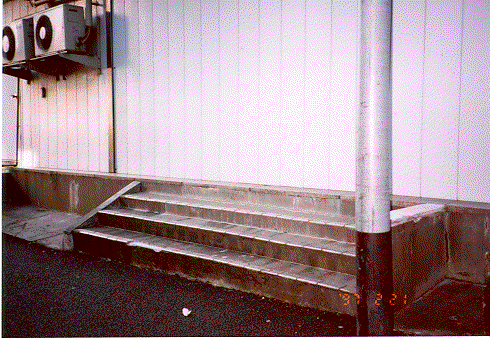
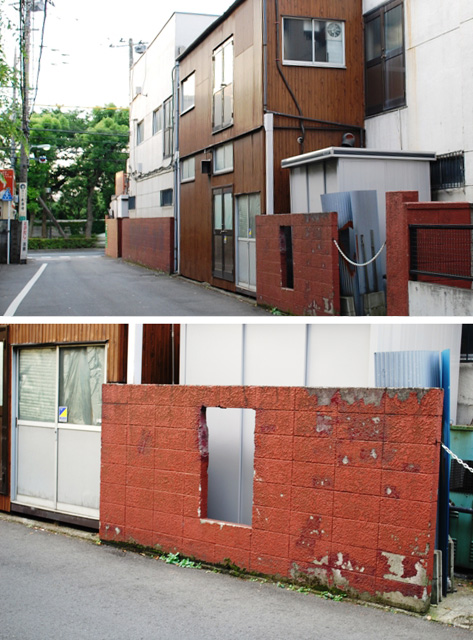
So, there's a Japanese artistic concept called a Thomasson.
In short, they are "defunct
and useless
objects, attached
to someone's property and aesthetically maintained."
But a more nuanced
explanation involves artist Akasegawa
Genpei, baseball player Gary Thomasson,
and a whole generation of Japanese kids who wandered around Tokyo,
looking for architectural abnormalities.
Now that the book has found its way to English, American readers are submitting some pretty fascinating discoveries of their own .
An extremely influential writer and visual artist, Akasegawa Gempei started as a founding member of the neo-dada group Hi Red Center in the 60s, staging a lot of public performances. When Tokyo launched a series of "Let's Clean Up Our City" campaigns for the upcoming Olympics, Akasegawa and company took it a step further by dressing in lab coats and cleaning single cobblestones with rubbing alcohol and toothbrushes.
As a sculptor, Akasegawa became interested in making things with money. This eventually earned him a counterfeiting charge, and he appeared in court to defend his work as "art"--the formal opposite of currency. Lacking a stringent legal definition of art, Akasegawa called on his friends from Hi Red Center to provide "expert testimony." This involved Nakanishi Natsuyuki appearing with his body covered in closepins and other such performances, and quickly turned the trial into a performance piece. Akasegawa demanded that all of his friends' "testimonies" be treated as proper evidence, and the court had no choice but to carefully photograph and document each of these performances. The result is retroactively known as "The 1000-Yen Trial Incident," and is one of the 20th century's most seminal works of Japanese art.



An extremely influential writer and visual artist, Akasegawa Gempei started as a founding member of the neo-dada group Hi Red Center in the 60s, staging a lot of public performances. When Tokyo launched a series of "Let's Clean Up Our City" campaigns for the upcoming Olympics, Akasegawa and company took it a step further by dressing in lab coats and cleaning single cobblestones with rubbing alcohol and toothbrushes.
As a sculptor, Akasegawa became interested in making things with money. This eventually earned him a counterfeiting charge, and he appeared in court to defend his work as "art"--the formal opposite of currency. Lacking a stringent legal definition of art, Akasegawa called on his friends from Hi Red Center to provide "expert testimony." This involved Nakanishi Natsuyuki appearing with his body covered in closepins and other such performances, and quickly turned the trial into a performance piece. Akasegawa demanded that all of his friends' "testimonies" be treated as proper evidence, and the court had no choice but to carefully photograph and document each of these performances. The result is retroactively known as "The 1000-Yen Trial Incident," and is one of the 20th century's most seminal works of Japanese art.

I love stuff like this, you have no idea how glad I am to hear that there is a name for it.
In St. Paul, we have the Skyway to Nowhere, there's one in Minneapolis too.
posted by Think_Long at 5:18 PM on May 7, 2010
In St. Paul, we have the Skyway to Nowhere, there's one in Minneapolis too.

posted by Think_Long at 5:18 PM on May 7, 2010
Also, kick ass post.
posted by Joey Michaels at 5:18 PM on May 7, 2010
posted by Joey Michaels at 5:18 PM on May 7, 2010
My God, what a fantastic post this is.
posted by penduluum at 5:21 PM on May 7, 2010 [4 favorites]
posted by penduluum at 5:21 PM on May 7, 2010 [4 favorites]
In St. Paul, we have the Skyway to Nowhere, there's one in Minneapolis too.
Think_Long, that is a masterpiece of the genre.
posted by zonkers at 5:28 PM on May 7, 2010
Think_Long, that is a masterpiece of the genre.
posted by zonkers at 5:28 PM on May 7, 2010
During the Big Dig in Boston, there were a lot of onramps and highways left hanging in the air for many years. While my parents drove by them I would often wonder whether I wouldn't be able to ride the onramps into another dimension.
Anyway, this post is beautiful, and I'd like to sum it up with the "See also" section for Thomasson on Japanese Wikipedia:
* Artistic value
* Vestigial organ
* Ruin
* also "Hundred Famous Views of What the Hell?"
posted by shii at 5:30 PM on May 7, 2010 [1 favorite]
Anyway, this post is beautiful, and I'd like to sum it up with the "See also" section for Thomasson on Japanese Wikipedia:
* Artistic value
* Vestigial organ
* Ruin
* also "Hundred Famous Views of What the Hell?"
posted by shii at 5:30 PM on May 7, 2010 [1 favorite]
Joey Michaels: "Can something that is aesthetically pleasing truly be called useless?"
I think the important aspect is that it would no longer be beautiful if it had any use.
posted by idiopath at 5:30 PM on May 7, 2010 [3 favorites]
I think the important aspect is that it would no longer be beautiful if it had any use.
posted by idiopath at 5:30 PM on May 7, 2010 [3 favorites]
I always thought William Gibson made that up!
posted by monkeymike at 5:30 PM on May 7, 2010 [3 favorites]
posted by monkeymike at 5:30 PM on May 7, 2010 [3 favorites]
Fantastic! Reminds me of the Winchester Mystery House
posted by mia_farrow at 5:34 PM on May 7, 2010 [1 favorite]
posted by mia_farrow at 5:34 PM on May 7, 2010 [1 favorite]
I have been noticing details in cityscapes like this for years- so glad there is a name now for it. I always imagined them as portholes to another place and time.
posted by flyfsh_peter at 5:36 PM on May 7, 2010 [1 favorite]
posted by flyfsh_peter at 5:36 PM on May 7, 2010 [1 favorite]
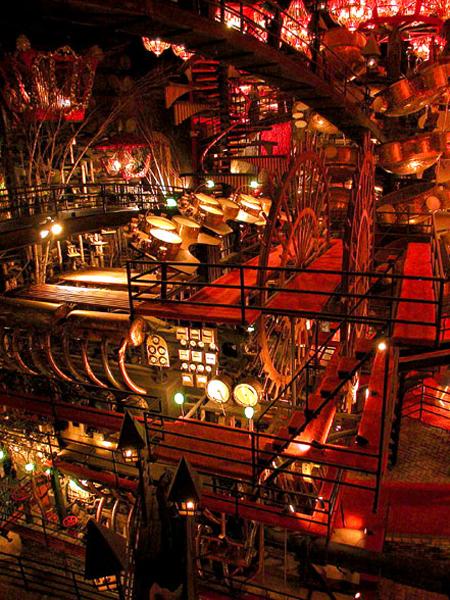
I wonder if the collection of steel ladders at the House On The Rock would count?
posted by idiopath at 5:42 PM on May 7, 2010 [1 favorite]
posted by idiopath at 5:42 PM on May 7, 2010 [1 favorite]
Martin Kippenberger's book/concept, Psychobuildings fits in here somewhere too.
posted by R. Mutt at 5:54 PM on May 7, 2010
posted by R. Mutt at 5:54 PM on May 7, 2010
I think what makes these things so intriguing is the way they inhabit a place so inconscpicuously, and yet once you've noticed them, they seem to define the place entirely, as if everything worth remembering about that place is contained within them.
Something about this makes me positively giddy inside. I take great comfort in knowing that not only are there things like this out there, but that there are people who care enough to take care of such things, there is someone who cares enough about this phenonemon to catalogue and create a book about it, and there is someone who thinks this is interesting enough to post to MetaFilter. I was feeling kind of alone today and this post has cheered me greatly, thanks so much.
posted by oulipian at 6:11 PM on May 7, 2010 [2 favorites]
Something about this makes me positively giddy inside. I take great comfort in knowing that not only are there things like this out there, but that there are people who care enough to take care of such things, there is someone who cares enough about this phenonemon to catalogue and create a book about it, and there is someone who thinks this is interesting enough to post to MetaFilter. I was feeling kind of alone today and this post has cheered me greatly, thanks so much.
posted by oulipian at 6:11 PM on May 7, 2010 [2 favorites]
Toronto has a huge Thomasson - it's section of highway that was supossed to go much further, but the project was cancelled, so they tore down the road, but left the supports standing. I love stuff like this - now I know what to call it.
posted by 5_13_23_42_69_666 at 6:17 PM on May 7, 2010

posted by 5_13_23_42_69_666 at 6:17 PM on May 7, 2010
You see these in every city; how many apartments, like ours in Hell's Kitchen, had a fireplace mantlepiece but no fireplace? Semi-blocked doors, walled-off terraces, connecting passageways of an old large house blocked off to make two smaller houses, staircases deprived of their entryways, all common sights.
And while I enjoy all the mystical connotations of these, they also kind of make me sad; poor abandoned things. And also a little annoyed at what, most of the time, is just poorly-done renovation work.
/joykiller
posted by emjaybee at 6:33 PM on May 7, 2010
And while I enjoy all the mystical connotations of these, they also kind of make me sad; poor abandoned things. And also a little annoyed at what, most of the time, is just poorly-done renovation work.
/joykiller
posted by emjaybee at 6:33 PM on May 7, 2010
excellent post!
posted by puny human at 6:33 PM on May 7, 2010
posted by puny human at 6:33 PM on May 7, 2010
"All art is quite useless." ~Oscar Wilde
I'm pretty sure there's someone other than me who wants to make a game of inventing uses for these things. You built a bridge to nowhere? Park a truck below it and use it as a platform to drop stuff in. Those individually cleaned cobblestones? Morse code... or perhaps Clean Graffiti. There'll be gangs of Thomasson artists fighting against the Repurposers trying to find a purpose for these things and thereby destroying something beautiful. It will be glorious.
posted by LogicalDash at 6:44 PM on May 7, 2010 [1 favorite]
I'm pretty sure there's someone other than me who wants to make a game of inventing uses for these things. You built a bridge to nowhere? Park a truck below it and use it as a platform to drop stuff in. Those individually cleaned cobblestones? Morse code... or perhaps Clean Graffiti. There'll be gangs of Thomasson artists fighting against the Repurposers trying to find a purpose for these things and thereby destroying something beautiful. It will be glorious.
posted by LogicalDash at 6:44 PM on May 7, 2010 [1 favorite]
This is one of the best posts I have ever seen.
posted by mhoye at 6:45 PM on May 7, 2010 [1 favorite]
posted by mhoye at 6:45 PM on May 7, 2010 [1 favorite]
This is wonderful - it's almost as if people are treating these as pets in some cases.
That said, I'm pretty sure that quite a few of the examples offered in the "nuanced explanation" video are low-rent fire escapes.
posted by skyscraper at 6:52 PM on May 7, 2010
That said, I'm pretty sure that quite a few of the examples offered in the "nuanced explanation" video are low-rent fire escapes.
posted by skyscraper at 6:52 PM on May 7, 2010
Creating deliberate Thomassons is the art of Chindōgu [previously].
posted by LogicalDash at 6:56 PM on May 7, 2010
posted by LogicalDash at 6:56 PM on May 7, 2010
That site is the kind of place I could spend hours browsing if only the "case files" had a next and prev button. Instead I have to look at the search page and load them each one by one? FAIL.
posted by Afroblanco at 7:26 PM on May 7, 2010 [1 favorite]
posted by Afroblanco at 7:26 PM on May 7, 2010 [1 favorite]
just poorly-done renovation work
And those very same mistakes which made it a failure as a renovation make it an excellent Thomasson.
It's a sort of semiotic recycling. We can't go anywhere on this road? OK, let's use it as art instead. Efficient!
posted by LogicalDash at 7:51 PM on May 7, 2010 [1 favorite]
And those very same mistakes which made it a failure as a renovation make it an excellent Thomasson.
It's a sort of semiotic recycling. We can't go anywhere on this road? OK, let's use it as art instead. Efficient!
posted by LogicalDash at 7:51 PM on May 7, 2010 [1 favorite]
I know someone called Thomasin. I'm trying really hard not to send this on to her.
I utterly love things that are remnants, or not-quites. They're beautiful reminders that projects and developments and changes don't just go from one state to another, but that there's a whole enormous amount of stuff that has to happen. And sometimes it just stops, part way.
posted by Dandeson Coates, Sec'y at 8:00 PM on May 7, 2010
I utterly love things that are remnants, or not-quites. They're beautiful reminders that projects and developments and changes don't just go from one state to another, but that there's a whole enormous amount of stuff that has to happen. And sometimes it just stops, part way.
posted by Dandeson Coates, Sec'y at 8:00 PM on May 7, 2010
I always thought William Gibson made that up!
Yeah, Thomassons, Kurtas: every time I think Gibson is making something up, it turns out to be some fascinating little piece of outre culture that I wish I had stumbled on before.
And while I fervently hope that Tokyo avoids tectonic disaster, I do hope that if the supposedly impending massive earthquake DOES level Tokyo, it will universally be referred to as 'Godzilla.'
Now if we can only get some sim/stim goin'....
posted by umberto at 8:21 PM on May 7, 2010
Yeah, Thomassons, Kurtas: every time I think Gibson is making something up, it turns out to be some fascinating little piece of outre culture that I wish I had stumbled on before.
And while I fervently hope that Tokyo avoids tectonic disaster, I do hope that if the supposedly impending massive earthquake DOES level Tokyo, it will universally be referred to as 'Godzilla.'
Now if we can only get some sim/stim goin'....
posted by umberto at 8:21 PM on May 7, 2010
My university has a building whose internal structure would likely count as one of these. It is a repurposed ramped parking garage, turned into a science building. The hallways are slightly sloped, and the main central section of the building is a set of paired ramps.
One of the most facinating things about this buidling, besides the doors hidden behind rails, the off kilter floors, and well, THE RAMPS, is that every "floor" has its rooms numbered from top down, and that no two floors have the same number of rooms. So as you walk up, the numbers seem out of sequence - particularly on floors where rooms have been joined or split after the fact. But as you walk down from the top, you realize there is an order to it.
posted by strixus at 9:07 PM on May 7, 2010 [1 favorite]
One of the most facinating things about this buidling, besides the doors hidden behind rails, the off kilter floors, and well, THE RAMPS, is that every "floor" has its rooms numbered from top down, and that no two floors have the same number of rooms. So as you walk up, the numbers seem out of sequence - particularly on floors where rooms have been joined or split after the fact. But as you walk down from the top, you realize there is an order to it.
posted by strixus at 9:07 PM on May 7, 2010 [1 favorite]
I guess the standpipe in my kitchen to a now-nonexistent drain doesn't count even if there is proper roof construction above it that was done after the drain was no longer connected? There's the upper half of a window on the attic stairs. And we discovered the top lintel of a door when we redid the dining room roof last summer (that door would have been gone in about 1890 when the dining room was built).
Use a building for enough generations and you're going to end up with some Thomassons. This is a fantastic post; it kind of explains part of the attraction I have for old houses.
posted by Michael Roberts at 9:30 PM on May 7, 2010
Use a building for enough generations and you're going to end up with some Thomassons. This is a fantastic post; it kind of explains part of the attraction I have for old houses.
posted by Michael Roberts at 9:30 PM on May 7, 2010
Idiopath, that thing gives me the shakes just looking at it. If that's real, I don't think I could walk on it. If I had to go out there, I'd be on my hands and knees.
posted by Chocolate Pickle at 11:31 PM on May 7, 2010 [1 favorite]
posted by Chocolate Pickle at 11:31 PM on May 7, 2010 [1 favorite]
With the abrupt cancellation of the Yamba dam project in Japan, some very interesting Tomassons are being created ...
posted by woodblock100 at 1:41 AM on May 8, 2010 [1 favorite]

posted by woodblock100 at 1:41 AM on May 8, 2010 [1 favorite]
Oh splendid. Now I've got a new hobby. Brussels has just got to be filled with them... I know one good one already and am delighted that there's a word for them.
posted by quarsan at 2:02 AM on May 8, 2010
posted by quarsan at 2:02 AM on May 8, 2010
Awesome! There's a name for the Staple Street bridge! (I love my neighborhood.)
posted by The Bellman at 4:50 AM on May 8, 2010

posted by The Bellman at 4:50 AM on May 8, 2010
> Yeah, Thomassons, Kurtas: every time I think Gibson is making something up ...
It's Curta, and damn that Gibson. After striking up a friendship with the translator of Georges Ifrah's books a few years back, I decided to buy a Curta. It was going to be pretty expensive, but I was checking prices, monitoring mailing lists ... and there were a few out there I could just afford. I was just about to close in on one - and the prices tripled overnight; what?! Only bloody William bloody Gibson and his bloody Pattern bloody Recognition bloody book. It hit the stores, and well-heeled scenesters had to have their little bit of magic cool-by-association kitsch.
posted by scruss at 5:09 AM on May 8, 2010 [1 favorite]
It's Curta, and damn that Gibson. After striking up a friendship with the translator of Georges Ifrah's books a few years back, I decided to buy a Curta. It was going to be pretty expensive, but I was checking prices, monitoring mailing lists ... and there were a few out there I could just afford. I was just about to close in on one - and the prices tripled overnight; what?! Only bloody William bloody Gibson and his bloody Pattern bloody Recognition bloody book. It hit the stores, and well-heeled scenesters had to have their little bit of magic cool-by-association kitsch.
posted by scruss at 5:09 AM on May 8, 2010 [1 favorite]
Bridge to Nowhere, San Gabriel Mountains, near Azusa, California.
posted by notyou at 7:29 AM on May 8, 2010
posted by notyou at 7:29 AM on May 8, 2010
The Thomasson is our pregame for the apocalypse.
posted by artof.mulata at 10:34 AM on May 8, 2010 [1 favorite]
posted by artof.mulata at 10:34 AM on May 8, 2010 [1 favorite]
Louisville's Big Four Bridge used to fit, then, but is now halfway (?) converted to a pedestrian bridge with ramps going up the KY side, I think.
Also found this site with lots of unfinished or half-destroyed bridges while looking for a good picture of the Big Four.
posted by dilettante at 11:33 AM on May 8, 2010
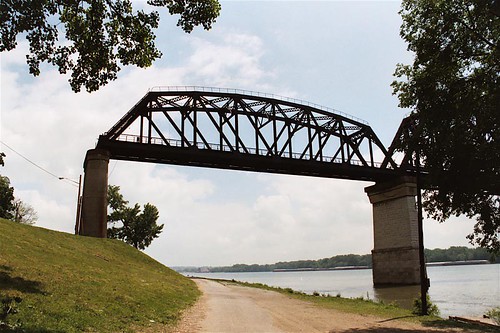
Also found this site with lots of unfinished or half-destroyed bridges while looking for a good picture of the Big Four.
posted by dilettante at 11:33 AM on May 8, 2010
Where my Pops lives in North Carolina there's a highway that just ends in the woods. It was built after a reservoir cut off access to some peoples land but the project was never completed and the locals took to calling it the "Road to Nowhere". They have been fighting to have the road finished for 40 plus years, but for now, it's a well maintained highway that goes off into the woods through tunnels and a bridge but terminates in a turnaround.
posted by Megafly at 9:41 PM on May 8, 2010
posted by Megafly at 9:41 PM on May 8, 2010
I hate to get all Internet Detective here, but isn't this one two different bridges? Note the different fences below, the broken railing on the far side on one, and the broken light on the roof... which is a shame, as I'd like such a thing to actually exist.
posted by eykal at 1:58 PM on May 9, 2010
posted by eykal at 1:58 PM on May 9, 2010
Great that there's a name for this. There's a set of three stairs going nowhere on 16th street towards 3rd in SF that always struck me as artistic somehow... exactly this.
posted by jcruelty at 8:13 PM on May 9, 2010
posted by jcruelty at 8:13 PM on May 9, 2010
Have some of these at my high school. Stairs to nowhere.
posted by infinitewindow at 9:08 PM on May 9, 2010
posted by infinitewindow at 9:08 PM on May 9, 2010
This one was on there-i-fixed-it:
thereifixedit
posted by lundman at 6:28 AM on May 10, 2010 [1 favorite]
thereifixedit

posted by lundman at 6:28 AM on May 10, 2010 [1 favorite]
Oh splendid. Now I've got a new hobby. Brussels has just got to be filled with them... I know one good one already and am delighted that there's a word for them.
The Belgians already have a word for this: they call them "Great Useless Works". Sadly, the Wiki page is only in French or Dutch. Apparently they tend to originate from Belgium's entrenched political logrolling between Flanders and Wallonia, where if one region got, say, a tramline the other one would too, regardless of whether anyone would ride it.
It reminds me of the old joke where two men are continuously digging and filling holes: one guy digs the hole, the other fills it up, they move up the road ten yards, they do the same. Asked what they're doing, they reply: the third guy that plants the tree is off today. That's Belgian politics.
posted by goodnewsfortheinsane at 6:24 AM on May 11, 2010 [1 favorite]
The Belgians already have a word for this: they call them "Great Useless Works". Sadly, the Wiki page is only in French or Dutch. Apparently they tend to originate from Belgium's entrenched political logrolling between Flanders and Wallonia, where if one region got, say, a tramline the other one would too, regardless of whether anyone would ride it.
It reminds me of the old joke where two men are continuously digging and filling holes: one guy digs the hole, the other fills it up, they move up the road ten yards, they do the same. Asked what they're doing, they reply: the third guy that plants the tree is off today. That's Belgian politics.
posted by goodnewsfortheinsane at 6:24 AM on May 11, 2010 [1 favorite]
This reminds me of the Animatrix segment called Beyond where "The children have stumbled across an amalgamation of anomalies within an old, dilapidated building."
The most intriguing ones for me are the ones I find in rural areas or even out in the Wilderness. Remnants of a story no longer being told. Art is in the crotch of the beholder.
Now you've gone and done it, I'll be seeing these things all summer.
posted by Twang at 6:37 PM on May 12, 2010
The most intriguing ones for me are the ones I find in rural areas or even out in the Wilderness. Remnants of a story no longer being told. Art is in the crotch of the beholder.
Now you've gone and done it, I'll be seeing these things all summer.
posted by Twang at 6:37 PM on May 12, 2010
« Older Rosie Hardy: naturally talented photographer... | Dead. Newer »
This thread has been archived and is closed to new comments
posted by Joey Michaels at 5:17 PM on May 7, 2010 [2 favorites]