20 to 1
July 27, 2011 10:25 AM Subscribe
In America, the typical black household had just $5,677 in wealth (assets minus debts) in 2009, the typical Hispanic household had $6,325 in wealth and the typical white household had $113,149. These lopsided wealth ratios are the largest since the government began publishing such data a quarter century ago. Data from the US Census: Survey of Income and Program Participation (SIPP).
Is "typical" is this case an average or a mean? Tossing out Bill Gates, Warren Buffett and company co. These guys can screw results (Riches Americans). Just wondering ...
posted by busillis at 10:34 AM on July 27, 2011
posted by busillis at 10:34 AM on July 27, 2011
Congratulations, Republicans!
posted by goethean at 10:34 AM on July 27, 2011 [7 favorites]
posted by goethean at 10:34 AM on July 27, 2011 [7 favorites]
I meant "skew," but "screw" works in this case too. :P
posted by busillis at 10:35 AM on July 27, 2011 [1 favorite]
posted by busillis at 10:35 AM on July 27, 2011 [1 favorite]
Mean or median?
The first line of the article says median.
posted by burnmp3s at 10:35 AM on July 27, 2011 [4 favorites]
The first line of the article says median.
posted by burnmp3s at 10:35 AM on July 27, 2011 [4 favorites]
busillis: Is "typical" is this case an average or a me[di]an?
First sentence of article:
The median wealth of white households is...
posted by gurple at 10:35 AM on July 27, 2011
First sentence of article:
The median wealth of white households is...
posted by gurple at 10:35 AM on July 27, 2011
rich get richer poor get poorer
posted by zeoslap at 10:36 AM on July 27, 2011 [1 favorite]
posted by zeoslap at 10:36 AM on July 27, 2011 [1 favorite]
*chest-bumps burnmp3s*
posted by gurple at 10:36 AM on July 27, 2011 [6 favorites]
posted by gurple at 10:36 AM on July 27, 2011 [6 favorites]
In other words non-white America increasingly has nothing to lose.
posted by 2bucksplus at 10:36 AM on July 27, 2011 [18 favorites]
posted by 2bucksplus at 10:36 AM on July 27, 2011 [18 favorites]
I would like to see these statistics for those of us who aren't homeowners.
Given the last few years, I'd guess homeowning is not the wealth advantage it used to be.
posted by chundo at 10:38 AM on July 27, 2011
Given the last few years, I'd guess homeowning is not the wealth advantage it used to be.
posted by chundo at 10:38 AM on July 27, 2011
As an Asian person, I love how I am never represented in any of these things at all, unless I want to dig in to the full fine print.
posted by sweetkid at 10:40 AM on July 27, 2011 [36 favorites]
posted by sweetkid at 10:40 AM on July 27, 2011 [36 favorites]
Here is 2002 data for comparison, with a lot more charts/breakdowns. It's pretty much the same story with regard to race. Or 1984, if you want to go really far back.
Since most of the wealth is the residence, the actual numbers are going to correlate pretty well with housing prices.
posted by smackfu at 10:40 AM on July 27, 2011 [4 favorites]
Since most of the wealth is the residence, the actual numbers are going to correlate pretty well with housing prices.
posted by smackfu at 10:40 AM on July 27, 2011 [4 favorites]
This says less about income disparity than it does about predatory lending.
posted by horsemuth at 10:41 AM on July 27, 2011 [4 favorites]
posted by horsemuth at 10:41 AM on July 27, 2011 [4 favorites]
If it makes you feel better sweetkid, you are in that 2002 data I linked. Asian or Pacific Islanders trail the White numbers by a bit, but are still far higher than Black or Hispanic.
posted by smackfu at 10:42 AM on July 27, 2011
posted by smackfu at 10:42 AM on July 27, 2011
Which is why the tax cuts and the trickle-down-theory is irrelevant nonsense. Speaking of trickle-down:
posted by Foci for Analysis at 10:44 AM on July 27, 2011 [83 favorites]
The economist John Kenneth Galbraith noted that "trickle-down economics" had been tried before in the United States in the 1890s under the name "horse and sparrow theory." He wrote, "Mr. David Stockman has said that supply-side economics was merely a cover for the trickle-down approach to economic policy—what an older and less elegant generation called the horse-and-sparrow theory: 'If you feed the horse enough oats, some will pass through to the road for the sparrows.'" Galbraith claimed that the horse and sparrow theory was partly to blame for the Panic of 1896.[14] During this period, in his Cross of Gold speech, Democrat William Jennings Bryan said:Some hundred years later, politicians are still arguing that trickle-down is a sound idea."There are those who believe that, if you will only legislate to make the well-to-do prosperous, their prosperity will leak through on those below. The Democratic idea, however, has been that if you legislate to make the masses prosperous, their prosperity will find its way up through every class which rests up on them."
posted by Foci for Analysis at 10:44 AM on July 27, 2011 [83 favorites]
So basically, I made a mistake by not becoming a drug dealer?
posted by Brandon Blatcher at 10:47 AM on July 27, 2011 [6 favorites]
posted by Brandon Blatcher at 10:47 AM on July 27, 2011 [6 favorites]
Near as I can tell, the entire modern Republican agenda is to un-do every bit of social progress from the 20th century.
posted by stenseng at 10:50 AM on July 27, 2011 [23 favorites]
posted by stenseng at 10:50 AM on July 27, 2011 [23 favorites]
I find the figures for equity to be a bit dubious. I live amongst many white collar, white professionals who are prudent with their money and I don't know of many of them who will claim to be anywhere near that $113,000 in wealth.
posted by tgrundke at 10:51 AM on July 27, 2011 [3 favorites]
posted by tgrundke at 10:51 AM on July 27, 2011 [3 favorites]
Some hundred years later, politicians are still arguing that trickle-down is a sound idea
And, of course, even those making these arguments don't really believe them. They are, by design, a ruse.
posted by mondo dentro at 10:52 AM on July 27, 2011 [3 favorites]
And, of course, even those making these arguments don't really believe them. They are, by design, a ruse.
posted by mondo dentro at 10:52 AM on July 27, 2011 [3 favorites]
If these stats were printed about apartheid South Africa, there'd be boycotts and protests. I'm not saying that the situations are equivalent, because they are certainly quite different in many respects, but the end results are pretty damning.
posted by zachlipton at 10:52 AM on July 27, 2011 [1 favorite]
posted by zachlipton at 10:52 AM on July 27, 2011 [1 favorite]
Man I am failing at being the typical white person.
posted by desjardins at 10:52 AM on July 27, 2011 [31 favorites]
posted by desjardins at 10:52 AM on July 27, 2011 [31 favorites]
So basically, I made a mistake by not becoming a drug dealer?
Not if the average drug dealer's hourly wage really is akin to that of someone working fast food.
posted by PeterMcDermott at 10:53 AM on July 27, 2011
Not if the average drug dealer's hourly wage really is akin to that of someone working fast food.
posted by PeterMcDermott at 10:53 AM on July 27, 2011
@tgrundke If any of them own a home, or have been paying on a home for any significant amount of time that'll count towards their assets-debt, and that's what they're calling "wealth" for this study.
A paid off car would get you a few thousand, etc.
posted by sotonohito at 10:56 AM on July 27, 2011 [1 favorite]
A paid off car would get you a few thousand, etc.
posted by sotonohito at 10:56 AM on July 27, 2011 [1 favorite]
As an Asian person, I love how I am never represented in any of these things at all, unless I want to dig in to the full fine print.
posted by sweetkid at 10:40 AM on July 27 [6 favorites −] Favorite added! [!]
I am surpised from the links posted by smakfu that Asian households fared so poorly. I thought we were the Model Minority!! My tiger momma is going to be PISSED.
posted by helmutdog at 10:57 AM on July 27, 2011 [4 favorites]
posted by sweetkid at 10:40 AM on July 27 [6 favorites −] Favorite added! [!]
I am surpised from the links posted by smakfu that Asian households fared so poorly. I thought we were the Model Minority!! My tiger momma is going to be PISSED.
posted by helmutdog at 10:57 AM on July 27, 2011 [4 favorites]
I live amongst many white collar, white professionals who are prudent with their money and I don't know of many of them who will claim to be anywhere near that $113,000 in wealth.
Maybe an implicit definition of "wealth" is a little too fuzzy? From the article:
Household wealth is the accumulated sum of assets (houses, cars, savings and checking accounts, stocks and mutual funds, retirement accounts, etc.) minus the sum of debt (mortgages, auto loans, credit card debt, etc.).
I think people particularly don't think about retirement accounts when they do their coin-counting.
posted by gurple at 10:59 AM on July 27, 2011 [5 favorites]
Maybe an implicit definition of "wealth" is a little too fuzzy? From the article:
Household wealth is the accumulated sum of assets (houses, cars, savings and checking accounts, stocks and mutual funds, retirement accounts, etc.) minus the sum of debt (mortgages, auto loans, credit card debt, etc.).
I think people particularly don't think about retirement accounts when they do their coin-counting.
posted by gurple at 10:59 AM on July 27, 2011 [5 favorites]
I find the figures for equity to be a bit dubious. I live amongst many white collar, white professionals who are prudent with their money and I don't know of many of them who will claim to be anywhere near that $113,000 in wealth.
I assume much of the money is in 401(k)s and IRAs, which most people don't think of when they think of their own wealth (as the money is restricted).
This is per-household, so with dual-income professional metropolitan households on the East and West Coasts added in, and including people towards the ends of their careers, it doesn't seem implausible.
posted by zippy at 11:01 AM on July 27, 2011 [1 favorite]
I assume much of the money is in 401(k)s and IRAs, which most people don't think of when they think of their own wealth (as the money is restricted).
This is per-household, so with dual-income professional metropolitan households on the East and West Coasts added in, and including people towards the ends of their careers, it doesn't seem implausible.
posted by zippy at 11:01 AM on July 27, 2011 [1 favorite]
Excellent, now I can tell my racist mother that we're lower than both Blacks and Hispanics! Looking forward to that foaming-at-the-mouth rant.
/wish this news was closer to Thanksgiving for maximum effect.
posted by Old'n'Busted at 11:03 AM on July 27, 2011 [4 favorites]
/wish this news was closer to Thanksgiving for maximum effect.
posted by Old'n'Busted at 11:03 AM on July 27, 2011 [4 favorites]
*chest-bumps zippy*
Also, if you're a young person, consider that the results represent a spectrum of ages. People who have been saving actively tend to accumulate some amount of wealth over time.
posted by gurple at 11:04 AM on July 27, 2011
Also, if you're a young person, consider that the results represent a spectrum of ages. People who have been saving actively tend to accumulate some amount of wealth over time.
posted by gurple at 11:04 AM on July 27, 2011
And water is wet.
Seriously I wonder when Americans, particularly those trapped in the lower social economic class will demand change. Real fucking change. The type of re-ordering of the likes we haven't seen.
posted by handbanana at 11:07 AM on July 27, 2011 [1 favorite]
Seriously I wonder when Americans, particularly those trapped in the lower social economic class will demand change. Real fucking change. The type of re-ordering of the likes we haven't seen.
posted by handbanana at 11:07 AM on July 27, 2011 [1 favorite]
This has to do with home ownership and not "trickle-down". Wealth doesn't mean cash in a checking account.
posted by Ideefixe at 11:11 AM on July 27, 2011
posted by Ideefixe at 11:11 AM on July 27, 2011
Seriously I wonder when Americans, particularly those trapped in the lower social economic class will demand change. Real fucking change.
Yeah, I was about to do that, but the Titans just signed Hasselbeck and I'm wondering how CJ is going to react. I got this ill fitted I'm looking at, but I'm not trying to cop that if Tennessee is gonna be garbage this year. They got receivers but I don't know if...what were we talking about again?
posted by cashman at 11:12 AM on July 27, 2011 [2 favorites]
Yeah, I was about to do that, but the Titans just signed Hasselbeck and I'm wondering how CJ is going to react. I got this ill fitted I'm looking at, but I'm not trying to cop that if Tennessee is gonna be garbage this year. They got receivers but I don't know if...what were we talking about again?
posted by cashman at 11:12 AM on July 27, 2011 [2 favorites]
I hope that, when the masses rise up, they find my $10,000 in household wealth too tiny to be worth clobbering.
posted by Foam Pants at 11:12 AM on July 27, 2011
posted by Foam Pants at 11:12 AM on July 27, 2011
I love that not only are we never going to see reparations, but they're actively draining money from us again*.
"In 2009, the typical black household had just $5,677 in wealth. Hispanic families had about $6,325 in wealth. The average white household had a net worth of $113,149."
Please note that $5,000 of that wealth is in rims. Hispanic folks are richer for also owning a burro.
But, c'mon, guys. Let's go easy on the job creators. We all know a job creator; they're that person in the office who makes more work for everyone with everything they do.
"Y'all enjoy that money, nice white folks, yes suh! No, suh, I don't need it. Probably just blow it on fried chicken and mentholated cigarettes, you know how us black folks is."
*does a little softshoe*
* Yes, black folks need to stop spending their money on stupid shit; I've seen the Chappelle's Show sketch. There's also a lot of predatory financial practices that go on. In short, it's complicated.
posted by Eideteker at 11:14 AM on July 27, 2011 [2 favorites]
"In 2009, the typical black household had just $5,677 in wealth. Hispanic families had about $6,325 in wealth. The average white household had a net worth of $113,149."
Please note that $5,000 of that wealth is in rims. Hispanic folks are richer for also owning a burro.
But, c'mon, guys. Let's go easy on the job creators. We all know a job creator; they're that person in the office who makes more work for everyone with everything they do.
"Y'all enjoy that money, nice white folks, yes suh! No, suh, I don't need it. Probably just blow it on fried chicken and mentholated cigarettes, you know how us black folks is."
*does a little softshoe*
* Yes, black folks need to stop spending their money on stupid shit; I've seen the Chappelle's Show sketch. There's also a lot of predatory financial practices that go on. In short, it's complicated.
posted by Eideteker at 11:14 AM on July 27, 2011 [2 favorites]
Seriously I wonder when Americans, particularly those trapped in the lower social economic class will demand change. Real fucking change. The type of re-ordering of the likes we haven't seen.
My guess is not very soon. Too many shiny things to look at.
posted by goethean at 11:14 AM on July 27, 2011 [1 favorite]
My guess is not very soon. Too many shiny things to look at.
posted by goethean at 11:14 AM on July 27, 2011 [1 favorite]
[not to imply that whites don't like to look at shiny things also....oh, nevermind.
posted by goethean at 11:16 AM on July 27, 2011
posted by goethean at 11:16 AM on July 27, 2011
This has to do with home ownership and not "trickle-down".
I disagree. There is a causal relationship between the ideological positions that dominate a period and the income and wealth distributions seen in society, via the policies they enact.
posted by mondo dentro at 11:16 AM on July 27, 2011
I disagree. There is a causal relationship between the ideological positions that dominate a period and the income and wealth distributions seen in society, via the policies they enact.
posted by mondo dentro at 11:16 AM on July 27, 2011
I am surpised from the links posted by smakfu that Asian households fared so poorly.
What's interesting is the ride Asians had between the 2002 data smackfu linked to and now. In 2005 they had the best median net worth. From the pew social trends article: "Their net worth fell from $168,103 in 2005 to $78,066 in 2009, a drop of 54%". Although if you factor out immigration the drop is 31%.
posted by Gary at 11:19 AM on July 27, 2011 [1 favorite]
What's interesting is the ride Asians had between the 2002 data smackfu linked to and now. In 2005 they had the best median net worth. From the pew social trends article: "Their net worth fell from $168,103 in 2005 to $78,066 in 2009, a drop of 54%". Although if you factor out immigration the drop is 31%.
posted by Gary at 11:19 AM on July 27, 2011 [1 favorite]
For purposes of calculating "wealth," don't they include stuff you don't actually own, but still owe a mortgage on? For example, I believe the appraised value of your house (even if you're just on year one of a 30 year mortgage) counts as part of your wealth, despite the fact that it's basically nothing but a drain on your income and spending power. Anybody know?
In which case, these numbers might be misleading, given how useless and costly the housing crash has rendered a major portion of what's classified as "wealth."
posted by saulgoodman at 11:22 AM on July 27, 2011
In which case, these numbers might be misleading, given how useless and costly the housing crash has rendered a major portion of what's classified as "wealth."
posted by saulgoodman at 11:22 AM on July 27, 2011
This post on Sociological Images uses a different set of charts to compare the 2009 and 2005 figures; notice how for both blacks and hispanics, median wealth dropped by over half. It also dropped by over half for Asians, who in 2005 had an even higher median wealth than whites; now they have significantly lower median wealth.
I am surpised from the links posted by smakfu that Asian households fared so poorly. I thought we were the Model Minority!! My tiger momma is going to be PISSED.
"Asian" can be a misleading category when it's used in statistics like this, since there are different Asian ethnicities. Hmong refugees, for example, are usually lumped into the same category as a second-generation Japanese-American, even though the socioeconomic situation for an average member of those groups are very different.
posted by Kutsuwamushi at 11:22 AM on July 27, 2011 [4 favorites]
I am surpised from the links posted by smakfu that Asian households fared so poorly. I thought we were the Model Minority!! My tiger momma is going to be PISSED.
"Asian" can be a misleading category when it's used in statistics like this, since there are different Asian ethnicities. Hmong refugees, for example, are usually lumped into the same category as a second-generation Japanese-American, even though the socioeconomic situation for an average member of those groups are very different.
posted by Kutsuwamushi at 11:22 AM on July 27, 2011 [4 favorites]
Give the trickle-down time to work, people! Geez, all these minorities want instant gratification.
posted by Philosopher Dirtbike at 11:22 AM on July 27, 2011
posted by Philosopher Dirtbike at 11:22 AM on July 27, 2011
"Asian" can be a misleading category when it's used in statistics like this, since there are different Asian ethnicities. Hmong refugees, for example, are usually lumped into the same category as a second-generation Japanese-American, even though the socioeconomic situation for an average member of those groups are very different.
So true and also -- way to make the stats useless with your lumping, Census.
posted by sweetkid at 11:25 AM on July 27, 2011 [2 favorites]
So true and also -- way to make the stats useless with your lumping, Census.
posted by sweetkid at 11:25 AM on July 27, 2011 [2 favorites]
I assume much of the money is in 401(k)s and IRAs, which most people don't think of when they think of their own wealth (as the money is restricted).
You assume wrongly. Most people's wealth, if they have any, is going to be in their houses and cars. Some people have a nice large amount of money saved up to retire, but do you think that old lady at the cash register is working there for fun?
posted by Deathalicious at 11:25 AM on July 27, 2011 [1 favorite]
You assume wrongly. Most people's wealth, if they have any, is going to be in their houses and cars. Some people have a nice large amount of money saved up to retire, but do you think that old lady at the cash register is working there for fun?
posted by Deathalicious at 11:25 AM on July 27, 2011 [1 favorite]
Hey! Turns out I'm black! I may have to have an awkward conversation with my parents.
posted by TheWhiteSkull at 11:27 AM on July 27, 2011 [6 favorites]
posted by TheWhiteSkull at 11:27 AM on July 27, 2011 [6 favorites]
(re Asians) Although if you factor out immigration the drop is 31%.
I wonder if that is suggestive of Asian people living in areas that were particularly hard-hit by the slump/normalization in housing values? That could skew the numbers significantly, but unless you happened to buy or sell a house during that period, or take out a HELOC or something, you might not have "felt" much poorer.
posted by Kadin2048 at 11:29 AM on July 27, 2011
I wonder if that is suggestive of Asian people living in areas that were particularly hard-hit by the slump/normalization in housing values? That could skew the numbers significantly, but unless you happened to buy or sell a house during that period, or take out a HELOC or something, you might not have "felt" much poorer.
posted by Kadin2048 at 11:29 AM on July 27, 2011
Obligatory Chris Rock on the difference between being rich and being wealthy.
posted by Apropos of Something at 11:30 AM on July 27, 2011 [8 favorites]
posted by Apropos of Something at 11:30 AM on July 27, 2011 [8 favorites]
I am guessing that for white non-homeowners, the wealth is concentrated mostly in New Balance brand sneakers, Arcade Fire CDs, iPhones, and Subaru automobiles.
posted by 1adam12 at 11:30 AM on July 27, 2011 [6 favorites]
posted by 1adam12 at 11:30 AM on July 27, 2011 [6 favorites]
I wonder if that is suggestive of Asian people living in areas that were particularly hard-hit by the slump/normalization in housing values?
The article does explicitly say that is the case for Black/Hispanic.
posted by smackfu at 11:31 AM on July 27, 2011
The article does explicitly say that is the case for Black/Hispanic.
posted by smackfu at 11:31 AM on July 27, 2011
Speaking of trickle-down ... 'If you feed the horse enough oats, some will pass through to the road for the sparrows.'
So 100 years of social progress and what we've got to show is the rich saying we should be glad they're pissing on us instead of glad they're shitting on us?
We could wait another 100 years and see what's next, or maybe time for pitchforks?
posted by crayz at 11:33 AM on July 27, 2011 [1 favorite]
So 100 years of social progress and what we've got to show is the rich saying we should be glad they're pissing on us instead of glad they're shitting on us?
We could wait another 100 years and see what's next, or maybe time for pitchforks?
posted by crayz at 11:33 AM on July 27, 2011 [1 favorite]
black folks need to stop spending their money on stupid shit
I wonder if there's any evidence that discretionary spending amongst people with similar incomes is different by race. Man have I known a lot of poor white people who blow their entire paycheck. It's just not necessarily for stuff as visible as rims and Jordans.
posted by desjardins at 11:33 AM on July 27, 2011 [2 favorites]
I wonder if there's any evidence that discretionary spending amongst people with similar incomes is different by race. Man have I known a lot of poor white people who blow their entire paycheck. It's just not necessarily for stuff as visible as rims and Jordans.
posted by desjardins at 11:33 AM on July 27, 2011 [2 favorites]
sweetkid : As an Asian person, I love how I am never represented in any of these things at all, unless I want to dig in to the full fine print.
You also don't usually see "white" broken down into Irish, Scottish, and any other once-oppressed "ethnic" group, for the simple reason that those categories (as well as your own) don't fit the desired spin.
Funny, that.
posted by pla at 11:36 AM on July 27, 2011 [2 favorites]
You also don't usually see "white" broken down into Irish, Scottish, and any other once-oppressed "ethnic" group, for the simple reason that those categories (as well as your own) don't fit the desired spin.
Funny, that.
posted by pla at 11:36 AM on July 27, 2011 [2 favorites]
If you need (anecdotal) evidence of rich white people spending money on stupid shit, I invite you to turn on HGTV. Though, most of those shows there also prove the theorem that the easiest way to get free stuff is to be rich already.
posted by Apropos of Something at 11:37 AM on July 27, 2011 [2 favorites]
posted by Apropos of Something at 11:37 AM on July 27, 2011 [2 favorites]
Sorry, I meant that first one as "Italian", not Irish... But Irish works just as well.
posted by pla at 11:37 AM on July 27, 2011
posted by pla at 11:37 AM on July 27, 2011
Spartacus! Spartacus! Where art thou my Spartacus!
posted by Slackermagee at 11:38 AM on July 27, 2011
posted by Slackermagee at 11:38 AM on July 27, 2011
Mr. David Stockman has said that supply-side economics was merely a cover for the trickle-down approach to economic policy—what an older and less elegant generation called the horse-and-sparrow theory: 'If you feed the horse enough oats, some will pass through to the road for the sparrows.'"
And they started calling it the "trickle down theory" when the "horse and sparrow theory" was too readily dismissed as horseshit."
posted by orange swan at 11:40 AM on July 27, 2011 [4 favorites]
And they started calling it the "trickle down theory" when the "horse and sparrow theory" was too readily dismissed as horseshit."
posted by orange swan at 11:40 AM on July 27, 2011 [4 favorites]
desjardins : I wonder if there's any evidence that discretionary spending amongst people with similar incomes is different by race.
Take this as just barely better than anecdote, but I recall that exact point coming up in a sociology class I took 13ish years ago... And the answer came out to "no".
For comparable income levels, blacks and whites (Hispanic didn't come up) buy almost identical types of crap, across all economic groups.
posted by pla at 11:41 AM on July 27, 2011 [1 favorite]
Take this as just barely better than anecdote, but I recall that exact point coming up in a sociology class I took 13ish years ago... And the answer came out to "no".
For comparable income levels, blacks and whites (Hispanic didn't come up) buy almost identical types of crap, across all economic groups.
posted by pla at 11:41 AM on July 27, 2011 [1 favorite]
Man have I known a lot of poor white people who blow their entire paycheck. It's just not necessarily for stuff as visible as rims and Jordans.
Quoted for truth.
posted by ob at 11:41 AM on July 27, 2011
Quoted for truth.
posted by ob at 11:41 AM on July 27, 2011
You also don't usually see "white" broken down into Irish, Scottish, and any other once-oppressed "ethnic" group, for the simple reason that those categories (as well as your own) don't fit the desired spin.
Scottish-Americans were generally the ones doing the oppressing.
posted by theodolite at 11:42 AM on July 27, 2011 [2 favorites]
Scottish-Americans were generally the ones doing the oppressing.
posted by theodolite at 11:42 AM on July 27, 2011 [2 favorites]
In fact entire malls owe their existence to the fact that white people blow their money on stupid shit that they don't need.
posted by ob at 11:45 AM on July 27, 2011 [2 favorites]
posted by ob at 11:45 AM on July 27, 2011 [2 favorites]
You also don't usually see "white" broken down into Irish, Scottish, and any other once-oppressed "ethnic" group, for the simple reason that those categories (as well as your own) don't fit the desired spin.
I could drive a Mack truck through the definition of "oppressed" you're using.
posted by ofthestrait at 11:45 AM on July 27, 2011 [1 favorite]
I could drive a Mack truck through the definition of "oppressed" you're using.
posted by ofthestrait at 11:45 AM on July 27, 2011 [1 favorite]
If you sold everything you own right now and put all your cash toward your debts (including investments, cash in savings accounts and retirement accounts), what would you be left with? That's what this number is measuring.
I live amongst many white collar, white professionals who are prudent with their money and I don't know of many of them who will claim to be anywhere near that $113,000 in wealth.
I don't really know what to say to that. $113k seems about right to me. Older people are going to have a higher number, and younger people less. Older people with their house and car paid off, and no student loans left are going to be way over that number, depending on housing prices, of course. That is completely attainable for a white collar professional who is prudent with money.
posted by Pruitt-Igoe at 11:47 AM on July 27, 2011 [1 favorite]
I live amongst many white collar, white professionals who are prudent with their money and I don't know of many of them who will claim to be anywhere near that $113,000 in wealth.
I don't really know what to say to that. $113k seems about right to me. Older people are going to have a higher number, and younger people less. Older people with their house and car paid off, and no student loans left are going to be way over that number, depending on housing prices, of course. That is completely attainable for a white collar professional who is prudent with money.
posted by Pruitt-Igoe at 11:47 AM on July 27, 2011 [1 favorite]
Note Figure 3 which shows a comparison of new worth by race with and without the value of homes included. It looks like a significant amount of the difference by race can be attributed to home ownership rates. Differences in income by race are much less.
The post is about wealth. The problem is not incomes, this is about wealth. In that same Figure 3 (2007 data - "median household financial [non-home] wealth) you reference, even with the house taken out (scody, take note), white wealth is 43k while black and hispanic wealth is either .5k and .4k or .4k and .5k. I can't tell which is which because they are so low you can't tell which bar graph is which category.
So it is actually worse if you remove home ownership - "If we exclude home equity from the calculations and consider only financial wealth, the ratios are in the neighborhood of 100:1."
posted by cashman at 11:57 AM on July 27, 2011 [4 favorites]
The post is about wealth. The problem is not incomes, this is about wealth. In that same Figure 3 (2007 data - "median household financial [non-home] wealth) you reference, even with the house taken out (scody, take note), white wealth is 43k while black and hispanic wealth is either .5k and .4k or .4k and .5k. I can't tell which is which because they are so low you can't tell which bar graph is which category.
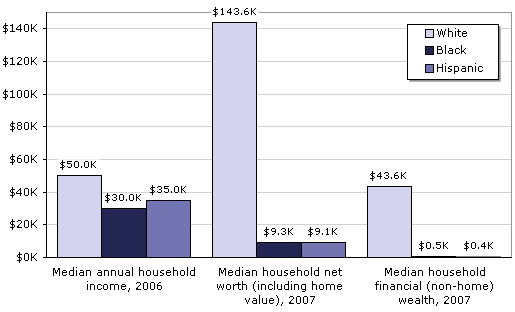
So it is actually worse if you remove home ownership - "If we exclude home equity from the calculations and consider only financial wealth, the ratios are in the neighborhood of 100:1."
posted by cashman at 11:57 AM on July 27, 2011 [4 favorites]
What are white people spending their money on? Thomas Kincaid "art", Collector Barbie Dolls, 800 thread count sheets, Starbucks coffee, and bags of lawn weed-N-feed.
posted by Secret Life of Gravy at 12:01 PM on July 27, 2011 [1 favorite]
posted by Secret Life of Gravy at 12:01 PM on July 27, 2011 [1 favorite]
I wonder if that is suggestive of Asian people living in areas that were particularly hard-hit by the slump/normalization in housing values?
If you compare the states where Asians live with what happened to home prices between 2005 and 2009, it seems that way. 4.5 million (33.8%) live in California, which was hit hard by falling house prices.
posted by Gary at 12:03 PM on July 27, 2011
If you compare the states where Asians live with what happened to home prices between 2005 and 2009, it seems that way. 4.5 million (33.8%) live in California, which was hit hard by falling house prices.
posted by Gary at 12:03 PM on July 27, 2011
theodolite : Scottish-Americans were generally the ones doing the oppressing.
Never heard the expression "Scots' work", eh?
posted by pla at 12:03 PM on July 27, 2011
Never heard the expression "Scots' work", eh?
posted by pla at 12:03 PM on July 27, 2011
I live amongst many white collar, white professionals who are prudent with their money and I don't know of many of them who will claim to be anywhere near that $113,000 in wealth.
Are they twenty-somethings paying off grad-school debt? Because white collar people who are prudent with their money and don't have a barely-six figures of net worth including retirement and real estate equity are doing it wrong.
posted by codswallop at 12:04 PM on July 27, 2011
Are they twenty-somethings paying off grad-school debt? Because white collar people who are prudent with their money and don't have a barely-six figures of net worth including retirement and real estate equity are doing it wrong.
posted by codswallop at 12:04 PM on July 27, 2011
800 thread count sheets
It's like sleeping in lotion.
posted by cashman at 12:04 PM on July 27, 2011 [4 favorites]
It's like sleeping in lotion.
posted by cashman at 12:04 PM on July 27, 2011 [4 favorites]
bags of lawn weed-N-feed.
Considering that most peoples' largest capital investment are their homes, that's not frivolous.
posted by codswallop at 12:05 PM on July 27, 2011
Considering that most peoples' largest capital investment are their homes, that's not frivolous.
posted by codswallop at 12:05 PM on July 27, 2011
I live amongst many white collar, white professionals who are prudent with their money and I don't know of many of them who will claim to be anywhere near that $113,000 in wealth.
Well, there's a good amount of selection bias here--the people you know subject to all kinds of non-random factors. Do you know any former white collar professionals who've retired? Because there's a lot of boomers that will have quite a lot of cash to live on. Do you know people who live in California, or people who live in Iowa? Location will matter a lot too, if you're able to put a larger chunk of "cost of living" into your mortgage every month.
Personally, I do keep track of net worth, and I'm at $20k right now. I'm the newest hire and at the very bottom of our departmental wages for programmers, and haven't been working for more than a few years. I haven't done retirement projections, but a quick consultation with an online calculator suggests I'll have over a million by then. My grandfather, a professional engineer for the state, retired with a hefty sum as well. Since I don't own a home, the recession and housing bust has not dramatically affected my net wealth.
posted by pwnguin at 12:06 PM on July 27, 2011
"Asian" can be a misleading category when it's used in statistics like this, since there are different Asian ethnicities. Hmong refugees, for example, are usually lumped into the same category as a second-generation Japanese-American
Not to mention people from South Asia. There doesn't seem to be any distinction for Indian or Middle Eastern people.
posted by Gary at 12:09 PM on July 27, 2011 [1 favorite]
Not to mention people from South Asia. There doesn't seem to be any distinction for Indian or Middle Eastern people.
posted by Gary at 12:09 PM on July 27, 2011 [1 favorite]
Considering that most peoples' largest capital investment are their homes, that's not frivolous.
Yeah, it is. The amount of water, chemicals, and labor poured into maintaining lawns in American homes is stunning and wasteful.
posted by Secret Life of Gravy at 12:10 PM on July 27, 2011 [3 favorites]
Yeah, it is. The amount of water, chemicals, and labor poured into maintaining lawns in American homes is stunning and wasteful.
posted by Secret Life of Gravy at 12:10 PM on July 27, 2011 [3 favorites]
Whoops. That should read:
Considering that most peoples' largest capital investment are their homes, that's not frivolous.
Yeah, it is. The amount of water, chemicals, and labor poured into maintaining lawns in American homes is stunning and wasteful.
posted by Secret Life of Gravy at 12:11 PM on July 27, 2011
Considering that most peoples' largest capital investment are their homes, that's not frivolous.
Yeah, it is. The amount of water, chemicals, and labor poured into maintaining lawns in American homes is stunning and wasteful.
posted by Secret Life of Gravy at 12:11 PM on July 27, 2011
Old people hang on to their money. If they made social security "means tested" old people would give their money to younger sons and daughters (to impoverish themselves and stay qualified). The middle aged would spend it or start small businesses and thus save America from default by jumpstarting the economy.
posted by Bitter soylent at 12:13 PM on July 27, 2011 [1 favorite]
posted by Bitter soylent at 12:13 PM on July 27, 2011 [1 favorite]
Ooh, let's play "How will this thread derail?"
1) Scottish-Americans are/are not oppressed
2) Lawn care is/is not wasteful
posted by desjardins at 12:13 PM on July 27, 2011 [10 favorites]
1) Scottish-Americans are/are not oppressed
2) Lawn care is/is not wasteful
posted by desjardins at 12:13 PM on July 27, 2011 [10 favorites]
Yeah, it is. The amount of water, chemicals, and labor poured into maintaining lawns in American homes is stunning and wasteful.
I read somewhere that lawns were started as a public demonstration that you were rich enough to have land that was not used for production (livestock or garden).
posted by Bitter soylent at 12:17 PM on July 27, 2011
I read somewhere that lawns were started as a public demonstration that you were rich enough to have land that was not used for production (livestock or garden).
posted by Bitter soylent at 12:17 PM on July 27, 2011
1) Scottish-Americans are/are not oppressed
2) Lawn care is/is not wasteful
Something something Scott's Miracle-Gro.
posted by kmz at 12:17 PM on July 27, 2011 [19 favorites]
2) Lawn care is/is not wasteful
Something something Scott's Miracle-Gro.
posted by kmz at 12:17 PM on July 27, 2011 [19 favorites]
Yeah, it is. The amount of water, chemicals, and labor poured into maintaining lawns in American homes is stunning and wasteful.
Can be wasteful. You can have a nice yard on a budget and you'd better believe that a nice yard affects the value of your property. Weed-n-feed's pretty cheap.
posted by codswallop at 12:21 PM on July 27, 2011
Can be wasteful. You can have a nice yard on a budget and you'd better believe that a nice yard affects the value of your property. Weed-n-feed's pretty cheap.
posted by codswallop at 12:21 PM on July 27, 2011
Wells Fargo Target Of Justice Department Probe; Agency Alleges Discriminatory Lending - June 26, 2011
"The Department of Justice is preparing a lawsuit against Wells Fargo, the nation's largest home mortgage lender, for allegedly preying upon African American borrowers during the housing bubble and steering them into high-cost subprime loans, according to three people with direct knowledge of the probe."
...
"The allegations mirror those in public actions taken by the Federal Reserve and a separate lawsuit filed by the city of Baltimore.
"Last week, the Fed said that perhaps more than 10,000 borrowers were inappropriately steered into subprime mortgage loans or had their loan documents falsified by bank personnel. Wells Fargo agreed to pay $85 million to settle the civil charges. It did not admit wrongdoing.
"In its ongoing case against Baltimore, Wells Fargo stands accused of using those same practices, but deploying them against black borrowers in majority-black neighborhoods, an act commonly known as 'reverse redlining.' The city alleges that the bank targeted black borrowers, knowing they'd ultimately default on their loans, but did not fear shouldering the cost because Wells sold those loans to investors. Wells Fargo denies the allegations."
posted by naju at 12:22 PM on July 27, 2011
"The Department of Justice is preparing a lawsuit against Wells Fargo, the nation's largest home mortgage lender, for allegedly preying upon African American borrowers during the housing bubble and steering them into high-cost subprime loans, according to three people with direct knowledge of the probe."
...
"The allegations mirror those in public actions taken by the Federal Reserve and a separate lawsuit filed by the city of Baltimore.
"Last week, the Fed said that perhaps more than 10,000 borrowers were inappropriately steered into subprime mortgage loans or had their loan documents falsified by bank personnel. Wells Fargo agreed to pay $85 million to settle the civil charges. It did not admit wrongdoing.
"In its ongoing case against Baltimore, Wells Fargo stands accused of using those same practices, but deploying them against black borrowers in majority-black neighborhoods, an act commonly known as 'reverse redlining.' The city alleges that the bank targeted black borrowers, knowing they'd ultimately default on their loans, but did not fear shouldering the cost because Wells sold those loans to investors. Wells Fargo denies the allegations."
posted by naju at 12:22 PM on July 27, 2011
Don't get mad at me, because I'm just curious. How well does this support the idea that efforts to level the playing field among the races need not be race-based? If economic policy is designed to increase the relative wealth of the poor and working classes without regard to race, wouldn't black people be the broadest beneficiaries? It wouldn't be as hard to recruit the poor and working class white population if they didn't feel alienated from redistribution efforts. I'll be the first person to admit that demands for reparation are justified, but from a tactical perspective it would seem that cultivating political capital from a wide popular base would make more strategic sense. I admit, I could be missing something.
posted by jwhite1979 at 12:22 PM on July 27, 2011
posted by jwhite1979 at 12:22 PM on July 27, 2011
Well, I'm a white "homeowner" (meaning, I rent it from the bank) with a desirable job (software developer), and doing a rough estimate with this calculator, my personal wealth stands at about $6,000.00. So it doesn't all just come down to home ownership.
posted by saulgoodman at 12:26 PM on July 27, 2011
posted by saulgoodman at 12:26 PM on July 27, 2011
If you sold everything you own right now and put all your cash toward your debts (including investments, cash in savings accounts and retirement accounts), what would you be left with? That's what this number is measuring.
120 thousand dollars!
in the negative :(
posted by Tarumba at 12:28 PM on July 27, 2011 [1 favorite]
120 thousand dollars!
in the negative :(
posted by Tarumba at 12:28 PM on July 27, 2011 [1 favorite]
Haha yeah. I'm gainfully employed in the 75%+ salary range, and my "wealth" is several thousands in the red. Finally, an accurate way to judge how miserably poor I am due to student loans!
posted by naju at 12:31 PM on July 27, 2011
posted by naju at 12:31 PM on July 27, 2011
So it doesn't all just come down to home ownership.
The way I heard it reported on NPR, the minorities were far more likely to be entirely invested in real estate, so when that went south, they fell hard. Sounds like home ownership is the problem to me...
posted by pwnguin at 12:32 PM on July 27, 2011 [1 favorite]
The way I heard it reported on NPR, the minorities were far more likely to be entirely invested in real estate, so when that went south, they fell hard. Sounds like home ownership is the problem to me...
posted by pwnguin at 12:32 PM on July 27, 2011 [1 favorite]
If you sold everything you own right now and put all your cash toward your debts (including investments, cash in savings accounts and retirement accounts), what would you be left with? That's what this number is measuring.
-$175,000 or so.
posted by jwhite1979 at 12:33 PM on July 27, 2011 [1 favorite]
-$175,000 or so.
posted by jwhite1979 at 12:33 PM on July 27, 2011 [1 favorite]
let's start a club, then.
posted by Tarumba at 12:35 PM on July 27, 2011 [1 favorite]
posted by Tarumba at 12:35 PM on July 27, 2011 [1 favorite]
"Asian" can be a misleading category when it's used in statistics like this, since there are different Asian ethnicities. Hmong refugees, for example, are usually lumped into the same category as a second-generation Japanese-American, even though the socioeconomic situation for an average member of those groups are very different.
Surely this is the case for any racial category? Socioeconomically distinct groups like the Pennsylvania Dutch or the Russian immigrant community in New York are lumped in with "White".
posted by baf at 12:35 PM on July 27, 2011
Surely this is the case for any racial category? Socioeconomically distinct groups like the Pennsylvania Dutch or the Russian immigrant community in New York are lumped in with "White".
posted by baf at 12:35 PM on July 27, 2011
y'all don't feel weird posting your personal wealth on the internet?
posted by sweetkid at 12:35 PM on July 27, 2011
posted by sweetkid at 12:35 PM on July 27, 2011
Never heard the expression "Scots' work", eh?
I never have. Is that the kind of work Andrew Carnegie and Thomas Jefferson did for a living?
posted by riruro at 12:36 PM on July 27, 2011
I never have. Is that the kind of work Andrew Carnegie and Thomas Jefferson did for a living?
posted by riruro at 12:36 PM on July 27, 2011
y'all don't feel weird posting your personal wealth on the internet?
Not really. I'm open to reasons why I should though.
posted by jwhite1979 at 12:37 PM on July 27, 2011
Not really. I'm open to reasons why I should though.
posted by jwhite1979 at 12:37 PM on July 27, 2011
Not really. I'm open to reasons why I should though.
Someone might steal your debt!
posted by codswallop at 12:41 PM on July 27, 2011 [6 favorites]
Someone might steal your debt!
posted by codswallop at 12:41 PM on July 27, 2011 [6 favorites]
Not really. I honestly don't care anymore. It's not like my state isn't selling all my information to marketers anyway.
posted by saulgoodman at 12:42 PM on July 27, 2011 [2 favorites]
posted by saulgoodman at 12:42 PM on July 27, 2011 [2 favorites]
y'all don't feel weird posting your personal wealth on the internet?
At best, they will stop pestering me with trash mail.
That's right, don't waste money sending me catalogues and Victoria's Secret booklets, whoever you are!
posted by Tarumba at 12:42 PM on July 27, 2011
At best, they will stop pestering me with trash mail.
That's right, don't waste money sending me catalogues and Victoria's Secret booklets, whoever you are!
posted by Tarumba at 12:42 PM on July 27, 2011
Please steal my debt...
posted by Tarumba at 12:43 PM on July 27, 2011 [1 favorite]
posted by Tarumba at 12:43 PM on July 27, 2011 [1 favorite]
Yeah, I can't think of any reason why not either, I would just feel weird about it.
posted by sweetkid at 12:43 PM on July 27, 2011
posted by sweetkid at 12:43 PM on July 27, 2011
sweetkid: "y'all don't feel weird posting your personal wealth on the internet?"
My salary information is public information, posted on the internet. My benefits package is published to the world, and I see no reason to fear a one significant figure disclosure of wealth. It's not like my bank allows people to withdraw money from me by guessing how many digits are in my balance.
posted by pwnguin at 12:47 PM on July 27, 2011 [1 favorite]
My salary information is public information, posted on the internet. My benefits package is published to the world, and I see no reason to fear a one significant figure disclosure of wealth. It's not like my bank allows people to withdraw money from me by guessing how many digits are in my balance.
posted by pwnguin at 12:47 PM on July 27, 2011 [1 favorite]
Ooh, let's play "How will this thread derail?"
1) Scottish-Americans are/are not oppressed
2) Lawn care is/is not wasteful
Compromise.
posted by Sangermaine at 12:47 PM on July 27, 2011 [6 favorites]
1) Scottish-Americans are/are not oppressed
2) Lawn care is/is not wasteful
Compromise.

posted by Sangermaine at 12:47 PM on July 27, 2011 [6 favorites]
Compromise.
posted by Sangermaine at 12:47 PM on July 27 [+] [!]
That's not a true scotsman, though.
posted by gauche at 12:56 PM on July 27, 2011 [4 favorites]
posted by Sangermaine at 12:47 PM on July 27 [+] [!]
That's not a true scotsman, though.
posted by gauche at 12:56 PM on July 27, 2011 [4 favorites]
The number "20 to 1" is pretty meaningless given that wealth can be negative. (If the average fresh college graduate had zero wealth, would we say that the ratio of wealth among everyone to among college grads was infinity to one?)
that being said, this gap is ridiculously huge, and I am probably poking holes in the statistics because I feel powerless to do anything about the actual problem.
posted by madcaptenor at 1:10 PM on July 27, 2011
that being said, this gap is ridiculously huge, and I am probably poking holes in the statistics because I feel powerless to do anything about the actual problem.
posted by madcaptenor at 1:10 PM on July 27, 2011
Shouldn't this include a mean average, rather than just a median? Just saying that median by itself leaves us to consider that (say) five million african-american households could have $5000 in wealth, while all but one white household could have $5,677 in wealth offset by one white household with $220,621 in wealth.
Obviously those specific numbers are extremely unlikely, but a lot of people are going to assume a mean average if they don't understand what a median average is...and in isolation, a median average isn't particularly useful for telling us if we have a small number of exceptional outliers dragging the median in one direction.
posted by davejay at 1:21 PM on July 27, 2011
Obviously those specific numbers are extremely unlikely, but a lot of people are going to assume a mean average if they don't understand what a median average is...and in isolation, a median average isn't particularly useful for telling us if we have a small number of exceptional outliers dragging the median in one direction.
posted by davejay at 1:21 PM on July 27, 2011
I live amongst many white collar, white professionals who are prudent with their money and I don't know of many of them who will claim to be anywhere near that $113,000 in wealth.
Really? Keep in mind these figures include any equity people hold in their homes, cars, etc. Someone who has been making mortgage payments for twenty years or so in your average East Coast suburb is likely to be above that $113,000 median just in home equity alone.
posted by dixiecupdrinking at 1:23 PM on July 27, 2011
Really? Keep in mind these figures include any equity people hold in their homes, cars, etc. Someone who has been making mortgage payments for twenty years or so in your average East Coast suburb is likely to be above that $113,000 median just in home equity alone.
posted by dixiecupdrinking at 1:23 PM on July 27, 2011
in isolation, a median average isn't particularly useful for telling us if we have a small number of exceptional outliers dragging the median in one direction.
I'm no statistician but I think you're mixing up mean and median here. Aren't medians used precisely to minimize the effect of exceptional outliers?
posted by dixiecupdrinking at 1:25 PM on July 27, 2011 [1 favorite]
I'm no statistician but I think you're mixing up mean and median here. Aren't medians used precisely to minimize the effect of exceptional outliers?
posted by dixiecupdrinking at 1:25 PM on July 27, 2011 [1 favorite]
Yeah, the ratio is stupid and kind of meaningless. It's like when people say 50F -> 100F is double the temperature! It's really not.
The absolute difference should stand on its own. If they want to dress it up, they could express it as hours or years of work at the average or minimum wage.
posted by Pruitt-Igoe at 1:25 PM on July 27, 2011
The absolute difference should stand on its own. If they want to dress it up, they could express it as hours or years of work at the average or minimum wage.
posted by Pruitt-Igoe at 1:25 PM on July 27, 2011
davejay - the point of using the median is that outliers DON'T drag it unduly in one direction or another. Your hypothetical "all but one white household" example would produce a median of $5,677 - there is no offset from the one wealthy household.
posted by desjardins at 1:25 PM on July 27, 2011
posted by desjardins at 1:25 PM on July 27, 2011
Do I have median and mean mixed up? Shit. Looking it up now.
posted by davejay at 1:28 PM on July 27, 2011
posted by davejay at 1:28 PM on July 27, 2011
Okay, not mixed up -- just completely wrong on what median is. Thank you, Chicago Public School System statistics class. (facepalm)
posted by davejay at 1:29 PM on July 27, 2011 [1 favorite]
posted by davejay at 1:29 PM on July 27, 2011 [1 favorite]
(and it goes without saying that I'm a lot more depressed about these numbers, now that I can't rationalize it somewhat by the potential for outliers.)
posted by davejay at 1:30 PM on July 27, 2011
posted by davejay at 1:30 PM on July 27, 2011
Pruitt-Igoe: I agree that it would help to express this as a number of years at the average wage. (Not the minimum. The minimum changes abruptly, and it would be nice to be able to see if the gap is growing or shrinking with time.)
posted by madcaptenor at 1:36 PM on July 27, 2011
posted by madcaptenor at 1:36 PM on July 27, 2011
I don't understand economics I guess. According to the calculator listed above, my wife and I are worth $262,000. We are in our 30s. No credit card debt or student loans. We have a small mortgage on a house in Baltimore and own our cars.
Why is it that we still feel broke all of the time?
posted by extraheavymarcellus at 1:37 PM on July 27, 2011
Why is it that we still feel broke all of the time?
posted by extraheavymarcellus at 1:37 PM on July 27, 2011
I wonder if there's any evidence that discretionary spending amongst people with similar incomes is different by race. Man have I known a lot of poor white people who blow their entire paycheck. It's just not necessarily for stuff as visible as rims and Jordans.
There was a study done some time in the last two years that looked at the spend/save behavior of people when they received a lump sum of money (as opposed to regular income from work). The study found, essentially, that--regardless of race--the lower the income level, the more likely people were to take "found" money (like a tax return) and spend it on items they couldn't have otherwise bought. The higher the income level, the more likely people were to save that money instead.
I can remember reading a article on the study; I can even remember the image that was on the webpage with the article -- but damn if I can find a reference for it now. Anyone else out there remember this?
posted by elfgirl at 1:39 PM on July 27, 2011 [1 favorite]
There was a study done some time in the last two years that looked at the spend/save behavior of people when they received a lump sum of money (as opposed to regular income from work). The study found, essentially, that--regardless of race--the lower the income level, the more likely people were to take "found" money (like a tax return) and spend it on items they couldn't have otherwise bought. The higher the income level, the more likely people were to save that money instead.
I can remember reading a article on the study; I can even remember the image that was on the webpage with the article -- but damn if I can find a reference for it now. Anyone else out there remember this?
posted by elfgirl at 1:39 PM on July 27, 2011 [1 favorite]
Not to make this a statistics class, but someone explain to me, please. Let's say my median average is 10,000, and this tells me that half of the samples are under 10,000 and half are over. Unless I'm mistaken, this doesn't tell me how much under and over the samples are; in a sample size of eleven, five might be 9,000 and five might be 100,000, or vice versa. Is this correct, or am I missing something?
Why is it that we still feel broke all of the time?
extraheavymarcellus, because liquid assets are different from assets. You (presumably) have wealth tied up in your home and your cars, but that wealth is not available to you unless you sell those assets to convert them to wealth. Having to sell things you need in order to access your wealth is a great way to feel poor without actually being so.
posted by davejay at 1:40 PM on July 27, 2011
Why is it that we still feel broke all of the time?
extraheavymarcellus, because liquid assets are different from assets. You (presumably) have wealth tied up in your home and your cars, but that wealth is not available to you unless you sell those assets to convert them to wealth. Having to sell things you need in order to access your wealth is a great way to feel poor without actually being so.
posted by davejay at 1:40 PM on July 27, 2011
Well, extraheavymarcellus, that would depend on your ratio of income to expenditures, but possibly more on the fact that "brokeness" is a relative feeling. To take an extreme example, some Sudanese refugee would feel incredibly, beyond-belief wealthy if they had what you have. (Not trying to make you feel guilty.)
posted by desjardins at 1:40 PM on July 27, 2011 [1 favorite]
posted by desjardins at 1:40 PM on July 27, 2011 [1 favorite]
argh, liquid assets are a subset of assets. maybe I shouldn't talk any more today.
posted by davejay at 1:40 PM on July 27, 2011
posted by davejay at 1:40 PM on July 27, 2011
If you sold everything you own right now and put all your cash toward your debts (including investments, cash in savings accounts and retirement accounts), what would you be left with? That's what this number is measuring.
-$30,000. In comparison to similar responses in this thread, I'M RICH BEOTCH!
posted by Mister Fabulous at 1:41 PM on July 27, 2011
-$30,000. In comparison to similar responses in this thread, I'M RICH BEOTCH!
posted by Mister Fabulous at 1:41 PM on July 27, 2011
davejay - you're right. that's what standard deviation tells us.
posted by desjardins at 1:41 PM on July 27, 2011
posted by desjardins at 1:41 PM on July 27, 2011
black folks need to stop spending their money on stupid shit
No, poor people need to stop spending their money on stupid shit. I live in New Hampshire, which is about as lily-white (at least around here) as you're going to find and we have plenty of poor people and some days it seems like each and everyone of them smoke. Etc. And other confirmation bias mistakes and things going on in this mess of a thread. Good work Mefites in finding anecdotal evidence of white people amongst yourselves who don't consider themselves wealthy without adjusting for the fact most of the folks posting skew younger than the median.
You could probably break these wealth things out by college education v. non-college educated or any number of factors, but race makes for the best pageviews and outrage. Poor people need help, not a specific brand of poor people. Because they're the ones that are getting fucked generation-in and generation-out. They need nutrition, healthcare and education, which together comprise something resembling an Equal Opportunity. But feel free to spend your time bemoaning your undersized prick at a worthless measuring contest instead.
posted by yerfatma at 1:42 PM on July 27, 2011 [3 favorites]
No, poor people need to stop spending their money on stupid shit. I live in New Hampshire, which is about as lily-white (at least around here) as you're going to find and we have plenty of poor people and some days it seems like each and everyone of them smoke. Etc. And other confirmation bias mistakes and things going on in this mess of a thread. Good work Mefites in finding anecdotal evidence of white people amongst yourselves who don't consider themselves wealthy without adjusting for the fact most of the folks posting skew younger than the median.
You could probably break these wealth things out by college education v. non-college educated or any number of factors, but race makes for the best pageviews and outrage. Poor people need help, not a specific brand of poor people. Because they're the ones that are getting fucked generation-in and generation-out. They need nutrition, healthcare and education, which together comprise something resembling an Equal Opportunity. But feel free to spend your time bemoaning your undersized prick at a worthless measuring contest instead.
posted by yerfatma at 1:42 PM on July 27, 2011 [3 favorites]
Metafilter: I don't understand economics I guess
posted by yerfatma at 1:43 PM on July 27, 2011 [2 favorites]
posted by yerfatma at 1:43 PM on July 27, 2011 [2 favorites]
In that case, I'll wish that this included the standard deviation.
black folks need to stop spending their money on stupid shit
No, poor people need to stop spending their money on stupid shit.
I think it is "people need to stop spending their money on stupid shit."
and spend it on public education funding
posted by davejay at 1:44 PM on July 27, 2011
black folks need to stop spending their money on stupid shit
No, poor people need to stop spending their money on stupid shit.
I think it is "people need to stop spending their money on stupid shit."
and spend it on public education funding
posted by davejay at 1:44 PM on July 27, 2011
on the wealth calculator, it mentions "current cash value" of life insurance. How do I know that? I know what it pays out if my husband or I were to die.
posted by desjardins at 1:45 PM on July 27, 2011
posted by desjardins at 1:45 PM on July 27, 2011
Life Insurance could be playing a big role. I've got about 150k in term life. If I use that in the calculator linked above, I'm worth a hell of a lot more than if I don't.
It wouldn't surprise me to find out that white households are more likely to have life-insurance (as a job benefit or otherwise).
posted by oddman at 1:47 PM on July 27, 2011
It wouldn't surprise me to find out that white households are more likely to have life-insurance (as a job benefit or otherwise).
posted by oddman at 1:47 PM on July 27, 2011
Hit the button too fast, but now this is twice as relevant: the cash value of the life insurance policy is different (and considerably smaller) than the amount you're insured for.
posted by griphus at 1:49 PM on July 27, 2011 [2 favorites]
posted by griphus at 1:49 PM on July 27, 2011 [2 favorites]
oddman: "It wouldn't surprise me to find out that white households are more likely to have life-insurance (as a job benefit or otherwise)."
If you read the publication appendix A, it mentions that cash value of life insurance policies aren't counted. Nor are your home furnishings or jewelry. So if you want to compare against this survey, omit those.
posted by pwnguin at 1:51 PM on July 27, 2011
If you read the publication appendix A, it mentions that cash value of life insurance policies aren't counted. Nor are your home furnishings or jewelry. So if you want to compare against this survey, omit those.
posted by pwnguin at 1:51 PM on July 27, 2011
Life Insurance could be playing a big role.
I'm pretty sure they're not talking about term life insurance here, but about policies which accumulate a surrender value. The policies most people get through work do not have a cash value and should not be included in net worth calculations.
posted by balberth at 1:52 PM on July 27, 2011 [2 favorites]
I'm pretty sure they're not talking about term life insurance here, but about policies which accumulate a surrender value. The policies most people get through work do not have a cash value and should not be included in net worth calculations.
posted by balberth at 1:52 PM on July 27, 2011 [2 favorites]
Medians and Means: Just as the gap in median household wealth among racial and ethnic groups rose from 2005 to 2009, so too did the gap in mean household wealth. However, the mean differences are not as dramatic as the median differences. (A median is the midpoint that separates the upper half from the lower half of a given group; a mean is an average, and, in this case, the average is driven upward by households with high net worth). In 2005, mean white household wealth was 2.3 times that of Hispanics and 3 times that of blacks. By 2009, it was 3.7 times that of both Hispanics and blacks.The mean differences are not as dramatic specifically because of those outliers. Lots of really rich white people. Very few really rich black or Hispanic people.
if we get life insurance through an employer, do we get a statement? I don't ever remember getting this in the mail
posted by desjardins at 1:52 PM on July 27, 2011
Also yeah, count me in as a white person with negative five-figure assets. However, that is primarily due to student loans, which reflects its own kind of privilege.
posted by dixiecupdrinking at 1:53 PM on July 27, 2011
posted by dixiecupdrinking at 1:53 PM on July 27, 2011
Davejay: standard deviation suffers from the same problem as the mean, in that a few outliers can skew the hell out of it. You want, say, the 25th and 75th percentiles.
posted by madcaptenor at 1:59 PM on July 27, 2011 [2 favorites]
posted by madcaptenor at 1:59 PM on July 27, 2011 [2 favorites]
Why is it that we still feel broke all of the time?
because you are surrounded by images from the media (advertising mostly) saying you are not happy because you don't have x. And at the end of the month there isn't any money left over for x. Our standard of living is soooo much higher now than even 30 years ago and our abundance hasn't resulted in enough, it has resulted in wanting more. The big reason people are poor (in the sense of not having wealth, you can have lots of income and still be not wealthy if you don't invest it or at least save some of it) is they live beyond their means.
No some are poor due to genuine circumstances beyond their control. Most of the poor I know or have known (including me when I was younger and dumber) stay poor due to bad decisions. And no race or group has a monopoly on bad decisions. Most of the nation is broke ass white people due to living in a society and culture where it is precieved that conspicous consumption makes you a more virtous person. It is a vicious cycle that is mostly built on a lie-they truly wealthy don't flaunt it-they don't have to. The aspierational poor due and by that stay poor.
posted by bartonlong at 1:59 PM on July 27, 2011 [3 favorites]
because you are surrounded by images from the media (advertising mostly) saying you are not happy because you don't have x. And at the end of the month there isn't any money left over for x. Our standard of living is soooo much higher now than even 30 years ago and our abundance hasn't resulted in enough, it has resulted in wanting more. The big reason people are poor (in the sense of not having wealth, you can have lots of income and still be not wealthy if you don't invest it or at least save some of it) is they live beyond their means.
No some are poor due to genuine circumstances beyond their control. Most of the poor I know or have known (including me when I was younger and dumber) stay poor due to bad decisions. And no race or group has a monopoly on bad decisions. Most of the nation is broke ass white people due to living in a society and culture where it is precieved that conspicous consumption makes you a more virtous person. It is a vicious cycle that is mostly built on a lie-they truly wealthy don't flaunt it-they don't have to. The aspierational poor due and by that stay poor.
posted by bartonlong at 1:59 PM on July 27, 2011 [3 favorites]
However, that is primarily due to student loans, which reflects its own kind of privilege.
What good is your invisible knapsack if it's full of bricks?
posted by codswallop at 2:00 PM on July 27, 2011 [1 favorite]
What good is your invisible knapsack if it's full of bricks?
posted by codswallop at 2:00 PM on July 27, 2011 [1 favorite]
I'm also working with negative 5 figures, due to not having been out of grad school that long (just building up retirement) + having loans from said grad school. On an everyday basis, though, I don't feel very poor, but I'm sure part of that is ignoring the fact that I'll likely want to retire at some point.
Still, I think about this sometimes when I drive by some of the very poor areas of town, where people might own their home (value ~20k) but have very little retirement, no car, and very little income. Even though their overall value is greater than mine, my experience just likely feels more stable due to other factors.
posted by bizzyb at 2:06 PM on July 27, 2011 [1 favorite]
Still, I think about this sometimes when I drive by some of the very poor areas of town, where people might own their home (value ~20k) but have very little retirement, no car, and very little income. Even though their overall value is greater than mine, my experience just likely feels more stable due to other factors.
posted by bizzyb at 2:06 PM on July 27, 2011 [1 favorite]
Well, as long as we're still better off than black people, I guess we should all be pretty happy with how things are working out for us, economically, right?
Why the hell is it that ever since this debt crisis issue started heating up with the threat of pushing us all back into an even deeper recession, the media all seem to have decided the theme of the moment is "Black vs. White" economic disparity? It started with that damn Life magazine cover about famine in Ethopia, and ever since, all I've been hearing on NPR and from the left wing punditry is how whites really don't have it so bad compared to those blacks.
White or black, everyone deserves better and more economic opportunity. Except those at the top who've been too busy giving themselves extra rich-only tax cuts and gigantic bonuses for the last 30 years to notice or care they've been destroying the US economic base and running the global economy into the ground. Maybe we'll have to take special pains to make sure the benefits get shared equally, but that can only happen once we start turning things around more generally. And I am pissed that the "lefty" think tank guy on NPR today kept repeating that average household income has grown "only 15%" for most Americans over the last 30 years, while only mentioning as a barely noticed aside that, in fact, that modest increase is actually due to the fact that more households are now two income households--meaning that individual income has actually shrunk so much when adjusted for inflation that, in reality, it now takes two people working in a household just to earn enough to barely surpass with what a single worker could have brought into a household 30 years ago!
posted by saulgoodman at 2:09 PM on July 27, 2011 [3 favorites]
Why the hell is it that ever since this debt crisis issue started heating up with the threat of pushing us all back into an even deeper recession, the media all seem to have decided the theme of the moment is "Black vs. White" economic disparity? It started with that damn Life magazine cover about famine in Ethopia, and ever since, all I've been hearing on NPR and from the left wing punditry is how whites really don't have it so bad compared to those blacks.
White or black, everyone deserves better and more economic opportunity. Except those at the top who've been too busy giving themselves extra rich-only tax cuts and gigantic bonuses for the last 30 years to notice or care they've been destroying the US economic base and running the global economy into the ground. Maybe we'll have to take special pains to make sure the benefits get shared equally, but that can only happen once we start turning things around more generally. And I am pissed that the "lefty" think tank guy on NPR today kept repeating that average household income has grown "only 15%" for most Americans over the last 30 years, while only mentioning as a barely noticed aside that, in fact, that modest increase is actually due to the fact that more households are now two income households--meaning that individual income has actually shrunk so much when adjusted for inflation that, in reality, it now takes two people working in a household just to earn enough to barely surpass with what a single worker could have brought into a household 30 years ago!
posted by saulgoodman at 2:09 PM on July 27, 2011 [3 favorites]
Negative numbers of high magnitude are also a sign that at some point someone lent you an awful lot of money. I doubt that is the case for the groups with the low median wealth.
posted by TheKM at 2:34 PM on July 27, 2011 [4 favorites]
posted by TheKM at 2:34 PM on July 27, 2011 [4 favorites]
Secret Life of Gravy: "Yeah, it is. The amount of water, chemicals, and labor poured into maintaining lawns in American homes is stunning and wasteful."
Heh, not mine. *peers out through jungle*
posted by mkb at 2:37 PM on July 27, 2011
Heh, not mine. *peers out through jungle*
posted by mkb at 2:37 PM on July 27, 2011
Why the hell is it that ever since this debt crisis issue started heating up with the threat of pushing us all back into an even deeper recession, the media all seem to have decided the theme of the moment is "Black vs. White" economic disparity?
Because God Forbid we find common cause.
posted by yerfatma at 2:40 PM on July 27, 2011
Because God Forbid we find common cause.
posted by yerfatma at 2:40 PM on July 27, 2011
Why is it that we still feel broke all of the time?
Because you are. Your retirement savings don't really count because that is your income after the age of 65, so if you blow it now, you are poor later. So you're down to just liquid assets, and equity on a home. Have kids and want them to go to college? $100k per child in tuition, minimum.
If you've accumulated say $100-200k of net worth in your 30's you aren't really doing that well. You're doing okay.
But that's precisely the wrong way to think. You should be thinking of your grandchildren.
Let's say you have no kids yet, but plan to have one. Take $10,000 and put it into an account. You leave it in there not for 10 years or 15 years, but for 65 years. Assume it gets an average annual real rate of interest (i.e. the rate of interest - inflation) over this time of 6%.
In 65 years that account will have over $500,000 (in today's dollars) in it.
But that's not the clever bit. The clever bit is to teach your kids to do this for their grandkids. Because if your kid rolls it over one more generation, then the account is ripening for 95 years, and you just made you great-grandchild a millionaire three times over.
Here's the point: You aren't going to miss the $10,000, and this takes absolutely no work after it is set up. But it makes the life of a loved won tremendously easier, because you are buying down their fears about money. Money is what ends marriages, creates stress, causes people to sacrifice their lives in jobs they hate.
Your kids won't become spoiled brats, because the money isn't for them, and whenever does get the money gets it when they are an adult (and they don't even have to know about it, as long as their parents do). So everybody still has to work and save. And maybe you teach your kids to teach their kids to forever roll this money over. So it isn't really about giving anyone a cushy life as much as it is about accumulating wealth that your family can rely on in case of emergency.
But now for the really really clever bit.
Say you let it ripen for an even 100 years. When you set the account/trust/whatever up, you include a letter to be opened only when the account matures.
Now when the account matures in 100 years, at a 6% real rate of interest, the account will be just shy of $3.5M (again this is in today's dollars because the interest rate is after inflation. The actual dollar value will be based on the average nominal interest rate (or RoR, whatever, you get the picture)). So a hundred years pass by, and your great grandkids open the letter.
And the letter contains instructions on using the assets in the account as starting capital for a private bank.
The bank will lend money to and accept deposits from your great grandchildren and their children only, not the public. Now, when your great-grandkids need a loan, they borrow it from their own bank and pay themselves the interest. They have to pay it back, so it still enforces good money habits, but it lets the assets under your family's control multiply exponentially, while also ensuring that your family never has to resort to shoddy banks or rely on benefits from the government to survive.
And before anyone says that this isn't worth it, consider that if the interest rate is just 1% higher, 7%, then after 100 years the account will have almost $8.7 million in it (more than double). And before any says it's risky doing business with your family, consider how risky it is doing business with faceless corporations.
posted by Pastabagel at 2:45 PM on July 27, 2011 [7 favorites]
Because you are. Your retirement savings don't really count because that is your income after the age of 65, so if you blow it now, you are poor later. So you're down to just liquid assets, and equity on a home. Have kids and want them to go to college? $100k per child in tuition, minimum.
If you've accumulated say $100-200k of net worth in your 30's you aren't really doing that well. You're doing okay.
But that's precisely the wrong way to think. You should be thinking of your grandchildren.
Let's say you have no kids yet, but plan to have one. Take $10,000 and put it into an account. You leave it in there not for 10 years or 15 years, but for 65 years. Assume it gets an average annual real rate of interest (i.e. the rate of interest - inflation) over this time of 6%.
In 65 years that account will have over $500,000 (in today's dollars) in it.
But that's not the clever bit. The clever bit is to teach your kids to do this for their grandkids. Because if your kid rolls it over one more generation, then the account is ripening for 95 years, and you just made you great-grandchild a millionaire three times over.
Here's the point: You aren't going to miss the $10,000, and this takes absolutely no work after it is set up. But it makes the life of a loved won tremendously easier, because you are buying down their fears about money. Money is what ends marriages, creates stress, causes people to sacrifice their lives in jobs they hate.
Your kids won't become spoiled brats, because the money isn't for them, and whenever does get the money gets it when they are an adult (and they don't even have to know about it, as long as their parents do). So everybody still has to work and save. And maybe you teach your kids to teach their kids to forever roll this money over. So it isn't really about giving anyone a cushy life as much as it is about accumulating wealth that your family can rely on in case of emergency.
But now for the really really clever bit.
Say you let it ripen for an even 100 years. When you set the account/trust/whatever up, you include a letter to be opened only when the account matures.
Now when the account matures in 100 years, at a 6% real rate of interest, the account will be just shy of $3.5M (again this is in today's dollars because the interest rate is after inflation. The actual dollar value will be based on the average nominal interest rate (or RoR, whatever, you get the picture)). So a hundred years pass by, and your great grandkids open the letter.
And the letter contains instructions on using the assets in the account as starting capital for a private bank.
The bank will lend money to and accept deposits from your great grandchildren and their children only, not the public. Now, when your great-grandkids need a loan, they borrow it from their own bank and pay themselves the interest. They have to pay it back, so it still enforces good money habits, but it lets the assets under your family's control multiply exponentially, while also ensuring that your family never has to resort to shoddy banks or rely on benefits from the government to survive.
And before anyone says that this isn't worth it, consider that if the interest rate is just 1% higher, 7%, then after 100 years the account will have almost $8.7 million in it (more than double). And before any says it's risky doing business with your family, consider how risky it is doing business with faceless corporations.
posted by Pastabagel at 2:45 PM on July 27, 2011 [7 favorites]
I doubt that is the case for the groups with the low median wealth.
Not necessarily. A lot of Federal college loan programs are needs based, and meant to provide economic opportunity.
Ha. I can't even type that word without hearing it spoken ironically in my head anymore.
posted by saulgoodman at 2:47 PM on July 27, 2011
Not necessarily. A lot of Federal college loan programs are needs based, and meant to provide economic opportunity.
Ha. I can't even type that word without hearing it spoken ironically in my head anymore.
posted by saulgoodman at 2:47 PM on July 27, 2011
Assume it gets an average annual real rate of interest (i.e. the rate of interest - inflation) over this time of 6%.
Pretty big assumption. Where can I get a constant 6% over *generations*, immune to crashes, taxes, collapses and seizures?
posted by codswallop at 2:55 PM on July 27, 2011 [2 favorites]
Pretty big assumption. Where can I get a constant 6% over *generations*, immune to crashes, taxes, collapses and seizures?
posted by codswallop at 2:55 PM on July 27, 2011 [2 favorites]
TheKM: "Negative numbers of high magnitude are also a sign that at some point someone lent you an awful lot of money. I doubt that is the case for the groups with the low median wealth."
The 2002 data smackfu linked to offers a view of assets and liabilities split out over age groups in Table 5. If I'm reading it correctly, unsecured debt for people younger than 35 funded 20 percent of their net worth (-19.9). Which is up 4 percent vs 2 years prior. Table 4 lists median net worth by age of household. And there you see clearly, the median net worth for people under 35 is not a hell of a lot: 5 thousand dollars, 3 of which is in their home. (This is the subprime crisis in a nutshell, visible in 2002.)
Point is, young people in general get loans. It would look better if the numbers listed holding a degree as an asset, but the lawyers in the thread will probably argue future earnings have been found to be surprisingly volatile.
posted by pwnguin at 3:39 PM on July 27, 2011
The 2002 data smackfu linked to offers a view of assets and liabilities split out over age groups in Table 5. If I'm reading it correctly, unsecured debt for people younger than 35 funded 20 percent of their net worth (-19.9). Which is up 4 percent vs 2 years prior. Table 4 lists median net worth by age of household. And there you see clearly, the median net worth for people under 35 is not a hell of a lot: 5 thousand dollars, 3 of which is in their home. (This is the subprime crisis in a nutshell, visible in 2002.)
Point is, young people in general get loans. It would look better if the numbers listed holding a degree as an asset, but the lawyers in the thread will probably argue future earnings have been found to be surprisingly volatile.
posted by pwnguin at 3:39 PM on July 27, 2011
Pretty big assumption. Where can I get a constant 6% over *generations*, immune to crashes, taxes, collapses and seizures?
posted by codswallop at 5:55 PM on July 27
It's an average. Some years better, some years worse.
Since 1900 (end-of-year 1899), through 2010, the average total return/year of the DJIA (Dow Jones Industrial Average) was approximately 9.4% -- 4.8% in price appreciation, plus approx 4.7% in dividends. (Some numbers won't add up due to rounding.) This number does not include inflation, however, which over the same time frame averages to 3.5%
Using a larger stock index like the S&P 500 produces even better results.
And don't forget this thing could invest in everything, gold, china stocks, etc. But that's another topic.
posted by Pastabagel at 3:40 PM on July 27, 2011
First you have to have $10K. I'm not sure why you think we "aren't going to miss it."
posted by desjardins at 3:51 PM on July 27, 2011 [1 favorite]
posted by desjardins at 3:51 PM on July 27, 2011 [1 favorite]
Pastabagel's absolutely correct of course but the usual answer is "So what, I won't even know those people". Wealthy people do things like this, of course, but the ability to put aside large amounts of money for long periods of time is as functional a definition of wealth as any I have heard.
posted by 2bucksplus at 4:03 PM on July 27, 2011
posted by 2bucksplus at 4:03 PM on July 27, 2011
Are they twenty-somethings paying off grad-school debt? Because white collar people who are prudent with their money and don't have a barely-six figures of net worth including retirement and real estate equity are doing it wrong.
There are a lot of ways in which money can be used. I'm not sure it's fair to label a whole swath of them as "doing it wrong."
Do they have a disability? Do they have a family member in jail or on trial? Have they ever been accidentally liable for a major injury? etc etc.
Your comment smacks of ignorance, arrogance, and privilege.
"y'all don't feel weird posting your personal wealth on the internet?"
It's funny how taboo the subject still is, for obvious reasons. My wife and I (non-homeowners are slightly above the median, but I couldn't tell you exactly because most of it is hers).
I don't own anything expensive (my wife bought a car in cash, which is insured), and I've already had my house broken into and robbed (wife's laptops, my cheap digital camera), my wife keeps insurance.
I admit it's easier to share with a (slim) veil of anonymity, but I'm not too threatened by somone knowing I have $X.
The social taboo is much stronger. I doubt you'll see many millionaires on here describing their assets in detail. People who are negative to $200,000 are probably comfortable naming a figure, but once you start to be "rich" people tend to think of you differently (imo).
If I were solo, my combined liquid savings (1.2%, baby!) and retirement accounts would be about $60K--$44K (just looked it up) is 401k.
What good is your invisible knapsack if it's full of bricks?
Ask the three little pigs.
posted by mrgrimm at 4:24 PM on July 27, 2011 [1 favorite]
There are a lot of ways in which money can be used. I'm not sure it's fair to label a whole swath of them as "doing it wrong."
Do they have a disability? Do they have a family member in jail or on trial? Have they ever been accidentally liable for a major injury? etc etc.
Your comment smacks of ignorance, arrogance, and privilege.
"y'all don't feel weird posting your personal wealth on the internet?"
It's funny how taboo the subject still is, for obvious reasons. My wife and I (non-homeowners are slightly above the median, but I couldn't tell you exactly because most of it is hers).
I don't own anything expensive (my wife bought a car in cash, which is insured), and I've already had my house broken into and robbed (wife's laptops, my cheap digital camera), my wife keeps insurance.
I admit it's easier to share with a (slim) veil of anonymity, but I'm not too threatened by somone knowing I have $X.
The social taboo is much stronger. I doubt you'll see many millionaires on here describing their assets in detail. People who are negative to $200,000 are probably comfortable naming a figure, but once you start to be "rich" people tend to think of you differently (imo).
If I were solo, my combined liquid savings (1.2%, baby!) and retirement accounts would be about $60K--$44K (just looked it up) is 401k.
What good is your invisible knapsack if it's full of bricks?
Ask the three little pigs.
posted by mrgrimm at 4:24 PM on July 27, 2011 [1 favorite]
Pastabagel's absolutely correct of course but the usual answer is "So what, I won't even know those people".
And then there is the argument that a multimillionaire whose entire wealth is inherited and never has to struggle financially may be "less happy" or some otherwise vague comparative than someone making $75K who earned it all herself.
posted by mrgrimm at 4:26 PM on July 27, 2011
And then there is the argument that a multimillionaire whose entire wealth is inherited and never has to struggle financially may be "less happy" or some otherwise vague comparative than someone making $75K who earned it all herself.
posted by mrgrimm at 4:26 PM on July 27, 2011
Where can I get a constant 6% over *generations*, immune to crashes, taxes, collapses and seizures?
"immune to"? That's not how economics works. If stuff was immune to variability, there wouldn't be an interest rate and there wouldn't be investments. There's risk in everything, especially if the Republicans have their way with T-notes. But if you invest it in something with a good track record (I mean like stocks, not a specific stock) and leave it alone for years without worrying about it, you'll be fine. All the Chicken Littles now are how you make money. Stick some cash in and take a risk.
posted by yerfatma at 4:36 PM on July 27, 2011
"immune to"? That's not how economics works. If stuff was immune to variability, there wouldn't be an interest rate and there wouldn't be investments. There's risk in everything, especially if the Republicans have their way with T-notes. But if you invest it in something with a good track record (I mean like stocks, not a specific stock) and leave it alone for years without worrying about it, you'll be fine. All the Chicken Littles now are how you make money. Stick some cash in and take a risk.
posted by yerfatma at 4:36 PM on July 27, 2011
MetaFilter: bemoaning your undersized prick.
posted by nickmark at 5:41 PM on July 27, 2011 [1 favorite]
posted by nickmark at 5:41 PM on July 27, 2011 [1 favorite]
The social taboo is much stronger. I doubt you'll see many millionaires on here describing their assets in detail.
Whatever did become of Mutant?
posted by sevenyearlurk at 6:18 PM on July 27, 2011
Whatever did become of Mutant?
posted by sevenyearlurk at 6:18 PM on July 27, 2011
sevenyearlurk: "The social taboo is much stronger. I doubt you'll see many millionaires on here describing their assets in detail.
Whatever did become of Mutant?"
He answered an economic question on AskMe less than a week ago.
posted by mkb at 7:01 PM on July 27, 2011
Whatever did become of Mutant?"
He answered an economic question on AskMe less than a week ago.
posted by mkb at 7:01 PM on July 27, 2011
Well now I feel foolish on top of feeling poor and bitchy :)
posted by sevenyearlurk at 7:17 PM on July 27, 2011
posted by sevenyearlurk at 7:17 PM on July 27, 2011
The way that things have evolved, it doesn't matter a good goddamn what ethnicity or 'race' you are: if you're not in the socio-economic top 10%, you're fucked regardless. The only question is the degree to which you are fucked.
posted by stavrosthewonderchicken at 7:25 PM on July 27, 2011 [2 favorites]
posted by stavrosthewonderchicken at 7:25 PM on July 27, 2011 [2 favorites]
First you have to have $10K. I'm not sure why you think we "aren't going to miss it."
posted by desjardins at 6:51 PM on July 27
Would you have taken your current job if it and all the other ones you interviewed for paid $10k less?
Taa daa. I just made you ten grand.
posted by Pastabagel at 8:05 PM on July 27, 2011
posted by desjardins at 6:51 PM on July 27
Would you have taken your current job if it and all the other ones you interviewed for paid $10k less?
Taa daa. I just made you ten grand.
posted by Pastabagel at 8:05 PM on July 27, 2011
the typical white household had $113,149.
I would like to see these statistics for those of us who aren't homeowners.
posted by scody at 1:34 PM on July 27 [28 favorites −] [!]
You can put the blame on me, scody. I'm the white guy who fucks up the whitefolks' average.
I do live in Queens. But I live in Queens ironically.
And I only go to work as a condition of my trust fund. That, and for the lulz.
Yessir. jason's "Mad Phat Money" planet. That's me.
posted by jason's_planet at 8:56 PM on July 27, 2011
I would like to see these statistics for those of us who aren't homeowners.
posted by scody at 1:34 PM on July 27 [28 favorites −] [!]
You can put the blame on me, scody. I'm the white guy who fucks up the whitefolks' average.
I do live in Queens. But I live in Queens ironically.
And I only go to work as a condition of my trust fund. That, and for the lulz.
Yessir. jason's "Mad Phat Money" planet. That's me.
posted by jason's_planet at 8:56 PM on July 27, 2011
Pastabagel, I like the cut of your jib.
I also think that if you would miss the $10,000 (I know I would), but have a spare $100 laying around, you can take the end-game approach (of setting up a fake "household bank" funded with the $100) and have the kids put their allowance savings into it, and making loans to them out of it. If they end up breaking the bank (because you've paid them so much savings interest that the original $100 has all gone into their deposits) then you've taught your kids how to manage money well, and if the bank ends up flush with extra money because they keep borrowing and having to pay it back with interest, then you get to pay them less allowance (by paying some of their own interest payments back to them) as they learn how to dutifully pay back a loan.
Granted, it won't make anyone wealthy, but it sure makes it a lot more likely that they'll have an extra $10,000 someday to execute your plan with.
posted by davejay at 9:07 PM on July 27, 2011
I also think that if you would miss the $10,000 (I know I would), but have a spare $100 laying around, you can take the end-game approach (of setting up a fake "household bank" funded with the $100) and have the kids put their allowance savings into it, and making loans to them out of it. If they end up breaking the bank (because you've paid them so much savings interest that the original $100 has all gone into their deposits) then you've taught your kids how to manage money well, and if the bank ends up flush with extra money because they keep borrowing and having to pay it back with interest, then you get to pay them less allowance (by paying some of their own interest payments back to them) as they learn how to dutifully pay back a loan.
Granted, it won't make anyone wealthy, but it sure makes it a lot more likely that they'll have an extra $10,000 someday to execute your plan with.
posted by davejay at 9:07 PM on July 27, 2011
Well, I have a decent job and a couple of cars but I am failing to see anyone in my "mostly white" neighborhood with 113,149 dollars worth of anything. I rent my home so I don't own and all I see when I look down the street is a bunch of "for sale" signs. I guess I feel like I have more in common with the black and hispanic demographics in this survey.
The company that I work for hires a diverse group of people from all over the world and when we get together, find we have more problems in common than any survey can project. I never really cared for these kinds of reports because I believe it causes an unnessesary animosity without any actual insight into situational improvement. Pointing out that your demographic is poor and another is rich solves nothing and causes resentment to other people that probably share similar struggles.
If you are a rich white person in a rich white neighborhood and your next door neighbor is hispanic, he is probably rich as well. In my neighborhood, we have mostly white people and some hispanic, asian and black households. I am willing to guess that their mortgage issues are not that far apart. I look at all the cars on my street and for an exception or two, they all cost about the same and they are all around the same age.
I would prefer that a study would one day share things we all have in common but I doubt that would garner any attention. People like to set them selves apart and have something to blame for their misfortune.
posted by vegascharlie777 at 3:24 AM on July 28, 2011
The company that I work for hires a diverse group of people from all over the world and when we get together, find we have more problems in common than any survey can project. I never really cared for these kinds of reports because I believe it causes an unnessesary animosity without any actual insight into situational improvement. Pointing out that your demographic is poor and another is rich solves nothing and causes resentment to other people that probably share similar struggles.
If you are a rich white person in a rich white neighborhood and your next door neighbor is hispanic, he is probably rich as well. In my neighborhood, we have mostly white people and some hispanic, asian and black households. I am willing to guess that their mortgage issues are not that far apart. I look at all the cars on my street and for an exception or two, they all cost about the same and they are all around the same age.
I would prefer that a study would one day share things we all have in common but I doubt that would garner any attention. People like to set them selves apart and have something to blame for their misfortune.
posted by vegascharlie777 at 3:24 AM on July 28, 2011
Here's the point: You aren't going to miss the $10,000
I think if you read the article, you would find that the black and hispanic people, on average, are going to miss it quite a bit, as it is double their net worth. Maybe they can take a $10k advance on their credit card to invest at 6%?
posted by bystander at 4:37 AM on July 28, 2011
I think if you read the article, you would find that the black and hispanic people, on average, are going to miss it quite a bit, as it is double their net worth. Maybe they can take a $10k advance on their credit card to invest at 6%?
posted by bystander at 4:37 AM on July 28, 2011
I think if you read the article, you would find that the black and hispanic people, on average, are going to miss it quite a bit, as it is double their net worth.
*sigh* Guess what, if you start with just $500, in 100 years you end up with $170,000 at 6%, but $1M at 8%.
Here's the point, if you haven't figured it out already. IT DOESN'T MATTER HOW MUCH YOU START WITH. What matters is that you start. There are three variables in this system, and only one of them can possibly be in your control--the starting amount. The time period is 100% certain. 100 years will come and go whether you do this or not. And the interest rate is completely beyond your control, so don't bother worrying about it. You can't be sure that the real RoR won't be -1%, nor can you be sure it won't be 14% ($500 at 14% for 100 years is $245 million; start with $10,000 and you end with $4.9 billion).
It's called the time value of money, and you should learn it like it was the fifth fundamental force of the universe.
Currently, you are choosing to put down $0. What I'm suggesting is that you pick anything higher.
posted by Pastabagel at 7:27 AM on July 28, 2011 [6 favorites]
*sigh* Guess what, if you start with just $500, in 100 years you end up with $170,000 at 6%, but $1M at 8%.
Here's the point, if you haven't figured it out already. IT DOESN'T MATTER HOW MUCH YOU START WITH. What matters is that you start. There are three variables in this system, and only one of them can possibly be in your control--the starting amount. The time period is 100% certain. 100 years will come and go whether you do this or not. And the interest rate is completely beyond your control, so don't bother worrying about it. You can't be sure that the real RoR won't be -1%, nor can you be sure it won't be 14% ($500 at 14% for 100 years is $245 million; start with $10,000 and you end with $4.9 billion).
It's called the time value of money, and you should learn it like it was the fifth fundamental force of the universe.
Currently, you are choosing to put down $0. What I'm suggesting is that you pick anything higher.
posted by Pastabagel at 7:27 AM on July 28, 2011 [6 favorites]
Pastabagel, I'm not arguing your general point. Just was put off by what I saw as a flippant tone.
In any case, when I think about my extended family (almost all white), I can see where the six digit figures come from. My mom & stepdad own their home free and clear, and I doubt they have any major debts. Neither graduated from college. My dad and stepmom are almost done paying off their house, own 3 vehicles, and again, no debt. All my aunts and uncles are in similar shape, as are my in-laws and siblings (though my generation still has significant debt).
I guess that makes me the outlier. :/ Several long periods of unemployment, combined with medical issues, contributed to this, but mostly it's my responsibility and I face a lot of regret.
posted by desjardins at 8:29 AM on July 28, 2011
In any case, when I think about my extended family (almost all white), I can see where the six digit figures come from. My mom & stepdad own their home free and clear, and I doubt they have any major debts. Neither graduated from college. My dad and stepmom are almost done paying off their house, own 3 vehicles, and again, no debt. All my aunts and uncles are in similar shape, as are my in-laws and siblings (though my generation still has significant debt).
I guess that makes me the outlier. :/ Several long periods of unemployment, combined with medical issues, contributed to this, but mostly it's my responsibility and I face a lot of regret.
posted by desjardins at 8:29 AM on July 28, 2011
Well, I have a decent job and a couple of cars but I am failing to see anyone in my "mostly white" neighborhood with 113,149 dollars worth of anything. I
Around here in the Northeast, an average suburb has houses that are in the $300-400k range. Not as high as the West, not as low as the South and Midwest. I would not be surprised if those people had $100-200k of wealth in those houses after 10 years.
posted by smackfu at 11:19 AM on July 28, 2011
Around here in the Northeast, an average suburb has houses that are in the $300-400k range. Not as high as the West, not as low as the South and Midwest. I would not be surprised if those people had $100-200k of wealth in those houses after 10 years.
posted by smackfu at 11:19 AM on July 28, 2011
Pastabagel: "IT DOESN'T MATTER HOW MUCH YOU START WITH. "
Oh, it most certainly does. 5 thousand is barely enough to cover expensive medical procedures covered by a high deductible plan, or replacing your car. It doesn't account for all the other emergencies you will need to finance somehow. Sure, you can attempt to default on your medical debt, but I don't recall seeing "intergenerational wealth trust funds" as a protected asset class.
There's also the tightly coupled problem of exponential population growth. And taxes, division of estate and laches. And in the short term, a substantial dip in aggregate demand, leading to a dip in aggregate income by which this theoretical bank of grandpa-whats-his-face.
posted by pwnguin at 12:50 PM on July 28, 2011 [1 favorite]
Oh, it most certainly does. 5 thousand is barely enough to cover expensive medical procedures covered by a high deductible plan, or replacing your car. It doesn't account for all the other emergencies you will need to finance somehow. Sure, you can attempt to default on your medical debt, but I don't recall seeing "intergenerational wealth trust funds" as a protected asset class.
There's also the tightly coupled problem of exponential population growth. And taxes, division of estate and laches. And in the short term, a substantial dip in aggregate demand, leading to a dip in aggregate income by which this theoretical bank of grandpa-whats-his-face.
posted by pwnguin at 12:50 PM on July 28, 2011 [1 favorite]
From the article:
Er, did it?
(You know how some posts about women struggling against sexual harassment/assault get flooded with "Men suffer too!" comments? This thread reads a lot like that to me. Why all the equivocation?)
Pastabagel, I actually managed to put almost $10,000 in my savings account by steadily building it over the last four years. Someone in my family was recently diagnosed with a terminal, incurable disease. Guess where that money went? It's like you're talking about the climate when we're complaining about the weather: you are blithely addressing short-term (lifetime) problems with a long-term (legacy) solution.
P.S.: what grandchildren?
posted by tyro urge at 9:57 AM on July 29, 2011
These lopsided wealth ratios are the largest since the government began publishing such data a quarter century ago and roughly twice the size of the ratios that had prevailed between these three groups for the two decades prior to the Great Recession that ended in 2009[emphasis mine]
Er, did it?
(You know how some posts about women struggling against sexual harassment/assault get flooded with "Men suffer too!" comments? This thread reads a lot like that to me. Why all the equivocation?)
Pastabagel, I actually managed to put almost $10,000 in my savings account by steadily building it over the last four years. Someone in my family was recently diagnosed with a terminal, incurable disease. Guess where that money went? It's like you're talking about the climate when we're complaining about the weather: you are blithely addressing short-term (lifetime) problems with a long-term (legacy) solution.
P.S.: what grandchildren?
posted by tyro urge at 9:57 AM on July 29, 2011
tyro urge : Someone in my family was recently diagnosed with a terminal, incurable disease. Guess where that money went?
A going-away party?
Seriously, not to make light of your personal situation, but you've pointed out one of the major areas we waste absolutely insane amounts of money, one that we desperately need to adopt a healthier cultural attitude toward - End-of-life care.
When you know your time has come, morphine comes cheap and when things get too bad, you can easily take just a bit too much. Don't leave your family and friends scrambling to pay for "just one more" last-ditch 100k experimental treatment, go with dignity.
posted by pla at 3:50 PM on July 29, 2011
A going-away party?
Seriously, not to make light of your personal situation, but you've pointed out one of the major areas we waste absolutely insane amounts of money, one that we desperately need to adopt a healthier cultural attitude toward - End-of-life care.
When you know your time has come, morphine comes cheap and when things get too bad, you can easily take just a bit too much. Don't leave your family and friends scrambling to pay for "just one more" last-ditch 100k experimental treatment, go with dignity.
posted by pla at 3:50 PM on July 29, 2011
Seriously, not to make light of your personal situation, but you've pointed out one of the major areas we waste absolutely insane amounts of money, one that we desperately need to adopt a healthier cultural attitude toward - End-of-life care.
While I actually agree with that statement in general, I would point out that not everyone with a terminal, incurable disease is facing death within a matter of weeks, and not all of the high costs associated with terminal illness are those of immediate end-of-life care. For example, it's entirely possible for some people to live with terminal, incurable, Stage IV cancer for years with certain types of treatment. And yeah, believe it or not, but given the choice between living for six months without treatment or for two years with treatment, lots of people are going to choose the two years, no matter how expensive it is.
posted by scody at 4:12 PM on July 29, 2011 [1 favorite]
While I actually agree with that statement in general, I would point out that not everyone with a terminal, incurable disease is facing death within a matter of weeks, and not all of the high costs associated with terminal illness are those of immediate end-of-life care. For example, it's entirely possible for some people to live with terminal, incurable, Stage IV cancer for years with certain types of treatment. And yeah, believe it or not, but given the choice between living for six months without treatment or for two years with treatment, lots of people are going to choose the two years, no matter how expensive it is.
posted by scody at 4:12 PM on July 29, 2011 [1 favorite]
"y'all don't feel weird posting your personal wealth on the internet?"
Why affluent Americans decline interviews
posted by mrgrimm at 12:15 PM on August 1, 2011
Why affluent Americans decline interviews
posted by mrgrimm at 12:15 PM on August 1, 2011
While I actually agree with that statement in general, I would point out that not everyone with a terminal, incurable disease is facing death within a matter of weeks, and not all of the high costs associated with terminal illness are those of immediate end-of-life care. For example, it's entirely possible for some people to live with terminal, incurable, Stage IV cancer for years with certain types of treatment. And yeah, believe it or not, but given the choice between living for six months without treatment or for two years with treatment, lots of people are going to choose the two years, no matter how expensive it is.
I agree with you, but the beauty is that we don't even have to force that decision one way or another. Health care is so expensive and out of control in this country that we can save an enormous pile of money by simply asking the question, helping patients understand their options, and then following through with their wishes. By all means, give that patient the treatment and do everything we can to give them the best two years possible, but when they only have two months left, find out whether they want their life to end with CPR and an ambulance ride or quietly at home.
Patients making such difficult decisions ought to understand that forgoing certain treatments doesn't mean being abandoned, and that modern medicine has a host of ways to help make their remaining time more comfortable regardless of their choice. The cultural calculus needs to change from "never give up and let the doctors do anything and everything possible" to "medical treatments have risks and rewards, and after learning about them I'm going to choose what I think I want best."
We don't have to have death panels to lower the costs associated with terminal illness. Simply discussing patients' wishes openly and honestly and doing our best to satisfy their desires would save a bundle, and improve the quality of millions of lives to boot.
posted by zachlipton at 8:47 PM on August 1, 2011
I agree with you, but the beauty is that we don't even have to force that decision one way or another. Health care is so expensive and out of control in this country that we can save an enormous pile of money by simply asking the question, helping patients understand their options, and then following through with their wishes. By all means, give that patient the treatment and do everything we can to give them the best two years possible, but when they only have two months left, find out whether they want their life to end with CPR and an ambulance ride or quietly at home.
Patients making such difficult decisions ought to understand that forgoing certain treatments doesn't mean being abandoned, and that modern medicine has a host of ways to help make their remaining time more comfortable regardless of their choice. The cultural calculus needs to change from "never give up and let the doctors do anything and everything possible" to "medical treatments have risks and rewards, and after learning about them I'm going to choose what I think I want best."
We don't have to have death panels to lower the costs associated with terminal illness. Simply discussing patients' wishes openly and honestly and doing our best to satisfy their desires would save a bundle, and improve the quality of millions of lives to boot.
posted by zachlipton at 8:47 PM on August 1, 2011
Patients making such difficult decisions ought to understand that forgoing certain treatments doesn't mean being abandoned, and that modern medicine has a host of ways to help make their remaining time more comfortable regardless of their choice. The cultural calculus needs to change from "never give up and let the doctors do anything and everything possible" to "medical treatments have risks and rewards, and after learning about them I'm going to choose what I think I want best."
Absolutely, I completely agree with this 100%. My personal preferences run so strongly to quality-of-life over quantity-of-life that when I got my cancer diagnosis last year, I immediately informed my doctors that I didn't want extraordinary measures at the end, wanted morphine to be able to go peacefully, etc. etc., and they were all, "Um... your prognosis doesn't appear terminal at this point. So maybe we can just, you know, treat you?" And I was all, "well, yeah, just as long as there's still some sweet painkillers in it for me."
posted by scody at 11:52 PM on August 1, 2011 [1 favorite]
Absolutely, I completely agree with this 100%. My personal preferences run so strongly to quality-of-life over quantity-of-life that when I got my cancer diagnosis last year, I immediately informed my doctors that I didn't want extraordinary measures at the end, wanted morphine to be able to go peacefully, etc. etc., and they were all, "Um... your prognosis doesn't appear terminal at this point. So maybe we can just, you know, treat you?" And I was all, "well, yeah, just as long as there's still some sweet painkillers in it for me."
posted by scody at 11:52 PM on August 1, 2011 [1 favorite]
« Older The Teen Suicide Epidemic in Michele Bachmann's... | Educational and Informative Fun with Photography:... Newer »
This thread has been archived and is closed to new comments
I would like to see these statistics for those of us who aren't homeowners.
posted by scody at 10:34 AM on July 27, 2011 [31 favorites]