Our glorious new public/private partnership military industrial police complex
November 19, 2011 8:24 PM Subscribe
Who's coordinating crackdowns on Occupy Wall Street? The San Francisco Bay Guardian reports that, although there was rampant speculation about Homeland Security's role in Occupy Wall Street crackdowns across the nation given multiple police force's paramilitary actions, the Feds are not directly involved. Instead, planning has been facilitated by an affiliated non-profit organization called Police Executive Research Forum, aka PERF.
But what exactly is PERF?
"The Police Executive Research Forum (PERF) is a national membership organization of progressive police executives from the largest city, county and state law enforcement agencies. PERF is dedicated to improving policing and advancing professionalism through research and involvement in public policy debate. Incorporated in 1977, PERF's primary sources of operating revenues are government grants and contracts, and partnerships with private foundations and other organizations."
PERF publishes studies, such as Future Technology Needs in Law Enforcement, a Partner Paper with Lockheed Martin (pdf)
And books such as Chief Concerns: Exploring the Challenges of Police Use of Force which was "generously supported by Motorola Inc."
There is currently a crowd sourced investigation into #PERF underway, and it looks like they may be the next big Anonymous target
But what exactly is PERF?
"The Police Executive Research Forum (PERF) is a national membership organization of progressive police executives from the largest city, county and state law enforcement agencies. PERF is dedicated to improving policing and advancing professionalism through research and involvement in public policy debate. Incorporated in 1977, PERF's primary sources of operating revenues are government grants and contracts, and partnerships with private foundations and other organizations."
PERF publishes studies, such as Future Technology Needs in Law Enforcement, a Partner Paper with Lockheed Martin (pdf)
And books such as Chief Concerns: Exploring the Challenges of Police Use of Force which was "generously supported by Motorola Inc."
There is currently a crowd sourced investigation into #PERF underway, and it looks like they may be the next big Anonymous target
The guide encourages the use of undercover officers and snatch squads to “grab the bad guys and remove them from the crowd.”
Occupiers, be on the lookout for scruffy-looking PERF herders!
posted by thescientificmethhead at 8:35 PM on November 19, 2011 [51 favorites]
Occupiers, be on the lookout for scruffy-looking PERF herders!
posted by thescientificmethhead at 8:35 PM on November 19, 2011 [51 favorites]
Yeah, wow. So I'm still not sure - what is PERF's agenda here? Why push a crackdown?
posted by Miko at 8:39 PM on November 19, 2011
posted by Miko at 8:39 PM on November 19, 2011
There's only one letter difference between PERF and PERP.
And there have already been accusations that some of the bad guys in the crowd ARE undercover officers or 'police-affiliated' people.
This will not end well.
posted by oneswellfoop at 8:40 PM on November 19, 2011 [6 favorites]
And there have already been accusations that some of the bad guys in the crowd ARE undercover officers or 'police-affiliated' people.
This will not end well.
posted by oneswellfoop at 8:40 PM on November 19, 2011 [6 favorites]
Democray Now! scored an interview with the Executive Director of PERF and (AND!) the former police chief of Seattle who presided over the 1999 Battle in Seattle who now repudiates paramilitary policing!
posted by morganw at 8:41 PM on November 19, 2011 [12 favorites]
posted by morganw at 8:41 PM on November 19, 2011 [12 favorites]
Yeah, wow. So I'm still not sure - what is PERF's agenda here? Why push a crackdown?
PERF's agenda is that the police are tools of the Establishment, and they serve their masters well and will do their bidding in order to preserve the status quo.
posted by hippybear at 8:41 PM on November 19, 2011 [22 favorites]
PERF's agenda is that the police are tools of the Establishment, and they serve their masters well and will do their bidding in order to preserve the status quo.
posted by hippybear at 8:41 PM on November 19, 2011 [22 favorites]
The guide encourages the use of undercover officers and snatch squads to “grab the bad guys and remove them from the crowd.” funded by teh banker's lobby, currently unoccupied
on preview, herf, derf and nerf the three nephews of uncle perf?
posted by infini at 8:41 PM on November 19, 2011 [1 favorite]
on preview, herf, derf and nerf the three nephews of uncle perf?
posted by infini at 8:41 PM on November 19, 2011 [1 favorite]
Managing Major Events: Best Practices From the Field (PDF) as published by them and sponsored by Motorola
posted by Blasdelb at 8:44 PM on November 19, 2011 [3 favorites]
posted by Blasdelb at 8:44 PM on November 19, 2011 [3 favorites]
PERF's agenda is that the police are tools of the Establishment, and they serve their masters well and will do their bidding in order to preserve the status quo.
Sure, I get the theoretical orientation, but that's kind of general. What's their case for pushing action now, given the obvious costs?
posted by Miko at 8:48 PM on November 19, 2011
Sure, I get the theoretical orientation, but that's kind of general. What's their case for pushing action now, given the obvious costs?
posted by Miko at 8:48 PM on November 19, 2011
sponsored by Motorola
This kind of thing is getting a little closer to answering my question.
posted by Miko at 8:48 PM on November 19, 2011 [4 favorites]
This kind of thing is getting a little closer to answering my question.
posted by Miko at 8:48 PM on November 19, 2011 [4 favorites]
This is a natural step of our continued transition of government control to corporate control. Our military dirty jobs are done by Blackwater (a company that kills people? This is legal how?). Then they replaced airport security with the TSA, which is heavy-handed and useless. Now they relinquish our police control to PERF? How terrifying.
Money has crept too far into politics. All along the political process, people are padding their own pockets or spending all their effort on paying the overdue bills of our government. Not a lot of focus is left for actually governing ourselves. That's been outsourced to the lowest bidder.
posted by lubujackson at 8:55 PM on November 19, 2011 [19 favorites]
Money has crept too far into politics. All along the political process, people are padding their own pockets or spending all their effort on paying the overdue bills of our government. Not a lot of focus is left for actually governing ourselves. That's been outsourced to the lowest bidder.
posted by lubujackson at 8:55 PM on November 19, 2011 [19 favorites]
The hamfisted section on social media is mildly interesting reading.
It is extremely important to have someone from the Police Department monitoring social media
sites. We have a full-time person at our intelligence resource center who follows social media. Following Facebook and other social networks is important because you can gather some very important intelligence from those sources. There are three types of people who frequently organize large gatherings of people, or who spread information about such gatherings: “flash mob” types, entertainment people, and social activists. So we have someone following all of these types of social media outlets.
Yeah, you sound very astute. Finger on the pulse of Young America. I'm sure you've got this covered.
posted by Miko at 8:56 PM on November 19, 2011 [30 favorites]
It is extremely important to have someone from the Police Department monitoring social media
sites. We have a full-time person at our intelligence resource center who follows social media. Following Facebook and other social networks is important because you can gather some very important intelligence from those sources. There are three types of people who frequently organize large gatherings of people, or who spread information about such gatherings: “flash mob” types, entertainment people, and social activists. So we have someone following all of these types of social media outlets.
Yeah, you sound very astute. Finger on the pulse of Young America. I'm sure you've got this covered.
posted by Miko at 8:56 PM on November 19, 2011 [30 favorites]
All my friends are flash mob types.
posted by flapjax at midnite at 8:59 PM on November 19, 2011 [11 favorites]
posted by flapjax at midnite at 8:59 PM on November 19, 2011 [11 favorites]
This is reminiscent of the "Association of Chief Police Officers" in England. ACPO was an unaccountable organization (that is, not in a Police Force line management scheme, nor under Parliamentary control) which ran a network of long-standing embedded undercover police acting as embedded agent provocateurs within environmental and other groups, to the extent of having multi year sexual relationships with activists, obviously under false pretences. (e.g.,2.)
The shadowy unaccountability of PERF seems to mesh with a general strategy of co-ordinating behaviour through third parties in order to provide a veneer of ""plausible deniability for decisions made not in the public interest.
posted by Rumple at 8:59 PM on November 19, 2011 [26 favorites]
The shadowy unaccountability of PERF seems to mesh with a general strategy of co-ordinating behaviour through third parties in order to provide a veneer of ""plausible deniability for decisions made not in the public interest.
posted by Rumple at 8:59 PM on November 19, 2011 [26 favorites]
Saw this Twitter this morning from @eclecticbrotha:
If the only thing sustaining #ows is "look at this youtube vid of so-and-so getting their ass kicked by cops", you've lost focus.
Seriously, this is how ows is getting beat--by letting this get ows off income equality and Citizens United.
Just get back in there and push the economic message.
Seriously, people are pissed that police have standards organizations? Crowd control and police procedures are standardized by these tiny organizations and have been for years.
These organizations lack executive power and write standards that police departments incorporate into their general orders.
You have to expect that the police are going to crack down on illegal encampments. That's the whole purpose--you're supposed to show that the laws as written are bad by breaking them through civil disobedience.
This is not to say that use of pepper spray by UC personnel isn't highly problematic, its to say that complaining about this to the exclusion of your larger message will get you beat in the court of public opinion quick.
The NYC march Thursday was the right idea--stay on the message of income equality and if this creates videos of where people are saying things that the population agrees with and getting treated wrongly, the secret is to let the viewer draw the obvious conclusion themselves. You can't unconvince someone of a conclusion they think they came up themselves.
Keep hitting the income inequality--dont get drawn into arguments of whether the police are acting legally. They almost always are--that's the point--people need to ask why it requires this level of civil disobedience to get this message out.
posted by Ironmouth at 9:01 PM on November 19, 2011 [110 favorites]
If the only thing sustaining #ows is "look at this youtube vid of so-and-so getting their ass kicked by cops", you've lost focus.
Seriously, this is how ows is getting beat--by letting this get ows off income equality and Citizens United.
Just get back in there and push the economic message.
Seriously, people are pissed that police have standards organizations? Crowd control and police procedures are standardized by these tiny organizations and have been for years.
These organizations lack executive power and write standards that police departments incorporate into their general orders.
You have to expect that the police are going to crack down on illegal encampments. That's the whole purpose--you're supposed to show that the laws as written are bad by breaking them through civil disobedience.
This is not to say that use of pepper spray by UC personnel isn't highly problematic, its to say that complaining about this to the exclusion of your larger message will get you beat in the court of public opinion quick.
The NYC march Thursday was the right idea--stay on the message of income equality and if this creates videos of where people are saying things that the population agrees with and getting treated wrongly, the secret is to let the viewer draw the obvious conclusion themselves. You can't unconvince someone of a conclusion they think they came up themselves.
Keep hitting the income inequality--dont get drawn into arguments of whether the police are acting legally. They almost always are--that's the point--people need to ask why it requires this level of civil disobedience to get this message out.
posted by Ironmouth at 9:01 PM on November 19, 2011 [110 favorites]
Sure, I get the theoretical orientation, but that's kind of general. What's their case for pushing action now, given the obvious costs?
The obvious costs? About acting only 2 months into what could be a lengthy demonstration/movement as opposed to letting it simmer for a few more months and then moving in? The costs are pretty slim right now. The Powers That Be need to get rid of this before it becomes an entrenched meme within the common man's thought system, and need to do it before the real election season begins. Using the excuses of "health and safety concerns" now to drive out the protestors from their encampments and not allowing them to continue into a new calendar year is a pretty obvious case for pushing for action now. The costs are minimal -- it will only be the few scapegoats who act outside logical, legal, and ethical bounds (i.e. the cop who wielded the pepperspray at UC Davis) who will take the fall, letting the Establishment remain intact.
posted by hippybear at 9:04 PM on November 19, 2011 [3 favorites]
The obvious costs? About acting only 2 months into what could be a lengthy demonstration/movement as opposed to letting it simmer for a few more months and then moving in? The costs are pretty slim right now. The Powers That Be need to get rid of this before it becomes an entrenched meme within the common man's thought system, and need to do it before the real election season begins. Using the excuses of "health and safety concerns" now to drive out the protestors from their encampments and not allowing them to continue into a new calendar year is a pretty obvious case for pushing for action now. The costs are minimal -- it will only be the few scapegoats who act outside logical, legal, and ethical bounds (i.e. the cop who wielded the pepperspray at UC Davis) who will take the fall, letting the Establishment remain intact.
posted by hippybear at 9:04 PM on November 19, 2011 [3 favorites]
Seriously, this is how ows is getting beat--by letting this get ows off income equality and Citizens United.
Just get back in there and push the economic message.
I think this is totally right on. And we need to keep saying it, because this stuff is distracting as hell.
posted by Miko at 9:05 PM on November 19, 2011 [5 favorites]
Just get back in there and push the economic message.
I think this is totally right on. And we need to keep saying it, because this stuff is distracting as hell.
posted by Miko at 9:05 PM on November 19, 2011 [5 favorites]
As for Anon attacking such organizations--good luck with that. All it is is a bunch of committees writing best practices language, just like CALEA, the larger and more well known of these organizations. Generally, these groups focus on standardization reducesuse of force problems.
posted by Ironmouth at 9:05 PM on November 19, 2011
posted by Ironmouth at 9:05 PM on November 19, 2011
The Powers That Be
Yeah, need more specifics. More about this:
PERF's primary sources of operating revenues are government grants and contracts, and partnerships with private foundations and other organizations.
***
All it is is a bunch of committees writing best practices language
That's not "all it is" if they're coordinating timely conference calls and recommending specific actions, which the links indicate they did.
posted by Miko at 9:08 PM on November 19, 2011 [9 favorites]
Yeah, need more specifics. More about this:
PERF's primary sources of operating revenues are government grants and contracts, and partnerships with private foundations and other organizations.
***
All it is is a bunch of committees writing best practices language
That's not "all it is" if they're coordinating timely conference calls and recommending specific actions, which the links indicate they did.
posted by Miko at 9:08 PM on November 19, 2011 [9 favorites]
This is not to say that use of pepper spray by UC personnel isn't highly problematic, its to say that complaining about this to the exclusion of your larger message will get you beat in the court of public opinion quick.
The occupations are revolutionary, they are not democratic. They will only work if they remove the ability of the state to enforce the law, and the only way to do that is in conflict with the police. If the story becomes the police vs the people, then they are succeeding. They aren't trying to win in the court of public opinion. They're trying to stop the machinery of commerce and the state from doing business. You don't need everyone on board with that, you just need enough people.
posted by empath at 9:09 PM on November 19, 2011 [10 favorites]
The occupations are revolutionary, they are not democratic. They will only work if they remove the ability of the state to enforce the law, and the only way to do that is in conflict with the police. If the story becomes the police vs the people, then they are succeeding. They aren't trying to win in the court of public opinion. They're trying to stop the machinery of commerce and the state from doing business. You don't need everyone on board with that, you just need enough people.
posted by empath at 9:09 PM on November 19, 2011 [10 favorites]
This is a natural step of our continued transition of government control to corporate control. [...] Then they replaced airport security with the TSA
You realize that pre-9/11 airport security were typically private (aka corporate), and now they're government employees, right? So that would be the exact opposite of a "transition of government control to corporate control"?
I agree about the general slide-towards-despotism thing, but you just brought up a really striking counterexample to the popular 'rights erosion via privatization' narrative.
posted by Kadin2048 at 9:10 PM on November 19, 2011 [7 favorites]
You realize that pre-9/11 airport security were typically private (aka corporate), and now they're government employees, right? So that would be the exact opposite of a "transition of government control to corporate control"?
I agree about the general slide-towards-despotism thing, but you just brought up a really striking counterexample to the popular 'rights erosion via privatization' narrative.
posted by Kadin2048 at 9:10 PM on November 19, 2011 [7 favorites]
Motorola has a significant stake in emergency response communication technology - also for police cars and fire engines and such like. Once an entire team of designers flew in from Florida to show how they'd built a to scale model of a cutaway police car to test their equipment under simulated conditions. Mind you, this was presented on the Steelcase floor but luckily in the Galvin room.
posted by infini at 9:10 PM on November 19, 2011 [1 favorite]
posted by infini at 9:10 PM on November 19, 2011 [1 favorite]
It's pretty absurd to call a "best-practice" research organization that facilitates networking among cops "corporate control" of the police.
And attacking the cops - no matter how much they might deserve it, and they do - is absolutely no way for an American social movement to succeed.
posted by downing street memo at 9:13 PM on November 19, 2011 [4 favorites]
And attacking the cops - no matter how much they might deserve it, and they do - is absolutely no way for an American social movement to succeed.
posted by downing street memo at 9:13 PM on November 19, 2011 [4 favorites]
I spent a few minutes going through the links and web site. I couldn't find any evidence that PERF is anything more than a professional organization. Could someone point me to some evidence that this NPO is coordinating efforts re: OWS as per the FPP statement that "planning has been facilitated by an affiliated non-profit organization"... My apologies if I'm missing that reference.
posted by tomswift at 9:14 PM on November 19, 2011 [2 favorites]
posted by tomswift at 9:14 PM on November 19, 2011 [2 favorites]
The occupations are revolutionary, they are not democratic. They will only work if they remove the ability of the state to enforce the law, and the only way to do that is in conflict with the police.
I disagree. Is it your belief that there is any serious likelihood of the government of the United States being overthrown?
Because if it is not, the gains will be thrown away by a focus on trying to overthrow the government, a position which I informally estimate has less than 1% support in the US.
posted by Ironmouth at 9:15 PM on November 19, 2011 [6 favorites]
I disagree. Is it your belief that there is any serious likelihood of the government of the United States being overthrown?
Because if it is not, the gains will be thrown away by a focus on trying to overthrow the government, a position which I informally estimate has less than 1% support in the US.
posted by Ironmouth at 9:15 PM on November 19, 2011 [6 favorites]
And attacking the cops - no matter how much they might deserve it, and they do - is absolutely no way for an American social movement to succeed.
Fascinating. I thought it was all about civil disobedience and passive resistance.
Is MetaFilter considered social media, do you know?
posted by infini at 9:16 PM on November 19, 2011 [1 favorite]
Fascinating. I thought it was all about civil disobedience and passive resistance.
Is MetaFilter considered social media, do you know?
posted by infini at 9:16 PM on November 19, 2011 [1 favorite]
And attacking the cops - no matter how much they might deserve it, and they do - is absolutely no way for an American social movement to succeed.
Haven't seen a whole lotta people attacking the cops. Lotsa cops attacking people, though.
posted by flapjax at midnite at 9:18 PM on November 19, 2011 [47 favorites]
Haven't seen a whole lotta people attacking the cops. Lotsa cops attacking people, though.
posted by flapjax at midnite at 9:18 PM on November 19, 2011 [47 favorites]
Fascinating. I thought it was all about civil disobedience and passive resistance.
Just to be clear, I'm not suggesting that cop-attacking is actually going on with any real frequency at various occupations, but suggesting that making a cop organization a target of the movement will inevitably backfire. We Americans are awfully authoritarian, when it comes down to it.
posted by downing street memo at 9:18 PM on November 19, 2011 [2 favorites]
Just to be clear, I'm not suggesting that cop-attacking is actually going on with any real frequency at various occupations, but suggesting that making a cop organization a target of the movement will inevitably backfire. We Americans are awfully authoritarian, when it comes down to it.
posted by downing street memo at 9:18 PM on November 19, 2011 [2 favorites]
I couldn't find any evidence that PERF is anything more than a professional organization. Could someone point me to some evidence that this NPO is coordinating efforts re: OWS
From the first link:
The Police Executive Research Forum, an international non-governmental organization with ties to law enforcement and the U.S. Department of Homeland Security, has been coordinating conference calls with major metropolitan mayors and police chiefs to advise them on policing matters and discuss response to the Occupy movement. The group has distributed a recently published guide on policing political events.
Speaking to Democracy Now! On November 17, PERF Executive Director Chuck Wexler acknowledged PERF's coordination of a series of conference-call strategy sessions with big-city police chiefs. These calls were distinct from the widely reported national conference calls of major metropolitan mayors.
posted by Miko at 9:19 PM on November 19, 2011 [3 favorites]
From the first link:
The Police Executive Research Forum, an international non-governmental organization with ties to law enforcement and the U.S. Department of Homeland Security, has been coordinating conference calls with major metropolitan mayors and police chiefs to advise them on policing matters and discuss response to the Occupy movement. The group has distributed a recently published guide on policing political events.
Speaking to Democracy Now! On November 17, PERF Executive Director Chuck Wexler acknowledged PERF's coordination of a series of conference-call strategy sessions with big-city police chiefs. These calls were distinct from the widely reported national conference calls of major metropolitan mayors.
posted by Miko at 9:19 PM on November 19, 2011 [3 favorites]
All it is is a bunch of committees writing best practices language
The idea that defense contractors are working with the folks writing best practices language for police is a little disturbing in and of itself.
posted by immlass at 9:20 PM on November 19, 2011 [9 favorites]
The idea that defense contractors are working with the folks writing best practices language for police is a little disturbing in and of itself.
posted by immlass at 9:20 PM on November 19, 2011 [9 favorites]
attacking the cops - no matter how much they might deserve it, and they do - is absolutely no way for an American social movement to succeed.
Fascinating. I thought it was all about civil disobedience and passive resistance.
There is no place in civil disobedience and passive resistance for attacking the police.
posted by hippybear at 9:21 PM on November 19, 2011 [3 favorites]
Fascinating. I thought it was all about civil disobedience and passive resistance.
There is no place in civil disobedience and passive resistance for attacking the police.
posted by hippybear at 9:21 PM on November 19, 2011 [3 favorites]
Is it your belief that there is any serious likelihood of the government of the United States being overthrown?
Nope. But that is the tactic they've decided to use, for good or ill. And it's a tactic that has repeatedly taken down governments in the past.
I don't think we should pretend that they're trying to win at the ballot box. They aren't registering voters.
posted by empath at 9:21 PM on November 19, 2011 [1 favorite]
Nope. But that is the tactic they've decided to use, for good or ill. And it's a tactic that has repeatedly taken down governments in the past.
I don't think we should pretend that they're trying to win at the ballot box. They aren't registering voters.
posted by empath at 9:21 PM on November 19, 2011 [1 favorite]
coordinating conference calls with major metropolitan mayors and police chiefs to advise them on policing matters and discuss response to the Occupy movement.
No offense, but this is awfully innocuous. I work for an organization exactly like this, except the people on our conference calls are corporate marketers, not cops. Our advice is totally unbinding. We even have the occasional event/conference call around events (pretty sure we did one in 2008 around the financial crisis, for instance)
posted by downing street memo at 9:22 PM on November 19, 2011 [2 favorites]
No offense, but this is awfully innocuous. I work for an organization exactly like this, except the people on our conference calls are corporate marketers, not cops. Our advice is totally unbinding. We even have the occasional event/conference call around events (pretty sure we did one in 2008 around the financial crisis, for instance)
posted by downing street memo at 9:22 PM on November 19, 2011 [2 favorites]
So a bunch of cops coordinate via conference calls, share tactics and whatnot, they are all members of PERF, a bog standard professional organization. So this means PERF is directing tactics and timing? Might as well say AARP or the Republican party is dictating tactics and timing.
has been coordinating conference calls with major metropolitan mayors and police chiefs to advise them on policing matters and discuss response to the Occupy movement
Who at PERF is coordinating calls? the membership or leaders themselves? Who happen to be the police chiefs who will be on the call?
Maybe my outrage engine is misfiring but you gotta give me more red meat than this.
posted by Ad hominem at 9:22 PM on November 19, 2011 [4 favorites]
has been coordinating conference calls with major metropolitan mayors and police chiefs to advise them on policing matters and discuss response to the Occupy movement
Who at PERF is coordinating calls? the membership or leaders themselves? Who happen to be the police chiefs who will be on the call?
Maybe my outrage engine is misfiring but you gotta give me more red meat than this.
posted by Ad hominem at 9:22 PM on November 19, 2011 [4 favorites]
Miko, thanks... I didn't see that. I guess the question might be, are the police departments utilizing the structure created by PERF to communicate (as the OWS folks are using twitter/facebook/etc), or is PERF dictating policy...?
posted by tomswift at 9:22 PM on November 19, 2011
posted by tomswift at 9:22 PM on November 19, 2011
So you conduct conference calls that you expect to have no effect at all? That's quite a business model.
Also, it's clearly stated and acknowledge that the subject of the calls was "response" to the occupations. Whether "binding" or no, it would stretch the imagination to suppose that no tactics were recommended, and none of the recommendations heeded.
I am not sure, finally, that your organization is "exactly like this." We have conference calls at my job too, but I am sure the content is pretty different from this one.
Do you take the position that the combined crackdown on occupations in so many cities over the same week is coincidental?
posted by Miko at 9:24 PM on November 19, 2011 [8 favorites]
Also, it's clearly stated and acknowledge that the subject of the calls was "response" to the occupations. Whether "binding" or no, it would stretch the imagination to suppose that no tactics were recommended, and none of the recommendations heeded.
I am not sure, finally, that your organization is "exactly like this." We have conference calls at my job too, but I am sure the content is pretty different from this one.
Do you take the position that the combined crackdown on occupations in so many cities over the same week is coincidental?
posted by Miko at 9:24 PM on November 19, 2011 [8 favorites]
Following Miko, to make my point clear about the comparison to ACPO, no doubt PERF is shielded from all sorts of freedom of information laws, transparency legislation, or even rules about corporate donations, if any.
Ironmouth has his beliefs about the intrinsic righteousness of the policing profession, but I would be very leery of such organizations which (though perhaps not set up for such purposes, as ACPO was not) can be co-opted or re-purposed to be an unaccountable tool of the "Security-Industrial Complex."
posted by Rumple at 9:25 PM on November 19, 2011 [11 favorites]
Ironmouth has his beliefs about the intrinsic righteousness of the policing profession, but I would be very leery of such organizations which (though perhaps not set up for such purposes, as ACPO was not) can be co-opted or re-purposed to be an unaccountable tool of the "Security-Industrial Complex."
posted by Rumple at 9:25 PM on November 19, 2011 [11 favorites]
My guess would be that the guidance and assistance would be similar to what NGOs and such consulting firms do in other situations - crisis response management strategy, tactics and approach, the key is not that they are coordinating anything themselves, oh no, but if they happen to give the same advice on tactical strategy and every city then happens to follow through on the same thing, one could nitpick the fact taht it was not technically coordinated by them, I don't think.
posted by infini at 9:25 PM on November 19, 2011
posted by infini at 9:25 PM on November 19, 2011
or is PERF dictating policy...?
I don't think you have to dictate policy. They aren't in a position to. But they could communicate the idea that you, as a person responsible for community policing decisions, might want to recognize that your paycheck signers are getting fed up with the situation and that PERF is here to some recommend some solutions.
posted by Miko at 9:26 PM on November 19, 2011 [2 favorites]
I don't think you have to dictate policy. They aren't in a position to. But they could communicate the idea that you, as a person responsible for community policing decisions, might want to recognize that your paycheck signers are getting fed up with the situation and that PERF is here to some recommend some solutions.
posted by Miko at 9:26 PM on November 19, 2011 [2 favorites]
Do you take the position that the combined crackdown on occupations in so many cities over the same week is coincidental?
They probably weren't, but coordination isn't the problem, the tactics are the problem. There's no law against police chiefs talking to each other.
posted by downing street memo at 9:27 PM on November 19, 2011 [2 favorites]
They probably weren't, but coordination isn't the problem, the tactics are the problem. There's no law against police chiefs talking to each other.
posted by downing street memo at 9:27 PM on November 19, 2011 [2 favorites]
"Do you take the position that the combined crackdown on occupations in so many cities over the same week is coincidental?"
ahhh.. that's the question... but I would doubt that a nationwide response, as you're suggesting, was initiated by an NPO professional organization....
posted by tomswift at 9:27 PM on November 19, 2011
ahhh.. that's the question... but I would doubt that a nationwide response, as you're suggesting, was initiated by an NPO professional organization....
posted by tomswift at 9:27 PM on November 19, 2011
But if PERF is an organization made up by executive law enforcement officers, and If PERF is dictating anything, this is pretty much just deciding amongst themselves.
posted by Ad hominem at 9:28 PM on November 19, 2011
posted by Ad hominem at 9:28 PM on November 19, 2011
So a professional organization for large city police administrators has a conference call about one of the largest protest movements in years and we are supposed to be outraged? The police have a problem on their hand and they're obviously not handling it well currently. Why wouldn't they communicate?
posted by demiurge at 9:29 PM on November 19, 2011 [2 favorites]
posted by demiurge at 9:29 PM on November 19, 2011 [2 favorites]
FPPs are only about outrage?
posted by infini at 9:34 PM on November 19, 2011 [3 favorites]
posted by infini at 9:34 PM on November 19, 2011 [3 favorites]
Ironmouth has his beliefs about the intrinsic righteousness of the policing profession, but I would be very leery of such organizations which (though perhaps not set up for such purposes, as ACPO was not) can be co-opted or re-purposed to be an unaccountable tool of the "Security-Industrial Complex."
What I have is actual experience in use of force cases. I have a simple belief--some uses of force are legal and some are not--in other words, the world is a complex place.
Here, some of the police actions are legal and some are not. Blanket condemnation and blanket praise are not appropriate.
posted by Ironmouth at 9:35 PM on November 19, 2011 [4 favorites]
What I have is actual experience in use of force cases. I have a simple belief--some uses of force are legal and some are not--in other words, the world is a complex place.
Here, some of the police actions are legal and some are not. Blanket condemnation and blanket praise are not appropriate.
posted by Ironmouth at 9:35 PM on November 19, 2011 [4 favorites]
I guess there's room to wonder. They certainly are a research organization, among other things.
But the fact that this call on November 10 was followed up by a week of increasinly aggressive police tactics and protest-site clearings is hard to ignore.
Among their grantors are Lockheed Martin, Xerox, and Mellon, along with a whole lot of universities, public agencies and municipalities.
posted by Miko at 9:35 PM on November 19, 2011 [3 favorites]
But the fact that this call on November 10 was followed up by a week of increasinly aggressive police tactics and protest-site clearings is hard to ignore.
Among their grantors are Lockheed Martin, Xerox, and Mellon, along with a whole lot of universities, public agencies and municipalities.
posted by Miko at 9:35 PM on November 19, 2011 [3 favorites]
thescientificmethhead: "Occupiers, be on the lookout for scruffy-looking PERF herders!"
Who's scruffy lookin'?!
posted by Reverend John at 9:37 PM on November 19, 2011 [1 favorite]
Who's scruffy lookin'?!
posted by Reverend John at 9:37 PM on November 19, 2011 [1 favorite]
Oddest thing about the organization is that they are pretty adamant that you absolutely positively must have a four year college degree to be a member.
Seems that anyone interested in policing that has a four year college degree can become a subscribing member. Someone here should become a member and report back on any nefarious plans.
posted by Ad hominem at 9:40 PM on November 19, 2011 [2 favorites]
Seems that anyone interested in policing that has a four year college degree can become a subscribing member. Someone here should become a member and report back on any nefarious plans.
posted by Ad hominem at 9:40 PM on November 19, 2011 [2 favorites]
Rumple writes: Ironmouth has his beliefs about the intrinsic righteousness of the policing profession...
Ironmouth writes: What I have is actual experience in use of force cases.
What is the nature of your actual experience, Ironmouth? Care to elaborate?
posted by flapjax at midnite at 9:49 PM on November 19, 2011 [4 favorites]
Ironmouth writes: What I have is actual experience in use of force cases.
What is the nature of your actual experience, Ironmouth? Care to elaborate?
posted by flapjax at midnite at 9:49 PM on November 19, 2011 [4 favorites]
Bwithh, I also found the insights from the police chief of Seattle reflecting on his experience to add another perspective to Madrigal's post,
Much of the problem is rooted in a rigid command-and-control hierarchy based on the military model. American police forces are beholden to archaic internal systems of authority whose rules emphasize bureaucratic regulations over conduct on the streets. An officer’s hair length, the shine on his shoes and the condition of his car are more important than whether he treats a burglary victim or a sex worker with dignity and respect. In the interest of “discipline,” too many police bosses treat their frontline officers as dependent children, which helps explain why many of them behave more like juvenile delinquents than mature, competent professionals. It also helps to explain why persistent, patterned misconduct, including racism, sexism, homophobia, brutality, perjury and corruption, do not go away, no matter how many blue-ribbon panels are commissioned or how much training is provided.
External political factors are also to blame, such as the continuing madness of the drug war. Last year police arrested 1.6 million nonviolent drug offenders. In New York City alone almost 50,000 people (overwhelmingly black, Latino or poor) were busted for possession of small amounts of marijuana—some of it, we have recently learned, planted by narcotics officers. The counterproductive response to 9/11, in which the federal government began providing military equipment and training even to some of the smallest rural departments, has fueled the militarization of police forces. Everyday policing is characterized by a SWAT mentality, every other 911 call a military mission. What emerges is a picture of a vital public-safety institution perpetually at war with its own people. The tragic results—raids gone bad, wrong houses hit, innocent people and family pets shot and killed by police—are chronicled in Radley Balko’s excellent 2006 report Overkill: The Rise of Paramilitary Police Raids in America.
posted by infini at 9:50 PM on November 19, 2011 [22 favorites]
Much of the problem is rooted in a rigid command-and-control hierarchy based on the military model. American police forces are beholden to archaic internal systems of authority whose rules emphasize bureaucratic regulations over conduct on the streets. An officer’s hair length, the shine on his shoes and the condition of his car are more important than whether he treats a burglary victim or a sex worker with dignity and respect. In the interest of “discipline,” too many police bosses treat their frontline officers as dependent children, which helps explain why many of them behave more like juvenile delinquents than mature, competent professionals. It also helps to explain why persistent, patterned misconduct, including racism, sexism, homophobia, brutality, perjury and corruption, do not go away, no matter how many blue-ribbon panels are commissioned or how much training is provided.
External political factors are also to blame, such as the continuing madness of the drug war. Last year police arrested 1.6 million nonviolent drug offenders. In New York City alone almost 50,000 people (overwhelmingly black, Latino or poor) were busted for possession of small amounts of marijuana—some of it, we have recently learned, planted by narcotics officers. The counterproductive response to 9/11, in which the federal government began providing military equipment and training even to some of the smallest rural departments, has fueled the militarization of police forces. Everyday policing is characterized by a SWAT mentality, every other 911 call a military mission. What emerges is a picture of a vital public-safety institution perpetually at war with its own people. The tragic results—raids gone bad, wrong houses hit, innocent people and family pets shot and killed by police—are chronicled in Radley Balko’s excellent 2006 report Overkill: The Rise of Paramilitary Police Raids in America.
posted by infini at 9:50 PM on November 19, 2011 [22 favorites]
Somewhat related: MSNBC has a memo (pdf) from consulting firm CLGC to the American Bankers Association that appears to promise a lot of negative publicity for OWS in exchange for $850,000.
posted by Gilbert at 9:51 PM on November 19, 2011 [6 favorites]
posted by Gilbert at 9:51 PM on November 19, 2011 [6 favorites]
Additional data point:
The ICMA, International City/County Management Association, is doing research and giving advice for city managers on how to deal with Occupations. For example:
ICMA Survey Shows Most “Occupy Movement” Protests Are Manageable
The Challenge of Managing Occupy Wall Street
The ICMA believes the Occupation can be professionally managed by bureaucrats. These bureaucrats are not elected officials and hold no real power, but they act as if they have authority. In my local Occupation, the City Manager is our nemesis.
posted by charlie don't surf at 9:57 PM on November 19, 2011 [2 favorites]
The ICMA, International City/County Management Association, is doing research and giving advice for city managers on how to deal with Occupations. For example:
ICMA Survey Shows Most “Occupy Movement” Protests Are Manageable
The Challenge of Managing Occupy Wall Street
The ICMA believes the Occupation can be professionally managed by bureaucrats. These bureaucrats are not elected officials and hold no real power, but they act as if they have authority. In my local Occupation, the City Manager is our nemesis.
posted by charlie don't surf at 9:57 PM on November 19, 2011 [2 favorites]
Anonymous 'attacking' anything means at best 'hacking and publishing their email', which reveals the illegal or immoral activities said organizations inevitably engage in. A Very Good Thing.
posted by jeffburdges at 10:03 PM on November 19, 2011 [4 favorites]
posted by jeffburdges at 10:03 PM on November 19, 2011 [4 favorites]
Seriously, this is how ows is getting beat--by letting this get ows off income equality and Citizens United.I think this is totally right on. And we need to keep saying it, because this stuff is distracting as hell.
Just get back in there and push the economic message.
This IS the economic message.
"If you try to protest inequality, and you get too noisy, a large fascist conspiracy will do everything it can to stop you. Money buys force. This is who it's bought."
How is that not the message? Is the message getting too specific or something?
posted by clarknova at 10:04 PM on November 19, 2011 [28 favorites]
Interesting studies, charlie don't surf, but I can't help but wonder how much of this is whistling by the graveyard. It seems to me that if people are actually taking this as seriously as this, then it must be a problem.
posted by Gilbert at 10:06 PM on November 19, 2011 [1 favorite]
posted by Gilbert at 10:06 PM on November 19, 2011 [1 favorite]
This IS the economic message.
"If you try to protest inequality, and you get too noisy, a large fascist conspiracy will do everything it can to stop you. Money buys force. This is who it's bought."
How is that not the message? Is the message getting too specific or something?
Probably getting too close to potentially drowning out all the celebrities, presidential hopefuls and Christmas sale advertising
posted by infini at 10:10 PM on November 19, 2011 [4 favorites]
"If you try to protest inequality, and you get too noisy, a large fascist conspiracy will do everything it can to stop you. Money buys force. This is who it's bought."
How is that not the message? Is the message getting too specific or something?
Probably getting too close to potentially drowning out all the celebrities, presidential hopefuls and Christmas sale advertising
posted by infini at 10:10 PM on November 19, 2011 [4 favorites]
Saw this Twitter this morning from @eclecticbrotha:
If the only thing sustaining #ows is "look at this youtube vid of so-and-so getting their ass kicked by cops", you've lost focus.
Seriously, this is how ows is getting beat--by letting this get ows off income equality and Citizens United.
Just get back in there and push the economic message.
Seriously, people are pissed that police have standards organizations? Crowd control and police procedures are standardized by these tiny organizations and have been for years.
These organizations lack executive power and write standards that police departments incorporate into their general orders.
You have to expect that the police are going to crack down on illegal encampments. That's the whole purpose--you're supposed to show that the laws as written are bad by breaking them through civil disobedience.
This is not to say that use of pepper spray by UC personnel isn't highly problematic, its to say that complaining about this to the exclusion of your larger message will get you beat in the court of public opinion quick.
The NYC march Thursday was the right idea--stay on the message of income equality and if this creates videos of where people are saying things that the population agrees with and getting treated wrongly, the secret is to let the viewer draw the obvious conclusion themselves. You can't unconvince someone of a conclusion they think they came up themselves.
Keep hitting the income inequality--dont get drawn into arguments of whether the police are acting legally. They almost always are--that's the point--people need to ask why it requires this level of civil disobedience to get this message out.
Out of concern for the movement the police lawyer would like you to stop talking about the police abuse.
posted by furiousxgeorge at 10:20 PM on November 19, 2011 [38 favorites]
If the only thing sustaining #ows is "look at this youtube vid of so-and-so getting their ass kicked by cops", you've lost focus.
Seriously, this is how ows is getting beat--by letting this get ows off income equality and Citizens United.
Just get back in there and push the economic message.
Seriously, people are pissed that police have standards organizations? Crowd control and police procedures are standardized by these tiny organizations and have been for years.
These organizations lack executive power and write standards that police departments incorporate into their general orders.
You have to expect that the police are going to crack down on illegal encampments. That's the whole purpose--you're supposed to show that the laws as written are bad by breaking them through civil disobedience.
This is not to say that use of pepper spray by UC personnel isn't highly problematic, its to say that complaining about this to the exclusion of your larger message will get you beat in the court of public opinion quick.
The NYC march Thursday was the right idea--stay on the message of income equality and if this creates videos of where people are saying things that the population agrees with and getting treated wrongly, the secret is to let the viewer draw the obvious conclusion themselves. You can't unconvince someone of a conclusion they think they came up themselves.
Keep hitting the income inequality--dont get drawn into arguments of whether the police are acting legally. They almost always are--that's the point--people need to ask why it requires this level of civil disobedience to get this message out.
Out of concern for the movement the police lawyer would like you to stop talking about the police abuse.
posted by furiousxgeorge at 10:20 PM on November 19, 2011 [38 favorites]
Yeah, furiousxgeorge, you pretty much nailed the blatant Concern Trolling. Wasn't there a MeTa post the other day looking for examples of that? Textbook example.
posted by Rumple at 10:38 PM on November 19, 2011 [3 favorites]
posted by Rumple at 10:38 PM on November 19, 2011 [3 favorites]
I have a vague feeling that the court of public opinion might be quite susceptible to the news that its sons and daughters are having their mouths pried open and pepper spray forced into their throats by the Police for protesting about a corporate takeover of public services. That feels sort of like an object lesson.
posted by running order squabble fest at 10:40 PM on November 19, 2011 [2 favorites]
posted by running order squabble fest at 10:40 PM on November 19, 2011 [2 favorites]
The other thread has linked to a professor from UC Davis' article and I found this bit relevant:
Yesterday, the militarization of policing in the U.S. arrived on my own campus.
These issues go to the core of what democracy means. We have a major economic crisis in this country that was brought on by the greedy and irresponsible behavior of big banks. No banker has been arrested, and certainly none have been pepper sprayed. Arrests and chemical assault is for those trying to defend their homes, their jobs, and their schools.
These are not trivial matters. This is a moment to stand up and be counted. I am proud to teach at a university where students have done so.
posted by infini at 10:43 PM on November 19, 2011 [6 favorites]
Yesterday, the militarization of policing in the U.S. arrived on my own campus.
These issues go to the core of what democracy means. We have a major economic crisis in this country that was brought on by the greedy and irresponsible behavior of big banks. No banker has been arrested, and certainly none have been pepper sprayed. Arrests and chemical assault is for those trying to defend their homes, their jobs, and their schools.
These are not trivial matters. This is a moment to stand up and be counted. I am proud to teach at a university where students have done so.
posted by infini at 10:43 PM on November 19, 2011 [6 favorites]
dont get drawn into arguments of whether the police are acting legally. They almost always are
Every totalitarian state legalizes their abuse of power. That you prefer we pretend otherwise is a curious form of respect for the law.
posted by deanklear at 11:12 PM on November 19, 2011 [9 favorites]
Every totalitarian state legalizes their abuse of power. That you prefer we pretend otherwise is a curious form of respect for the law.
posted by deanklear at 11:12 PM on November 19, 2011 [9 favorites]
Today, we tried something new. Our Incident Commander Mike Leloff met with protestors before a march and asked if they wanted a police escort. When they told him no, he asked that they self-police their event and obey the law; police would only respond if there were complaints. The march participants agreed, and the event proceeded without any problems, or a police presence.
posted by furiousxgeorge at 11:16 PM on November 19, 2011 [10 favorites]
posted by furiousxgeorge at 11:16 PM on November 19, 2011 [10 favorites]
Out of concern for the movement the police lawyer would like you to stop talking about the police abuse.
Is all this stuff about income inequality and corporatism just a distraction? Is the Occupy movement defined by its persecution?
signed--- A Very Concerned Troll
posted by 2N2222 at 11:21 PM on November 19, 2011 [6 favorites]
Is all this stuff about income inequality and corporatism just a distraction? Is the Occupy movement defined by its persecution?
signed--- A Very Concerned Troll
posted by 2N2222 at 11:21 PM on November 19, 2011 [6 favorites]
It turns out people can talk about both the economic agenda and the tactics used to supress the protesters at the same time.
It's hard to believe that within 24 hours, much of America would be talking about Occupy Wall Street, to the point where there were plans to replicate it in all 50 states. It took two things to make that difference. The first was a ragtag army of about 1,000 everyday Americans who took their fight to reclaim their rights of free speech and free assembly to one of the most iconic public spaces in all of America, the 128-year-old Brooklyn Bridge. The second was a gross miscalculation by the New York Police Department, which apparently thought it could break the back of Occupy Wall Street by surrounding the marchers in a so-called "kettle" on a miserably wet evening and then by arresting more than 700 people.
...and in fact you generate more media coverage that way.
posted by furiousxgeorge at 11:26 PM on November 19, 2011 [3 favorites]
It's hard to believe that within 24 hours, much of America would be talking about Occupy Wall Street, to the point where there were plans to replicate it in all 50 states. It took two things to make that difference. The first was a ragtag army of about 1,000 everyday Americans who took their fight to reclaim their rights of free speech and free assembly to one of the most iconic public spaces in all of America, the 128-year-old Brooklyn Bridge. The second was a gross miscalculation by the New York Police Department, which apparently thought it could break the back of Occupy Wall Street by surrounding the marchers in a so-called "kettle" on a miserably wet evening and then by arresting more than 700 people.
...and in fact you generate more media coverage that way.
posted by furiousxgeorge at 11:26 PM on November 19, 2011 [3 favorites]
I just wanted to point out for the record that this reporting was produced by venerable San Francisco institution the SF Bay Guardian, not the (comparatively anemic) SF Examiner as stated in the post; I'm sure a big vein would be throbbing dangerously in publisher Bruce Brugmann's forehead if he saw this error. Also, here's the Philadelphia Tribune article about police monitoring social media which the Guardian piece obliquely references (PERF organized the one-day conference on 10/14).
posted by whir at 11:28 PM on November 19, 2011 [2 favorites]
posted by whir at 11:28 PM on November 19, 2011 [2 favorites]
This seems as good a place as any to leave this. NYPD cop pushes a State Supreme Court Judge against a wall for trying to intervene in the police beating of a woman.
posted by Navelgazer at 11:31 PM on November 19, 2011 [9 favorites]
posted by Navelgazer at 11:31 PM on November 19, 2011 [9 favorites]
Forbes: Maybe it’s time to Occupy more than Wall Street. I mean, I see that it’s all wound together. I really do appreciate the focus on crony capitalism and the revolving door between Washington D.C. and Wall Street. But the increasingly scary portrait of an ever more powerful, unhampered system of law enforcement really does worry me. These incidents illustrate why it should worry everyone, regardless of your class or political stripe.
posted by furiousxgeorge at 11:35 PM on November 19, 2011 [5 favorites]
posted by furiousxgeorge at 11:35 PM on November 19, 2011 [5 favorites]
police monitoring social media
Yes, its a good thing that all this social media is monitoring the police's actions, otherwise we'd never have come to know or see what was really going on.
NYPD cop pushes a State Supreme Court Judge against a wall for trying to intervene in the police beating of a woman.
and, this does deserve a LOL - a very bleak one at a civil society where the justice system seems internally broken
posted by infini at 11:36 PM on November 19, 2011
Yes, its a good thing that all this social media is monitoring the police's actions, otherwise we'd never have come to know or see what was really going on.
NYPD cop pushes a State Supreme Court Judge against a wall for trying to intervene in the police beating of a woman.
and, this does deserve a LOL - a very bleak one at a civil society where the justice system seems internally broken
posted by infini at 11:36 PM on November 19, 2011
Is all this stuff about income inequality and corporatism just a distraction? Is the Occupy movement defined by its persecution?
Who are these cops working for?
posted by dirigibleman at 11:39 PM on November 19, 2011 [1 favorite]
Who are these cops working for?
posted by dirigibleman at 11:39 PM on November 19, 2011 [1 favorite]
Is all this stuff about income inequality and corporatism just a distraction? Is the Occupy movement defined by its persecution?
signed--- A Very Concerned Troll
He's honest about it, at least.
posted by Blazecock Pileon at 11:51 PM on November 19, 2011 [1 favorite]
signed--- A Very Concerned Troll
He's honest about it, at least.
posted by Blazecock Pileon at 11:51 PM on November 19, 2011 [1 favorite]
It's hard not to watch people harmed for being in the way of a sidewalk and think that something has gone wrong. The persecution is the problem, not the bug.
posted by Gilbert at 12:05 AM on November 20, 2011
posted by Gilbert at 12:05 AM on November 20, 2011
This is all about fixing the system so we don't have a bought government. Let's not lose sight of that.
Focus on police brutality does two things, depending on who you are:
1) If you realize that the government is bought, but you weren't optimistic about anything ever happening about it, you go, "Oh wow. Lots of other Americans are determined to fix this. Maybe we can really do this."
2) If you don't really see the same problems with the system that OWS sees, you go, "What the fuck is going on? People are getting brutalized by police on the news every day?" This is where Occupy needs to use their words and explain what this is all about. Income equality, deeply embedded systemic corruption, campaign finance reform, universal healthcare, better regulation in many industries ..... discussion all of these things need to accompany the protests or their efforts aren't being as useful as they could be.
Maybe part of the strength of occupy is that there is so little literal information coming out of it, that it's hard to 'refute.' That's great, but at some point you have to do the honest hard work of making a successful argument for these things, and I hope we find someone who is up to the task.
This is the way I see things.
posted by victory_laser at 12:28 AM on November 20, 2011 [2 favorites]
Focus on police brutality does two things, depending on who you are:
1) If you realize that the government is bought, but you weren't optimistic about anything ever happening about it, you go, "Oh wow. Lots of other Americans are determined to fix this. Maybe we can really do this."
2) If you don't really see the same problems with the system that OWS sees, you go, "What the fuck is going on? People are getting brutalized by police on the news every day?" This is where Occupy needs to use their words and explain what this is all about. Income equality, deeply embedded systemic corruption, campaign finance reform, universal healthcare, better regulation in many industries ..... discussion all of these things need to accompany the protests or their efforts aren't being as useful as they could be.
Maybe part of the strength of occupy is that there is so little literal information coming out of it, that it's hard to 'refute.' That's great, but at some point you have to do the honest hard work of making a successful argument for these things, and I hope we find someone who is up to the task.
This is the way I see things.
posted by victory_laser at 12:28 AM on November 20, 2011 [2 favorites]
Yeah, furiousxgeorge, you pretty much nailed the blatant Concern Trolling. Wasn't there a MeTa post the other day looking for examples of that? Textbook example
You never do answer the actual argument, do you? Just name-calling my argument. Never one actual point against it. All ad hominem--who I am, attacking motives--never a word about how I'm wrong in saying that Americans will see for themselves where the police have and have not gone over the line. Never a word about how getting off the critical message of income inequality and the problem of money=speech is wrong makes it harder to connect with the actual people who will contact the politicians and get them to move things towards the overall goals.
I mean really, you do not see how making it an us against the police battle takes away from the 99% versus the 1% battle?
If you have points to counter the points I've made, I would like to hear them. I'm certain a solid argument could be made against my actual points, without applying some label that, frankly, screams that you cannot answer my points. Even I don't believe my points are unrebuttable. Why can't you just make out a case?
In the end, the narrative of "they're conspiring to get us" at the first sign of cities moving to limit the scope of the protests to the rules and regulations in place is giving up the larger goals. It may seem emotionally fufilling, but real change comes from getting back on message. What, really, is the surprise here? That local governments will seek to limit protests to particular times in an effort to reduce the massive costs these things generate? This was a massive surprise? Were you shocked by thr fact that sometimes police made errors, like in California? Was it your belief that cities were going to just sit by while costs shot up?
You have to show this is more important than those costs--that this is about income inequality and money=speech. If that focus is lost you won't get the change you want.
posted by Ironmouth at 12:31 AM on November 20, 2011 [9 favorites]
You never do answer the actual argument, do you? Just name-calling my argument. Never one actual point against it. All ad hominem--who I am, attacking motives--never a word about how I'm wrong in saying that Americans will see for themselves where the police have and have not gone over the line. Never a word about how getting off the critical message of income inequality and the problem of money=speech is wrong makes it harder to connect with the actual people who will contact the politicians and get them to move things towards the overall goals.
I mean really, you do not see how making it an us against the police battle takes away from the 99% versus the 1% battle?
If you have points to counter the points I've made, I would like to hear them. I'm certain a solid argument could be made against my actual points, without applying some label that, frankly, screams that you cannot answer my points. Even I don't believe my points are unrebuttable. Why can't you just make out a case?
In the end, the narrative of "they're conspiring to get us" at the first sign of cities moving to limit the scope of the protests to the rules and regulations in place is giving up the larger goals. It may seem emotionally fufilling, but real change comes from getting back on message. What, really, is the surprise here? That local governments will seek to limit protests to particular times in an effort to reduce the massive costs these things generate? This was a massive surprise? Were you shocked by thr fact that sometimes police made errors, like in California? Was it your belief that cities were going to just sit by while costs shot up?
You have to show this is more important than those costs--that this is about income inequality and money=speech. If that focus is lost you won't get the change you want.
posted by Ironmouth at 12:31 AM on November 20, 2011 [9 favorites]
You never do answer the actual argument, do you? Just name-calling my argument. Never one actual point against it. All ad hominem--who I am, attacking motives--never a word about how I'm wrong in saying that Americans will see for themselves where the police have and have not gone over the line.
You're right, ad hominem attacks disprove nothing. They only indicate where one might have a motive to twist arguments -- not that it has been done. It does indicate, however, the possibility that it might be happening, and that is reason enough to be wary.
As for answering the argument, furiousxgeorge did say:
It turns out people can talk about both the economic agenda and the tactics used to supress the protesters at the same time.
That sounds like it does answer your argument, which if I read it correctly is that they should focus only on the economic message and not the suppression -- that there is no need to focus only on one.
posted by JHarris at 12:38 AM on November 20, 2011 [1 favorite]
You're right, ad hominem attacks disprove nothing. They only indicate where one might have a motive to twist arguments -- not that it has been done. It does indicate, however, the possibility that it might be happening, and that is reason enough to be wary.
As for answering the argument, furiousxgeorge did say:
It turns out people can talk about both the economic agenda and the tactics used to supress the protesters at the same time.
That sounds like it does answer your argument, which if I read it correctly is that they should focus only on the economic message and not the suppression -- that there is no need to focus only on one.
posted by JHarris at 12:38 AM on November 20, 2011 [1 favorite]
We're beginning to split hairs.
Anyone else heard about this:
Rep. Deutch Introduces OCCUPIED Constitutional Amendment To Ban Corporate Money In Politics
Also, Cornel West has dones the best job I've seen in putting incorporating the motivation & goals of Occupy into a form that makes sense.
http://www.youtube.com/watch?v=JKqNnxkpYOU
posted by victory_laser at 1:01 AM on November 20, 2011 [4 favorites]
Anyone else heard about this:
Rep. Deutch Introduces OCCUPIED Constitutional Amendment To Ban Corporate Money In Politics
Also, Cornel West has dones the best job I've seen in putting incorporating the motivation & goals of Occupy into a form that makes sense.
http://www.youtube.com/watch?v=JKqNnxkpYOU
posted by victory_laser at 1:01 AM on November 20, 2011 [4 favorites]
What, really, is the surprise here? That local governments will seek to limit protests to particular times in an effort to reduce the massive costs these things generate? This was a massive surprise? Were you shocked by thr fact that sometimes police made errors, like in California? Was it your belief that cities were going to just sit by while costs shot up?
City governments deploy way more cops than they need, which is expensive; then they use the cost as an argument for shutting down the occupation. They invent nonexistent "health and safety" concerns, then send in hundreds of cops to clear out the occupation and physically prevent the protesters from returning -- again, driving up the cost to the city through unnecessary action. Cops violently assault nonviolent protesters and destroy their property, and their defenders write off these unnecessary and heavy-handed acts as mere inevitable "errors." None of this is surprising, but it sure as hell is ideological. Inter-city police coordination and recurring episodes of police brutality are symptoms of the problem the Occupy movement is trying to address: not only is there a lot of inequality in our society, but the people at the top are prepared to stomp on you if you try to do anything about it.
posted by twirlip at 1:07 AM on November 20, 2011 [29 favorites]
City governments deploy way more cops than they need, which is expensive; then they use the cost as an argument for shutting down the occupation. They invent nonexistent "health and safety" concerns, then send in hundreds of cops to clear out the occupation and physically prevent the protesters from returning -- again, driving up the cost to the city through unnecessary action. Cops violently assault nonviolent protesters and destroy their property, and their defenders write off these unnecessary and heavy-handed acts as mere inevitable "errors." None of this is surprising, but it sure as hell is ideological. Inter-city police coordination and recurring episodes of police brutality are symptoms of the problem the Occupy movement is trying to address: not only is there a lot of inequality in our society, but the people at the top are prepared to stomp on you if you try to do anything about it.
posted by twirlip at 1:07 AM on November 20, 2011 [29 favorites]
Ironmouth, no elaboration on that actual experience you mentioned upthread?
posted by flapjax at midnite at 1:12 AM on November 20, 2011 [2 favorites]
posted by flapjax at midnite at 1:12 AM on November 20, 2011 [2 favorites]
To be clear, I don't think PERF's actions here are particularly, uh, perfidious in and of themselves. But the fact that this sort of coordination is happening adds to our understanding of just how seriously the powers that be are taking what is actually a fairly moderate, nonviolent movement predicated on exercising a few basic rights.
posted by twirlip at 1:13 AM on November 20, 2011 [12 favorites]
posted by twirlip at 1:13 AM on November 20, 2011 [12 favorites]
Exactly, twirlip. That's the nail on the head.
posted by flapjax at midnite at 1:34 AM on November 20, 2011 [2 favorites]
posted by flapjax at midnite at 1:34 AM on November 20, 2011 [2 favorites]
To get back to the original post, why this is worrisome. It's obvious that if it had been the feds leading a coordinated crackdown on Occupy protests in a couple of dozen of cities this would've been outrageous, because obviously the feds should not have this sort of control over what are supposedly local police authorities, bypassing the latter's chain of command too. Moreover, it would show that the crackdowns are not inspired by anything the local Occupy movelets were doing, or concerns for elf and safety, or anything else used as an excuse.
Instead, by using a private organisation like PERF which, if it's anything like ACPO is in the UK, isn't bound by all sorts of laws restricting what government organisations can and cannot do, has more freedom to conspire. Because it looks so innocent, having such an organisation coordinate the crackdown inspires less outrage, as seen on this very thread.
Looking at organisations like ACPO or PERF you need to look beyond their mission statement at the de facto powers they've acquired, in a way that leaves them outside of democratic accountability.
posted by MartinWisse at 2:14 AM on November 20, 2011 [8 favorites]
Instead, by using a private organisation like PERF which, if it's anything like ACPO is in the UK, isn't bound by all sorts of laws restricting what government organisations can and cannot do, has more freedom to conspire. Because it looks so innocent, having such an organisation coordinate the crackdown inspires less outrage, as seen on this very thread.
Looking at organisations like ACPO or PERF you need to look beyond their mission statement at the de facto powers they've acquired, in a way that leaves them outside of democratic accountability.
posted by MartinWisse at 2:14 AM on November 20, 2011 [8 favorites]
A bit more about ACPO (the UK organization to which PERF bears an uncanny resemblance):
The Association of Chief Police Officers was constituted as a limited liability private company specifically to render it exempt from freedom of information act disclosure orders. Nominally it existed as a talking shop and professional standards body for senior cops -- anodyne and at first appearances a good thing to have around. And indeed, it probably started out as just that. But from the 1990s onwards it was also acting as a private-sector contractor to the Home Office, retained for various services ... including running the National Public Order Intelligence Unit, a covert intelligence agency directed at domestic political dissidents (environmental, animal rights, and anti-nuclear activists). While some of its targets (notably in the animal rights area) used violent tactics, most were expressly non-violent. And NPOIU techniques involved the aforementioned infiltration, use of agent-provocateurs who took leading roles in planning protests that went beyond the legal limits of free speech, and a bunch of dubious tactics.
This came to a head a year ago when Mark Kennedy broke cover, triggering a public enquiry and some rapid restructuring of ACPO along more accountable lines.
Which leads me to wonder: if PERF really is the US counterpart to ACPO, what is PERF's equivalent of the NPOIU in terms of skeletons in closets?
posted by cstross at 2:21 AM on November 20, 2011 [11 favorites]
The Association of Chief Police Officers was constituted as a limited liability private company specifically to render it exempt from freedom of information act disclosure orders. Nominally it existed as a talking shop and professional standards body for senior cops -- anodyne and at first appearances a good thing to have around. And indeed, it probably started out as just that. But from the 1990s onwards it was also acting as a private-sector contractor to the Home Office, retained for various services ... including running the National Public Order Intelligence Unit, a covert intelligence agency directed at domestic political dissidents (environmental, animal rights, and anti-nuclear activists). While some of its targets (notably in the animal rights area) used violent tactics, most were expressly non-violent. And NPOIU techniques involved the aforementioned infiltration, use of agent-provocateurs who took leading roles in planning protests that went beyond the legal limits of free speech, and a bunch of dubious tactics.
This came to a head a year ago when Mark Kennedy broke cover, triggering a public enquiry and some rapid restructuring of ACPO along more accountable lines.
Which leads me to wonder: if PERF really is the US counterpart to ACPO, what is PERF's equivalent of the NPOIU in terms of skeletons in closets?
posted by cstross at 2:21 AM on November 20, 2011 [11 favorites]
I think the absolute stupidest thing the police did was to intervene at all. It's like kicking a hornets nest.
Left to themselves the hornets go in and out of their nest. Kick the nest and they will sting you as much as they can.
I believe OWS would have fizzled over the Winter months. Now it's probably here for awhile.
Wading in and busting heads radicalized people. Spying on them and using agents provocateurs is a good way to push people over the edge.
Smart policing would have been to just keep a watchful eye on the situation, and only to do something if the real protesters did something stupid.
Don't put people in to make it happen.
posted by Katjusa Roquette at 2:22 AM on November 20, 2011 [2 favorites]
Left to themselves the hornets go in and out of their nest. Kick the nest and they will sting you as much as they can.
I believe OWS would have fizzled over the Winter months. Now it's probably here for awhile.
Wading in and busting heads radicalized people. Spying on them and using agents provocateurs is a good way to push people over the edge.
Smart policing would have been to just keep a watchful eye on the situation, and only to do something if the real protesters did something stupid.
Don't put people in to make it happen.
posted by Katjusa Roquette at 2:22 AM on November 20, 2011 [2 favorites]
From Securitizing America, one of the sources in Bwithh's "Why I feel bad for the pepper spraying policeman" link:
Normalization of granting First Amendment rights ONLY to people conforming to police-determined behaviouralguidelines restrictions (and only those bystanders prudent enough to keep well clear of nonconformers). Whom does this protect and serve, indeed. #democracyfail [x-posted in UCDavis thread]
posted by cybercoitus interruptus at 2:23 AM on November 20, 2011 [9 favorites]
during the negotiated management period, police stated that their highest priority was to respect the First Amendment even for those that expressed unpopular messages (McPhail et al. 1998). Now, when applying strategic incapacitation police openly declare that only protesters who agree in advance to engage in the permitting process and follow police-determined guidelines will be accorded protection of their rights to free speech and peaceful assembly. . . . Preemptive arrests neutralize both individuals and organizations whose actions police cannot predict with certainty. . . . Such pro-active policing detains potentially disruptive actors from protest situations and sends a message to all others that regardless of their actual actions they are targets for arrest if they fit the profile of a transgressive protester. . . . [regarding specific post-9/11 cases] police appeared to pre-emptively use non-lethal force to neutralize threats, perceived or actual, posed by transgressive protesters. Quite often bystanders and contained protesters acting within the limitations of their protest permits were also incapacitated as the effects of such non-lethal weapons spilled over beyond their intended targets . . .[emphasis mine]
Does [strategic incapacitation's] use make our society safer or merely cultivate the perception of reduced risk? Does the profiling, labeling and sorting of activists favor some messages over others? To what extent does police management of both space and the media affect public opinion? Does the normalization of strategic incapacitation have a chilling effect on protest or drive it underground where it becomes more radicalized?
Normalization of granting First Amendment rights ONLY to people conforming to police-determined behavioural
posted by cybercoitus interruptus at 2:23 AM on November 20, 2011 [9 favorites]
PS to that last: criminal convictions have been overturned in the UK because it turned out that the "crimes" for which they were handed down had been substantially organized by the police officers infiltrating the activist groups.
(It looks to be the case that US courts take a different view, but here in the UK judges frown on entrapment as a police tactic.)
posted by cstross at 2:24 AM on November 20, 2011
(It looks to be the case that US courts take a different view, but here in the UK judges frown on entrapment as a police tactic.)
posted by cstross at 2:24 AM on November 20, 2011
Seriously, this is how ows is getting beat--by letting this get ows off income equality and Citizens United.
Just get back in there and push the economic message.
Mic check...mic check...
I agree, but, I'm afraid what's being inadvertently discovered here through the occupy movement, just how advanced the Law-Enforcement Industrial Complex has come since the vast monies and exceptional extra-ordinary powers that were granted it through the PATRIOT Act. And with the talk of cut backs in military spending as the U.S. steps back from Iraq and Afghanistan with the death of OBL and the dismantling of Al Queada, it can be seen where the Military Industrial Complex is moving off to a bit to make up for the lost revenue. I would bet serious money it's not just Lockheed Martin making forays into "crowd control" and "Riot suppression" technologies (cf. the NYPD's attempt at using LRAD. And that's the most relatively basic of these new tools...). The idea that companies like that and Raytheon, General Dynamics, Boeing etc...shifting their focus to domestic applications is something incredibly troubling. I mean, incredibly incredibly troubling.
Sure, let's keep the focus on the economic issues, but if these corporations begin to market high tech protest suppression devices, nothing will ever change if people become rightly afraid to take part in them.
Ultimately some serious legislation needs to be enacted that outlaws those sorts of tools for domestic tools or limit their use to the absolute most dire of circumstances. But even as I write that, I realize, that's a waste of time because TASERS and Pepper Spray itself was only to be used in the most dire of circumstances and look it how that turned out.
One other thing, and this is another egregious by-product of 911, and that is the creation of the "hero-class" of exceptional powers that was made of law enforcement. That was a HUGE and MISGUIDED development, and this is a potent cluster of developments (Domestic Crowd Technology, the surveillance industrial complex, the shifting of military technologies to domestic use, the PATRIOT Act and the "hero-class") that's now coming into it's own, and I fear that it's a Pandora's box of repressive horrors that we've only seen the tip of the iceberg of....
posted by Skygazer at 2:32 AM on November 20, 2011 [18 favorites]
Just get back in there and push the economic message.
Mic check...mic check...
I agree, but, I'm afraid what's being inadvertently discovered here through the occupy movement, just how advanced the Law-Enforcement Industrial Complex has come since the vast monies and exceptional extra-ordinary powers that were granted it through the PATRIOT Act. And with the talk of cut backs in military spending as the U.S. steps back from Iraq and Afghanistan with the death of OBL and the dismantling of Al Queada, it can be seen where the Military Industrial Complex is moving off to a bit to make up for the lost revenue. I would bet serious money it's not just Lockheed Martin making forays into "crowd control" and "Riot suppression" technologies (cf. the NYPD's attempt at using LRAD. And that's the most relatively basic of these new tools...). The idea that companies like that and Raytheon, General Dynamics, Boeing etc...shifting their focus to domestic applications is something incredibly troubling. I mean, incredibly incredibly troubling.
Sure, let's keep the focus on the economic issues, but if these corporations begin to market high tech protest suppression devices, nothing will ever change if people become rightly afraid to take part in them.
Ultimately some serious legislation needs to be enacted that outlaws those sorts of tools for domestic tools or limit their use to the absolute most dire of circumstances. But even as I write that, I realize, that's a waste of time because TASERS and Pepper Spray itself was only to be used in the most dire of circumstances and look it how that turned out.
One other thing, and this is another egregious by-product of 911, and that is the creation of the "hero-class" of exceptional powers that was made of law enforcement. That was a HUGE and MISGUIDED development, and this is a potent cluster of developments (Domestic Crowd Technology, the surveillance industrial complex, the shifting of military technologies to domestic use, the PATRIOT Act and the "hero-class") that's now coming into it's own, and I fear that it's a Pandora's box of repressive horrors that we've only seen the tip of the iceberg of....
posted by Skygazer at 2:32 AM on November 20, 2011 [18 favorites]
Ironmouth, no elaboration on that actual experience you mentioned upthread?
Ironmouth has elaborated on his professional background several times in the past, this fairly recently:
I'm a civil-service employment lawyer who has focused on law enforcement cases. I've represented multiple officers in use of force cases.
posted by dhartung at 2:58 AM on November 20, 2011 [3 favorites]
Ironmouth has elaborated on his professional background several times in the past, this fairly recently:
I'm a civil-service employment lawyer who has focused on law enforcement cases. I've represented multiple officers in use of force cases.
posted by dhartung at 2:58 AM on November 20, 2011 [3 favorites]
Mod note: Newspaper name changed in the post, as per this comment, and a good samaritan mefite who brought it to our attention.
posted by taz (staff) at 3:01 AM on November 20, 2011 [1 favorite]
posted by taz (staff) at 3:01 AM on November 20, 2011 [1 favorite]
As has been noted above, the idea that raising economic questions can be done in isolation from a wider context is itself an ideological position; this book [big old PDF] considers how the shift from the term political economy - what Smith, Ricardo and Marx thought they were engaged in - to mere economics came about -- "through the desocialisation and dehistoricisation of the dismal science, accompanied by the separation of economics from other social sciences, especially economic history and sociology."
So one the one hand I think Ironmouth's not too far off base with trusting people to make the links themselves; but on t'other, you do have to be wary of the deliberately narrow way the whole notion of 'economics' has come to be framed.
posted by Abiezer at 3:45 AM on November 20, 2011 [9 favorites]
So one the one hand I think Ironmouth's not too far off base with trusting people to make the links themselves; but on t'other, you do have to be wary of the deliberately narrow way the whole notion of 'economics' has come to be framed.
posted by Abiezer at 3:45 AM on November 20, 2011 [9 favorites]
Oh, thanks dhartung.
posted by flapjax at midnite at 3:49 AM on November 20, 2011 [2 favorites]
posted by flapjax at midnite at 3:49 AM on November 20, 2011 [2 favorites]
Abiezer: showing the frame around 'economics' would force us to recognize that alternate economic paradigms exist. This was, shall we say, not seen as desirable by the authorities in the USA during the War on Communism. And it's still seen as undesirable by those who extract maximum value from the current economic configuration of the capitalist system.
Economics as practiced by public intellectuals in the USA is little better than Lysenkoism.
posted by cstross at 3:52 AM on November 20, 2011 [11 favorites]
Economics as practiced by public intellectuals in the USA is little better than Lysenkoism.
posted by cstross at 3:52 AM on November 20, 2011 [11 favorites]
hey, but wait a minute you guys. once SOPA passes, the homeland security apparatus is gonna be the only job-creator in the country! you wanna TERK their JERBS?!
posted by fetamelter at 3:53 AM on November 20, 2011 [1 favorite]
posted by fetamelter at 3:53 AM on November 20, 2011 [1 favorite]
EARLY ON IN in the Day of Rage or Anger in NY, a good friend wrote me to tell me that his daughter knows a policeman who told her police nationwide were sharing info on how to
handle these occupy movements.
Since we do not have a national police force, this seems a way of establishing one off the books.
posted by Postroad at 3:55 AM on November 20, 2011
handle these occupy movements.
Since we do not have a national police force, this seems a way of establishing one off the books.
posted by Postroad at 3:55 AM on November 20, 2011
"If you try to protest inequality, and you get too noisy, a large fascist conspiracy will do everything it can to stop you. Money buys force. This is who it's bought."
Yes, it's enlightenting to see if you hadn't been aware of it already, but I think many of you are far too optomistic about how this reads to the broader, less-involved public. I think the police tactics are working - they are driving at restoring the normal order and asserting government power, which honestly can be comforting to people who become anxious when things grow unpredictable - and the American public does not have much of a history of sympathy to those who take on the police. The trajectory this is on right now isn't likely to yield a lot of heroes and attract the sympathy of the citizens who have not yet jumped into the movement with both feet.
I agree that people can take in more than one message, but between the camp logistics and dealing with police response, the movement is just completely losing focus and even a chance to issue a call to action which people on the fence would feel welcomed by and interested in. So, credit this round to the police. They've been successful in changing the tone and dividing the supporters based on their attitude to police and state-managed order.
posted by Miko at 3:59 AM on November 20, 2011 [4 favorites]
Yes, it's enlightenting to see if you hadn't been aware of it already, but I think many of you are far too optomistic about how this reads to the broader, less-involved public. I think the police tactics are working - they are driving at restoring the normal order and asserting government power, which honestly can be comforting to people who become anxious when things grow unpredictable - and the American public does not have much of a history of sympathy to those who take on the police. The trajectory this is on right now isn't likely to yield a lot of heroes and attract the sympathy of the citizens who have not yet jumped into the movement with both feet.
I agree that people can take in more than one message, but between the camp logistics and dealing with police response, the movement is just completely losing focus and even a chance to issue a call to action which people on the fence would feel welcomed by and interested in. So, credit this round to the police. They've been successful in changing the tone and dividing the supporters based on their attitude to police and state-managed order.
posted by Miko at 3:59 AM on November 20, 2011 [4 favorites]
There is at least one lobby group that for a nice price will furnish help to the GOP et al should politicians feel that OCW people will turn votes away from them. This then is how they can strike back with negative narratives.
posted by Postroad at 4:02 AM on November 20, 2011
posted by Postroad at 4:02 AM on November 20, 2011
EARLY ON IN in the Day of Rage or Anger in NY, a good friend wrote me to tell me that his daughter knows a policeman who told her police nationwide were sharing info on how to
handle these occupy movements.
Yeah, well a good friend of mine has a cousin that said the police were not talking to each other in different cities.
Man, this debate stuff is waaaay easier than I was led to believe.
posted by Dagobert at 4:08 AM on November 20, 2011 [2 favorites]
handle these occupy movements.
Yeah, well a good friend of mine has a cousin that said the police were not talking to each other in different cities.
Man, this debate stuff is waaaay easier than I was led to believe.
posted by Dagobert at 4:08 AM on November 20, 2011 [2 favorites]
cstross: Economics as practiced by public intellectuals in the USA is little better than Lysenkoism.
Need to look that one up:
Lysenkoism
noun
1°The doctrine that maintained that environmentally acquired characteristics could be inherited.
2°The use of pseudo-science in furtherance of an ideology.
*Via Ninjawords Dictionary
posted by Skygazer at 4:44 AM on November 20, 2011 [3 favorites]
Need to look that one up:
Lysenkoism
noun
1°The doctrine that maintained that environmentally acquired characteristics could be inherited.
2°The use of pseudo-science in furtherance of an ideology.
*Via Ninjawords Dictionary
posted by Skygazer at 4:44 AM on November 20, 2011 [3 favorites]
I think many of you are far too optomistic about how this reads to the broader, less-involved public. I think the police tactics are working - they are driving at restoring the normal order and asserting government power, which honestly can be comforting to people who become anxious when things grow unpredictable - and the American public does not have much of a history of sympathy to those who take on the police.
This.
It doesn't help that law enforcement and local government have been incredibly successful at getting their "story" in front of the press, spinning the crackdowns as "public health and safety" issues, including vague, unsubstantiated mentions of sexual assaults deep inside the tent encampments. Even supposedly "liberal" NPR has, without comment or balance, broadcast soundbites provided by the authorities in-support of their spin as the crackdowns happened.
posted by Thorzdad at 4:50 AM on November 20, 2011 [1 favorite]
This.
It doesn't help that law enforcement and local government have been incredibly successful at getting their "story" in front of the press, spinning the crackdowns as "public health and safety" issues, including vague, unsubstantiated mentions of sexual assaults deep inside the tent encampments. Even supposedly "liberal" NPR has, without comment or balance, broadcast soundbites provided by the authorities in-support of their spin as the crackdowns happened.
posted by Thorzdad at 4:50 AM on November 20, 2011 [1 favorite]
NPR really isn't liberal. I do think their reporting has failed, as has the reporting of other major outlets, but it's a mistake to expect their news bias to reflect the left - it really doesn't. If anything, its bias is upper-middle-class.
posted by Miko at 4:59 AM on November 20, 2011 [13 favorites]
posted by Miko at 4:59 AM on November 20, 2011 [13 favorites]
Absolutely. NPR is Upper Middle Class News par excellence. They are as afraid of "class war" as Fox News is. Always about culture, this politics shit in America.
Miko you are right on one very important level, but history changes the calculus. Sort of hard to find people today who'd admit they were vehemently opposed to MLK's tactics or the great Civil Rights marches. Back then, a majority of Americans thought MLK was a communist rebel and approved the brutal police tactics used against the Civil Rights marchers.
Ordinary citizens don't think too much about how they'll look to history, since mostly they're anonymous. But leaders and politicians certainly do. Look at Linda Katehi's face in the video last night. That is someone watching her carefully built career and reputation crumble before her all because she told her goons to bust some heads. I can guarantee you a lot of university administrators are seeing that clip in the next few days and feeling a chill come over them. Katehi is a very accomplished engineer and administrator with a sterling record up to now. One stupid decision has made her infamous to history.
Now to hold our elected officials to the same standard.
posted by spitbull at 5:39 AM on November 20, 2011 [9 favorites]
Miko you are right on one very important level, but history changes the calculus. Sort of hard to find people today who'd admit they were vehemently opposed to MLK's tactics or the great Civil Rights marches. Back then, a majority of Americans thought MLK was a communist rebel and approved the brutal police tactics used against the Civil Rights marchers.
Ordinary citizens don't think too much about how they'll look to history, since mostly they're anonymous. But leaders and politicians certainly do. Look at Linda Katehi's face in the video last night. That is someone watching her carefully built career and reputation crumble before her all because she told her goons to bust some heads. I can guarantee you a lot of university administrators are seeing that clip in the next few days and feeling a chill come over them. Katehi is a very accomplished engineer and administrator with a sterling record up to now. One stupid decision has made her infamous to history.
Now to hold our elected officials to the same standard.
posted by spitbull at 5:39 AM on November 20, 2011 [9 favorites]
A successful protest strategy uses a two-prong approach. The message, in this case of income inequality and over-reaching corporate power, is brought to the attention of the public though demonstrations. The over-reaction of police - it seems like it's almost inevitable - is one of the catalysts that brings the issue to the public's attention. The strategy is risky in that it depends on some things that are difficult to control: the willingness of the protesters to remain non-violent, and the willingness of the media to convey the story.
But it can work. Fellow name of Mohandas freed an entire nation, fellow name of Martin turned a society around, fellow name of Jesus started a religion that swept a continent (then it got all twisted up, but that's another story).
Counters to non-violent civil disobedience: agents-provacateurs, crowd-control strategies and corporate-controlled media. When you can criticize these tactics, it doesn't hurt your cause to do so, and rather than distracting from the main message, it points to it.
posted by tommyD at 5:46 AM on November 20, 2011 [5 favorites]
But it can work. Fellow name of Mohandas freed an entire nation, fellow name of Martin turned a society around, fellow name of Jesus started a religion that swept a continent (then it got all twisted up, but that's another story).
Counters to non-violent civil disobedience: agents-provacateurs, crowd-control strategies and corporate-controlled media. When you can criticize these tactics, it doesn't hurt your cause to do so, and rather than distracting from the main message, it points to it.
posted by tommyD at 5:46 AM on November 20, 2011 [5 favorites]
Small thought experiment:
Let's say I'm dealing a little weed in the neighborhood. Nothing big. But I'm breaking the law and the local police would be interested in my activities.
Now picture 500 other guys like me, say 10 in each state. Same deal - small time, low key, etc. We would all be of minimal interest to 500 different local police forces.
Now we all start a regular correspondence on "tips of the trade". Little ideas that we've tried that have been successful that may benefit our fellow weed dealers. Nothing has changed except now it's RICO and FEDERAL and of concern to THE BIG BOYS.
What's good for the goose is good for the gander. Extra-political coordination of police forces is problematic. It deserves examination, not dismissal.
posted by Benny Andajetz at 6:03 AM on November 20, 2011 [17 favorites]
Let's say I'm dealing a little weed in the neighborhood. Nothing big. But I'm breaking the law and the local police would be interested in my activities.
Now picture 500 other guys like me, say 10 in each state. Same deal - small time, low key, etc. We would all be of minimal interest to 500 different local police forces.
Now we all start a regular correspondence on "tips of the trade". Little ideas that we've tried that have been successful that may benefit our fellow weed dealers. Nothing has changed except now it's RICO and FEDERAL and of concern to THE BIG BOYS.
What's good for the goose is good for the gander. Extra-political coordination of police forces is problematic. It deserves examination, not dismissal.
posted by Benny Andajetz at 6:03 AM on November 20, 2011 [17 favorites]
spitbull, I'm not sure about your interpretation of Katehi although I hope it is correct. Watching the walk of shame last night felt victorious. I don't have a television, so I went to the CNN and MSNBC websites to see their news clips for the incident. I assume that what I saw is what Americans saw this morning on their TV.
Instead of waiting until Monday, she was giving a phoned-in interview. Her careful words and the manicured video that accompanied it would lead anyone to believe that there were lots of out-of-control students, wrong police actions in the face of that, and Katehi at the head investigating and supporting the students.
The videographer managed to find the one student out of the hundreds who had a Palestinian keffiyeh. Instead of interviewing a student under the same circumstances as Katehi (with a night's sleep and talking points prepared), they interviewed a student that night either before or after Katehi left. She did a good job, but she's standing in the dark and could not hear over the crowd. She doesn't have experience speaking to media, and doesn't have staff to help her with talking points. Just a small person sharing the thought that they were wrongly abused.
The news didn't show her walk of shame. Didn't point out that the police stepped over the students that "entrapped" them to get a good face-shot. Didn't show the cameras panning out during the press conference to reveal the sad, small room. Of course, there's no way to put a positive spin on the video of an officer spraying students like so many aphids on his rose bushes, but still....
Katehi had her talking points all lined up, they threw softball questions at her, and the videos were thoughtfully chosen and edited to present a specific point of view. Katehi didn't look broken, she looked like a freaking leader.
Hurrah for our "liberal mainstream media." Most Americans aren't watching livestream videos. They sip their morning coffee while the TV gives them the news. Any video clips seen after the news has told them what to think is interpreted as slanted or incorrect or incomplete because hey, they keep up! They keep current! Between all the ads for things to buy this Friday, they were told all they needed to know. So how can there be real movement, real justice, when most of us don't even know that many facts are missing?
posted by Houstonian at 6:25 AM on November 20, 2011 [16 favorites]
Instead of waiting until Monday, she was giving a phoned-in interview. Her careful words and the manicured video that accompanied it would lead anyone to believe that there were lots of out-of-control students, wrong police actions in the face of that, and Katehi at the head investigating and supporting the students.
The videographer managed to find the one student out of the hundreds who had a Palestinian keffiyeh. Instead of interviewing a student under the same circumstances as Katehi (with a night's sleep and talking points prepared), they interviewed a student that night either before or after Katehi left. She did a good job, but she's standing in the dark and could not hear over the crowd. She doesn't have experience speaking to media, and doesn't have staff to help her with talking points. Just a small person sharing the thought that they were wrongly abused.
The news didn't show her walk of shame. Didn't point out that the police stepped over the students that "entrapped" them to get a good face-shot. Didn't show the cameras panning out during the press conference to reveal the sad, small room. Of course, there's no way to put a positive spin on the video of an officer spraying students like so many aphids on his rose bushes, but still....
Katehi had her talking points all lined up, they threw softball questions at her, and the videos were thoughtfully chosen and edited to present a specific point of view. Katehi didn't look broken, she looked like a freaking leader.
Hurrah for our "liberal mainstream media." Most Americans aren't watching livestream videos. They sip their morning coffee while the TV gives them the news. Any video clips seen after the news has told them what to think is interpreted as slanted or incorrect or incomplete because hey, they keep up! They keep current! Between all the ads for things to buy this Friday, they were told all they needed to know. So how can there be real movement, real justice, when most of us don't even know that many facts are missing?
posted by Houstonian at 6:25 AM on November 20, 2011 [16 favorites]
EARLY ON IN in the Day of Rage or Anger in NY, a good friend wrote me to tell me that his daughter knows a policeman who told her police nationwide were sharing info on how to handle these occupy movements.
Since we do not have a national police force, this seems a way of establishing one off the books.
It seems there's more and more of this stuff happening thanks to the 1% mentality of those in power.
There's the American Legislative Exchange Council, which has been helping draft 1%-preserving legislation for local, state, and national level politicians to introduce, creating a coordinated effort at all levels of government nationwide.
There's the Koch Brothers conferences, two of them so far this year, which are attended by conservative politicians and thinkers, a 1% planning and strategy session and fundraiser for maintaining control and furthering their cause.
And now we see PERF clearly for the first time, despite it having been around for 30 years.
The Establishment and the 1% have been planning how to take and keep power in secret for years. We're only just now starting to figure it out.
posted by hippybear at 7:02 AM on November 20, 2011 [1 favorite]
Since we do not have a national police force, this seems a way of establishing one off the books.
It seems there's more and more of this stuff happening thanks to the 1% mentality of those in power.
There's the American Legislative Exchange Council, which has been helping draft 1%-preserving legislation for local, state, and national level politicians to introduce, creating a coordinated effort at all levels of government nationwide.
There's the Koch Brothers conferences, two of them so far this year, which are attended by conservative politicians and thinkers, a 1% planning and strategy session and fundraiser for maintaining control and furthering their cause.
And now we see PERF clearly for the first time, despite it having been around for 30 years.
The Establishment and the 1% have been planning how to take and keep power in secret for years. We're only just now starting to figure it out.
posted by hippybear at 7:02 AM on November 20, 2011 [1 favorite]
There are situations under which federal contractors become subject to FOIA requests, probably should find out if PERF fits that bill, or any state FOIA-like laws.
posted by jeffburdges at 7:05 AM on November 20, 2011
posted by jeffburdges at 7:05 AM on November 20, 2011
From Bwitth's link above: The large-scale deployment of video recording technologies combined with high-speed media diffusion channels have allowed everyone to see what only a tiny number did back in 2003 in Miami. They are seeing kids getting pepper sprayed and hundreds of protesters getting arrested. They're watching police throw flash grenades into groups of American citizens.
The blogger makes the point that in the 1970's police response to protesters changed radically, switching from "escalated force" to suppress protests to a more cooperative approach working with the protesters to minimize actual law breaking. The blog doesn't say so specifically but a lot of this had to do with Kent State, which a lot of people saw as the pinnacle of failure for the old model and which had a lot to do with the ultimate success of the protests in ending the Vietnam War.
But after 1999 the model swung back, largely because the police had less lethal tools and because they had gotten a lot better at keeping horrible imagery out of the media. And that has worked for them for a decade or so. But now the horrible imagery is getting out again, and the police have completely forgotten the lessons of the early 1970's and as at Kent State Dick and Jane are seeing not Dirty Fucking Hippies but ordinary kids just like their own being callously abused.
I think that picture of John Pike spraying the students is very close to a Kent State moment. His expression as he tortures the passive kids encodes the same callous dismissal that the state which hired him feels for their protest. This is exactly the sort of thing that gets twice as many people to show up the next day.
Another very new thing is the crowdsourced identification of minions like John Pike; the message is clear and powerful that if you do something like this you will not skate like the anonymous dirtbag who shot the students at Kent State. This is a message which obviously has not had time to penetrate the ranks of our police; they are still trying to manage this problem by stealing everyone's cameras and wearing reflective masks. But cameras are shrinking to the size of bobby pins, ordinary people can now field UAV's, and cell phones are so ubiquitous it's becoming impossible to block them all. Eventually the cops are going to have to come to terms with the idea of being held individually accountable for their actions.
posted by localroger at 7:31 AM on November 20, 2011 [21 favorites]
The blogger makes the point that in the 1970's police response to protesters changed radically, switching from "escalated force" to suppress protests to a more cooperative approach working with the protesters to minimize actual law breaking. The blog doesn't say so specifically but a lot of this had to do with Kent State, which a lot of people saw as the pinnacle of failure for the old model and which had a lot to do with the ultimate success of the protests in ending the Vietnam War.
But after 1999 the model swung back, largely because the police had less lethal tools and because they had gotten a lot better at keeping horrible imagery out of the media. And that has worked for them for a decade or so. But now the horrible imagery is getting out again, and the police have completely forgotten the lessons of the early 1970's and as at Kent State Dick and Jane are seeing not Dirty Fucking Hippies but ordinary kids just like their own being callously abused.
I think that picture of John Pike spraying the students is very close to a Kent State moment. His expression as he tortures the passive kids encodes the same callous dismissal that the state which hired him feels for their protest. This is exactly the sort of thing that gets twice as many people to show up the next day.
Another very new thing is the crowdsourced identification of minions like John Pike; the message is clear and powerful that if you do something like this you will not skate like the anonymous dirtbag who shot the students at Kent State. This is a message which obviously has not had time to penetrate the ranks of our police; they are still trying to manage this problem by stealing everyone's cameras and wearing reflective masks. But cameras are shrinking to the size of bobby pins, ordinary people can now field UAV's, and cell phones are so ubiquitous it's becoming impossible to block them all. Eventually the cops are going to have to come to terms with the idea of being held individually accountable for their actions.
posted by localroger at 7:31 AM on November 20, 2011 [21 favorites]
You have to expect that the police are going to crack down on illegal encampments. That's the whole purpose--you're supposed to show that the laws as written are bad by breaking them through civil disobedience.
Protesters who break the law by staying in a park overnight get beaten, pepper sprayed, arrested, and "made examples of." Corporations that break the law are given billions of dollars. Police officers who enforce this disparity face no consequences unless they become the center of a PR firestorm -- in other words there is no systemic accountability; the "system" only punishes individual citizens, not state actors or corporations.
Seems like highlighting that, over and over, and getting it on the news daily, meshes pretty well with the "focus" of OWS.
posted by verb at 7:46 AM on November 20, 2011 [26 favorites]
Protesters who break the law by staying in a park overnight get beaten, pepper sprayed, arrested, and "made examples of." Corporations that break the law are given billions of dollars. Police officers who enforce this disparity face no consequences unless they become the center of a PR firestorm -- in other words there is no systemic accountability; the "system" only punishes individual citizens, not state actors or corporations.
Seems like highlighting that, over and over, and getting it on the news daily, meshes pretty well with the "focus" of OWS.
posted by verb at 7:46 AM on November 20, 2011 [26 favorites]
crowdsourced identification of minions like John Pike
Call me callous but I hope Anonymous destroys this dude's life.
posted by nathancaswell at 7:48 AM on November 20, 2011 [3 favorites]
Call me callous but I hope Anonymous destroys this dude's life.
posted by nathancaswell at 7:48 AM on November 20, 2011 [3 favorites]
Bwithh's link to the Atlantic is very good, tracking the changes in modern anti-protest policing (including the "Miami Model") in a pretty concise way. cybercoitus interruptus' further link to one of that piece's sources, the July 2011 "Securitizing America" article, is even better - very useful reading.
posted by mediareport at 7:51 AM on November 20, 2011 [1 favorite]
posted by mediareport at 7:51 AM on November 20, 2011 [1 favorite]
What, really, is the surprise here? That local governments will seek to limit protests to particular times in an effort to reduce the massive costs these things generate? This was a massive surprise? Were you shocked by thr fact that sometimes police made errors, like in California? Was it your belief that cities were going to just sit by while costs shot up?
I'm shocked, as everyone who cares about a democracy in the United States should be, because we have trained policing forces that look increasingly like military forces. This means that politicians can exert military control over cities without having to declare martial law. It's one less hurdle for an authoritarian to abuse a crisis situation and throw the entire nation into turmoil. And what's the soft version of this? A committee made up of military contractors, mayors, and police executives giving helpful advice on how to deprive people of their right to assembly without technically breaking the law.
Broadly, the balance of power is tipping from the judicial branches to the executive branches. The reality is that if a police officer decides to mace someone, tase them, and lock them up using abused charges like "resisting arrest" and "disturbing the peace" they are going to do it, and 99 times out of 100, they're going to get away with it without anything more than a slap on the wrists. It's creating a dangerous group of people who not only think they are above the law, but who know they are above the law and abuse that privilege all the time.
As this militarized force becomes increasingly privatized and used to protect corporate interest instead of public interest, you want us to ignore that because it's bad for the message that the wealthy and powerful are destroying our rights through corruption of our government?
posted by deanklear at 7:52 AM on November 20, 2011 [16 favorites]
I'm shocked, as everyone who cares about a democracy in the United States should be, because we have trained policing forces that look increasingly like military forces. This means that politicians can exert military control over cities without having to declare martial law. It's one less hurdle for an authoritarian to abuse a crisis situation and throw the entire nation into turmoil. And what's the soft version of this? A committee made up of military contractors, mayors, and police executives giving helpful advice on how to deprive people of their right to assembly without technically breaking the law.
Broadly, the balance of power is tipping from the judicial branches to the executive branches. The reality is that if a police officer decides to mace someone, tase them, and lock them up using abused charges like "resisting arrest" and "disturbing the peace" they are going to do it, and 99 times out of 100, they're going to get away with it without anything more than a slap on the wrists. It's creating a dangerous group of people who not only think they are above the law, but who know they are above the law and abuse that privilege all the time.
As this militarized force becomes increasingly privatized and used to protect corporate interest instead of public interest, you want us to ignore that because it's bad for the message that the wealthy and powerful are destroying our rights through corruption of our government?
posted by deanklear at 7:52 AM on November 20, 2011 [16 favorites]
I'd agree localroger except cops aren't generally doing any hard time for brutal aggravated assault and voluntary manslaughter. We should be cataloging as many abuses and officer names as possible, not just the celebrity police thugs like Anthony Bologna and John Pike. Any criminal cops who aren't prosecuted should become a scandal during the DA's next reelection campaign. We'll take down criminal cops only by taking down the DAs who protect them.
posted by jeffburdges at 7:58 AM on November 20, 2011 [6 favorites]
posted by jeffburdges at 7:58 AM on November 20, 2011 [6 favorites]
> Eventually the cops are going to have to come to terms with the idea of being held individually accountable for their actions.
This is in accord with Brin's (?) idea that universal surveillance, and a transparent society, and a new utopia are all together like peas in a pod. I sympathize with the argument but I am not so sure it's right.
posted by bukvich at 7:59 AM on November 20, 2011
This is in accord with Brin's (?) idea that universal surveillance, and a transparent society, and a new utopia are all together like peas in a pod. I sympathize with the argument but I am not so sure it's right.
posted by bukvich at 7:59 AM on November 20, 2011
In other words, we should make a point of naming the DAs who could prosecute cops like Bologna, Pike, etc., that way people googling those DAs a couple years later find the story.
posted by jeffburdges at 8:00 AM on November 20, 2011 [1 favorite]
posted by jeffburdges at 8:00 AM on November 20, 2011 [1 favorite]
nathancaswell: Call me callous but I hope Anonymous destroys this dude's life.
Whatever happens to him he'll be better off than the kids who got shot at Kent State. Since, as jeffburdges points out, cops aren't being prosecuted for their abuses in this fiasco, this is where justice will be found. If the cops don't want the justice to be quite that rough they might eventually consider arranging the more formal kind.
It's getting hard to see just how far things will have to go before the Powers that Be realize they are going to have to make some real concessions. I don't think they are going to be able to contain the situation; so far everything they've done has served the #occupiers' purposes more than their own, making the protest larger, more visible, and more sympathetic.
Those powers have been entrenched for so long that they have forgotten what it was like to lose control of the message, and they are totally mismanaging it so far. The recently leaked lobbyist memo offering to help fix the situation for $850K indicates that some of them are starting to get worried. I fear it might take an actual Kent State moment, though, the kind where people really get killed, to drive it all the way home.
posted by localroger at 8:06 AM on November 20, 2011 [1 favorite]
Whatever happens to him he'll be better off than the kids who got shot at Kent State. Since, as jeffburdges points out, cops aren't being prosecuted for their abuses in this fiasco, this is where justice will be found. If the cops don't want the justice to be quite that rough they might eventually consider arranging the more formal kind.
It's getting hard to see just how far things will have to go before the Powers that Be realize they are going to have to make some real concessions. I don't think they are going to be able to contain the situation; so far everything they've done has served the #occupiers' purposes more than their own, making the protest larger, more visible, and more sympathetic.
Those powers have been entrenched for so long that they have forgotten what it was like to lose control of the message, and they are totally mismanaging it so far. The recently leaked lobbyist memo offering to help fix the situation for $850K indicates that some of them are starting to get worried. I fear it might take an actual Kent State moment, though, the kind where people really get killed, to drive it all the way home.
posted by localroger at 8:06 AM on November 20, 2011 [1 favorite]
Most Americans aren't watching livestream videos. They sip their morning coffee while the TV gives them the news.
Would that I even had that privilege. When the big protests were going on on the 17th, I turned on local TV to see if there was anything on about them and found only country music, cartoons, cooking shows, and the weather. I have to watch livestreams and follow Twitter to have any idea of what's actually going on.
posted by limeonaire at 8:06 AM on November 20, 2011 [2 favorites]
Would that I even had that privilege. When the big protests were going on on the 17th, I turned on local TV to see if there was anything on about them and found only country music, cartoons, cooking shows, and the weather. I have to watch livestreams and follow Twitter to have any idea of what's actually going on.
posted by limeonaire at 8:06 AM on November 20, 2011 [2 favorites]
The strategy is risky in that it depends on some things that are difficult to control: the willingness of the protesters to remain non-violent, and the willingness of the media to convey the story.
It is risky. And not only do the protestors need to remain nonviolent, they also need to maintain focus, which is really hard to do in this scenario. The police strategy is basically to shatter focus and destroy collective cause between the protestors and the public. Whether they can do that really depends on the protestor's clarity and effort to keep connecting the dots in spite of the fact that there are a lot of sideshows going on.
posted by Miko at 8:08 AM on November 20, 2011 [2 favorites]
It is risky. And not only do the protestors need to remain nonviolent, they also need to maintain focus, which is really hard to do in this scenario. The police strategy is basically to shatter focus and destroy collective cause between the protestors and the public. Whether they can do that really depends on the protestor's clarity and effort to keep connecting the dots in spite of the fact that there are a lot of sideshows going on.
posted by Miko at 8:08 AM on November 20, 2011 [2 favorites]
Very interesting stuff. I'm somewhat familiar with PERF and I find the notion that a research organization coordinating nationwide police crackdowns on OWS far fetched. This is one of the 'best practices' documents that PERF put out to that seems to be drawing some attention in this discussion--I didn't see it linked so I thought I'd add it.
There are a pretty wide range of academic researchers, think tanks, government organizations, and others besides (and more) that more or less operate in the same realm as PERF--that is, they conduct research in policing using government grant money, disseminate research findings, and facilitate the discussion of policy decisions in policing.
I'm not sure why the existence of these organizations/ researchers is surprising, since there are similar organizations that serve the same purpose for other professions, many of which have actual regulatory power over those professions (I'm thinking of the AMA, ABA, etc.). PERF and similar research organizations don't have anything resembling that type of authority--or in fact, authority of any kind.
I suppose I think that research and information dissemination activities like those being discussed here are pretty innocuous. Is there a difference between the legitimacy of activities such as:
-conducting research about whether a particular police practice is effective
-disseminating those research findings
-holding conferences for police practitioners to listen to the findings of research
-having phone conferences or webinars on particular police tactics and technology
Because this is the extent of research org/ individual researcher participation these issues. Of course, the issue of for-profit companies being involved in these types of activities (like Motorola, apparently) is another issue, but of course I don't know that much about what Motorola is actually doing in these studies. Or is it the notion that these activities are occurring during a major social movement--but as someone else already mentioned, when else would police departments be really concerned about mass protests other than when mass protests are occurring?
posted by _cave at 8:22 AM on November 20, 2011 [3 favorites]
There are a pretty wide range of academic researchers, think tanks, government organizations, and others besides (and more) that more or less operate in the same realm as PERF--that is, they conduct research in policing using government grant money, disseminate research findings, and facilitate the discussion of policy decisions in policing.
I'm not sure why the existence of these organizations/ researchers is surprising, since there are similar organizations that serve the same purpose for other professions, many of which have actual regulatory power over those professions (I'm thinking of the AMA, ABA, etc.). PERF and similar research organizations don't have anything resembling that type of authority--or in fact, authority of any kind.
I suppose I think that research and information dissemination activities like those being discussed here are pretty innocuous. Is there a difference between the legitimacy of activities such as:
-conducting research about whether a particular police practice is effective
-disseminating those research findings
-holding conferences for police practitioners to listen to the findings of research
-having phone conferences or webinars on particular police tactics and technology
Because this is the extent of research org/ individual researcher participation these issues. Of course, the issue of for-profit companies being involved in these types of activities (like Motorola, apparently) is another issue, but of course I don't know that much about what Motorola is actually doing in these studies. Or is it the notion that these activities are occurring during a major social movement--but as someone else already mentioned, when else would police departments be really concerned about mass protests other than when mass protests are occurring?
posted by _cave at 8:22 AM on November 20, 2011 [3 favorites]
As cstross observed, the ACPO (UK's PERF) has been running a private FBI-like unit called the National Public Order Intelligence Unit that engaged in numerous illegal activities related to spying on activists, organizers, etc. without being subject to public scrutiny. I donno if U.S. FOIA laws are any stronger than their British equivalents with respect to contractors.
posted by jeffburdges at 8:34 AM on November 20, 2011
posted by jeffburdges at 8:34 AM on November 20, 2011
I find the notion that a research organization coordinating nationwide police crackdowns on OWS far fetched.
From the first article linked in the FPP:
posted by hippybear at 8:36 AM on November 20, 2011 [3 favorites]
From the first article linked in the FPP:
The Police Executive Research Forum, an international non-governmental organization with ties to law enforcement and the U.S. Department of Homeland Security, has been coordinating conference calls with major metropolitan mayors and police chiefs to advise them on policing matters and discuss response to the Occupy movement.And
Speaking to Democracy Now! On November 17, PERF Executive Director Chuck Wexler acknowledged PERF's coordination of a series of conference-call strategy sessions with big-city police chiefs. These calls were distinct from the widely reported national conference calls of major metropolitan mayors.And
The coordination of political crackdowns on the Occupy movement has been conducted behind closed doors, with city officials and PERF refusing to say how many cities participated in the conference calls and the exact nature of the discussions. Reports of at least a dozen cities and some indication of as many as 40 accepting PERF advice and/or strategic documents include San Francisco, Seattle, New York, Portland, Oakland, Atlanta, and Washington DC.
PERF coordinated a November 10 conference call with city police chiefs across the country – and many of these cities undertook crackdowns shortly afterward.I don't think it's really that far fetched. The lines drawn are pretty clear -- PERF conducted conference call strategy sessions with police chiefs around the country, provided research about how to handle the protests, and then the police departments in these various cities went to work breaking up the Occupy protestors in those cities.
posted by hippybear at 8:36 AM on November 20, 2011 [3 favorites]
Gotta luv the talking points in the Oakland mayor's admission that she's conference-called with people in 18 other cities.
I was recently on a conference call with 18 cities across the country who had the same situation wherewhat had started as a political movement and a political encampment ended up being an encampment that was no longer in control of the people who started them,” Quan shared, adding that she was concerned about the “anarchist” element within the movement who would risk “destabilizing” the demonstrations.
IOW "It's for your own good."
posted by NorthernLite at 8:42 AM on November 20, 2011 [1 favorite]
I was recently on a conference call with 18 cities across the country who had the same situation wherewhat had started as a political movement and a political encampment ended up being an encampment that was no longer in control of the people who started them,” Quan shared, adding that she was concerned about the “anarchist” element within the movement who would risk “destabilizing” the demonstrations.
IOW "It's for your own good."
posted by NorthernLite at 8:42 AM on November 20, 2011 [1 favorite]
I'm somewhat familiar with PERF and I find the notion that a research organization coordinating nationwide police crackdowns on OWS far fetched.
If there's a committee influencing how my government is spending my tax dollars, it should without question be run inside the government. If someone I pay is talking about my police force to Motorola, I'd better have a full audio feed and transcript, or as far as I'm concerned, they're involved in straight corruption. If there's evidence that a meeting has taken place, and there's no record of it, the punishment (after an investigation by another part of government) is that the politician needs to be fired, and the corporation needs to be fined for a year's profits or entirely dissolved.
In this case, there are off the record conversations happening in an extra-govenrmental body that has no voting accountability. I can't vote PERF out of existence, therefore, it shouldn't be serving any government function. Like it or not, if it's providing a conduit for conversations that aren't through accountable channels, it's subverting our democracy, period. On top of that, there's evidence (as shown in other comments) that coordination is happening. All of this is a continuation of the extremely troubling trend of handing our rights to the care of private organizations.
posted by deanklear at 8:45 AM on November 20, 2011 [16 favorites]
If there's a committee influencing how my government is spending my tax dollars, it should without question be run inside the government. If someone I pay is talking about my police force to Motorola, I'd better have a full audio feed and transcript, or as far as I'm concerned, they're involved in straight corruption. If there's evidence that a meeting has taken place, and there's no record of it, the punishment (after an investigation by another part of government) is that the politician needs to be fired, and the corporation needs to be fined for a year's profits or entirely dissolved.
In this case, there are off the record conversations happening in an extra-govenrmental body that has no voting accountability. I can't vote PERF out of existence, therefore, it shouldn't be serving any government function. Like it or not, if it's providing a conduit for conversations that aren't through accountable channels, it's subverting our democracy, period. On top of that, there's evidence (as shown in other comments) that coordination is happening. All of this is a continuation of the extremely troubling trend of handing our rights to the care of private organizations.
posted by deanklear at 8:45 AM on November 20, 2011 [16 favorites]
"This is reminiscent of the "Association of Chief Police Officers" in England."
Um... Chuck Wexler, the CEO of PERF, is very influential in British policing too, it appears. Here he is, speaking at the UK's Association of Police Authorities conference at Heathrow.
In February 2006 Wexler was awarded an OBE (Order of the British Empire) for his extensive work with British and American police agencies.
So really, who's to say that there isn't a UK equivalent to all this?
posted by markkraft at 9:01 AM on November 20, 2011 [2 favorites]
Um... Chuck Wexler, the CEO of PERF, is very influential in British policing too, it appears. Here he is, speaking at the UK's Association of Police Authorities conference at Heathrow.
In February 2006 Wexler was awarded an OBE (Order of the British Empire) for his extensive work with British and American police agencies.
So really, who's to say that there isn't a UK equivalent to all this?
posted by markkraft at 9:01 AM on November 20, 2011 [2 favorites]
Bill Bratton, two-time president of PERF, was also advising Downing Street on dealing with gangs and was Prime Minister Cameron's choice to take over Scotland Yard before the Home Office clarified that the head of Scotland Yard had to be a British subject.
That said, the US is often a test bed for pacification approaches and technologies, so it's not wholly surprising that the upper echelons of US policing would be able to snag lucrative consulting gigs - Bob Kiley did the same thing as a consultant on London's transport network.
posted by running order squabble fest at 9:24 AM on November 20, 2011 [1 favorite]
That said, the US is often a test bed for pacification approaches and technologies, so it's not wholly surprising that the upper echelons of US policing would be able to snag lucrative consulting gigs - Bob Kiley did the same thing as a consultant on London's transport network.
posted by running order squabble fest at 9:24 AM on November 20, 2011 [1 favorite]
Speaking to Democracy Now! On November 17, PERF Executive Director Chuck Wexler acknowledged PERF's coordination of a series of conference-call strategy sessions with big-city police chiefs. These calls were distinct from the widely reported national conference calls of major metropolitan mayors.
Norm Stamper, the author of the second link, was also there. Here's the segment:
Paramilitary Policing of Occupy Wall Street: Excessive Use of Force amidst the New Military Urbanism
posted by homunculus at 9:26 AM on November 20, 2011
Norm Stamper, the author of the second link, was also there. Here's the segment:
Paramilitary Policing of Occupy Wall Street: Excessive Use of Force amidst the New Military Urbanism
posted by homunculus at 9:26 AM on November 20, 2011
If there's a committee influencing how my government is spending my tax dollars, it should without question be run inside the government.
That's a pretty extreme point of view with far-reaching implications for everything from libraries to the NSF to the NEH to the USDA to the DHS to the DOD. IT's how a lot of government work gets done, not all of it evil, and it is so tightly woven in it is not at all easy to argue for its separation. Government has worked this way for a long time - making grants and contracting out private research with a public dimension.
posted by Miko at 9:27 AM on November 20, 2011 [1 favorite]
That's a pretty extreme point of view with far-reaching implications for everything from libraries to the NSF to the NEH to the USDA to the DHS to the DOD. IT's how a lot of government work gets done, not all of it evil, and it is so tightly woven in it is not at all easy to argue for its separation. Government has worked this way for a long time - making grants and contracting out private research with a public dimension.
posted by Miko at 9:27 AM on November 20, 2011 [1 favorite]
From the first article linked in the FPP:
The Police Executive Research Forum, an international non-governmental organization with ties to law enforcement and the U.S. Department of Homeland Security, has been coordinating conference calls with major metropolitan mayors and police chiefs to advise them on policing matters and discuss response to the Occupy movement.
Right, I saw that, but it's not clear to me that meeting about how to police mass protests/gatherings = coordinating a crackdown. There's a fine line between providing advice based on research and providing an active forum for police orgs to coordinate responses to OWS in a non-accountable way. Police departments and other law enforcement often consult research organizations before making/ enforcing policies; e.g., domestic violence, gun control policies, etc. both as a practical matter and a way to avoid later litigation. In particular, I don't see much in the documents by PERF or the news reports that shows that PERF is favoring repressive actions as a result of OWS--their documents seem to favor a less aggressive approach.
Deanklear, I kind of agree with you that the lack of accountability is troubling in these cases. I would see it as a good thing if agencies that were dealing with government organizations such as police were clearly subject to FOIA requests (not sure if PERF is or not--I think it's a nonprofit). The lack of easy public access to grant-funded research by various organizations generally is very troubling, but can be particularly alarming when that research is related to policing and similar key social institutions. Because I don't think that PERF was actually making policy decisions, I wouldn't characterize them as serving a government function as such, but inasmuch as they act as consultants to actual government agencies, those conversations should be on the record.
The Brattons and Wexlers of the world are definitely influential on policing, but I'm not sure why this is particularly surprising. Police departments don't operate in a complete void, and there is a definite community of government and other institutions that influence their activities. They would be the exception rather than the rule among public agencies if this wasn't the case.
posted by _cave at 9:33 AM on November 20, 2011
The Police Executive Research Forum, an international non-governmental organization with ties to law enforcement and the U.S. Department of Homeland Security, has been coordinating conference calls with major metropolitan mayors and police chiefs to advise them on policing matters and discuss response to the Occupy movement.
Right, I saw that, but it's not clear to me that meeting about how to police mass protests/gatherings = coordinating a crackdown. There's a fine line between providing advice based on research and providing an active forum for police orgs to coordinate responses to OWS in a non-accountable way. Police departments and other law enforcement often consult research organizations before making/ enforcing policies; e.g., domestic violence, gun control policies, etc. both as a practical matter and a way to avoid later litigation. In particular, I don't see much in the documents by PERF or the news reports that shows that PERF is favoring repressive actions as a result of OWS--their documents seem to favor a less aggressive approach.
Deanklear, I kind of agree with you that the lack of accountability is troubling in these cases. I would see it as a good thing if agencies that were dealing with government organizations such as police were clearly subject to FOIA requests (not sure if PERF is or not--I think it's a nonprofit). The lack of easy public access to grant-funded research by various organizations generally is very troubling, but can be particularly alarming when that research is related to policing and similar key social institutions. Because I don't think that PERF was actually making policy decisions, I wouldn't characterize them as serving a government function as such, but inasmuch as they act as consultants to actual government agencies, those conversations should be on the record.
The Brattons and Wexlers of the world are definitely influential on policing, but I'm not sure why this is particularly surprising. Police departments don't operate in a complete void, and there is a definite community of government and other institutions that influence their activities. They would be the exception rather than the rule among public agencies if this wasn't the case.
posted by _cave at 9:33 AM on November 20, 2011
One of the linked articles mentions a paper jointly published by PERF and Lockheed Martin.
posted by Houstonian at 9:41 AM on November 20, 2011 [3 favorites]
The paper argues for police enhancements of many different kinds of surveillance and information sharing technologies, using findings from a survey it distributed to hundreds of police departments nationwide in order to gauge the level of technology already in use by these PDs and those PDs desire for new tools.I compare it to the revised press release by JP Morgan (original; revised current), which looks like this if new content is in italics and removed content is striked out:

Beginning in 2010, JPMorgan ChaseGenerally what the revision did was make it less immediate (not in October, but in the beginning of the year before OWS) and removed menion of the same technologies mentioned in the PERF/Lockheed paper. They are pretty aligned in their goals, and JP Morgan has the money to make it happen.recentlydonated technology, time and resources valued atan unprecedented$4.6 million to the New York City Police Foundation, including 1,000 new patrol car laptops. The gift was the largest in the history of the foundation and will enable the New York City Police Department to strengthen security in the Big Apple.The money will pay for 1,000 new patrol car laptops, as well as security monitoring software in the NYPD’s main data center.
posted by Houstonian at 9:41 AM on November 20, 2011 [3 favorites]
That's a pretty extreme point of view with far-reaching implications for everything from libraries to the NSF to the NEH to the USDA to the DHS to the DOD. IT's how a lot of government work gets done, not all of it evil, and it is so tightly woven in it is not at all easy to argue for its separation. Government has worked this way for a long time - making grants and contracting out private research with a public dimension.
And I don't have a problem with it, as long as all communication gets permanently recorded and is accessible by any member of the public. In that case I'm specifically talking about people on government payroll having private conversations about their government work without my knowledge. Advisories and foundations and private companies being contracted by the government is just fine, as long as no one inside the government is serving both bodies at the same time. It's a simple case of conflict of interest.
Given, we're still fighting to have our elected officials held to some standard of accountability when they meet with executives on official business, but moving those conversations to private forums is purely anti-democratic.
posted by deanklear at 9:50 AM on November 20, 2011 [4 favorites]
And I don't have a problem with it, as long as all communication gets permanently recorded and is accessible by any member of the public. In that case I'm specifically talking about people on government payroll having private conversations about their government work without my knowledge. Advisories and foundations and private companies being contracted by the government is just fine, as long as no one inside the government is serving both bodies at the same time. It's a simple case of conflict of interest.
Given, we're still fighting to have our elected officials held to some standard of accountability when they meet with executives on official business, but moving those conversations to private forums is purely anti-democratic.
posted by deanklear at 9:50 AM on November 20, 2011 [4 favorites]
as long as all communication gets permanently recorded and is accessible by any member of the public.
Yes, this is what troubles me about the closed-door meetings we've recently been learning about. Government should be transparent, and so many of the planning sessions are taking place out of the public eye.
posted by hippybear at 9:56 AM on November 20, 2011 [1 favorite]
Yes, this is what troubles me about the closed-door meetings we've recently been learning about. Government should be transparent, and so many of the planning sessions are taking place out of the public eye.
posted by hippybear at 9:56 AM on November 20, 2011 [1 favorite]
From the first time I came across the UCDavis thread and really started to look at what was happening with OWS in the United States, I'd been concerned about teh larger (as in global) impact of all this - now that the BBC has that iconic photo of the pepper spraying Pike up online, and this snippet from the other thread, drives it home:
Just heard felool on State TV say, “In the West they suppress protests, so why can’t we do it here?” #OWS #tahrir
The idea that people in Egypt are completely divorced from what’s happening in the US simply doesn’t stand up any more.
posted by infini at 10:18 AM on November 20, 2011 [2 favorites]
Just heard felool on State TV say, “In the West they suppress protests, so why can’t we do it here?” #OWS #tahrir
The idea that people in Egypt are completely divorced from what’s happening in the US simply doesn’t stand up any more.
posted by infini at 10:18 AM on November 20, 2011 [2 favorites]
And with the talk of cut backs in military spending as the U.S. steps back from Iraq and Afghanistan with the death of OBL and the dismantling of Al Queada, it can be seen where the Military Industrial Complex is moving off to a bit to make up for the lost revenue. I would bet serious money it's not just Lockheed Martin making forays into "crowd control" and "Riot suppression" technologies (cf. the NYPD's attempt at using LRAD. And that's the most relatively basic of these new tools...). The idea that companies like that and Raytheon, General Dynamics, Boeing etc...shifting their focus to domestic applications is something incredibly troubling. I mean, incredibly incredibly troubling.
A county north of Houston made news in Europe at the end of October by taking delivery of a new “weaponizable” drone, a squat remote-controlled helicopter called a ShadowHawk that can fire Tasers or beanbags at people on the ground. Police in Montgomery County say the drone would chase drug smugglers or escaping criminals. Alarmed Europeans wondered if some aspect of drone warfare — so far a problem only for terrorists and other strangers in poor and distant countries — had come home to the First World.
“In the end the police have the same consideration as the military,” writes a columnist at Telepolis, a tech website in Germany, “namely that using drones in risky situations can keep personnel out of danger.”
posted by infini at 10:18 AM on November 20, 2011 [1 favorite]
A county north of Houston made news in Europe at the end of October by taking delivery of a new “weaponizable” drone, a squat remote-controlled helicopter called a ShadowHawk that can fire Tasers or beanbags at people on the ground. Police in Montgomery County say the drone would chase drug smugglers or escaping criminals. Alarmed Europeans wondered if some aspect of drone warfare — so far a problem only for terrorists and other strangers in poor and distant countries — had come home to the First World.
“In the end the police have the same consideration as the military,” writes a columnist at Telepolis, a tech website in Germany, “namely that using drones in risky situations can keep personnel out of danger.”
posted by infini at 10:18 AM on November 20, 2011 [1 favorite]
running order squabble fest: Bill Bratton, two-time president of PERF
And so another part of the puzzle falls into place. I was positive Bratton would have a role in the behavior and techniques of these coordinated police forces. Rudy Guiliani's shiny pate via his security consulting firm, I'm sure, is also in the picture somewhere and would be surprised if his company did not have an exalted presence with PERF.
Because of this, which was Guiliani's and Bratton's key law enforcement accomplishment:
[Via Wikipedia] Bratton's policing style is influenced by the broken windows theory that if minor, petty crime is not dealt with, crime will increase.[3] He advocates having an ethnically diverse police force representative of the population[4], maintaining a strong relationship with the law-abiding population[5], tackling police corruption[3], being tough on gangs and a strict no-tolerance of anti-social behaviour.[6]
Broken Windows goes on the idea that if the small offenses aren't aggressively pursued then they lead to a general sense in the citizenry that there's a laissez faire attitude or softness in the police that means you can try and get away with bigger crimes.
The thing is that, although it's results were impressive, it never really was resolved whether that was due to the theory or to the decline in the segment of African-American men of a certain age around the same time it was instituted in the early 90s.
It was probably a mixture of both things, but, one thing it did do was criminalize everyone in the eyes of the NYPD and the feeling was intense and palpable.
Fast forward a decade and a half and not only have you criminalized all the citizens of a place, but you also have:
-A danger of domestic terrorism due to 911
-A vast expenditure in new law enforcement technology and coordination on the Federal, state and local level
-The creation of a "hero-class" out of law enforcement that is given preferred treatment and special status and a immunity from prosecution and internal scrutiny, as well as broad public acceptance and leeway.
-The technological advancement of multiple, non-lethal, methods of restraining, controlling and immobilizing or neutralizing suspects (TASER, Pepper Sprays, rubber bullets, LRAD, Microwaves, Drones and other autonomous "robots" etc..)
-The broadening of government surveillance and arrest powers, through the PATRIOT Act (which was supposed to "sunset" btw).
-The creation of a Law Enforcement/Security services industrial complex being used as a new revenue stream by military contractors and manufacturers.
-The use of of greater paramilitary techniques for dealing with urban suppression.
-The dehumanization of Progressives, Democrats, Liberals, young people, college students, unions, minority groups, (Immigrants, Legal and illegal) by nationalistic authoritarian right wing media (Fox, Freep, Rush etc) and authoritarian TP, and GOP groups.
Add all that up and the idea of a "police state" has never felt quite so real. And also the real danger that there might be a perfect storm of conditions for significant bloodshed of innocent citizens expressing First Amendment rights, at the hands of domestic law enforcement.
posted by Skygazer at 10:23 AM on November 20, 2011 [7 favorites]
And so another part of the puzzle falls into place. I was positive Bratton would have a role in the behavior and techniques of these coordinated police forces. Rudy Guiliani's shiny pate via his security consulting firm, I'm sure, is also in the picture somewhere and would be surprised if his company did not have an exalted presence with PERF.
Because of this, which was Guiliani's and Bratton's key law enforcement accomplishment:
[Via Wikipedia] Bratton's policing style is influenced by the broken windows theory that if minor, petty crime is not dealt with, crime will increase.[3] He advocates having an ethnically diverse police force representative of the population[4], maintaining a strong relationship with the law-abiding population[5], tackling police corruption[3], being tough on gangs and a strict no-tolerance of anti-social behaviour.[6]
Broken Windows goes on the idea that if the small offenses aren't aggressively pursued then they lead to a general sense in the citizenry that there's a laissez faire attitude or softness in the police that means you can try and get away with bigger crimes.
The thing is that, although it's results were impressive, it never really was resolved whether that was due to the theory or to the decline in the segment of African-American men of a certain age around the same time it was instituted in the early 90s.
It was probably a mixture of both things, but, one thing it did do was criminalize everyone in the eyes of the NYPD and the feeling was intense and palpable.
Fast forward a decade and a half and not only have you criminalized all the citizens of a place, but you also have:
-A danger of domestic terrorism due to 911
-A vast expenditure in new law enforcement technology and coordination on the Federal, state and local level
-The creation of a "hero-class" out of law enforcement that is given preferred treatment and special status and a immunity from prosecution and internal scrutiny, as well as broad public acceptance and leeway.
-The technological advancement of multiple, non-lethal, methods of restraining, controlling and immobilizing or neutralizing suspects (TASER, Pepper Sprays, rubber bullets, LRAD, Microwaves, Drones and other autonomous "robots" etc..)
-The broadening of government surveillance and arrest powers, through the PATRIOT Act (which was supposed to "sunset" btw).
-The creation of a Law Enforcement/Security services industrial complex being used as a new revenue stream by military contractors and manufacturers.
-The use of of greater paramilitary techniques for dealing with urban suppression.
-The dehumanization of Progressives, Democrats, Liberals, young people, college students, unions, minority groups, (Immigrants, Legal and illegal) by nationalistic authoritarian right wing media (Fox, Freep, Rush etc) and authoritarian TP, and GOP groups.
Add all that up and the idea of a "police state" has never felt quite so real. And also the real danger that there might be a perfect storm of conditions for significant bloodshed of innocent citizens expressing First Amendment rights, at the hands of domestic law enforcement.
posted by Skygazer at 10:23 AM on November 20, 2011 [7 favorites]
Hi All,
I guess my experience is that I did work at Motorola, and I am neither surprised nor outraged at this news. They built their business on military and law enforcement, a lot of it anyway. Like any company, they have strategies and one of them is to go into towns or countries and offer concessions for the privilege of supplying the government with equipment and infrastructure. A lot of good people work for them. I don't always agree with their practices. Sometimes I strongly disagree.
What perhaps concerns me the most are the think tanks with people like Chris Galvin on the board. I had no hard feelings toward Bob Galvin. I felt he was a good guy. He used to come down and eat with us in the cafeteria and come up and say hi and talk to us. Merle Gilmore was very nice and a good business man. Most of the people I worked with were very intelligent and polite and nice. I think all of them would be appalled at the pepper spraying and other heavy-handed police tactics. You have to understand, it's very common for them to help write best practices and such -- indeed, they go to universities and sponsor research, etc. That's not the problem.
The problem as I see it is the fanatics on either side. Think tanks that seek to influence government.
So this is sort of a red herring, that Motorola was involved in sponsoring some document. Correct me if I'm wrong, but they employed 140,000 people worldwide in the late 1990's. And I believe Chris Galvin has a good heart, but his direction has not always been true. It was very hard to see people being laid off in the late 1990's, I mean, one guy had to be dragged out of his office because he couldn't believe he'd been laid off (ISP: involuntary severance program). I was one of the only contractors kept on board, because there was a hiring freeze and I was supporting some important people, so they couldn't even fill me into the slot of my predecessor. I got a lot of flack for being there, from other employees. Once I finally got hired in, I was so depressed by the whole atmosphere that I only lasted 7 months or so. Just not my bag.
There are two sides to this coin: companies that provide jobs, and corporate greed that seeks to influence our government. Someone is at the top and working the corporate greed angle. Someone is a jerk and deserves to be held accountable. But that someone is not the whole company, it is the board members and perhaps certain members of management, like the guy who used to stand by my desk and talk openly to other managers about peons like me. But that same guy ran around our floor making sure everyone was out of the building when we had a bomb threat. That same guy used to gripe at me about his son who made mead and the bottles exploded in his basement. His son was a friend of mine and he and I and another co-worker used to hang out and go on jaunts together in the Chicago area. He was nice but he also had his jerk side.
People can be good or bad. I don't pretend to know what is going on behind the scenes in all of this. I do know that most people are good. And I do know that most people who work for Motorola are good. I miss all of my former co-workers and I wish them well. Look at the think tanks and the people in Congress who accept money from them. Focus on that, OWS people. Don't just say, "oh hai, Corporate Greed, you are my enemy!" It's not that simple. It's all interwoven, like a scarf made of variegated yarn. Pick it apart and then you will begin to unravel the causes. And then, hopefully, find the solutions.
And finally, President Obama needs to step in and take charge. I had written to him and offered my support, in a vague sort of way. I didn't favor GW Bush, but I also wrote to him and offered my support (along with some rice, before the war in Iraq, remember that?). I think that this is a great opportunity for President Obama to step forward and take charge and offer the people assurances and actually follow through on them. We don't have people protesting and living in tent cities in the parks for no reason. It's tough times, and someone needs to acknowledge that. Someone at the top needs to admit a mistake has been made, and apologize, and then do something about it. I feel that Mr. Obama has been too wishy-washy with the current Congress and House and he needs to step up his game if he wants to re-win the Presidency. Be more firm. Both here and abroad. No decision is a decision in and of itself. Do something now, and don't second guess yourself, President Obama. Your people are crying out to you: you promised us change and we believed in you: now bring it or step down.
Hugs,
~~Marie
posted by Marie Mon Dieu at 10:27 AM on November 20, 2011 [4 favorites]
I guess my experience is that I did work at Motorola, and I am neither surprised nor outraged at this news. They built their business on military and law enforcement, a lot of it anyway. Like any company, they have strategies and one of them is to go into towns or countries and offer concessions for the privilege of supplying the government with equipment and infrastructure. A lot of good people work for them. I don't always agree with their practices. Sometimes I strongly disagree.
What perhaps concerns me the most are the think tanks with people like Chris Galvin on the board. I had no hard feelings toward Bob Galvin. I felt he was a good guy. He used to come down and eat with us in the cafeteria and come up and say hi and talk to us. Merle Gilmore was very nice and a good business man. Most of the people I worked with were very intelligent and polite and nice. I think all of them would be appalled at the pepper spraying and other heavy-handed police tactics. You have to understand, it's very common for them to help write best practices and such -- indeed, they go to universities and sponsor research, etc. That's not the problem.
The problem as I see it is the fanatics on either side. Think tanks that seek to influence government.
So this is sort of a red herring, that Motorola was involved in sponsoring some document. Correct me if I'm wrong, but they employed 140,000 people worldwide in the late 1990's. And I believe Chris Galvin has a good heart, but his direction has not always been true. It was very hard to see people being laid off in the late 1990's, I mean, one guy had to be dragged out of his office because he couldn't believe he'd been laid off (ISP: involuntary severance program). I was one of the only contractors kept on board, because there was a hiring freeze and I was supporting some important people, so they couldn't even fill me into the slot of my predecessor. I got a lot of flack for being there, from other employees. Once I finally got hired in, I was so depressed by the whole atmosphere that I only lasted 7 months or so. Just not my bag.
There are two sides to this coin: companies that provide jobs, and corporate greed that seeks to influence our government. Someone is at the top and working the corporate greed angle. Someone is a jerk and deserves to be held accountable. But that someone is not the whole company, it is the board members and perhaps certain members of management, like the guy who used to stand by my desk and talk openly to other managers about peons like me. But that same guy ran around our floor making sure everyone was out of the building when we had a bomb threat. That same guy used to gripe at me about his son who made mead and the bottles exploded in his basement. His son was a friend of mine and he and I and another co-worker used to hang out and go on jaunts together in the Chicago area. He was nice but he also had his jerk side.
People can be good or bad. I don't pretend to know what is going on behind the scenes in all of this. I do know that most people are good. And I do know that most people who work for Motorola are good. I miss all of my former co-workers and I wish them well. Look at the think tanks and the people in Congress who accept money from them. Focus on that, OWS people. Don't just say, "oh hai, Corporate Greed, you are my enemy!" It's not that simple. It's all interwoven, like a scarf made of variegated yarn. Pick it apart and then you will begin to unravel the causes. And then, hopefully, find the solutions.
And finally, President Obama needs to step in and take charge. I had written to him and offered my support, in a vague sort of way. I didn't favor GW Bush, but I also wrote to him and offered my support (along with some rice, before the war in Iraq, remember that?). I think that this is a great opportunity for President Obama to step forward and take charge and offer the people assurances and actually follow through on them. We don't have people protesting and living in tent cities in the parks for no reason. It's tough times, and someone needs to acknowledge that. Someone at the top needs to admit a mistake has been made, and apologize, and then do something about it. I feel that Mr. Obama has been too wishy-washy with the current Congress and House and he needs to step up his game if he wants to re-win the Presidency. Be more firm. Both here and abroad. No decision is a decision in and of itself. Do something now, and don't second guess yourself, President Obama. Your people are crying out to you: you promised us change and we believed in you: now bring it or step down.
Hugs,
~~Marie
posted by Marie Mon Dieu at 10:27 AM on November 20, 2011 [4 favorites]
House = Senate. Whoops!
posted by Marie Mon Dieu at 10:42 AM on November 20, 2011
posted by Marie Mon Dieu at 10:42 AM on November 20, 2011
Don't just say, "oh hai, Corporate Greed, you are my enemy!" It's not that simple.
When a corporation is incentivized to take away my constitutional rights in order to add to their bottom line, it is that simple.
posted by deanklear at 10:46 AM on November 20, 2011 [4 favorites]
When a corporation is incentivized to take away my constitutional rights in order to add to their bottom line, it is that simple.
posted by deanklear at 10:46 AM on November 20, 2011 [4 favorites]
RoboCop came out the year I was born. I watched it a lot as a kid. I never realized, until much later, the story being told. I just saw a good guy in a metal suit, disobeying orders to do the right thing.
Now OCP has taken over policing for real. We call it PERF.
Welcome to your cyberpunk dystopia.
It's worse than imagined, though. OCP was obviously, almost comically, criminal. They were easy to understand and easy to hate. OCP used an iron fist (walking death robots, whatever), but we get the taser and pepper spray. It looks moderate in comparison. It looks restrained.
And it's exactly how you handle livestock: as gently as you can manage, because they're worth money to you.
And they're easier to deal with if they're calm.
Personally, I think we should re-evaluate what tyranny looks like.
posted by edguardo at 10:55 AM on November 20, 2011 [5 favorites]
Now OCP has taken over policing for real. We call it PERF.
Welcome to your cyberpunk dystopia.
It's worse than imagined, though. OCP was obviously, almost comically, criminal. They were easy to understand and easy to hate. OCP used an iron fist (walking death robots, whatever), but we get the taser and pepper spray. It looks moderate in comparison. It looks restrained.
And it's exactly how you handle livestock: as gently as you can manage, because they're worth money to you.
And they're easier to deal with if they're calm.
Personally, I think we should re-evaluate what tyranny looks like.
posted by edguardo at 10:55 AM on November 20, 2011 [5 favorites]
When a corporation is incentivized to take away my constitutional rights in order to add to their bottom line, it is that simple.
I don't disagree. I do agree, as a matter of fact. It's just that I am saying that these are huge entities and the employees are not to blame, nor the founders, per se, but the people who make the decisions may be hard to track down immediately. Immediately, we need some relief, as a people. Relief doesn't come in a pepper spray can - meaning, we can't get rid of the problem by dispersing some college students - or by just blaming a vague Corporate Greed. It comes from targeting those specific people who are influencing our government.
Unfortunately, that takes time. So I believe President Obama needs to step in and offer these people some relief, because that's what we voted him in for. Change. I can give cans of food to my neighbors but I can't give them jobs. My husband is losing his job at the end of December. But we will have money due to an inheritance. Others are not so lucky. Remember the CCA and the WPA? We need something like that, like right now. IMHO. And then sort out the greedmongers later. People need help right now.
posted by Marie Mon Dieu at 10:57 AM on November 20, 2011 [1 favorite]
I don't disagree. I do agree, as a matter of fact. It's just that I am saying that these are huge entities and the employees are not to blame, nor the founders, per se, but the people who make the decisions may be hard to track down immediately. Immediately, we need some relief, as a people. Relief doesn't come in a pepper spray can - meaning, we can't get rid of the problem by dispersing some college students - or by just blaming a vague Corporate Greed. It comes from targeting those specific people who are influencing our government.
Unfortunately, that takes time. So I believe President Obama needs to step in and offer these people some relief, because that's what we voted him in for. Change. I can give cans of food to my neighbors but I can't give them jobs. My husband is losing his job at the end of December. But we will have money due to an inheritance. Others are not so lucky. Remember the CCA and the WPA? We need something like that, like right now. IMHO. And then sort out the greedmongers later. People need help right now.
posted by Marie Mon Dieu at 10:57 AM on November 20, 2011 [1 favorite]
It comes from targeting those specific people who are influencing our government.
What if the position is ultimately the source of the injustice, not the one occupying it? What if certain establishments are necessarily unjust, necessarily exploitative, and necessarily staffed by corrupt individuals?
Good luck playing whack-a-mole with crooked CEOs.
posted by edguardo at 11:00 AM on November 20, 2011 [1 favorite]
What if the position is ultimately the source of the injustice, not the one occupying it? What if certain establishments are necessarily unjust, necessarily exploitative, and necessarily staffed by corrupt individuals?
Good luck playing whack-a-mole with crooked CEOs.
posted by edguardo at 11:00 AM on November 20, 2011 [1 favorite]
If this were happening in Africa or India or China, what would we be saying about the hidden threads behind Marie's variegated yarn? Sadly enough, the word corruption comes to mind. I've heard inequality and injustice and whatnot, but why am I not hearing any outcry about corruption?
posted by infini at 11:11 AM on November 20, 2011
posted by infini at 11:11 AM on November 20, 2011
What if the position is ultimately the source of the injustice, not the one occupying it? What if certain establishments are necessarily unjust, necessarily exploitative, and necessarily staffed by corrupt individuals?
Good luck playing whack-a-mole with crooked CEOs.
Well, I think you need to be more clear here. The position is the source of the injustice could mean anything. And I am not playing whack-a-mole, while I do understand your frustration, believe me, I do. But getting angry only serves to get your blood pressure up. And mind, frankly.
What is the solution? Tell me. After you have gotten out all the anger at these people, what is the solution? I have been angry for so many years, at these things and guess what? It doesn't get me anywhere. It gets me in a foil, being angry. But it doesn't get me any closer to a solution. We have to work together and figure it out, don't you see? I am not the enemy. I have been through all of the things that the OWS protestors have been through and then some. My father-in-law died on September 19th and then my mother took sick and died on November 7th, and she got cremated on her birthday, November 9th. I helped arrange her funeral because the men couldn't deal with it and I was there at her hospital bedside every day while she was gasping for breath after a massive stroke. I spent my birthday, 11/11 and my husband's birthday, 11/11, going over funeral details.
She was a woman who would say the rosary over anyone who needed help. I don't exactly subscribe to that religion but I believe that thoughts and energy can be applied to a common purpose if we will all stop arguing about it and agree what that common purpose is. What is it? I will gladly agree to your purpose if you will just tell me what it is, specifically. I am perfectly willing to let you take hits at me all day long. But I am not your enemy.
Just tell me what you want, so that I can apply my thoughts and energy toward that. Because I will. Whether anyone believes it or not. I'll pray or send energy or letters or good will or vibrations, I don't care. Please be specific and non-combative, that's all I ask.
posted by Marie Mon Dieu at 11:20 AM on November 20, 2011 [3 favorites]
Good luck playing whack-a-mole with crooked CEOs.
Well, I think you need to be more clear here. The position is the source of the injustice could mean anything. And I am not playing whack-a-mole, while I do understand your frustration, believe me, I do. But getting angry only serves to get your blood pressure up. And mind, frankly.
What is the solution? Tell me. After you have gotten out all the anger at these people, what is the solution? I have been angry for so many years, at these things and guess what? It doesn't get me anywhere. It gets me in a foil, being angry. But it doesn't get me any closer to a solution. We have to work together and figure it out, don't you see? I am not the enemy. I have been through all of the things that the OWS protestors have been through and then some. My father-in-law died on September 19th and then my mother took sick and died on November 7th, and she got cremated on her birthday, November 9th. I helped arrange her funeral because the men couldn't deal with it and I was there at her hospital bedside every day while she was gasping for breath after a massive stroke. I spent my birthday, 11/11 and my husband's birthday, 11/11, going over funeral details.
She was a woman who would say the rosary over anyone who needed help. I don't exactly subscribe to that religion but I believe that thoughts and energy can be applied to a common purpose if we will all stop arguing about it and agree what that common purpose is. What is it? I will gladly agree to your purpose if you will just tell me what it is, specifically. I am perfectly willing to let you take hits at me all day long. But I am not your enemy.
Just tell me what you want, so that I can apply my thoughts and energy toward that. Because I will. Whether anyone believes it or not. I'll pray or send energy or letters or good will or vibrations, I don't care. Please be specific and non-combative, that's all I ask.
posted by Marie Mon Dieu at 11:20 AM on November 20, 2011 [3 favorites]
My suggested solution?
A general strike with the goal of permanent occupation.
posted by edguardo at 11:24 AM on November 20, 2011 [1 favorite]
A general strike with the goal of permanent occupation.
posted by edguardo at 11:24 AM on November 20, 2011 [1 favorite]
> the people who make the decisions may be hard to track down immediately
So use the techniques the state does of busting small time criminals in a search for the big fish. Charge the chief officers and board and hope they flip the real guilty party. Pierce the corporate veil.
> why am I not hearing any outcry about corruption?
I'm hearing a lot about a corrupt system that makes legal revolving doors between lobbying firms, the military-industrial complex and elected officials and "money is speech" (perhaps a bigger problem with Citizens United than "corporations are people").
posted by morganw at 11:25 AM on November 20, 2011
So use the techniques the state does of busting small time criminals in a search for the big fish. Charge the chief officers and board and hope they flip the real guilty party. Pierce the corporate veil.
> why am I not hearing any outcry about corruption?
I'm hearing a lot about a corrupt system that makes legal revolving doors between lobbying firms, the military-industrial complex and elected officials and "money is speech" (perhaps a bigger problem with Citizens United than "corporations are people").
posted by morganw at 11:25 AM on November 20, 2011
What if the position is ultimately the source of the injustice, not the one occupying it? What if certain establishments are necessarily unjust, necessarily exploitative, and necessarily staffed by corrupt individuals?
Good luck playing whack-a-mole with crooked CEOs.
If we can play whack-a-mole with potheads, we can do it with executives.
posted by furiousxgeorge at 11:32 AM on November 20, 2011 [3 favorites]
Good luck playing whack-a-mole with crooked CEOs.
If we can play whack-a-mole with potheads, we can do it with executives.
posted by furiousxgeorge at 11:32 AM on November 20, 2011 [3 favorites]
What is the solution? Tell me. After you have gotten out all the anger at these people, what is the solution?
Why is it our job to come up with a solution? I don't have to know my treatment when I go to the doctor; I just have to describe my ailment. I don't have to know how to fix my car before I take it to the mechanic, I just have to tell them how it's broken. If a computer program I'm using crashes on me all the time, I don't have to identify the fault in the source code before I'm allowed to try and get it fixed.
I have been through all of the things that the OWS protestors have been through and then some.
Then why aren't you out in the streets with the rest of us? Your sweet words about your relatives, saintly and dying though they may be, are touching; but they are irrelevant to the massive economic inequality and concentration of power amongst the wealthy in this country. If you're "not the enemy," as you say -- if you want to work with us to come up with a solution, then your first step is to abandon your "me vs. you" rhetoric and your "why are you so gosh-darned angry?" concern-trolling and actually listen to what people have to say instead of deflecting, defusing, and denying.
posted by KathrynT at 11:33 AM on November 20, 2011 [12 favorites]
Why is it our job to come up with a solution? I don't have to know my treatment when I go to the doctor; I just have to describe my ailment. I don't have to know how to fix my car before I take it to the mechanic, I just have to tell them how it's broken. If a computer program I'm using crashes on me all the time, I don't have to identify the fault in the source code before I'm allowed to try and get it fixed.
I have been through all of the things that the OWS protestors have been through and then some.
Then why aren't you out in the streets with the rest of us? Your sweet words about your relatives, saintly and dying though they may be, are touching; but they are irrelevant to the massive economic inequality and concentration of power amongst the wealthy in this country. If you're "not the enemy," as you say -- if you want to work with us to come up with a solution, then your first step is to abandon your "me vs. you" rhetoric and your "why are you so gosh-darned angry?" concern-trolling and actually listen to what people have to say instead of deflecting, defusing, and denying.
posted by KathrynT at 11:33 AM on November 20, 2011 [12 favorites]
If we can play whack-a-mole with potheads, we can do it with executives.
Isn't the attempt to play whack-a-mole with potheads called "the war on drugs," and widely considered a massive failure...? :/
posted by edguardo at 11:34 AM on November 20, 2011
Isn't the attempt to play whack-a-mole with potheads called "the war on drugs," and widely considered a massive failure...? :/
posted by edguardo at 11:34 AM on November 20, 2011
My suggested solution?
A general strike with the goal of permanent occupation.
You're preaching to the choir here. I have been involved in the labor movement.
Oh, and KathrynT, I don't appreciate you telling me I should be on the streets when I was upcountry arranging my mother's funeral. Not called for. That is pretty low.
posted by Marie Mon Dieu at 11:36 AM on November 20, 2011 [1 favorite]
A general strike with the goal of permanent occupation.
You're preaching to the choir here. I have been involved in the labor movement.
Oh, and KathrynT, I don't appreciate you telling me I should be on the streets when I was upcountry arranging my mother's funeral. Not called for. That is pretty low.
posted by Marie Mon Dieu at 11:36 AM on November 20, 2011 [1 favorite]
I don't appreciate you telling me I should be on the streets when I was upcountry arranging my mother's funeral. Not called for. That is pretty low.
Oh spare me. I'm not literally in the streets because I have two small children. That doesn't stop me from identifying intellectually and emotionally with the movement, from working to further their goals instead of cutting them down. If you have the cycles to post to Metafilter disingenuously criticizing OWS, you have the cycles to work (online or off) in support, as well. You don't have to be bunking down in Zuccotti Park to be part of this movement.
posted by KathrynT at 11:41 AM on November 20, 2011 [4 favorites]
Oh spare me. I'm not literally in the streets because I have two small children. That doesn't stop me from identifying intellectually and emotionally with the movement, from working to further their goals instead of cutting them down. If you have the cycles to post to Metafilter disingenuously criticizing OWS, you have the cycles to work (online or off) in support, as well. You don't have to be bunking down in Zuccotti Park to be part of this movement.
posted by KathrynT at 11:41 AM on November 20, 2011 [4 favorites]
Hey Marie Mon Dieu, I think I understand where you are coming from. One of my first comments on Metafilter, in fact, was in defense of my former employer -- which was taking considerable heat, and which was a company I loved to work at. People were saying things that just didn't make sense, and some posters here even argued that they knew what was going on inside the company when, in fact, they could not have. At the time it felt like they tarred all the employees with the same feather. It left me confused; I wasn't the enemy!
I agree that there are companies with some corrupt management who employ thousands of good people, people who are not corrupt, people who have no idea about the uncovered corrupt actions of their management. As an innocent person, it's hard to be lumped in with the bad. As a generally happy employee, it's hard to say that there was no good to be found. We should focus on holding specific people accountable instead of seeing them as one mass and judging the lot with one stroke.
Like everywhere, though, here we talk about groups of people. And we get riled up. But I don't think that in Mefites hearts they are really condemning every person in the group. If you are a good person, and also a Motorola worker, we're not talking about you.
I say this as a Texan-but-not-one-of-those-Texans, Christian-but-not-one-of-those-Christians, former-Enroner-but-not-one-of-those-Enroners. When they say "Motorola" they don't mean the good folks there like yourself.
posted by Houstonian at 11:44 AM on November 20, 2011 [2 favorites]
I agree that there are companies with some corrupt management who employ thousands of good people, people who are not corrupt, people who have no idea about the uncovered corrupt actions of their management. As an innocent person, it's hard to be lumped in with the bad. As a generally happy employee, it's hard to say that there was no good to be found. We should focus on holding specific people accountable instead of seeing them as one mass and judging the lot with one stroke.
Like everywhere, though, here we talk about groups of people. And we get riled up. But I don't think that in Mefites hearts they are really condemning every person in the group. If you are a good person, and also a Motorola worker, we're not talking about you.
I say this as a Texan-but-not-one-of-those-Texans, Christian-but-not-one-of-those-Christians, former-Enroner-but-not-one-of-those-Enroners. When they say "Motorola" they don't mean the good folks there like yourself.
posted by Houstonian at 11:44 AM on November 20, 2011 [2 favorites]
What is the solution? Tell me. After you have gotten out all the anger at these people, what is the solution?
The solution is to introduce true transparency to the government, and whomever the government talks to (with reasonable limitations for law enforcement and whistle-blowing.) I don't support OWS because I agree with 100% of their politics, but I support them because I think the end result will be better government transparency. That benefits every American who cares to be in the political process. Just like I believe in capital markets with some regulation to ensure everyone is getting true information, I also believe the same transparency is the only way to ensure the government is truly acting in the public interest, instead of compromised positions caused by corruption.
I don't want to control what the President or Vice President or local school board members think. I just want to know that whenever they discuss the real business of government while they are my employee, I can read that conversation in print and look up the audio and hear it for myself.
Government employees and contractors have no right to privacy, because they are the only entity entrusted with protecting our privacy. If you don't want to give up your privacy to become a politician, I don't want you representing me. If you don't want your corporation to be subject to those rules, limit your company's involvement to regular business transactions. If corporations want those big profitable contracts, they come with some strings attached. If they break those rules, the penalties should be severe, like a year's worth of profits or the dissolution of their charter.
tl;dr: I want transparency and accountability. You can't have one without the other.
posted by deanklear at 11:50 AM on November 20, 2011 [3 favorites]
The solution is to introduce true transparency to the government, and whomever the government talks to (with reasonable limitations for law enforcement and whistle-blowing.) I don't support OWS because I agree with 100% of their politics, but I support them because I think the end result will be better government transparency. That benefits every American who cares to be in the political process. Just like I believe in capital markets with some regulation to ensure everyone is getting true information, I also believe the same transparency is the only way to ensure the government is truly acting in the public interest, instead of compromised positions caused by corruption.
I don't want to control what the President or Vice President or local school board members think. I just want to know that whenever they discuss the real business of government while they are my employee, I can read that conversation in print and look up the audio and hear it for myself.
Government employees and contractors have no right to privacy, because they are the only entity entrusted with protecting our privacy. If you don't want to give up your privacy to become a politician, I don't want you representing me. If you don't want your corporation to be subject to those rules, limit your company's involvement to regular business transactions. If corporations want those big profitable contracts, they come with some strings attached. If they break those rules, the penalties should be severe, like a year's worth of profits or the dissolution of their charter.
tl;dr: I want transparency and accountability. You can't have one without the other.
posted by deanklear at 11:50 AM on November 20, 2011 [3 favorites]
I am not criticizing the OWS movement. And I find your comment offensive. "Oh spare me." My mother just died, did you not hear that? My father-in-law just died, did you not hear that too? If you have no empathy for me, then where is your empathy for your fellow human beings? The very ones whom you seek to support? WTF? I was not home with access to the internet. I was away, supporting my family in a remote area. I was not near the city, nor any city who is protesting. Think deer and woods.
I am just trying to give my experience. I don't like corporations. But they provide jobs and they have to be held accountable, yes. I LEFT a good paying job because I hated their ethics. I joined a labor organization. I don't like them or their tactics, no. I hate corporate greed and their government influence. And it's been going on for more years than either you or I have been on this planet. So please stop attacking me, who is on your side, and look to the think tanks, who are not on your side. And thanks for the sympathy.
posted by Marie Mon Dieu at 11:53 AM on November 20, 2011 [5 favorites]
I am just trying to give my experience. I don't like corporations. But they provide jobs and they have to be held accountable, yes. I LEFT a good paying job because I hated their ethics. I joined a labor organization. I don't like them or their tactics, no. I hate corporate greed and their government influence. And it's been going on for more years than either you or I have been on this planet. So please stop attacking me, who is on your side, and look to the think tanks, who are not on your side. And thanks for the sympathy.
posted by Marie Mon Dieu at 11:53 AM on November 20, 2011 [5 favorites]
Isn't the attempt to play whack-a-mole with potheads called "the war on drugs," and widely considered a massive failure...? :/
Hey, it keeps me from selling or growing pot. The point is, inability to erase the problem entirely has never been a reason to stop law enforcement.
posted by furiousxgeorge at 11:53 AM on November 20, 2011 [1 favorite]
Hey, it keeps me from selling or growing pot. The point is, inability to erase the problem entirely has never been a reason to stop law enforcement.
posted by furiousxgeorge at 11:53 AM on November 20, 2011 [1 favorite]
Marie, I'm sorry for your loss. I know that dealing with the death of a parent can be a difficult and draining experience. I've watched my mother go through this process as well; my grandmother passed away a few months ago after a crushingly debilitating illness, and it was incredibly hard on everyone.
But here's the thing: I don't understand what recent deaths in your family, tragic and upsetting as they are, have to do with your insistence that OWS has to come up with a solution and stop being so angry before you'll listen to them. The two issues are simply not related. And regardless of your situation in the past weeks or months, you have internet connectivity now, you're posting now, and this is what you're choosing to say.
It may be a coincidence that your rhetoric is identical to that of deliberate provocateurs, up to and including Karl Rove, and if that's so, it's unfortunate. But whether coincidentally or not, you have managed to hit nearly every center-right talking point, and that makes me wary.
posted by KathrynT at 12:07 PM on November 20, 2011 [11 favorites]
But here's the thing: I don't understand what recent deaths in your family, tragic and upsetting as they are, have to do with your insistence that OWS has to come up with a solution and stop being so angry before you'll listen to them. The two issues are simply not related. And regardless of your situation in the past weeks or months, you have internet connectivity now, you're posting now, and this is what you're choosing to say.
It may be a coincidence that your rhetoric is identical to that of deliberate provocateurs, up to and including Karl Rove, and if that's so, it's unfortunate. But whether coincidentally or not, you have managed to hit nearly every center-right talking point, and that makes me wary.
posted by KathrynT at 12:07 PM on November 20, 2011 [11 favorites]
Cartoon: The Ten Stupidest Objections to the Occupy Wall Street Movement
posted by gwint at 12:08 PM on November 20, 2011 [1 favorite]
posted by gwint at 12:08 PM on November 20, 2011 [1 favorite]
At any rate, I've said my piece and I've made my point. I don't want to contribute to a pileon or a derail, so I'll drop it and step away.
posted by KathrynT at 12:13 PM on November 20, 2011
posted by KathrynT at 12:13 PM on November 20, 2011
It may be a coincidence that your rhetoric is identical to that of deliberate provocateurs, up to and including Karl Rove, and if that's so, it's unfortunate. But whether coincidentally or not, you have managed to hit nearly every center-right talking point, and that makes me wary.
What? I don't get this? I am a Democrat. I voted for Gay Marriage and legal pot here in Maine. I have ancestors from both the Civil War and the Revolutionary War. I''m into tarot card reading and lighting candles for people. I have long curly hair and I wear it proudly.
Did I not call out President Obama for not doing more? Is that the problem? I voted for the guy and god forbid I would vote for a Republican, but I have the right to tell him he's falling down on the job, eh? I have a letter from him. I have some of the most liberal Republican Senators in the country here, and they write back to me, as do my Congress reps.
I am not right wing at all. But I want those who are elected to get down to business and do something. My ancestors, recent and ancient, guide me in my steps. I am all for liberal actions. I want health care. I want jobs. I want my fellow Mainers to have food and jobs and opportunity. And no, I don't like our current governor. And I don't like the current Wisconsin governor. I hate it all, KathrynT. I hate it with a passion. A white heat burning passion.
But at the same time, as my Irish ancestors learned, we have to work together. My fear is that the OWS will peter out without some common cause. I want them to have a sticking point. That the Irish did not have. Always arguing amongst themselves and then blowing up people and for what? Against the big man. A lot of dead boys. I don't want to see a lot of dead boys in this cause, you see? I don't want to see my son dying for no reason.
We have to be smart and work together toward the common cause. Not fight against each other as the Irish did years ago. Do you understand? Let's not let them divide us.
posted by Marie Mon Dieu at 12:41 PM on November 20, 2011 [3 favorites]
What? I don't get this? I am a Democrat. I voted for Gay Marriage and legal pot here in Maine. I have ancestors from both the Civil War and the Revolutionary War. I''m into tarot card reading and lighting candles for people. I have long curly hair and I wear it proudly.
Did I not call out President Obama for not doing more? Is that the problem? I voted for the guy and god forbid I would vote for a Republican, but I have the right to tell him he's falling down on the job, eh? I have a letter from him. I have some of the most liberal Republican Senators in the country here, and they write back to me, as do my Congress reps.
I am not right wing at all. But I want those who are elected to get down to business and do something. My ancestors, recent and ancient, guide me in my steps. I am all for liberal actions. I want health care. I want jobs. I want my fellow Mainers to have food and jobs and opportunity. And no, I don't like our current governor. And I don't like the current Wisconsin governor. I hate it all, KathrynT. I hate it with a passion. A white heat burning passion.
But at the same time, as my Irish ancestors learned, we have to work together. My fear is that the OWS will peter out without some common cause. I want them to have a sticking point. That the Irish did not have. Always arguing amongst themselves and then blowing up people and for what? Against the big man. A lot of dead boys. I don't want to see a lot of dead boys in this cause, you see? I don't want to see my son dying for no reason.
We have to be smart and work together toward the common cause. Not fight against each other as the Irish did years ago. Do you understand? Let's not let them divide us.
posted by Marie Mon Dieu at 12:41 PM on November 20, 2011 [3 favorites]
Confusion and lack of clarity is what is muddying up the waters, as far as I can tell/read.
posted by infini at 12:44 PM on November 20, 2011
posted by infini at 12:44 PM on November 20, 2011
Not to mention the derail from the topic at hand in this specific thread, which while may be somewhat relevant to OWS and their principles, in a roundabout manner, is not about OWS at all.
posted by infini at 12:45 PM on November 20, 2011
posted by infini at 12:45 PM on November 20, 2011
Then I give the floor to you, infini. Have at it.
posted by Marie Mon Dieu at 1:10 PM on November 20, 2011
posted by Marie Mon Dieu at 1:10 PM on November 20, 2011
I really don't think a rehash of the ows "lack of clarity" issue is all that great for two people who seem to be entirely new to the movement's history to be having in this thread. A lot of these very same issues have been hashed out and discussed in all of the previous Occupy Wall Street threads, so maybe the best place to find the information you're both looking for is by searching metafilter for those threads and then reading them first? (I understand it's a lot to take in, they've got thousands of comments about this same issue of lack of clarity, demands, no one issue, lacvk of focus, etc. but I'm not sure it's such a great idea to add thousands more here to those that already exist).
posted by stagewhisper at 1:22 PM on November 20, 2011 [6 favorites]
posted by stagewhisper at 1:22 PM on November 20, 2011 [6 favorites]
The shadow of that hideous strength,
Sax mile and more it is in length...
posted by a humble nudibranch at 1:27 PM on November 20, 2011
Sax mile and more it is in length...
posted by a humble nudibranch at 1:27 PM on November 20, 2011
No, I just don't like being accused of being some right wing fluffernutter when I'm not. Okay? I was just telling my story. And then someone starts telling me about how I am a Karl Rove person and I was like, no, not really me. And then thank you all for the sympathies about my mom and my father-in-law. He was at MIT for physics and taught electrical engineering. And my mother won an award for her paper on how world peace could be achieved via musicians: Because musicians speak the international language so none of the world governments need to argue.
How nice, you say. Especially KathrynT. How nice that my ancestors spoke into this world. I will tell you how nice my mother was. She said the rosary every day for everyone and anyone who needed it, that's how nice she was, KathrynT. She was that nice. That even if she didn't know you, she would have said the rosary for you. To Saint Jude. That's how my mother was. She was very giving.
But I am not that nice. I will tell it like it is. There are some judgmental people in the world who do not give a flying fuck, and KathynT, I want to know that you are one of them, so I can record it in my book. Ayuh.
posted by Marie Mon Dieu at 1:57 PM on November 20, 2011
How nice, you say. Especially KathrynT. How nice that my ancestors spoke into this world. I will tell you how nice my mother was. She said the rosary every day for everyone and anyone who needed it, that's how nice she was, KathrynT. She was that nice. That even if she didn't know you, she would have said the rosary for you. To Saint Jude. That's how my mother was. She was very giving.
But I am not that nice. I will tell it like it is. There are some judgmental people in the world who do not give a flying fuck, and KathynT, I want to know that you are one of them, so I can record it in my book. Ayuh.
posted by Marie Mon Dieu at 1:57 PM on November 20, 2011
Marie, I'm really sorry to hear about your mom. I feel like maybe this is not a great time or place for you to be having an argument that's not really about that, maybe give this thread a break?
posted by cortex at 2:05 PM on November 20, 2011
posted by cortex at 2:05 PM on November 20, 2011
I can't imagine PERF advised rolling this out at the Tampa Occupy protests. I hope.
posted by stagewhisper at 2:40 PM on November 20, 2011 [1 favorite]
posted by stagewhisper at 2:40 PM on November 20, 2011 [1 favorite]
uhh, I'm going to go ahead and suggest that there is no earthly reason that the police would need a fucking tank. Unless they're battling the A Team I suppose.
posted by Think_Long at 3:30 PM on November 20, 2011
posted by Think_Long at 3:30 PM on November 20, 2011
uhh, I'm going to go ahead and suggest that there is no earthly reason that the police would need a fucking tank. Unless they're battling the A Team I suppose.
Maybe they think they need it to get some nuts...
posted by flapjax at midnite at 3:34 PM on November 20, 2011
Maybe they think they need it to get some nuts...
posted by flapjax at midnite at 3:34 PM on November 20, 2011
"Quit yo Jibber-jabber! You ain't hurt, yo pathetic!, Argh! If I ever catch you acting like a crazy fool again, you're gonna meet my friend pain"
posted by growabrain at 4:03 PM on November 20, 2011
posted by growabrain at 4:03 PM on November 20, 2011
They originally got that tank for the Super Bowl played in 2009. Not that that makes any more sense.
posted by Houstonian at 4:05 PM on November 20, 2011
posted by Houstonian at 4:05 PM on November 20, 2011
So has anyone turned up to an OWS protest with a sign saying "SUPPORT THE POLICE! TAX THE RICH TO INCREASE THEIR WAGES!" yet?
posted by Jimbob at 4:07 PM on November 20, 2011 [2 favorites]
posted by Jimbob at 4:07 PM on November 20, 2011 [2 favorites]
Glenn Greenwald: How we came to this: The shocking abuse of police power at UC-Davis is important precisely because it is not aberrational
posted by homunculus at 4:25 PM on November 20, 2011 [5 favorites]
posted by homunculus at 4:25 PM on November 20, 2011 [5 favorites]
That's a great article homunculus, and brings up something I've been thinking about over the last day or two, which is that maybe that police forces continue to be caught on tape overreacting to peaceful protesters by inflicting pain and injuries upon them not because they haven't fully come to grips with the fact that everything they do will be caught on video and posted for the rest of the citizenry to see, but *because they know it will*. At the risk of sounding more inflammatory than I mean to be, that's why terrorists send out videos of beheadings.
posted by stagewhisper at 4:44 PM on November 20, 2011 [1 favorite]
posted by stagewhisper at 4:44 PM on November 20, 2011 [1 favorite]
That Greenwald column is right on. The comments suck, of course, as they always do. Hell, they could be out of M&Ms at the local store and 2nd-amendment nuts would advocate carrying firearms as the solution.
posted by maxwelton at 5:33 PM on November 20, 2011 [1 favorite]
posted by maxwelton at 5:33 PM on November 20, 2011 [1 favorite]
I have to say that I agree with the idea that there is no mutual exclusivity between bringing attention to police abuses and the message of economic equality. Especially considering that engaging in the peaceable assembly calling for the latter seem to increasingly bring on the former, and especially since were it not for people on the ground recording these things as they happen, it's doubtful they'd be getting what limited coverage the MSM is giving them anyway.
I used to consider myself an optimist when it comes to the American spirit; that in the face of an entrenched status quo that hurts everything our society holds dear, those brave enough to fight for change are lauded and supported. But somehow I feel we let the militarization of our police go unchecked, because they were fighting the bad guys, after all - the drug dealers, the terrorists, the illegal immigrants - and us law-abiding, non-violent, legally-registered types had nothing to fear. We let them momentum carry on, year after year, dismissing any words of anxiety over this growing trend as paranoia.
Would that we could go back and stop this from ever getting this far. What it will take to stand up to this police force, just to engage in non-violent direct action, sends chills up my spine and my mind hesitates to even begin to imagine how much worse things will have to get before they get better.
posted by Marisa Stole the Precious Thing at 5:41 PM on November 20, 2011 [1 favorite]
I used to consider myself an optimist when it comes to the American spirit; that in the face of an entrenched status quo that hurts everything our society holds dear, those brave enough to fight for change are lauded and supported. But somehow I feel we let the militarization of our police go unchecked, because they were fighting the bad guys, after all - the drug dealers, the terrorists, the illegal immigrants - and us law-abiding, non-violent, legally-registered types had nothing to fear. We let them momentum carry on, year after year, dismissing any words of anxiety over this growing trend as paranoia.
Would that we could go back and stop this from ever getting this far. What it will take to stand up to this police force, just to engage in non-violent direct action, sends chills up my spine and my mind hesitates to even begin to imagine how much worse things will have to get before they get better.
posted by Marisa Stole the Precious Thing at 5:41 PM on November 20, 2011 [1 favorite]
So - would anyone like to take bets on the chances of the arrest of a lone operator who had been under surveillance for two years and was allegedly planning to blow up mailboxes in upstate New York occasioning a security crackdown in New York City? Or am I being ridiculous?
posted by running order squabble fest at 5:44 PM on November 20, 2011 [2 favorites]
posted by running order squabble fest at 5:44 PM on November 20, 2011 [2 favorites]
But somehow I feel we let the militarization of our police go unchecked, because they were fighting the bad guys, after all - the drug dealers, the terrorists, the illegal immigrants - and us law-abiding, non-violent, legally-registered types had nothing to fear. We let them momentum carry on, year after year, dismissing any words of anxiety over this growing trend as paranoia.
It really goes to show just how strong and pervasive the racial and socioeconomic divide in this country has been. The communities that the police honed these techniques on have been fighting this fight for a very long time. Hopefully recent events will get us closer to realizing that the people that so many have always thought of as "other people" have been part of "us" all along.
posted by billyfleetwood at 5:59 PM on November 20, 2011 [8 favorites]
It really goes to show just how strong and pervasive the racial and socioeconomic divide in this country has been. The communities that the police honed these techniques on have been fighting this fight for a very long time. Hopefully recent events will get us closer to realizing that the people that so many have always thought of as "other people" have been part of "us" all along.
posted by billyfleetwood at 5:59 PM on November 20, 2011 [8 favorites]
So has anyone turned up to an OWS protest with a sign saying "SUPPORT THE POLICE! TAX THE RICH TO INCREASE THEIR WAGES!" yet?
Yes! Shoot, where did I see that? Agh, I've looked at too many related links lately, my history is borked. I think however whoever made that sign won't be rolling it out today :(
Greenwald's article on the militarization of the police is SPOT ON. Militarizing the police ensures use of force against ... whoever. If there are no terrorists to be found, they'll use it on someone else. Because, as I said in another thread, they don't get all dressed up for nothin.
posted by zomg at 6:10 PM on November 20, 2011
Yes! Shoot, where did I see that? Agh, I've looked at too many related links lately, my history is borked. I think however whoever made that sign won't be rolling it out today :(
Greenwald's article on the militarization of the police is SPOT ON. Militarizing the police ensures use of force against ... whoever. If there are no terrorists to be found, they'll use it on someone else. Because, as I said in another thread, they don't get all dressed up for nothin.
posted by zomg at 6:10 PM on November 20, 2011
Yes, billyfleetwood, and that's why it raised my hackles to see some people in this thread saying that the movement is unfocused if it strays from the message that big corporate money needs to get out of politics. This is not a one issue movement, and to toss some of the other very important problems OSW has been calling attention to (like the horrible stop and frisk laws) would mean throwing some of our most important civil rights issues under the bus just so moderates would feel less uncomfortable.
posted by stagewhisper at 6:12 PM on November 20, 2011 [1 favorite]
posted by stagewhisper at 6:12 PM on November 20, 2011 [1 favorite]
‘Snatch squads’ caught on camera at London student rally
posted by jeffburdges at 6:52 PM on November 20, 2011 [1 favorite]
posted by jeffburdges at 6:52 PM on November 20, 2011 [1 favorite]
What it will take to stand up to this police force, just to engage in non-violent direct action, sends chills up my spine and my mind hesitates to even begin to imagine how much worse things will have to get before they get better.
I was thinking about this the other day, and I think protest and non-violent resistance can only go so far. The only permanent and continuous solution I came up with would take a long time. And that is people that normally wouldn't even consider being police officers should apply to be cops. Police agencies always make a big deal about wanting to hire people from all walks of life and how they lack female officers, minority officers, educated officers, etc. Well, they should be forced to put their money where their mouth is.
posted by FJT at 6:54 PM on November 20, 2011
I was thinking about this the other day, and I think protest and non-violent resistance can only go so far. The only permanent and continuous solution I came up with would take a long time. And that is people that normally wouldn't even consider being police officers should apply to be cops. Police agencies always make a big deal about wanting to hire people from all walks of life and how they lack female officers, minority officers, educated officers, etc. Well, they should be forced to put their money where their mouth is.
posted by FJT at 6:54 PM on November 20, 2011
So has anyone turned up to an OWS protest with a sign saying "SUPPORT THE POLICE! TAX THE RICH TO INCREASE THEIR WAGES!" yet?
I've heard chanting to that general effect, aimed directly at police forces, by OWS protestors in NYC on some of the videos I've seen.
posted by flapjax at midnite at 6:55 PM on November 20, 2011 [1 favorite]
I've heard chanting to that general effect, aimed directly at police forces, by OWS protestors in NYC on some of the videos I've seen.
posted by flapjax at midnite at 6:55 PM on November 20, 2011 [1 favorite]
I'm not really happy with bringing the cop's pay into the discussion.
I don't have any problem with a good, experienced, empathetic cop making twice as much as a junior English professor or biology postdoc. I don't see a lot of profs quitting their jobs and going into law enforcement, so the perqs of academia must be worth the huge pay cut.
I do have a problem with a thug cop making that much money, but I'd have a problem with a thug cop getting hired at any salary.
posted by miyabo at 6:56 PM on November 20, 2011 [2 favorites]
I don't have any problem with a good, experienced, empathetic cop making twice as much as a junior English professor or biology postdoc. I don't see a lot of profs quitting their jobs and going into law enforcement, so the perqs of academia must be worth the huge pay cut.
I do have a problem with a thug cop making that much money, but I'd have a problem with a thug cop getting hired at any salary.
posted by miyabo at 6:56 PM on November 20, 2011 [2 favorites]
I was thinking about this the other day, and I think protest and non-violent resistance can only go so far.
Yeah, Gandhi found that non-violent resistance and protest only had to go about 250 miles during his Salt March.
posted by hippybear at 6:57 PM on November 20, 2011 [2 favorites]
Yeah, Gandhi found that non-violent resistance and protest only had to go about 250 miles during his Salt March.
posted by hippybear at 6:57 PM on November 20, 2011 [2 favorites]
is unfocused if it strays from the message that big corporate money needs to get out of politics. This is not a one issue movement, and to toss some of the other very important problems OSW has been calling attention to (like the horrible stop and frisk laws) would mean throwing some of our most important civil rights issues under the bus
thanks for shoving me out the door to go read the other threads, btw, I found this
People want out of this fiendish system, rigged to inexorably circumvent every hope we have for a more balanced world. They want major changes. I think I understand now that this is what the Occupy movement is all about.
please please tell me if I'm reading the wrong stuff
posted by infini at 7:03 PM on November 20, 2011
thanks for shoving me out the door to go read the other threads, btw, I found this
People want out of this fiendish system, rigged to inexorably circumvent every hope we have for a more balanced world. They want major changes. I think I understand now that this is what the Occupy movement is all about.
please please tell me if I'm reading the wrong stuff
posted by infini at 7:03 PM on November 20, 2011
> police forces continue to be caught on tape... inflicting pain and injuries... *because they know it will*
It's certainly a disincentive for me to drive up to Oakland or SF. My shoulder already hurts and my lungs are already screwed up. I'm a grown-ass man. I don't want a knee on my neck or pepper spray in my face and I know I'd have a really hard time staying calm with all that aggro "stop resisting! stop resisting!" bullshit.
I am sorry I missed the last class at the "people's classroom" at Occupy San José. That, I can cope with.
posted by morganw at 7:04 PM on November 20, 2011 [1 favorite]
It's certainly a disincentive for me to drive up to Oakland or SF. My shoulder already hurts and my lungs are already screwed up. I'm a grown-ass man. I don't want a knee on my neck or pepper spray in my face and I know I'd have a really hard time staying calm with all that aggro "stop resisting! stop resisting!" bullshit.
I am sorry I missed the last class at the "people's classroom" at Occupy San José. That, I can cope with.
posted by morganw at 7:04 PM on November 20, 2011 [1 favorite]
Yeah, Gandhi found that non-violent resistance and protest only had to go about 250 miles during his Salt March.
I find it ironic that you mention India, which independence movement is a lot more complex than the rose tinted view you're alluding to. India had it's own revolutionaries, anti-British armies, and mutinies happening as Gandhi was doing his thing too.
posted by FJT at 7:13 PM on November 20, 2011 [1 favorite]
I find it ironic that you mention India, which independence movement is a lot more complex than the rose tinted view you're alluding to. India had it's own revolutionaries, anti-British armies, and mutinies happening as Gandhi was doing his thing too.
posted by FJT at 7:13 PM on November 20, 2011 [1 favorite]
Yeah, Gandhi found that non-violent resistance and protest only had to go about 250 miles during his Salt March.
I don't think this necessarily dismisses FJT's idea, though, of more decent people joining the police force; a change-from-within type of scenario. As with any great social upheaval, this isn't the only possible solution, and it's not without its problems (how many "decent" people join the police force, only to be marginalized to traffic cops or have the decency beaten out of them by the system?), but it's certainly a viable part of the solution.
posted by Marisa Stole the Precious Thing at 7:17 PM on November 20, 2011
I don't think this necessarily dismisses FJT's idea, though, of more decent people joining the police force; a change-from-within type of scenario. As with any great social upheaval, this isn't the only possible solution, and it's not without its problems (how many "decent" people join the police force, only to be marginalized to traffic cops or have the decency beaten out of them by the system?), but it's certainly a viable part of the solution.
posted by Marisa Stole the Precious Thing at 7:17 PM on November 20, 2011
Yeah, it wasn't meant to much to be dismissive of anyone's idea, as much as it was a reflection of my random-access brain's association with "only goes so far" with the length of Gandhi's march to the sea to gather salt followed by thousands of non-violent participants in his protest.
The thing is, until the whole Occupy movement reaches a bit of a critical mass, the "only goes so far" will truly be a limitation here in the US. We've had more than a few galvanizing moments so far (Oakland's general strike and shutting down the port, NYC's response to the clearing of Liberty Park and the subsequent mobile protests)... But unless we have a movement which gathers the same steam as the Indian independence movement, which had tens of thousands being persecuted by the Establishment and that was only a fraction of those who were behind the protests... we're not really going to see change.
The thing which bothers me the most has already been mentioned in this thread -- the Powers That Be are doing everything they can think of to try to discourage the citizenry from taking part in this movement, and they're doing it by seeking to make the idea of participation one which is linked with fear. "If I do this, I'll suffer these extreme consequences."
That they're doing this means that the protests are a threat to them. Not to mention the dark and cold of winter coming on, which also drives people indoors and out of communal interactions such at the Occupy protests. But unless the average Joe and Jane find it within themselves to overcome the fear and the cold, the movement is going to peter out.
I sincerely hope all this continues until winter passes. If it does, I'm sure we're going to find a swelling of participation rising from the enduring support of the general populace. Once the number of people in the protests across the country begins to approach the unemployment rage (U3 or U6 calculation, either one would suffice), we'll find the powers have to respond either with productive negotiations, or with force far beyond a bit of pepper spray. The great floundering tentacled beast will either begin to negotiate, or it will strike back with all the might it can muster.
posted by hippybear at 7:28 PM on November 20, 2011 [1 favorite]
The thing is, until the whole Occupy movement reaches a bit of a critical mass, the "only goes so far" will truly be a limitation here in the US. We've had more than a few galvanizing moments so far (Oakland's general strike and shutting down the port, NYC's response to the clearing of Liberty Park and the subsequent mobile protests)... But unless we have a movement which gathers the same steam as the Indian independence movement, which had tens of thousands being persecuted by the Establishment and that was only a fraction of those who were behind the protests... we're not really going to see change.
The thing which bothers me the most has already been mentioned in this thread -- the Powers That Be are doing everything they can think of to try to discourage the citizenry from taking part in this movement, and they're doing it by seeking to make the idea of participation one which is linked with fear. "If I do this, I'll suffer these extreme consequences."
That they're doing this means that the protests are a threat to them. Not to mention the dark and cold of winter coming on, which also drives people indoors and out of communal interactions such at the Occupy protests. But unless the average Joe and Jane find it within themselves to overcome the fear and the cold, the movement is going to peter out.
I sincerely hope all this continues until winter passes. If it does, I'm sure we're going to find a swelling of participation rising from the enduring support of the general populace. Once the number of people in the protests across the country begins to approach the unemployment rage (U3 or U6 calculation, either one would suffice), we'll find the powers have to respond either with productive negotiations, or with force far beyond a bit of pepper spray. The great floundering tentacled beast will either begin to negotiate, or it will strike back with all the might it can muster.
posted by hippybear at 7:28 PM on November 20, 2011 [1 favorite]
There is a threat of violence way back behind the OWS protests, not these guys, but the notion of legitimacy itself inherently warns of indirect violence.
Italy's unification was achieved through deception, even more so than the Bolshevik re-revolution in Russia. As a result, there were various rebellious local governments in Southern Italy which eventually became the modern day mafia. As a result, Italy's organized crime scene has an incredible claim to legitimacy that cannot realistically be shaken.
Today, the first lady of France, Carla Bruni-Sarkozy, actually kinda despises France because she was an Italian girl bundled off to France as a child during a long crime wave of Mafia kidnappings of rich children. Imagine your parents are wealthy enough to buy you anything in the world, but what they buy you is a trip far away because your own country is too dangerous.
Imho, the Zetas gusto for murdering journalists suggests they're moving towards this a legitimacy that makes the country perpetually unsafe, no matter your wealth. I donno if Anonymous could halt that rise, but Mexico's law enforcement certainly cannot while it sucks upon the U.S.'s military teat.
There are also plenty of American organizations, like right-wing loons or drug gangs, that could easily exploit our government trashing it's legitimacy, but they'd all turn upon our elites quickly enough once they felt the society reflecting their internal legitimacy, or something like that.
At present, we have a congress with a 9% approval rating, that isn't legitimate government.
posted by jeffburdges at 7:53 PM on November 20, 2011
Italy's unification was achieved through deception, even more so than the Bolshevik re-revolution in Russia. As a result, there were various rebellious local governments in Southern Italy which eventually became the modern day mafia. As a result, Italy's organized crime scene has an incredible claim to legitimacy that cannot realistically be shaken.
Today, the first lady of France, Carla Bruni-Sarkozy, actually kinda despises France because she was an Italian girl bundled off to France as a child during a long crime wave of Mafia kidnappings of rich children. Imagine your parents are wealthy enough to buy you anything in the world, but what they buy you is a trip far away because your own country is too dangerous.
Imho, the Zetas gusto for murdering journalists suggests they're moving towards this a legitimacy that makes the country perpetually unsafe, no matter your wealth. I donno if Anonymous could halt that rise, but Mexico's law enforcement certainly cannot while it sucks upon the U.S.'s military teat.
There are also plenty of American organizations, like right-wing loons or drug gangs, that could easily exploit our government trashing it's legitimacy, but they'd all turn upon our elites quickly enough once they felt the society reflecting their internal legitimacy, or something like that.
At present, we have a congress with a 9% approval rating, that isn't legitimate government.
posted by jeffburdges at 7:53 PM on November 20, 2011
The thing is, until the whole Occupy movement reaches a bit of a critical mass, the "only goes so far" will truly be a limitation here in the US. We've had more than a few galvanizing moments so far (Oakland's general strike and shutting down the port, NYC's response to the clearing of Liberty Park and the subsequent mobile protests)... But unless we have a movement which gathers the same steam as the Indian independence movement, which had tens of thousands being persecuted by the Establishment and that was only a fraction of those who were behind the protests... we're not really going to see change.
This. My mother actually pointed this out to me yesterday when I was describing what'd happened at UCDavis, using the Anna Hazare demonstrations against corruption in India recently as an example. He's considered a Gandhian, using the same principles of passive resistance and non violent protest. Apparently he'd discussed this with the police before hand - there were tens of thousands of people involved and all the police did (or could, I imagine) was just kind of hang around and be there. Numbers do matter.
posted by infini at 7:55 PM on November 20, 2011 [1 favorite]
This. My mother actually pointed this out to me yesterday when I was describing what'd happened at UCDavis, using the Anna Hazare demonstrations against corruption in India recently as an example. He's considered a Gandhian, using the same principles of passive resistance and non violent protest. Apparently he'd discussed this with the police before hand - there were tens of thousands of people involved and all the police did (or could, I imagine) was just kind of hang around and be there. Numbers do matter.
posted by infini at 7:55 PM on November 20, 2011 [1 favorite]
Not to mention the dark and cold of winter coming on, which also drives people indoors and out of communal interactions such at the Occupy protests. But unless the average Joe and Jane find it within themselves to overcome the fear and the cold, the movement is going to peter out.
I think this aspect gets understated. The bracing, sometimes dangerous, winters that hit many parts of the country are going to put a dent in the numbers of people out there, no question. How many people own four-season tents and proper deep winter gear? How many more would be willing to donate them? How better equipped are the cops going to be for long times outdoors in low temperatures? How many of them are going to lose their tempers at being out there in the first place?
That the numbers will drop in the winter is going to be a fact; but if the numbers remain high and visible, I wonder what kind of message that will send, how that might testify to the sincerity and authenticity of the movement. I really believe the winter is going to be the turning point here, one way or the other.
posted by Marisa Stole the Precious Thing at 8:02 PM on November 20, 2011
I think this aspect gets understated. The bracing, sometimes dangerous, winters that hit many parts of the country are going to put a dent in the numbers of people out there, no question. How many people own four-season tents and proper deep winter gear? How many more would be willing to donate them? How better equipped are the cops going to be for long times outdoors in low temperatures? How many of them are going to lose their tempers at being out there in the first place?
That the numbers will drop in the winter is going to be a fact; but if the numbers remain high and visible, I wonder what kind of message that will send, how that might testify to the sincerity and authenticity of the movement. I really believe the winter is going to be the turning point here, one way or the other.
posted by Marisa Stole the Precious Thing at 8:02 PM on November 20, 2011
Check OCCUPY FAIRBANKS on Facebook. They are seeing -40 temps already.
posted by Jumpin Jack Flash at 8:16 PM on November 20, 2011 [1 favorite]
posted by Jumpin Jack Flash at 8:16 PM on November 20, 2011 [1 favorite]
For some reason I imagine people brave enough to live in Fairbanks in the first place are already going waterskiing and sunbathing in those temperatures.
Seriously, that's pretty awesome.
posted by Marisa Stole the Precious Thing at 8:24 PM on November 20, 2011
Seriously, that's pretty awesome.
posted by Marisa Stole the Precious Thing at 8:24 PM on November 20, 2011
One thing I found interesting, the articles about who is controlling the OWS police response, are from The Wall Street Journal.
Overall, the powers given to private corporate armies in the US, are a horrifying and ubiquitous degradation of the freedoms we have enjoyed in this country for so long. If corporate security agents are sufficiently angry, or frightened, they can shoot you for being near their infrastructure. With vast corridors ceded to utility, water, railway, and other unnamed entities, our entire nation just became much less safe for us to inhabit, travel, explore, occupy, or enjoy.
With the nasty, shrill, tone of this time, and the rancor and chest thumping on the internet, tacit permission to hurt dissenters, and cavalier disregard of them by those who feel they will gain political coinage from the right, well, it really feels like the run up to the 1968 election, and the shootings at Kent State.
At any moment, some kid, who is severely allergic to pepper spray will die at one of these events, and the kid's death will be the only warning the allergy existed. I have mentioned before the defense industry has been working feverishly to create crowd control weapons, to sell anywhere the market exists. They doubtlessly are looking for real-time exercises to tout their sufficiency.
With our drone capabilities and satellite surveillance, the aspect of the hunters and the hunted are coming home in American cities. With cradle to grave data mining, direct observation of citizen movement, a class of relentless voyeurs exists that is paid more than most people make, via government grants, to deprive us of our allegedly timeless rights to privacy. The mutton heads imply, well, if you are doing what you are supposed to be doing, then there is no reason to worry about being observed. The rest of you are warm toast, with bullet holes or cayenne sauce.
posted by Oyéah at 9:05 PM on November 20, 2011 [1 favorite]
Overall, the powers given to private corporate armies in the US, are a horrifying and ubiquitous degradation of the freedoms we have enjoyed in this country for so long. If corporate security agents are sufficiently angry, or frightened, they can shoot you for being near their infrastructure. With vast corridors ceded to utility, water, railway, and other unnamed entities, our entire nation just became much less safe for us to inhabit, travel, explore, occupy, or enjoy.
With the nasty, shrill, tone of this time, and the rancor and chest thumping on the internet, tacit permission to hurt dissenters, and cavalier disregard of them by those who feel they will gain political coinage from the right, well, it really feels like the run up to the 1968 election, and the shootings at Kent State.
At any moment, some kid, who is severely allergic to pepper spray will die at one of these events, and the kid's death will be the only warning the allergy existed. I have mentioned before the defense industry has been working feverishly to create crowd control weapons, to sell anywhere the market exists. They doubtlessly are looking for real-time exercises to tout their sufficiency.
With our drone capabilities and satellite surveillance, the aspect of the hunters and the hunted are coming home in American cities. With cradle to grave data mining, direct observation of citizen movement, a class of relentless voyeurs exists that is paid more than most people make, via government grants, to deprive us of our allegedly timeless rights to privacy. The mutton heads imply, well, if you are doing what you are supposed to be doing, then there is no reason to worry about being observed. The rest of you are warm toast, with bullet holes or cayenne sauce.
posted by Oyéah at 9:05 PM on November 20, 2011 [1 favorite]
I live in the opaque state, zero transparency. The new state environmental statutes have just been drafted in secret with the help of the attorney from the merchant's association, sitting in on the draft were mining interests, industry interests, and only one environmentally oriented person, allotted 1/2 day to work, and was ignored. The state legislator heading up the effort stated that since the EPA was likely unconstitutional, then the state had to draft their own laws. These groups meet by and for money, greed, and cowardice. Best ass-kicking practices.
posted by Oyéah at 9:09 PM on November 20, 2011 [1 favorite]
posted by Oyéah at 9:09 PM on November 20, 2011 [1 favorite]
PERF's agenda is that the police are tools of the Establishment, and they serve their masters well and will do their bidding in order to preserve the status quo.
And to increase their funding.
posted by Mental Wimp at 9:20 PM on November 20, 2011
And to increase their funding.
posted by Mental Wimp at 9:20 PM on November 20, 2011
I'm not really happy with bringing the cop's pay into the discussion.
History will demonstrate that the moment that the police / army / whoever come on side with the revolutionaries, the revolution is won. As I've said in a recent comment, police unions, for example, are historically not in solidarity with every other union - in failed, pathetic, weak movements. Get the cops on side, and the fight is over, just as if you get popular opinion on your side, the fight is over.
And this isn't a movement against the police. The cops haven't destroyed the global economy. The cops haven't taken your job, stolen your chance of getting an education, repossessed your house. They're being sent in to "do their job" - as they've been told to do. It should be an aim of the movement to convince them there are people further up Wall Street who they need to be charging with crimes.
posted by Jimbob at 11:36 PM on November 20, 2011 [2 favorites]
History will demonstrate that the moment that the police / army / whoever come on side with the revolutionaries, the revolution is won. As I've said in a recent comment, police unions, for example, are historically not in solidarity with every other union - in failed, pathetic, weak movements. Get the cops on side, and the fight is over, just as if you get popular opinion on your side, the fight is over.
And this isn't a movement against the police. The cops haven't destroyed the global economy. The cops haven't taken your job, stolen your chance of getting an education, repossessed your house. They're being sent in to "do their job" - as they've been told to do. It should be an aim of the movement to convince them there are people further up Wall Street who they need to be charging with crimes.
posted by Jimbob at 11:36 PM on November 20, 2011 [2 favorites]
I'll also say that the obsession with "Oh noes the police hurt us!" is getting to be a bit of a distraction. You don't protest unless you expect to offer a sacrifice. It's not a fucking party. You go expecting to be beaten, sprayed, arrested. The whole idea behind "non-violent protest" is that it's the other guys who are going to be violent towards you.
posted by Jimbob at 11:40 PM on November 20, 2011
posted by Jimbob at 11:40 PM on November 20, 2011
Miko: That's a pretty extreme point of view with far-reaching implications for everything from libraries to the NSF to the NEH to the USDA to the DHS to the DOD.
You think it's extreme to require private entities who contract for and/or advise the government on policy issues to be covered by Freedom of Information rules?
Here's the third paragraph from the Wikipedia article on Freedom of Information:
Most freedom of information laws exclude the private sector from their jurisdiction. Information held by the private sector cannot be accessed as a legal right. This limitation entails serious implications because the private sector is performing many functions which were previously the domain of the public sector. As a result, information that was previously public is now within the private sector, and the private contractors cannot be forced to disclose information.
The footnote for that paragraph links to a paper published in the "Journal of Alternative Perspectives on Social Sciences" entitled "Exclusion of Private Sector from Freedom of Information Laws: Implications from a Human Rights Perspective" (pdf). Here's the abstract:
Most freedom of information laws exclude the private sector from their jurisdictional purview, and apply only to information and records held by the state, subject to exemptions. A main reason for the exclusion is that the laws have evolved in the conventional human rights framework, which has long imposed obligations for human rights on the state only. A departure from this convention is now taking place with sharing of human rights responsibilities with the private sector as well. In this scenario, exclusion of the private sector from the laws has deleterious effects on transparency and integrity in public policy as well as on capability of the citizens to exercise their human rights. Because the private sector is now performing many public functions that were conventionally performed by the state, substantial amount of information held by the former is now placed out of the scope of legal regime for access to information. Therefore, extension of the regime to the private sector has become vital for advancement of the human rights agenda.
In short, if you agree with the principle behind Freedom of Information regulations for government actors, it seems pretty logical that the principles should be expanded to include non government entities who are contracting for and/or advising the government on policy issues.
Otherwise, all a governmental official needs to do in order to hide what should be public knowledge from the public is to contract with a private consultant to gather and maintain that knowledge.
posted by syzygy at 12:56 AM on November 21, 2011 [1 favorite]
You think it's extreme to require private entities who contract for and/or advise the government on policy issues to be covered by Freedom of Information rules?
Here's the third paragraph from the Wikipedia article on Freedom of Information:
Most freedom of information laws exclude the private sector from their jurisdiction. Information held by the private sector cannot be accessed as a legal right. This limitation entails serious implications because the private sector is performing many functions which were previously the domain of the public sector. As a result, information that was previously public is now within the private sector, and the private contractors cannot be forced to disclose information.
The footnote for that paragraph links to a paper published in the "Journal of Alternative Perspectives on Social Sciences" entitled "Exclusion of Private Sector from Freedom of Information Laws: Implications from a Human Rights Perspective" (pdf). Here's the abstract:
Most freedom of information laws exclude the private sector from their jurisdictional purview, and apply only to information and records held by the state, subject to exemptions. A main reason for the exclusion is that the laws have evolved in the conventional human rights framework, which has long imposed obligations for human rights on the state only. A departure from this convention is now taking place with sharing of human rights responsibilities with the private sector as well. In this scenario, exclusion of the private sector from the laws has deleterious effects on transparency and integrity in public policy as well as on capability of the citizens to exercise their human rights. Because the private sector is now performing many public functions that were conventionally performed by the state, substantial amount of information held by the former is now placed out of the scope of legal regime for access to information. Therefore, extension of the regime to the private sector has become vital for advancement of the human rights agenda.
In short, if you agree with the principle behind Freedom of Information regulations for government actors, it seems pretty logical that the principles should be expanded to include non government entities who are contracting for and/or advising the government on policy issues.
Otherwise, all a governmental official needs to do in order to hide what should be public knowledge from the public is to contract with a private consultant to gather and maintain that knowledge.
posted by syzygy at 12:56 AM on November 21, 2011 [1 favorite]
Jimbob: I'll also say that the obsession with "Oh noes the police hurt us!" is getting to be a bit of a distraction.
I agree with this sentiment, to some extent. I slept last night on some of the ideas shared by IronMouth earlier in this thread, as well as on some of the responses (It turns out people can talk about both the economic agenda and the tactics used to supress the protesters at the same time).
There's truth in both points of view, but I think IronMouth is right to some degree - we need to make sure we stay 'on message' here, and the message is "money has corrupted our democracy" along with the obvious corollary that this corruption has, by and large, led to unfair advantages for monied interests, whether they be corporations or wealthy individuals. Economic inequality is one of the primary results of the corollary.
I have found that these messages resonate with many who are not 'in the choir,' and if we want this movement to reach critical mass, we need to continue hammering these messages and educating the inquisitive.
Videos of police brutality bring eyeballs and inquisitive outsiders. They also help to galvanize 'the choir' and they do bring additional supporters, but I think this movement is too young and too fuzzy in the minds of potential supporters for the focus to change from the actual message to one of 'look how the cops are being brutal.'
As long as there are potential supporters out there who don't understand the core values of the movement, which values are attractive to many, we need to make sure we're hammering those core values over and over. Let the police do their job, bringing the eyeballs and the inquisitive outsiders, and we should do our job of educating and converting those outsiders, working toward critical mass.
As an aside - I emailed the author of this Atlantic piece (linked in one of the OWS threads) on police brutality related to OWS and asked her to embed the video of the Oakland videographer who the police, deliberately and without warning, shot with a rubber bullet at close range. She added it within a few hours.
We should continue to help the sympathetic media source stories like this - we should spread the word about police brutality, but we need to remember the message and keep it at the forefront.
posted by syzygy at 1:25 AM on November 21, 2011 [2 favorites]
I agree with this sentiment, to some extent. I slept last night on some of the ideas shared by IronMouth earlier in this thread, as well as on some of the responses (It turns out people can talk about both the economic agenda and the tactics used to supress the protesters at the same time).
There's truth in both points of view, but I think IronMouth is right to some degree - we need to make sure we stay 'on message' here, and the message is "money has corrupted our democracy" along with the obvious corollary that this corruption has, by and large, led to unfair advantages for monied interests, whether they be corporations or wealthy individuals. Economic inequality is one of the primary results of the corollary.
I have found that these messages resonate with many who are not 'in the choir,' and if we want this movement to reach critical mass, we need to continue hammering these messages and educating the inquisitive.
Videos of police brutality bring eyeballs and inquisitive outsiders. They also help to galvanize 'the choir' and they do bring additional supporters, but I think this movement is too young and too fuzzy in the minds of potential supporters for the focus to change from the actual message to one of 'look how the cops are being brutal.'
As long as there are potential supporters out there who don't understand the core values of the movement, which values are attractive to many, we need to make sure we're hammering those core values over and over. Let the police do their job, bringing the eyeballs and the inquisitive outsiders, and we should do our job of educating and converting those outsiders, working toward critical mass.
As an aside - I emailed the author of this Atlantic piece (linked in one of the OWS threads) on police brutality related to OWS and asked her to embed the video of the Oakland videographer who the police, deliberately and without warning, shot with a rubber bullet at close range. She added it within a few hours.
We should continue to help the sympathetic media source stories like this - we should spread the word about police brutality, but we need to remember the message and keep it at the forefront.
posted by syzygy at 1:25 AM on November 21, 2011 [2 favorites]
I'll also say that the obsession with "Oh noes the police hurt us!" is getting to be a bit of a distraction. You don't protest unless you expect to offer a sacrifice. It's not a fucking party. You go expecting to be beaten, sprayed, arrested. The whole idea behind "non-violent protest" is that it's the other guys who are going to be violent towards you.
So when the kids were chanting "The whole world is watching!" as the cops were beating and teargassing them at the DNC in '68, they were talking about what, the snappy color coordination? You bring attention to police abuse because it is wrong, and because you want the whole world to see how the status quo responds to a peaceful challenge. If you're breaking the law in an act of civil disobedience, yes, expect to be arrested and take it as a challenge to an unjust law or set of laws. But to tell people to just grit their teeth and power through as they're being physically brutalized and their human rights trampled upon is ludicrous.
posted by Marisa Stole the Precious Thing at 1:28 AM on November 21, 2011 [3 favorites]
So when the kids were chanting "The whole world is watching!" as the cops were beating and teargassing them at the DNC in '68, they were talking about what, the snappy color coordination? You bring attention to police abuse because it is wrong, and because you want the whole world to see how the status quo responds to a peaceful challenge. If you're breaking the law in an act of civil disobedience, yes, expect to be arrested and take it as a challenge to an unjust law or set of laws. But to tell people to just grit their teeth and power through as they're being physically brutalized and their human rights trampled upon is ludicrous.
posted by Marisa Stole the Precious Thing at 1:28 AM on November 21, 2011 [3 favorites]
Marisa Stole the Precious Thing: But to tell people to just grit their teeth and power through as they're being physically brutalized and their human rights trampled upon is ludicrous.
I really don't think that's what JimBob was trying to say.
We are protesting something. That thing is of interest to many who aren't yet part of the movement.
It would be a mistake to move the focus to police brutality at the expense of the actual message because there are many potential supporters who may be turned off if they don't understand the reason behind the protesting.
It's a question of framing - are we protesting for a real reason, or are we just out causing trouble for the sake of causing trouble? Are we protesting for protesting's sake, or are we protesting for a real reason? I think there are plenty of people who, if they are educated about the real reasons we're protesting, will be more likely to join the bandwagon, than they would be if all we tell them is "we're protesting about *mumble mumble*, look at how brutal the cops are!"
There's some real nuance there.
And this is aimed at everyone taking part in these threads, not specifically at you, Marisa:
I'd also like to entreat all of you to be civil - I hate to see two people who look like they're on my side fighting with each other, maybe over a slight difference of opinion or even a misunderstanding / misreading of each other's words. We should all be working to create an inclusive environment and trying to welcome those who come with questions. Some of us have been following this from the very start, and have already gone through all of the motions and arguments - our minds are made up. But there are plenty more out there who are just waking up - just coming around to asking questions - and we need to realize that those who ask honest questions, or who maybe haven't been watching from the very start, need to be educated just like we were at the beginning.
It makes no sense to alienate allies or potential allies here - we need all the help and momentum we can get.
posted by syzygy at 1:43 AM on November 21, 2011
I really don't think that's what JimBob was trying to say.
We are protesting something. That thing is of interest to many who aren't yet part of the movement.
It would be a mistake to move the focus to police brutality at the expense of the actual message because there are many potential supporters who may be turned off if they don't understand the reason behind the protesting.
It's a question of framing - are we protesting for a real reason, or are we just out causing trouble for the sake of causing trouble? Are we protesting for protesting's sake, or are we protesting for a real reason? I think there are plenty of people who, if they are educated about the real reasons we're protesting, will be more likely to join the bandwagon, than they would be if all we tell them is "we're protesting about *mumble mumble*, look at how brutal the cops are!"
There's some real nuance there.
And this is aimed at everyone taking part in these threads, not specifically at you, Marisa:
I'd also like to entreat all of you to be civil - I hate to see two people who look like they're on my side fighting with each other, maybe over a slight difference of opinion or even a misunderstanding / misreading of each other's words. We should all be working to create an inclusive environment and trying to welcome those who come with questions. Some of us have been following this from the very start, and have already gone through all of the motions and arguments - our minds are made up. But there are plenty more out there who are just waking up - just coming around to asking questions - and we need to realize that those who ask honest questions, or who maybe haven't been watching from the very start, need to be educated just like we were at the beginning.
It makes no sense to alienate allies or potential allies here - we need all the help and momentum we can get.
posted by syzygy at 1:43 AM on November 21, 2011
Well, with all due civility, I don't buy the mutual exclusivity of "stay on message" and "shine a light on police brutality". The cause, and the status quo's reaction to the cause, have always been in a symbiotic relationship towards change. This has been a historical fact of every civil movement, and the imploring to "please don't shine a light on police brutality" and "expect to get beaten and gassed" - as if to bring it to the world's attention means we are somehow surprised that it happens - absolutely baffles me and ignores history.
posted by Marisa Stole the Precious Thing at 2:40 AM on November 21, 2011 [2 favorites]
posted by Marisa Stole the Precious Thing at 2:40 AM on November 21, 2011 [2 favorites]
Marisa Stole the Precious Thing: Well, with all due civility, I don't buy the mutual exclusivity of "stay on message" and "shine a light on police brutality".
That makes two of us - and that's why I asked the author of the Atlantic article to add a link to the video of the rubber bullet incident in Oakland to her article.
My point is that we need to be careful to make sure that the core message doesn't become subsumed under the rightful activity of 'shining a light on police brutality.'
Both are important, but if we're not careful, and we focus solely on the police brutality, to the detriment of the core, original message, there is a danger that our efforts will be undermined. The original message is powerful and resonant - we need to continue hammering it and educating while we help to spread news of obvious acts of police brutality.
posted by syzygy at 2:55 AM on November 21, 2011
That makes two of us - and that's why I asked the author of the Atlantic article to add a link to the video of the rubber bullet incident in Oakland to her article.
My point is that we need to be careful to make sure that the core message doesn't become subsumed under the rightful activity of 'shining a light on police brutality.'
Both are important, but if we're not careful, and we focus solely on the police brutality, to the detriment of the core, original message, there is a danger that our efforts will be undermined. The original message is powerful and resonant - we need to continue hammering it and educating while we help to spread news of obvious acts of police brutality.
posted by syzygy at 2:55 AM on November 21, 2011
the gains will be thrown away by a focus on trying to overthrow the government, a position which I informally estimate has less than 1% support in the US
Yes, but which 1%?
posted by flabdablet at 4:33 AM on November 21, 2011
Yes, but which 1%?
posted by flabdablet at 4:33 AM on November 21, 2011
Umm, police brutality is very much 'on message'. Adbusters' original one demand referred to the lack of any real democracy, largely due to the influence of money on politics. Economic inequality and police militarization are both consequences. We should not protect either our biggest banks or our police from their crimes.
posted by jeffburdges at 5:16 AM on November 21, 2011 [3 favorites]
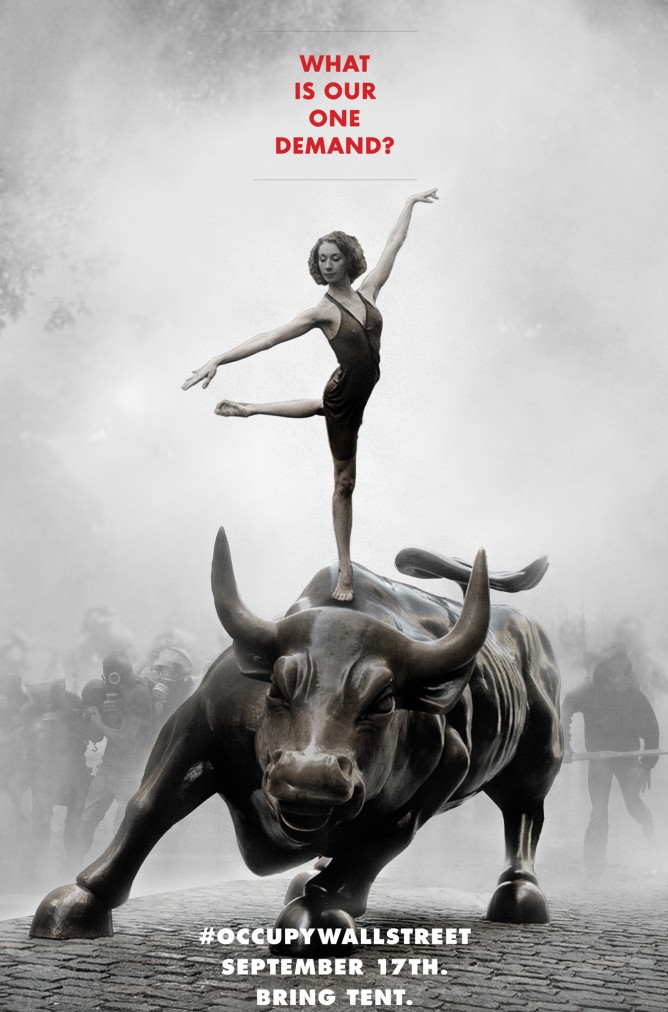
posted by jeffburdges at 5:16 AM on November 21, 2011 [3 favorites]
jeffburdges: Adbusters' original one demand referred to the lack of any real democracy, largely due to the influence of money on politics.
This is the message.
posted by syzygy at 6:04 AM on November 21, 2011
This is the message.
posted by syzygy at 6:04 AM on November 21, 2011
As for answering the argument, furiousxgeorge did say:
It turns out people can talk about both the economic agenda and the tactics used to supress the protesters at the same time.
Anyone who says that (a) doesn't acknowlege limited media time and (b) forgets that they will show blood to the exclusion of your message. Ever negotiated for coverage with a Big 3 network news producer? First think they ask you for is "did anyone die?"
That's from personal experience.
posted by Ironmouth at 10:01 AM on November 21, 2011
It turns out people can talk about both the economic agenda and the tactics used to supress the protesters at the same time.
Anyone who says that (a) doesn't acknowlege limited media time and (b) forgets that they will show blood to the exclusion of your message. Ever negotiated for coverage with a Big 3 network news producer? First think they ask you for is "did anyone die?"
That's from personal experience.
posted by Ironmouth at 10:01 AM on November 21, 2011
You think it's extreme to require private entities who contract for and/or advise the government on policy issues to be covered by Freedom of Information rules?
No, I don't think that's extreme. What I thought was extreme, and the point which danklear actually clarified following that question, is this specific idea:
If there's a committee influencing how my government is spending my tax dollars, it should without question be run inside the government.
...because we don't at all do all government work from "inside the government" and, for reasons of efficiency and expertise, shouldn't. I think danklear agrees with this point based on his clarification.
I don't disagree, though, that contracted relationships with non-governmental groups paid for on the government dime should generate an open public record.
You are free to move on to the next outrage.
posted by Miko at 10:08 AM on November 21, 2011
No, I don't think that's extreme. What I thought was extreme, and the point which danklear actually clarified following that question, is this specific idea:
If there's a committee influencing how my government is spending my tax dollars, it should without question be run inside the government.
...because we don't at all do all government work from "inside the government" and, for reasons of efficiency and expertise, shouldn't. I think danklear agrees with this point based on his clarification.
I don't disagree, though, that contracted relationships with non-governmental groups paid for on the government dime should generate an open public record.
You are free to move on to the next outrage.
posted by Miko at 10:08 AM on November 21, 2011
Miko: You are free to move on to the next outrage.
No outrage intended. I re-read my comment after I posted it, and immediately wished I had prefixed the first 'You' with a 'do'.
posted by syzygy at 10:13 AM on November 21, 2011
No outrage intended. I re-read my comment after I posted it, and immediately wished I had prefixed the first 'You' with a 'do'.
posted by syzygy at 10:13 AM on November 21, 2011
Anyone who says that (a) doesn't acknowlege limited media time and (b) forgets that they will show blood to the exclusion of your message. Ever negotiated for coverage with a Big 3 network news producer?
You're suggesting that a movement trying to draw attention to inequality and the subversion of democracy by moneyed interests needs to water down its message to suit the news organizations owned and operated by those interests?
posted by twirlip at 10:20 AM on November 21, 2011 [2 favorites]
You're suggesting that a movement trying to draw attention to inequality and the subversion of democracy by moneyed interests needs to water down its message to suit the news organizations owned and operated by those interests?
posted by twirlip at 10:20 AM on November 21, 2011 [2 favorites]
So - would anyone like to take bets on the chances of the arrest of a lone operator who had been under surveillance for two years and was allegedly planning to blow up mailboxes in upstate New York occasioning a security crackdown in New York City? Or am I being ridiculous?
Here's the guy. I guess we'll hear about the crackdown soon if it's coming, but you can't be too careful.
posted by contraption at 10:29 AM on November 21, 2011
Here's the guy. I guess we'll hear about the crackdown soon if it's coming, but you can't be too careful.
posted by contraption at 10:29 AM on November 21, 2011
I'm kind of troubled by the fact that it's *not* Homeland Security that's set up conference calls, but instead an organization with ties to various corporations. Certainly transparency is a problem, but there's more to it than that and it ties into the issue of corporations having too much power over our government agencies. Federal agencies are beholden to big business to the degree that Homeland Security directors have less pull than corporate lobbying groups, and I've witnessed this first hand over the last couple of years.
My community has been battling Spectra Energy's huge natural gas pipeline. The route Spectra has submitted to The Federal Regulatory Commission (aka FERC) is likely to be approved, even though it runs through one of the most densely populated cities in the U.S. and does not in any way it not benefit our city. FERC has never voted down a project like this. There are viable alternate routes under the Hudson that would move the blast zone away from myself and my neighbors, but Spectra refuses to submit plans for alternate routes since underwater construction would cut into their profit margin. FERC is not pressing Spectra for alternate route proposals.
Anyone with half a brain (and that includes some of our local government officials) has been fighting against this project. There hasn't been a single government official in Jersey City who hasn't committed themselves whole-heartedly to fighting against Spectra's plan, including the mayor, the entire city council, the chief of police, and the fire chief.
The fact that FERC is ignoring Jersey City's unanimous opposition isn't nearly as surprising or troubling as the fact that they are ignoring Jersey City's Director of Homeland Security's extremely outspoken opposition to the route. The planned expansion will pass through or nearby a number of heavy industrial and chemical plants and in close proximity to what the Homeland Security Department has designated as Tier 1 & Tier 2 Critical Infrastructure. The director been at the public hearings about the project and has publicly stated to the FREC board under no uncertain terms that he believes the probability is high that burying this pipeline here will result in catastrophic conditions.
It doesn't matter. FERC will still push this through regardless of what DHS has to say about the proposal because of their incestous ties to oil and gas industry insiders.
posted by stagewhisper at 12:18 PM on November 21, 2011 [2 favorites]
My community has been battling Spectra Energy's huge natural gas pipeline. The route Spectra has submitted to The Federal Regulatory Commission (aka FERC) is likely to be approved, even though it runs through one of the most densely populated cities in the U.S. and does not in any way it not benefit our city. FERC has never voted down a project like this. There are viable alternate routes under the Hudson that would move the blast zone away from myself and my neighbors, but Spectra refuses to submit plans for alternate routes since underwater construction would cut into their profit margin. FERC is not pressing Spectra for alternate route proposals.
Anyone with half a brain (and that includes some of our local government officials) has been fighting against this project. There hasn't been a single government official in Jersey City who hasn't committed themselves whole-heartedly to fighting against Spectra's plan, including the mayor, the entire city council, the chief of police, and the fire chief.
The fact that FERC is ignoring Jersey City's unanimous opposition isn't nearly as surprising or troubling as the fact that they are ignoring Jersey City's Director of Homeland Security's extremely outspoken opposition to the route. The planned expansion will pass through or nearby a number of heavy industrial and chemical plants and in close proximity to what the Homeland Security Department has designated as Tier 1 & Tier 2 Critical Infrastructure. The director been at the public hearings about the project and has publicly stated to the FREC board under no uncertain terms that he believes the probability is high that burying this pipeline here will result in catastrophic conditions.
It doesn't matter. FERC will still push this through regardless of what DHS has to say about the proposal because of their incestous ties to oil and gas industry insiders.
posted by stagewhisper at 12:18 PM on November 21, 2011 [2 favorites]
Anyone who says that (a) doesn't acknowlege limited media time and (b) forgets that they will show blood to the exclusion of your message. Ever negotiated for coverage with a Big 3 network news producer? First think they ask you for is "did anyone die?"
That's from personal experience.
The Week: Oct. 1
Some 700 protesters are arrested in a march across the Brooklyn Bridge. Some protesters say the police purposefully lured and trapped them on the multi-tiered bridge's road level; the police say they warned protesters to stay on the walkway level. The mass arrests push the protests to the front page of newspapers and the top of TV news broadcasts. OWS-inspired protests start in Washington, D.C., and Los Angeles.
St. Petersburg Times: Ranks of Wall Street protest swells, The Occupy Wall Street demonstration started out last month with fewer than a dozen college students spending days and nights in Zuccotti Park, saying they hoped to change or expose economic polices that benefit the richest 1 percent of Americans. The protest has grown significantly, both in New York City and elsewhere as people across the country, from Boston to Los Angeles, display their solidarity in similar protests.
The arrests of more than 700 people on Saturday as thousands tried to cross the Brooklyn Bridge seemed to pour oil on the rage of those who camped out overnight in Zuccotti Park, a private plaza off Broadway near Wall Street.
The growing, cross-country movement "signals a shift in consciousness," said Jared Schy, a young man sitting squeezed between three others who participated in Saturday's march from Manhattan's Financial District to the bridge.
The evidence is pointing towards the movement being bolstered by the news of police overreactions. Yet, when they marched to the bridge again there was plenty of focus on the economic agenda and the police conflict was minimal.
I know it's your job to make sure scumbags like Pike never face consequences, but you aren't going to convince the rest of us to help you.
posted by furiousxgeorge at 12:30 PM on November 21, 2011
That's from personal experience.
The Week: Oct. 1
Some 700 protesters are arrested in a march across the Brooklyn Bridge. Some protesters say the police purposefully lured and trapped them on the multi-tiered bridge's road level; the police say they warned protesters to stay on the walkway level. The mass arrests push the protests to the front page of newspapers and the top of TV news broadcasts. OWS-inspired protests start in Washington, D.C., and Los Angeles.
St. Petersburg Times: Ranks of Wall Street protest swells, The Occupy Wall Street demonstration started out last month with fewer than a dozen college students spending days and nights in Zuccotti Park, saying they hoped to change or expose economic polices that benefit the richest 1 percent of Americans. The protest has grown significantly, both in New York City and elsewhere as people across the country, from Boston to Los Angeles, display their solidarity in similar protests.
The arrests of more than 700 people on Saturday as thousands tried to cross the Brooklyn Bridge seemed to pour oil on the rage of those who camped out overnight in Zuccotti Park, a private plaza off Broadway near Wall Street.
The growing, cross-country movement "signals a shift in consciousness," said Jared Schy, a young man sitting squeezed between three others who participated in Saturday's march from Manhattan's Financial District to the bridge.
The evidence is pointing towards the movement being bolstered by the news of police overreactions. Yet, when they marched to the bridge again there was plenty of focus on the economic agenda and the police conflict was minimal.
I know it's your job to make sure scumbags like Pike never face consequences, but you aren't going to convince the rest of us to help you.
posted by furiousxgeorge at 12:30 PM on November 21, 2011
I understand what is being said about staying on message (and perhaps you may consider that this is no place for us foreigners, but there were reasons, some embedded here, why I left the US after a decade of making my home there) and what has been said about people being prepared for the brutal response of the authorities, but also, critically, needing to understand what exactly they may be fighting for...
A link from the other thread on why gratuitous seeming brutality (though in order with the laws of the powers that be) can ignite a critical mass, not only globally, but the peacefulness of the intentions of those protesting emphasize their points of protest.
posted by infini at 12:48 PM on November 21, 2011
Anyone who says that (a) doesn't acknowlege limited media time and (b) forgets that they will show blood to the exclusion of your message. Ever negotiated for coverage with a Big 3 network news producer?
You're suggesting that a movement trying to draw attention to inequality and the subversion of democracy by moneyed interests needs to water down its message to suit the news organizations owned and operated by those interests?
The opposite. They want you to talk about you v. the police, not about the 99% v. the 1%. Talk about the 99% v. the 1%.
posted by Ironmouth at 1:11 PM on November 21, 2011 [1 favorite]
You're suggesting that a movement trying to draw attention to inequality and the subversion of democracy by moneyed interests needs to water down its message to suit the news organizations owned and operated by those interests?
The opposite. They want you to talk about you v. the police, not about the 99% v. the 1%. Talk about the 99% v. the 1%.
posted by Ironmouth at 1:11 PM on November 21, 2011 [1 favorite]
Josh Marshall of Talking Points Memo, Concern Trolling:
I’ve wondered about this for a week or two. And I haven’t known quite what to make of it or how to express it. It didn’t start with this pepper spray incident at UC Davis. But that sort of crystallized it further in my mind: the core message about economic inequality is being overwhelmed by a distinct story about (depending on your perspective) street violence and police brutality or excessive militarization of crowd control.posted by Ironmouth at 1:33 PM on November 21, 2011
Last week I met a person heavily involved with OWS in New York. And I told him that something seemed to have changed in the previous couple weeks — basically that the dominant imagery had become about confrontations with the police rather than the core economic messages which had been more dominant previously. In most cases it didn’t seem to be the fault of the OWS protesters. It was peaceful or mainly peaceful protests getting met by excessive police responses. But still, at the level of imagery and message, the end result can be the same. And in this case, I’m not talking about the ridiculousness and movement-character assassination on Fox News. I’m talking about coverage that lacks that sort of committed bias.
Something similar is at play with this pepper spray incident at UC Davis. Yes, this is horrific. And in my mind at least it puts a spotlight on a more general trend in the country — which is increasingly tech-based and/or militarized policing strategies. But how much do the acts of the campus police at UC Davis have to do with economic inequality and the ownership of the state by the super wealthy? Unless you’re up for a Chomskian analysis of our present moment, pretty little, I think. And a lot of the people I talk to in OWS totally get this. After all these are the public employees whose pensions and benefits are on the line across the country.
I can see the argument about how they’re connected. But I think it’s far more theoretical than real.
The arrests of more than 700 people on Saturday as thousands tried to cross the Brooklyn Bridge seemed to pour oil on the rage of those who camped out overnight in Zuccotti Park, a private plaza off Broadway near Wall Street.
The growing, cross-country movement "signals a shift in consciousness," said Jared Schy, a young man sitting squeezed between three others who participated in Saturday's march from Manhattan's Financial District to the bridge.
The evidence is pointing towards the movement being bolstered by the news of police overreactions. Yet, when they marched to the bridge again there was plenty of focus on the economic agenda and the police conflict was minimal.
I know it's your job to make sure scumbags like Pike never face consequences, but you aren't going to convince the rest of us to help you.
That was more than a month ago. This is now. I'm saying that the news wants you to stop talking about the 99% v. the 1%. Stop doing it.
I also know that you're above the ad hominem attacks. Disagree with me, that's fine. Personal attacks aren't your style.
posted by Ironmouth at 1:35 PM on November 21, 2011
The growing, cross-country movement "signals a shift in consciousness," said Jared Schy, a young man sitting squeezed between three others who participated in Saturday's march from Manhattan's Financial District to the bridge.
The evidence is pointing towards the movement being bolstered by the news of police overreactions. Yet, when they marched to the bridge again there was plenty of focus on the economic agenda and the police conflict was minimal.
I know it's your job to make sure scumbags like Pike never face consequences, but you aren't going to convince the rest of us to help you.
That was more than a month ago. This is now. I'm saying that the news wants you to stop talking about the 99% v. the 1%. Stop doing it.
I also know that you're above the ad hominem attacks. Disagree with me, that's fine. Personal attacks aren't your style.
posted by Ironmouth at 1:35 PM on November 21, 2011
Ironmouth, would you prefer that those of us that have been assaulted by police should just shut up about it? We can talk about more than one thing at once you know. It's not the fault of OWS that what gets dominant play is police brutality, but we also shouldn't be required to not point out the techniques that are being used to squash our voices and limit the numbers of people willing to put their bodies on the line.
About that press, they're taking their own stand against police brutality that limits their ability to do their job. Please note the signatures on this letter include radical left wing anti-police organizations such as The Wall Street Journal and The New York Post.
posted by stagewhisper at 1:50 PM on November 21, 2011 [2 favorites]
About that press, they're taking their own stand against police brutality that limits their ability to do their job. Please note the signatures on this letter include radical left wing anti-police organizations such as The Wall Street Journal and The New York Post.
posted by stagewhisper at 1:50 PM on November 21, 2011 [2 favorites]
That was more than a month ago. This is now. I'm saying that the news wants you to stop talking about the 99% v. the 1%. Stop doing it.
Between then and now Penn State appeared and dominated the news and now UC Davis has OWS right back on the front page. There might be a missing white girl tomorrow, who knows?
OWS-inspired protests start in Washington, D.C., and Los Angeles.
...and as the media follows the new stories like five year olds playing soccer LA and DC and NY and Philly and everyone else is still there preaching the same economic message. You seem to experience the world through one layer of separation at all times. The reality of OWS is on the street, not CNN. The reality of police abuse is in the people being attacked, not in the courtroom where you make sure the attackers face no consequences.
Personal attacks aren't your style.
Yes they are!
posted by furiousxgeorge at 2:13 PM on November 21, 2011
Between then and now Penn State appeared and dominated the news and now UC Davis has OWS right back on the front page. There might be a missing white girl tomorrow, who knows?
OWS-inspired protests start in Washington, D.C., and Los Angeles.
...and as the media follows the new stories like five year olds playing soccer LA and DC and NY and Philly and everyone else is still there preaching the same economic message. You seem to experience the world through one layer of separation at all times. The reality of OWS is on the street, not CNN. The reality of police abuse is in the people being attacked, not in the courtroom where you make sure the attackers face no consequences.
Personal attacks aren't your style.
Yes they are!
posted by furiousxgeorge at 2:13 PM on November 21, 2011
I tend to believe that given the nascent stage of this movement, any news is in a way good news, and that the police brutality message actually resonates quite well -- and much more concretely for some -- than the abstract economic message.
posted by dhartung at 2:36 PM on November 21, 2011
posted by dhartung at 2:36 PM on November 21, 2011
I tend to believe that given the nascent stage of this movement, any news is in a way good news, and that the police brutality message actually resonates quite well -- and much more concretely for some -- than the abstract economic message.
I tend to think they're one and the same. Was their anyone wringing their hands in Birmingham in the 60s, telling civil rights activists to stop focusing too much on getting firehosed or having police dogs sicked on them, that to do so would shift the focus from the integrationist message and onto police brutality? No, of course not, and the media attention that brutality received contributed to the sympathy and the outrage of the rest of the country. This is what I mean about the Action and Reaction being inseparable parts of the process of change.
posted by Marisa Stole the Precious Thing at 2:41 PM on November 21, 2011 [6 favorites]
I tend to think they're one and the same. Was their anyone wringing their hands in Birmingham in the 60s, telling civil rights activists to stop focusing too much on getting firehosed or having police dogs sicked on them, that to do so would shift the focus from the integrationist message and onto police brutality? No, of course not, and the media attention that brutality received contributed to the sympathy and the outrage of the rest of the country. This is what I mean about the Action and Reaction being inseparable parts of the process of change.
posted by Marisa Stole the Precious Thing at 2:41 PM on November 21, 2011 [6 favorites]
Exactly Marisa! There is zero chance the police brutality coverage will distract an unemployed person from her unemployment. Ergo, the protests should continue without any problems.
There are only two serious threads I know about : The cold weather might make staying outdoors indefinitely difficult, which makes occupying buildings important, that or protest further south. Democrats will try co-opting OWS support as support for Democratic candidates, thus destroying OWS's legitimacy and support amongst independents. The income inequality message strongly favors Democrats, let them use that message themselves if they like, but don't let them distract OWS from it's own messages.
posted by jeffburdges at 3:33 PM on November 21, 2011 [1 favorite]
There are only two serious threads I know about : The cold weather might make staying outdoors indefinitely difficult, which makes occupying buildings important, that or protest further south. Democrats will try co-opting OWS support as support for Democratic candidates, thus destroying OWS's legitimacy and support amongst independents. The income inequality message strongly favors Democrats, let them use that message themselves if they like, but don't let them distract OWS from it's own messages.
posted by jeffburdges at 3:33 PM on November 21, 2011 [1 favorite]
Ironmouth, would you prefer that those of us that have been assaulted by police should just shut up about it? We can talk about more than one thing at once you know. It's not the fault of OWS that what gets dominant play is police brutality, but we also shouldn't be required to not point out the techniques that are being used to squash our voices and limit the numbers of people willing to put their bodies on the line.
I'm saying something quite simple. If you are commenting on this to a news camera or reporter, turn the topic to the 99% v. the 1%. If you are voting in the General Assembly vote to put focus on the 99% v. the 1%, not about Bloomberg.
posted by Ironmouth at 3:38 PM on November 21, 2011
I'm saying something quite simple. If you are commenting on this to a news camera or reporter, turn the topic to the 99% v. the 1%. If you are voting in the General Assembly vote to put focus on the 99% v. the 1%, not about Bloomberg.
posted by Ironmouth at 3:38 PM on November 21, 2011
That's not how the general assembly works or what it does but I'll keep it in mind. :/
posted by stagewhisper at 3:49 PM on November 21, 2011
posted by stagewhisper at 3:49 PM on November 21, 2011
What I am not understanding is why the disproportionate and overbearing clampdown (on the press as well as the protestors) is not considered an aspect of the 1% vs the 99%, Ironmouth?
As far as I've understood, the 1% control the systems and infrastructure, thus demonstrating an inequality in not just $$ terms but also in power and influence (all of which most likely have an equation taht demonstrates their integral relationship to each other) - thus the fact that you have stonewalling around press efforts or simply games playing around discussion topics, including the increasing militarization of a civil society service (profit from left over equipment?) and its use against the public (whom I've understood to be the very 99% we are supposed to be discussing)
Therefore, in this context, discussion on the topic of 1% vs the 99% is in no way any different from the subject of pepper sprays against children sitting on the ground.
Please articulate how this does not reflect the inequalities and the embedded power structure of the environment?
posted by infini at 3:50 PM on November 21, 2011 [5 favorites]
As far as I've understood, the 1% control the systems and infrastructure, thus demonstrating an inequality in not just $$ terms but also in power and influence (all of which most likely have an equation taht demonstrates their integral relationship to each other) - thus the fact that you have stonewalling around press efforts or simply games playing around discussion topics, including the increasing militarization of a civil society service (profit from left over equipment?) and its use against the public (whom I've understood to be the very 99% we are supposed to be discussing)
Therefore, in this context, discussion on the topic of 1% vs the 99% is in no way any different from the subject of pepper sprays against children sitting on the ground.
Please articulate how this does not reflect the inequalities and the embedded power structure of the environment?
posted by infini at 3:50 PM on November 21, 2011 [5 favorites]
Furthermore, I note from following a link in the other thread to this little article, that there has been no loss of message, in fact, only a greater spotlight shone on the problem among those who, otherwise, may not have noticed.
Parents use pepper spray incident as teachable moment
For Carrie Ziser, a former teacher at Birch Lane Elementary School, there was a civics lesson involved here, but more than that, too.
“We’ve been really upset and concerned about things in this country,” she said, mentioning unemployment and growing poverty, as well as concern about public education.
“And when we watched kids just a mile from our house being pepper-sprayed, we had to come. We have so much in Davis, this is the bare minimum of what we can do,” she said, adding that she has “never felt more proud of these students.”
Her children, she said, have been following the news and watched the video of students being pepper sprayed.
“They were scared by it,” she said, noting that her husband is a UC Davis English professor, so “these are papa’s students.”
For his part, Michael Ziser expressed disbelief over the incident, and that police would “think it was OK,” a sentiment he said his colleagues unanimously share.
Lucy Bolz, 3 1/2, hasn’t seen the video, said her mom, Allison, but knows what happened. So she made a sign that said, ‘”Police are supposed to be helpers,” which she was holding aloft as she sat on the shoulders of her dad, Brian Bolz, at the rally.
Allison and Brian Bolz are both longtime Davis residents who saw in the pepper-spraying incident “a very clear issue of right and wrong,” Allison Bolz said.
It bothered them both enough to come out for what Brian Bolz said not only was his daughter’s first protest, but also his own.
“The police looked like they were following the rules,” he said of the pepper-spraying. “And it just seems like an institutional breakdown.”
posted by infini at 4:04 PM on November 21, 2011 [4 favorites]
Parents use pepper spray incident as teachable moment
For Carrie Ziser, a former teacher at Birch Lane Elementary School, there was a civics lesson involved here, but more than that, too.
“We’ve been really upset and concerned about things in this country,” she said, mentioning unemployment and growing poverty, as well as concern about public education.
“And when we watched kids just a mile from our house being pepper-sprayed, we had to come. We have so much in Davis, this is the bare minimum of what we can do,” she said, adding that she has “never felt more proud of these students.”
Her children, she said, have been following the news and watched the video of students being pepper sprayed.
“They were scared by it,” she said, noting that her husband is a UC Davis English professor, so “these are papa’s students.”
For his part, Michael Ziser expressed disbelief over the incident, and that police would “think it was OK,” a sentiment he said his colleagues unanimously share.
Lucy Bolz, 3 1/2, hasn’t seen the video, said her mom, Allison, but knows what happened. So she made a sign that said, ‘”Police are supposed to be helpers,” which she was holding aloft as she sat on the shoulders of her dad, Brian Bolz, at the rally.
Allison and Brian Bolz are both longtime Davis residents who saw in the pepper-spraying incident “a very clear issue of right and wrong,” Allison Bolz said.
It bothered them both enough to come out for what Brian Bolz said not only was his daughter’s first protest, but also his own.
“The police looked like they were following the rules,” he said of the pepper-spraying. “And it just seems like an institutional breakdown.”
posted by infini at 4:04 PM on November 21, 2011 [4 favorites]
What I am not understanding is why the disproportionate and overbearing clampdown (on the press as well as the protestors) is not considered an aspect of the 1% vs the 99%, Ironmouth?
As far as I've understood, the 1% control the systems and infrastructure, thus demonstrating an inequality in not just $$ terms but also in power and influence (all of which most likely have an equation taht demonstrates their integral relationship to each other) - thus the fact that you have stonewalling around press efforts or simply games playing around discussion topics, including the increasing militarization of a civil society service (profit from left over equipment?) and its use against the public (whom I've understood to be the very 99% we are supposed to be discussing)
Therefore, in this context, discussion on the topic of 1% vs the 99% is in no way any different from the subject of pepper sprays against children sitting on the ground.
Please articulate how this does not reflect the inequalities and the embedded power structure of the environment?
Let me be clear. CNN is running pepper-spray porn. They are fascinated with watching protesters get pushed around and focusing on their complaints about access.
There are probably 10,000 people involved in that fight, and 99.9999% of people are not currently in an OWS encampment.
The population of the US is 307,000,000. This is about 303,030,000 people versus 3,030,000. And the powers who want people not to think about this are banking on people stopping talking about that, because they can't win that argument. But they have a much better chance of winning the "should people be able to camp in the park all of the time and protest without a permit" argument and the "if people don't do what a police officer says, is it ok to pepper spray them" argument.
posted by Ironmouth at 7:32 PM on November 21, 2011 [1 favorite]
As far as I've understood, the 1% control the systems and infrastructure, thus demonstrating an inequality in not just $$ terms but also in power and influence (all of which most likely have an equation taht demonstrates their integral relationship to each other) - thus the fact that you have stonewalling around press efforts or simply games playing around discussion topics, including the increasing militarization of a civil society service (profit from left over equipment?) and its use against the public (whom I've understood to be the very 99% we are supposed to be discussing)
Therefore, in this context, discussion on the topic of 1% vs the 99% is in no way any different from the subject of pepper sprays against children sitting on the ground.
Please articulate how this does not reflect the inequalities and the embedded power structure of the environment?
Let me be clear. CNN is running pepper-spray porn. They are fascinated with watching protesters get pushed around and focusing on their complaints about access.
There are probably 10,000 people involved in that fight, and 99.9999% of people are not currently in an OWS encampment.
The population of the US is 307,000,000. This is about 303,030,000 people versus 3,030,000. And the powers who want people not to think about this are banking on people stopping talking about that, because they can't win that argument. But they have a much better chance of winning the "should people be able to camp in the park all of the time and protest without a permit" argument and the "if people don't do what a police officer says, is it ok to pepper spray them" argument.
posted by Ironmouth at 7:32 PM on November 21, 2011 [1 favorite]
It's fairly easy to leverage the attention back to the message. Remember how we talked about how the police over-reaction on the bridge helped magnify the attention OWS received and helped spread their economic message? That was all about police, right?
It wasn't then, it isn't now.
Democracy Now: Thursday’s protest marking the Occupy movement’s second month anniversary coincided with an event planned months earlier by unions and others. Marches were held on bridges across the country to draw attention to how federal funding to fix ailing infrastructure in the country could put unemployed people back to work. Protesters blocked bridges in Los Angeles, Chicago, Philadelphia, Detroit, St. Louis, Houston, Milwaukee, Minneapolis, Hartford and Portland. Democracy Now! producer Renée Feltz reports that in New York City, labor leaders were arrested trying to block the entrance to the Brooklyn Bridge, including SEIU president Mary Kay Henry. "We think there’s an economic emergency in this country that can be fixed, and millions of people can go back to work in good jobs," Henry says. [includes rush transcript]
But yeah, obviously the SEIU president is in desperate need of advice on media relations. Why did she go back to the bridge and get herself arrested when that would just bring more questions about police instead of the economic message?
Ironmouth, it's the same message. Calling out the police abuse goes hand in hand with everything else. You have to put your worship of authority figures aside on this one and let the police take their lumps in the media, don't worry, the cops who abused those kids will still have due process for what they did and a chance to dodge all responsibility if their lawyer is clever enough!
posted by furiousxgeorge at 7:55 PM on November 21, 2011 [1 favorite]
It wasn't then, it isn't now.
Democracy Now: Thursday’s protest marking the Occupy movement’s second month anniversary coincided with an event planned months earlier by unions and others. Marches were held on bridges across the country to draw attention to how federal funding to fix ailing infrastructure in the country could put unemployed people back to work. Protesters blocked bridges in Los Angeles, Chicago, Philadelphia, Detroit, St. Louis, Houston, Milwaukee, Minneapolis, Hartford and Portland. Democracy Now! producer Renée Feltz reports that in New York City, labor leaders were arrested trying to block the entrance to the Brooklyn Bridge, including SEIU president Mary Kay Henry. "We think there’s an economic emergency in this country that can be fixed, and millions of people can go back to work in good jobs," Henry says. [includes rush transcript]
But yeah, obviously the SEIU president is in desperate need of advice on media relations. Why did she go back to the bridge and get herself arrested when that would just bring more questions about police instead of the economic message?
Ironmouth, it's the same message. Calling out the police abuse goes hand in hand with everything else. You have to put your worship of authority figures aside on this one and let the police take their lumps in the media, don't worry, the cops who abused those kids will still have due process for what they did and a chance to dodge all responsibility if their lawyer is clever enough!
posted by furiousxgeorge at 7:55 PM on November 21, 2011 [1 favorite]
You're absolutely right, Ironmouth, have you shared this with your local OWS?
posted by infini at 8:02 PM on November 21, 2011
posted by infini at 8:02 PM on November 21, 2011
Public/private partnership military industrial police complex? Check this out:
Some of my friends split off of my local Occupation and started one in a neighboring city. Their Occupation has received absolutely zero notice from the local newspaper and its jointly owned TV station, they were obviously being deliberately ignored since they got good coverage from the other TV station in town (a Fox News affiliate even).
The Occupants found out that a local electronics manufacturer won a major Defense Department contract to build components for a UAV, an unmanned military surveillance aircraft, smaller than the Predator, shorter range, but capable of carrying missiles and other weapon platforms. It clearly is intended for Homeland Security use as well as military application. So our neighboring Occupation started working on a Direct Action, planning a protest at the contractor's new facility, a vacant industrial building in the center of town.
The Occupants got up this morning and that newspaper and their TV station were on site, for the first time ever. A couple of hours later, the police showed up with an eviction notice from the city, giving them 24 hours to leave the site, despite an ongoing negotiation with representatives from the city who said there would be no action taken, while they made their case that no permit was needed (that's a long story, but really, this is land specifically zoned for camping).
Now the interesting thing is how the newspaper and TV knew the police were delivering an eviction notice, even before the Occupants heard about it. The reporters showed up before the police. And it turns out, the owner of the newspaper and TV station is also an owner of the vacant industrial building that the defense contractor is leasing for this project.
It is obvious that the paper and TV were deliberately ignoring the Occupation, until it became known that they were about to protest a defense project that would make profits for the paper and TV station's owners. So the owners pushed hard on the city government to crack down on the Occupants, before they could execute their Direct Action and raise a public controversy. Only when profits from a military-industrial project were threatened, did they get any attention from the paper and TV, and then it was 100% negative.
posted by charlie don't surf at 8:15 PM on November 21, 2011 [13 favorites]
Some of my friends split off of my local Occupation and started one in a neighboring city. Their Occupation has received absolutely zero notice from the local newspaper and its jointly owned TV station, they were obviously being deliberately ignored since they got good coverage from the other TV station in town (a Fox News affiliate even).
The Occupants found out that a local electronics manufacturer won a major Defense Department contract to build components for a UAV, an unmanned military surveillance aircraft, smaller than the Predator, shorter range, but capable of carrying missiles and other weapon platforms. It clearly is intended for Homeland Security use as well as military application. So our neighboring Occupation started working on a Direct Action, planning a protest at the contractor's new facility, a vacant industrial building in the center of town.
The Occupants got up this morning and that newspaper and their TV station were on site, for the first time ever. A couple of hours later, the police showed up with an eviction notice from the city, giving them 24 hours to leave the site, despite an ongoing negotiation with representatives from the city who said there would be no action taken, while they made their case that no permit was needed (that's a long story, but really, this is land specifically zoned for camping).
Now the interesting thing is how the newspaper and TV knew the police were delivering an eviction notice, even before the Occupants heard about it. The reporters showed up before the police. And it turns out, the owner of the newspaper and TV station is also an owner of the vacant industrial building that the defense contractor is leasing for this project.
It is obvious that the paper and TV were deliberately ignoring the Occupation, until it became known that they were about to protest a defense project that would make profits for the paper and TV station's owners. So the owners pushed hard on the city government to crack down on the Occupants, before they could execute their Direct Action and raise a public controversy. Only when profits from a military-industrial project were threatened, did they get any attention from the paper and TV, and then it was 100% negative.
posted by charlie don't surf at 8:15 PM on November 21, 2011 [13 favorites]
syzygy (from the previous, massive, OWS thread): plenty of people are still asking, "why are they marching - why are they 'camping'?", and there is a slightly longer line of logic between our reason to protest and the institutionalized violence against the protesters - not in my mind, nor in the mind of radicals or those 'in the choir', but at least in the minds of many middle Americans who are making their minds up about Occupy right now. . . . I guess you could call it a war for the public consciousness.
Thanks y'all for the debate on this point. Been thinking about it. Got to agree with syzygy, based on my own experience bringing OWS up with people IRL who get their news from, not even Fox, but mainstream media. Mainstream media focuses on things like "300 protestors arrested during Nov 17 protests" while leaving out the fact that 30,000 protestors turned out, "policeman's hand cut when protestor threw glass object at him" while leaving out any mention of protestors injured by cops, and "students pepper sprayed after refusing to comply with police orders...police surrounded by students" without mentioning students' inspiring de-escalation or the fact that they weren't actually blocking anything or anyone.
The 1%'s control, disproportionate influence, and lack of accountability is the bedrock that underlies most of the societal and economic dysfunctions that OWS targets. People not plugged into alt media like metafilter and twitter are more likely to "get it" if they hear the links spelled out, as often as possible.
Most of us here are doing this. Still, the more, the better, to optimize our chances at displacing the "What's this OWS all about anyway / They haven't got a message" message IRL and in mainstream media. Making the 1% and their system-rigging visible can (IMO, should) encompass police brutality as one of the 1%'s tools. But we can't count on police brutality in and of itself, even that excellent 4-view UC Davis video, to persuade the numbers to come on board that would make the movement unstoppable. It's too easily rationalized away by people trained since 9/11 to prioritize "order" and "security" above anything else (how to create a sick system 101).
posted by cybercoitus interruptus at 3:05 AM on November 22, 2011 [1 favorite]
Thanks y'all for the debate on this point. Been thinking about it. Got to agree with syzygy, based on my own experience bringing OWS up with people IRL who get their news from, not even Fox, but mainstream media. Mainstream media focuses on things like "300 protestors arrested during Nov 17 protests" while leaving out the fact that 30,000 protestors turned out, "policeman's hand cut when protestor threw glass object at him" while leaving out any mention of protestors injured by cops, and "students pepper sprayed after refusing to comply with police orders...police surrounded by students" without mentioning students' inspiring de-escalation or the fact that they weren't actually blocking anything or anyone.
The 1%'s control, disproportionate influence, and lack of accountability is the bedrock that underlies most of the societal and economic dysfunctions that OWS targets. People not plugged into alt media like metafilter and twitter are more likely to "get it" if they hear the links spelled out, as often as possible.
Most of us here are doing this. Still, the more, the better, to optimize our chances at displacing the "What's this OWS all about anyway / They haven't got a message" message IRL and in mainstream media. Making the 1% and their system-rigging visible can (IMO, should) encompass police brutality as one of the 1%'s tools. But we can't count on police brutality in and of itself, even that excellent 4-view UC Davis video, to persuade the numbers to come on board that would make the movement unstoppable. It's too easily rationalized away by people trained since 9/11 to prioritize "order" and "security" above anything else (how to create a sick system 101).
posted by cybercoitus interruptus at 3:05 AM on November 22, 2011 [1 favorite]
cybercoitus interruptus: (from the previous, massive, OWS thread)
Oh my - I posted that response in the wrong thread. Meant to post it here. I've asked the mods whether it would be possible to move it over here for me.
posted by syzygy at 3:46 AM on November 22, 2011
Oh my - I posted that response in the wrong thread. Meant to post it here. I've asked the mods whether it would be possible to move it over here for me.
posted by syzygy at 3:46 AM on November 22, 2011
The mods deleted the comment I posted in the wrong discussion (at my request) and told me I could re-post it here - so here you go. This is the comment cybercoitus interruptus refers to here.
Marisa Stole the Precious Thing: I tend to think they're one and the same. Was their anyone wringing their hands in Birmingham in the 60s, telling civil rights activists to stop focusing too much on getting firehosed or having police dogs sicked on them, that to do so would shift the focus from the integrationist message and onto police brutality? No, of course not, and the media attention that brutality received contributed to the sympathy and the outrage of the rest of the country. This is what I mean about the Action and Reaction being inseparable parts of the process of change.
There is one important difference: Everyone knew what the civil rights activists were marching for. They all knew the message. The message was clear and no one was asking, "why are they marching?", and there was no fuzzy train of logic between the reason for their marches and the institutionalized violence against them - the violence truly WAS what they were protesting.
That's not the case here and now - plenty of people are still asking, "why are they marching - why are they 'camping'?", and there is a slightly longer line of logic between our reason to protest and the institutionalized violence against the protesters - not in my mind, nor in the mind of radicals or those 'in the choir', but at least in the minds of many middle Americans who are making their minds up about Occupy right now.
The reason the civil rights activists were protesting was just, and because it was well known by all, it gave moral backing to their protests. The reason we are protesting is also just, but that reason will not lend moral backing to our protests in the eyes of the public who don't even know that reason yet.
So my point is - we need to continue hammering the message of economic inequality and perverted democracy - the just reason behind our protests - in order to continue to build support and moral backing. We need to make sure that instances of horrific, unconscionable institutionalized brutality are widely publicized and (hopefully) dealt with, but we need to continue to make clear with convincing arguments the reason behind the protests.
People aren't just camping for camping's sake. People aren't just protesting because they're rabble-rousers or spoiled whiners. We are protesting for a good and just cause, and we need to make sure we are communicating that cause every chance we get.
---
I'm going to try not to harp on this too much, but I'll say a couple of things before I move on. First off, I'm probably one of the most 'fuck the police' people you're ever going to have the pleasure of meeting, so I'm not coming at this out of any sense of misplaced empathy for the police who misbehave - my blood boils when I see the police using violence against peaceful protesters. I'm coming at this from the standpoint of someone who supports the Occupy movement fully, and who hopes to see them be the vehicle for radical change in our society. I have donated and will continue to do so. I can't be at the protests, physically, since I'm an expat living in Europe, but I will take part in protests the next time I'm back in the States.
I also use every chance I can get to try to cogently explain the message to those who haven't yet been educated. I come across plenty of people who don't understand what all the 'fuss' is about, and I find that, often, these people want to know the reason behind the protests - they're upset about the violence, but that's not enough to get them to support the movement - they need to know what the movement is about. They have to be taught what is behind the movement, and I find that the message of economic inequality and democracy perverted by money resonates with many, when it's skillfully argued.
I guess you could call it a war for the public consciousness. Take a scale from one to five, one being 'strongly approve of OWS', five being 'strongly disapprove of OWS'. Take a hypothetical random sample of 100 individuals, evenly spread across the scale. I will engage with each of them using different tactics - for me it's a win if I can move someone from the 'strongly disapprove' column to the 'somewhat disapprove' column. Basically, I want to move everyone I come in contact with toward 'strongly approve', although I know I won't be able to convert everyone, completely. I have found in my discussions that the message of economic inequality and campaign finance issues are more resonant than simply talking about police brutality with everyone but those already on the 'support' side of things, i.e. those who are not already 'in the choir'.
Lastly, before you respond, please realize that we're on the same side here. I'm not looking to start a fight with my allies - I'm simply offering my reasoned input based on the conversations I've had with inquisitive outsiders, and on my desire to see the Occupy movement be as successful as possible. This movement is young, and there are still many who need to be educated - many who are on the fence, or who have even decided they're anti-Occupy, but who can be turned around with thoughtful arguments about the message at the core of Occupy.
Please try to read the nuance contained in my argument and understand that we're on the same side.
posted by syzygy at 3:55 AM on November 22, 2011 [2 favorites]
Marisa Stole the Precious Thing: I tend to think they're one and the same. Was their anyone wringing their hands in Birmingham in the 60s, telling civil rights activists to stop focusing too much on getting firehosed or having police dogs sicked on them, that to do so would shift the focus from the integrationist message and onto police brutality? No, of course not, and the media attention that brutality received contributed to the sympathy and the outrage of the rest of the country. This is what I mean about the Action and Reaction being inseparable parts of the process of change.
There is one important difference: Everyone knew what the civil rights activists were marching for. They all knew the message. The message was clear and no one was asking, "why are they marching?", and there was no fuzzy train of logic between the reason for their marches and the institutionalized violence against them - the violence truly WAS what they were protesting.
That's not the case here and now - plenty of people are still asking, "why are they marching - why are they 'camping'?", and there is a slightly longer line of logic between our reason to protest and the institutionalized violence against the protesters - not in my mind, nor in the mind of radicals or those 'in the choir', but at least in the minds of many middle Americans who are making their minds up about Occupy right now.
The reason the civil rights activists were protesting was just, and because it was well known by all, it gave moral backing to their protests. The reason we are protesting is also just, but that reason will not lend moral backing to our protests in the eyes of the public who don't even know that reason yet.
So my point is - we need to continue hammering the message of economic inequality and perverted democracy - the just reason behind our protests - in order to continue to build support and moral backing. We need to make sure that instances of horrific, unconscionable institutionalized brutality are widely publicized and (hopefully) dealt with, but we need to continue to make clear with convincing arguments the reason behind the protests.
People aren't just camping for camping's sake. People aren't just protesting because they're rabble-rousers or spoiled whiners. We are protesting for a good and just cause, and we need to make sure we are communicating that cause every chance we get.
---
I'm going to try not to harp on this too much, but I'll say a couple of things before I move on. First off, I'm probably one of the most 'fuck the police' people you're ever going to have the pleasure of meeting, so I'm not coming at this out of any sense of misplaced empathy for the police who misbehave - my blood boils when I see the police using violence against peaceful protesters. I'm coming at this from the standpoint of someone who supports the Occupy movement fully, and who hopes to see them be the vehicle for radical change in our society. I have donated and will continue to do so. I can't be at the protests, physically, since I'm an expat living in Europe, but I will take part in protests the next time I'm back in the States.
I also use every chance I can get to try to cogently explain the message to those who haven't yet been educated. I come across plenty of people who don't understand what all the 'fuss' is about, and I find that, often, these people want to know the reason behind the protests - they're upset about the violence, but that's not enough to get them to support the movement - they need to know what the movement is about. They have to be taught what is behind the movement, and I find that the message of economic inequality and democracy perverted by money resonates with many, when it's skillfully argued.
I guess you could call it a war for the public consciousness. Take a scale from one to five, one being 'strongly approve of OWS', five being 'strongly disapprove of OWS'. Take a hypothetical random sample of 100 individuals, evenly spread across the scale. I will engage with each of them using different tactics - for me it's a win if I can move someone from the 'strongly disapprove' column to the 'somewhat disapprove' column. Basically, I want to move everyone I come in contact with toward 'strongly approve', although I know I won't be able to convert everyone, completely. I have found in my discussions that the message of economic inequality and campaign finance issues are more resonant than simply talking about police brutality with everyone but those already on the 'support' side of things, i.e. those who are not already 'in the choir'.
Lastly, before you respond, please realize that we're on the same side here. I'm not looking to start a fight with my allies - I'm simply offering my reasoned input based on the conversations I've had with inquisitive outsiders, and on my desire to see the Occupy movement be as successful as possible. This movement is young, and there are still many who need to be educated - many who are on the fence, or who have even decided they're anti-Occupy, but who can be turned around with thoughtful arguments about the message at the core of Occupy.
Please try to read the nuance contained in my argument and understand that we're on the same side.
posted by syzygy at 3:55 AM on November 22, 2011 [2 favorites]
and I find that the message of economic inequality and democracy perverted by money resonates with many, when it's skillfully argued.
While looking for some income data on sub sahara, I just stumbled across this factoid, dated September 19th from the Atlantic
The U.S., in purple with a Gini coefficient of 0.450, ranks near the extreme end of the inequality scale. Looking for the other countries marked in purple gives you a quick sense of countries with comparable income inequality, and it's an unflattering list: Cameroon, Madagascar, Rwanda, Uganda, Ecuador. A number are currently embroiled in or just emerging from deeply destabilizing conflicts, some of them linked to income inequality: Mexico, Côte d'Ivoire, Sri Lanka, Nepal, Serbia.
posted by infini at 5:11 AM on November 22, 2011 [1 favorite]
While looking for some income data on sub sahara, I just stumbled across this factoid, dated September 19th from the Atlantic
The U.S., in purple with a Gini coefficient of 0.450, ranks near the extreme end of the inequality scale. Looking for the other countries marked in purple gives you a quick sense of countries with comparable income inequality, and it's an unflattering list: Cameroon, Madagascar, Rwanda, Uganda, Ecuador. A number are currently embroiled in or just emerging from deeply destabilizing conflicts, some of them linked to income inequality: Mexico, Côte d'Ivoire, Sri Lanka, Nepal, Serbia.
posted by infini at 5:11 AM on November 22, 2011 [1 favorite]
Since the topic of 'discussion turning away from Wall Street issues' seems to have concentrated on this thread I'll repost a comment I made elsewhere.
posted by Anything at 5:15 AM on November 22, 2011
I wonder if there are many who've received injuries under police brutality or who've had valuable items destroyed by the police who'd be willing to present what has been done to them -- with the message that this is nothing next to the hundreds of billions worth of fraud on Wall Street that no one's gone to jail for.It was argued that this is already being done but I asked for links and so far haven't found any.
Or next to the corrupt campaign finance system. Or the repeal of Glass-Steagall.
I don't blame anyone though if personal injury takes first place in their minds.
posted by Anything at 5:15 AM on November 22, 2011
I tend to think they're one and the same. Was their anyone wringing their hands in Birmingham in the 60s, telling civil rights activists to stop focusing too much on getting firehosed or having police dogs sicked on them, that to do so would shift the focus from the integrationist message and onto police brutality?
it's also true that yes, there were these people. There was not a unified front in the civil rights movement, and a lot of people did think civil disobedience, especially the kind exemplified in the Freedom Rides which at certain points were actually beggging for violent opposition, was not a tactic that would help the movement. Because that movement was successful we tend to romanticize it and imagine that it didn't contain the complex diversity of points of view and differences of opinion on tactics and message that this movement of today has. But it most certainly did, and you don't have to read too far in the history of the movement to find these very ideas expressed by those who proposed either more violent or much less confrontational actions.
posted by Miko at 5:20 AM on November 22, 2011 [2 favorites]
it's also true that yes, there were these people. There was not a unified front in the civil rights movement, and a lot of people did think civil disobedience, especially the kind exemplified in the Freedom Rides which at certain points were actually beggging for violent opposition, was not a tactic that would help the movement. Because that movement was successful we tend to romanticize it and imagine that it didn't contain the complex diversity of points of view and differences of opinion on tactics and message that this movement of today has. But it most certainly did, and you don't have to read too far in the history of the movement to find these very ideas expressed by those who proposed either more violent or much less confrontational actions.
posted by Miko at 5:20 AM on November 22, 2011 [2 favorites]
Just one example before I have to go to work:
The following year, a longstanding critic* of King delivered an address that focused on an alternative way for black Americans to secure progress in civil rights. Dr. Joseph H. Jackson, president of the National Baptist Convention, was known as "the black pope" because of his leadership of the largest religious organization of blacks in the United States. Jackson thought King's civil disobedience and nonviolent but confrontational methods undermined the very rule of law that black Americans desperately needed. Appealing to the historic contribution of blacks to the development and prosperity of America, Jackson counseled that less controversial and provocative means should be adopted in the struggle for civil rights. He also encouraged them not to neglect their "ability, talent, genius, and capacity" in efforts of self-help and self-improvement. Citing the 1954 Brown decision and 1964 Civil Rights Act as important signs of progress and hope for black Americans, Jackson argued that to advance in America, blacks had to work with and not against the structures and ideals of the nation.posted by Miko at 5:25 AM on November 22, 2011 [2 favorites]
There is one important difference: Everyone knew what the civil rights activists were marching for. They all knew the message. The message was clear and no one was asking, "why are they marching?", and there was no fuzzy train of logic between the reason for their marches and the institutionalized violence against them - the violence truly WAS what they were protesting.
I imagine there was also initial confusion as to what civil rights activists wanted. It wasn't as if the press was being given the red carpet treatment. There were many different conflicting desires going on at the time, and only in retrospect do they seem clear. It's not as if the civil rights movement sprang from the ground overnight, fully formed. Let's not forget the Occupy movement is but a few months old. And yet today, just as then, there are a lot of different desires and goals being expressed within this larger movement towards equality. It doesn't require any fuzzy train of logic to make the distinction between why people organizing and speaking up against moneyed interests would be attacked so viciously by the armed forces put in charge of maintaining the status quo.
posted by Marisa Stole the Precious Thing at 6:00 AM on November 22, 2011 [2 favorites]
I imagine there was also initial confusion as to what civil rights activists wanted. It wasn't as if the press was being given the red carpet treatment. There were many different conflicting desires going on at the time, and only in retrospect do they seem clear. It's not as if the civil rights movement sprang from the ground overnight, fully formed. Let's not forget the Occupy movement is but a few months old. And yet today, just as then, there are a lot of different desires and goals being expressed within this larger movement towards equality. It doesn't require any fuzzy train of logic to make the distinction between why people organizing and speaking up against moneyed interests would be attacked so viciously by the armed forces put in charge of maintaining the status quo.
posted by Marisa Stole the Precious Thing at 6:00 AM on November 22, 2011 [2 favorites]
You're absolutely right, Ironmouth, have you shared this with your local OWS?
Thanks. I will. I sent the GA in NY a long email at the beginning on how to focus on certain things and how to interact with the police. I'll send this out presently.
posted by Ironmouth at 8:55 AM on November 22, 2011 [1 favorite]
Thanks. I will. I sent the GA in NY a long email at the beginning on how to focus on certain things and how to interact with the police. I'll send this out presently.
posted by Ironmouth at 8:55 AM on November 22, 2011 [1 favorite]
Here is a pdf of the signed letter that the NYT drafted which includes a few specific incidences of the press not only being denied access but also being physically assaulted. A coalition has been formed to monitor NYPD/Press relations. There has been no response so far from Bloomberg or the chief of police.
posted by stagewhisper at 11:57 AM on November 22, 2011 [4 favorites]
posted by stagewhisper at 11:57 AM on November 22, 2011 [4 favorites]
Mod note: Odd off-topic comment and responses removed. Not sure what is up here but feel free to email us if you're having trouble figuring out how the site works.
posted by jessamyn (staff) at 10:39 AM on November 23, 2011
posted by jessamyn (staff) at 10:39 AM on November 23, 2011
There is one important difference: Everyone knew what the civil rights activists were marching for.
Everyone who cares to know knows why the #occupiers are camping: 1% of the people own half the wealth. That is their complaint. The reason you see people scratching their heads about WTF #Occupy wants is that the people who own the MSM are part of that 1% and they do not, under any circumstances, want to help #Occupy get that message out.
At this stage #Occupy is probably correct not to focus on specific solutions, because there are many potential remedies all of which will be noxious to the people who have all that wealth and power. Getting the situation corrected will probably involve a lot of creative negotiation in the wake of a lot of violence. Narrowing to specific solutions at this stage sets up the specific solutions to be knocked off one at a time by focused lobbying, which is how the Powers that Be want it to play out.
One could say, in the early days of the Civil Rights movement, exactly what did the marchers want? Did they want to eat at the same counter as white folks in Walgreens? Did they want poll taxes and exams eliminated? Be specific, man! But what they actually wanted was very simple, for everyone to be treated the same. It only looks complicated when you look at the possible ways of making it happen, and the way they made that happen was convoluted enough that it doesn't work today for some other groups, like gays, who weren't specifically included in its language.
posted by localroger at 12:17 PM on November 23, 2011 [5 favorites]
Everyone who cares to know knows why the #occupiers are camping: 1% of the people own half the wealth. That is their complaint. The reason you see people scratching their heads about WTF #Occupy wants is that the people who own the MSM are part of that 1% and they do not, under any circumstances, want to help #Occupy get that message out.
At this stage #Occupy is probably correct not to focus on specific solutions, because there are many potential remedies all of which will be noxious to the people who have all that wealth and power. Getting the situation corrected will probably involve a lot of creative negotiation in the wake of a lot of violence. Narrowing to specific solutions at this stage sets up the specific solutions to be knocked off one at a time by focused lobbying, which is how the Powers that Be want it to play out.
One could say, in the early days of the Civil Rights movement, exactly what did the marchers want? Did they want to eat at the same counter as white folks in Walgreens? Did they want poll taxes and exams eliminated? Be specific, man! But what they actually wanted was very simple, for everyone to be treated the same. It only looks complicated when you look at the possible ways of making it happen, and the way they made that happen was convoluted enough that it doesn't work today for some other groups, like gays, who weren't specifically included in its language.
posted by localroger at 12:17 PM on November 23, 2011 [5 favorites]
Nieman Journalism Lab: The image — and its subsequent meme-ification — marked the moment when the Occupy movement expanded its purview: It moved beyond its concern with economic justice to espouse, simply, justice. It became as much about inequality as a kind of Platonic concern as it is about income inequality as a practical one. It became, in other words, something more than a political movement.
posted by furiousxgeorge at 12:34 PM on November 23, 2011 [2 favorites]
posted by furiousxgeorge at 12:34 PM on November 23, 2011 [2 favorites]
localroger: Everyone who cares to know knows why the #occupiers are camping: 1% of the people own half the wealth. That is their complaint. The reason you see people scratching their heads about WTF #Occupy wants is that the people who own the MSM are part of that 1% and they do not, under any circumstances, want to help #Occupy get that message out.
Yes, I'm partly concerned with educating those who don't yet know what it's about - that is, those standing on the outside and asking questions for the first time.
At this stage #Occupy is probably correct not to focus on specific solutions, because there are many potential remedies all of which will be noxious to the people who have all that wealth and power.
I'm not talking about providing specific remedies - I'm talking about hammering the messages of economic inequity and the perversion of democracy via money, just to be clear. I think we still have potential converts out there who need to hear this message, and I think we have a number of people who we can move toward the "support the 99% movement" side of the scale, if we continue being clear about those core messages.
posted by syzygy at 12:44 PM on November 23, 2011
Yes, I'm partly concerned with educating those who don't yet know what it's about - that is, those standing on the outside and asking questions for the first time.
At this stage #Occupy is probably correct not to focus on specific solutions, because there are many potential remedies all of which will be noxious to the people who have all that wealth and power.
I'm not talking about providing specific remedies - I'm talking about hammering the messages of economic inequity and the perversion of democracy via money, just to be clear. I think we still have potential converts out there who need to hear this message, and I think we have a number of people who we can move toward the "support the 99% movement" side of the scale, if we continue being clear about those core messages.
posted by syzygy at 12:44 PM on November 23, 2011
I'm talking about hammering the messages of economic inequity and the perversion of democracy via money, just to be clear. I think we still have potential converts out there who need to hear this message, and I think we have a number of people who we can move toward the "support the 99% movement" side of the scale, if we continue being clear about those core messages.
How The U.S. Is Quickly Becoming A Third World Country - seeking alpha, an investment advice site, accompanies this assessment with charts and graphs (though their version of the Gini difference I'd linked to earlier upthread is a lot more confusing)
The United States is increasingly similar to a 3rd world county in several ways and is accelerating towards 3rd world status. Economic data indicate a harsh reality that obviates mainstream political debate. The evidence suggests that, without fundamental reforms, the U.S. will become a post industrial neo-3rd-world country by 2032.
Fundamental characteristics that define a 3rd world country include high unemployment, lack of economic opportunity, low wages, widespread poverty, extreme concentration of wealth, unsustainable government debt, control of the government by international banks and multinational corporations, weak rule of law and counterproductive government policies. All of these characteristics are evident in the U.S. today.
Other factors include poor public health, nutrition and education, as well as lack of infrastructure. Public health and nutrition in the U.S., while below European standards, stand well above those of 3rd world countries. American public education now ranks behind poorer countries, like Estonia, but remains superior to that of 3rd world countries. While crumbling infrastructure can be seen in cities across America, the vast infrastructure of the United States cannot be compared to a 3rd world country. However, all of these factors will rapidly deteriorate in a declining economy.
Unemployment and Lack of Economic Opportunity
Unemployment, which is a deep, structural problem in the U.S., is a fundamental challenge to economic opportunity. The U.S. labor market is in a long-term downward trend linked to globalization, i.e., offshoring of manufacturing, outsourcing of jobs and deindustrialization.
The U.S. workforce has declined by approximately 6.5% since its year 2000 peak to roughly 58.2% of working age adults and the U.S. now suffers chronic unemployment of 9.1%. Although the workforce grew in the 1980s and 1990s, as dual income families became the norm, the size of the workforce is shrinking due to a lack of economic opportunity.
posted by infini at 3:23 PM on November 23, 2011 [6 favorites]
How The U.S. Is Quickly Becoming A Third World Country - seeking alpha, an investment advice site, accompanies this assessment with charts and graphs (though their version of the Gini difference I'd linked to earlier upthread is a lot more confusing)
The United States is increasingly similar to a 3rd world county in several ways and is accelerating towards 3rd world status. Economic data indicate a harsh reality that obviates mainstream political debate. The evidence suggests that, without fundamental reforms, the U.S. will become a post industrial neo-3rd-world country by 2032.
Fundamental characteristics that define a 3rd world country include high unemployment, lack of economic opportunity, low wages, widespread poverty, extreme concentration of wealth, unsustainable government debt, control of the government by international banks and multinational corporations, weak rule of law and counterproductive government policies. All of these characteristics are evident in the U.S. today.
Other factors include poor public health, nutrition and education, as well as lack of infrastructure. Public health and nutrition in the U.S., while below European standards, stand well above those of 3rd world countries. American public education now ranks behind poorer countries, like Estonia, but remains superior to that of 3rd world countries. While crumbling infrastructure can be seen in cities across America, the vast infrastructure of the United States cannot be compared to a 3rd world country. However, all of these factors will rapidly deteriorate in a declining economy.
Unemployment and Lack of Economic Opportunity
Unemployment, which is a deep, structural problem in the U.S., is a fundamental challenge to economic opportunity. The U.S. labor market is in a long-term downward trend linked to globalization, i.e., offshoring of manufacturing, outsourcing of jobs and deindustrialization.
The U.S. workforce has declined by approximately 6.5% since its year 2000 peak to roughly 58.2% of working age adults and the U.S. now suffers chronic unemployment of 9.1%. Although the workforce grew in the 1980s and 1990s, as dual income families became the norm, the size of the workforce is shrinking due to a lack of economic opportunity.
posted by infini at 3:23 PM on November 23, 2011 [6 favorites]
NYPD instructs officers to stop interfering with journalists. No leaked memo from Ray Kelly that was read at precincts is online yet. AP was furnished with a copy of it, not sure if they plan on publishing the contents.
posted by stagewhisper at 4:14 PM on November 23, 2011
posted by stagewhisper at 4:14 PM on November 23, 2011
Missed this until now, a NYT piece from a few days ago that adds more first-person examples of reporters being assaulted while trying to do their jobs.
posted by stagewhisper at 9:11 AM on November 26, 2011 [2 favorites]
posted by stagewhisper at 9:11 AM on November 26, 2011 [2 favorites]
I believe it's what they are calling the "Finest" message. Here's a blog entry about that and here is what was provided to the NPPA and police (the "finest" message).
posted by Houstonian at 2:09 PM on November 26, 2011 [2 favorites]
posted by Houstonian at 2:09 PM on November 26, 2011 [2 favorites]
I liked Naomi Wolf's article The shocking truth about the crackdown on Occupy, which discusses DHS coordinating the crackdown, although she didn't know about PERF.
posted by jeffburdges at 12:50 PM on November 27, 2011
posted by jeffburdges at 12:50 PM on November 27, 2011
jeffburdges, it's probably worth reading some response articles to Wolf's - there's no evidence to back up the DHS coordination story other than a single unsourced claim, as best was I can tell. There's plenty to be outraged at without going down that rabbit trail, I think.
posted by verb at 1:59 PM on November 27, 2011
posted by verb at 1:59 PM on November 27, 2011
A Million Gardens (for the 99% of the 99%)
I Love OWS and the Slogan “99%”
It is a great slogan that puts in bold relief the immense power of the one percent of humanity that exists parasitically on the rest. “We are the 99%.” It is a declaration that in some significant way, people are more awake to their circumstances than they were. Around this slogan, we have seen courageous and principled people take to the streets in a great shout of “No!” at the powers and principalities of late neoliberalism; and we have seen that this outburst resonates with far more people than the ruling layer of society expected. We have seen the protestors demonstrate with their bodies that under their façade of civility, this ruling layer relies in the last instance on truncheons, teargas, guns and jails. This unmasking is more important in many ways than what will come afterward, because without it, we accommodate – and we all accommodate in one way or another, even those protesting – without any clarity. Let these thousand flowers bloom.
posted by infini at 6:00 PM on November 27, 2011
I Love OWS and the Slogan “99%”
It is a great slogan that puts in bold relief the immense power of the one percent of humanity that exists parasitically on the rest. “We are the 99%.” It is a declaration that in some significant way, people are more awake to their circumstances than they were. Around this slogan, we have seen courageous and principled people take to the streets in a great shout of “No!” at the powers and principalities of late neoliberalism; and we have seen that this outburst resonates with far more people than the ruling layer of society expected. We have seen the protestors demonstrate with their bodies that under their façade of civility, this ruling layer relies in the last instance on truncheons, teargas, guns and jails. This unmasking is more important in many ways than what will come afterward, because without it, we accommodate – and we all accommodate in one way or another, even those protesting – without any clarity. Let these thousand flowers bloom.
posted by infini at 6:00 PM on November 27, 2011
Not sure what the most current thread for discussion is, but I really liked this New Yorker piece about a guy from Seattle who basically lost everything and went to Zucotti park.
posted by codacorolla at 9:15 AM on November 28, 2011
posted by codacorolla at 9:15 AM on November 28, 2011
Wired article "An Open Letter to Police on the Occasion of This Eviction"
posted by stagewhisper at 10:20 AM on November 29, 2011
posted by stagewhisper at 10:20 AM on November 29, 2011
This unmasking is more important in many ways than what will come afterward, because without it, we accommodate – and we all accommodate in one way or another, even those protesting – without any clarity. Let these thousand flowers bloom.
posted by infini at 6:00 PM on November 27 [+] [!]
Let's hope the crowd doesn't merely blink and move on. There is much to fix, well beyond the financial system and extending to our politics and our broader institutions.
posted by Mental Wimp at 10:53 AM on November 29, 2011 [1 favorite]
posted by infini at 6:00 PM on November 27 [+] [!]
Let's hope the crowd doesn't merely blink and move on. There is much to fix, well beyond the financial system and extending to our politics and our broader institutions.
posted by Mental Wimp at 10:53 AM on November 29, 2011 [1 favorite]
Naomi Wolf’s ‘Shocking Truth’ About the ‘Occupy Crackdowns’ Offers Anything but the Truth
posted by homunculus at 2:45 PM on November 29, 2011 [1 favorite]
posted by homunculus at 2:45 PM on November 29, 2011 [1 favorite]
The reaction to Wolf's piece sounds weird coming from Alternet. It's not really a total refutation though, regardless of how much dismissing and condemning language it uses however, because of this:
Among the “advice” reportedly disseminated by DHS was that cities should demonize their occupations by highlighting health and safety violations, and evict them without warning in the dead of night. As a supporter of the Occupy Movement and a civil libertarian, I find that offensive and inappropriate – DHS should be worried about terrorism, not political dissent.
That's bad enough all by itself.
posted by JHarris at 9:30 AM on November 30, 2011 [3 favorites]
Among the “advice” reportedly disseminated by DHS was that cities should demonize their occupations by highlighting health and safety violations, and evict them without warning in the dead of night. As a supporter of the Occupy Movement and a civil libertarian, I find that offensive and inappropriate – DHS should be worried about terrorism, not political dissent.
That's bad enough all by itself.
posted by JHarris at 9:30 AM on November 30, 2011 [3 favorites]
Mayor Bloomberg doesn't need no stinking help from the Feds:
“I have my own army in the NYPD, which is the seventh biggest army in the world."
posted by stagewhisper at 12:33 PM on November 30, 2011 [2 favorites]
“I have my own army in the NYPD, which is the seventh biggest army in the world."
posted by stagewhisper at 12:33 PM on November 30, 2011 [2 favorites]
the seventh biggest army in the world
More like 77th. 35,000 sworn officers makes it the size of Tunisia's army. If you go per capita, it's around 58th. The actual seventh-largest military is Turkey's with 620,000 troops.
That's bad enough all by itself.
Well, of course it is, but the key word here is "reportedly", and that's under a lot of debate. The only real source is an unknown blogger working for a mini-HuffPo clone.
I mean, I wouldn't be at all surprised if there were DHS contacts, even DHS advice being given of the "how we did it in the COINTELPRO days" variety. Nor would it be at all unexpected that they would be present at some of the occupations and monitoring evictions and other activity. But it would be nice to have some actual evidence of any unconstitutional posse comitatus type bounds-crossing, and that we don't have -- and it doesn't make a lot of sense to say that DHS "ordered" any of these cities to perform evictions, because they already dearly want to on their own authority. What is remarkable is the coordination of message and to a lesser extent of timing. But also I am not surprised that cities are seeking out each others' advice with or without the help of the Feds or PERF or whatever private consultants they can grab by the lapels. This is the first time in a generation that there has been anything like an extended multi-city protest effort ("unrest" if you can call it that). I just don't think it's helpful at all to get out ahead of the facts, and Wolf and Moore have done the movement a disservice by dialing up the dental fillings radio station.
posted by dhartung at 1:31 PM on November 30, 2011
More like 77th. 35,000 sworn officers makes it the size of Tunisia's army. If you go per capita, it's around 58th. The actual seventh-largest military is Turkey's with 620,000 troops.
That's bad enough all by itself.
Well, of course it is, but the key word here is "reportedly", and that's under a lot of debate. The only real source is an unknown blogger working for a mini-HuffPo clone.
I mean, I wouldn't be at all surprised if there were DHS contacts, even DHS advice being given of the "how we did it in the COINTELPRO days" variety. Nor would it be at all unexpected that they would be present at some of the occupations and monitoring evictions and other activity. But it would be nice to have some actual evidence of any unconstitutional posse comitatus type bounds-crossing, and that we don't have -- and it doesn't make a lot of sense to say that DHS "ordered" any of these cities to perform evictions, because they already dearly want to on their own authority. What is remarkable is the coordination of message and to a lesser extent of timing. But also I am not surprised that cities are seeking out each others' advice with or without the help of the Feds or PERF or whatever private consultants they can grab by the lapels. This is the first time in a generation that there has been anything like an extended multi-city protest effort ("unrest" if you can call it that). I just don't think it's helpful at all to get out ahead of the facts, and Wolf and Moore have done the movement a disservice by dialing up the dental fillings radio station.
posted by dhartung at 1:31 PM on November 30, 2011
The only real source is an unknown blogger working for a mini-HuffPo clone.
Off-topic, but Alternet has been around for a lot longer than Huffington Post.
posted by Anything at 5:33 PM on November 30, 2011
Off-topic, but Alternet has been around for a lot longer than Huffington Post.
posted by Anything at 5:33 PM on November 30, 2011
I believe the poster was talking about the original source of the claim that the DHS was involved, not Alternet's response to her column.
posted by verb at 9:23 PM on November 30, 2011
posted by verb at 9:23 PM on November 30, 2011
Bloomberg sounds filled with hubris and bluster and impotent rage. A two-bit tinpot tyrant.
posted by Skygazer at 4:13 AM on December 1, 2011
posted by Skygazer at 4:13 AM on December 1, 2011
This seemed like the best thread to note this in: related to the BART-shutting-off-cell-service-during-protest thing from August, ‘FCC to probe San Francisco subway cell phone "interruption" policy"’
posted by XMLicious at 4:41 PM on December 2, 2011 [2 favorites]
posted by XMLicious at 4:41 PM on December 2, 2011 [2 favorites]
Even in Churches, Wall Street Protesters Can’t Escape Watch of Police (nyt)
posted by stagewhisper at 9:44 AM on December 3, 2011 [1 favorite]
posted by stagewhisper at 9:44 AM on December 3, 2011 [1 favorite]
A rebuttal from Naomi Wolf: Critics have accused me of concocting a fact-free 'conspiracy theory' about the policing of Occupy. I stand by my contentions
posted by homunculus at 1:17 PM on December 3, 2011 [2 favorites]
posted by homunculus at 1:17 PM on December 3, 2011 [2 favorites]
Two recent articles propose links between Israeli military and police forces and our domestic response to OWS.
posted by stagewhisper at 3:14 PM on December 4, 2011 [1 favorite]
posted by stagewhisper at 3:14 PM on December 4, 2011 [1 favorite]
Our military dirty jobs are done by Blackwater (a company that kills people? This is legal how?)
Speaking of Blackwater and friends: ‘Gentlemen, We Shot a Judge’ and Other Tales of Blackwater, DynCorp, and Triple Canopy’s Rampage Through Iraq
posted by homunculus at 11:41 AM on December 14, 2011 [2 favorites]
Speaking of Blackwater and friends: ‘Gentlemen, We Shot a Judge’ and Other Tales of Blackwater, DynCorp, and Triple Canopy’s Rampage Through Iraq
posted by homunculus at 11:41 AM on December 14, 2011 [2 favorites]
« Older Drone music, sorta | Ghostface Killah On Living Newer »
This thread has been archived and is closed to new comments
posted by Blasdelb at 8:34 PM on November 19, 2011 [9 favorites]