Apollo 15, The notable and not so notable firsts
December 2, 2011 5:28 AM Subscribe
Designed as "an expeditionary force for a geologic assault1" on the Moon’s Hadley Rille, Apollo 15 was a groundbreaking lunar mission. Designed to be devoted entirely to scientific exploration, it included a number of notable firsts: first to land outside of the lunar mare; first 3 day stay on the moon; first use of the Lunar Rover by Commander David Scott and Lunar Module Pilot Jim Irwin; first use of the Scientific Instrument Module, used by Command Module Pilot Al Worden to study the moon from lunar orbit; and first launch of a subsatellite, used to map the plasma, particle and magnetic fields of the moon. On top of that, Scott gave a visual proof of Galileo's theory of objects in gravity fields in a vacuum, showing gravity acts equally on all objects regardless of their mass. Scott and Irwin also discovered of the Genesis Rock, a piece the moon's primordial crust, formed only 100 million years after the solar system itself.
The mission was a spectacular success, publicly called "One of the most brilliant missions in space science ever flown". The crew was lauded and their future with NASA seemed assured.
Then the stamps hit the fan and Apollo 15 became the first US space crew that was ever fired.
The problem began years ago, back at the dawn of the space age. Philately, or stamp collecting, produced a subgenre, astrophilately, which specialized in studying stamps and postal history that were related to astronomy
Since the early part of the 20th century, the US Postal Service has been issuing postal stamps to commemorate American milestones in space. Examples include stamps for:
Palomar Mountain Observatory, commemorating “first light” of what was then the world’s largest telescope.
Robert Goddard, the “father” of rockets
Echo 1, the first communications satellite
The Mercury program, America’s first man in space program
Gemini program, the followup up to Mercury and precursor to Apollo
As more people became interested in the hobby, postal covers, cachets and cancellations were added to the types of items marking events or milestones. Covers were particularly popular. With a cover, an envelope with words and art would be mailed on the particular day of an event, thus postmarking it for historical purposes.
Examples include:
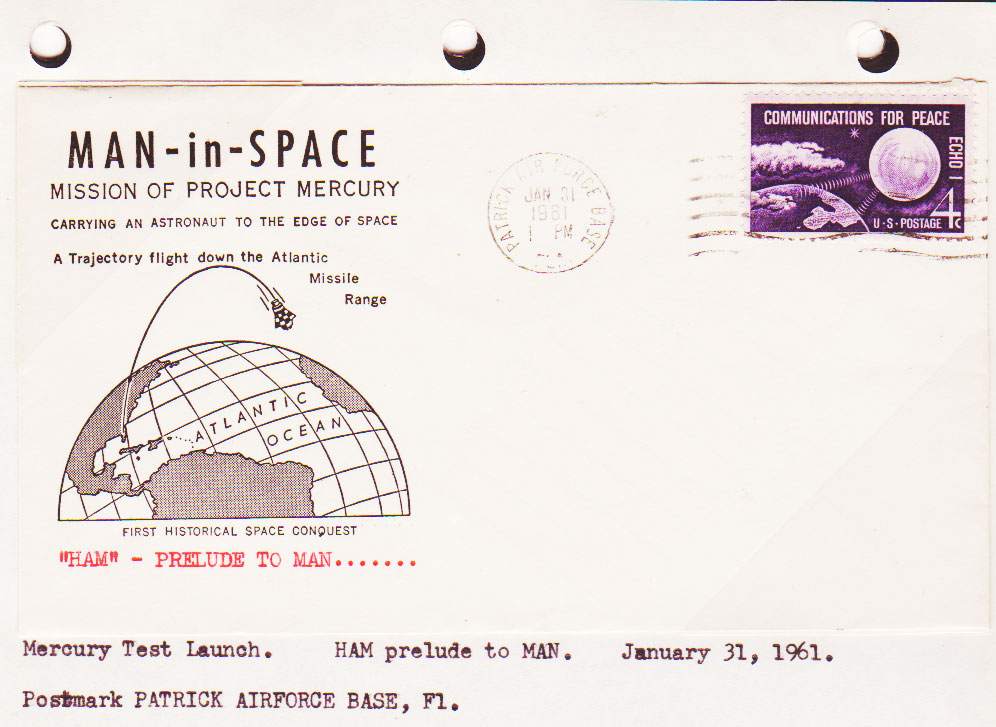
The first chimp in space, Ham
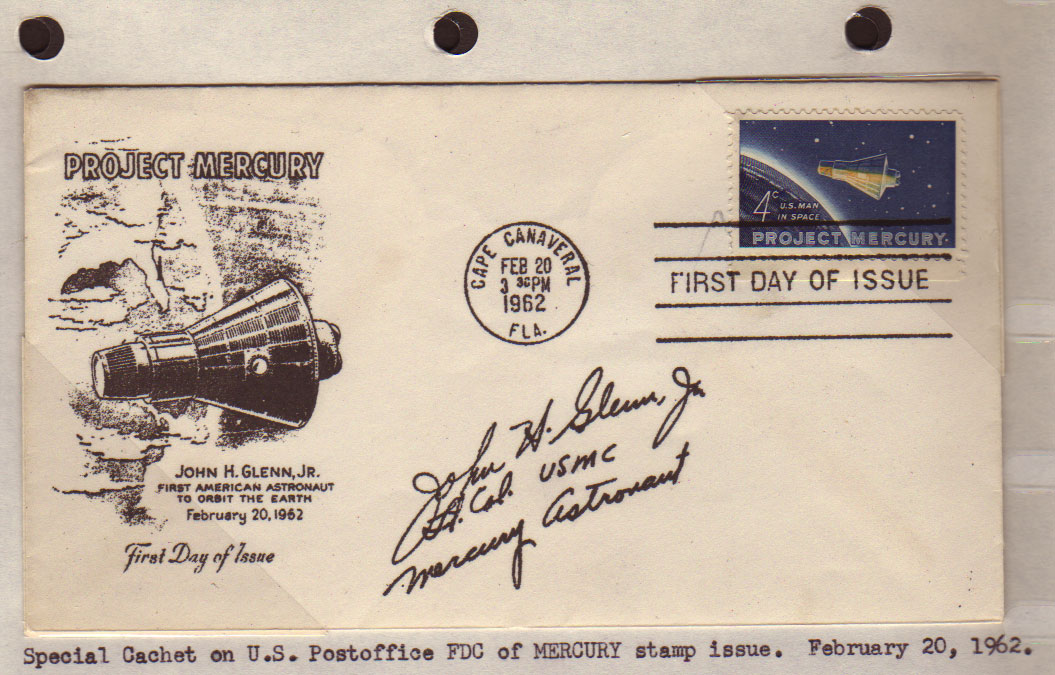
John Glen, first American to orbit the Earth
Gemini 3, first manned launch of the program
Gemini 4, first American EVA or “spacewalk”.
More examples
The Apollo program marked a particular zenith of astrophilately, with official stamp covers being included on flights. Apollo 15 contributed to this practice, with 243 official stamp covers. But the crew also carried an additional 400 unofficial covers on the flight through a deal made with German stamp collector, Hermann Sieger.
The terms of deal were this: upon completion of the mission, 100 of the unofficial covers were sold to Sieger for $7,000. Those 100 covers would be sold sometime after the Apollo program ended. The remaining 300 were to split among the 3 astronauts to use as they wished.
Problems arose when Seiger began selling his portion of the covers after the mission ended, not when the entire Apollo program ended, as previously agreed. When the astronauts learned of the sales, they returned the money to Sieger and asked him to cease selling the covers, but were ignored.
Eventually the sales became public, prompting Congress to call for investigations, citing the issue of personally profiting by US government employees. NASA demanded and received the covers from the astronauts, then pulled the crew from their backup duties on Apollo 17. They were all placed on administrative leave and not so subtly told they’d never fly in space again. Investigations by the Justice department, Congress and NASA found that neither federal laws nor NASA regulations were broken.
Dave Scott and Al Worden worked at NASA research centers for several years before moving into private business. Jim Irwin, moved by walking on the moon, completely left NASA and formed the High Flight Foundation, a Christian organization designed to spread the Word of God. He died in 1991, due a heart attack, purposes due one of the other negative firsts of Apollo 15, the heart problems Irwin had during the mission. Had he been on Earth would have placed him an ICU for a heart attack. Since he was in pure oxygen and weightless or low gravity environment, NASA doctors decided he was in the best possible place he could be for a heart attack and never informed him or the crew of the problems until some point after the crew returned to Earth.
As to the unofficial covers, they remained with NASA until the early 80s. In 1983 Al Worden filed suit against NASA for return of the covers, citing the partnership between the US Post OFfice and NASA to sell covers flown on the US Space Shuttle. The courts agreed and the covers were returned to the astronauts.
All three members of the crew have written autobiographies and mentioned the incident within. Scott offers a view different from NASA’s, Irwin never publicly commented, just shrugged his shoulders about it in his book and moved on, while Worden echoes Scott’s sentiments of raw deal. They weren't the first crew to profit by unofficial means, they were just the first to bring large scale notice to the practice.
How much are the covers worth today? Between $10-17 thousand each.
1: Andrew Chaikin, A Man on the Moon: The Voyages of the Apollo Astronauts (The Penquin Group, 1994), p 408


The mission was a spectacular success, publicly called "One of the most brilliant missions in space science ever flown". The crew was lauded and their future with NASA seemed assured.
Then the stamps hit the fan and Apollo 15 became the first US space crew that was ever fired.
The problem began years ago, back at the dawn of the space age. Philately, or stamp collecting, produced a subgenre, astrophilately, which specialized in studying stamps and postal history that were related to astronomy
Since the early part of the 20th century, the US Postal Service has been issuing postal stamps to commemorate American milestones in space. Examples include stamps for:
Palomar Mountain Observatory, commemorating “first light” of what was then the world’s largest telescope.
Robert Goddard, the “father” of rockets
Echo 1, the first communications satellite
The Mercury program, America’s first man in space program
Gemini program, the followup up to Mercury and precursor to Apollo
As more people became interested in the hobby, postal covers, cachets and cancellations were added to the types of items marking events or milestones. Covers were particularly popular. With a cover, an envelope with words and art would be mailed on the particular day of an event, thus postmarking it for historical purposes.
Examples include:
The first chimp in space, Ham
John Glen, first American to orbit the Earth
Gemini 3, first manned launch of the program

Gemini 4, first American EVA or “spacewalk”.
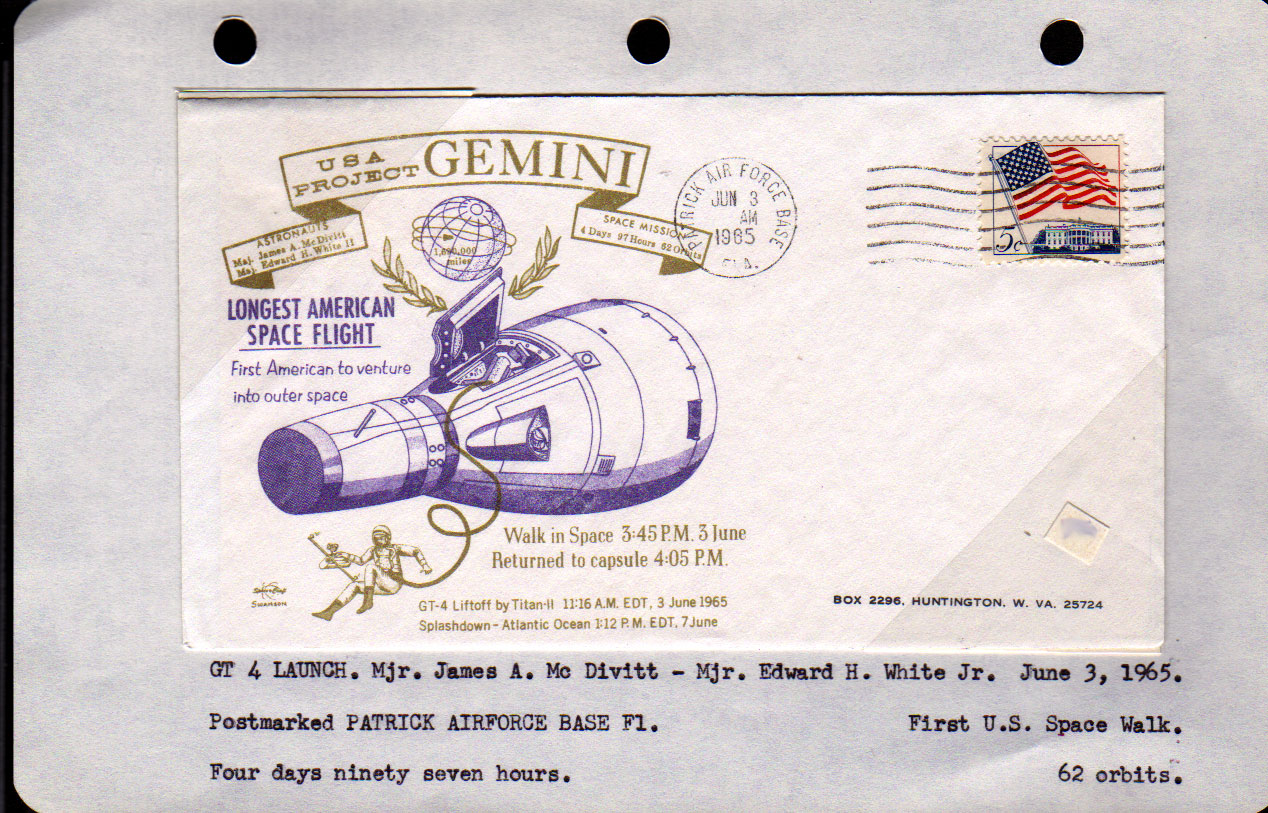
More examples
The Apollo program marked a particular zenith of astrophilately, with official stamp covers being included on flights. Apollo 15 contributed to this practice, with 243 official stamp covers. But the crew also carried an additional 400 unofficial covers on the flight through a deal made with German stamp collector, Hermann Sieger.
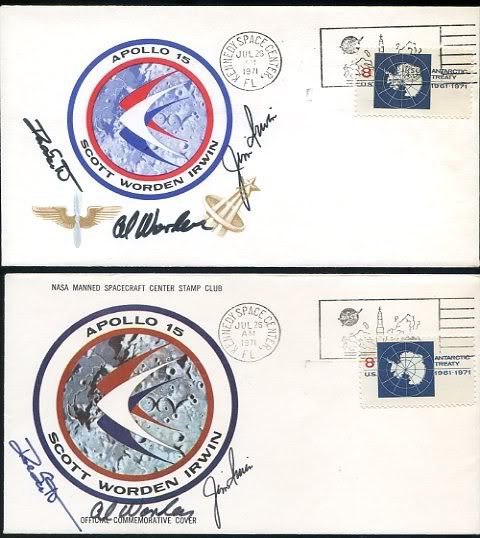

The terms of deal were this: upon completion of the mission, 100 of the unofficial covers were sold to Sieger for $7,000. Those 100 covers would be sold sometime after the Apollo program ended. The remaining 300 were to split among the 3 astronauts to use as they wished.
Problems arose when Seiger began selling his portion of the covers after the mission ended, not when the entire Apollo program ended, as previously agreed. When the astronauts learned of the sales, they returned the money to Sieger and asked him to cease selling the covers, but were ignored.
Eventually the sales became public, prompting Congress to call for investigations, citing the issue of personally profiting by US government employees. NASA demanded and received the covers from the astronauts, then pulled the crew from their backup duties on Apollo 17. They were all placed on administrative leave and not so subtly told they’d never fly in space again. Investigations by the Justice department, Congress and NASA found that neither federal laws nor NASA regulations were broken.
Dave Scott and Al Worden worked at NASA research centers for several years before moving into private business. Jim Irwin, moved by walking on the moon, completely left NASA and formed the High Flight Foundation, a Christian organization designed to spread the Word of God. He died in 1991, due a heart attack, purposes due one of the other negative firsts of Apollo 15, the heart problems Irwin had during the mission. Had he been on Earth would have placed him an ICU for a heart attack. Since he was in pure oxygen and weightless or low gravity environment, NASA doctors decided he was in the best possible place he could be for a heart attack and never informed him or the crew of the problems until some point after the crew returned to Earth.
As to the unofficial covers, they remained with NASA until the early 80s. In 1983 Al Worden filed suit against NASA for return of the covers, citing the partnership between the US Post OFfice and NASA to sell covers flown on the US Space Shuttle. The courts agreed and the covers were returned to the astronauts.

All three members of the crew have written autobiographies and mentioned the incident within. Scott offers a view different from NASA’s, Irwin never publicly commented, just shrugged his shoulders about it in his book and moved on, while Worden echoes Scott’s sentiments of raw deal. They weren't the first crew to profit by unofficial means, they were just the first to bring large scale notice to the practice.
How much are the covers worth today? Between $10-17 thousand each.
1: Andrew Chaikin, A Man on the Moon: The Voyages of the Apollo Astronauts (The Penquin Group, 1994), p 408
Fantastic. Thanks!
posted by foxywombat at 5:51 AM on December 2, 2011
posted by foxywombat at 5:51 AM on December 2, 2011
Brandon Blatcher throwing down for December. Well done. Nice post.
An additional 400 unofficial covers on the flight
That's a bit more than a souvenir. It's an unauthorized weight of a kilogram or more and I could see how NASA would not care for that.
But is also shows that even in the height of space hysteria, those astronauts couldn't make a decent living apart from making commercials for Tang and other crap. Some of them even resorted to pilfering: Apollo astronaut Edgar Mitchell has decided to give up the camera he kept as a memento of his 1971 moon mission rather than face a federal lawsuit over its ownership.
posted by three blind mice at 5:52 AM on December 2, 2011 [2 favorites]
An additional 400 unofficial covers on the flight
That's a bit more than a souvenir. It's an unauthorized weight of a kilogram or more and I could see how NASA would not care for that.
But is also shows that even in the height of space hysteria, those astronauts couldn't make a decent living apart from making commercials for Tang and other crap. Some of them even resorted to pilfering: Apollo astronaut Edgar Mitchell has decided to give up the camera he kept as a memento of his 1971 moon mission rather than face a federal lawsuit over its ownership.
posted by three blind mice at 5:52 AM on December 2, 2011 [2 favorites]
This is an amazing post about one of the best Apollo missions (in terms of science done) which was unfortunately tainted by the stamp thing.
The episode of From The Earth To The Moon that covers this mission (Galileo Was Right) is one of the better ones. The way the three of them go from hot shot pilot to real geologists, thanks to their training, is wonderful. It's also a good portrayal of the competition between the rocket guys and the scientists.
posted by bondcliff at 5:55 AM on December 2, 2011 [1 favorite]
The episode of From The Earth To The Moon that covers this mission (Galileo Was Right) is one of the better ones. The way the three of them go from hot shot pilot to real geologists, thanks to their training, is wonderful. It's also a good portrayal of the competition between the rocket guys and the scientists.
posted by bondcliff at 5:55 AM on December 2, 2011 [1 favorite]
I recall watching the feather/hammer drop live as a kid and really getting excited seeing it work as advertised. Even though you "know" it should work, because it's what you've been taught, seeing it actually happen violates everything your lizard brain tells you should happen.
So cool.
posted by Thorzdad at 5:57 AM on December 2, 2011 [2 favorites]
So cool.
posted by Thorzdad at 5:57 AM on December 2, 2011 [2 favorites]
Good gosh this is a fine post. Wait are profiting from this?
posted by joinks at 5:57 AM on December 2, 2011
posted by joinks at 5:57 AM on December 2, 2011
That's what surprises me--bringing unauthorized heavy objects onto a space flight doesn't break NASA rules?
posted by Holy Zarquon's Singing Fish at 5:58 AM on December 2, 2011
posted by Holy Zarquon's Singing Fish at 5:58 AM on December 2, 2011
IIRC, there was always a certain amount of space/weight allocated for personal souvenirs; the issue was whether astronauts could then go and profit from bringing them. Apollo 13 CMP Jack Swigert got caught up in the same mess.
posted by mcwetboy at 6:01 AM on December 2, 2011
posted by mcwetboy at 6:01 AM on December 2, 2011
That's what surprises me--bringing unauthorized heavy objects onto a space flight doesn't break NASA rules?
Oh it does, but it's also somewhat of a tradition.
posted by bondcliff at 6:02 AM on December 2, 2011 [1 favorite]
Oh it does, but it's also somewhat of a tradition.
posted by bondcliff at 6:02 AM on December 2, 2011 [1 favorite]
Okay I guess the form of a phenomenal Metafilter post is a little bit clearer now. Unbelievable post.
posted by scunning at 6:07 AM on December 2, 2011
posted by scunning at 6:07 AM on December 2, 2011
I don't know about the corned-beef sandwich bondcliff. The last paragraph caught my eye:
In hindsight, it might look as if a mountain was made out of the proverbial molehill, but the response of officials in light of unofficial food in orbit shows how high tensions were in the 1960's. There was little room for error and any free variables in human spaceflight plans were kept to a minimum. So when an astronaut took it upon himself to pack his own lunch, it became an intolerable act of disrespect rather than being a funny stunt.
posted by three blind mice at 6:19 AM on December 2, 2011 [1 favorite]
In hindsight, it might look as if a mountain was made out of the proverbial molehill, but the response of officials in light of unofficial food in orbit shows how high tensions were in the 1960's. There was little room for error and any free variables in human spaceflight plans were kept to a minimum. So when an astronaut took it upon himself to pack his own lunch, it became an intolerable act of disrespect rather than being a funny stunt.
posted by three blind mice at 6:19 AM on December 2, 2011 [1 favorite]
Of the ridiculous amount of time I spend on the web, MeFi is one of the very few places I visit daily, and exceptional posts like this are the main reason. Superb.
posted by dbiedny at 6:43 AM on December 2, 2011
posted by dbiedny at 6:43 AM on December 2, 2011
He was in 'pure oxygen'? Is that possible to breathe?
posted by spicynuts at 6:57 AM on December 2, 2011
posted by spicynuts at 6:57 AM on December 2, 2011
If it weren't, oxygen masks would be kind of useless.
posted by Holy Zarquon's Singing Fish at 7:10 AM on December 2, 2011 [1 favorite]
posted by Holy Zarquon's Singing Fish at 7:10 AM on December 2, 2011 [1 favorite]
I'm guessing that NASA's somewhat heavy-handed treatment of the crew was mainly a PR move. This was a time when the public's support for Apollo and NASA was waning, missions were on the chopping block -- NASA wanted to preserve the squeaky-clean astronaut image. These were heroes, not hedge fund managers.
But, whatever. Best mission evar, A+++.
posted by RobotVoodooPower at 7:11 AM on December 2, 2011 [1 favorite]
But, whatever. Best mission evar, A+++.
posted by RobotVoodooPower at 7:11 AM on December 2, 2011 [1 favorite]
I concur with all the commenters who loved this post. Fantastic.
The Apollo 15 crew were arguably not the first crew fired. The Apollo 7 crew (Schirra, Cunningham, Eisele) never flew again after squabbling with Mission Control throughout the mission. Original Mercury astronauts Scott Carpenter and Gordon Cooper also were taken off the flight schedules after messing up on a mission (Carpenter) or refusing to participate in training (Cooper). In most of these cases, though, the astronauts weren't fired - just not put on the flight schedule, leaving them to figure it out. Awfully passive-aggressive of the NASA brass.
On the other hand, John Young did not suffer any consequences for the corned beef sandwich. He went on to command another Gemini mission, fly to the moon - TWICE - and then command the first flight of the space shuttle. There's a lesson in there somewhere ...
posted by zomg at 7:13 AM on December 2, 2011 [1 favorite]
The Apollo 15 crew were arguably not the first crew fired. The Apollo 7 crew (Schirra, Cunningham, Eisele) never flew again after squabbling with Mission Control throughout the mission. Original Mercury astronauts Scott Carpenter and Gordon Cooper also were taken off the flight schedules after messing up on a mission (Carpenter) or refusing to participate in training (Cooper). In most of these cases, though, the astronauts weren't fired - just not put on the flight schedule, leaving them to figure it out. Awfully passive-aggressive of the NASA brass.
On the other hand, John Young did not suffer any consequences for the corned beef sandwich. He went on to command another Gemini mission, fly to the moon - TWICE - and then command the first flight of the space shuttle. There's a lesson in there somewhere ...
posted by zomg at 7:13 AM on December 2, 2011 [1 favorite]
If it weren't, oxygen masks would be kind of useless.
My experience with oxygen masks is that they deliver a mix of air and oxygen. Tanks for scuba are air, not oxygen. Masks in the ER have a slider on them to allow regulation of the mix of fresh air with pure oxygen. This is why I was confused. So it's not going to affect cognition to breathe nothing but pure oxygen for an extended period?
posted by spicynuts at 7:16 AM on December 2, 2011
Apparently they get used to it, spicynuts. Also it's at a lower-than-atmospheric pressure, which makes a difference. They use pure oxygen on spacewalks now, still. In case of a small suit puncture the astronauts will not suffer the bends (nitrogen coming out of solution in the blood and forming bubbles) when the pressure drops.
posted by zomg at 7:21 AM on December 2, 2011 [2 favorites]
posted by zomg at 7:21 AM on December 2, 2011 [2 favorites]
Oh man, stamp collecting. With the decreased use of snail mail in general, and the introduction of sticker stamps a decade ago or so, I'd say that it's probably on its last breaths.
However, the truth is it has been on a long decline. It was huge in the 50s, and it lead to many people "investing" in stamps with the belief that they would always increase in value over their face value.
This proved to be uncorrect. I often went to a store that featured arts and crafts but oddly had a small corner devoted to stamp collecting. The lady there must have been a philatelist, that's the only reason I could see for hanging out there day after day when I was pretty much the only person who stopped by. Turns out she was the owner of the store, which is why she could do what she wanted, I guess. One day I noticed she was sealing up a bunch of letters and affixing stamps to them in small denominations. This was back when you could send a letter for less than 30 cents, so it had a couple of 10s, a few 5s, some 2s, some 1s. I asked her about it. She said that people went crazy back in the day, hoarding sheets and sheets of stamps. Decades later, they found themselves with sheets and sheets of stamps with no appreciable value. So they would sell them off, often below face value, and so as a result she had sheets and sheets of rather uninteresting stamps that she used for all store correspondence.
This is a fascinating post and I will have to read through the links thoroughly at some point, but honestly as someone who once collected stamps the whole hobby seems very depressing to me. It's like being a member of the Milli Vanilli fan club.
posted by Deathalicious at 7:21 AM on December 2, 2011 [2 favorites]
However, the truth is it has been on a long decline. It was huge in the 50s, and it lead to many people "investing" in stamps with the belief that they would always increase in value over their face value.
This proved to be uncorrect. I often went to a store that featured arts and crafts but oddly had a small corner devoted to stamp collecting. The lady there must have been a philatelist, that's the only reason I could see for hanging out there day after day when I was pretty much the only person who stopped by. Turns out she was the owner of the store, which is why she could do what she wanted, I guess. One day I noticed she was sealing up a bunch of letters and affixing stamps to them in small denominations. This was back when you could send a letter for less than 30 cents, so it had a couple of 10s, a few 5s, some 2s, some 1s. I asked her about it. She said that people went crazy back in the day, hoarding sheets and sheets of stamps. Decades later, they found themselves with sheets and sheets of stamps with no appreciable value. So they would sell them off, often below face value, and so as a result she had sheets and sheets of rather uninteresting stamps that she used for all store correspondence.
This is a fascinating post and I will have to read through the links thoroughly at some point, but honestly as someone who once collected stamps the whole hobby seems very depressing to me. It's like being a member of the Milli Vanilli fan club.
posted by Deathalicious at 7:21 AM on December 2, 2011 [2 favorites]
Great post, and confirms one of life's great truths: philately will get you nowhere.
posted by MuffinMan at 7:24 AM on December 2, 2011 [4 favorites]
posted by MuffinMan at 7:24 AM on December 2, 2011 [4 favorites]
Thanks, zomg...interesting. I had always been told that pure oxygen would impair brain function.
posted by spicynuts at 7:25 AM on December 2, 2011
posted by spicynuts at 7:25 AM on December 2, 2011
Great post, and confirms one of life's great truths: philately will get you nowhere.
Yeah..just ask Monica Lewinsky.
posted by spicynuts at 7:25 AM on December 2, 2011 [1 favorite]
Technicality:
...Genesis Rock, a piece the moon's primordial crust, formed only 100 million years after the solar system itself.
It was originally thought they had found a piece of the Moon's primordial crust, but later analysis initially showed that the rock was only 4.1 ± 0.1 billion years old, which is younger than the Moon itself; and was formed after the Moon's crust solidified.
spicynuts: He was in 'pure oxygen'? Is that possible to breathe?
...
My experience with oxygen masks is that they deliver a mix of air and oxygen. Tanks for scuba are air, not oxygen. Masks in the ER have a slider on them to allow regulation of the mix of fresh air with pure oxygen. This is why I was confused. So it's not going to affect cognition to breathe nothing but pure oxygen for an extended period?
The problem with breathing pure oxygen is that things burn violently and easily in it, so the slightest spark has the potential to flame your face and lungs. The oxygen won't burn by itself, of course, but the third leg - combustibles - are almost omnipresent.
So, in a hospital, "patient dies screaming in fireball while family looks on helplessly" is a real possibility. Underwater, it's still risky - hypothetically, some metal could collide with metal in the plumbing... But in space, where every gram of "filler" gas (nitrogen or helium or whatever) costs big bucks to get there, pure O2 it is.
Fortunately, NASA's space suits were a "No Smoking"-zone, long before it became fashionable in other public places.
posted by IAmBroom at 7:29 AM on December 2, 2011
...Genesis Rock, a piece the moon's primordial crust, formed only 100 million years after the solar system itself.
It was originally thought they had found a piece of the Moon's primordial crust, but later analysis initially showed that the rock was only 4.1 ± 0.1 billion years old, which is younger than the Moon itself; and was formed after the Moon's crust solidified.
spicynuts: He was in 'pure oxygen'? Is that possible to breathe?
...
My experience with oxygen masks is that they deliver a mix of air and oxygen. Tanks for scuba are air, not oxygen. Masks in the ER have a slider on them to allow regulation of the mix of fresh air with pure oxygen. This is why I was confused. So it's not going to affect cognition to breathe nothing but pure oxygen for an extended period?
The problem with breathing pure oxygen is that things burn violently and easily in it, so the slightest spark has the potential to flame your face and lungs. The oxygen won't burn by itself, of course, but the third leg - combustibles - are almost omnipresent.
So, in a hospital, "patient dies screaming in fireball while family looks on helplessly" is a real possibility. Underwater, it's still risky - hypothetically, some metal could collide with metal in the plumbing... But in space, where every gram of "filler" gas (nitrogen or helium or whatever) costs big bucks to get there, pure O2 it is.
Fortunately, NASA's space suits were a "No Smoking"-zone, long before it became fashionable in other public places.
posted by IAmBroom at 7:29 AM on December 2, 2011
Fortunately, NASA's space suits were a "No Smoking"-zone, long before it became fashionable in other public places.
I was under the impression that after the Apollo 1 fire, they added some nitrogen to the mix as the astronauts threatened to strike or something.
posted by hoyland at 7:33 AM on December 2, 2011
I was under the impression that after the Apollo 1 fire, they added some nitrogen to the mix as the astronauts threatened to strike or something.
posted by hoyland at 7:33 AM on December 2, 2011
That's what surprises me--bringing unauthorized heavy objects onto a space flight doesn't break NASA rules?
There's a back story here, one I couldn't find any good links on it for the full story, I've only come across it in astronaut biographies or autobiographies.
Apollo 14 narrowly avoided a similar scandal. The astronauts took some extra medallions into space, with the full intent of selling them for profit. NASA caught wind of it and did...something. Not sure if they made the astronauts give up their cache or what. Also, somewhere there's paperwork where NASA admits to knowing or finding out previous instances of Apollo astronauts profiting from stuff they took into space, but they didn't name the astronauts.
After the Apollo 15 incident, NASA wrote rules about what an astronaut could bring aboard.
What's odd about the mission is that Deke Slayton, head of the astronaut office, had to personally sign off on the PPK's (Personal Preference Kit), the pouch of personal items that astronauts carried into space. Only Slayton and the astronauts would know what were in the kits and only astronaut could make the contents public.
Supposedly there is no paperwork for the Apollo 15 PPKs (I can't verify this, it's what I recall reading in books written by Scott and Slayton, who seem to detest each other). There was an oversight, for reasons still unknown. Scott swears there was no way they could have snuck the covers aboard without someone knowing, citing the way they were intimately dressed by support personal on launch day. But he also later admitted to carrying the covers himself in a pocket of his spacesuit.
The Apollo 15 crew were arguably not the first crew fired. The Apollo 7 crew (Schirra, Cunningham, Eisele) never flew again after squabbling with Mission Control throughout the mission.
The Apollo 7 crew doesn't count in my book, because Schirra explicitly stated he would be retiring after the flight about 3 weeks before the mission launched, so they couldn't fire him from anything. Eisele served on the backup crew of Apollo 10, before being pushed out the door. Cunningham went on to head up the Apollo Aplications program, which morphed into Skylab. He probably would have flown there, if astronaut Pete Conrad, a three time vet of spaceflight, decided to make Skylab his and basically muscled Cunningham out as head of the program. According to Flight Director Chris Kraft, who had originally stated he didn't want any members of Apollo 7 flying again (and killed Scott Carpenter's career), Cunningham came to him and said he was stuck between a rock and hard place, what with his commander, Schirra, being argumentative, so he had no choice but to follow order of his immediate superior. Kraft said he understood and was willing to give him another shot.
Carpenter was a single person, hence I didn't count him as the plural crew. Cooper flew two missions total and was muscled out by Alan Shepard for command of Apollo 14, though Cooper's poor performance as backup Commander of Apollo 10 didn't hurt.
The Apollo 15 crew was scheduled to back up Apollo 17 (which was sort of dead end gig since it was going to be the last lunar mission) and then pulled off that once the stamp scandal broke out. Scott was part of the Apollo-Soyuz project and supposedly was a contender to command the mission, but the stamp scandal squashed that. Irwin left and Worden was moved to a non-flight position. In one of the last links of the original post, Worden describes it as firing.
He was in 'pure oxygen'? Is that possible to breathe?
Yeah, but it has incredible risks, as seen in the tragic Apollo 1 fire. All of the Apollo missions flew with 100% oxygen.
I was under the impression that after the Apollo 1 fire, they added some nitrogen to the mix as the astronauts threatened to strike or something.
Nope, was deemed too expensive to revamp, so they kept it, but made the cabin about as fireproof as possible. I think they changed environment for the Shuttle.
Brandon Blatcher throwing down for December. Well done. Nice post.
I've been thinking of doing this particular post since April. The awesome post contest is nice and all, and winning would be totally sweet for bragging rights, but if I happen to win anything, the prize will be donated to another MeFite. I still intend to make lots of posts in December, just for kicks and the spirit of the season or some shit like that.
posted by Brandon Blatcher at 7:39 AM on December 2, 2011 [3 favorites]
There's a back story here, one I couldn't find any good links on it for the full story, I've only come across it in astronaut biographies or autobiographies.
Apollo 14 narrowly avoided a similar scandal. The astronauts took some extra medallions into space, with the full intent of selling them for profit. NASA caught wind of it and did...something. Not sure if they made the astronauts give up their cache or what. Also, somewhere there's paperwork where NASA admits to knowing or finding out previous instances of Apollo astronauts profiting from stuff they took into space, but they didn't name the astronauts.
After the Apollo 15 incident, NASA wrote rules about what an astronaut could bring aboard.
What's odd about the mission is that Deke Slayton, head of the astronaut office, had to personally sign off on the PPK's (Personal Preference Kit), the pouch of personal items that astronauts carried into space. Only Slayton and the astronauts would know what were in the kits and only astronaut could make the contents public.
Supposedly there is no paperwork for the Apollo 15 PPKs (I can't verify this, it's what I recall reading in books written by Scott and Slayton, who seem to detest each other). There was an oversight, for reasons still unknown. Scott swears there was no way they could have snuck the covers aboard without someone knowing, citing the way they were intimately dressed by support personal on launch day. But he also later admitted to carrying the covers himself in a pocket of his spacesuit.
The Apollo 15 crew were arguably not the first crew fired. The Apollo 7 crew (Schirra, Cunningham, Eisele) never flew again after squabbling with Mission Control throughout the mission.
The Apollo 7 crew doesn't count in my book, because Schirra explicitly stated he would be retiring after the flight about 3 weeks before the mission launched, so they couldn't fire him from anything. Eisele served on the backup crew of Apollo 10, before being pushed out the door. Cunningham went on to head up the Apollo Aplications program, which morphed into Skylab. He probably would have flown there, if astronaut Pete Conrad, a three time vet of spaceflight, decided to make Skylab his and basically muscled Cunningham out as head of the program. According to Flight Director Chris Kraft, who had originally stated he didn't want any members of Apollo 7 flying again (and killed Scott Carpenter's career), Cunningham came to him and said he was stuck between a rock and hard place, what with his commander, Schirra, being argumentative, so he had no choice but to follow order of his immediate superior. Kraft said he understood and was willing to give him another shot.
Carpenter was a single person, hence I didn't count him as the plural crew. Cooper flew two missions total and was muscled out by Alan Shepard for command of Apollo 14, though Cooper's poor performance as backup Commander of Apollo 10 didn't hurt.
The Apollo 15 crew was scheduled to back up Apollo 17 (which was sort of dead end gig since it was going to be the last lunar mission) and then pulled off that once the stamp scandal broke out. Scott was part of the Apollo-Soyuz project and supposedly was a contender to command the mission, but the stamp scandal squashed that. Irwin left and Worden was moved to a non-flight position. In one of the last links of the original post, Worden describes it as firing.
He was in 'pure oxygen'? Is that possible to breathe?
Yeah, but it has incredible risks, as seen in the tragic Apollo 1 fire. All of the Apollo missions flew with 100% oxygen.
I was under the impression that after the Apollo 1 fire, they added some nitrogen to the mix as the astronauts threatened to strike or something.
Nope, was deemed too expensive to revamp, so they kept it, but made the cabin about as fireproof as possible. I think they changed environment for the Shuttle.
Brandon Blatcher throwing down for December. Well done. Nice post.
I've been thinking of doing this particular post since April. The awesome post contest is nice and all, and winning would be totally sweet for bragging rights, but if I happen to win anything, the prize will be donated to another MeFite. I still intend to make lots of posts in December, just for kicks and the spirit of the season or some shit like that.
posted by Brandon Blatcher at 7:39 AM on December 2, 2011 [3 favorites]
Awesome post that I'll have to dive into after work.
(Somebody wants himself an iPad!)
posted by The Deej at 7:41 AM on December 2, 2011
(Somebody wants himself an iPad!)
posted by The Deej at 7:41 AM on December 2, 2011
The problem with using pure oxygen in the Apollo cabin wasn't the fact that it was pure oxygen, it was the pressure. In space the cabin was pressurized at 5 psi, which isn't all that more dangerous than regular air; on the launch pad, to maintain outward pressure at sea level, the cabin was pressurized at 16 psi, which made things considerably more flammable. The post-Apollo 1 redesign added 40% nitrogen at sea-level air pressure for the launch, which was vented/purged/replaced with a 5 psi pure oxygen atmosphere once in space. [1, 2]
posted by mcwetboy at 7:52 AM on December 2, 2011 [1 favorite]
posted by mcwetboy at 7:52 AM on December 2, 2011 [1 favorite]
So it's not going to affect cognition to breathe nothing but pure oxygen for an extended period?
Instead of 1 atmosphere of 20% oxygen, they use 20% atmosphere of pure oxygen. Partial pressure is the same, so the body mostly don't give a shit.
posted by ROU_Xenophobe at 8:13 AM on December 2, 2011 [2 favorites]
Instead of 1 atmosphere of 20% oxygen, they use 20% atmosphere of pure oxygen. Partial pressure is the same, so the body mostly don't give a shit.
posted by ROU_Xenophobe at 8:13 AM on December 2, 2011 [2 favorites]
Thanks, zomg...interesting. I had always been told that pure oxygen would impair brain function.
For oxygen exposure the key is the partial pressure, not the concentration.
At high partial pressures, it can cause seizures extended exposure can also cause respiratory irritation. While in space the capsule was at high % Oxygen but low overall pressure so that the ppO2 wasn't much higher than on Earth.
Some SCUBA divers breathe pure oxygen at very shallow depths for decompression, but accidentally breathing from a high O2 deco cylinder at depth is usually quickly fatal because the total combination of high pressure and high % O2 leads to high ppO2.
posted by atrazine at 8:14 AM on December 2, 2011
For oxygen exposure the key is the partial pressure, not the concentration.
At high partial pressures, it can cause seizures extended exposure can also cause respiratory irritation. While in space the capsule was at high % Oxygen but low overall pressure so that the ppO2 wasn't much higher than on Earth.
Some SCUBA divers breathe pure oxygen at very shallow depths for decompression, but accidentally breathing from a high O2 deco cylinder at depth is usually quickly fatal because the total combination of high pressure and high % O2 leads to high ppO2.
posted by atrazine at 8:14 AM on December 2, 2011
My jaw is literally agape with the depth and intricacy of this part of history that I have just been fed. What an amazing story.
I hear the ethics and engineering issues, but really feel like NASA (and Congress) could have more allowance for the fact that these people (all admirable and courageous, but still subject to the same frailties and temptations of us all) were going into fucking space, and would want to get what they could out of this inexpressibly rare experience, each in their own way. But that's just me.
posted by dry white toast at 8:29 AM on December 2, 2011
I hear the ethics and engineering issues, but really feel like NASA (and Congress) could have more allowance for the fact that these people (all admirable and courageous, but still subject to the same frailties and temptations of us all) were going into fucking space, and would want to get what they could out of this inexpressibly rare experience, each in their own way. But that's just me.
posted by dry white toast at 8:29 AM on December 2, 2011
but really feel like NASA (and Congress) could have more allowance for the fact that these people (all admirable and courageous, but still subject to the same frailties and temptations of us all) were going into fucking space, and would want to get what they could out of this inexpressibly rare experience, each in their own way. But that's just me.
I think this is exactly the reason they didn't tolerate it. I remember reading an interview with one of the flight directors, where he talked about how there were no personal items on any of the mission control consoles. No stuffed animals, photos of kids, or mementos of any kind. His quote was something like "We launch rockets in this room. We have to take it seriously."
posted by bondcliff at 8:33 AM on December 2, 2011
I think this is exactly the reason they didn't tolerate it. I remember reading an interview with one of the flight directors, where he talked about how there were no personal items on any of the mission control consoles. No stuffed animals, photos of kids, or mementos of any kind. His quote was something like "We launch rockets in this room. We have to take it seriously."
posted by bondcliff at 8:33 AM on December 2, 2011
I will have to contest the fact that the first J-mission astronauts were also the first ones to be "fired". James McDivitt from Apollo 9 resigned from NASA right around the same time as the Alfred Worden and James Irwin for his stance against Gene Cernan flying on Apollo 17. Dave Scott stayed with NASA for quite some time (though he wasn't allowed to fly) after Apollo 15, and Worden left NASA in 1975. I would venture to say that McDivitt could arguably be the first "fired" Apollo astronaut by resigning in 1972.
On a completely unrelated note and to lighten the mood a bit, I recently went to Kennedy Space Center for the Astronaut Autograph event. I asked Mr. Scott and Mr. Worden a very important question: "Are you a turtle?"
Mr. Scott is an old fashioned guy who wouldn't swear in front of a woman, said "I used to be." But Mr. Worden, being a straight shooter that he has always been, looked down and said sheepishly, "You bet your sweet ass I am!"
So Mr. Scott now owes me a drink. XD
posted by vnvlain at 8:34 AM on December 2, 2011 [2 favorites]
On a completely unrelated note and to lighten the mood a bit, I recently went to Kennedy Space Center for the Astronaut Autograph event. I asked Mr. Scott and Mr. Worden a very important question: "Are you a turtle?"
Mr. Scott is an old fashioned guy who wouldn't swear in front of a woman, said "I used to be." But Mr. Worden, being a straight shooter that he has always been, looked down and said sheepishly, "You bet your sweet ass I am!"
So Mr. Scott now owes me a drink. XD
posted by vnvlain at 8:34 AM on December 2, 2011 [2 favorites]
But you can't let Federal Employees get away with making money! Ever! Even if it doesn't cost us a dime. They're just not natural people, see.
posted by saulgoodman at 8:34 AM on December 2, 2011 [1 favorite]
posted by saulgoodman at 8:34 AM on December 2, 2011 [1 favorite]
(That hamburger was for dry white toast up here).
Agree with the consensus: really cool post, BB
posted by saulgoodman at 8:36 AM on December 2, 2011
Agree with the consensus: really cool post, BB
posted by saulgoodman at 8:36 AM on December 2, 2011
Tanks for scuba are air, not oxygen. Masks in the ER have a slider on them to allow regulation of the mix of fresh air with pure oxygen. This is why I was confused. So it's not going to affect cognition to breathe nothing but pure oxygen for an extended period?
The reason SCUBA tanks are usually for air is that it's all around us, easy and cheap. All you need is a compressor. However, at sufficiently high pressure, nitrogen becomes toxic (causing nitrogen narcosis), and therefore, if you're going down deep enough or long enough, you need mixed-gas. First there's Nitrox, which normal air technically is, but which divers use to refer to air that's enriched in oxygen relative to nitrogen. The diver's risk of the bends and nitrogen narcosis is reduced using an oxygen-rich mixture.
However, there remains a danger of Oxygen Toxicity. "Central nervous system toxicity is caused by short exposure to high concentrations of oxygen at greater than atmospheric pressure." For this reason, for certain kinds of technical diving, tri-mix (noble gas, nitrogen, and oxygen), or Heliox, Argox, or other mixes, are used. To the best of my knowledge the noble gases are all biologically safe (except radon, of course.)
TL, DR: yes, oxygen can be toxic, but the problem is NOT that pure oxygen is being breathed; it's the high partial pressure. I think you can breath pure oxygen forever, so long as it's at the right pressure and no one lights a match.
posted by endless_forms at 8:44 AM on December 2, 2011
The reason SCUBA tanks are usually for air is that it's all around us, easy and cheap. All you need is a compressor. However, at sufficiently high pressure, nitrogen becomes toxic (causing nitrogen narcosis), and therefore, if you're going down deep enough or long enough, you need mixed-gas. First there's Nitrox, which normal air technically is, but which divers use to refer to air that's enriched in oxygen relative to nitrogen. The diver's risk of the bends and nitrogen narcosis is reduced using an oxygen-rich mixture.
However, there remains a danger of Oxygen Toxicity. "Central nervous system toxicity is caused by short exposure to high concentrations of oxygen at greater than atmospheric pressure." For this reason, for certain kinds of technical diving, tri-mix (noble gas, nitrogen, and oxygen), or Heliox, Argox, or other mixes, are used. To the best of my knowledge the noble gases are all biologically safe (except radon, of course.)
TL, DR: yes, oxygen can be toxic, but the problem is NOT that pure oxygen is being breathed; it's the high partial pressure. I think you can breath pure oxygen forever, so long as it's at the right pressure and no one lights a match.
posted by endless_forms at 8:44 AM on December 2, 2011
I will have to contest the fact that the first J-mission astronauts were also the first ones to be "fired". James McDivitt from Apollo 9 resigned from NASA right around the same time as the Alfred Worden and James Irwin for his stance against Gene Cernan flying on Apollo 17.
McDivitt had the choice of walking on the moon with Apollo 14 or 17, but refused to take a subordinate role. He had always been commander of his missions (Gemini 4 and Apollo 9) and had no intention of taking a back seat on any future ones.
This is according to Chris Kraft in his auto-biography, who thought highly of McDivitt and was annoyed that he'd quit over something like the decision of naming Cernan as commander of Apollo 17.
posted by Brandon Blatcher at 8:59 AM on December 2, 2011 [1 favorite]
McDivitt had the choice of walking on the moon with Apollo 14 or 17, but refused to take a subordinate role. He had always been commander of his missions (Gemini 4 and Apollo 9) and had no intention of taking a back seat on any future ones.
This is according to Chris Kraft in his auto-biography, who thought highly of McDivitt and was annoyed that he'd quit over something like the decision of naming Cernan as commander of Apollo 17.
posted by Brandon Blatcher at 8:59 AM on December 2, 2011 [1 favorite]
This is a great post, and weirdly timed as I was just thinking this morning about the Apollo missions. I'll always have kind of a soft spot for Jim Irwin. He was a member of my grandfather's Methodist congregation in Livingston, TX, and they stayed in touch for a while after my grandfather was assigned a different charge. He sent me an autographed copy of this little book after he wrote it, and I just can't think of anything my space-obsessed childhood self would have found more awesome short of going to the moon myself.
posted by invitapriore at 9:17 AM on December 2, 2011
posted by invitapriore at 9:17 AM on December 2, 2011
Brandon, I can't tell you how excited I get whenever I see one of your space posts. Well done, and what a fantastic story.
posted by Salieri at 9:26 AM on December 2, 2011
posted by Salieri at 9:26 AM on December 2, 2011
I think they changed environment for the Shuttle.
Yes, the Shuttle used an earth-standard 14 psi oxygen-nitrogen mix, as the ISS still does. Only during spacewalks did Shuttle astronauts breathe a low-psi oxygen-only atmosphere. (ISS spacewalkers breathe an 8.3 psi nitrox blend.)
posted by Mars Saxman at 10:16 AM on December 2, 2011
Yes, the Shuttle used an earth-standard 14 psi oxygen-nitrogen mix, as the ISS still does. Only during spacewalks did Shuttle astronauts breathe a low-psi oxygen-only atmosphere. (ISS spacewalkers breathe an 8.3 psi nitrox blend.)
posted by Mars Saxman at 10:16 AM on December 2, 2011
therefore, if you're going down deep enough or long enough, you need mixed-gas. First there's Nitrox, which normal air technically is, but which divers use to refer to air that's enriched in oxygen relative to nitrogen.
Nitrox lets you stay down longer without decompression, it does not let you dive deeper and actually has a shallower maximum operating depth than un-enriched air.
posted by atrazine at 10:35 AM on December 2, 2011
Nitrox lets you stay down longer without decompression, it does not let you dive deeper and actually has a shallower maximum operating depth than un-enriched air.
posted by atrazine at 10:35 AM on December 2, 2011
Then there was the guy who had sex on the moon.
posted by Obscure Reference at 10:54 AM on December 2, 2011 [1 favorite]
posted by Obscure Reference at 10:54 AM on December 2, 2011 [1 favorite]
"He was in 'pure oxygen'? Is that possible to breathe?"
Pure oxygen is breathable, but with pure O2 there are always concerns.
The primary problem is that high partial pressure of O2 can cause oxygen toxicity (both CNS and pulmonary). Dalton's law states that total pressure of a gas is the sum of the partial pressure of it's consituents. So for air at 1 atmosphere of pressure, which is roughly 21% O2 and 79% N2, partial pressure of O2 is 0.21 and N2 is 0.79. The recommended limit (in scuba) is 1.6 at rest, 1.4 when active, so pure O2 at sea level is no big deal. Scuba divers, can be exposed to greater pressures (1 additional atmosphere every 10m), and sometimes use Enriched Air which has more than 21% of oxygen, so when diving ppO2 should always be kept below 1.4. Pure O2 is used by some divers to accelerate decompression stops, and is breathed at 20'.
There's another fun thing with pure O2. Pure O2 (especially at high pressure) significantly lower the flashpoint of various materials. Almost anything will burn with O2 at a high enough pressure (metal included). So it's best not to use fire around pure O2.
posted by coust at 11:11 AM on December 2, 2011
Pure oxygen is breathable, but with pure O2 there are always concerns.
The primary problem is that high partial pressure of O2 can cause oxygen toxicity (both CNS and pulmonary). Dalton's law states that total pressure of a gas is the sum of the partial pressure of it's consituents. So for air at 1 atmosphere of pressure, which is roughly 21% O2 and 79% N2, partial pressure of O2 is 0.21 and N2 is 0.79. The recommended limit (in scuba) is 1.6 at rest, 1.4 when active, so pure O2 at sea level is no big deal. Scuba divers, can be exposed to greater pressures (1 additional atmosphere every 10m), and sometimes use Enriched Air which has more than 21% of oxygen, so when diving ppO2 should always be kept below 1.4. Pure O2 is used by some divers to accelerate decompression stops, and is breathed at 20'.
There's another fun thing with pure O2. Pure O2 (especially at high pressure) significantly lower the flashpoint of various materials. Almost anything will burn with O2 at a high enough pressure (metal included). So it's best not to use fire around pure O2.
posted by coust at 11:11 AM on December 2, 2011
Thanks for the education, folks. TIL I didn't know as much about pure oxygen environs as I thought! (But I still remember my dad teaching me about the fire dangersfeatures of pure ox, while welding.)
posted by IAmBroom at 12:14 PM on December 2, 2011
posted by IAmBroom at 12:14 PM on December 2, 2011
I hear the ethics and engineering issues, but really feel like NASA (and Congress) could have more allowance for the fact that these people (all admirable and courageous, but still subject to the same frailties and temptations of us all) were going into fucking space, and would want to get what they could out of this inexpressibly rare experience, each in their own way. But that's just me.
Sure, they were the guys strapped to the tip of a controlled explosion, but they wouldn't have had the opportunity without thousands of other hard working and deserving engineers, specialists, theorists, machinists, politicians, janitors, and so many more.
Why do i think the astronauts snout not make shady deals for money? As you put it, these people were going into fucking space. Plenty of benefits came naturally from that honor and responsibility.
posted by m@f at 12:16 PM on December 2, 2011
Sure, they were the guys strapped to the tip of a controlled explosion, but they wouldn't have had the opportunity without thousands of other hard working and deserving engineers, specialists, theorists, machinists, politicians, janitors, and so many more.
Why do i think the astronauts snout not make shady deals for money? As you put it, these people were going into fucking space. Plenty of benefits came naturally from that honor and responsibility.
posted by m@f at 12:16 PM on December 2, 2011
Philately and NASA history?
This post is one Monty Python/Craft Beer/Civil War reference away from being an absolute zenith of posts.
Outstanding post, soldier.
posted by Sphinx at 12:28 PM on December 2, 2011
This post is one Monty Python/Craft Beer/Civil War reference away from being an absolute zenith of posts.
Outstanding post, soldier.
posted by Sphinx at 12:28 PM on December 2, 2011
Why do i think the astronauts snout not make shady deals for money? As you put it, these people were going into fucking space. Plenty of benefits came naturally from that honor and responsibility.
They couldn't get life insurance, at least at first, was one rationale I've read for the astronauts doing this. I think they were just trying to make some dough once they noticed a lot could be made and that everyone else, except the people putting literally putting their ass on the line, was making it.
posted by Brandon Blatcher at 12:32 PM on December 2, 2011
They couldn't get life insurance, at least at first, was one rationale I've read for the astronauts doing this. I think they were just trying to make some dough once they noticed a lot could be made and that everyone else, except the people putting literally putting their ass on the line, was making it.
posted by Brandon Blatcher at 12:32 PM on December 2, 2011
Absolutely fabulous post. Thank you!
posted by Joey Michaels at 2:08 PM on December 2, 2011
posted by Joey Michaels at 2:08 PM on December 2, 2011
As long as we're talking about unauthorized space souvenirs, some mention should be made of Virgil "Gus" Grissom (the second American in space, and one of the three astronauts to die aboard Apollo 1). Anyone who's read or seen The Right Stuff remembers that Grissom's Mercury flight ended with the hatch to the capsule blowing prematurely, and Grissom almost drowning as the capsule sank to the bottom of the ocean; Grissom basically spent the rest of his prematurely-shortened life denying that he had (accidentally or in a panic) hit the emergency capsule hatch trigger. In the book, Tom Wolfe says that Grissom may have endangered himself by stashing rolls of dimes in his spacesuit that he'd planned to sell as souvenirs afterwards.
Well, I don't think that there were any Grissom-authenticated space dimes ever on the market (although he may have changed his mind out of embarrassment at the hatch incident), but when the capsule was recovered in 1999 (minus the hatch, which still leaves that question open), "restorers found cigarette butts, a disposable plastic cap, a motel-room bar of Dial soap, five $1 bills and 52 Mercury dimes."
Hmmm.
posted by Halloween Jack at 2:18 PM on December 2, 2011 [2 favorites]
Well, I don't think that there were any Grissom-authenticated space dimes ever on the market (although he may have changed his mind out of embarrassment at the hatch incident), but when the capsule was recovered in 1999 (minus the hatch, which still leaves that question open), "restorers found cigarette butts, a disposable plastic cap, a motel-room bar of Dial soap, five $1 bills and 52 Mercury dimes."
Hmmm.
posted by Halloween Jack at 2:18 PM on December 2, 2011 [2 favorites]
minus the hatch, which still leaves that question open
The argument is that in order to blow the hatch, you had to hit it pretty hard, which left a bruise. Grissom had no such bruise.
On Wally Schirra's Sigma 7 flight, he waited inside the spaceship until it was brought aboard the carrier. He then purposely blew the hatch as Grissom was alleged to have done. Schirra had the bruise.
posted by Brandon Blatcher at 2:29 PM on December 2, 2011 [1 favorite]
The argument is that in order to blow the hatch, you had to hit it pretty hard, which left a bruise. Grissom had no such bruise.
On Wally Schirra's Sigma 7 flight, he waited inside the spaceship until it was brought aboard the carrier. He then purposely blew the hatch as Grissom was alleged to have done. Schirra had the bruise.
posted by Brandon Blatcher at 2:29 PM on December 2, 2011 [1 favorite]
That's one small stamp for Man...
posted by twoleftfeet at 4:43 PM on December 2, 2011 [1 favorite]
posted by twoleftfeet at 4:43 PM on December 2, 2011 [1 favorite]
I will have to contest the fact that the first J-mission astronauts were also the first ones to be "fired".
Scott Carpenter was more or less blackballed after his Mercury flight. He had become so distracted by the experience of being in space that he ended up using all of his reentry control fuel, missed his mark by several seconds, and landed hundreds of miles off course.
Not sure if you could really call it a "firing," but he immediately took a leave of absence from NASA and never went into space again.
posted by ShutterBun at 5:42 PM on December 2, 2011
Scott Carpenter was more or less blackballed after his Mercury flight. He had become so distracted by the experience of being in space that he ended up using all of his reentry control fuel, missed his mark by several seconds, and landed hundreds of miles off course.
Not sure if you could really call it a "firing," but he immediately took a leave of absence from NASA and never went into space again.
posted by ShutterBun at 5:42 PM on December 2, 2011
What's odd about the mission is that Deke Slayton, head of the astronaut office, had to personally sign off on the PPK's (Personal Preference Kit), the pouch of personal items that astronauts carried into space. Only Slayton and the astronauts would know what were in the kits and only astronaut could make the contents public.
Even so, Pete Conrad and Alan Bean managed to smuggle a self-timer for their Hasselblad on board Apollo 12. And Grissom himself smuggled a corned beef sandwich onto Gemini 3.
posted by ShutterBun at 5:45 PM on December 2, 2011
Even so, Pete Conrad and Alan Bean managed to smuggle a self-timer for their Hasselblad on board Apollo 12. And Grissom himself smuggled a corned beef sandwich onto Gemini 3.
posted by ShutterBun at 5:45 PM on December 2, 2011
there were no personal items on any of the mission control consoles. No stuffed animals, photos of kids, or mementos of any kind. His quote was something like "We launch rockets in this room. We have to take it seriously."
Another consideration would be that during a days-long mission, the flight controllers would work in shifts, so whatever station you were working at would be shared by 2 other controllers.
However, a look through one of the astronaut's cuff checklists reveals that NASA was not totally without a sense of humor.
posted by ShutterBun at 5:58 PM on December 2, 2011 [1 favorite]
Another consideration would be that during a days-long mission, the flight controllers would work in shifts, so whatever station you were working at would be shared by 2 other controllers.
However, a look through one of the astronaut's cuff checklists reveals that NASA was not totally without a sense of humor.
posted by ShutterBun at 5:58 PM on December 2, 2011 [1 favorite]
A high partial pressure of oxygen is toxic to the lung. For a patient on a mechanical ventilator in an ICU, one tries to keep the oxygen as low as you can get away with. An FiO2 of 100% can cause significant lung damage in 2-3 days, 70% in a week or so. 50% is usually safe indefinitely. (My knowledge on this subject is about 15 years old.)
posted by neuron at 6:03 PM on December 2, 2011
posted by neuron at 6:03 PM on December 2, 2011
He had become so distracted by the experience of being in space that he ended up using all of his reentry control fuel, missed his mark by several seconds, and landed hundreds of miles off course.
Not sure if you could really call it a "firing," but he immediately took a leave of absence from NASA and never went into space again.
1. Some memoirs[10][11] have revived the simmering controversy over who or what, exactly, was to blame for the overshoot, suggesting, for example, that Carpenter was distracted by the science and engineering experiments dictated by the flight plan and by the well-reported fireflies phenomenon. Yet fuel consumption and other aspects of the vehicle operation were, during Project Mercury, as much, if not more, the responsibility of the ground controllers. Moreover, hardware malfunctions went unidentified, while organizational tensions between the astronaut office and the flight controller office — tensions that NASA did not resolve until the later Gemini and Apollo programs — may account for much of the latter-day criticism of Carpenter's performance during his flight.[2]
2. In that same Wikipedia article, it says he took a leave of in 63, yet his flight was in '62. The leave was so he could take part in the Navy's Sealab. Later he injured his arm and was ruled unfit to fly, despite two operations in '64 and '67. He left NASA in '68.
John Young smuggled the sandwich aboard Gemini 3, with Wally Schirra's help. Gus had noting to do with. Young got written up for it.
posted by Brandon Blatcher at 6:06 PM on December 2, 2011
Not sure if you could really call it a "firing," but he immediately took a leave of absence from NASA and never went into space again.
1. Some memoirs[10][11] have revived the simmering controversy over who or what, exactly, was to blame for the overshoot, suggesting, for example, that Carpenter was distracted by the science and engineering experiments dictated by the flight plan and by the well-reported fireflies phenomenon. Yet fuel consumption and other aspects of the vehicle operation were, during Project Mercury, as much, if not more, the responsibility of the ground controllers. Moreover, hardware malfunctions went unidentified, while organizational tensions between the astronaut office and the flight controller office — tensions that NASA did not resolve until the later Gemini and Apollo programs — may account for much of the latter-day criticism of Carpenter's performance during his flight.[2]
2. In that same Wikipedia article, it says he took a leave of in 63, yet his flight was in '62. The leave was so he could take part in the Navy's Sealab. Later he injured his arm and was ruled unfit to fly, despite two operations in '64 and '67. He left NASA in '68.
John Young smuggled the sandwich aboard Gemini 3, with Wally Schirra's help. Gus had noting to do with. Young got written up for it.
posted by Brandon Blatcher at 6:06 PM on December 2, 2011
Ah, yep, it looks like Young did indeed smuggle the sandwich (which suddenly sounds very suggestive) At any rate, it's clear that unauthorized items were most definitely taken on missions at times.
Carpenter's delayed leave of absence was almost certainly a face-saving move on NASA's part. Chris Kraft makes no mistake about who he blamed the bulk of Apollo 7's problems on. Carpenter himself described his reaction to the reentry attitude problems as being "interested, but not involved" and freely admits to having been "distracted" during the flight.
Granted, it would have been unthinkable to actually "fire" Carpenter from the Mercury program. He had only one subsequent NASA assignment, as CapCom on Mercury 9.
Given that pretty much all of the astronauts involved in mission controversies still ended up keeping jobs at NASA for at least a year after their last flight, it's fair to say that no astronaut (in the "Space Race era") has ever been "fired" by NASA, but NASA occasionally used the "you will never fly again" protocol to certain effect.
posted by ShutterBun at 7:01 PM on December 2, 2011
Carpenter's delayed leave of absence was almost certainly a face-saving move on NASA's part. Chris Kraft makes no mistake about who he blamed the bulk of Apollo 7's problems on. Carpenter himself described his reaction to the reentry attitude problems as being "interested, but not involved" and freely admits to having been "distracted" during the flight.
Granted, it would have been unthinkable to actually "fire" Carpenter from the Mercury program. He had only one subsequent NASA assignment, as CapCom on Mercury 9.
Given that pretty much all of the astronauts involved in mission controversies still ended up keeping jobs at NASA for at least a year after their last flight, it's fair to say that no astronaut (in the "Space Race era") has ever been "fired" by NASA, but NASA occasionally used the "you will never fly again" protocol to certain effect.
posted by ShutterBun at 7:01 PM on December 2, 2011
Another kind of astronaut "smuggling": astronaut Edgar Mitchell of Apollo 14 is apparently trying to sell a lunar "data acquisition camera" that he brought back with him without authorization.
Given the extremely close scrutiny the astronauts endured once they returned to Earth, it's nearly unfathomable to imagine how he could have pulled it off. (he says it was given to him as a "gift" by NASA, which is not totally unheard of.)
posted by ShutterBun at 7:13 PM on December 2, 2011
Given the extremely close scrutiny the astronauts endured once they returned to Earth, it's nearly unfathomable to imagine how he could have pulled it off. (he says it was given to him as a "gift" by NASA, which is not totally unheard of.)
posted by ShutterBun at 7:13 PM on December 2, 2011
Well it looks like they got themselves into a sticky situation.
/puts on sunglasses
YEEEAAAAAHHHHH!
posted by Hello, I'm David McGahan at 3:59 AM on December 4, 2011
/puts on sunglasses
YEEEAAAAAHHHHH!
posted by Hello, I'm David McGahan at 3:59 AM on December 4, 2011
« Older A Critic at the Occupation | I am Joe's FPP Newer »
This thread has been archived and is closed to new comments
posted by kinnakeet at 5:42 AM on December 2, 2011 [14 favorites]