Why Pepper?
January 4, 2012 7:26 AM Subscribe
Should pepper, long known as the Master Spice, maintain its choice place next to salt on our tables? Does its storied history as a luxury item justify it's perpetual privileged placement? Or does this mundane choice need rethinking?
And if we put pepper back into the spice rack with the cumin and coriander, what would we replace it with? What makes for "universal spice" suitable to be in arms-reach of every dish? I've never really questioned pepper but now that I think about it I am intrigued by various suggested alternatives.
And if we put pepper back into the spice rack with the cumin and coriander, what would we replace it with? What makes for "universal spice" suitable to be in arms-reach of every dish? I've never really questioned pepper but now that I think about it I am intrigued by various suggested alternatives.
I have an intuition that western palates would be totally different if, say, nutmeg or allspice took the place of pepper on our tables.
posted by gauche at 7:33 AM on January 4, 2012 [2 favorites]
posted by gauche at 7:33 AM on January 4, 2012 [2 favorites]
MSG, people. Shakers of MSG.
posted by griphus at 7:34 AM on January 4, 2012 [39 favorites]
posted by griphus at 7:34 AM on January 4, 2012 [39 favorites]
How can you eat scrambled eggs without pepper? IT'S IMPOSSIBLE.
posted by desjardins at 7:35 AM on January 4, 2012 [29 favorites]
posted by desjardins at 7:35 AM on January 4, 2012 [29 favorites]
But MSG’s lack of nuance and its association with allergies (be they real or imagined) make it a pariah for the contemporary dinner table.
Imagined. Always imagined. MSG allergies are the "Korean fan death" of the West. If you were truly allergic to glutamates, you would either be dead, or possessed of a neurological system completely unlike that of any other human being. You would also be completely unable to eat, say, tomato with some salt on it.
posted by Sticherbeast at 7:35 AM on January 4, 2012 [97 favorites]
Imagined. Always imagined. MSG allergies are the "Korean fan death" of the West. If you were truly allergic to glutamates, you would either be dead, or possessed of a neurological system completely unlike that of any other human being. You would also be completely unable to eat, say, tomato with some salt on it.
posted by Sticherbeast at 7:35 AM on January 4, 2012 [97 favorites]
I think a lot of recipes would have to change if the default spices were different. Like, eggs and ginger? Mashed potatoes with cilantro? I dunno.
posted by DU at 7:36 AM on January 4, 2012
posted by DU at 7:36 AM on January 4, 2012
Garlic.
You say that like a) I can't have both and b) I do not already add garlic to everything.
posted by GenjiandProust at 7:36 AM on January 4, 2012 [22 favorites]
You say that like a) I can't have both and b) I do not already add garlic to everything.
posted by GenjiandProust at 7:36 AM on January 4, 2012 [22 favorites]
It's time to bring back MSG shakers.
MSG shakers are so two comments ago....
posted by GenjiandProust at 7:37 AM on January 4, 2012 [4 favorites]
MSG shakers are so two comments ago....
posted by GenjiandProust at 7:37 AM on January 4, 2012 [4 favorites]
Mashed potatoes with cilantro?
Oh my god mashed potatoes with recaito sounds like the most delicious thing.
posted by griphus at 7:38 AM on January 4, 2012 [2 favorites]
Oh my god mashed potatoes with recaito sounds like the most delicious thing.
posted by griphus at 7:38 AM on January 4, 2012 [2 favorites]
In my apartment, the usual suspects are red pepper, oyster sauce, garlic, black pepper, and soy sauce, in about that descending order.
posted by Sticherbeast at 7:39 AM on January 4, 2012 [2 favorites]
posted by Sticherbeast at 7:39 AM on January 4, 2012 [2 favorites]
from my cold, dead, flavorless hands.
posted by elizardbits at 7:39 AM on January 4, 2012 [3 favorites]
posted by elizardbits at 7:39 AM on January 4, 2012 [3 favorites]
Jesus was way cool
Everybody liked Jesus
Everybody wanted to hang out with him
Anything he wanted to do, he did
He turned water into wine
And if he wanted to
He could have turned pepper into garlic
Or ketchup into Sriracha
Or salt into capsaicin powder
posted by mkb at 7:40 AM on January 4, 2012 [7 favorites]
Everybody liked Jesus
Everybody wanted to hang out with him
Anything he wanted to do, he did
He turned water into wine
And if he wanted to
He could have turned pepper into garlic
Or ketchup into Sriracha
Or salt into capsaicin powder
posted by mkb at 7:40 AM on January 4, 2012 [7 favorites]
I do not add salt to anything, but there are few savoury dishes that aren't improved by pepper. I like cumin and garlic but don't want them in all my meals. MSG shakers are an intriguing idea, though.
posted by jeather at 7:40 AM on January 4, 2012 [3 favorites]
posted by jeather at 7:40 AM on January 4, 2012 [3 favorites]
Also, he would replace nutmeg with mace, dammit. I hate nutmeg.
posted by mkb at 7:41 AM on January 4, 2012 [1 favorite]
posted by mkb at 7:41 AM on January 4, 2012 [1 favorite]
MSG shakers are an intriguing idea, though.
BOOM HEADSHOT
posted by Sticherbeast at 7:41 AM on January 4, 2012 [1 favorite]
BOOM HEADSHOT
posted by Sticherbeast at 7:41 AM on January 4, 2012 [1 favorite]
Allow me, please, to speak up for Old People. We have dead or dying taste buds. So we like really spicy food. Don
t care how the food tastes so long as it is hot . That means either pepper or better, hot sauce.
We fare told to avoid salt. Sugar. Fats. But Hot Sauce we love.
posted by Postroad at 7:41 AM on January 4, 2012 [12 favorites]
t care how the food tastes so long as it is hot . That means either pepper or better, hot sauce.
We fare told to avoid salt. Sugar. Fats. But Hot Sauce we love.
posted by Postroad at 7:41 AM on January 4, 2012 [12 favorites]
They are meant to be together. It is so. Do not be so cruel as to separate them.
posted by infini at 7:42 AM on January 4, 2012 [4 favorites]


posted by infini at 7:42 AM on January 4, 2012 [4 favorites]
It's time to bring back MSG shakers.
The other problem with this is that MSG tastes good and improves most meals. It's basically magic with no downside. Americans can't handle the idea that something could taste good without being bad for us. So people convince themselves that it's somehow unhealthy: if it isn't allergies, then people just think it's an extra-horrible kind of fat that clogs your arteries. (Arguably the idea that it's bad for you makes it taste better.)
posted by vogon_poet at 7:43 AM on January 4, 2012 [6 favorites]
The other problem with this is that MSG tastes good and improves most meals. It's basically magic with no downside. Americans can't handle the idea that something could taste good without being bad for us. So people convince themselves that it's somehow unhealthy: if it isn't allergies, then people just think it's an extra-horrible kind of fat that clogs your arteries. (Arguably the idea that it's bad for you makes it taste better.)
posted by vogon_poet at 7:43 AM on January 4, 2012 [6 favorites]
We do not need to retire anything from the table. We need a larger cruet which can accomodate salt, black pepper, nutmeg, paprika, several vinegars, and a daily selection of chili sauces.
posted by Wolfdog at 7:45 AM on January 4, 2012 [34 favorites]
posted by Wolfdog at 7:45 AM on January 4, 2012 [34 favorites]
A couple of the articles mention Maraş pepper as an alternative to black pepper. We've been using something very similar on our table recently, Urfa pepper, and it's quite delicious. It's capsicum, so totally different from black pepper. But it has the same role of adding a little heat and fruitiness. Urfa also tastes smokey to me, like a chipotle, which may be why it's different from Maraş.
The Slate article also mentions Tabasco as an alternative. It certainly is one, in practice, at most diners across the west and south of the US. But Tabasco is the worst possible hot sauce, a mass produced industrial garbage. It's a very one dimensional flavor: cheap white vinegar, not pepper. There are better cajun hot sauces (Crystal is what you see in diners in Louisiana), but for table purposes I prefer a simple Mexican hot sauce like Tapatio or Cholula.
I absolutely love the flavor of black pepper in a strong, pure form. A pasta carbonara or a Caesar salad heavily flavored with black pepper is so delicious. Sadly almost all the black pepper we get in the US is flavorless, old, dead. Doubly so if it's sitting already ground in a shaker on the table. You might as well be putting flyspecks on your food.
I'd be grateful if someone can recommend a source of good strong black pepper. I went so far as to order a bunch of Tellicherry from a spice purveyor on Amazon once. It's OK, but lacks that intense fruity flavor of great black pepper. Even fresh ground it's very bland.
posted by Nelson at 7:46 AM on January 4, 2012 [10 favorites]
The Slate article also mentions Tabasco as an alternative. It certainly is one, in practice, at most diners across the west and south of the US. But Tabasco is the worst possible hot sauce, a mass produced industrial garbage. It's a very one dimensional flavor: cheap white vinegar, not pepper. There are better cajun hot sauces (Crystal is what you see in diners in Louisiana), but for table purposes I prefer a simple Mexican hot sauce like Tapatio or Cholula.
I absolutely love the flavor of black pepper in a strong, pure form. A pasta carbonara or a Caesar salad heavily flavored with black pepper is so delicious. Sadly almost all the black pepper we get in the US is flavorless, old, dead. Doubly so if it's sitting already ground in a shaker on the table. You might as well be putting flyspecks on your food.
I'd be grateful if someone can recommend a source of good strong black pepper. I went so far as to order a bunch of Tellicherry from a spice purveyor on Amazon once. It's OK, but lacks that intense fruity flavor of great black pepper. Even fresh ground it's very bland.
posted by Nelson at 7:46 AM on January 4, 2012 [10 favorites]
It's actually salt that we could do less of; most food already has plenty of salt. Besides, if I want to add a salty taste to something, why wouldn't I just use Old Bay? Other than crabs, I put Old Bay on potatoes, corn and sometimes chicken.
I put pepper on just about everything.
posted by spaltavian at 7:47 AM on January 4, 2012 [4 favorites]
I put pepper on just about everything.
posted by spaltavian at 7:47 AM on January 4, 2012 [4 favorites]
Everything in my house eventually gets Paprika dumped on top of it.
posted by The Whelk at 7:48 AM on January 4, 2012 [3 favorites]
posted by The Whelk at 7:48 AM on January 4, 2012 [3 favorites]
What about bourbon? Is bourbon a spice?
posted by shakespeherian at 7:49 AM on January 4, 2012 [77 favorites]
posted by shakespeherian at 7:49 AM on January 4, 2012 [77 favorites]
Americans can't handle the idea that something could taste good without being bad for us.
Yeah. Plus, MSG is an abbreviation for a chemical name, which makes it sound hideously unnatural - as though sodium chloride or dihydrogen monoxide would also be hideously unnatural.
Also, people still think Chinese Food Syndrome is a real thing unto itself, where some exotic, scary-sounding artificial chemical must have been added by the cunning, wily, mustache-twirling Chinese in order to both make it appeal to Americans, with the downside of making us sick, when in reality it's just the same thing that happens whenever you eat too much rich, fatty, sugary, sodium-heavy food.
Everything in my house eventually gets Paprika dumped on top of it.
My, you must be Hungary.
posted by Sticherbeast at 7:50 AM on January 4, 2012 [32 favorites]
Yeah. Plus, MSG is an abbreviation for a chemical name, which makes it sound hideously unnatural - as though sodium chloride or dihydrogen monoxide would also be hideously unnatural.
Also, people still think Chinese Food Syndrome is a real thing unto itself, where some exotic, scary-sounding artificial chemical must have been added by the cunning, wily, mustache-twirling Chinese in order to both make it appeal to Americans, with the downside of making us sick, when in reality it's just the same thing that happens whenever you eat too much rich, fatty, sugary, sodium-heavy food.
Everything in my house eventually gets Paprika dumped on top of it.
My, you must be Hungary.
posted by Sticherbeast at 7:50 AM on January 4, 2012 [32 favorites]
Oh yeah, Old Bay. Add that to my list.
posted by Wolfdog at 7:50 AM on January 4, 2012 [6 favorites]
posted by Wolfdog at 7:50 AM on January 4, 2012 [6 favorites]
Kosher salt and freshly ground pepper, sprinkled on a plate, eaten by licking one's fingers and rubbing them in it, then licking them off, is the taste of the gods and is only improved by the presence of small amounts of congealing animal fat. Seriously, people, why are you eating food at all when you could be mainlining pure flavour? Cut to the chase already!
posted by seanmpuckett at 7:52 AM on January 4, 2012 [11 favorites]
posted by seanmpuckett at 7:52 AM on January 4, 2012 [11 favorites]
Does anyone know how much capsicum, roughly, does supermarket (or, generally, non-gourmet) paprika have? I like the flavor but I have a really, really hard time with even small amounts of capsicum so I'm usually really stingy with it, but would rather not be.
posted by griphus at 7:52 AM on January 4, 2012
posted by griphus at 7:52 AM on January 4, 2012
To answer the questions, as posed by the poster: Yes, yes, no.
posted by brand-gnu at 7:52 AM on January 4, 2012
posted by brand-gnu at 7:52 AM on January 4, 2012
Should pepper, long known as the Master Spice, maintain its choice place next to salt on our tables?
Wha. . . ?
What the hell is that salt doing on my table next to the pepper?! Put it back in the kitchen where it belongs.
USDA sodium content of common foods (PDF).
I mean really, what planet. . . .
posted by Herodios at 7:53 AM on January 4, 2012 [5 favorites]
Wha. . . ?
What the hell is that salt doing on my table next to the pepper?! Put it back in the kitchen where it belongs.
USDA sodium content of common foods (PDF).
I mean really, what planet. . . .
posted by Herodios at 7:53 AM on January 4, 2012 [5 favorites]
"Would you care for some fresh ground--"
"YES."
I love pepper. When I'm in a restaurant I often have to unscrew the top of the pepper shaker to get as much pepper as I want. I put so much pepper on my eggs they're practically black. When I eat french fries I squirt ketchup on my plate and then cover the ketchup with pepper. After reading that Salon article I really want to try Marash Pepper.
posted by Fuzzy Monster at 7:53 AM on January 4, 2012 [4 favorites]
"YES."
I love pepper. When I'm in a restaurant I often have to unscrew the top of the pepper shaker to get as much pepper as I want. I put so much pepper on my eggs they're practically black. When I eat french fries I squirt ketchup on my plate and then cover the ketchup with pepper. After reading that Salon article I really want to try Marash Pepper.
posted by Fuzzy Monster at 7:53 AM on January 4, 2012 [4 favorites]
Americans can't handle the idea that something could taste good without being bad for us. So people convince themselves that it's somehow unhealthy:
Well, what this American can't handle is yet another migraine headache. Which is kind of a downside for the product, for we who suffer them. I've tasted it and don't think I'm missing much, FWIW.
posted by middleclasstool at 7:53 AM on January 4, 2012 [7 favorites]
Well, what this American can't handle is yet another migraine headache. Which is kind of a downside for the product, for we who suffer them. I've tasted it and don't think I'm missing much, FWIW.
posted by middleclasstool at 7:53 AM on January 4, 2012 [7 favorites]
So I grew up in South India, where black pepper comes from, and I do find it interesting to compare the use of black pepper there vs. in the US and other Western countries. I feel that we tend to be a bit more discriminating about the use of pepper -- most dishes that use black pepper tend to have that peppery taste as a predominant part of the flavor profile, rather than just an afterthought added with the salt. We're far more likely to throw a pinch of cayenne or sliced green chillies into something rather than black pepper I feel. On the other hand our peppery dishes, are much more peppery.
posted by peacheater at 7:53 AM on January 4, 2012 [5 favorites]
posted by peacheater at 7:53 AM on January 4, 2012 [5 favorites]
And you're not taking the salt anywhere! I love salt, don't give me any of that naturally salt crap. Most things need a bit of salt to make them come alive.
posted by peacheater at 7:55 AM on January 4, 2012 [3 favorites]
posted by peacheater at 7:55 AM on January 4, 2012 [3 favorites]
I'd be grateful if someone can recommend a source of good strong black pepper.
Penzeys Whole Special Extra Bold is a good bet. I've smelled them at a Penzeys retail location, and it is quite potent. I haven't cooked with it, but all of the many other Penzeys spices I've used have been top notch.
posted by jedicus at 7:56 AM on January 4, 2012 [6 favorites]
Penzeys Whole Special Extra Bold is a good bet. I've smelled them at a Penzeys retail location, and it is quite potent. I haven't cooked with it, but all of the many other Penzeys spices I've used have been top notch.
posted by jedicus at 7:56 AM on January 4, 2012 [6 favorites]
what would we replace it with?
Everyone knows the secret to Pure Flavor is... ordinary water! "Yes, ordinary water, laced with nothing more than a few spoonfuls of LSD."
posted by Fuzzy Monster at 7:58 AM on January 4, 2012 [6 favorites]
Everyone knows the secret to Pure Flavor is... ordinary water! "Yes, ordinary water, laced with nothing more than a few spoonfuls of LSD."
posted by Fuzzy Monster at 7:58 AM on January 4, 2012 [6 favorites]
Snippet of history to add to peacheater's comment on said regional cuisine
Mulligatawny means “pepper water” and is believed to be loosely based on a stew the Brits loved that their Tamil servants would often serve. They “demanded” a soup course which, before this time in history, had never been a part of Indian food culture. The result was a thinned out version of the stew base that they liked so much. According to research, the British eventually brought the invented soup dish back home where it became a well-loved classic there, but because of its many, many variations, it is hard to know what the original recipe contained.
posted by infini at 7:58 AM on January 4, 2012
Mulligatawny means “pepper water” and is believed to be loosely based on a stew the Brits loved that their Tamil servants would often serve. They “demanded” a soup course which, before this time in history, had never been a part of Indian food culture. The result was a thinned out version of the stew base that they liked so much. According to research, the British eventually brought the invented soup dish back home where it became a well-loved classic there, but because of its many, many variations, it is hard to know what the original recipe contained.
posted by infini at 7:58 AM on January 4, 2012
Leave my pepper alone.
I also love smoked salt. Can we replace table salt with smoked salt?
posted by Ad hominem at 7:58 AM on January 4, 2012 [5 favorites]
I also love smoked salt. Can we replace table salt with smoked salt?
posted by Ad hominem at 7:58 AM on January 4, 2012 [5 favorites]
Added to my shopping list: Marash pepper, Aleppo Pepper, and Grains of Paradise.
posted by cross_impact at 7:59 AM on January 4, 2012 [1 favorite]
posted by cross_impact at 7:59 AM on January 4, 2012 [1 favorite]
Well, what this American can't handle is yet another migraine headache. Which is kind of a downside for the product, for we who suffer them. I've tasted it and don't think I'm missing much, FWIW.
So, if you were to have a dish with both salt and tomato, that would trigger a migraine? You can't have pizza, or any Italian food, or Japanese soups, or anything with seaweed, or asparagus, or anything with soy sauce? And it doesn't strike you as suspicious that your fellow migraine sufferers outside of the West never find MSG to be a trigger?
Good article on MSG.
posted by Sticherbeast at 8:00 AM on January 4, 2012 [17 favorites]
So, if you were to have a dish with both salt and tomato, that would trigger a migraine? You can't have pizza, or any Italian food, or Japanese soups, or anything with seaweed, or asparagus, or anything with soy sauce? And it doesn't strike you as suspicious that your fellow migraine sufferers outside of the West never find MSG to be a trigger?
Good article on MSG.
posted by Sticherbeast at 8:00 AM on January 4, 2012 [17 favorites]
My mother-in-law carries a big bottle of Tabasco sauce in her purse wherever she goes. In some parts of the south, vinegar-based hot sauces are on the table right next to the salt and pepper shakers, and used more often than either.
Now, if you're up for a real debate - Frank's Red Hot or Texas Pete or McIlhenny's Tobasco? McIlhenny's Red vs. Green?
posted by Slap*Happy at 8:01 AM on January 4, 2012 [1 favorite]
Now, if you're up for a real debate - Frank's Red Hot or Texas Pete or McIlhenny's Tobasco? McIlhenny's Red vs. Green?
posted by Slap*Happy at 8:01 AM on January 4, 2012 [1 favorite]
We had family here for Thanksgiving. They were shocked by our lack of salt and pepper shakers on the dining room table. We don't use a lot of salt, and pepper I usually dump in large quantities straight from the spice container into everything, so there's not really a need to add more at the table. (also we don't eat at the table much)
posted by hydropsyche at 8:03 AM on January 4, 2012
posted by hydropsyche at 8:03 AM on January 4, 2012
Now, if you're up for a real debate - Frank's Red Hot or Texas Pete or McIlhenny's Tobasco? McIlhenny's Red vs. Green?
They all have their place (Tabasco for general use, Frank's for wings, for example), as does rooster sauce(great on eggs!) and even a little Dave's from time to time.
posted by TedW at 8:05 AM on January 4, 2012 [2 favorites]
They all have their place (Tabasco for general use, Frank's for wings, for example), as does rooster sauce(great on eggs!) and even a little Dave's from time to time.
posted by TedW at 8:05 AM on January 4, 2012 [2 favorites]
I also love smoked salt salmon. Can we replace table salt with smoked salt salmon?
posted by oulipian at 8:07 AM on January 4, 2012 [11 favorites]
posted by oulipian at 8:07 AM on January 4, 2012 [11 favorites]
The problem isn't black pepper, it's preground black pepper. It's oxidized, dessicated and most of the volatile compounds have already left the building. Might as well be cigarette ash you're sprinkling on your food.
Saying black pepper is worthless based on the stuff in a pepper shaker is like saying tea is bad, when you've never had anything but five-year-old Lipton teabags.
posted by me3dia at 8:08 AM on January 4, 2012 [33 favorites]
Saying black pepper is worthless based on the stuff in a pepper shaker is like saying tea is bad, when you've never had anything but five-year-old Lipton teabags.
posted by me3dia at 8:08 AM on January 4, 2012 [33 favorites]
The best-flavored hot sauce is Cholula.
posted by shakespeherian at 8:08 AM on January 4, 2012 [12 favorites]
posted by shakespeherian at 8:08 AM on January 4, 2012 [12 favorites]
Is bourbon a spice?
Don't be silly. Bourbon is a food group.
posted by mhoye at 8:12 AM on January 4, 2012 [12 favorites]
Don't be silly. Bourbon is a food group.
posted by mhoye at 8:12 AM on January 4, 2012 [12 favorites]
I read that as "dissolves my culinary equipment" and thought "Respect!"
posted by hardcode at 8:12 AM on January 4, 2012 [9 favorites]
posted by hardcode at 8:12 AM on January 4, 2012 [9 favorites]
If they ever find out that pepper causes cancer, I am so fucked.
But yes, Tapatio is far superior to Tabasco (especially on eggs!) although Tabasco will do in a pinch.
posted by Pogo_Fuzzybutt at 8:14 AM on January 4, 2012 [6 favorites]
I rarely use black pepper. (desjardins: on eggs I use Herbamare herb salt, or just salt if I've used herbs or a curry powder I've blended up for the occasion.) Soy, Thai fish sauce, and various Tabasco-like sauces I use much more often, depending on the dish. (I like the lime in Frank's Red Hot, but I'm always trying new varieties.) It's always struck me as one of those unquestioned social conventions like "you have to have orange juice for breakfast" (or have breakfast at all, for that matter), when actually, I don't even really like OJ that much.
Pepper's elevation over other spices seems like a medieval throwback, a remnant of a time when it was more available than others. It seems typically European that a spice that in its home area is used much more discriminately would be adopted as a one-size-fits-all flavouring. (Of course, there was a lot of rotten meat flavour to cover up back then.)
posted by Philofacts at 8:20 AM on January 4, 2012
Pepper's elevation over other spices seems like a medieval throwback, a remnant of a time when it was more available than others. It seems typically European that a spice that in its home area is used much more discriminately would be adopted as a one-size-fits-all flavouring. (Of course, there was a lot of rotten meat flavour to cover up back then.)
posted by Philofacts at 8:20 AM on January 4, 2012
And you're not taking the salt anywhere!
Indeed. Salt is my favourite food.
posted by Capt. Renault at 8:21 AM on January 4, 2012
Indeed. Salt is my favourite food.
posted by Capt. Renault at 8:21 AM on January 4, 2012
I couldn't live without sumac (the third condiment in Persian restaurants; the only way I can describe it is tasting sharp) or hing (asafoetida; smells like cow poop, but when cooked gives the best. onion. flavour. evar.). Would also give a shout out to black salt, which is actually pink and smells alarmingly farty.
peacheater doth not lie about the south Indian pepper. I've twice made the mistake of ordering Chettinad-style Black Pepper Chicken 'hot'. I think most of the skin has grown back.
posted by scruss at 8:23 AM on January 4, 2012 [12 favorites]
peacheater doth not lie about the south Indian pepper. I've twice made the mistake of ordering Chettinad-style Black Pepper Chicken 'hot'. I think most of the skin has grown back.
posted by scruss at 8:23 AM on January 4, 2012 [12 favorites]
Saying black pepper is worthless based on the stuff in a pepper shaker is like saying tea is bad, when you've never had anything but five-year-old Lipton teabags.
T.U.S.A.
posted by Herodios at 8:23 AM on January 4, 2012 [4 favorites]
T.U.S.A.
They bring you a cup with a lemon slice
An' a nunopened tea bag beside it -- 'ow nice
An' a pot o' water and it may be 'ot
But boilin' it isn't -- so tea you 'ave not
Pour boiling water over the tea. . .
Pour boiling water over the tea. . .
Pour boiling water over the tea. . .
Pour boiling water over the tea. . .
posted by Herodios at 8:23 AM on January 4, 2012 [4 favorites]
Of course, there was a lot of rotten meat flavour to cover up back then.
This is an oft-repeated myth:
This is an oft-repeated myth:
The most common myth about medieval food is that the heavy use of spices was a technique for disguising the taste of rotten meat in the days before refrigeration. "Yet spices had gone out of fashion by the seventeenth century, three hundred years before refrigerators were invented. In any case, municipal records show that the authorities were well aware of hygiene, and of the need for quality controls on fresh food". Besides, spices were expensive and not likely wasted on rot. Another myth is that the spices were used as preservatives, but medievals were not idiots -- spices do not function as preservatives. Fish was salted, as were beef and mutton; and vinegar, sugar, and honey could be used for preservation.posted by jedicus at 8:25 AM on January 4, 2012 [18 favorites]
Do you know who else believed in a Master Spice?
posted by exogenous at 8:26 AM on January 4, 2012 [11 favorites]
posted by exogenous at 8:26 AM on January 4, 2012 [11 favorites]
Now, if you're up for a real debate - Frank's Red Hot or Texas Pete or McIlhenny's Tobasco? McIlhenny's Red vs. Green?
I'm not a hot sauce fan, so my opinion here is free of the pernicious influence of personal preference, and I can render an opinion based on universal principles. As in the case of soft drinks, barbeque, and college basketball teams*, you pick the one from North Carolina. Texas Pete it is.
*Note: That's the one from North Carolina, not the one from Durham.
posted by Bulgaroktonos at 8:26 AM on January 4, 2012 [8 favorites]
I'm not a hot sauce fan, so my opinion here is free of the pernicious influence of personal preference, and I can render an opinion based on universal principles. As in the case of soft drinks, barbeque, and college basketball teams*, you pick the one from North Carolina. Texas Pete it is.
*Note: That's the one from North Carolina, not the one from Durham.
posted by Bulgaroktonos at 8:26 AM on January 4, 2012 [8 favorites]
Soy or fish sauce---the Romans swore by garum), for example. Umami and salt.
Lemon or lime juice adds a real lift to many veg and meat dishes. Citric acid is most of the magic here.
Hot pepper is mentioned in the article, but horseradish and/or wasabi also stimulate the tongue.
posted by bonehead at 8:28 AM on January 4, 2012
Lemon or lime juice adds a real lift to many veg and meat dishes. Citric acid is most of the magic here.
Hot pepper is mentioned in the article, but horseradish and/or wasabi also stimulate the tongue.
posted by bonehead at 8:28 AM on January 4, 2012
Do you know who else believed in a Master Spice?
She was the one with the mustache, right?
posted by condour75 at 8:28 AM on January 4, 2012 [7 favorites]
She was the one with the mustache, right?
posted by condour75 at 8:28 AM on January 4, 2012 [7 favorites]
Oh, and truffle oil of course. Everyone keeps a bottle on their table, right?
posted by bonehead at 8:28 AM on January 4, 2012
posted by bonehead at 8:28 AM on January 4, 2012
People love cinnamon. It should be on tables at restaurants along with salt and pepper. Anytime anyone says, "Oh This is so good. What's in it?" The answer invariably comes back, Cinnamon. Cinnamon. Again and again.
-- Seinfeld, "The Dinner Party" (scr. Larry David)
posted by ricochet biscuit at 8:29 AM on January 4, 2012 [5 favorites]
-- Seinfeld, "The Dinner Party" (scr. Larry David)
posted by ricochet biscuit at 8:29 AM on January 4, 2012 [5 favorites]
I was just recently considering this very thing. During the past holiday season I did a lot of cooking. Two big dishes that I prepared were beef brisket and beef stew. Both in a slow cooker. When I prepared the brisket, I was about to do the salt and pepper rub thing, prior to a quick browning. But I started to think about the need for the pepper. While I use freshly ground pepper, I decided not to use it. I was putting a lot of flavor components into the pot and black pepper just wasn't necessary. In fact, I was worried that it would introduce an off note, an unnecessary bitterness. And so I left it out. The brisket came out fine (very fine, actually).
The next weekend I left the pepper in the stew, because I believe that the stew called for pepper. It was a strong enough mix of flavors that could hold its own with a nice dose of ground pepper. It was also tender and savory.
So yeah, pepper is hardly a must use condiment. Especially a next to the salt shaker kind of thing. I'd actually put a bottle of my favorite hot sauce there instead. In fact I do.
posted by Splunge at 8:34 AM on January 4, 2012
The next weekend I left the pepper in the stew, because I believe that the stew called for pepper. It was a strong enough mix of flavors that could hold its own with a nice dose of ground pepper. It was also tender and savory.
So yeah, pepper is hardly a must use condiment. Especially a next to the salt shaker kind of thing. I'd actually put a bottle of my favorite hot sauce there instead. In fact I do.
posted by Splunge at 8:34 AM on January 4, 2012
Wait, nobody's mentioned sriracha yet?
posted by madcaptenor at 8:34 AM on January 4, 2012 [5 favorites]
posted by madcaptenor at 8:34 AM on January 4, 2012 [5 favorites]
I rarely use black pepper.
I use it sparingly. Most dishes with peas or beans seem to love pepper. Cooked greens? Not so much. I don't cook a lot of meat at home, although, when I do, salt and pepper get used pretty freely.
posted by GenjiandProust at 8:35 AM on January 4, 2012
I use it sparingly. Most dishes with peas or beans seem to love pepper. Cooked greens? Not so much. I don't cook a lot of meat at home, although, when I do, salt and pepper get used pretty freely.
posted by GenjiandProust at 8:35 AM on January 4, 2012
Would you believe that I went shopping the other day and the supermarket was out of sriracha? Heathen dogs.
posted by Splunge at 8:38 AM on January 4, 2012
posted by Splunge at 8:38 AM on January 4, 2012
Saying black pepper is worthless based on the stuff in a pepper shaker is like saying tea is bad, when you've never had anything but five-year-old Lipton teabags.
Truly. And it doesn't even have to be black pepper. Grind up some red, green, or white peppercorns.
Pepper tastes great and builds muscles. What I don't understand is why salt deserves to be on the table with pepper. The food should already be properly seasoned with salt. Pepper and another spice--cinnamon, cumin, paprika, chile flakes, etc--would be more appropriate than salt/msg.
I understand, "hey, this has no flavor, get me some salt," but putting it on the table just begs the insult.
I am reminded once again of my never-made condiment belt, which would render all such arguments moot.
The best-flavored hot sauce is Cholula.
Cholula and Tapatio are toss-ups (different, but toss-ups for me).
Burn Baby Burn has a very nice habanero flavor without insane heat. It's on the same heat level as Habanero Tabasco, but much better flavor, imo. Unfortunately, buying in bulk (12/$50) seems as or more expensive than the store price.
Frank's Red Hot or Texas Pete or McIlhenny's Tobasco? McIlhenny's Red vs. Green?
Easy. Frank's. I'm not much of a straight red or green Tabasco fan--I prefer the habanero or chipotle flavors, but really, any of the above instead. Frank's Red Hot is great.
posted by mrgrimm at 8:38 AM on January 4, 2012 [3 favorites]
Truly. And it doesn't even have to be black pepper. Grind up some red, green, or white peppercorns.

Pepper tastes great and builds muscles. What I don't understand is why salt deserves to be on the table with pepper. The food should already be properly seasoned with salt. Pepper and another spice--cinnamon, cumin, paprika, chile flakes, etc--would be more appropriate than salt/msg.
I understand, "hey, this has no flavor, get me some salt," but putting it on the table just begs the insult.
I am reminded once again of my never-made condiment belt, which would render all such arguments moot.
The best-flavored hot sauce is Cholula.
Cholula and Tapatio are toss-ups (different, but toss-ups for me).
Burn Baby Burn has a very nice habanero flavor without insane heat. It's on the same heat level as Habanero Tabasco, but much better flavor, imo. Unfortunately, buying in bulk (12/$50) seems as or more expensive than the store price.
Frank's Red Hot or Texas Pete or McIlhenny's Tobasco? McIlhenny's Red vs. Green?
Easy. Frank's. I'm not much of a straight red or green Tabasco fan--I prefer the habanero or chipotle flavors, but really, any of the above instead. Frank's Red Hot is great.
posted by mrgrimm at 8:38 AM on January 4, 2012 [3 favorites]
I don't think I'm 'allergic' to MSG, but I do find a correlation between places that use it heavily, and unwell feelings afterwords. My suspicion is that the places that cut corners on taste with MSG, are also cutting corners on safety in areas that actually matter.
In Seattle, truffle oil is was the new thing de jure. I don't get the appeal. If I never have another truffle oil french fry, I'll be happy man.
Given that I only ever use salt in baking recipes, and I pour garlic powder (and pepper) on everything, I'm thinking maybe the part of the pair that will change in my house is the salt shaker.
posted by nomisxid at 8:39 AM on January 4, 2012 [3 favorites]
In Seattle, truffle oil is was the new thing de jure. I don't get the appeal. If I never have another truffle oil french fry, I'll be happy man.
Given that I only ever use salt in baking recipes, and I pour garlic powder (and pepper) on everything, I'm thinking maybe the part of the pair that will change in my house is the salt shaker.
posted by nomisxid at 8:39 AM on January 4, 2012 [3 favorites]
I use it sparingly. Most dishes with peas or beans seem to love pepper.
Potatoes
Sweet potatoes
Broccoli
Eggs
Grilled Cheese
SOUP
posted by mrgrimm at 8:40 AM on January 4, 2012 [2 favorites]
Potatoes
Sweet potatoes
Broccoli
Eggs
Grilled Cheese
SOUP
posted by mrgrimm at 8:40 AM on January 4, 2012 [2 favorites]
Man, if you haven't tried Cackalacky (sweet potato) based sauce ...
posted by Comrade_robot at 8:41 AM on January 4, 2012 [4 favorites]
posted by Comrade_robot at 8:41 AM on January 4, 2012 [4 favorites]
My dad introduced me years ago to Jane's, with the selling point that "it makes everything taste better, except for ice cream." I have to say that I was skeptical, but I have since found his boast to be much like the apparently hyperbolic reviews I heard about The Wire: entirely justified. Jane's is awesome.
posted by ricochet biscuit at 8:43 AM on January 4, 2012 [4 favorites]
posted by ricochet biscuit at 8:43 AM on January 4, 2012 [4 favorites]
What I don't understand is why salt deserves to be on the table with pepper.
Do you understand that different people might want different amounts of salt on things?
posted by Wolfdog at 8:43 AM on January 4, 2012 [3 favorites]
Do you understand that different people might want different amounts of salt on things?
posted by Wolfdog at 8:43 AM on January 4, 2012 [3 favorites]
It seems typically European that a spice that in its home area is used much more discriminately would be adopted as a one-size-fits-all flavouring.
Or the Europeans just knew better, that pepper is delicious in almost all dishes, as they had no traditions of pepper usage to pay attention to.
posted by jeather at 8:43 AM on January 4, 2012 [2 favorites]
Or the Europeans just knew better, that pepper is delicious in almost all dishes, as they had no traditions of pepper usage to pay attention to.
posted by jeather at 8:43 AM on January 4, 2012 [2 favorites]
Truffle oil is manufactured artificially, not made from truffles.
posted by Nelson at 8:43 AM on January 4, 2012 [4 favorites]
posted by Nelson at 8:43 AM on January 4, 2012 [4 favorites]
Wait, nobody's mentioned sriracha yet?
Not a big fan of sweetened hot sauces, tho the texture is nice.
posted by Slap*Happy at 8:46 AM on January 4, 2012 [2 favorites]
Not a big fan of sweetened hot sauces, tho the texture is nice.
posted by Slap*Happy at 8:46 AM on January 4, 2012 [2 favorites]
I'm a big fan of letting the cook season food appropriately, and not sitting down at the table and dumping salt and pepper all over everything before even tasting it.
posted by Stagger Lee at 8:46 AM on January 4, 2012 [1 favorite]
posted by Stagger Lee at 8:46 AM on January 4, 2012 [1 favorite]
SOUP
This depends on the soup, I think. I have a vegetable soup that tastes just fine with Togarashi (Japanese red pepper). I think it would be a bit weird with black pepper, but I haven't tried that. Pea and bean soups? Oh, yes, please!
posted by GenjiandProust at 8:46 AM on January 4, 2012
This depends on the soup, I think. I have a vegetable soup that tastes just fine with Togarashi (Japanese red pepper). I think it would be a bit weird with black pepper, but I haven't tried that. Pea and bean soups? Oh, yes, please!
posted by GenjiandProust at 8:46 AM on January 4, 2012
I'm a big fan of letting the cook season food appropriately, and not sitting down at the table and dumping salt and pepper all over everything before even tasting it.
Is there no third possibility?
posted by ricochet biscuit at 8:49 AM on January 4, 2012 [9 favorites]
Is there no third possibility?
posted by ricochet biscuit at 8:49 AM on January 4, 2012 [9 favorites]
Salt-n-Pepa would have to change their name to Salt-n-Ms. G
posted by Kabanos at 8:50 AM on January 4, 2012 [8 favorites]
posted by Kabanos at 8:50 AM on January 4, 2012 [8 favorites]
Eggs (cooked any way you like): Tabasco, administered every two drops until desired taste is reached.
Macaroni and Cheese: one dash of Frank's Red Hot Original Hot Sauce
For all recipes in which garlic is a required ingredient: Always use fresh garlic and always double the amount required.
Mashed potatoes: fresh-ground black pepper, 4-5 grinds per 1/2 cup serving
Salt is quite subjective, but I always season thusly in my savory dishes: 4 pinches of salt for every serving that will be given to a human to eat. This usually curtails the need for salt at table.
Also, soy sauce is my secret ingredient for beef stew and my award winning chili.
For everything else, there's smoked spanish paprika (seriously, just try it on stuff, it's like magic!). Penzey's is my favorite brand so far.
posted by Doleful Creature at 8:50 AM on January 4, 2012 [8 favorites]
Macaroni and Cheese: one dash of Frank's Red Hot Original Hot Sauce
For all recipes in which garlic is a required ingredient: Always use fresh garlic and always double the amount required.
Mashed potatoes: fresh-ground black pepper, 4-5 grinds per 1/2 cup serving
Salt is quite subjective, but I always season thusly in my savory dishes: 4 pinches of salt for every serving that will be given to a human to eat. This usually curtails the need for salt at table.
Also, soy sauce is my secret ingredient for beef stew and my award winning chili.
For everything else, there's smoked spanish paprika (seriously, just try it on stuff, it's like magic!). Penzey's is my favorite brand so far.
posted by Doleful Creature at 8:50 AM on January 4, 2012 [8 favorites]
The problem isn't black pepper, it's preground black pepper.
This exactly. I grew up thinking I hated "pepper". Glad I found out I was wrong!
posted by mikepop at 8:51 AM on January 4, 2012 [2 favorites]
This exactly. I grew up thinking I hated "pepper". Glad I found out I was wrong!
posted by mikepop at 8:51 AM on January 4, 2012 [2 favorites]
I'm a big fan of letting the cook season food appropriately, and not sitting down at the table and dumping salt and pepper all over everything before even tasting it.
I once knew someone who salted their sandwiches. Like they would get a sandwich from Cosi, and eat with the sandwich in one hand and a salt shaker in the other, dumping more salt on the sandwich every couple of bites. I grew up in a household without salt(as in there is literally no salt for cooking in the house), so that was the damn weirdest thing I've seen.
posted by Bulgaroktonos at 8:52 AM on January 4, 2012
I once knew someone who salted their sandwiches. Like they would get a sandwich from Cosi, and eat with the sandwich in one hand and a salt shaker in the other, dumping more salt on the sandwich every couple of bites. I grew up in a household without salt(as in there is literally no salt for cooking in the house), so that was the damn weirdest thing I've seen.
posted by Bulgaroktonos at 8:52 AM on January 4, 2012
Ah, sticherbeast, I clicked on that link with such anticipation! I am one of three vegetarians in my house, and the only one who eats mushrooms. Umami is sorely lacking in our lives.
And what a letdown :( a pretentious and annoying website that doesn't tell me what umami paste is! Followed by a googling that tells me, sadly, it's a meat-eaters treat but not veggie-friendly. So it's back to the miso-recipe pages for us.
posted by headnsouth at 8:52 AM on January 4, 2012
And what a letdown :( a pretentious and annoying website that doesn't tell me what umami paste is! Followed by a googling that tells me, sadly, it's a meat-eaters treat but not veggie-friendly. So it's back to the miso-recipe pages for us.
posted by headnsouth at 8:52 AM on January 4, 2012
I like cumin and garlic but don't want them in all my meals.
That doesn't even make sense
posted by Hoopo at 8:55 AM on January 4, 2012 [4 favorites]
That doesn't even make sense
posted by Hoopo at 8:55 AM on January 4, 2012 [4 favorites]
Things I frown at when my wife reaches for them: A1, Ketchup, and The salt and the pepper shakers - It mean's I've done it wrong (or she has no taste, which is not the case). I have spent our four years together getting those items used less and less frequently - not by coerrsion, but by learning her tastes and slowly remolding them so that nearly everything I make does not require them.
Of those four things - I mind her reaching for the pepper the least, as it is has a strong purpose as a finishing spice. Add it too early and you get the bitter taste that Splunge mentions above - boiling it and burning it brings out bitter and acrid components and kills the fresh crisp taste. Cooks use peppercorns (not pepper) when they make stocks becausee the temperature is low enough to steep (and keep it in a cheesecloth bag along with the garni for easy removal as well as to prevent it from winding up at the bottom of the pot and over-heated), but if you make a 12 hour stock, generally you don't want to add the pepper untill hour 7. I grind it when I'm making marinades, along with corriander and cumin and star anise - I'll dry toast those before blending them into my mustard/vinegar/worcestershire/oil base.
Garlic is great, but it is tough as a condiment because different foods require garlic in different forms - sometimes you need it roasted and pressed into a paste, sometimes you need crisp and fresh, sometimes you need pasted fresh - there is very little you can do to anticipate what you'll need unless you plan on incorporating it into the dish ahead of time and planning accordingly.
The same goes with cumin and corriander (and star anise, and caraway, and cinnamon, and allspice, , and nutmeg, and so on for the whole spices) - most of those should be toasted before usage...
And so that brings me back to pepper... if it needs a hit of something to elevate the flavor, pepper is it....
Side note: I have 20+ varieties of peppercorns at home, about 5 varieties of dried peppers, and I am currently down to 4 salts.
And sriracha is cool, but it is officially the Frank's Hot Sauce of Asian cuisine.
posted by Nanukthedog at 8:55 AM on January 4, 2012 [4 favorites]
Of those four things - I mind her reaching for the pepper the least, as it is has a strong purpose as a finishing spice. Add it too early and you get the bitter taste that Splunge mentions above - boiling it and burning it brings out bitter and acrid components and kills the fresh crisp taste. Cooks use peppercorns (not pepper) when they make stocks becausee the temperature is low enough to steep (and keep it in a cheesecloth bag along with the garni for easy removal as well as to prevent it from winding up at the bottom of the pot and over-heated), but if you make a 12 hour stock, generally you don't want to add the pepper untill hour 7. I grind it when I'm making marinades, along with corriander and cumin and star anise - I'll dry toast those before blending them into my mustard/vinegar/worcestershire/oil base.
Garlic is great, but it is tough as a condiment because different foods require garlic in different forms - sometimes you need it roasted and pressed into a paste, sometimes you need crisp and fresh, sometimes you need pasted fresh - there is very little you can do to anticipate what you'll need unless you plan on incorporating it into the dish ahead of time and planning accordingly.
The same goes with cumin and corriander (and star anise, and caraway, and cinnamon, and allspice, , and nutmeg, and so on for the whole spices) - most of those should be toasted before usage...
And so that brings me back to pepper... if it needs a hit of something to elevate the flavor, pepper is it....
Side note: I have 20+ varieties of peppercorns at home, about 5 varieties of dried peppers, and I am currently down to 4 salts.
And sriracha is cool, but it is officially the Frank's Hot Sauce of Asian cuisine.
posted by Nanukthedog at 8:55 AM on January 4, 2012 [4 favorites]
The problem isn't black pepper, it's preground black pepper. It's oxidized, dessicated and most of the volatile compounds have already left the building.
So important. I keep two of those old-fashioned coffee mills with drawers, one for black and one for white pepper. Especially with the white pepper, very fine and freshly ground, people comment, "what is this unusual flavor?"
At an upscale LA restaurant I asked if there was a pepper grinder available. The waiter simply answered, "no." So I used the shaker, and it was readily apparent that the pepper in the shaker had been freshly ground that day. So I gave the waiter a knowing nod.
posted by StickyCarpet at 8:58 AM on January 4, 2012
So important. I keep two of those old-fashioned coffee mills with drawers, one for black and one for white pepper. Especially with the white pepper, very fine and freshly ground, people comment, "what is this unusual flavor?"
At an upscale LA restaurant I asked if there was a pepper grinder available. The waiter simply answered, "no." So I used the shaker, and it was readily apparent that the pepper in the shaker had been freshly ground that day. So I gave the waiter a knowing nod.
posted by StickyCarpet at 8:58 AM on January 4, 2012
Fresh black pepper rules. Use way too much of it to achieve awesomeness.
Frank's is good but way too mild. The Xtra Hot version has some good heat though.
Tabasco is vile.
Tapatio is also fairly good, but a bit too much of a vinegar taste for me. Good heat, but also could be hotter.
Cholulu is nectar from the gods, but could also stand to be hotter.
Sriracha is awesome if you want spicy ketchup. It's not so much a hot sauce as it is a spicy condoment.
There you go, my preferences that none of you asked for but have been given anyways. like salt on your dinner table.
posted by utsutsu at 9:00 AM on January 4, 2012
Frank's is good but way too mild. The Xtra Hot version has some good heat though.
Tabasco is vile.
Tapatio is also fairly good, but a bit too much of a vinegar taste for me. Good heat, but also could be hotter.
Cholulu is nectar from the gods, but could also stand to be hotter.
Sriracha is awesome if you want spicy ketchup. It's not so much a hot sauce as it is a spicy condoment.
There you go, my preferences that none of you asked for but have been given anyways. like salt on your dinner table.
posted by utsutsu at 9:00 AM on January 4, 2012
Things I frown at when my wife reaches for them: A1, Ketchup, and The salt and the pepper shakers - It mean's I've done it wrong (or she has no taste, which is not the case). I have spent our four years together getting those items used less and less frequently - not by coerrsion, but by learning her tastes and slowly remolding them so that nearly everything I make does not require them.
If I tried to cook so that my wife wouldn't reach for the salt at every meal, we would both be dead of hypertension, and she would have still been putting extra salt on at her last meal. Of course, my wife puts extra salt on her McDonald's hashbrowns.
posted by Bulgaroktonos at 9:01 AM on January 4, 2012 [5 favorites]
If I tried to cook so that my wife wouldn't reach for the salt at every meal, we would both be dead of hypertension, and she would have still been putting extra salt on at her last meal. Of course, my wife puts extra salt on her McDonald's hashbrowns.
posted by Bulgaroktonos at 9:01 AM on January 4, 2012 [5 favorites]
The assumption in all of this is that I have a table.
And folks who want everything to be HOTTER remind me of headbangers who've been to too many concerts. You've entered the pain + damage realm, friends. Turn It Down.
posted by philip-random at 9:05 AM on January 4, 2012 [5 favorites]
And folks who want everything to be HOTTER remind me of headbangers who've been to too many concerts. You've entered the pain + damage realm, friends. Turn It Down.
posted by philip-random at 9:05 AM on January 4, 2012 [5 favorites]
The salt shaker is for eggs and knishes. The peppermill is for every damn thing on the plate. Hot sauce has its place, too--most places, in fact--but pepper is just about universal. I can't think of a savory food I won't grind too-much black pepper on.
And of course the hot sauce of choice is Cholula. Tapatio's not bad, when I can get it cheap, but most of the time it's priced like Cholula, and there's no contest.
Things I frown at when my wife reaches for them: A1, Ketchup, and The salt and the pepper shakers - It mean's I've done it wrong
The only time I don't mind my wife reaching for the salt is when we're having pasta--because I generally undersalt it to leave room for the pecorino romano I heap on top of mine (which she doesn't eat).
posted by uncleozzy at 9:07 AM on January 4, 2012
And of course the hot sauce of choice is Cholula. Tapatio's not bad, when I can get it cheap, but most of the time it's priced like Cholula, and there's no contest.
Things I frown at when my wife reaches for them: A1, Ketchup, and The salt and the pepper shakers - It mean's I've done it wrong
The only time I don't mind my wife reaching for the salt is when we're having pasta--because I generally undersalt it to leave room for the pecorino romano I heap on top of mine (which she doesn't eat).
posted by uncleozzy at 9:07 AM on January 4, 2012
When I lived in the Czech Republic in the mid-90s, MSG shakers WERE common on restaurant tables. It was the first time I'd used the stuff, and well...it was pretty good.
posted by bitter-girl.com at 9:07 AM on January 4, 2012
posted by bitter-girl.com at 9:07 AM on January 4, 2012
What I don't understand is why salt deserves to be on the table with pepper. The food should already be properly seasoned with salt.
Laying some salt crystals on top of the food, to be eaten before they dissolve into the sauce or juices, gives more salt flavor with less salt.
posted by StickyCarpet at 9:11 AM on January 4, 2012 [6 favorites]
Laying some salt crystals on top of the food, to be eaten before they dissolve into the sauce or juices, gives more salt flavor with less salt.
posted by StickyCarpet at 9:11 AM on January 4, 2012 [6 favorites]
Goes with everything. I use crushed red chili on my meals in place of pepper, but proper fresh ground pepper is actually a pretty stellar spice when used appropriately.
You don't want to see how much salt I put on my McDonald's fries.
posted by Go Banana at 9:11 AM on January 4, 2012
You don't want to see how much salt I put on my McDonald's fries.
posted by Go Banana at 9:11 AM on January 4, 2012
Baker once told me that you could put cinnamon on cow dung and people would love it.
posted by Postroad at 9:13 AM on January 4, 2012
posted by Postroad at 9:13 AM on January 4, 2012
Cholulu is nectar from the gods, but could also stand to be hotter.
It's certainly not very hot, but that's why I buy it in big-ass bottles.
posted by shakespeherian at 9:17 AM on January 4, 2012
It's certainly not very hot, but that's why I buy it in big-ass bottles.
posted by shakespeherian at 9:17 AM on January 4, 2012
That wasn't a danish.
posted by griphus at 9:18 AM on January 4, 2012 [2 favorites]
posted by griphus at 9:18 AM on January 4, 2012 [2 favorites]
He's heading for that small danish.
posted by shakespeherian at 9:21 AM on January 4, 2012 [1 favorite]
posted by shakespeherian at 9:21 AM on January 4, 2012 [1 favorite]
The assumption in all of this is that I have a table.
This reminds me of one of my students in Japan. He was kind of a weird guy, as far as we could tell he was some kind of artist that lived alone in a trailer. It was a beginner-level group, and the guy kept saying something like "yesterday I eat food and then I do the dish and then I go to bed". One of the other students corrected him, 'no, you do the dishes'. The guy turns and says "No, I have only one dish".
posted by Hoopo at 9:27 AM on January 4, 2012 [17 favorites]
This reminds me of one of my students in Japan. He was kind of a weird guy, as far as we could tell he was some kind of artist that lived alone in a trailer. It was a beginner-level group, and the guy kept saying something like "yesterday I eat food and then I do the dish and then I go to bed". One of the other students corrected him, 'no, you do the dishes'. The guy turns and says "No, I have only one dish".
posted by Hoopo at 9:27 AM on January 4, 2012 [17 favorites]
It's certainly not very hot, but that's why I buy it in big-ass bottles.
Can't get those up here in Canada, at least not where I shop. I've found a hot sauce store online and am tempted to order a bunch of the giant bottles.
I was shocked and pleased to find Cholula in Mexico... the big bottles going for the same price that I get the tiny bottles for back here :/
posted by utsutsu at 9:28 AM on January 4, 2012
Can't get those up here in Canada, at least not where I shop. I've found a hot sauce store online and am tempted to order a bunch of the giant bottles.
I was shocked and pleased to find Cholula in Mexico... the big bottles going for the same price that I get the tiny bottles for back here :/
posted by utsutsu at 9:28 AM on January 4, 2012
I couldn't live without sumac (the third condiment in Persian restaurants; the only way I can describe it is tasting sharp)
I think of it as lemony. And yes, it can brighten up pretty much anything.
posted by scalefree at 9:31 AM on January 4, 2012
I think of it as lemony. And yes, it can brighten up pretty much anything.
posted by scalefree at 9:31 AM on January 4, 2012
I couldn't live in a world that didn't have green El Yucateco.
posted by Lentrohamsanin at 9:34 AM on January 4, 2012 [3 favorites]
posted by Lentrohamsanin at 9:34 AM on January 4, 2012 [3 favorites]
Can't get those up here in Canada, at least not where I shop.
I have no idea if you have a World Market near you, but that's the only place I've found them in Chicago.
posted by shakespeherian at 9:36 AM on January 4, 2012
I have no idea if you have a World Market near you, but that's the only place I've found them in Chicago.
posted by shakespeherian at 9:36 AM on January 4, 2012
I would just like to say this is a fantastic thread and now I have so many new spices to shove in my mouth thanks
posted by six-or-six-thirty at 9:39 AM on January 4, 2012
posted by six-or-six-thirty at 9:39 AM on January 4, 2012
If anyone wants to send me some Crystal over to the UK, or knows a good UK source memail me. Epic craving going on right now.
posted by knapah at 9:39 AM on January 4, 2012
posted by knapah at 9:39 AM on January 4, 2012
You can't just replace black pepper with white pepper - they have different "profiles". I cooked competition chili for years, and a chili trick I picked up along the way is that black pepper "burns up front" (you taste it right away) and white pepper "burns on the backside" ( it takes longer to register and the flavor appears much later in the taste).
Also, MSG is, indeed, magic. The problem with MSG is it makes things taste "more" like themselves. MSG can work wonders on good food, but if you put MSG in shitty food, you just get shittier food.
posted by Benny Andajetz at 9:45 AM on January 4, 2012 [5 favorites]
Also, MSG is, indeed, magic. The problem with MSG is it makes things taste "more" like themselves. MSG can work wonders on good food, but if you put MSG in shitty food, you just get shittier food.
posted by Benny Andajetz at 9:45 AM on January 4, 2012 [5 favorites]
nth-ing Tony's. That stuff is great on almost everything.
posted by 40 Watt at 9:45 AM on January 4, 2012
posted by 40 Watt at 9:45 AM on January 4, 2012
Herbes de Provence. Though, granted, they're better added while still cooking.
Eggs? Herbes de Provence. (OMG, so good.)
Beef? Braise it with herbes de Provence.
Poultry? Bake it with olive oil and herbes de Provence.
Baked potato? Slathered in olive oil and spiced with herbes de Provence.
They're not exotic here, btw, the plants grow wild in southern France. (Which is why they're called herbes de Provence.) In Corsica you can get herbes du maquis, which are often a bit stronger – they add myrtle leaves, IIRC, and the island gets a bit more sun than we do, so the rosemary and thyme especially get nice and potent.
posted by fraula at 9:47 AM on January 4, 2012 [3 favorites]
Eggs? Herbes de Provence. (OMG, so good.)
Beef? Braise it with herbes de Provence.
Poultry? Bake it with olive oil and herbes de Provence.
Baked potato? Slathered in olive oil and spiced with herbes de Provence.
They're not exotic here, btw, the plants grow wild in southern France. (Which is why they're called herbes de Provence.) In Corsica you can get herbes du maquis, which are often a bit stronger – they add myrtle leaves, IIRC, and the island gets a bit more sun than we do, so the rosemary and thyme especially get nice and potent.
posted by fraula at 9:47 AM on January 4, 2012 [3 favorites]
Also, MSG is, indeed, magic. The problem with MSG is it makes things taste "more" like themselves. MSG can work wonders on good food, but if you put MSG in shitty food, you just get shittier food.
I discovered this the hard way by putting MSG powder on Zatarain's. It was like Batman putting on Green Lantern's ring.
posted by Sticherbeast at 9:47 AM on January 4, 2012 [8 favorites]
I discovered this the hard way by putting MSG powder on Zatarain's. It was like Batman putting on Green Lantern's ring.
posted by Sticherbeast at 9:47 AM on January 4, 2012 [8 favorites]
It was like Batman putting on Green Lantern's ring.
This is almost as good as my new favorite expression (and replacement for 'gilding the lily'): a hat on a hat.
posted by shakespeherian at 9:50 AM on January 4, 2012 [4 favorites]
This is almost as good as my new favorite expression (and replacement for 'gilding the lily'): a hat on a hat.
posted by shakespeherian at 9:50 AM on January 4, 2012 [4 favorites]
I vote Yes on pepper and No on salt. There’s too much salt in most things, I can’t even eat some things because they’re already too salty.
I’ve come back around on Tabasco, I was tired of it for a while but about a decade ago I realized it really was great. The cousins, Frank’s, Texas Pete’s, etc. are dull and have way too much salt, almost 10 times as much as Tabasco, which has very little salt for a hot sauce. An odd moment was in Jerry McGuire when a woman tells a man not to use Tabasco because it has too much salt.
On the other hand I’m kind of tired of Cholula and Tapitio. If you like those though I’d suggest Gringo Bandito, Dexter from the Offspring’s sauce. It’s a lot like those with a little more depth and goes well with a lot of things.
posted by bongo_x at 9:50 AM on January 4, 2012
I’ve come back around on Tabasco, I was tired of it for a while but about a decade ago I realized it really was great. The cousins, Frank’s, Texas Pete’s, etc. are dull and have way too much salt, almost 10 times as much as Tabasco, which has very little salt for a hot sauce. An odd moment was in Jerry McGuire when a woman tells a man not to use Tabasco because it has too much salt.
On the other hand I’m kind of tired of Cholula and Tapitio. If you like those though I’d suggest Gringo Bandito, Dexter from the Offspring’s sauce. It’s a lot like those with a little more depth and goes well with a lot of things.
posted by bongo_x at 9:50 AM on January 4, 2012
Most of my friends would be lost without a bottle of siracha to kick up their food. Mac & cheese and a bottle of siracha seemed to be a pretty common meal for one of my former roommates. I'm personally not a huge fan of it, the flavor just doesn't do it for me. I really like the chipotle flavored tabasco, the regular kind is too bland. Cholula is pretty good as well, I got a two pack of giant bottles of it from Costco.
posted by borkencode at 9:54 AM on January 4, 2012
posted by borkencode at 9:54 AM on January 4, 2012
This is a great post, by the way. Hats off to you, cross_impact!
posted by 40 Watt at 9:55 AM on January 4, 2012
posted by 40 Watt at 9:55 AM on January 4, 2012
Cholula? Psh. VALENTINA -- red (a bit hotter than Cholula, & much tastier) or black (considerably hotter), poured on everything. (Harder to find in the Hispanic foods sections of regular US groceries than Cholula is, but most Latin American markets carry it, and it's sooo worth it.)
posted by Westringia F. at 9:57 AM on January 4, 2012 [4 favorites]
posted by Westringia F. at 9:57 AM on January 4, 2012 [4 favorites]
Attempting to interfere with my pepper grinder will result in a cheese grater to your face. That is all.
posted by Inspector.Gadget at 9:58 AM on January 4, 2012 [1 favorite]
posted by Inspector.Gadget at 9:58 AM on January 4, 2012 [1 favorite]
good lord, people. MSG does indeed give me the worst migraines of my life. worse than champagne, coffee, citrus, no sleep, all of it together. promise. I've done the elimination diets. trust me, I would love to be able to eat Doritos and miso soup from any old Japanese restaurant, but every time I tell myself, "perhaps MSG isn't a trigger", I pay. IN PAIN.
posted by changeling at 9:58 AM on January 4, 2012 [7 favorites]
posted by changeling at 9:58 AM on January 4, 2012 [7 favorites]
Also, MSG is, indeed, magic. The problem with MSG is it makes things taste "more" like themselves. MSG can work wonders on good food, but if you put MSG in shitty food, you just get shittier food.
So that's what was in the Eversomuchmoreso that Homer Price bought from the traveling salesman!
posted by Herodios at 9:58 AM on January 4, 2012 [4 favorites]
So that's what was in the Eversomuchmoreso that Homer Price bought from the traveling salesman!
posted by Herodios at 9:58 AM on January 4, 2012 [4 favorites]
Attempting to interfere with my pepper grinder will result in a cheese grater to your face. That is all.
Indeed.
In addition to the pepper mill, we always keep two cheese graters at hand; the smaller one, which we call the 'lesser grater' and the othe. . .
posted by Herodios at 10:02 AM on January 4, 2012 [7 favorites]
Indeed.
In addition to the pepper mill, we always keep two cheese graters at hand; the smaller one, which we call the 'lesser grater' and the othe. . .
posted by Herodios at 10:02 AM on January 4, 2012 [7 favorites]
rooster sauce
It's much more amusing if you call it cock sauce.
Also, everything tastes good with a raw hot pepper to crunch on.
posted by PapaLobo at 10:09 AM on January 4, 2012 [1 favorite]
It's much more amusing if you call it cock sauce.
Also, everything tastes good with a raw hot pepper to crunch on.
posted by PapaLobo at 10:09 AM on January 4, 2012 [1 favorite]
Apparently the argument against pepper in the third link is that one time this dude used to much so why do the rest of us still keep it around?
Me, personally, I feel bad at restaurants with peppiers, because when they get to me they're going to be twisting until their wrists break off.
posted by Navelgazer at 10:21 AM on January 4, 2012
Me, personally, I feel bad at restaurants with peppiers, because when they get to me they're going to be twisting until their wrists break off.
posted by Navelgazer at 10:21 AM on January 4, 2012
Cholula? Psh. VALENTINA
You're scientifically wrong.
posted by shakespeherian at 10:21 AM on January 4, 2012 [1 favorite]
You're scientifically wrong.
posted by shakespeherian at 10:21 AM on January 4, 2012 [1 favorite]
I was at a very good restaurant a while back that did not have either salt or pepper on the tables. I could have lived without the pepper, but thought the lack of salt was presumptuous. Is this a trend?
posted by not_that_epiphanius at 10:45 AM on January 4, 2012 [1 favorite]
posted by not_that_epiphanius at 10:45 AM on January 4, 2012 [1 favorite]
Yeah, I'd take Cholula over Valentina any day of the week. The latter always seems to have a weird chalky mouthfeel... and frankly, if I want something hotter than Cholula I'll sprinkle habanero powder onto Cholula.
Habanero powder is pretty much what I use on everything these days -- it's a perfect blend of flavor and serious heat. I was buying it from redsavina.com, but the price has gotten progressively more ridiculous over the years. The guys at the veggie stand had a huge bag of it for $5 this year, so I switched. The huge bag is not nearly as hot, but I just use more...
Also, A1 sauce is fantastic, and even a great steak is improved by having a little pool of A1 beside it to dip into, every fourth or fifth bite. That is all.
posted by vorfeed at 10:55 AM on January 4, 2012 [2 favorites]
Habanero powder is pretty much what I use on everything these days -- it's a perfect blend of flavor and serious heat. I was buying it from redsavina.com, but the price has gotten progressively more ridiculous over the years. The guys at the veggie stand had a huge bag of it for $5 this year, so I switched. The huge bag is not nearly as hot, but I just use more...
Also, A1 sauce is fantastic, and even a great steak is improved by having a little pool of A1 beside it to dip into, every fourth or fifth bite. That is all.
posted by vorfeed at 10:55 AM on January 4, 2012 [2 favorites]
There are better cajun hot sauces (Crystal is what you see in diners in Louisiana)
Crystal is what they serve at restaurants that can't afford Tobasco...in much the same way that Hunt's ketchup is serverd instead of Heinz wherever brain damage runs rampant.
posted by sexyrobot at 10:58 AM on January 4, 2012 [2 favorites]
Crystal is what they serve at restaurants that can't afford Tobasco...in much the same way that Hunt's ketchup is serverd instead of Heinz wherever brain damage runs rampant.
posted by sexyrobot at 10:58 AM on January 4, 2012 [2 favorites]
I've been enjoying the "flower pepper" that Trader Joe's has been selling - has rose petals, calendula, lavender, and cornflower along with black peppercorns. They apparently import it from South Africa, so I've been wondering if it is A Thing there.
posted by gusandrews at 10:59 AM on January 4, 2012 [1 favorite]
posted by gusandrews at 10:59 AM on January 4, 2012 [1 favorite]
jeather: I do not add salt to anything, but there are few savoury dishes that aren't improved by pepper. I like cumin and garlic but don't want them in all my meals.
*shocked face*
BLASPHEMY!!!!
The power of garlic compels you!!
The power of garlic compels you!!
The power of garlic compels you!!
*passes out*
posted by Hairy Lobster at 11:09 AM on January 4, 2012
*shocked face*
BLASPHEMY!!!!
The power of garlic compels you!!
The power of garlic compels you!!
The power of garlic compels you!!
*passes out*
posted by Hairy Lobster at 11:09 AM on January 4, 2012
So, if you were to have a dish with both salt and tomato, that would trigger a migraine? You can't have pizza, or any Italian food, or Japanese soups, or anything with seaweed, or asparagus, or anything with soy sauce? And it doesn't strike you as suspicious that your fellow migraine sufferers outside of the West never find MSG to be a trigger?
You seem to be on a bit of a hobby horse about MSG, sticherbeast.
I, personally do have a sensitivity to it. But what you fail to understand is that, in order for me to have an equivalent amount of MSG that is in, say, a bag of Cheetos, I would have to eat POUNDS of mushrooms, a half dozen pizzas, and probably a few dozen tomatoes.
It's *entirely* about the quantity consumed. I have never had any trouble eating food where glutamates occur naturally. But when that particular flavor-enhancer is extracted, and concentrated, you end up with a concentration tens to hundreds of times that found in normal food.
I'll take the Pepsi challenge on this one, sticherbeast. And to add to my confidence, I, right now, will put $1000 down that with a double-blind test where one dish is savory without added MSG, and on a separate day the same dish has the amount of MSG found in a Jack-in-the-Box Chicken strips meal with their House dressing.
If I don't end up with a headache on the MSG-laden dish, you'll have a nice crispy set of ten 100-dollar bills. If I do, in fact, end up with the same type of headache I had last time I had the meal I describe above (1998, if you must know), you will cover, in full, my Emergency room visit, and in addition, give me $1000. In addition, since you assert that whatever seems to be happening to me is either the product of hysteria or otherwise delusional, you have to foot the cost of setting up and running the double-blind.
posted by chimaera at 11:13 AM on January 4, 2012 [8 favorites]
If we could both get access to a neutral professional who could design an appropriate double-blind test, then I would happily take your bet. For example, instead of giving you the exact, fried, gloppy, ranch-ridden meal which you had before receiving a headache, we would prepare two otherwise identical healthy meals, with the only difference being the presence (or quantity) of MSG. Incidentally, here's a previous double-blind study from Food and Chemical Toxicology.
But what you fail to understand is that, in order for me to have an equivalent amount of MSG that is in, say, a bag of Cheetos, I would have to eat POUNDS of mushrooms, a half dozen pizzas, and probably a few dozen tomatoes.
Is there a source for these quantity numbers, or do they instead come from a gut feeling? My Google-fu is failing me when it comes to a reliable-looking MSG quantity chart. Also, are we talking about added MSG or naturally created MSG (such as by combining tomatoes with salt)?
Also, eating an entire bag of Cheetos is bad for you for several reasons, outside of any possible threat from MSG.
posted by Sticherbeast at 11:27 AM on January 4, 2012 [3 favorites]
But what you fail to understand is that, in order for me to have an equivalent amount of MSG that is in, say, a bag of Cheetos, I would have to eat POUNDS of mushrooms, a half dozen pizzas, and probably a few dozen tomatoes.
Is there a source for these quantity numbers, or do they instead come from a gut feeling? My Google-fu is failing me when it comes to a reliable-looking MSG quantity chart. Also, are we talking about added MSG or naturally created MSG (such as by combining tomatoes with salt)?
Also, eating an entire bag of Cheetos is bad for you for several reasons, outside of any possible threat from MSG.
posted by Sticherbeast at 11:27 AM on January 4, 2012 [3 favorites]
(Also, I would never stake $1000 on a study with a single participant. There would have to be more trials and subjects, of course.)
posted by Sticherbeast at 11:28 AM on January 4, 2012
posted by Sticherbeast at 11:28 AM on January 4, 2012
gilrain, which studies were you looking at? I'm intrigued.
posted by Sticherbeast at 11:30 AM on January 4, 2012
posted by Sticherbeast at 11:30 AM on January 4, 2012
ctrl + F "szechuan pepper" not found
What is the matter with you people?! A little tongue numbness never hurt anyone!
posted by chinston at 11:31 AM on January 4, 2012 [5 favorites]
What is the matter with you people?! A little tongue numbness never hurt anyone!
posted by chinston at 11:31 AM on January 4, 2012 [5 favorites]
Crumbled bacon.
posted by The ____ of Justice at 11:53 AM on January 4, 2012 [3 favorites]
posted by The ____ of Justice at 11:53 AM on January 4, 2012 [3 favorites]
A potentially useful side note? Gernot Katzer’s Spice Pages: (almost) everything you ever wanted to know about most spices, including history, chemical composition and what it's called in other languages.
I found this site back in c. 1997, and it's still there. I think it's the oldest website I've had continuously bookmarked.
posted by digitalprimate at 11:55 AM on January 4, 2012 [7 favorites]
I found this site back in c. 1997, and it's still there. I think it's the oldest website I've had continuously bookmarked.
posted by digitalprimate at 11:55 AM on January 4, 2012 [7 favorites]
We have an MSG shaker on the table. I had no idea we were such trendsetters.
posted by fshgrl at 11:55 AM on January 4, 2012 [1 favorite]
posted by fshgrl at 11:55 AM on January 4, 2012 [1 favorite]
Looking at the numbers for tomatoes, if it takes a few dozen tomatoes to get you to the amount of sodium glutamate in a bag of Cheetos, then a lunch sized bag of Cheetos would has to be something like 5 -10% glutamic acid by weight. That seems unlikely.
Could you give us some links Gilrain? Because now I'm curious.
posted by Kid Charlemagne at 11:59 AM on January 4, 2012
Could you give us some links Gilrain? Because now I'm curious.
posted by Kid Charlemagne at 11:59 AM on January 4, 2012
To my surprise, the majority of the research seems to solidly back up that there is a minority of the population much more sensitive to glutamates and that, in those individuals, they can trigger headaches at a much lower dose than the general population.
From the the 2010 Handbook of Clinical Neurology: "intake of alcohol, caffeine withdrawal, skipping meals, and possibly dehydration may trigger migraine and TTH in some patients. Scientific evidence is lacking that any other food or food additive plays a relevant role as a trigger factor of headaches."
From a 2006 literature review in the Journal of the American Academy of Nurse Practitioners:
I saw another that concluded that the rate of sensitivity may be as low as 1%, and thus a number of studies which have found no link may not have used a large enough sample size... but I can't seem to pull that one up again, frustratingly.
The largest study conducted so far found no evidence for the existence of glutamate sensitivity. From the Appetite paper:
posted by jedicus at 12:04 PM on January 4, 2012 [5 favorites]
From the the 2010 Handbook of Clinical Neurology: "intake of alcohol, caffeine withdrawal, skipping meals, and possibly dehydration may trigger migraine and TTH in some patients. Scientific evidence is lacking that any other food or food additive plays a relevant role as a trigger factor of headaches."
From a 2006 literature review in the Journal of the American Academy of Nurse Practitioners:
Since the first report of the so-called Chinese restaurant syndrome 40 years ago, clinical trials have failed to identify a consistent relationship between the consumption of MSG and the constellation of symptoms that comprise the syndrome. Furthermore, MSG has been described as a trigger for asthma and migraine headache exacerbations, but there are no consistent data to support this relationship. Although there have been reports of an MSG-sensitive subset of the population, this has not been demonstrated in placebo-controlled trials.From a 2009 review in Appetite (full paper here [pdf]): "Despite a widespread belief that glutamate can elicit asthma, migraine headache and Chinese Restaurant Syndrome (CRS), there are no consistent clinical data to support this claim. In addition, findings from the literature indicate that there is no consistent evidence to suggest that individuals may be uniquely sensitive to glutamate."
I saw another that concluded that the rate of sensitivity may be as low as 1%, and thus a number of studies which have found no link may not have used a large enough sample size... but I can't seem to pull that one up again, frustratingly.
The largest study conducted so far found no evidence for the existence of glutamate sensitivity. From the Appetite paper:
In 2000, a combined research team from Boston University,If the effect is real, it's so vanishingly rare that the vast majority of alleged sufferers do not actually have the condition.
Harvard University, Northwestern University and the University of California at Los Angeles conducted the largest study to date of glutamate and its potential side effects. This study, by Geha et al. (2000), specifically included subjects who reported a history of glutamate sensitivity. The study was organized to test subjects for any reaction to glutamate, followed by subsequent re-challenges of those subjects who demonstrated a response. Their tests were double-blind, placebo-controlled, and randomized with the goals of identification of subjects with two or more symptoms of glutamate sensitivity on multiple occasions with no demonstrable response to the placebo. Out of 130 subjects tested, only two maintained consistent responses to glutamate. The research concluded that there were no reproducible responses. Despite claims that glutamate might cause headache or other symptoms, their study failed to produce any reproducible symptoms. Furthermore, all of the subjects in this study claimed to have a history of glutamate hypersensitivity.
posted by jedicus at 12:04 PM on January 4, 2012 [5 favorites]
Thanks, gilrain.
For what it's worth, I do not work for the seaweed or pizza or Parmesan industries, and if I'm wrong, I'm wrong. I would certainly never knowingly feed glutamates to someone who indicates that they have an MSG sensitivity.
That said, studies like this and this summarize what I've already read about MSG - that scientists have been unable to find evidence that MSG ingestion causes migraines, even among those who self-report sensitivity to MSG. This study, which I have not read, allegedly shows that self-reported triggers are typically unreliable in general, especially when it comes to things like cheese. From my modest Google-fu, the closest thing to a modern dissenting view on the MSG issue was this study on the effect of glutamates on peripheral arterial tone. This study shows that MSG may cause an occasional reaction in some people - but only in the absence of food, puzzlingly enough, which obviously suggests that more study is needed.
I've read that MSG sensitivity is difficult to test for in general, as there isn't really a placebo out there which tastes like MSG, and on a varied first world diet, it's almost impossible to avoid MSG in the long term, whether it's added from a shaker or naturally occurring from the constituent ingredients. I don't know why they don't perform more tests where the participants just eat a truly MSG-free meal, with either a placebo or a capsule full of a realistic amount of MSG, but there is probably a logical reason why this isn't the favored approach.
By the way, I saw the same capsule-as-trigger study as you, gilrain, and as strange as the conclusion is, I buy it! is it something about gelatin? Why not use gelatin-free capsules from now on, then? I'm probably missing something.
(By the way, I note, with condescending amusement, this page from a student at Vanderbilt. She claims that fresh fruits and vegetables will be free from MSG, which is wrong as tomatoes and asparagus are full of glutamates and are often served with salt, and she also claims that imported Italian cheese should be MSG-free, which is not only wrong, but also weirdly chauvinistic about the Italian cheesemaking industry. While this one student's veracity is not the question up for debate, it is indicative of the general difficulty, obscurity, and ignorance we face when trying to control MSG in our diets.)
You want to talk about bets? I make a bet that MSG sensitivity is part of something bigger and more complicated than MSG itself. Processed food in general which contains high MSG also contains a number of other chemicals, such as nitrites. More work is needed to see what's going on. I also wonder about studies of MSG outside of the West, or studies of MSG conducted on people of various ethnicities.
posted by Sticherbeast at 12:08 PM on January 4, 2012 [1 favorite]
For what it's worth, I do not work for the seaweed or pizza or Parmesan industries, and if I'm wrong, I'm wrong. I would certainly never knowingly feed glutamates to someone who indicates that they have an MSG sensitivity.
That said, studies like this and this summarize what I've already read about MSG - that scientists have been unable to find evidence that MSG ingestion causes migraines, even among those who self-report sensitivity to MSG. This study, which I have not read, allegedly shows that self-reported triggers are typically unreliable in general, especially when it comes to things like cheese. From my modest Google-fu, the closest thing to a modern dissenting view on the MSG issue was this study on the effect of glutamates on peripheral arterial tone. This study shows that MSG may cause an occasional reaction in some people - but only in the absence of food, puzzlingly enough, which obviously suggests that more study is needed.
I've read that MSG sensitivity is difficult to test for in general, as there isn't really a placebo out there which tastes like MSG, and on a varied first world diet, it's almost impossible to avoid MSG in the long term, whether it's added from a shaker or naturally occurring from the constituent ingredients. I don't know why they don't perform more tests where the participants just eat a truly MSG-free meal, with either a placebo or a capsule full of a realistic amount of MSG, but there is probably a logical reason why this isn't the favored approach.
By the way, I saw the same capsule-as-trigger study as you, gilrain, and as strange as the conclusion is, I buy it! is it something about gelatin? Why not use gelatin-free capsules from now on, then? I'm probably missing something.
(By the way, I note, with condescending amusement, this page from a student at Vanderbilt. She claims that fresh fruits and vegetables will be free from MSG, which is wrong as tomatoes and asparagus are full of glutamates and are often served with salt, and she also claims that imported Italian cheese should be MSG-free, which is not only wrong, but also weirdly chauvinistic about the Italian cheesemaking industry. While this one student's veracity is not the question up for debate, it is indicative of the general difficulty, obscurity, and ignorance we face when trying to control MSG in our diets.)
You want to talk about bets? I make a bet that MSG sensitivity is part of something bigger and more complicated than MSG itself. Processed food in general which contains high MSG also contains a number of other chemicals, such as nitrites. More work is needed to see what's going on. I also wonder about studies of MSG outside of the West, or studies of MSG conducted on people of various ethnicities.
posted by Sticherbeast at 12:08 PM on January 4, 2012 [1 favorite]
Black pepper is amazing and goes nearly everywhere.
Sriracha is nice when you want something tobascoish that stays put.
Most everything is alreadys over salted hence the only salt in my kitchen not incorporated into anything else is the bag I keep for icy sidewalks. Salt is not a flavor people. It's and indicator that someone can't cook, you can't taste and I am about to get sores on my tongue.
Every table is improved with a grater and hard cheese.
posted by mce at 12:12 PM on January 4, 2012
Sriracha is nice when you want something tobascoish that stays put.
Most everything is alreadys over salted hence the only salt in my kitchen not incorporated into anything else is the bag I keep for icy sidewalks. Salt is not a flavor people. It's and indicator that someone can't cook, you can't taste and I am about to get sores on my tongue.
Every table is improved with a grater and hard cheese.
posted by mce at 12:12 PM on January 4, 2012
... in order for me to have an equivalent amount of MSG that is in, say, a bag of Cheetos, I would have to eat POUNDS of mushrooms, a half dozen pizzas, and probably a few dozen tomatoes. It's *entirely* about the quantity consumed.
A colleague's lab was commissioned to do experimental research on MSG, by the MSG industry.
What they found was that chefs use, say, salt, in a certain way. You swirl a little salt into a small portion of the pot, adding and tasting, until it is too salty. Then you stir it down into the pot, adding the amount needed to achieve that proportion in the entire preparation.
MSG doesn't work that way. It has a good initial result, but you can't easily tell when you've maxed out on it. So there is tendency to add too much. MSG achieves its whole function with just a little bit.
The research was buried by the sponsors, and MSG continues to be delivered to cafeterias in 55 gallon drums.
posted by StickyCarpet at 12:26 PM on January 4, 2012 [1 favorite]
A colleague's lab was commissioned to do experimental research on MSG, by the MSG industry.
What they found was that chefs use, say, salt, in a certain way. You swirl a little salt into a small portion of the pot, adding and tasting, until it is too salty. Then you stir it down into the pot, adding the amount needed to achieve that proportion in the entire preparation.
MSG doesn't work that way. It has a good initial result, but you can't easily tell when you've maxed out on it. So there is tendency to add too much. MSG achieves its whole function with just a little bit.
The research was buried by the sponsors, and MSG continues to be delivered to cafeterias in 55 gallon drums.
posted by StickyCarpet at 12:26 PM on January 4, 2012 [1 favorite]
You swirl a little salt into a small portion of the pot, adding and tasting, until it is too salty.
Oops, meant to add that the chef then backs off a bit from "too salty" to "just less than too salty."
posted by StickyCarpet at 12:28 PM on January 4, 2012
Oops, meant to add that the chef then backs off a bit from "too salty" to "just less than too salty."
posted by StickyCarpet at 12:28 PM on January 4, 2012
I've often wondered if the so-called MSG reactions are actually sulphite sensitivities. Sulphites can induce asthma attacks in sensitive populations, and while not shown on that web-page, I've heard many comment that headaches are a common symptom too. Sulphites are used as preservatives in many of the foods that people report as "MSG contaminated": soya sauce, preserved meats, etc...
I have no proof of this, just idle speculation. The symptoms may be real, but the cause may be poorly understood.
posted by bonehead at 12:29 PM on January 4, 2012 [1 favorite]
I have no proof of this, just idle speculation. The symptoms may be real, but the cause may be poorly understood.
posted by bonehead at 12:29 PM on January 4, 2012 [1 favorite]
Here in Tucson people carry around their own salt shakers in the summer to replace the salt they sweat out. I don't know if this is worthwhile or not but I've seen quite a few people do it.
As for a pepper replacement, I don't think it needs replacing because fresh ground black pepper is delicious! When cooking at home I don't use it much..just a dash of whatever seasoning blend looks appropriate.
I love Old Bay, but since I grew up in Maryland it's a bit too distinctive..makes everything taste like crabs.
Lawry's is a good general purpose multi-seasoning..as is Lousiana creole salt. To me it doesn't taste particularly creole..just a nice blend of salty, garlicky, peppery, and spicy-but maybe that would be different if I grew up there.
I'm not a big fan of Tobasco-except for those tiny bottles we used to get in C-rations that were extra extra hot. Those kicked ass.
What I do like about Tobasco is the massive fucking salt dome under Avery Island. When I have Tobasco I like knowing that I am tasting that dome.
posted by chronkite at 12:30 PM on January 4, 2012
As for a pepper replacement, I don't think it needs replacing because fresh ground black pepper is delicious! When cooking at home I don't use it much..just a dash of whatever seasoning blend looks appropriate.
I love Old Bay, but since I grew up in Maryland it's a bit too distinctive..makes everything taste like crabs.
Lawry's is a good general purpose multi-seasoning..as is Lousiana creole salt. To me it doesn't taste particularly creole..just a nice blend of salty, garlicky, peppery, and spicy-but maybe that would be different if I grew up there.
I'm not a big fan of Tobasco-except for those tiny bottles we used to get in C-rations that were extra extra hot. Those kicked ass.
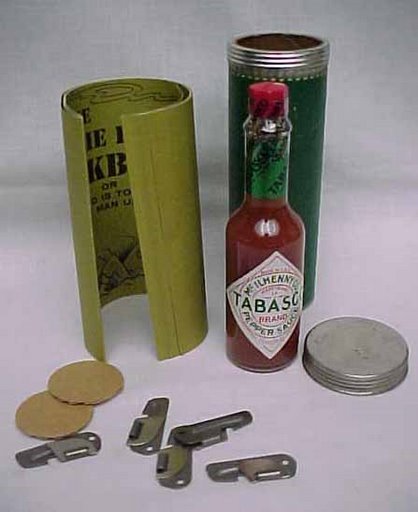
What I do like about Tobasco is the massive fucking salt dome under Avery Island. When I have Tobasco I like knowing that I am tasting that dome.
posted by chronkite at 12:30 PM on January 4, 2012
The salt and the pepper shakers - It mean's I've done it wrong
This is a common misperception. Some people like their food a bit saltier, and it is no slam on the chef if the diner wants to add more salt. You can't get salt out of food, but you can add it and there's nothing wrong with that.
posted by cell divide at 12:36 PM on January 4, 2012 [2 favorites]
This is a common misperception. Some people like their food a bit saltier, and it is no slam on the chef if the diner wants to add more salt. You can't get salt out of food, but you can add it and there's nothing wrong with that.
posted by cell divide at 12:36 PM on January 4, 2012 [2 favorites]
You can't get salt out of food
Au contraire..at least if you're the cook and it's a stew/gravy/sauce/broth etc.
Just put a few raw potato slices in and give it a little while. They'll soak up the excess salt.
posted by chronkite at 12:44 PM on January 4, 2012 [1 favorite]
Au contraire..at least if you're the cook and it's a stew/gravy/sauce/broth etc.
Just put a few raw potato slices in and give it a little while. They'll soak up the excess salt.
posted by chronkite at 12:44 PM on January 4, 2012 [1 favorite]
I'm thinking maybe the part of the pair that will change in my house is the salt shaker.
I don't even put salt on the table anymore. Out of sight, out of mind (especially for a 3 y.o. who LOVES salt). If something is bad enough that it needs more salt, there's a problem with my dish. (Obviously, adults at the table are free to get up and grab the salt, lol.)
What I don't understand is why salt deserves to be on the table with pepper.
Do you understand that different people might want different amounts of salt on things?
I can kind of grok the concept, but then again, no. I think adding salt to food is an outdated notion. I don't eat meat, so maybe my frame of reference is different. Providing diners with salt makes less sense to me than giving them hot sauce, mustard, relish, or even just straight spices like paprika, cinnamon, chili flakes, or turmeric.
A lot of restaurants I go to, upscale and down (mostly down) don't offer salt and pepper on the table. (particularly Asian restaurants.)
posted by mrgrimm at 12:49 PM on January 4, 2012
I don't even put salt on the table anymore. Out of sight, out of mind (especially for a 3 y.o. who LOVES salt). If something is bad enough that it needs more salt, there's a problem with my dish. (Obviously, adults at the table are free to get up and grab the salt, lol.)
What I don't understand is why salt deserves to be on the table with pepper.
Do you understand that different people might want different amounts of salt on things?
I can kind of grok the concept, but then again, no. I think adding salt to food is an outdated notion. I don't eat meat, so maybe my frame of reference is different. Providing diners with salt makes less sense to me than giving them hot sauce, mustard, relish, or even just straight spices like paprika, cinnamon, chili flakes, or turmeric.
A lot of restaurants I go to, upscale and down (mostly down) don't offer salt and pepper on the table. (particularly Asian restaurants.)
posted by mrgrimm at 12:49 PM on January 4, 2012
Sichuan pepper/flower peppers. In EVERYTHING. And sichuan pepper oil dumped in soups, noodles, and in sandwiches (favourite lazy lunch: chicken, kewpie mayo, sichuan pepper oil, tomatoes, cucumbers. Tasty madness, I say).
Makes anything palatable, though that just might be the numbness doing it's thing.
posted by zennish at 12:50 PM on January 4, 2012 [1 favorite]
Makes anything palatable, though that just might be the numbness doing it's thing.
posted by zennish at 12:50 PM on January 4, 2012 [1 favorite]
I got some smoked peppercorns at my local co-op health food store. I shall grind some into my soup tonight. Long live pepper!
posted by Marie Mon Dieu at 12:53 PM on January 4, 2012
posted by Marie Mon Dieu at 12:53 PM on January 4, 2012
Or does this mundane choice need rethinking?
It's mundane because it's available on every table. It's available on every table because it is the most versatile of the savory spices, IMHO
posted by Mental Wimp at 12:54 PM on January 4, 2012
It's mundane because it's available on every table. It's available on every table because it is the most versatile of the savory spices, IMHO
posted by Mental Wimp at 12:54 PM on January 4, 2012
The food should already be properly seasoned with salt.
Except that salt is like capsaicin. There's a wide variation in the amount of salt that seems "right" to people.
posted by straight at 1:02 PM on January 4, 2012 [2 favorites]
Except that salt is like capsaicin. There's a wide variation in the amount of salt that seems "right" to people.
posted by straight at 1:02 PM on January 4, 2012 [2 favorites]
I dunno, on my table there's Adobo powder in one shaker and a bottle of Crystal hot sauce next to it. My life is bunnies, rainbows and sunshine... until I pull out my homemade Sriracha, and then shit gets brütal.
posted by 1f2frfbf at 1:05 PM on January 4, 2012
posted by 1f2frfbf at 1:05 PM on January 4, 2012
Something else that adds an unami flavor (and is good for you) is nutritional yeast. (Some know it as great on popcorn.) I have a separate spice bottle which is mostly nutritional yeast but also has many extra secret ingredients like garlic, cayenne, black pepper, and a dozen other ingredients in commercial blends.
posted by kozad at 1:18 PM on January 4, 2012 [1 favorite]
posted by kozad at 1:18 PM on January 4, 2012 [1 favorite]
Keep pepper, ditch salt, add other spices.
posted by jeffburdges at 1:32 PM on January 4, 2012
posted by jeffburdges at 1:32 PM on January 4, 2012
And you're not taking the salt anywhere! I love salt, don't give me any of that naturally salt crap. Most things need a bit of salt to make them come alive.
posted by peacheater at 16:55 on January 4
Epony-?
posted by springload at 1:34 PM on January 4, 2012
posted by peacheater at 16:55 on January 4
Epony-?
posted by springload at 1:34 PM on January 4, 2012
See, the thing in my case is that it took a long time for me to actually arrive at the conclusion that I have a sensitivity to MSG. Mainly because when people talk about such sensitivities, they use the language of "allergy" -- which for most people, even a tiny exposure means a huge reaction.
This also results in a bunch of people being super-skeptical about claims to MSG sensitivities, because, well, MSG *is* naturally occurring in a TON of foods.
Because I get headaches fairly frequently anyway, I kept a headache diary, trying to tease out all of the various things that had a correlation. Why did certain breaded and fried things cause me a problem and others didn't? Why could I eat mushroom pizza with cheese and tomatoes, but eating at a certain Chinese restaurant nearby caused headaches reliably (but not when I ate at a different one just down the road)? It's when I finally figured out that it wasn't the mere PRESENCE of MSG that was the problem, it was the QUANTITY.
Finally, on the very worst headaches of my life, there was one correlation that fit EVERY instance of my most severe headaches. It wasn't just eating something with MSG -- it was eating a whole meal where most or all of the food doesn't have naturally occurring MSG, but where it's been added, and likely added a LOT. KFC Chicken, Chicken strips dipped in Ranch dressing, certain canned soups, a friend who puts a ton of Accent on everything they make. I have virtually no reaction to MSG until I've eaten way too much, and then my head makes me pay for it, big time.
So yeah, I understand why people are skeptical, because it is indeed virtually impossible to avoid MSG and other glutamates in normal foods, but in my case, I have decades of history and a one to one correlation between the very worst headaches I've ever had and eating a large amount of MSG.
posted by chimaera at 1:34 PM on January 4, 2012 [4 favorites]
This also results in a bunch of people being super-skeptical about claims to MSG sensitivities, because, well, MSG *is* naturally occurring in a TON of foods.
Because I get headaches fairly frequently anyway, I kept a headache diary, trying to tease out all of the various things that had a correlation. Why did certain breaded and fried things cause me a problem and others didn't? Why could I eat mushroom pizza with cheese and tomatoes, but eating at a certain Chinese restaurant nearby caused headaches reliably (but not when I ate at a different one just down the road)? It's when I finally figured out that it wasn't the mere PRESENCE of MSG that was the problem, it was the QUANTITY.
Finally, on the very worst headaches of my life, there was one correlation that fit EVERY instance of my most severe headaches. It wasn't just eating something with MSG -- it was eating a whole meal where most or all of the food doesn't have naturally occurring MSG, but where it's been added, and likely added a LOT. KFC Chicken, Chicken strips dipped in Ranch dressing, certain canned soups, a friend who puts a ton of Accent on everything they make. I have virtually no reaction to MSG until I've eaten way too much, and then my head makes me pay for it, big time.
So yeah, I understand why people are skeptical, because it is indeed virtually impossible to avoid MSG and other glutamates in normal foods, but in my case, I have decades of history and a one to one correlation between the very worst headaches I've ever had and eating a large amount of MSG.
posted by chimaera at 1:34 PM on January 4, 2012 [4 favorites]
All I know is, my personal tastes are the *correct* ones.
posted by kyrademon at 1:40 PM on January 4, 2012 [4 favorites]
posted by kyrademon at 1:40 PM on January 4, 2012 [4 favorites]
Why could I eat mushroom pizza with cheese and tomatoes, but eating at a certain Chinese restaurant nearby caused headaches reliably (but not when I ate at a different one just down the road)? It's when I finally figured out that it wasn't the mere PRESENCE of MSG that was the problem, it was the QUANTITY.
Where are you getting your figures for MSG quantity?
posted by Sticherbeast at 1:42 PM on January 4, 2012
Where are you getting your figures for MSG quantity?
posted by Sticherbeast at 1:42 PM on January 4, 2012
learning her tastes and slowly remolding them
Teach me your taste moulding ways. My fiancee hates just about everything I make that isn't meat and potatoes.
posted by asnider at 2:07 PM on January 4, 2012
Teach me your taste moulding ways. My fiancee hates just about everything I make that isn't meat and potatoes.
posted by asnider at 2:07 PM on January 4, 2012
Oh great. Just what the world needs: hipster pepper.
posted by Pinback at 2:13 PM on January 4, 2012 [1 favorite]
posted by Pinback at 2:13 PM on January 4, 2012 [1 favorite]
Maybe you should just shake some MSG onto some bread (assuming you're not allergic to bread) to test if it really is the MSG that you are allergic to. Also, the doctor can do a simple test to see what foods you're allergic to.
posted by pez_LPhiE at 2:15 PM on January 4, 2012
posted by pez_LPhiE at 2:15 PM on January 4, 2012
I don't believe I've ever added pepper (or salt, for that matter) to a dish after it has been brought to table, primarily because I am in the silly habit of rendering my meals edible prior to serving. That said, I would replace the salt and pepper shakers with a bottle of good all-purpose hot sauce, and a block of vintage cheese.
posted by tumid dahlia at 2:46 PM on January 4, 2012 [1 favorite]
posted by tumid dahlia at 2:46 PM on January 4, 2012 [1 favorite]
Why do we have to replace pepper with another spice? What about a big pot of damn good butter on the table to slather over our food? And perhaps a dish of lemon wedges. Mmmmmmm....
posted by ninazer0 at 2:57 PM on January 4, 2012
posted by ninazer0 at 2:57 PM on January 4, 2012
I have had ONE bad experience with MSG, and it follows a typical allergic pattern.
When I was young, I used "Accent" (MSG) a lot. Then for decades I was a vegetarian health food nut and avoided it. Then when I started eating meat again, I ate a big meal in Chinatown SF where they must buy MSG in kilos, and came home with a headache (and I never get headaches) and quite a fever. Just plain sick. Never happened again, so take the story with a grain of...um gourmet smoked truffle salt?
posted by kozad at 3:00 PM on January 4, 2012
When I was young, I used "Accent" (MSG) a lot. Then for decades I was a vegetarian health food nut and avoided it. Then when I started eating meat again, I ate a big meal in Chinatown SF where they must buy MSG in kilos, and came home with a headache (and I never get headaches) and quite a fever. Just plain sick. Never happened again, so take the story with a grain of...um gourmet smoked truffle salt?
posted by kozad at 3:00 PM on January 4, 2012
Cottage cheese with pepper, people - trust me.
posted by the littlest brussels sprout at 3:04 PM on January 4, 2012 [4 favorites]
posted by the littlest brussels sprout at 3:04 PM on January 4, 2012 [4 favorites]
digitalprimate: "A potentially useful side note? Gernot Katzer’s Spice Pages: (almost) everything you ever wanted to know about most spices, including history, chemical composition and what it's called in other languages.
I found this site back in c. 1997, and it's still there. I think it's the oldest website I've had continuously bookmarked."
Great website. Bookmarked for me as well. Thanks.
posted by Splunge at 3:07 PM on January 4, 2012
I found this site back in c. 1997, and it's still there. I think it's the oldest website I've had continuously bookmarked."
Great website. Bookmarked for me as well. Thanks.
posted by Splunge at 3:07 PM on January 4, 2012
Just a note to all of the people making snide remarks about not adding pepper because "food should be seasoned properly before it arrives on my plate" and such: black pepper is best added right at the very end of food prep (such as when it hits your plate). Typically, cooking pepper reduces the flavour and so it shouldn't be added until just before eating.*
*Some exceptions may apply.
posted by asnider at 3:12 PM on January 4, 2012 [2 favorites]
*Some exceptions may apply.
posted by asnider at 3:12 PM on January 4, 2012 [2 favorites]
You can't get salt out of food
Au contraire..at least if you're the cook and it's a stew/gravy/sauce/broth etc.
Just put a few raw potato slices in and give it a little while. They'll soak up the excess salt.
That's an old wive's tale, see this story.
posted by shoesietart at 3:13 PM on January 4, 2012 [1 favorite]
Au contraire..at least if you're the cook and it's a stew/gravy/sauce/broth etc.
Just put a few raw potato slices in and give it a little while. They'll soak up the excess salt.
That's an old wive's tale, see this story.
posted by shoesietart at 3:13 PM on January 4, 2012 [1 favorite]
Always use fresh garlic and always double the amount required.This reminds me of:
Roy's Rule For Ginger: always use 50% more ginger than the recipe calls for, even if the recipe was already altered by a previous application of Roy's Rule For Ginger.
Following this rule, the quantity of handwritten amendments in your recipe book increases linearly with time, but the quantity of awesome in your food increases exponentially.
posted by roystgnr at 3:22 PM on January 4, 2012 [4 favorites]
Following this rule, the quantity of handwritten amendments in your recipe book increases linearly with time, but the quantity of awesome in your food increases exponentially.
But doesn't this mean that you can only make each recipe a limited number of times, because otherwise your diet would consist nearly entirely of ginger?
posted by madcaptenor at 3:34 PM on January 4, 2012 [2 favorites]
But doesn't this mean that you can only make each recipe a limited number of times, because otherwise your diet would consist nearly entirely of ginger?
posted by madcaptenor at 3:34 PM on January 4, 2012 [2 favorites]
That's an old wive's tale, see this story.
Wait, what? I've never thought of the potato trick as being some sort of selective absorption of salt vs. other substances by the potato, just that adding potatoes increases the amount of stuff in the soup and thus makes the soup overall less salty. And that experiment is hardly fair -- he uses 1 tsp of salt and 1 tbsp of salt per quart of water. Then he tries to use six 1/4 inch pieces of potato to desalt the water. No one is saying that if you add three times to twelve times the amount of salt you should be, you'll have much luck with the potato trick. Potatoes aren't some sort of magic desalination plant. Just that if it's a matter of a little more salt than normal, adding a little potato to absorb the salty water will help.
posted by peacheater at 3:39 PM on January 4, 2012 [6 favorites]
Wait, what? I've never thought of the potato trick as being some sort of selective absorption of salt vs. other substances by the potato, just that adding potatoes increases the amount of stuff in the soup and thus makes the soup overall less salty. And that experiment is hardly fair -- he uses 1 tsp of salt and 1 tbsp of salt per quart of water. Then he tries to use six 1/4 inch pieces of potato to desalt the water. No one is saying that if you add three times to twelve times the amount of salt you should be, you'll have much luck with the potato trick. Potatoes aren't some sort of magic desalination plant. Just that if it's a matter of a little more salt than normal, adding a little potato to absorb the salty water will help.
posted by peacheater at 3:39 PM on January 4, 2012 [6 favorites]
Yeah, what peacheater said and also I wouldn't have said it works unless I'd tried it and it worked. And it did. Several times. Over several years.
posted by chronkite at 3:42 PM on January 4, 2012
posted by chronkite at 3:42 PM on January 4, 2012
The last restaurant I was at in Brazil brought me salt and malagueta when I asked for salt and pepper. So it's already on the way out, at least there.
posted by jewzilla at 3:46 PM on January 4, 2012 [1 favorite]
posted by jewzilla at 3:46 PM on January 4, 2012 [1 favorite]
Yeah, what peacheater said and also I wouldn't have said it works unless I'd tried it and it worked. And it did. Several times. Over several years.
oh yeah? Where are you getting your figures for potato quantity? Can you provide a double-blind salty-soup study?
/hamburger
posted by vorfeed at 3:55 PM on January 4, 2012 [3 favorites]
oh yeah? Where are you getting your figures for potato quantity? Can you provide a double-blind salty-soup study?
/hamburger
posted by vorfeed at 3:55 PM on January 4, 2012 [3 favorites]
All of this, and no sambal?! Are you people mad?
Other than that, Tony's is awesome, and spectacular on popcorn, too. And smoked paprika has made its way into my life, and everything is better for it.
Of course, traditional Japanese cuisine has possibly the saddest spice rack of all, sa/shi/su/se/so, or sugar (sato), salt (shiyo), vinegar (suu), soy sauce (se, for some reason) and miso (uh, miso). And that's it. My colleagues are usually stunned when I reheat leftovers, my wife's coworkers have complained (while eating fucking natto) that the lunches I make for her smell too strongly.
On the other hand, they do have shichimi, a seven spice chili powder mix that is awesome on just about everything.
posted by Ghidorah at 3:59 PM on January 4, 2012 [1 favorite]
Other than that, Tony's is awesome, and spectacular on popcorn, too. And smoked paprika has made its way into my life, and everything is better for it.
Of course, traditional Japanese cuisine has possibly the saddest spice rack of all, sa/shi/su/se/so, or sugar (sato), salt (shiyo), vinegar (suu), soy sauce (se, for some reason) and miso (uh, miso). And that's it. My colleagues are usually stunned when I reheat leftovers, my wife's coworkers have complained (while eating fucking natto) that the lunches I make for her smell too strongly.
On the other hand, they do have shichimi, a seven spice chili powder mix that is awesome on just about everything.
posted by Ghidorah at 3:59 PM on January 4, 2012 [1 favorite]
infini: "They are meant to be together. It is so. Do not be so cruel as to separate them."
We got these for our wedding. They got lost somewhere in our house during the move. We usually do pepper out of the grinder and salt out of the salt cellar, though.
posted by Deathalicious at 4:10 PM on January 4, 2012
We got these for our wedding. They got lost somewhere in our house during the move. We usually do pepper out of the grinder and salt out of the salt cellar, though.
posted by Deathalicious at 4:10 PM on January 4, 2012
Hmmm, I don't really like pepper and often forget about it entirely, but I salt my ice cream as I eat it (you should try it, amazing!) and MSG gives me a low-grade headache that I can't really feel because it also gives me a slight-but-definitely-there out-of-body experience, no joke. Every time. I feel it coming on and then I'm like, "oh crap, here we go again...I get to watch myself try to endure the rest of this evening from over in existential here...but at least my headache is over there" Then I wave as I hold on and try to ride it out.
Am I now the biggest weirdo in the thread?
I do madly love sriracha though, so that's a step towards normalcy, right?.
posted by iamkimiam at 4:14 PM on January 4, 2012
Am I now the biggest weirdo in the thread?
I do madly love sriracha though, so that's a step towards normalcy, right?.
posted by iamkimiam at 4:14 PM on January 4, 2012
ice cream already has a lot of salt as I understand it.
posted by Hoopo at 4:23 PM on January 4, 2012
posted by Hoopo at 4:23 PM on January 4, 2012
Lawry's is good to have around.
posted by jonmc at 4:35 PM on January 4, 2012 [1 favorite]
posted by jonmc at 4:35 PM on January 4, 2012 [1 favorite]
Rice Crispy Treats. Salt. Seriously. Put a little bit of salt on your plate. Dip your Rice Crispy square into the salt as you take a bite. Happy town, population: you.
posted by Ghidorah at 4:35 PM on January 4, 2012 [7 favorites]
posted by Ghidorah at 4:35 PM on January 4, 2012 [7 favorites]
I've developed a reasonably high tolerance to spicy food, but I grew up in a southwestern Ontario home where anything stronger-tasting than, say, boiled potatoes was considered bold fare.
posted by The Card Cheat at 5:09 PM on January 4, 2012
posted by The Card Cheat at 5:09 PM on January 4, 2012
Bill Bryson has a long Bryson-esque description of pepper and how it ended up on our tables in his book At Home. Worth reading if you want more detail on it.
posted by gingerbeer at 5:28 PM on January 4, 2012 [2 favorites]
posted by gingerbeer at 5:28 PM on January 4, 2012 [2 favorites]
My new favorite table condiment?
Ground Sichuan Pepper. I don't use it on everything, but it can really perk up a meal.
Penzey's sells a shaker of ground Sichuan pepper and salt together.
posted by spinifex23 at 5:55 PM on January 4, 2012
Ground Sichuan Pepper. I don't use it on everything, but it can really perk up a meal.
Penzey's sells a shaker of ground Sichuan pepper and salt together.
posted by spinifex23 at 5:55 PM on January 4, 2012
My vote is Maggi sauce. I was introduced in Poland (where it's added to rosiol, a delicious, simple, chicken vegetable broth), but I think the stuff I can buy stateside is different than the Polish stuff. I can't quite put my finger on it, and maybe it's just my imagination. (I can't do a side-by-side now, unfortunately, but I will at my earliest opportunity. Should make Science after my results are duplicated, so keep an eye out.) It's sorta worcestershire-y (also an underlooked table condiment) but not quite. Pyszne.
posted by LiteOpera at 6:36 PM on January 4, 2012
posted by LiteOpera at 6:36 PM on January 4, 2012
But doesn't this mean that you can only make each recipe a limited number of times, because otherwise your diet would consist nearly entirely of ginger?
This sounds like a delicious diet.
Also, a big plus to Sichuan pepper. It's so fantastically odd tasting.
posted by jeather at 6:42 PM on January 4, 2012 [1 favorite]
This sounds like a delicious diet.
Also, a big plus to Sichuan pepper. It's so fantastically odd tasting.
posted by jeather at 6:42 PM on January 4, 2012 [1 favorite]
I'm favoriting this thread so I can get back to all the additional spice suggestions. Damn, there are a lot of good ideas here.
posted by immlass at 6:50 PM on January 4, 2012
posted by immlass at 6:50 PM on January 4, 2012
but I grew up in a southwestern Ontario home where anything stronger-tasting than, say, boiled potatoes was considered bold fare.
I grew up in the midwest, and couldn't handle spiciness of any kind. Taco Bell nacho cheese-food sauce would make me sweat from the heat (seriously). Then I moved to Wuhan, in China for a year. People there put chili sauce on everything, so much so that it's a common stereotype of them amongst other Chinese people (one which I witnessed when I was in Guilin, and my friend from Wuhan asked the waiter for chili sauce, then drowned his food in it). The first few weeks were agony, but I learned to love it.
For whatever reason, though, it took me until I was thirty to have proper Thai food for the first time, and I now consider the first thirty years of my life to have been poorly thought out.
posted by Ghidorah at 7:09 PM on January 4, 2012
I grew up in the midwest, and couldn't handle spiciness of any kind. Taco Bell nacho cheese-food sauce would make me sweat from the heat (seriously). Then I moved to Wuhan, in China for a year. People there put chili sauce on everything, so much so that it's a common stereotype of them amongst other Chinese people (one which I witnessed when I was in Guilin, and my friend from Wuhan asked the waiter for chili sauce, then drowned his food in it). The first few weeks were agony, but I learned to love it.
For whatever reason, though, it took me until I was thirty to have proper Thai food for the first time, and I now consider the first thirty years of my life to have been poorly thought out.
posted by Ghidorah at 7:09 PM on January 4, 2012
My vote is Maggi sauce.
Maggi is pretty awesome, but a single tablespoon (or maybe it's a teaspoon!) has something like 125% of the recommended daily intake of sodium. It's hardly an everyday seasoning.
posted by asnider at 7:10 PM on January 4, 2012
Maggi is pretty awesome, but a single tablespoon (or maybe it's a teaspoon!) has something like 125% of the recommended daily intake of sodium. It's hardly an everyday seasoning.
posted by asnider at 7:10 PM on January 4, 2012
what would we replace it with
Garam masala? Furikake? Harissa? Nanami tohgarashi? And on the pure unadulterated pepper front, long pepper.
posted by squeak at 7:18 PM on January 4, 2012 [1 favorite]
Garam masala? Furikake? Harissa? Nanami tohgarashi? And on the pure unadulterated pepper front, long pepper.
posted by squeak at 7:18 PM on January 4, 2012 [1 favorite]
In parts of Europe, Mexico, Malaysia, and Brunei, In German-speaking countries as well as the Netherlands, Czech Republic, Slovenia, Slovakia, Poland and France, "Maggi" is still synonymous with the brand's "Maggi-Würze" (Maggi seasoning sauce), a dark, hydrolysed vegetable protein based sauce--Wikipedia
Maggi, Worcestershire sauce, soy sauce, yeast extract (Vegemite, Marmite), fish sauce, and a variety of "natural flavors" (they may be legally labelled as such in the US without further details) are mainly umami bombs of glutamate-rich flavor enhancers full of MSG, whether man made or not.
They are all delicious, although some are best used in small amounts.
posted by TedW at 7:31 PM on January 4, 2012
Maggi, Worcestershire sauce, soy sauce, yeast extract (Vegemite, Marmite), fish sauce, and a variety of "natural flavors" (they may be legally labelled as such in the US without further details) are mainly umami bombs of glutamate-rich flavor enhancers full of MSG, whether man made or not.
They are all delicious, although some are best used in small amounts.
posted by TedW at 7:31 PM on January 4, 2012
>what would we replace it with
Garam masala? Furikake? Harissa? Nanami tohgarashi? And on the pure unadulterated pepper front, long pepper.
Fresh ground tellicherry is more than a suitable replacement to the pre-ground McCormick's.
The pepper shaker is on the way out, anyway. The Sodexho-run cafeteria where I work is terrible. Massively underseasoned, and they have aerosol spray margarine they use on everything, "eggs" come from a milk carton, and the veggies are cooked until they're olive drab. Even they know better than to set out pre-ground pepper - little glass jars of peppercorns topped with disposable grinders are the new normal.
posted by Slap*Happy at 7:38 PM on January 4, 2012 [1 favorite]
Garam masala? Furikake? Harissa? Nanami tohgarashi? And on the pure unadulterated pepper front, long pepper.
Fresh ground tellicherry is more than a suitable replacement to the pre-ground McCormick's.
The pepper shaker is on the way out, anyway. The Sodexho-run cafeteria where I work is terrible. Massively underseasoned, and they have aerosol spray margarine they use on everything, "eggs" come from a milk carton, and the veggies are cooked until they're olive drab. Even they know better than to set out pre-ground pepper - little glass jars of peppercorns topped with disposable grinders are the new normal.
posted by Slap*Happy at 7:38 PM on January 4, 2012 [1 favorite]
Maggi, Worcestershire sauce, soy sauce, yeast extract (Vegemite, Marmite), fish sauce
I love everything on this list, except that I haven't tried vegemite or marmite, though I've never been informed enough to put them in a category together. I will change this soon.
posted by LiteOpera at 7:58 PM on January 4, 2012
I love everything on this list, except that I haven't tried vegemite or marmite, though I've never been informed enough to put them in a category together. I will change this soon.
posted by LiteOpera at 7:58 PM on January 4, 2012
I can't believe there has been so little pepper hate in this thread. Black pepper is an abomination. All it takes is a few flakes of the stuff on top of a dish and the whole thing tastes like nothing but pepper. I live with a pepper fan. I don't ask for much in our relationship, but when he's cooking us eggs for breakfast, can he please wait to pepper his eggs until mine have been removed from the pan? I don't think that's too much to ask.
What to replace it with? So many good options have been listed here already, but so few of them would be good on a wide variety of dishes. I doubt there is one "universal" seasoning that would work. Smoked paprika and red pepper flakes come the closest for me. Chili powder, Lawrey's, garlic salt, cilantro, and parsley are also good. And of course, cholula, tapatio, and sriracha.
posted by Teeth of the Hydra at 8:12 PM on January 4, 2012
What to replace it with? So many good options have been listed here already, but so few of them would be good on a wide variety of dishes. I doubt there is one "universal" seasoning that would work. Smoked paprika and red pepper flakes come the closest for me. Chili powder, Lawrey's, garlic salt, cilantro, and parsley are also good. And of course, cholula, tapatio, and sriracha.
posted by Teeth of the Hydra at 8:12 PM on January 4, 2012
Fresh ground tellicherry is more than a suitable replacement to the pre-ground McCormick's.
Nonsense! But then I grew up in a family who thought pushing the culinary envelope was by making sweet and sour meatballs from a betty crocker recipe ... so many spices to try, so little time and there's a whole wall of dried capsicums at my favourite spice shop yet to be explored.
posted by squeak at 8:22 PM on January 4, 2012
Nonsense! But then I grew up in a family who thought pushing the culinary envelope was by making sweet and sour meatballs from a betty crocker recipe ... so many spices to try, so little time and there's a whole wall of dried capsicums at my favourite spice shop yet to be explored.
posted by squeak at 8:22 PM on January 4, 2012
Furikake is my husband's condiment of choice for things like eggs and rice. We keep several bottles of it around since it comes in all sorts of different flavors.
posted by skycrashesdown at 8:24 PM on January 4, 2012
posted by skycrashesdown at 8:24 PM on January 4, 2012
All it takes is a few flakes of the stuff on top of a dish and the whole thing tastes like nothing but pepper
True - and it's particularly stark on top of eggs because of their mild flavor. But a lot of the art in cooking isn't just what spices you add, but when you add them. Pepper added at the start tends to dissipate and mellow, but when added at the end it's quite piquant. The same is true of garlic.
I rely more on Cayenne pepper to give a dish a mild heat. (I picked it up from an Escoffier cookbook - he used a Cayenne in a lot of dishes.)If you add it at the start, most people can't identify it, but they know there is a little something extra.
posted by borges at 8:27 PM on January 4, 2012
True - and it's particularly stark on top of eggs because of their mild flavor. But a lot of the art in cooking isn't just what spices you add, but when you add them. Pepper added at the start tends to dissipate and mellow, but when added at the end it's quite piquant. The same is true of garlic.
I rely more on Cayenne pepper to give a dish a mild heat. (I picked it up from an Escoffier cookbook - he used a Cayenne in a lot of dishes.)If you add it at the start, most people can't identify it, but they know there is a little something extra.
posted by borges at 8:27 PM on January 4, 2012
Oh yea Cayenne at the very beginning seems to suffuse a dish with a general low heat without getting bitter like black pepper.
posted by The Whelk at 8:33 PM on January 4, 2012
posted by The Whelk at 8:33 PM on January 4, 2012
Hungarian hot paprika! Pepper plant sauce, fish sauce, oregano, pili pili oil, sumac, habenero-lime hot sauce, sriracha, fresh grated nutmeg. How the hell could anyone pick one spice to replace black pepper? Nothing else is remotely as universal.
posted by BrotherCaine at 10:53 PM on January 4, 2012
posted by BrotherCaine at 10:53 PM on January 4, 2012
Speaking of eggs... the absolute best condiment you can add to a fried egg is dark soy sauce (the thick, jet-black kind, not light soy which is what Kikkoman and friends are). When it gets mixed with runny egg yolk, something amazing happens. When I lived in the States I always wished I had small bottle of dark soy sauce to bring with me to breakfast places.
posted by destrius at 11:09 PM on January 4, 2012 [1 favorite]
posted by destrius at 11:09 PM on January 4, 2012 [1 favorite]
I like habanero hot sauce (usually El Yucateco), but vinegar doesn't taste good with everything. For general spiciness, I use cayenne pepper. I have it in a large shaker at my table. It seems to work well as a general flavor enhancer, but there are still some foods I prefer with black pepper.
posted by lali at 11:22 PM on January 4, 2012
posted by lali at 11:22 PM on January 4, 2012
The last restaurant I was at in Brazil brought me salt and malagueta when I asked for salt and pepper. So it's
You've got to ask for pimenta do reino. That said, my partner's family did not have any in their house at all, and I had to go buy some, but they did have those awesome malagueta chiles. I took back a bottle of them and kept topping it up with oil and vinegar for about a year while I slowly ate the chiles inside.
posted by Joe Chip at 11:45 PM on January 4, 2012
WTF is this? If it were up to me, we'd dump the salt shakers and just have TWO pepper shakers.
posted by Foosnark at 7:16 AM on January 5, 2012 [2 favorites]
posted by Foosnark at 7:16 AM on January 5, 2012 [2 favorites]
I do not keep any seasoning on my kitchen table. Instead, I season my food while I cook it. I think the idea of any "omni-seasoning" (yes, even salt) is silly. Season your cooking properly and no one will require seasoning at the table.
posted by Kurichina at 12:14 PM on January 5, 2012
posted by Kurichina at 12:14 PM on January 5, 2012
Season your cooking properly and no one will require seasoning at the table.
I'm sure it's been pointed out above, but "season properly" is a subjective thing. Personally when I cook I go pretty heavy on the garlic and onions and hot peppers when I can, but if you're cooking for a large group or have a wide variety of palettes to please, a good strategy is to sometimes err on the side of less spicy/seasoned and let people spice it up as they please with salt, pepper, ketchup, mustard, horseradish, hot sauce, vinegar, salad dressing, or any number of other garnishes and flavors. I mean, my stepmother finds butter chicken too spicy. It's like a yoghurt sauce! It's not hot, at all! If I were to "season properly" for her, there would be No. Pepper. Ever.
posted by Hoopo at 1:36 PM on January 5, 2012
I'm sure it's been pointed out above, but "season properly" is a subjective thing. Personally when I cook I go pretty heavy on the garlic and onions and hot peppers when I can, but if you're cooking for a large group or have a wide variety of palettes to please, a good strategy is to sometimes err on the side of less spicy/seasoned and let people spice it up as they please with salt, pepper, ketchup, mustard, horseradish, hot sauce, vinegar, salad dressing, or any number of other garnishes and flavors. I mean, my stepmother finds butter chicken too spicy. It's like a yoghurt sauce! It's not hot, at all! If I were to "season properly" for her, there would be No. Pepper. Ever.
posted by Hoopo at 1:36 PM on January 5, 2012
We should use all the spices!
posted by borges at 12:41 PM on January 6, 2012 [2 favorites]
posted by borges at 12:41 PM on January 6, 2012 [2 favorites]
My vote's for Szechuan pepper, aleppo pepper (sooo good), really good smoked paprika (not that crap at the grocery store; fantastic on popcorn), a smoky pepper (chipotle's easy to get at the grocery store too), and, no really, Vietnamese cinnamon. Zatar (or at least sumac, yum) is good too. Oh, and preserved lemon! Mmm.
I recently got some ground dried kishk/kashk at a little market while out of town and am trying to figure out how to use it. New spices are fun, much sexier than, say, eyeshadow shopping to me.
posted by ifjuly at 12:55 PM on January 7, 2012
I recently got some ground dried kishk/kashk at a little market while out of town and am trying to figure out how to use it. New spices are fun, much sexier than, say, eyeshadow shopping to me.
posted by ifjuly at 12:55 PM on January 7, 2012
Not smoky pepper, smoky chili powder rather. D'oh.
And actually, I always feel a little sheepish about this because Papa John's gives you endless packets of the stuff for god's sake, but red pepper flakes are awesome on most basic sauteed or steamed vegetables that need a pick me up. They are sauteed okra's best buddy, for example.
posted by ifjuly at 12:57 PM on January 7, 2012
And actually, I always feel a little sheepish about this because Papa John's gives you endless packets of the stuff for god's sake, but red pepper flakes are awesome on most basic sauteed or steamed vegetables that need a pick me up. They are sauteed okra's best buddy, for example.
posted by ifjuly at 12:57 PM on January 7, 2012
And that bracing real cinnamon is good on vegetables, I mean, not just for baking. Cauliflower and spinach are two instant examples.
posted by ifjuly at 12:58 PM on January 7, 2012 [1 favorite]
posted by ifjuly at 12:58 PM on January 7, 2012 [1 favorite]
I credit blame this thread for the $85 I spent on spices today at San Francisco Herb Co.
posted by BrotherCaine at 6:52 PM on January 7, 2012 [4 favorites]
posted by BrotherCaine at 6:52 PM on January 7, 2012 [4 favorites]
« Older Dooooo Yooooo....Feeeeeeel Like I Doooooo | Pony Creator Newer »
This thread has been archived and is closed to new comments
Garlic.
posted by Faint of Butt at 7:30 AM on January 4, 2012 [41 favorites]