One Chicago hotel's story
February 14, 2012 2:46 AM Subscribe
NEW DELUXE TRANSIENT ROOMS WITH FREE ADULT MOVIES ... that's what the three-story-tall painted sign promised. It's faded and peeling now, but the sign's still there, though the Viceroy Hotel has been closed for nearly a decade.
Long a notorious flophouse and neighborhood locus of prostitution and drug-dealing in the West Loop section of Chicago's Near West Side, the Viceroy for decades was the absolute last resort for the down-on-their-luck, available in either twelve-hour or week-long increments. Chicago Journal reporter Mandy Burrell described it as "the most depressing place she'd ever been" when she very nearly stayed the night there in 2002.
It was the site, too, of the second murder allegedly committed by Donald Lang, a "deaf mute who was never taught to read or write or to use the sign language and was unable to communicate with anyone in any language." Charges against him for the first murder had been dismissed in large part due to uncertainty whether he was competent to stand trial. The 1972 conviction for the second murder was struck down due to similar uncertainty, but with the caveat that he was to be periodically retested to see if he had become mentally competent to stand trial. Until then, he would be confined (for the most part) in a state mental facility. Donald Lang's case would be chronicled in Dummy, a 1974 book by Ernest Tidyman (better known for the John Shaft novels), which was subsequently adapted into a 1979 CBS TV movie starring LeVar Burton and Paul Sorvino as Lang and his (also deaf) attorney, Lowell Myers.
A sad, hopeless place by the end of its existence as the Viceroy, but the building didn't start this way, of course. Built in 1929 as the Union Park Hotel, touted at the time as a boldly "modernistic" building, its facade features intricate brightly colored terra-cotta in bold and colorful geometric patterns. It's an example of the "apartment hotel", a form of residential building built in the Roaring Twenties to accommodate single professionals or childless couples who wanted better accommodations than a boarding house or a tenement flat, but couldn't afford or didn't want the expense of a house. These buildings featured small apartments (often furnished with space-saving innovations like the Murphy Bed) along with some of the services one might expect from a hotel (maid service, bellboy service, porters for groceries or garbage, etc).
One of the Union Park's first residents was a then-unknown Gene Autry, who'd just moved to Chicago to work for WLS on their National Barn Dance program. Not everyone at the Union Park was as wholesome as Gene Autry, of course, and even in the early, pre-Viceroy days, the Union Park wasn't free from scandal.
The Union Park was renamed the Viceroy in 1963, a name change perhaps concomitant with the decline in the hotel's fortunes. At this point many of the factors leading to the decline of the area around it were already in play (the devastation to neighborhoods caused by the construction of the Congress Expressway a few blocks south, for example).
The Viceroy finally closed forty years later in 2003. As the neighborhood around it began to be redeveloped, the city of Chicago bought the Viceroy in 2006 for 5.1 million dollars to preserve that space for eventual affordable housing in the future. Despite the building being named a Chicago landmark (incredibly comprehensive landmark commission report on the building (PDF)) and being placed on the National Registry of Historic Places, it took till last year for these plans to really get off the ground.
The architects for the renovation describe the project as a "6-story, 90-unit affordable residential and supportive services project and a historic and green rehabilitation." One floor will be reserved for the women of Grace House, a halfway house providing support and counseling for women exiting the Illinois prison system.
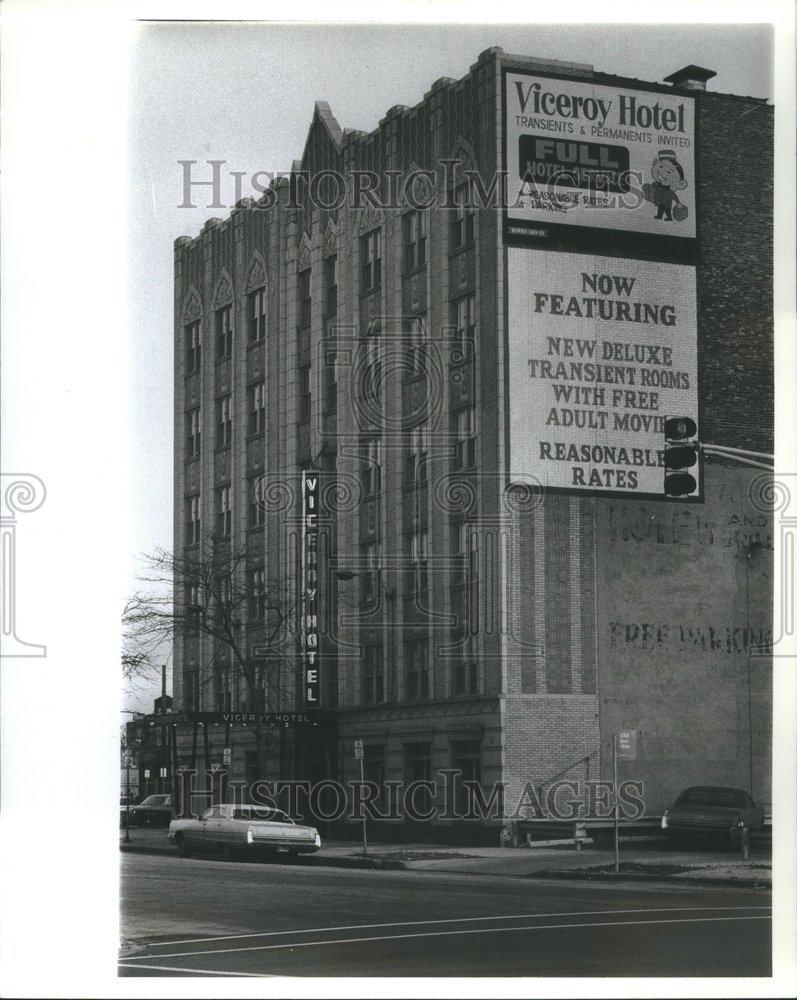
Long a notorious flophouse and neighborhood locus of prostitution and drug-dealing in the West Loop section of Chicago's Near West Side, the Viceroy for decades was the absolute last resort for the down-on-their-luck, available in either twelve-hour or week-long increments. Chicago Journal reporter Mandy Burrell described it as "the most depressing place she'd ever been" when she very nearly stayed the night there in 2002.
It was the site, too, of the second murder allegedly committed by Donald Lang, a "deaf mute who was never taught to read or write or to use the sign language and was unable to communicate with anyone in any language." Charges against him for the first murder had been dismissed in large part due to uncertainty whether he was competent to stand trial. The 1972 conviction for the second murder was struck down due to similar uncertainty, but with the caveat that he was to be periodically retested to see if he had become mentally competent to stand trial. Until then, he would be confined (for the most part) in a state mental facility. Donald Lang's case would be chronicled in Dummy, a 1974 book by Ernest Tidyman (better known for the John Shaft novels), which was subsequently adapted into a 1979 CBS TV movie starring LeVar Burton and Paul Sorvino as Lang and his (also deaf) attorney, Lowell Myers.
A sad, hopeless place by the end of its existence as the Viceroy, but the building didn't start this way, of course. Built in 1929 as the Union Park Hotel, touted at the time as a boldly "modernistic" building, its facade features intricate brightly colored terra-cotta in bold and colorful geometric patterns. It's an example of the "apartment hotel", a form of residential building built in the Roaring Twenties to accommodate single professionals or childless couples who wanted better accommodations than a boarding house or a tenement flat, but couldn't afford or didn't want the expense of a house. These buildings featured small apartments (often furnished with space-saving innovations like the Murphy Bed) along with some of the services one might expect from a hotel (maid service, bellboy service, porters for groceries or garbage, etc).

One of the Union Park's first residents was a then-unknown Gene Autry, who'd just moved to Chicago to work for WLS on their National Barn Dance program. Not everyone at the Union Park was as wholesome as Gene Autry, of course, and even in the early, pre-Viceroy days, the Union Park wasn't free from scandal.
The Union Park was renamed the Viceroy in 1963, a name change perhaps concomitant with the decline in the hotel's fortunes. At this point many of the factors leading to the decline of the area around it were already in play (the devastation to neighborhoods caused by the construction of the Congress Expressway a few blocks south, for example).
The Viceroy finally closed forty years later in 2003. As the neighborhood around it began to be redeveloped, the city of Chicago bought the Viceroy in 2006 for 5.1 million dollars to preserve that space for eventual affordable housing in the future. Despite the building being named a Chicago landmark (incredibly comprehensive landmark commission report on the building (PDF)) and being placed on the National Registry of Historic Places, it took till last year for these plans to really get off the ground.
The architects for the renovation describe the project as a "6-story, 90-unit affordable residential and supportive services project and a historic and green rehabilitation." One floor will be reserved for the women of Grace House, a halfway house providing support and counseling for women exiting the Illinois prison system.
Darn, forgot to add this: Demolition of the interior is already underway, and, now that renovations to the exterior of the building have begun as well, the iconic sign that for decades has promised transient housing with free adult movies is slowly disappearing as new brickwork replaces the old...
posted by orthicon halo at 3:13 AM on February 14, 2012
posted by orthicon halo at 3:13 AM on February 14, 2012
Excellent post. Wish I had more time to spend on these links.
posted by Vectorcon Systems at 3:40 AM on February 14, 2012
posted by Vectorcon Systems at 3:40 AM on February 14, 2012
Ha! I lived at the Viceroy for about 4 months back in 1987. I had a huge fight with my roommates and decided I wanted to be alone. I was still new in Chicago so I had no clue, really, about the seediness of the near west side. I grabbed a newspaper and looked for cheap hotels and the Viceroy was the one I chose. I'll never forget the look on the dab drivers' face as he fished my suitcase out of the trunk. He asked me "Are you sure you want to be here?" and I just sort of shrugged. Yes, I was pretty oblivious but I didn't really care.
I was paying $75 per week for a room of my own on the top floor and to me, this was heaven. They did not have T.V.s on the rooms so I think adult movies were mo longer being offered. Oh, it was seedy alright. There were roaches, strange smells and noises and blood spatters on the wall in my bathroom (which I left alone). The dresser drawers had boric acid in the bottom to keep the roaches at bay. I lived out of my suitcase rather than risk having my clothes infested. I was also the only white guy in the entire place which made me stick out. In my entire time there, I never, EVER had a single problem with anyone. The only incident of any note was when I walked to one of the local pawn shops and purchased an electric guitar and some guy tried to feebly stab me with a pocket knife and I walked out. He was a wino so I was able to walk briskly away from him.
I spent a lot of Saturday or Sunday afternoons watching baseball with the other residents in the dayroom/lounge (I still remember the Minnesota Twins/St. Louis Cardinals World Series like it was yesterday because I won a gold watch from one of the guys). There were Little Milton posters all over the lounge area and they let me take one which I had for years. I still remember that place like it was yesterday!
I eventually moved in with a co-worker to a nice apartment in Westmont but yeah, the Viceroy; part of my formative Chicago years. Thanks for the post.
posted by KevinSkomsvold at 3:53 AM on February 14, 2012 [71 favorites]
I was paying $75 per week for a room of my own on the top floor and to me, this was heaven. They did not have T.V.s on the rooms so I think adult movies were mo longer being offered. Oh, it was seedy alright. There were roaches, strange smells and noises and blood spatters on the wall in my bathroom (which I left alone). The dresser drawers had boric acid in the bottom to keep the roaches at bay. I lived out of my suitcase rather than risk having my clothes infested. I was also the only white guy in the entire place which made me stick out. In my entire time there, I never, EVER had a single problem with anyone. The only incident of any note was when I walked to one of the local pawn shops and purchased an electric guitar and some guy tried to feebly stab me with a pocket knife and I walked out. He was a wino so I was able to walk briskly away from him.
I spent a lot of Saturday or Sunday afternoons watching baseball with the other residents in the dayroom/lounge (I still remember the Minnesota Twins/St. Louis Cardinals World Series like it was yesterday because I won a gold watch from one of the guys). There were Little Milton posters all over the lounge area and they let me take one which I had for years. I still remember that place like it was yesterday!
I eventually moved in with a co-worker to a nice apartment in Westmont but yeah, the Viceroy; part of my formative Chicago years. Thanks for the post.
posted by KevinSkomsvold at 3:53 AM on February 14, 2012 [71 favorites]
Ugh. Apologies for the typos. I'm typing in the dark.
posted by KevinSkomsvold at 3:58 AM on February 14, 2012 [1 favorite]
posted by KevinSkomsvold at 3:58 AM on February 14, 2012 [1 favorite]
There were Little Milton posters all over the lounge area and they let me take one which I had for years.
Yay! This calls for one of my favorite Little Milton tracks!
posted by flapjax at midnite at 4:05 AM on February 14, 2012 [5 favorites]
Yay! This calls for one of my favorite Little Milton tracks!
posted by flapjax at midnite at 4:05 AM on February 14, 2012 [5 favorites]
And in honor of Union Park Hotel guest Gene Autry, let's hear his original 1939 recording of South of the Border, shall we? Although I like Patsy Cline's version, recorded 21 years later, better...
posted by flapjax at midnite at 4:19 AM on February 14, 2012
posted by flapjax at midnite at 4:19 AM on February 14, 2012
Outstanding post. Thank you.
posted by mojohand at 4:21 AM on February 14, 2012 [1 favorite]
posted by mojohand at 4:21 AM on February 14, 2012 [1 favorite]
If these walls could talk...
You know, you hear that phrase, but sometimes they can. Thanks.
posted by twoleftfeet at 4:45 AM on February 14, 2012 [1 favorite]
You know, you hear that phrase, but sometimes they can. Thanks.
posted by twoleftfeet at 4:45 AM on February 14, 2012 [1 favorite]
The only incident of any note was when I walked to one of the local pawn shops and purchased an electric guitar and some guy tried to feebly stab me with a pocket knife and I walked out.
Still got the guitar?
posted by quonsar II: smock fishpants and the temple of foon at 5:17 AM on February 14, 2012
Still got the guitar?
posted by quonsar II: smock fishpants and the temple of foon at 5:17 AM on February 14, 2012
NEW DELUXE TRANSIENT ROOMS WITH FREE ADULT MOVIES
I think I used to have that Stereolab album.
posted by D.C. at 5:31 AM on February 14, 2012 [10 favorites]
I think I used to have that Stereolab album.
posted by D.C. at 5:31 AM on February 14, 2012 [10 favorites]
Nice post, though the naivete and privileged tone of the Chicago Journal piece by Mandy Burrell really got on my nerves. (She was "most depressed" by the "normal people" who had to stay there! Bummer!)
Also, that link on "free" about the young woman from Minneapolis found unconscious in the hotel in 1948 is a great short story begging to be written, right down to the mysterious green drug bottle and an uncle clearly making up a story about possible amnesia to give the family a face-saving way out of the humiliation of their runaway daughter.
posted by aught at 5:32 AM on February 14, 2012 [2 favorites]
Also, that link on "free" about the young woman from Minneapolis found unconscious in the hotel in 1948 is a great short story begging to be written, right down to the mysterious green drug bottle and an uncle clearly making up a story about possible amnesia to give the family a face-saving way out of the humiliation of their runaway daughter.
posted by aught at 5:32 AM on February 14, 2012 [2 favorites]
quonsar II: smock fishpants and the temple of foon: "The only incident of any note was when I walked to one of the local pawn shops and purchased an electric guitar and some guy tried to feebly stab me with a pocket knife and I walked out.
Still got the guitar?"
I had it for years. It was a blonde Squier. I stripped it and traded it for a Gibson. Well worth almost getting stabbed for. /guitargeek.
posted by KevinSkomsvold at 5:36 AM on February 14, 2012 [5 favorites]
Still got the guitar?"
I had it for years. It was a blonde Squier. I stripped it and traded it for a Gibson. Well worth almost getting stabbed for. /guitargeek.
posted by KevinSkomsvold at 5:36 AM on February 14, 2012 [5 favorites]
I'm near there for meetings at the UE Hall just down Ashland pretty often, and maybe it's because I'm usually there on Sunday evenings, but my god, that is one desolate, depressing stretch of Chicago, it's like a bomb went off, you can walk blocks and blocks without seeing a single person. The presence of the occasional out-of-place nightclub or foodie restaurant only makes it worse.
Of course, one Sunday a year Pitchfork takes over Union Park across from the Viceroy and then it's absolutely mobbed. Here are hundreds of bikes parked for the festival, with the Viceroy in the background.
posted by enn at 6:03 AM on February 14, 2012
Of course, one Sunday a year Pitchfork takes over Union Park across from the Viceroy and then it's absolutely mobbed. Here are hundreds of bikes parked for the festival, with the Viceroy in the background.
posted by enn at 6:03 AM on February 14, 2012
Great post, and the descriptions of the Viceroy remind me a lot of the Cadillac Hotel in Rochester New York - I never set foot in the place myself but have heard stories, and even from the outside it exudes that "last resort" feeling. And it used to be a much nicer place.
I've stayed at the recently-refurbished Ace Hotel in New York a couple of times, and as I elbow my way through the hipsters who clog the lobby night and day I always wonder what it must have been like in its heyday- when it was still the Hotel Breslin but before it went downhill like the Viceroy.
posted by usonian at 6:08 AM on February 14, 2012
I've stayed at the recently-refurbished Ace Hotel in New York a couple of times, and as I elbow my way through the hipsters who clog the lobby night and day I always wonder what it must have been like in its heyday- when it was still the Hotel Breslin but before it went downhill like the Viceroy.

posted by usonian at 6:08 AM on February 14, 2012
I wonder if this is the same Jean Cropsey that woke up in the hospital after checking in to the Union Park with 2 bottles of whiskey and an urge to write a book about Cuba?
Age seems about right, the fathers' name seems possible ("R.E." vs. "Robert") and she's from MN too.
posted by aramaic at 6:12 AM on February 14, 2012 [2 favorites]
Age seems about right, the fathers' name seems possible ("R.E." vs. "Robert") and she's from MN too.
posted by aramaic at 6:12 AM on February 14, 2012 [2 favorites]
Phenomenal post, and Kevin's anecdote made it a phenomenal post even moreso. I'm going to have the image of the feeble wino with his pocket knife with me forever, so thank you. Great way to start a Tuesday.
So do any of the links tell more of the story of management, costs and revenue over the year? I always wonder about motel/hotels that are on the business equivalence of hospice, and wonder who is actually collecting revenue and who is hiring someone to run the joint. I guess it's like someone picks up the facility on the cheap, and just hires one property manager to run the place, who does so with minimal effort and minimal resources. And that probably because the only real lasting value people see for the building is the buildings story and its own past. But our of curiosity, I'd be interested in numbers. Like how much money does a down on its luck property like the viceroy actually bring in (before it gets bought by the city)?
posted by scunning at 6:20 AM on February 14, 2012
So do any of the links tell more of the story of management, costs and revenue over the year? I always wonder about motel/hotels that are on the business equivalence of hospice, and wonder who is actually collecting revenue and who is hiring someone to run the joint. I guess it's like someone picks up the facility on the cheap, and just hires one property manager to run the place, who does so with minimal effort and minimal resources. And that probably because the only real lasting value people see for the building is the buildings story and its own past. But our of curiosity, I'd be interested in numbers. Like how much money does a down on its luck property like the viceroy actually bring in (before it gets bought by the city)?
posted by scunning at 6:20 AM on February 14, 2012
Hey, I've seen that cartoon bellhop before! Just a few blocks away, over at the Rosemoor Hotel on Jackson St.
Maybe he's kind of a transient hotel ad mascot. I bet that little dude has a story.
posted by chambers at 7:10 AM on February 14, 2012 [2 favorites]
Maybe he's kind of a transient hotel ad mascot. I bet that little dude has a story.
posted by chambers at 7:10 AM on February 14, 2012 [2 favorites]
New York City's Carter Hotel (nee Dixie, the "dirtiest hotel in America") is still going strong, even after the pacification of Times Square.
Curious to know what the equivalents would be in other cities.
posted by IndigoJones at 7:20 AM on February 14, 2012
Curious to know what the equivalents would be in other cities.
posted by IndigoJones at 7:20 AM on February 14, 2012
Thank you for the awesome post.
My wife and I have been driving past it everyday for the past 10 months, and almost always ask each other, "So, when are we going to see some ADULT MOVIES?"
There are large holes in the exterior walls since the renovation started, and sometimes we can peer into the inside to get a glimpse of what we missed out on.
posted by photovox at 8:15 AM on February 14, 2012
My wife and I have been driving past it everyday for the past 10 months, and almost always ask each other, "So, when are we going to see some ADULT MOVIES?"
There are large holes in the exterior walls since the renovation started, and sometimes we can peer into the inside to get a glimpse of what we missed out on.
posted by photovox at 8:15 AM on February 14, 2012
This is fantastic! Love the history of buildings. Thanks for the post!
posted by nubianinthedesert at 8:19 AM on February 14, 2012
posted by nubianinthedesert at 8:19 AM on February 14, 2012
In my mind I'm picturing something akin to the Hotel Earle in Barton Fink. Thanks for the post.
posted by Sir Cholmondeley at 8:24 AM on February 14, 2012 [1 favorite]
posted by Sir Cholmondeley at 8:24 AM on February 14, 2012 [1 favorite]
It was the normal people who made me feel the worst. It's a horrible world where men pay poor women for sex on a filthy, burned-up mattress and where people smoke themselves into nothingness. But it's an even worse world that forces hardworking, hard-on-their-luck men and women to have to live in the same conditions.
By what stretch of the imagination are the "poor women" she's talking about not "hardworking" and "hard-on-their-luck"?
posted by WorkingMyWayHome at 9:20 AM on February 14, 2012 [1 favorite]
By what stretch of the imagination are the "poor women" she's talking about not "hardworking" and "hard-on-their-luck"?
posted by WorkingMyWayHome at 9:20 AM on February 14, 2012 [1 favorite]
Ugh. Apologies for the typos. I'm typing in the dark.
Should have written: "I'm typing by the transient flickering of free adult movies..."
posted by yoink at 9:38 AM on February 14, 2012 [6 favorites]
Should have written: "I'm typing by the transient flickering of free adult movies..."
posted by yoink at 9:38 AM on February 14, 2012 [6 favorites]
Huh, I drop my recycling off in the community dumpsters located in the Viceroy's parking lot and I had no idea that's what the building was. (Apparently I never look up.) This makes my recycling runs slightly less of a drag!
posted by enlarged to show texture at 11:17 AM on February 14, 2012 [1 favorite]
posted by enlarged to show texture at 11:17 AM on February 14, 2012 [1 favorite]
I've long suspected my current apartment building was originally one of those "apartment hotels." Apparently the building also dates to 1929, like the Viceroy, and the apartments are mostly studios with closets that were once Murphy beds. Much different area of the city, though, north side close to the lake - instead of declining into a flophouse, the building is now a slightly posh apartment building with fancy modern kitchens, an exercise room, and a roof deck with nice views.
posted by dnash at 11:36 AM on February 14, 2012
posted by dnash at 11:36 AM on February 14, 2012
Is there any known history to the outer wall ad designers and painters in Chicago? Is the little bellhop guy just a go-to hotel mascot design for a Chicago-based sign company, or has anyone seen him anywhere else?
posted by chambers at 2:51 PM on February 14, 2012
posted by chambers at 2:51 PM on February 14, 2012
"You bring me my Cheez-Whiz, boy?"
posted by flapjax at midnite at 4:17 PM on February 14, 2012 [1 favorite]
posted by flapjax at midnite at 4:17 PM on February 14, 2012 [1 favorite]
scunning: That's a really interesting question. The Viceroy Hotel Corp appears to have owned the building; that entity is listed as having been incorporated in 1963, coinciding with the building's name change. (Here's a noteworthy court case involving Viceroy which apparently invalidated Illinois' innkeeper lien laws on due process grounds.). That business now appears to be defunct, but seems to be associated with A.H. Windmiller and Associates. A.H. is Alfred, the associates seem to include Dennis (a son, perhaps?). The Windmillers appear to still own the nearby Rosemoor (explaining, perhaps, the same cartoon bellboy being used on both) via the Rosemoor Hotel Corp (incorporated in 1964, the year after the Viceroy) as well as (until recently) the Belair Hotel, another recently shuttered SRO. (The Rosemoor, by the way, is located on what was the original fabled Route 66.)
posted by orthicon halo at 8:10 AM on February 15, 2012 [3 favorites]
posted by orthicon halo at 8:10 AM on February 15, 2012 [3 favorites]
« Older be mine | It's not plagiarism, it's a mashup! Newer »
This thread has been archived and is closed to new comments
posted by LMGM at 3:00 AM on February 14, 2012 [1 favorite]