The Last Protestant Justice?
April 9, 2010 10:08 AM Subscribe
After sending strong signals by hiring just one clerk, Justice Stevens has officially announced his retirement. The retirement, which follows a very distinguished and lengthy tenure, is effective the end of the current U.S. Supreme Court term. President Obama now has his second chance to nominate to fill a vacancy left by a member of the Court's liberal wing. Among the most frequently mentioned possible candidates are Judge Diane Wood, Solicitor General Elena Kagan, Judge Merrick Garland, and Homeland Security Secretary Janet Napolitano.
Perhaps their religious affiliations will get some attention, as Nina Totenberg points out Stevens is the current Court's only Protestant. He is also the current leader of the liberal side of the Court.
Perhaps their religious affiliations will get some attention, as Nina Totenberg points out Stevens is the current Court's only Protestant. He is also the current leader of the liberal side of the Court.
I hope we get more fun new words that make no sense, like "Reverse Racist."
posted by mccarty.tim at 10:10 AM on April 9, 2010 [9 favorites]
posted by mccarty.tim at 10:10 AM on April 9, 2010 [9 favorites]
*sigh* Why can't it be Scalia or Thomas?
posted by kmz at 10:10 AM on April 9, 2010 [9 favorites]
posted by kmz at 10:10 AM on April 9, 2010 [9 favorites]
I nominate Zombie Earl Warren.
posted by entropicamericana at 10:13 AM on April 9, 2010 [16 favorites]
posted by entropicamericana at 10:13 AM on April 9, 2010 [16 favorites]
Remember when we learned that empathy is a vile, liberal sentiment?
I can't wait to hear the right wing railing against Protestants.
posted by shakespeherian at 10:13 AM on April 9, 2010 [3 favorites]
I can't wait to hear the right wing railing against Protestants.
posted by shakespeherian at 10:13 AM on April 9, 2010 [3 favorites]
I nominate Jessamyn.
posted by hellojed at 10:14 AM on April 9, 2010 [38 favorites]
posted by hellojed at 10:14 AM on April 9, 2010 [38 favorites]
I can't wait to see Obama's six appointees.
posted by felix betachat at 10:15 AM on April 9, 2010 [3 favorites]
posted by felix betachat at 10:15 AM on April 9, 2010 [3 favorites]
I found Jeffrey Toobin's New Yorker profile of Stevens to be quite good reading.
posted by Alvy Ampersand at 10:15 AM on April 9, 2010 [2 favorites]
posted by Alvy Ampersand at 10:15 AM on April 9, 2010 [2 favorites]
Perhaps their religious affiliations will get some attention, as Nina Totenberg points out Stevens is the current Court's only Protestant.
Probably. I wonder if anyone will care though, since it's not as if any of them will answer an abortion litmus test. Kagan and Garland are Jewish. Napolitano is Methodist. Does Diane Wood have a religious affiliation?
posted by zarq at 10:15 AM on April 9, 2010
Probably. I wonder if anyone will care though, since it's not as if any of them will answer an abortion litmus test. Kagan and Garland are Jewish. Napolitano is Methodist. Does Diane Wood have a religious affiliation?
posted by zarq at 10:15 AM on April 9, 2010
An atheist judge would sure be nice.
(not gonna happen)
posted by defenestration at 10:18 AM on April 9, 2010 [35 favorites]
(not gonna happen)
posted by defenestration at 10:18 AM on April 9, 2010 [35 favorites]
Take Napolitano, please. She's a thick-headed and abrasive as head of Homeland Security. Nominating her to the Supreme Court would at least mean that she would harm only Americans, rather than anyone and everyone else in the world.
posted by KokuRyu at 10:19 AM on April 9, 2010 [1 favorite]
posted by KokuRyu at 10:19 AM on April 9, 2010 [1 favorite]
For the record, none of these candidates has accused me of putting pubes in their Coke.
posted by East Manitoba Regional Junior Kabaddi Champion '94 at 10:19 AM on April 9, 2010 [6 favorites]
posted by East Manitoba Regional Junior Kabaddi Champion '94 at 10:19 AM on April 9, 2010 [6 favorites]
I wonder what it's like being a law student studying decisions made by judges -- and then later holding the capacity to effectively change the law. It's being a mountain climber who eventually attains the power of god and is able to move mountains -- being able to enact fundamental change on the ground that you've been walking on for so long.
posted by suedehead at 10:19 AM on April 9, 2010 [7 favorites]
posted by suedehead at 10:19 AM on April 9, 2010 [7 favorites]
I think Wood and especially Garland are red herrings. I'd give 3:2 odds on Kagan, with options for 1:8 on Sunstein and 1:10 on Sheldon Whitehouse, who's emerged as the dark horse. He's going to pick a non-judge. As for me, I'd like to see Pam Karlan, but it's not going to happen.
posted by allen.spaulding at 10:20 AM on April 9, 2010 [3 favorites]
posted by allen.spaulding at 10:20 AM on April 9, 2010 [3 favorites]
More seriously: Scalia just turned 74. Kennedy will in July. Alito is 60, Thomas is 61, Roberts is 55. Stevens is retiring at 90 (!). Do we have any hope of replacing a conservative member during Obama's presidency, even assuming he's re-elected?
posted by shakespeherian at 10:22 AM on April 9, 2010 [1 favorite]
posted by shakespeherian at 10:22 AM on April 9, 2010 [1 favorite]
Here's a great essay on how much the court has shifted to the right since 1980. Quick hits excerpt version here. Basically, while Stevens is now the leftmost member, he was once the center.
posted by Sfving at 10:22 AM on April 9, 2010 [8 favorites]
posted by Sfving at 10:22 AM on April 9, 2010 [8 favorites]
Well, this should be a staid, dignified professional affair befitting the gravity and responsibility of the office.
HAMBURGER. *sigh* Goddammit, hamburger.
posted by louche mustachio at 10:23 AM on April 9, 2010 [1 favorite]
HAMBURGER. *sigh* Goddammit, hamburger.
posted by louche mustachio at 10:23 AM on April 9, 2010 [1 favorite]
If only it was before April 1st. Obama could have nominated Ellen Degeneris, just so that the right wing would shit themselves.
posted by mccarty.tim at 10:26 AM on April 9, 2010 [6 favorites]
posted by mccarty.tim at 10:26 AM on April 9, 2010 [6 favorites]
Take Napolitano, please. She's a thick-headed and abrasive as head of Homeland Security. Nominating her to the Supreme Court would at least mean that she would harm only Americans, rather than anyone and everyone else in the world.
I see a flaw in your reasoning...
posted by zarq at 10:26 AM on April 9, 2010 [5 favorites]
I see a flaw in your reasoning...
posted by zarq at 10:26 AM on April 9, 2010 [5 favorites]
"Mr. President, I hereby offer the name of Judith Sheindlin, better known as "Judge Judy."
Judge Judy would be a true independent voice on the court. I don't know her politics but I have a gut feeling after watching her for many years she would rule by what the law and Constitution says not by some political agenda--neither Democrat nor Republican but right down the middle.
She has the best "cattle crap meter" in America and she can spot a phony or a liar a mile away. As she is wont to say, "If it doesn't make sense, it isn't true." Simple and direct--no nuance.
Her opinions would be short and concise so that even us bumpkins who ain't lawyers could understand them."
posted by iviken at 10:27 AM on April 9, 2010 [7 favorites]
Judge Judy would be a true independent voice on the court. I don't know her politics but I have a gut feeling after watching her for many years she would rule by what the law and Constitution says not by some political agenda--neither Democrat nor Republican but right down the middle.
She has the best "cattle crap meter" in America and she can spot a phony or a liar a mile away. As she is wont to say, "If it doesn't make sense, it isn't true." Simple and direct--no nuance.
Her opinions would be short and concise so that even us bumpkins who ain't lawyers could understand them."
posted by iviken at 10:27 AM on April 9, 2010 [7 favorites]
Do we have any hope of replacing a conservative member during Obama's presidency, even assuming he's re-elected?
[Ouija's]
---- [NO]---
posted by cavalier at 10:27 AM on April 9, 2010 [1 favorite]
[Ouija's]
---- [NO]---
posted by cavalier at 10:27 AM on April 9, 2010 [1 favorite]
Back before Sotomayer was nominated, I remember reading an analysis by someone suggesting that the person Obama should pick was a woman from (I want to say) California, either on one of the appeals courts there or working in one of the state law offices doing something (maybe?). She was apparently super sharp, highly praised by people in law from all sides of the political spectrum, and also gay. I don't think it's anyone mentioned in the FPP. Anyone know who I might be talking about?
posted by Caduceus at 10:31 AM on April 9, 2010
posted by Caduceus at 10:31 AM on April 9, 2010
More seriously: Scalia just turned 74. Kennedy will in July. Alito is 60, Thomas is 61, Roberts is 55. Stevens is retiring at 90 (!). Do we have any hope of replacing a conservative member during Obama's presidency, even assuming he's re-elected?
Out of that batch it would seem Scalia is the most likely. Not to be ghoulish but he just hit the US male life expectancy mark. Of course, SC members get top of the line health care so, in all likelihood he'll survive throughout, but it wouldn't be shocking if he had to retire because of health reasons. But, in reality he's probably in there for another 8 to 10 years.
Obama was/is important SC wise in that he came along in time to prevent any major conservative takeover, who come after Obama will decide if the general ideological split stays the same or actually changes.
posted by edgeways at 10:32 AM on April 9, 2010
Out of that batch it would seem Scalia is the most likely. Not to be ghoulish but he just hit the US male life expectancy mark. Of course, SC members get top of the line health care so, in all likelihood he'll survive throughout, but it wouldn't be shocking if he had to retire because of health reasons. But, in reality he's probably in there for another 8 to 10 years.
Obama was/is important SC wise in that he came along in time to prevent any major conservative takeover, who come after Obama will decide if the general ideological split stays the same or actually changes.
posted by edgeways at 10:32 AM on April 9, 2010
Glenn Greenwald: The horrible prospect of Supreme Court Justice Cass Sunstein. That guy would be a disaster for civil liberties.
posted by delmoi at 10:33 AM on April 9, 2010 [4 favorites]
posted by delmoi at 10:33 AM on April 9, 2010 [4 favorites]
I'd like to see Napolitano get the nomination. I loved her in Concrete Blonde.
posted by box at 10:33 AM on April 9, 2010 [7 favorites]
posted by box at 10:33 AM on April 9, 2010 [7 favorites]
I think you may be thinking of Kimberle Crenshaw, Caduceus. None of the leaks from May or now indicate she's under consideration.
posted by bearwife at 10:34 AM on April 9, 2010 [1 favorite]
posted by bearwife at 10:34 AM on April 9, 2010 [1 favorite]
Do we have any hope of replacing a conservative member during Obama's presidency, even assuming he's re-elected?
You could take a page from Pat Robertson & Co. and start praying for one of them to meet with an untimely "career"-ending accident. Or, just as effectively, you could click your heels together three times and say "Scalia, go home!", "Scalia, go home!", "Scalia, go home!"
posted by Atom Eyes at 10:35 AM on April 9, 2010
You could take a page from Pat Robertson & Co. and start praying for one of them to meet with an untimely "career"-ending accident. Or, just as effectively, you could click your heels together three times and say "Scalia, go home!", "Scalia, go home!", "Scalia, go home!"
posted by Atom Eyes at 10:35 AM on April 9, 2010
iviken: there's a very funny book about just that, "Supreme Courtship" by Christopher Buckley. Read it, unless you are in fact Christopher Buckley, in which case - hats off to you, sir!
posted by Ella Fynoe at 10:35 AM on April 9, 2010
posted by Ella Fynoe at 10:35 AM on April 9, 2010
Scalia, no scalia-ing! Scalia, no scalia-ing! Scalia, no scalia-ing!
posted by mccarty.tim at 10:35 AM on April 9, 2010 [7 favorites]
posted by mccarty.tim at 10:35 AM on April 9, 2010 [7 favorites]
Vanity Fair on Twitter: We're getting early reports that Obama plans to replace Justice Stevens with an iPad.
posted by defenestration at 10:35 AM on April 9, 2010 [2 favorites]
posted by defenestration at 10:35 AM on April 9, 2010 [2 favorites]
"Mr. President, I hereby offer the name of Judith Sheindlin, better known as "Judge Judy."
Please be joking.
posted by mgrichmond at 10:36 AM on April 9, 2010 [1 favorite]
Please be joking.
posted by mgrichmond at 10:36 AM on April 9, 2010 [1 favorite]
For the record, none of these candidates has accused me of putting pubes in their Coke.
Sir, were you ever a member of the East Manitoba Regional Junior Kabaddi organization in 1994?
posted by Blazecock Pileon at 10:36 AM on April 9, 2010 [3 favorites]
Sir, were you ever a member of the East Manitoba Regional Junior Kabaddi organization in 1994?
posted by Blazecock Pileon at 10:36 AM on April 9, 2010 [3 favorites]
President Obama now has his second chance to nominate to fill a vacancy left by a member of the Court's liberal wing.
Only in America could Stevens be considered liberal. Pro-death penalty. Thinks burning the flag should be illegal. Appointed by Ford. Christ, why don't we just dig up Reagan's corpse and make him a justice? "Oh but he dissented in Bush v. Gore!" Who fucking cares? Anyone who didn't have a hardon for death and evil would have fucking dissented. Do you want a delicious strawberry milkshake or a Big Gulp chock full of steamin' hot jenkum? MMMMM DRANK THAT JENKUM
posted by Optimus Chyme at 10:37 AM on April 9, 2010 [23 favorites]
Only in America could Stevens be considered liberal. Pro-death penalty. Thinks burning the flag should be illegal. Appointed by Ford. Christ, why don't we just dig up Reagan's corpse and make him a justice? "Oh but he dissented in Bush v. Gore!" Who fucking cares? Anyone who didn't have a hardon for death and evil would have fucking dissented. Do you want a delicious strawberry milkshake or a Big Gulp chock full of steamin' hot jenkum? MMMMM DRANK THAT JENKUM
posted by Optimus Chyme at 10:37 AM on April 9, 2010 [23 favorites]
That Fox News editorial is Poe's Law incarnate. I can't tell whether they're joking, or if they really think their target demographic is really that dumb.
posted by mccarty.tim at 10:37 AM on April 9, 2010 [1 favorite]
posted by mccarty.tim at 10:37 AM on April 9, 2010 [1 favorite]
Cadaceus, you're probably thinking of Pam Karlan (YouTube, Wikipedia) or Kathleen Sullivan, who are both at Stanford. Karlan is a little more blunt/easily caricatured than Sullivan, so she seems a less likely pick.
posted by maudlin at 10:39 AM on April 9, 2010
posted by maudlin at 10:39 AM on April 9, 2010
No, he's thinking of Ghostbusters 2.
posted by mccarty.tim at 10:39 AM on April 9, 2010 [10 favorites]
posted by mccarty.tim at 10:39 AM on April 9, 2010 [10 favorites]
Hey I'm not trying to be Mr. Cynical pee on anybody's parade but:
Obama was/is important SC wise in that he came along in time to prevent any major conservative takeover, [...]
Didn't we already get there? I mean, with Roberts and Alito, you pretty much have a solid 5-4 for any sort of ideological argument. Nothing from the SCOTUS blog last year ot the year prior indicated we would have anything but a strongly conservative court for the nigh future.
posted by cavalier at 10:40 AM on April 9, 2010
Obama was/is important SC wise in that he came along in time to prevent any major conservative takeover, [...]
Didn't we already get there? I mean, with Roberts and Alito, you pretty much have a solid 5-4 for any sort of ideological argument. Nothing from the SCOTUS blog last year ot the year prior indicated we would have anything but a strongly conservative court for the nigh future.
posted by cavalier at 10:40 AM on April 9, 2010
And Deval Patrick spends another rainy afternoon looking from his poll numbers to the phone, then back to the numbers.
posted by robocop is bleeding at 10:41 AM on April 9, 2010 [3 favorites]
posted by robocop is bleeding at 10:41 AM on April 9, 2010 [3 favorites]
Hunh, never heard of jenkum before. Thanks?
posted by Alvy Ampersand at 10:41 AM on April 9, 2010 [1 favorite]
posted by Alvy Ampersand at 10:41 AM on April 9, 2010 [1 favorite]
Could be. I don't think Karlan's been under consideration per any report from the White House either, though. She thinks her chances are slim.
posted by bearwife at 10:43 AM on April 9, 2010
posted by bearwife at 10:43 AM on April 9, 2010
When Sotomayor was appointed, I linked to some articles about Pam Karlan in the MeFi thread. Some interesting discussion there about other possible choices. Kagan was mentioned.
posted by zarq at 10:43 AM on April 9, 2010
posted by zarq at 10:43 AM on April 9, 2010
Well, bless him for resigning before the next round of elections, which could make things more difficult. Or not. He is a great example of how someone who was once considered conservative is not considered moderate - to - liberal. How times do change.
posted by theora55 at 10:44 AM on April 9, 2010
posted by theora55 at 10:44 AM on April 9, 2010
cavalier: yeah yeah yeah.. what I should have been a bit more precise in saying was additional conservative takeovers. A McCain win would have solidified the 5-4 into something like 6-3 or 7-2. If a Democrat is elected following Obama they stand a decent shot at replacing Scalia, which then would move it (more or less) 5-4 in the other direction.
posted by edgeways at 10:44 AM on April 9, 2010
posted by edgeways at 10:44 AM on April 9, 2010
Kathleen Sullivan sounds like the right name. I wish I could find that write up, though.
posted by Caduceus at 10:45 AM on April 9, 2010
posted by Caduceus at 10:45 AM on April 9, 2010
Since last year Stevens has said that the death penalty is unconstitutional.
posted by East Manitoba Regional Junior Kabaddi Champion '94 at 10:45 AM on April 9, 2010 [2 favorites]
posted by East Manitoba Regional Junior Kabaddi Champion '94 at 10:45 AM on April 9, 2010 [2 favorites]
Oh, and I don't know how well she'd do or if her soul is clean, but Napolitano would be the smartest member of the Court by a factor of about twenty. Alito uses his robes as a cumrag and Thomas has to have his spoons specially double-blunted so he doesn't blind himself when he has his pudding.
posted by Optimus Chyme at 10:45 AM on April 9, 2010 [18 favorites]
posted by Optimus Chyme at 10:45 AM on April 9, 2010 [18 favorites]
Man, could you imagine the right-wing freakout if Napolitano were nominated, since the Teabaggers all think she's out to get'em and take their guns.
posted by delmoi at 10:50 AM on April 9, 2010
posted by delmoi at 10:50 AM on April 9, 2010
Here's a little more about Kathleen Sullivan. I can't find anything that indicates she's being considered, though.
posted by bearwife at 10:50 AM on April 9, 2010
posted by bearwife at 10:50 AM on April 9, 2010
Al Gore.
posted by shakespeherian at 10:51 AM on April 9, 2010 [9 favorites]
posted by shakespeherian at 10:51 AM on April 9, 2010 [9 favorites]
The most frustrating part of the process will be of course the stupid fucking posturing of the Senate hearings. In a pure Machiavellian sense I almost (but not really) wish Sotomayor was the current nominee for the sheer Latino backlash against the GOP in the midterms.
posted by edgeways at 10:51 AM on April 9, 2010
posted by edgeways at 10:51 AM on April 9, 2010
Al Gore.
I'm behind this cause it would make some people's heads pop like ripe boils.
posted by The Whelk at 10:52 AM on April 9, 2010 [15 favorites]
... Kathleen Sullivan, who are both at Stanford ...
Kate Sullivan is so not at Stanford!
posted by rkent at 10:52 AM on April 9, 2010
Kate Sullivan is so not at Stanford!
posted by rkent at 10:52 AM on April 9, 2010
I 'd like to see Obama hold a press conference to announce his nomination of Harriet Miers, and then keep a straight face for as long as possible before bursting into uncontrollable laughter.
posted by enkd at 10:52 AM on April 9, 2010 [25 favorites]
posted by enkd at 10:52 AM on April 9, 2010 [25 favorites]
The SCOTUS has had a nice run of minorities.
I say, bring back the elderly, Catholic white men with an Ivy League education, a nice car, and a picket fence, if not exactly where they live, at least somewhere, even in storage.
Some proposed slogans for the next nominee:
"If you're not with the Pope, you have no hope."
"If not Harvard or Yale, it is certain you will fail."
posted by elder18 at 10:53 AM on April 9, 2010 [2 favorites]
I say, bring back the elderly, Catholic white men with an Ivy League education, a nice car, and a picket fence, if not exactly where they live, at least somewhere, even in storage.
Some proposed slogans for the next nominee:
"If you're not with the Pope, you have no hope."
"If not Harvard or Yale, it is certain you will fail."
posted by elder18 at 10:53 AM on April 9, 2010 [2 favorites]
Well... maybe. I am unclear on the propriety of being a named partner in the NY office of a major firm while holding a professorship in California. I guess if all the involved parties are cool with it.
posted by rkent at 10:53 AM on April 9, 2010
posted by rkent at 10:53 AM on April 9, 2010
In a pure Machiavellian sense I almost (but not really) wish Sotomayor was the current nominee for the sheer Latino backlash against the GOP in the midterms.
Oh, I totally do. I'm hoping that significant portions of the latino population still remember the way the GOP treated Sotomayor during her nomination process. It's a damn shame he couldn't have nominated someone else for that one and saved Sotomayor for this one. Would have been great.
posted by Caduceus at 10:55 AM on April 9, 2010
Oh, I totally do. I'm hoping that significant portions of the latino population still remember the way the GOP treated Sotomayor during her nomination process. It's a damn shame he couldn't have nominated someone else for that one and saved Sotomayor for this one. Would have been great.
posted by Caduceus at 10:55 AM on April 9, 2010
After seeing many interviews and being impressed with her clarity of thought and ability to express herself, I nominate Elizabeth Warren.
posted by hippybear at 10:56 AM on April 9, 2010 [8 favorites]
posted by hippybear at 10:56 AM on April 9, 2010 [8 favorites]
Elena Kagan would be a very strong candidate. Summa cum laude at Princeton. Magna cum laude at Harvard Law. Editor of Harvard Law Review. Professor at U of Chicago Law. Dean of Harvard Law. U.S. Solicitor General who argues on behalf of the government before the Supreme Court.
She seems like a dream candidate except for one little thing. She signed on with an amicus brief while Dean of Harvard Law challenging the Solomon Amendment that requires colleges to allow ROTC on campus if they get federal funds. Her grounds were that the military's "don't ask don't tell" policy was discriminatory. The Supremes upheld the Solomon Amendment with a unanimous decision. The right-wing will go absolutely insane, accusing her of a homosexual agenda just like they accused Sotomayor of being a rascist. I'm not sure Obama is up for the fight.
posted by JackFlash at 10:57 AM on April 9, 2010 [2 favorites]
She seems like a dream candidate except for one little thing. She signed on with an amicus brief while Dean of Harvard Law challenging the Solomon Amendment that requires colleges to allow ROTC on campus if they get federal funds. Her grounds were that the military's "don't ask don't tell" policy was discriminatory. The Supremes upheld the Solomon Amendment with a unanimous decision. The right-wing will go absolutely insane, accusing her of a homosexual agenda just like they accused Sotomayor of being a rascist. I'm not sure Obama is up for the fight.
posted by JackFlash at 10:57 AM on April 9, 2010 [2 favorites]
There's some interesting buzz around Amy Klobuchar that is spreading around DC. I think Whitehouse would be a stronger pick but that'd still be a fascinating route to take.
posted by allen.spaulding at 11:00 AM on April 9, 2010 [1 favorite]
posted by allen.spaulding at 11:00 AM on April 9, 2010 [1 favorite]
There's some interesting buzz around Amy Klobuchar that is spreading around DC. I think Whitehouse would be a stronger pick but that'd still be a fascinating route to take.
Whoa, really? On one level I think that'd be great (she's one of my Senators), on another, given that Pawlenty gets to pick her replacement until replacement election I'm not so sure.
posted by edgeways at 11:03 AM on April 9, 2010 [1 favorite]
Whoa, really? On one level I think that'd be great (she's one of my Senators), on another, given that Pawlenty gets to pick her replacement until replacement election I'm not so sure.
posted by edgeways at 11:03 AM on April 9, 2010 [1 favorite]
Wanna bet we're gonna get another of Obama's false equivalencies, where he gives the merits of a center-leftist and a hardcore lunatic reactionary fascist, and then decides to pick someone in the middle?
posted by klangklangston at 11:04 AM on April 9, 2010 [6 favorites]
posted by klangklangston at 11:04 AM on April 9, 2010 [6 favorites]
The right-wing will go absolutely insane
They will stage an insanity uprising no matter who he picks. He could pick Mike Huckabee and they'd go insane.
posted by blucevalo at 11:06 AM on April 9, 2010 [18 favorites]
They will stage an insanity uprising no matter who he picks. He could pick Mike Huckabee and they'd go insane.
posted by blucevalo at 11:06 AM on April 9, 2010 [18 favorites]
Out of that batch it would seem Scalia is the most likely. Not to be ghoulish but he just hit the US male life expectancy mark. Of course, SC members get top of the line health care so, in all likelihood he'll survive throughout, but it wouldn't be shocking if he had to retire because of health reasons. But, in reality he's probably in there for another 8 to 10 years.
Never underestimate people.
posted by The Whelk at 11:06 AM on April 9, 2010
Never underestimate people.
posted by The Whelk at 11:06 AM on April 9, 2010
That's the animating power of the Dark Side.
posted by klangklangston at 11:07 AM on April 9, 2010 [5 favorites]
posted by klangklangston at 11:07 AM on April 9, 2010 [5 favorites]
Whoever Obama picks will make people crazy not because of who they are but because Obama picked them.
posted by haveanicesummer at 11:16 AM on April 9, 2010 [7 favorites]
posted by haveanicesummer at 11:16 AM on April 9, 2010 [7 favorites]
Liu, would be interesting as well. And at 39, if he got though the farce of a nom process, he could serve a looooong time.
posted by edgeways at 11:19 AM on April 9, 2010
posted by edgeways at 11:19 AM on April 9, 2010
After seeing many interviews and being impressed with her clarity of thought and ability to express herself, I nominate Elizabeth Warren.
Noooooooo, she needs to be free to defeat Scott Brown in 2012.
posted by oinopaponton at 11:22 AM on April 9, 2010 [1 favorite]
Noooooooo, she needs to be free to defeat Scott Brown in 2012.
posted by oinopaponton at 11:22 AM on April 9, 2010 [1 favorite]
JackFlash, Kagan's a lesbian. So are Karlan and Sullivan, for that matter.
It's going to be Kagan, she's been groomed for this for years.
posted by amber_dale at 11:27 AM on April 9, 2010
It's going to be Kagan, she's been groomed for this for years.
posted by amber_dale at 11:27 AM on April 9, 2010
"Mr. President, I hereby offer the name of Judith Sheindlin, better known as "Judge Judy."
Please be joking.
Seriously. Judge Joe Brown would be a lot more fun.
posted by Astro Zombie at 11:36 AM on April 9, 2010 [2 favorites]
Please be joking.
Seriously. Judge Joe Brown would be a lot more fun.
posted by Astro Zombie at 11:36 AM on April 9, 2010 [2 favorites]
He could pick Mike Huckabee and they'd go insane.
Can crazy people go crazy? Aren't they already there?
posted by Bookhouse at 11:44 AM on April 9, 2010 [1 favorite]
Can crazy people go crazy? Aren't they already there?
posted by Bookhouse at 11:44 AM on April 9, 2010 [1 favorite]
Out of that batch it would seem Scalia is the most likely. Not to be ghoulish but he just hit the US male life expectancy mark.
No, he hit the life expectancy mark for US males at birth. For a 74 year old US male, the life expectancy is about 86. And he's in good health (so far as we know) and, as you say, receives top-notch medical care. So his life expectancy is probably a bit higher.
Not that you're wrong about him being the most likely of the listed batch to leave the court, but "most likely" is relative. It is more likely than not that he is with us for at least another decade, assuming he doesn't retire for non-health reasons.
posted by Justinian at 11:47 AM on April 9, 2010 [1 favorite]
No, he hit the life expectancy mark for US males at birth. For a 74 year old US male, the life expectancy is about 86. And he's in good health (so far as we know) and, as you say, receives top-notch medical care. So his life expectancy is probably a bit higher.
Not that you're wrong about him being the most likely of the listed batch to leave the court, but "most likely" is relative. It is more likely than not that he is with us for at least another decade, assuming he doesn't retire for non-health reasons.
posted by Justinian at 11:47 AM on April 9, 2010 [1 favorite]
I just hope he nominates someone liberal this time. Sotomayor is a very nice center-right woman, but we need an actual liberal on the Court for a change.
posted by sotonohito at 11:50 AM on April 9, 2010 [1 favorite]
posted by sotonohito at 11:50 AM on April 9, 2010 [1 favorite]
Obama should nominate himself.
posted by swift at 11:50 AM on April 9, 2010 [4 favorites]
posted by swift at 11:50 AM on April 9, 2010 [4 favorites]
"Mr. President, I hereby offer the name of Judith Sheindlin, better known as "Judge Judy."
Please be joking.
Seriously. Judge Joe Brown would be a lot more fun.
Seriously, of all the tv judges the one from People's Court would be the best on the Supreme Court. She actually seems to know that there is something called law and hey it might useful in the courtroom. Even if the courtroom is a tv show.
But, seriously, Judge Mathis or Judge Hatchett would be the most best, hands down.
posted by nooneyouknow at 11:51 AM on April 9, 2010 [1 favorite]
Please be joking.
Seriously. Judge Joe Brown would be a lot more fun.
But, seriously, Judge Mathis or Judge Hatchett would be the most best, hands down.
posted by nooneyouknow at 11:51 AM on April 9, 2010 [1 favorite]
I think the next Supreme Court Justice should be Jerry Springer, based mostly on his opinion in She A Ho v If You Could Take Care of Your Man He Wouldn't Be Knockin' On My Door.
posted by Mister_A at 11:51 AM on April 9, 2010 [6 favorites]
posted by Mister_A at 11:51 AM on April 9, 2010 [6 favorites]
The best thing that could happen is teaching Scalia to smoke cigarettes, because you know if he picks up the habit, Clarence Thomas will too.
posted by klangklangston at 11:52 AM on April 9, 2010 [36 favorites]
posted by klangklangston at 11:52 AM on April 9, 2010 [36 favorites]
I nominate Judge John Hodgman.
posted by brundlefly at 11:54 AM on April 9, 2010 [6 favorites]
posted by brundlefly at 11:54 AM on April 9, 2010 [6 favorites]
Pamela Karlan, while not going to be nominated, is really interesting because of how close to the ground on issues of racial and sexual others her work on voting reform has been. Most subtly radical intergration and mainstreaming in recent memory
posted by PinkMoose at 11:57 AM on April 9, 2010
posted by PinkMoose at 11:57 AM on April 9, 2010
The Toobin piece also points out that Stevens is the only member of the court with military experience.
posted by one_bean at 11:59 AM on April 9, 2010
posted by one_bean at 11:59 AM on April 9, 2010
President Obama says he'll make his choice very soon. It seems clear that Stevens wanted to give him a chance to put up a nominee for confirmation before the midterm elections.
posted by bearwife at 12:00 PM on April 9, 2010
posted by bearwife at 12:00 PM on April 9, 2010
Hmmm.... how quickly do you think we could push Jon Stewart through law school?
posted by shakespeherian at 12:00 PM on April 9, 2010 [4 favorites]
posted by shakespeherian at 12:00 PM on April 9, 2010 [4 favorites]
It depends on if Obama wants a fight or not. If he just wants a nominee to go through, he'll probably nominate a centrist. If he wants a fight, to illustrate how Obnoxious the republicans are before the midterms, he'll pick a more lefty type.
But frankly, I'd expect a conservative freakout no matter who he nominates.
posted by delmoi at 12:02 PM on April 9, 2010
But frankly, I'd expect a conservative freakout no matter who he nominates.
posted by delmoi at 12:02 PM on April 9, 2010
This is like an NPR wet dream for me: Nina Totenberg (S. Ct.) and Ari Shapiro (W. Hs), working together to cover the nomination process.
posted by greekphilosophy at 12:10 PM on April 9, 2010
posted by greekphilosophy at 12:10 PM on April 9, 2010
The best thing that could happen is teaching Scalia to smoke cigarettes, because you know if he picks up the habit, Clarence Thomas will too.
*sigh* obviously, because black people are so dumb that they just do whatever white people tell them to do.
posted by gyc at 12:13 PM on April 9, 2010
*sigh* obviously, because black people are so dumb that they just do whatever white people tell them to do.
posted by gyc at 12:13 PM on April 9, 2010
*sigh* obviously, because black people are so dumb that they just do whatever white people tell them to do.
No. Because Thomas is just that dumb. Do you pay any attention to the courts?
posted by saulgoodman at 12:17 PM on April 9, 2010 [14 favorites]
No. Because Thomas is just that dumb. Do you pay any attention to the courts?
posted by saulgoodman at 12:17 PM on April 9, 2010 [14 favorites]
Or was that mock outrage? I can't tell anymore.
posted by saulgoodman at 12:18 PM on April 9, 2010
posted by saulgoodman at 12:18 PM on April 9, 2010
gyc: *sigh* obviously, because black people are so dumb that they just do whatever white
Are you serious? Either you're not aware of the fact that Thomas has a well-known habit of not writing his on opinions and signing onto whatever Scalia writes, or you're trolling in the worst possible way. Regardless, you probably should apologize to klangklangston.
posted by spaltavian at 12:20 PM on April 9, 2010 [10 favorites]
Are you serious? Either you're not aware of the fact that Thomas has a well-known habit of not writing his on opinions and signing onto whatever Scalia writes, or you're trolling in the worst possible way. Regardless, you probably should apologize to klangklangston.
posted by spaltavian at 12:20 PM on April 9, 2010 [10 favorites]
*sigh* obviously, because black people are so dumb that they just do whatever white people tell them to do.
what
posted by shakespeherian at 12:21 PM on April 9, 2010 [1 favorite]
what
posted by shakespeherian at 12:21 PM on April 9, 2010 [1 favorite]
Woah, gyc. WAY off the mark.
posted by greekphilosophy at 12:21 PM on April 9, 2010 [1 favorite]
posted by greekphilosophy at 12:21 PM on April 9, 2010 [1 favorite]
*sigh* obviously, because black people are so dumb that they just do whatever white people tell them to do.
Where do you live where it's a stereotype that black people act like white people?
posted by Bookhouse at 12:21 PM on April 9, 2010 [3 favorites]
Where do you live where it's a stereotype that black people act like white people?
posted by Bookhouse at 12:21 PM on April 9, 2010 [3 favorites]
"Al Gore."
Bill Clinton.
posted by mr_crash_davis mark II: Jazz Odyssey at 12:25 PM on April 9, 2010 [3 favorites]
Bill Clinton.
posted by mr_crash_davis mark II: Jazz Odyssey at 12:25 PM on April 9, 2010 [3 favorites]
A long time ago a friend of mine got caught up in a big drug bust, and Judge Joe Brown let him off with probation.
True story.
posted by vibrotronica at 12:27 PM on April 9, 2010 [2 favorites]
True story.
posted by vibrotronica at 12:27 PM on April 9, 2010 [2 favorites]
*sigh* obviously, because black people are so dumb that they just do whatever white people tell them to do.
No, it's because Thomas has a long record of going along with whatever Scalia does. When they end up on different sides of a vote (which is rare) I understand it's almost always procedural, not philosophical.
posted by chimaera at 12:28 PM on April 9, 2010 [1 favorite]
No, it's because Thomas has a long record of going along with whatever Scalia does. When they end up on different sides of a vote (which is rare) I understand it's almost always procedural, not philosophical.
posted by chimaera at 12:28 PM on April 9, 2010 [1 favorite]
Hilary Clinton. That would rule.
posted by fallacy of the beard at 12:36 PM on April 9, 2010
posted by fallacy of the beard at 12:36 PM on April 9, 2010
Bill Clinton.
Would President Justice Clinton be banned from abusing the impressionable and starry-eyed young law interns?
posted by zarq at 12:36 PM on April 9, 2010 [1 favorite]
Would President Justice Clinton be banned from abusing the impressionable and starry-eyed young law interns?
posted by zarq at 12:36 PM on April 9, 2010 [1 favorite]
When they end up on different sides of a vote ...it's almost always procedural
What, Thomas has to vote first and picks wrong of something?
posted by bonehead at 12:37 PM on April 9, 2010
What, Thomas has to vote first and picks wrong of something?
posted by bonehead at 12:37 PM on April 9, 2010
were it april 1, my hope would have been harriet miers
posted by fallacy of the beard at 12:38 PM on April 9, 2010
posted by fallacy of the beard at 12:38 PM on April 9, 2010
I love Judy but I'd love even more for Judge Hatchett to scream at Scalia: 'You want me come off this bench?'
posted by ao4047 at 12:41 PM on April 9, 2010 [1 favorite]
posted by ao4047 at 12:41 PM on April 9, 2010 [1 favorite]
gcr: *sigh* obviously, because black people are so dumb that they just do whatever white people tell them to do.
You've spectacularly missed the point and are looking for racism where none exists. And yeah, I also think you owe klangklangston an apology.
posted by zarq at 12:42 PM on April 9, 2010 [2 favorites]
You've spectacularly missed the point and are looking for racism where none exists. And yeah, I also think you owe klangklangston an apology.
posted by zarq at 12:42 PM on April 9, 2010 [2 favorites]

Actually Scalia and Thomas disagree fairly frequently, it's just not on the high-profile culture war cases that get lots of attention. There have been actual studies of the Supreme Court voting records and they are not the twosome most likely to agree.
posted by amber_dale at 12:48 PM on April 9, 2010 [3 favorites]
posted by amber_dale at 12:48 PM on April 9, 2010 [3 favorites]
Maybe Judge Reinhold?
posted by oinopaponton
Only if "William Hung and his Hung Jury" are nominated as well as Supreme Court Band Laureate.
posted by haveanicesummer at 12:50 PM on April 9, 2010 [4 favorites]
posted by oinopaponton
Only if "William Hung and his Hung Jury" are nominated as well as Supreme Court Band Laureate.
posted by haveanicesummer at 12:50 PM on April 9, 2010 [4 favorites]
Greenwald is not a fan of Kegan:
The danger that we won't have such a status-quo-maintaining selection is three-fold: (1) Kagan, from her time at Harvard, is renowned for accommodating and incorporating conservative views, the kind of "post-ideological" attribute Obama finds so attractive; (2) for both political and substantive reasons, the Obama White House tends to avoid (with a few exceptions) any appointees to vital posts who are viewed as "liberal" or friendly to the Left; the temptation to avoid that kind of nominee heading into the 2010 midterm elections will be substantial (indeed, The New York Times' Peter Baker wrote last month of the candidates he said would be favored by the Left: "insiders doubt Mr. Obama would pick any of them now"); and (3) Kagan has already proven herself to be a steadfast Obama loyalist with her work as his Solicitor General, and the desire to have on the Court someone who has demonstrated fealty to Obama's broad claims of executive authority is likely to be great.He also quotes the NYT:
When Elena Kagan went before the Senate Judiciary Committee in February as President Obama’s nominee for solicitor general, Republicans were almost as effusive as the Democrats in their praise for her.posted by delmoi at 12:50 PM on April 9, 2010 [1 favorite]
There was no daylight between Ms. Kagan, who was the dean of Harvard Law School, and Senator Lindsey Graham, Republican of South Carolina, as he led her through a six-minute colloquy about the president’s broad authority to detain enemy combatants. . . . Indeed, there was so much adulation in the air from Republicans that one Democrat, Senator Amy Klobuchar of Minnesota, joked at the hearing that she understood how Ms. Kagan "managed to get a standing ovation" from the Federalist Society, a conservative legal group.
Much as I'd love to see Teabagger heads explode with the nomination of either Clinton, I don't think Obama should nominate anyone over the age of 50, and ideally younger than that. We need a judge who is going to stick around for a long time.
I'd like to see an openly gay nominee, but I don't think that will happen. I do think it might be smart, in the sense that it would likely help energize and mobilize parts of his base who have been enervated of late. I can also see how it could be risky as all get out, and Obama doesn't seem like a risk taker of that sort.
An atheist would also be nice, but that won't happen for a very long time.
But a genuine liberal, and ideally a younger genuine liberal, would be welcome, would energize his base, and wouldn't cost him with the independents. That, of course, will never happen. Obama will nominate someone to the right of Sotomayor, most likely older, white, and male.
posted by sotonohito at 12:56 PM on April 9, 2010
I'd like to see an openly gay nominee, but I don't think that will happen. I do think it might be smart, in the sense that it would likely help energize and mobilize parts of his base who have been enervated of late. I can also see how it could be risky as all get out, and Obama doesn't seem like a risk taker of that sort.
An atheist would also be nice, but that won't happen for a very long time.
But a genuine liberal, and ideally a younger genuine liberal, would be welcome, would energize his base, and wouldn't cost him with the independents. That, of course, will never happen. Obama will nominate someone to the right of Sotomayor, most likely older, white, and male.
posted by sotonohito at 12:56 PM on April 9, 2010
Hill-a-ry! Hill-a-ry!
posted by R. Mutt at 12:57 PM on April 9, 2010 [1 favorite]
posted by R. Mutt at 12:57 PM on April 9, 2010 [1 favorite]
Either Clinton would be a rockstar on the supreme court. Unfortunately, I don't think the dems have enough power right now to ram through a truly liberal justice.
posted by craven_morhead at 12:59 PM on April 9, 2010
posted by craven_morhead at 12:59 PM on April 9, 2010
"Where do you live where it's a stereotype that black people act like white people?"
White people drive like this. Black people drive in the exact same manner.
posted by klangklangston at 1:02 PM on April 9, 2010 [7 favorites]
White people drive like this. Black people drive in the exact same manner.
posted by klangklangston at 1:02 PM on April 9, 2010 [7 favorites]
I think Obama is looking for a consensus builder rather than a rock star. The "liberals" on the Court are in the minority. Certainly Sotomayor had a reputation for being a persuasive advocate with other judges on her court, and Stevens works well with others.
posted by bearwife at 1:11 PM on April 9, 2010
posted by bearwife at 1:11 PM on April 9, 2010
Obama should nominate YOU. And at the announcement he goes on chatroulette to see who it is!
posted by iamkimiam at 1:11 PM on April 9, 2010 [2 favorites]
posted by iamkimiam at 1:11 PM on April 9, 2010 [2 favorites]
Then it will be my penis!
posted by Kraftmatic Adjustable Cheese at 1:13 PM on April 9, 2010 [4 favorites]
posted by Kraftmatic Adjustable Cheese at 1:13 PM on April 9, 2010 [4 favorites]
Obama should nominate YOU. And at the announcement he goes on chatroulette to see who it is!
posted by iamkimiam
just what we need another dick on the bench
posted by Potomac Avenue at 1:14 PM on April 9, 2010 [5 favorites]
posted by iamkimiam
just what we need another dick on the bench
posted by Potomac Avenue at 1:14 PM on April 9, 2010 [5 favorites]
languagehat for Chief Justice. Word.
posted by Hobgoblin at 1:25 PM on April 9, 2010 [1 favorite]
posted by Hobgoblin at 1:25 PM on April 9, 2010 [1 favorite]
Does this mean we get a new Justice every summer?!
posted by Brandon Blatcher at 1:26 PM on April 9, 2010 [1 favorite]
posted by Brandon Blatcher at 1:26 PM on April 9, 2010 [1 favorite]
And see Christopher Buckley’s recent satire 'Supreme Courtship', about a sexy and outspoken Judge Judy, called Pepper, who gets called up to the Court…
posted by JL Sadstone at 1:30 PM on April 9, 2010
posted by JL Sadstone at 1:30 PM on April 9, 2010
Obama should nominate himself.
This is a great idea. The Teabaggers will never see it coming.
posted by Blazecock Pileon at 1:31 PM on April 9, 2010
This is a great idea. The Teabaggers will never see it coming.
posted by Blazecock Pileon at 1:31 PM on April 9, 2010
He should also run and win in the midterms, ideally for senate. Then he can become the majority leader, chief justice and president all at the same time. That's what I'd call a unitary executive.
posted by klangklangston at 1:38 PM on April 9, 2010 [2 favorites]
posted by klangklangston at 1:38 PM on April 9, 2010 [2 favorites]
Actually Scalia and Thomas disagree fairly frequently, it's just not on the high-profile culture war cases that get lots of attention.
Not entirely accurate
posted by thesmophoron at 1:40 PM on April 9, 2010
Not entirely accurate
posted by thesmophoron at 1:40 PM on April 9, 2010
Glenn Greenwald: The horrible prospect of Supreme Court Justice Cass Sunstein. That guy would be a disaster for civil liberties.
Only someone whose never read a single word of Cass Sunstien's work would post that to this thread.
posted by Ironmouth at 1:43 PM on April 9, 2010 [1 favorite]
Only someone whose never read a single word of Cass Sunstien's work would post that to this thread.
posted by Ironmouth at 1:43 PM on April 9, 2010 [1 favorite]
Let's be really clear here: Glenn Greenwald is a polemical fool whose opinions on legal cases and the law in general have everything to do with his needing to carve out an identity as a bomb-thrower and very little to do with the actual practice of law and he knows it.
Please don't take his advice on who to nominate.
posted by Ironmouth at 1:45 PM on April 9, 2010 [1 favorite]
Please don't take his advice on who to nominate.
posted by Ironmouth at 1:45 PM on April 9, 2010 [1 favorite]
Wouldn't it be great if he nominated an actual Muslim communist who was born in Kenya?
posted by shakespeherian at 1:46 PM on April 9, 2010 [5 favorites]
posted by shakespeherian at 1:46 PM on April 9, 2010 [5 favorites]
Personally, I think the Clintons would sail through nomination.
posted by Ironmouth at 1:46 PM on April 9, 2010 [1 favorite]
posted by Ironmouth at 1:46 PM on April 9, 2010 [1 favorite]
Kagan's a lesbian. So are Karlan and Sullivan, for that matter.
Interesting, I did not know that. That could make nominating Kagan a classic "give 'em enough rope to hang themselves" move against Republicans by Obama. Take a generally moderate liberal, who even some conservative tendencies, who happens to be gay, and nominate her without ever making an issue of her sexuality.
The rest could play out something like this:
Some Republicans lose their shit, falling all over themselves to make an issue of it. Others do not, pointing out she is actually Supremely qualified and not too far out of their ideology. The question "can a gay person be on the SCOTUS" becomes front-page news; or rather the fact that it IS a question to the Republican party does.
The majority of the public, regardless of their opinion of gay marriage, views this as appropriately repulsive -- right before the November elections. She gets the nomination anyway with some Republican support. Those Republicans face challenges from the truly loony rightwing for doing so, and the circular firing squad combined with a public backlash against this open homophobia helps limit Democratic losses in November.
Finally, Kagan herself could end up being pushed to the left by the process. Clarence Thomas was deeply personally affected by his own bruising nomination process. I don't know if or how that actually affected his jurisprudence, but that was at least about things he DID. I don't see how being told you're unqualified because of who you ARE could fail to have at least some effect on her views on gay rights, at the very least.
Speculation, obviously. But Obama has consistently and with great success taken the long view of politics; I can't help but think he delayed Kagan's nomination up until this point as some sort of master puppeteer strategy. At the end of his first term he would have nominated the first Hispanic and the first (open?) homosexual to the Court.
posted by ScotchRox at 1:47 PM on April 9, 2010 [5 favorites]
Interesting, I did not know that. That could make nominating Kagan a classic "give 'em enough rope to hang themselves" move against Republicans by Obama. Take a generally moderate liberal, who even some conservative tendencies, who happens to be gay, and nominate her without ever making an issue of her sexuality.
The rest could play out something like this:
Some Republicans lose their shit, falling all over themselves to make an issue of it. Others do not, pointing out she is actually Supremely qualified and not too far out of their ideology. The question "can a gay person be on the SCOTUS" becomes front-page news; or rather the fact that it IS a question to the Republican party does.
The majority of the public, regardless of their opinion of gay marriage, views this as appropriately repulsive -- right before the November elections. She gets the nomination anyway with some Republican support. Those Republicans face challenges from the truly loony rightwing for doing so, and the circular firing squad combined with a public backlash against this open homophobia helps limit Democratic losses in November.
Finally, Kagan herself could end up being pushed to the left by the process. Clarence Thomas was deeply personally affected by his own bruising nomination process. I don't know if or how that actually affected his jurisprudence, but that was at least about things he DID. I don't see how being told you're unqualified because of who you ARE could fail to have at least some effect on her views on gay rights, at the very least.
Speculation, obviously. But Obama has consistently and with great success taken the long view of politics; I can't help but think he delayed Kagan's nomination up until this point as some sort of master puppeteer strategy. At the end of his first term he would have nominated the first Hispanic and the first (open?) homosexual to the Court.
posted by ScotchRox at 1:47 PM on April 9, 2010 [5 favorites]
Personally, I think the future is like an eight ball, triangulation speculation.
posted by Mblue at 1:49 PM on April 9, 2010
posted by Mblue at 1:49 PM on April 9, 2010
I realize I am perhaps overly optimistic about American's distaste for open homophobia. I guess I'm just hoping that at this point, kulterkampf over marriage rights notwithstanding, a majority of people in this country can at least agree that saying someone isn't qualified for a job because of their sexuality is distasteful.
20 years ago there was actually a debate over whether a gay person should be allowed to teach in a public school; inexorable march of progress and all that.
posted by ScotchRox at 1:54 PM on April 9, 2010
20 years ago there was actually a debate over whether a gay person should be allowed to teach in a public school; inexorable march of progress and all that.
posted by ScotchRox at 1:54 PM on April 9, 2010
Others do not, pointing out she is actually Supremely qualified and not too far out of their ideology. The question "can a gay person be on the SCOTUS" becomes front-page news; or rather the fact that it IS a question to the Republican party does.
I think you're missing a likely step in this process: That the Republicans would create a gay marriage litmus test, point to all of the defeated gay marriage initiatives across the country, and attempt to make the nomination about gay marriage rather than homosexuality in general, as it has far less public support across the country.
posted by shakespeherian at 1:57 PM on April 9, 2010
I think you're missing a likely step in this process: That the Republicans would create a gay marriage litmus test, point to all of the defeated gay marriage initiatives across the country, and attempt to make the nomination about gay marriage rather than homosexuality in general, as it has far less public support across the country.
posted by shakespeherian at 1:57 PM on April 9, 2010
Only someone whose never read a single word of Cass Sunstien's work would post that to this thread.
I've read this
(description, via greenwald)
posted by delmoi at 1:58 PM on April 9, 2010 [4 favorites]
I've read this
(description, via greenwald)
In 2008, while at Harvard Law School, Sunstein co-wrote a truly pernicious paper proposing that the U.S. Government employ teams of covert agents and pseudo-"independent" advocates to "cognitively infiltrate" online groups and websites -- as well as other activist groups -- which advocate views that Sunstein deems "false conspiracy theories" about the Government. This would be designed to increase citizens' faith in government officials and undermine the credibility of conspiracists. The paper's abstract can be read, and the full paper downloaded, here.You're assumption that I've never read anything by Sunstien, is, like many of your assumptions, incorrect.
Sunstein advocates that the Government's stealth infiltration should be accomplished by sending covert agents into "chat rooms, online social networks, or even real-space groups." He also proposes that the Government make secret payments to so-called "independent" credible voices to bolster the Government's messaging (on the ground that those who don't believe government sources will be more inclined to listen to those who appear independent while secretly acting on behalf of the Government).
posted by delmoi at 1:58 PM on April 9, 2010 [4 favorites]
Wouldn't it be great if he nominated an actual Muslim communist who was born in Kenya?
I'm hoping the President picks George Soros through a recess appointment.
posted by horsewithnoname at 2:07 PM on April 9, 2010
I'm hoping the President picks George Soros through a recess appointment.
posted by horsewithnoname at 2:07 PM on April 9, 2010
I think you're missing a likely step in this process: That the Republicans would create a gay marriage litmus test,
That would be their best bet, but not a sure thing. Images are powerful, and I'm not sure how far they could press that issue in the confirmation hearings without it seeming like a bunch of old white dudes badgering this poor woman over her love life (which is what it would be). Like everything else, it will turn into an issue of message control and media.
How would they press that? "You're gay. how can you not be in favor of gay marriage?" Tough sell. At the very least, it would put a human face on the gay marriage issue, and she gets nominated anyway. At best, it's a big win for the administration and the dems in November. Most likely? somewhere in between, as always.
Obama can only give them enough rope; they have to cooperate and actually hang themselves.
posted by ScotchRox at 2:12 PM on April 9, 2010
That would be their best bet, but not a sure thing. Images are powerful, and I'm not sure how far they could press that issue in the confirmation hearings without it seeming like a bunch of old white dudes badgering this poor woman over her love life (which is what it would be). Like everything else, it will turn into an issue of message control and media.
How would they press that? "You're gay. how can you not be in favor of gay marriage?" Tough sell. At the very least, it would put a human face on the gay marriage issue, and she gets nominated anyway. At best, it's a big win for the administration and the dems in November. Most likely? somewhere in between, as always.
Obama can only give them enough rope; they have to cooperate and actually hang themselves.
posted by ScotchRox at 2:12 PM on April 9, 2010
I feel it is time for an openly gay Supreme Court Justice. Last time around, I was pulling for Kathleen Sullivan, but figured the fact that she failed the California Bar Exam would give the Republican assholes on the Judiciary Committee too much to chew on.
posted by pasici at 2:13 PM on April 9, 2010
posted by pasici at 2:13 PM on April 9, 2010
I think you're missing a likely step in this process: That the Republicans would create a gay marriage litmus test, point to all of the defeated gay marriage initiatives across the country, and attempt to make the nomination about gay marriage rather than homosexuality in general, as it has far less public support across the country.
Hasn't Kagen defended DADT, DoMA and other anti-gay marriage laws in her job as Solicitor General? I know the Obama administration has, but don't know if she personally was involved.
It's not all that clear where she stands on gay marriage legally.
posted by delmoi at 2:14 PM on April 9, 2010 [1 favorite]
Hasn't Kagen defended DADT, DoMA and other anti-gay marriage laws in her job as Solicitor General? I know the Obama administration has, but don't know if she personally was involved.
It's not all that clear where she stands on gay marriage legally.
posted by delmoi at 2:14 PM on April 9, 2010 [1 favorite]
In 2008, while at Harvard Law School, Sunstein co-wrote a truly pernicious paper proposing that the U.S. Government employ teams of covert agents and pseudo-"independent" advocates to "cognitively infiltrate" online groups and websites -- as well as other activist groups -- which advocate views that Sunstein deems "false conspiracy theories" about the Government.
The reason this would never actually work is because when you tell the American people the the democratically elected President is A SECRET MUSLIM TERRORIST FROM KENYA RAISED FROM BIRTH AS THE ANTICHRIST they FUCKING AGREE WITH YOU
posted by Optimus Chyme at 2:15 PM on April 9, 2010 [5 favorites]
The reason this would never actually work is because when you tell the American people the the democratically elected President is A SECRET MUSLIM TERRORIST FROM KENYA RAISED FROM BIRTH AS THE ANTICHRIST they FUCKING AGREE WITH YOU
posted by Optimus Chyme at 2:15 PM on April 9, 2010 [5 favorites]
How would they press that? "You're gay. how can you not be in favor of gay marriage?" Tough sell. At the very least, it would put a human face on the gay marriage issue, and she gets nominated anyway. At best, it's a big win for the administration and the dems in November. Most likely? somewhere in between, as always.
The problem is that most people aren't going to hear about it by watching the confirmation hearings, they'll see it on FOX News or the evening local or whatnot. As soon as she's nominated, before the confirmation process starts, the talking heads will start talking about whether Obama is trying to use her position on the Court as a way to assure that gay marriage is mandated nation-wide. By the time the hearings actually start, the old white dudes will have to ask her, won't they, or they'd be ignoring their consitutents, the poor old white dudes! Their hands are tied.
I'm not trying to naysay or concern troll this, mind you, I just don't think your relatively rosy expectations are justified.
posted by shakespeherian at 2:17 PM on April 9, 2010
The problem is that most people aren't going to hear about it by watching the confirmation hearings, they'll see it on FOX News or the evening local or whatnot. As soon as she's nominated, before the confirmation process starts, the talking heads will start talking about whether Obama is trying to use her position on the Court as a way to assure that gay marriage is mandated nation-wide. By the time the hearings actually start, the old white dudes will have to ask her, won't they, or they'd be ignoring their consitutents, the poor old white dudes! Their hands are tied.
I'm not trying to naysay or concern troll this, mind you, I just don't think your relatively rosy expectations are justified.
posted by shakespeherian at 2:17 PM on April 9, 2010
delmoi, you've just proven Ironmouth's point. IF you'd read Sunstein's actual article rather than Greenwald's deceptive gloss, you'd realize that Sunstein advocates anonymously calling out conspiracy-theory trolls on the internet. You know, like we do here at Metafilter.
Also, he makes it quite clear that there's little value in paying (secretly or otherwise) to have independent contractors like the Lincoln Group do the work for you:
By outsourcing this form of quasi-propaganda to an independent contractor whose participation would sooner or later be brought to light, the U.S. government fell between two stools, obtaining neither the credibility benefits of full transparency nor the credibility benefits of totally anonymous speech. Reuel Marc Gerecht, a former CIA case officer, commented that “[t]he historical parallel would be the [CIA’s] efforts during the Cold War to fund magazines, newspapers and journalists who believed that the West should triumph over communism. Much of what you do ought to be covert, and, certainly, if you contract it out, it isn’t."
Reading Greenwald doesn't count as reading Sunstein. That said, I don't like Sunstein as a SCOTUS judge as much as I like Kagan, Sullivan, or Karlan.
posted by anotherpanacea at 2:19 PM on April 9, 2010
Also, he makes it quite clear that there's little value in paying (secretly or otherwise) to have independent contractors like the Lincoln Group do the work for you:
By outsourcing this form of quasi-propaganda to an independent contractor whose participation would sooner or later be brought to light, the U.S. government fell between two stools, obtaining neither the credibility benefits of full transparency nor the credibility benefits of totally anonymous speech. Reuel Marc Gerecht, a former CIA case officer, commented that “[t]he historical parallel would be the [CIA’s] efforts during the Cold War to fund magazines, newspapers and journalists who believed that the West should triumph over communism. Much of what you do ought to be covert, and, certainly, if you contract it out, it isn’t."
Reading Greenwald doesn't count as reading Sunstein. That said, I don't like Sunstein as a SCOTUS judge as much as I like Kagan, Sullivan, or Karlan.
posted by anotherpanacea at 2:19 PM on April 9, 2010
Can someone who is more adept then me get a pool or prediction list going? I'd like to see how the Hive Mind stacks against popular opinion.
posted by The Whelk at 2:21 PM on April 9, 2010
posted by The Whelk at 2:21 PM on April 9, 2010
Can someone who is more adept then me get a pool or prediction list going? I'd like to see how the Hive Mind stacks against popular opinion.
Good odds (roughly in order)
Elena Kagan
Diane Wood
Merrick Garland
Leah Ward Sears
Not impossible
Harold Koh
Cass Sunstein
Carlos Moreno
Janet Napolitano
Unlikely
Deval Patrick
Hillary Clinton
Kim Wardlaw
Diane Motz
Eric Holder
Pam Karlan
Amy Klobuchar
Not happening
Kathleen Sullivan
Bill Clinton
Al Franken
You if your name hasn't been mentioned yet
posted by mightygodking at 2:38 PM on April 9, 2010 [4 favorites]
Good odds (roughly in order)
Elena Kagan
Diane Wood
Merrick Garland
Leah Ward Sears
Not impossible
Harold Koh
Cass Sunstein
Carlos Moreno
Janet Napolitano
Unlikely
Deval Patrick
Hillary Clinton
Kim Wardlaw
Diane Motz
Eric Holder
Pam Karlan
Amy Klobuchar
Not happening
Kathleen Sullivan
Bill Clinton
Al Franken
You if your name hasn't been mentioned yet
posted by mightygodking at 2:38 PM on April 9, 2010 [4 favorites]
Speaking of predictive bodies, Intrade was right on the money about the nominee last time. I checked the site earlier today but didn't see anything up yet this time around. (They seem to busy guessing who will be the next to step down.)
posted by bearwife at 2:48 PM on April 9, 2010
posted by bearwife at 2:48 PM on April 9, 2010
Here's a little bit of info about Sears. Apparently she is friends with Clarence Thomas though her ideology is very different. Mightygodking, why do you think she's so high on the likely nominee list?
posted by bearwife at 2:52 PM on April 9, 2010
posted by bearwife at 2:52 PM on April 9, 2010
I'm throwing Sheldon Whitehouse's name into that mix. Keep an eye on him. If you hear chatter, he might be able to pull that one off. He'd undercut all the anti-affirmative-action (in other words, veiled racist) remarks that any non-white-male candidate would get, while energizing the base. The Senate doesn't like to turn on its own. It might be a fascinating pick.
posted by allen.spaulding at 2:55 PM on April 9, 2010
posted by allen.spaulding at 2:55 PM on April 9, 2010
Mightygodking, why do you think she's so high on the likely nominee list?
Sears would be the first African-American woman to be named to the Supreme Court, she's got an impeccable judicial record, she's from the South, she's relatively young (55), and she's liberal but with the proven ability to work with conservatives. There's a whole lot there to appeal to Obama's sensibilities, and I know she was considered last time around.
She might not get it this time or next or at all. But frankly, every chance Obama has to nominate a Supreme Court judge is one where he'll consider Sears.
posted by mightygodking at 3:01 PM on April 9, 2010 [1 favorite]
Sears would be the first African-American woman to be named to the Supreme Court, she's got an impeccable judicial record, she's from the South, she's relatively young (55), and she's liberal but with the proven ability to work with conservatives. There's a whole lot there to appeal to Obama's sensibilities, and I know she was considered last time around.
She might not get it this time or next or at all. But frankly, every chance Obama has to nominate a Supreme Court judge is one where he'll consider Sears.
posted by mightygodking at 3:01 PM on April 9, 2010 [1 favorite]
delmoi, you've just proven Ironmouth's point. IF you'd read Sunstein's actual article rather than Greenwald's deceptive gloss, you'd realize that Sunstein advocates anonymously calling out conspiracy-theory trolls on the internet. You know, like we do here at Metafilter.
So are you calling me a liar? Or what? Like do you think I would just lie about having read a 30 page PDF because... why exactly?
I posted Greenwald's description because it was more interesting then the Abstract.
But just to be clear, yes, I have read the paper. You seem to think that because I disagree with it, I couldn't possibly disagree with it. Obviously, that's quite stupid.
I read it a couple months ago, and it mostly covered the history of conspiracy theories in the U.S. and an argument for why they are harmful. Eventually he gets into the "Cognitive infiltration" argument where he says the government should hire people to join conspiracy message boards and try to reason with people using logic. (Which anyone who's ever argued with people online would realize is highly unlikely to work, first of all).
It's also completely different from what "We do at metafilter". We don't go on other sites and get into flame wars with people who we disagree with without revealing who we are. It's actually much more similar to Chinese Wumao dang "50 cent party members", Chinese people recruited by the government to post on message boards in support of whatever the government wants to support. You can see an example of comments about them on ChinaSMACK in the wake of google's exit. Most of the comments were anti-google, and a few were suggesting that lots of the '5 wu party' members were out in force. (search on the page for 'wumao')
Yes, Sunstein's proposal was that the government only use truth and logic in their activities, but obviously in the real world that's absurd. It's also problematic when many people in government are confused about the truth themselves, such during the runup to the Iraq war, or really, any time republicans are in power.
I mean, what do you think these people would be saying about Global Warming if Sarah Palin got elected?
---
But the main point I'm trying to make is that, yes, I did in fact read the paper, despite the fact that I don't think it's a good idea.
posted by delmoi at 3:01 PM on April 9, 2010 [2 favorites]
So are you calling me a liar? Or what? Like do you think I would just lie about having read a 30 page PDF because... why exactly?
I posted Greenwald's description because it was more interesting then the Abstract.
But just to be clear, yes, I have read the paper. You seem to think that because I disagree with it, I couldn't possibly disagree with it. Obviously, that's quite stupid.
I read it a couple months ago, and it mostly covered the history of conspiracy theories in the U.S. and an argument for why they are harmful. Eventually he gets into the "Cognitive infiltration" argument where he says the government should hire people to join conspiracy message boards and try to reason with people using logic. (Which anyone who's ever argued with people online would realize is highly unlikely to work, first of all).
It's also completely different from what "We do at metafilter". We don't go on other sites and get into flame wars with people who we disagree with without revealing who we are. It's actually much more similar to Chinese Wumao dang "50 cent party members", Chinese people recruited by the government to post on message boards in support of whatever the government wants to support. You can see an example of comments about them on ChinaSMACK in the wake of google's exit. Most of the comments were anti-google, and a few were suggesting that lots of the '5 wu party' members were out in force. (search on the page for 'wumao')
Yes, Sunstein's proposal was that the government only use truth and logic in their activities, but obviously in the real world that's absurd. It's also problematic when many people in government are confused about the truth themselves, such during the runup to the Iraq war, or really, any time republicans are in power.
I mean, what do you think these people would be saying about Global Warming if Sarah Palin got elected?
---
But the main point I'm trying to make is that, yes, I did in fact read the paper, despite the fact that I don't think it's a good idea.
Reading Greenwald doesn't count as reading Sunstein. That said, I don't like Sunstein as a SCOTUS judge as much as I like Kagan, Sullivan, or Karlan.And calling me a liar isn't a substitute for an actual argument!
posted by delmoi at 3:01 PM on April 9, 2010 [2 favorites]
Meantime, Dawn Johnsen has withdrawn.
BREAKING NEWS 5:53 PM ET Obama’s Nominee for Senior Justice Department Post Withdraws
posted by etaoin at 3:04 PM on April 9, 2010
BREAKING NEWS 5:53 PM ET Obama’s Nominee for Senior Justice Department Post Withdraws
posted by etaoin at 3:04 PM on April 9, 2010
I'm not trying to naysay or concern troll this, mind you, I just don't think your relatively rosy expectations are justified.
Oh, no worries, I know. And they're not really expectations; its just one way I think it could play out; the way I hope it does.
Your definitely right that our broken Fourth Estate is going to frame the debate before it starts... the question is how. And I still think that given the personal nature of sexuality and its obvious relationship to gay marriage, it will certainly at least prompt the question of whether a gay person is able to serve at all, period.
Look at Sotomayor; it very quickly became all about her personal life experience, and being a Wise Latina or whatever the idiotic meme was isn't directly connected to any legal issue, whatsoever.
But I do think you're right to some extent -- it is entirely possible for the homophobia to remain veiled behind opposition to gay marriage. I just think its also possible that it won't. If only because the question "can a gay person serve?" is simpler than, and necessarily tied up in "can a gay person be objective on gay marriage?" If there's one thing our media loves, its simple narratives.
posted by ScotchRox at 3:04 PM on April 9, 2010
Oh, no worries, I know. And they're not really expectations; its just one way I think it could play out; the way I hope it does.
Your definitely right that our broken Fourth Estate is going to frame the debate before it starts... the question is how. And I still think that given the personal nature of sexuality and its obvious relationship to gay marriage, it will certainly at least prompt the question of whether a gay person is able to serve at all, period.
Look at Sotomayor; it very quickly became all about her personal life experience, and being a Wise Latina or whatever the idiotic meme was isn't directly connected to any legal issue, whatsoever.
But I do think you're right to some extent -- it is entirely possible for the homophobia to remain veiled behind opposition to gay marriage. I just think its also possible that it won't. If only because the question "can a gay person serve?" is simpler than, and necessarily tied up in "can a gay person be objective on gay marriage?" If there's one thing our media loves, its simple narratives.
posted by ScotchRox at 3:04 PM on April 9, 2010
In a recent book, Sunstein proposes that government recognition of marriage be discontinued. "Under our proposal, the word marriage would no longer appear in any laws, and marriage licenses would no longer be offered or recognized by any level of government," argues Sunstein. He continues, "the only legal status states would confer on couples would be a civil union, which would be a domestic partnership agreement between any two people." He goes on further, "Governments would not be asked to endorse any particular relationships by conferring on them the term marriage," and refers to state-recognized marriage as an "official license scheme.
well hello there!
i like this dude.
posted by Potomac Avenue at 3:26 PM on April 9, 2010 [3 favorites]
well hello there!
i like this dude.
posted by Potomac Avenue at 3:26 PM on April 9, 2010 [3 favorites]
Napolitano would be the smartest member of the Court by a factor of about twenty
Aren't you forgetting someone?
posted by sallybrown at 3:26 PM on April 9, 2010 [1 favorite]
Aren't you forgetting someone?
posted by sallybrown at 3:26 PM on April 9, 2010 [1 favorite]
Zombie Paul Wellstone ftw
posted by wowbobwow at 3:38 PM on April 9, 2010 [2 favorites]
posted by wowbobwow at 3:38 PM on April 9, 2010 [2 favorites]
Who Should Replace Justice Stevens? An offbeat shortlist.
posted by homunculus at 3:40 PM on April 9, 2010 [1 favorite]
posted by homunculus at 3:40 PM on April 9, 2010 [1 favorite]
The Unsung Empathy of Justice Stevens: Justice John Paul Stevens is the model for why empathy matters.
posted by homunculus at 3:52 PM on April 9, 2010
posted by homunculus at 3:52 PM on April 9, 2010
No. Because Thomas is just that dumb. Do you pay any attention to the courts?
Do you pay any attention to the courts?
Because anyone that pays any attention to the courts know that your assertion about Justice Thomas is 100% false.
Are you serious? Either you're not aware of the fact that Thomas has a well-known habit of not writing his on opinions and signing onto whatever Scalia writes, or you're trolling in the worst possible way. Regardless, you probably should apologize to klangklangston.
I am 100% serious. I am an attorney and an avid follower of the Supreme Court and your slanderous assertions about Justice Thomas is absolutely not "well-known" in the legal world.
posted by gyc at 4:02 PM on April 9, 2010
Do you pay any attention to the courts?
Because anyone that pays any attention to the courts know that your assertion about Justice Thomas is 100% false.
Are you serious? Either you're not aware of the fact that Thomas has a well-known habit of not writing his on opinions and signing onto whatever Scalia writes, or you're trolling in the worst possible way. Regardless, you probably should apologize to klangklangston.
I am 100% serious. I am an attorney and an avid follower of the Supreme Court and your slanderous assertions about Justice Thomas is absolutely not "well-known" in the legal world.
posted by gyc at 4:02 PM on April 9, 2010
I posted Greenwald's description because it was more interesting then the Abstract.
That's because it's inaccurate, misleading, and hyperbolic.
And calling me a liar isn't a substitute for an actual argument!
I'm not calling you a liar, delmoi. I like you, and I know you have good intentions. Come on! However, I think you've been mislead and are now misleading others. You approvingly quoted Greenwald saying this:
He also proposes that the Government make secret payments to so-called "independent" credible voices to bolster the Government's messaging (on the ground that those who don't believe government sources will be more inclined to listen to those who appear independent while secretly acting on behalf of the Government).
When in fact Greenwald says this:
By outsourcing this form of quasi-propaganda to an independent contractor whose participation would sooner or later be brought to light, the U.S. government fell between two stools, obtaining neither the credibility benefits of full transparency nor the credibility benefits of totally anonymous speech.
This whole controversy is an example Greenwald manipulating the "scholarly voice," where an author tries to give a cogent account of views she will later demolish. Just because Sunstein makes a dispassionate analysis of costs and benefits doesn't mean he prescribes every position he describes. This entire article is just an effort to work through some of the issues and problems around conspiracy sites on the internet. For instance, he prefers named "out" gov't agents doing the skeptical inquiry. He only tentatively suggests that sometimes anonymity (but not deception) will be the only means of achieving US goals, but then he spends the rest of the paper talking about how dangerous, difficult, and unlikely to succeed such efforts are!
People like Greenwald are the reasons it's impossible for many great scholars to do frank and honest scholarship and still stand a chance at a post in government. So many legal scholars just don't write on controversial issues at all. The culture of caution that produces rubs me the wrong way.
posted by anotherpanacea at 4:06 PM on April 9, 2010 [3 favorites]
That's because it's inaccurate, misleading, and hyperbolic.
And calling me a liar isn't a substitute for an actual argument!
I'm not calling you a liar, delmoi. I like you, and I know you have good intentions. Come on! However, I think you've been mislead and are now misleading others. You approvingly quoted Greenwald saying this:
He also proposes that the Government make secret payments to so-called "independent" credible voices to bolster the Government's messaging (on the ground that those who don't believe government sources will be more inclined to listen to those who appear independent while secretly acting on behalf of the Government).
When in fact Greenwald says this:
By outsourcing this form of quasi-propaganda to an independent contractor whose participation would sooner or later be brought to light, the U.S. government fell between two stools, obtaining neither the credibility benefits of full transparency nor the credibility benefits of totally anonymous speech.
This whole controversy is an example Greenwald manipulating the "scholarly voice," where an author tries to give a cogent account of views she will later demolish. Just because Sunstein makes a dispassionate analysis of costs and benefits doesn't mean he prescribes every position he describes. This entire article is just an effort to work through some of the issues and problems around conspiracy sites on the internet. For instance, he prefers named "out" gov't agents doing the skeptical inquiry. He only tentatively suggests that sometimes anonymity (but not deception) will be the only means of achieving US goals, but then he spends the rest of the paper talking about how dangerous, difficult, and unlikely to succeed such efforts are!
People like Greenwald are the reasons it's impossible for many great scholars to do frank and honest scholarship and still stand a chance at a post in government. So many legal scholars just don't write on controversial issues at all. The culture of caution that produces rubs me the wrong way.
posted by anotherpanacea at 4:06 PM on April 9, 2010 [3 favorites]
"Justice Thomas, in particular, remained willing to front new theories on critical questions, often writing only for himself, as in NAMUDNO. No other member of the Court is so independent in his thinking. The irony of course is that there remains a public perception, rooted in ignorance, that he is the handmaiden of other conservative Justices, particularly Justice Scalia. I disagree profoundly with Justice Thomas’s views on many questions, but if you believe that Supreme Court decisionmaking should be a contest of ideas rather than power, so that the measure of a Justice’s greatness is his contribution of new and thoughtful perspectives that enlarge the debate, then Justice Thomas is now our greatest Justice." -- Tom Goldstein.
posted by gyc at 4:07 PM on April 9, 2010 [1 favorite]
posted by gyc at 4:07 PM on April 9, 2010 [1 favorite]
Meantime, Dawn Johnsen has withdrawn.
The death of Dawn Johnsen's nomination
posted by homunculus at 4:15 PM on April 9, 2010
The death of Dawn Johnsen's nomination
posted by homunculus at 4:15 PM on April 9, 2010
Being known for occasionally being less connected with reality than Scalia isn't exactly something to be proud of.
posted by one more dead town's last parade at 4:16 PM on April 9, 2010 [1 favorite]
posted by one more dead town's last parade at 4:16 PM on April 9, 2010 [1 favorite]
gyc, even if the public perception is false and rooted in ignorance, that does not mean that you are unaware of the public perception or that passing it along is racist.
posted by shakespeherian at 4:27 PM on April 9, 2010
posted by shakespeherian at 4:27 PM on April 9, 2010
I am 100% serious. I am an attorney and an avid follower of the Supreme Court and your slanderous assertions about Justice Thomas is absolutely not "well-known" in the legal world.
This does not explain nor justify why you accused klangklangston of racism. You should either explain, or apologize.
posted by zarq at 4:31 PM on April 9, 2010 [1 favorite]
This does not explain nor justify why you accused klangklangston of racism. You should either explain, or apologize.
posted by zarq at 4:31 PM on April 9, 2010 [1 favorite]
If all the talk after Obama picked Sotomayor was correct, and part of his attraction to her (within the field of qualified choices) was the power of her inspiring life story, then I think Harold Hongju Koh should be considered a serious possibility. He would be the first Asian-American justice, which by itself is a big fucking deal, but he's also the son of Korean immigrants who grew up under Japanese colonial rule, which Koh has said influenced his personal philosophy. Oh, and when he was 6 he got a severe enough case of polio that even after serious operations and rehabilitation, it left him with a permanent limp.
But really I hope it's Judge Wood.
posted by sallybrown at 4:44 PM on April 9, 2010 [2 favorites]
But really I hope it's Judge Wood.
posted by sallybrown at 4:44 PM on April 9, 2010 [2 favorites]
Given that it's is a long held stereotype amongst some racists that blacks are genetically less intelligent than whites, what am I to think when a black Yale-educated lawyer is slandered, without evidence, that he is the lapdog of a white colleague and is too dumb to form and write his own opinions, given that noted Supreme Court experts (such as Tom Goldstein and Jan Crawford Greenburg) have already debunked any such nonsense?
posted by gyc at 4:50 PM on April 9, 2010
posted by gyc at 4:50 PM on April 9, 2010
gyc, here's a hint: People didn't think Bush was dumb because he was from the South, although that is also a stereotype.
posted by shakespeherian at 5:07 PM on April 9, 2010 [2 favorites]
posted by shakespeherian at 5:07 PM on April 9, 2010 [2 favorites]
what am I to think when a black Yale-educated lawyer is slandered, without evidence, that he is the lapdog of a white colleague and is too dumb to form and write his own opinions, given that noted Supreme Court experts (such as Tom Goldstein and Jan Crawford Greenburg) have already debunked any such nonsense?
This being MeFi and you having been a part of it for nearly ten years, I'm going to go out on a limb and say that racism shouldn't have been the first item that would show up in a descending list of probability.
posted by Pragmatica at 5:10 PM on April 9, 2010 [1 favorite]
This being MeFi and you having been a part of it for nearly ten years, I'm going to go out on a limb and say that racism shouldn't have been the first item that would show up in a descending list of probability.
posted by Pragmatica at 5:10 PM on April 9, 2010 [1 favorite]
I am an attorney and an avid follower of the Supreme Court and your slanderous assertions about Justice Thomas is absolutely not "well-known" in the legal world.
Come on--if you really are "an avid follower" of the Court then I highly doubt you're unfamiliar with the portrayal of Thomas as doing whatever Scalia does. Honestly, in the past few years it's overtaken "pubic hair on Coke can" to become the dominant joke people make about Thomas, and maybe even about the Court! It's the liberal SCOTUS watcher's equivalent of "Obama loves his teleprompter!" or "Bush is Cheney's puppet!"
That doesn't mean it's accurate (it's not, as amber_dale pointed out) or fair or even funny, but it's based partly on Scalia's being on the Court first (which makes people assume he has more clout than newer Justices), on Scalia and Thomas both subscribing to the same extreme manner of interpreting the Constitution (which was once a lot less mainstream than it is now), and on Justice Thomas' reticence in asking questions at oral argument, which (combined with his tendency to close his eyes during oral argument, presumably to focus, which I can confirm makes it look exactly like he's sleeping) gets people to assume that he doesn't give a shit about the merits, and instead rules with Scalia for ideological reasons. When people joke about Thomas and Scalia it's not "Thomas is dumb" or "Thomas is lazy," but rather "Thomas and Scalia are both reactionary conservatives who only care about conforming the law to originalism." If Thomas had come before Scalia the joke would be the other way around.
To say klangklangston is slandering Thomas or being racist by inventing the joke is absolutely ridiculous.
posted by sallybrown at 5:25 PM on April 9, 2010 [10 favorites]
Come on--if you really are "an avid follower" of the Court then I highly doubt you're unfamiliar with the portrayal of Thomas as doing whatever Scalia does. Honestly, in the past few years it's overtaken "pubic hair on Coke can" to become the dominant joke people make about Thomas, and maybe even about the Court! It's the liberal SCOTUS watcher's equivalent of "Obama loves his teleprompter!" or "Bush is Cheney's puppet!"
That doesn't mean it's accurate (it's not, as amber_dale pointed out) or fair or even funny, but it's based partly on Scalia's being on the Court first (which makes people assume he has more clout than newer Justices), on Scalia and Thomas both subscribing to the same extreme manner of interpreting the Constitution (which was once a lot less mainstream than it is now), and on Justice Thomas' reticence in asking questions at oral argument, which (combined with his tendency to close his eyes during oral argument, presumably to focus, which I can confirm makes it look exactly like he's sleeping) gets people to assume that he doesn't give a shit about the merits, and instead rules with Scalia for ideological reasons. When people joke about Thomas and Scalia it's not "Thomas is dumb" or "Thomas is lazy," but rather "Thomas and Scalia are both reactionary conservatives who only care about conforming the law to originalism." If Thomas had come before Scalia the joke would be the other way around.
To say klangklangston is slandering Thomas or being racist by inventing the joke is absolutely ridiculous.
posted by sallybrown at 5:25 PM on April 9, 2010 [10 favorites]
Given that it's is a long held stereotype amongst some racists that blacks are genetically less intelligent than whites, what am I to think when a black Yale-educated lawyer is slandered, without evidence, that he is the lapdog of a white colleague and is too dumb to form and write his own opinions, given that noted Supreme Court experts (such as Tom Goldstein and Jan Crawford Greenburg) have already debunked any such nonsense?
You are leading the witness, counselor.
Greenburg herself noted that the ongoing perception of Thomas as an intellectual lightweight who followed Scalia's lead at every turn was being perpetuated by liberal pundits. Those pundits had no need to indulge in race-baiting to vilify the man to their audiences. Thomas is already disliked by many non-Conservatives for what they perceive as draconian stances with regard to a variety of issues, including the separation of Church and State, the fourth amendment and Equal Protections. One can also easily interpret his legendary reticence to speak during cases as a sign that he is disengaged or worse.
In addition, there has been plenty of coverage of Thomas from various quarters that indisputably shows he consistently votes "with" Scalia. It's easy for pundits to focus on the final outcome and ignore the fact that he often reaches conclusions by different reasoning than Scalia. It's also easy to ignore the fact that Ginsberg and Breyer have nearly as high a level of voting alignment.
By all means, accuse him of being less or misinformed. But your accusation that his motivations are racist speak more to your lack of understanding of how Thomas continues to be presented to the public than his.
posted by zarq at 5:26 PM on April 9, 2010
You are leading the witness, counselor.
Greenburg herself noted that the ongoing perception of Thomas as an intellectual lightweight who followed Scalia's lead at every turn was being perpetuated by liberal pundits. Those pundits had no need to indulge in race-baiting to vilify the man to their audiences. Thomas is already disliked by many non-Conservatives for what they perceive as draconian stances with regard to a variety of issues, including the separation of Church and State, the fourth amendment and Equal Protections. One can also easily interpret his legendary reticence to speak during cases as a sign that he is disengaged or worse.
In addition, there has been plenty of coverage of Thomas from various quarters that indisputably shows he consistently votes "with" Scalia. It's easy for pundits to focus on the final outcome and ignore the fact that he often reaches conclusions by different reasoning than Scalia. It's also easy to ignore the fact that Ginsberg and Breyer have nearly as high a level of voting alignment.
By all means, accuse him of being less or misinformed. But your accusation that his motivations are racist speak more to your lack of understanding of how Thomas continues to be presented to the public than his.
posted by zarq at 5:26 PM on April 9, 2010
Orly Taitz.
posted by Anything at 5:26 PM on April 9, 2010 [3 favorites]
posted by Anything at 5:26 PM on April 9, 2010 [3 favorites]
"I am an attorney and an avid follower of the Supreme Court and your slanderous assertions about Justice Thomas is absolutely not "well-known" in the legal world."
As an attorney, you should know the difference between slander and libel, and you should know that implying that Thomas is a lapdog for Scalia falls far short of the legal definition of both. From your pop-eyed hyperbole here, I can then easily dismiss your gnashings and wailings and your "slander" of me as a racist, because for me to take you seriously you both have to be able to complete a coherent inference and, you know, know what words mean and use them accurately.
posted by klangklangston at 5:28 PM on April 9, 2010 [3 favorites]
As an attorney, you should know the difference between slander and libel, and you should know that implying that Thomas is a lapdog for Scalia falls far short of the legal definition of both. From your pop-eyed hyperbole here, I can then easily dismiss your gnashings and wailings and your "slander" of me as a racist, because for me to take you seriously you both have to be able to complete a coherent inference and, you know, know what words mean and use them accurately.
posted by klangklangston at 5:28 PM on April 9, 2010 [3 favorites]
He'd undercut all the anti-affirmative-action (in other words, veiled racist)
Affirmative Action means choosing candidates for positions based on their skin color. Differentiating between people based on the color of their skin, rather than the content of their character, is the definition of racism.
We shouldn't be choosing judges because they're black or female, we should be choosing them because they write good law. If that candidate happens to be black or female, great, but that's irrelevant. They're not better for the job because of their skin color, no matter what that color is. Clinging to that idea perpetuates racism, rather than eliminating it.
Reorienting those programs to repair real differences between people, like cultural background or wealth levels, might actually solve some problems. But promoting less qualified people because of a social construct, "race", something that has no real existence in genetic terms, means that mental construct gains legitimacy and can't be discarded.
Skin color needs to become irrelevant, but as long as Affirmative Action programs exist, it can't. Discriminating to stop racism is like fighting for peace or fucking for virginity. If we want to stop discrimination, we have actually stop discrimination, not just flip polarities and expect the idea to magically go away.
posted by Malor at 5:33 PM on April 9, 2010 [2 favorites]
Affirmative Action means choosing candidates for positions based on their skin color. Differentiating between people based on the color of their skin, rather than the content of their character, is the definition of racism.
We shouldn't be choosing judges because they're black or female, we should be choosing them because they write good law. If that candidate happens to be black or female, great, but that's irrelevant. They're not better for the job because of their skin color, no matter what that color is. Clinging to that idea perpetuates racism, rather than eliminating it.
Reorienting those programs to repair real differences between people, like cultural background or wealth levels, might actually solve some problems. But promoting less qualified people because of a social construct, "race", something that has no real existence in genetic terms, means that mental construct gains legitimacy and can't be discarded.
Skin color needs to become irrelevant, but as long as Affirmative Action programs exist, it can't. Discriminating to stop racism is like fighting for peace or fucking for virginity. If we want to stop discrimination, we have actually stop discrimination, not just flip polarities and expect the idea to magically go away.
posted by Malor at 5:33 PM on April 9, 2010 [2 favorites]
"We shouldn't be choosing judges because they're black or female, we should be choosing them because they write good law. If that candidate happens to be black or female, great, but that's irrelevant. They're not better for the job because of their skin color, no matter what that color is. Clinging to that idea perpetuates racism, rather than eliminating it."
Breadth of experience and diversity is important to the court—different backgrounds inherently means different experiences with the law. And in a big country, a lot of people have different experiences with the law and representing them is a worthy goal.
So, no, believing that race exists and is a significant part of identity, just as gender or sexual orientation or religion or military service or occupation or class or any given number of identity markers.
And the argument that we can't discriminate to fairness sounds rhetorically compelling but fails on its face as a practical argument. Since discrimination against historically oppressed groups has had and still has demonstrable negative outcomes, and still persists, eliminating programs that address that will not make the problem go away. It's sophistry to suggest that it would.
posted by klangklangston at 5:42 PM on April 9, 2010 [5 favorites]
Breadth of experience and diversity is important to the court—different backgrounds inherently means different experiences with the law. And in a big country, a lot of people have different experiences with the law and representing them is a worthy goal.
So, no, believing that race exists and is a significant part of identity, just as gender or sexual orientation or religion or military service or occupation or class or any given number of identity markers.
And the argument that we can't discriminate to fairness sounds rhetorically compelling but fails on its face as a practical argument. Since discrimination against historically oppressed groups has had and still has demonstrable negative outcomes, and still persists, eliminating programs that address that will not make the problem go away. It's sophistry to suggest that it would.
posted by klangklangston at 5:42 PM on April 9, 2010 [5 favorites]
If we want to stop discrimination, we have actually stop discrimination, not just flip polarities and expect the idea to magically go away.
Whoever said affirmative action was intended to stop discrimination (at least directly)? The preferential treatment with respect to educational and employment opportunities of people who have historically been (and to this date continue to be) socioeconomically disadvantaged due to institutional racism/sexism has little to do with stopping discrimination.
Skin color needs to become irrelevant, but as long as Affirmative Action programs exist, it can't.
Agreed. How's about we stop affirmative action programs when they are just about the only thing that make skin color relevant.
posted by drpynchon at 5:50 PM on April 9, 2010 [1 favorite]
Whoever said affirmative action was intended to stop discrimination (at least directly)? The preferential treatment with respect to educational and employment opportunities of people who have historically been (and to this date continue to be) socioeconomically disadvantaged due to institutional racism/sexism has little to do with stopping discrimination.
Skin color needs to become irrelevant, but as long as Affirmative Action programs exist, it can't.
Agreed. How's about we stop affirmative action programs when they are just about the only thing that make skin color relevant.
posted by drpynchon at 5:50 PM on April 9, 2010 [1 favorite]
I'm not calling you a liar, delmoi. I like you, and I know you have good intentions. Come on! However, I think you've been mislead and are now misleading others.Well, I said I read the paper, and you said I couldn't have. That's kind of annoying :P.
Anyway, I think the "Contractors vs. Government employees" angle is far from the least important angle here. Much more troubling is the idea of doing it at all or proposing it as a serious possibility.
Again, imagine what would happen if a global warming denier got elected. Can you imagine the damage that would cause? It's bad enough when corporations fund it.
But Republicans Sincerely believe that global warming is a hoax - a conspiracy theory.
posted by delmoi at 5:52 PM on April 9, 2010 [1 favorite]
I guess I do have a double standard. When a member of a marginalized group does something counter to the interests of that or another marginalized group, I assume they must be a moron or insane. But when a white man does something in opposition to a minority group, I just figure he's an asshole. I guess I'm just going to have to go ahead and label a lot more people assholes now. Starting with Justice Thomas.
posted by greekphilosophy at 5:54 PM on April 9, 2010 [2 favorites]
posted by greekphilosophy at 5:54 PM on April 9, 2010 [2 favorites]
Malor wrote Differentiating between people based on the color of their skin, rather than the content of their character, is the definition of racism.
No, actually, it isn't.
From Webster: "a belief that race is the primary determinant of human traits and capacities and that racial differences produce an inherent superiority of a particular race"
If you wish to say that affirmative action is bad, that's a valid position. I disagree, but it isn't a position that's automatically invalid. To claim that it is racist is, I think, invalid on the face of things.
Skin color needs to become irrelevant
Agree strongly.
but as long as Affirmative Action programs exist, it can't.
Disagree completely.
The problem is that people who aren't "white", and wow does the definition of that term change radically over time, were systemically oppressed and continue to be if not systemically oppressed at least systemically disadvantaged and kept down. A person who is "white" has more life advantages than one who is "black".
Artificially favoring those from the disadvantaged/oppressed group will, in theory anyway, help bring them out of the situation they've been pushed into.
I agree that affirmative action, especially when implemented via the clumsy means of quotas, is a less than ideal solution. But pretending that the solution is to ignore the problem that some groups are artificially pushed down isn't going to solve anything.
posted by sotonohito at 5:58 PM on April 9, 2010 [4 favorites]
No, actually, it isn't.
From Webster: "a belief that race is the primary determinant of human traits and capacities and that racial differences produce an inherent superiority of a particular race"
If you wish to say that affirmative action is bad, that's a valid position. I disagree, but it isn't a position that's automatically invalid. To claim that it is racist is, I think, invalid on the face of things.
Skin color needs to become irrelevant
Agree strongly.
but as long as Affirmative Action programs exist, it can't.
Disagree completely.
The problem is that people who aren't "white", and wow does the definition of that term change radically over time, were systemically oppressed and continue to be if not systemically oppressed at least systemically disadvantaged and kept down. A person who is "white" has more life advantages than one who is "black".
Artificially favoring those from the disadvantaged/oppressed group will, in theory anyway, help bring them out of the situation they've been pushed into.
I agree that affirmative action, especially when implemented via the clumsy means of quotas, is a less than ideal solution. But pretending that the solution is to ignore the problem that some groups are artificially pushed down isn't going to solve anything.
posted by sotonohito at 5:58 PM on April 9, 2010 [4 favorites]
@gyc
DUDE! am one to call out racist shit on MeFi at the drop of a hat and, you know what? you're out of line. you owe klangston an apology.
posted by liza at 6:04 PM on April 9, 2010
DUDE! am one to call out racist shit on MeFi at the drop of a hat and, you know what? you're out of line. you owe klangston an apology.
posted by liza at 6:04 PM on April 9, 2010
Oh, folks, I appreciate the sympathy, but if that's the meanest thing that gets said to me today, I'll be pretty happy. He doesn't need to apologize any more than I slandered Thomas.
posted by klangklangston at 6:07 PM on April 9, 2010
posted by klangklangston at 6:07 PM on April 9, 2010
Wouldn't it be great if he nominated an actual Muslim communist who was born in Kenya?
IgnoranceFilter - must a justice on the Supreme Court have been born a citizen of the United States, or can he or she have been born elsewhere, and later become a citizen?
As for Kenya: The Kenya earworm.
Holy Crap. Lions! Tours
posted by tzikeh at 6:20 PM on April 9, 2010
IgnoranceFilter - must a justice on the Supreme Court have been born a citizen of the United States, or can he or she have been born elsewhere, and later become a citizen?
As for Kenya: The Kenya earworm.
Holy Crap. Lions! Tours
posted by tzikeh at 6:20 PM on April 9, 2010
On behalf of everyone in this thread, I hereby apologize to everyone in this thread.
There. Happy now?
posted by nathanlindstrom at 6:21 PM on April 9, 2010
There. Happy now?
posted by nathanlindstrom at 6:21 PM on April 9, 2010
As an attorney, you should know the difference between slander and libel
Whoops.
posted by Blazecock Pileon at 6:22 PM on April 9, 2010
Whoops.
posted by Blazecock Pileon at 6:22 PM on April 9, 2010
IgnoranceFilter - must a justice on the Supreme Court have been born a citizen of the United States, or can he or she have been born elsewhere, and later become a citizen?
Under Article II of the Constitution, the President has the power to appoint literally anyone to the Supreme Court: Shiloh Jolie-Pitt, Charles Manson, Queen Elizabeth II, me, you, himself. The catch? The President's pick must be confirmed by the Senate.
posted by sallybrown at 6:43 PM on April 9, 2010 [1 favorite]
Under Article II of the Constitution, the President has the power to appoint literally anyone to the Supreme Court: Shiloh Jolie-Pitt, Charles Manson, Queen Elizabeth II, me, you, himself. The catch? The President's pick must be confirmed by the Senate.
posted by sallybrown at 6:43 PM on April 9, 2010 [1 favorite]
Whoever Obama picks will make people crazy not because of who they are but because Obama picked them.
Jack McCoy: because so may people conflate fiction with fact.
Dr. Gregory House: see above; also because it would be the best. confirmation hearings. ever.
Sarah Palin: let's see the GOP keep their tenuous hold on the Lunatic wing of the party base after that fiasco.
George Clooney: while they may hate his politics, he's George Clooney.
And finally:
CRAIG. FUCKING. FERGUSON. His clerk? Geoff Peterson, his Robot Skeleton Sidekick. Every SCOTUS hearing would begin with the justices lip-syncing to a popular tune.
posted by tzikeh at 6:47 PM on April 9, 2010 [3 favorites]
Jack McCoy: because so may people conflate fiction with fact.
Dr. Gregory House: see above; also because it would be the best. confirmation hearings. ever.
Sarah Palin: let's see the GOP keep their tenuous hold on the Lunatic wing of the party base after that fiasco.
George Clooney: while they may hate his politics, he's George Clooney.
And finally:
CRAIG. FUCKING. FERGUSON. His clerk? Geoff Peterson, his Robot Skeleton Sidekick. Every SCOTUS hearing would begin with the justices lip-syncing to a popular tune.
posted by tzikeh at 6:47 PM on April 9, 2010 [3 favorites]
Obama has the power to piss off so many people. More so than usual. He'd be irresponsible not to use it. He should do like Bush and make at least one joke nomination.
posted by mccarty.tim at 6:48 PM on April 9, 2010 [2 favorites]
posted by mccarty.tim at 6:48 PM on April 9, 2010 [2 favorites]
As a fellow alum of Hunter College High School, I would like to see Elena Kagan become the next Supreme Court justice.
Seriously, from what I remember of her, she was one of the smartest people I ever encountered in a school full of "smartest people."
posted by ltracey at 7:05 PM on April 9, 2010
Seriously, from what I remember of her, she was one of the smartest people I ever encountered in a school full of "smartest people."
posted by ltracey at 7:05 PM on April 9, 2010
Again, imagine what would happen if a global warming denier got elected. Can you imagine the damage that would cause? It's bad enough when corporations fund it.
But Republicans Sincerely believe that global warming is a hoax - a conspiracy theory.
I think you're making too much of the phrase 'cognitive infiltration' here. If the US government tries to "debunk" climate change, it'll lose. The peer reviewed studies just don't support skepticism. Sunstein's suggestion is that government employees should debunk "Jews did 9/11": real conspiracy theories. Because you read the article, you know that.
So then I'm confused: why do you worry so much that we might occasionally tell the truth to people who are deeply confused? It seems like your claim is that this is a new power or practice that ought to be reigned in. But the government lying isn't anything new: you were paying attention over last decade, right?
In that sense, of course, I do understand your anxiety, though I think it's misplaced (and amped up by Greenwald disseminating the FUD.) "If the state gets in the deliberation game, they'll win." That's a deep concern, but what you're missing is that since the government already participates in public deliberations, Sunstein is just talking about government employees going to visit places on the internet and doing its job.
He's talking about the internet version of Bob Gibbs: somebody to debunk all the nonsense that floats around on the internet until it gets pulled into the vortex of some extremism or another. In a sense, this is just public relations for the internet age. It's still our responsibility as citizens to make sure that the government in power is acting appropriately, and that means oversight and civic engagement, just like it always has.
Caveat Lector: I'm not a government employee, but even if I were, Glenn Greenwald's criticisms of Cass Sunstein would still be full of shit.
posted by anotherpanacea at 7:06 PM on April 9, 2010 [1 favorite]
But Republicans Sincerely believe that global warming is a hoax - a conspiracy theory.
I think you're making too much of the phrase 'cognitive infiltration' here. If the US government tries to "debunk" climate change, it'll lose. The peer reviewed studies just don't support skepticism. Sunstein's suggestion is that government employees should debunk "Jews did 9/11": real conspiracy theories. Because you read the article, you know that.
So then I'm confused: why do you worry so much that we might occasionally tell the truth to people who are deeply confused? It seems like your claim is that this is a new power or practice that ought to be reigned in. But the government lying isn't anything new: you were paying attention over last decade, right?
In that sense, of course, I do understand your anxiety, though I think it's misplaced (and amped up by Greenwald disseminating the FUD.) "If the state gets in the deliberation game, they'll win." That's a deep concern, but what you're missing is that since the government already participates in public deliberations, Sunstein is just talking about government employees going to visit places on the internet and doing its job.
He's talking about the internet version of Bob Gibbs: somebody to debunk all the nonsense that floats around on the internet until it gets pulled into the vortex of some extremism or another. In a sense, this is just public relations for the internet age. It's still our responsibility as citizens to make sure that the government in power is acting appropriately, and that means oversight and civic engagement, just like it always has.
Caveat Lector: I'm not a government employee, but even if I were, Glenn Greenwald's criticisms of Cass Sunstein would still be full of shit.
posted by anotherpanacea at 7:06 PM on April 9, 2010 [1 favorite]
Justice Oprah Winfrey: "Who will it be? Are you rea--hold on--are you ready? Hold on. My clerk is back in chambers. I want--you know, clerk, this calls for a drumroll. All right, open your boxes. Open your boxes, 1-2-3: YOU GET A WRIT OF HABEAS CORPUS! YOU GET A WRIT OF HABEAS CORPUS! YOU GET A WRIT OF HABEAS CORPUS! YOU GET A WRIT OF HABEAS CORPUS! EVERYBODY GETS A WRIT OF HABEAS CORPUS!!!!!!"
posted by sallybrown at 7:11 PM on April 9, 2010 [13 favorites]
posted by sallybrown at 7:11 PM on April 9, 2010 [13 favorites]
I'm not getting who Glenn Greenwald would like to see on the Court. Abbie Hoffman? Mikhail Bakunin? Does he not know about the whole Senate confirmation thingy?
True story - my mother told me that Cass Sunstein wants to "ban people's pets" and that he is hard at work on a pet banning regulation in the Obama administration.
posted by Mid at 7:59 PM on April 9, 2010
True story - my mother told me that Cass Sunstein wants to "ban people's pets" and that he is hard at work on a pet banning regulation in the Obama administration.
posted by Mid at 7:59 PM on April 9, 2010
IgnoranceFilter - must a justice on the Supreme Court have been born a citizen of the United States, or can he or she have been born elsewhere, and later become a citizen?
As far as I am aware there is no requirement that a Supreme Court justice be a United States citizen at all. Article II of the Constitution certainly doesn't require it. Obviously it is rather unlikely a non-citizen would be confirmed if nominated, but there is no bar to the President nominating such a person (apart from looking like an idiot).
So, yeah, Obama could nominate Hugo Chavez to the Supreme Court just to fuck with people. If he wanted to. Which he doesn't. Because he's not an idiot.
posted by Justinian at 8:34 PM on April 9, 2010
As far as I am aware there is no requirement that a Supreme Court justice be a United States citizen at all. Article II of the Constitution certainly doesn't require it. Obviously it is rather unlikely a non-citizen would be confirmed if nominated, but there is no bar to the President nominating such a person (apart from looking like an idiot).
So, yeah, Obama could nominate Hugo Chavez to the Supreme Court just to fuck with people. If he wanted to. Which he doesn't. Because he's not an idiot.
posted by Justinian at 8:34 PM on April 9, 2010
I think you're making too much of the phrase 'cognitive infiltration' here. If the US government tries to "debunk" climate change, it'll lose.
LOL what?
The peer reviewed studies just don't support skepticism.
What exactly are you expecting the government to "Lose" here? They are certainly not going to "lose" the majority of public support. I don't know the polling off the top of my head, but the number of Americans who believe in climate science has dropped in the wake of "climategate"
The argument deniers make is that the "peers" who review the papers are all part of the same establishment, who all believe in the global warming "religion" or are just trying to secure grant funding or whatever. And part of the "climategate" hoax was that climate scientists were rigging the peer review process.
And this is not stuff that the average person can understand on their own. It relies on complex computer modeling.
Also, one only needs to look back a few years for an example of the government misleading the American people with bogus info: The runup to the Iraq war.
They wouldn't be able to convince Everyone but they could probably convince enough people to tip the balance.
LOL what?
The peer reviewed studies just don't support skepticism.
What exactly are you expecting the government to "Lose" here? They are certainly not going to "lose" the majority of public support. I don't know the polling off the top of my head, but the number of Americans who believe in climate science has dropped in the wake of "climategate"
The argument deniers make is that the "peers" who review the papers are all part of the same establishment, who all believe in the global warming "religion" or are just trying to secure grant funding or whatever. And part of the "climategate" hoax was that climate scientists were rigging the peer review process.
And this is not stuff that the average person can understand on their own. It relies on complex computer modeling.
Also, one only needs to look back a few years for an example of the government misleading the American people with bogus info: The runup to the Iraq war.
They wouldn't be able to convince Everyone but they could probably convince enough people to tip the balance.
I'm not getting who Glenn Greenwald would like to see on the Court. Abbie Hoffman? Mikhail Bakunin? Does he not know about the whole Senate confirmation thingy?Well, if you wanted to know it seems like you could have actually read his article:
There won't be any questions about Kagan's qualifications, expertise or intellect -- she's exceptionally smart and knowledgeable -- and she largely holds positions on social issues, such as a solid pro-choice and pro-gay record, that will be pleasing to progressive constituencies. But the same is true for many outstanding candidates to replace Stevens, including Appellate Court Judge Diane Wood, former Yale Law School Dean and current State Department legal adviser Harold Koh, and Stanford Law Professor Pamela Karlan. And those choices, unlike Kagan (or Sunstein), would maintain the Court's fragile ideological balance rather than shifting it decisively to the Right for decades to come.posted by delmoi at 9:38 PM on April 9, 2010
Harriet Miers? Just wondering, and it wouldn't really surprise me.
posted by Balisong at 9:39 PM on April 9, 2010
posted by Balisong at 9:39 PM on April 9, 2010
He's going to put Lenin into it, I tell you. Lenin!
posted by five fresh fish at 10:31 PM on April 9, 2010
posted by five fresh fish at 10:31 PM on April 9, 2010
I think John Lennon would be an awesome Justice, FFF; he's bigger than Jesus I hear.
posted by Lord Chancellor at 10:50 PM on April 9, 2010
posted by Lord Chancellor at 10:50 PM on April 9, 2010
Affirmative Action means choosing candidates for positions based on their skin color. Differentiating between people based on the color of their skin, rather than the content of their character, is the definition of racism.
Go back to Free Republic.
posted by Pope Guilty at 11:25 PM on April 9, 2010
Go back to Free Republic.
posted by Pope Guilty at 11:25 PM on April 9, 2010
I don't know the polling off the top of my head, but the number of Americans who believe in climate science has dropped in the wake of "climategate."
The deniers still lost, because some things aren't a matter of public opinion alone. But some government employees certainly did use that to their advantage in offering bad reasons that made use of these misconceptions and deepened the conspiracy thinking of some extremists.
I'm not clear why this doesn't support my point: the state already participates in reason-giving in the public sphere. Do you want them to stop? Is reason-giving right-wing, now?
Also, one only needs to look back a few years for an example of the government misleading the American people with bogus info: The runup to the Iraq war.
They wouldn't be able to convince Everyone but they could probably convince enough people to tip the balance.
Well, perhaps I was being a bit too elliptical, but I made this point myself. States communicate, and sometimes states lie, deceive, and mislead. But the fact of their lying doesn't mean they should stop communicating, in my view. Is your view somehow different?
posted by anotherpanacea at 4:50 AM on April 10, 2010
The deniers still lost, because some things aren't a matter of public opinion alone. But some government employees certainly did use that to their advantage in offering bad reasons that made use of these misconceptions and deepened the conspiracy thinking of some extremists.
I'm not clear why this doesn't support my point: the state already participates in reason-giving in the public sphere. Do you want them to stop? Is reason-giving right-wing, now?
Also, one only needs to look back a few years for an example of the government misleading the American people with bogus info: The runup to the Iraq war.
They wouldn't be able to convince Everyone but they could probably convince enough people to tip the balance.
Well, perhaps I was being a bit too elliptical, but I made this point myself. States communicate, and sometimes states lie, deceive, and mislead. But the fact of their lying doesn't mean they should stop communicating, in my view. Is your view somehow different?
posted by anotherpanacea at 4:50 AM on April 10, 2010
I think the issue is that empirical analysis eventually gets people to the truth. Climategate may have skewed people against global warming, but in five years, people will still come to accept it as fact, because of evidence stacking up for it. This is just like how when the Bush administration lied about the Iraq War, evidence stacked up to show that they lied.
Lies do short term damage, but the truth does eventually come out. Coverups and slander just simply aren't that powerful.
posted by mccarty.tim at 6:39 AM on April 10, 2010
Lies do short term damage, but the truth does eventually come out. Coverups and slander just simply aren't that powerful.
posted by mccarty.tim at 6:39 AM on April 10, 2010
The argument that Affirmative Action is racist is just like the argument that Welfare is racist.
posted by mccarty.tim at 6:40 AM on April 10, 2010
posted by mccarty.tim at 6:40 AM on April 10, 2010
Not clear to me why Greenwald is so sure that Dianne Wood would be more protective of individual rights than Kagan. I just don't see it - Kagan seems to be as far to the left as could get past the senate. Wood is known as a moderate in the Seventh Circuit, not a leftie.
posted by Mid at 8:14 AM on April 10, 2010
posted by Mid at 8:14 AM on April 10, 2010
He's going to put Lenin into it, I tell you. Lenin!
I am the walrus.
posted by shakespeherian at 8:24 AM on April 10, 2010
I am the walrus.
posted by shakespeherian at 8:24 AM on April 10, 2010
Mid, Greenwald objects to some of Kagan's specific stances:
Kagan -- has a record that is almost as bad as Sunstein's when it comes to executive power abuses, civil liberties, and "War on Terror" radicalism.
I think that's problematic if he's assuming her actions as Solicitor General tell us how she would rule as a judge.
But, as far as Wood, there are two kinds of "moderate" when you're talking about a judge. The first is ideologically moderate, and I've always heard Wood talked about as a pretty strong liberal in that context, albeit one on a really ideologically conservative bench.
The second has to do with judicial philosophy--how prone a judge is to judicial restraint and incremental change versus big, bold, sweeping rulings. That's where she's called moderate, I think, especially when compared to Posner and Easterbrook, who are about as judicially liberal as it gets, willing to throw settled precedent out the window without a second thought.
And since Kagan's not a judge, though we know she's far to the left politically, we don't yet know her judicial philosophy.
posted by sallybrown at 8:45 AM on April 10, 2010
Kagan -- has a record that is almost as bad as Sunstein's when it comes to executive power abuses, civil liberties, and "War on Terror" radicalism.
I think that's problematic if he's assuming her actions as Solicitor General tell us how she would rule as a judge.
But, as far as Wood, there are two kinds of "moderate" when you're talking about a judge. The first is ideologically moderate, and I've always heard Wood talked about as a pretty strong liberal in that context, albeit one on a really ideologically conservative bench.
The second has to do with judicial philosophy--how prone a judge is to judicial restraint and incremental change versus big, bold, sweeping rulings. That's where she's called moderate, I think, especially when compared to Posner and Easterbrook, who are about as judicially liberal as it gets, willing to throw settled precedent out the window without a second thought.
And since Kagan's not a judge, though we know she's far to the left politically, we don't yet know her judicial philosophy.
posted by sallybrown at 8:45 AM on April 10, 2010
Fully agree. If I had to bet on who would be the most aggressive left-leaning appointee, I would put my money on Kagan after she has life tenure. We already know what Judge Wood is like with life tenure.
posted by Mid at 9:59 AM on April 10, 2010
posted by Mid at 9:59 AM on April 10, 2010
So, a few people have brought up Pam Karlan. It would be poetic justice for the clerk who drafted Blackmun's Bowers v. Hardwick dissent to write the Perry v. Schwarzenegger majority opinion that (cross fingers, knock on wood, etc) finds Prop 8 unconstitutional.
Does she have a shot?
posted by sallybrown at 10:38 AM on April 10, 2010
Does she have a shot?
posted by sallybrown at 10:38 AM on April 10, 2010
gyc: "I am 100% serious. I am an attorney and an avid follower of the Supreme Court and your slanderous assertions about Justice Thomas is absolutely not "well-known" in the legal world."
This joke is so common, I first encountered it in America: The Book. Twice.
From the chapter on the Supreme Court:
This joke is so common, I first encountered it in America: The Book. Twice.
From the chapter on the Supreme Court:
After hearing oral arguments, each justice retires to chambers to formulate a decision based upon his or her interpretation of the Constitution -- or, in the case of Clarence Thomas, Antonin Scaia's interpretation of the Constitution.And from the "Classroom Activities" section a few pages later:
Using felt and yarn, make a hand puppet of Clarence Thomas. Ta-da! You're Antonin Scalia!posted by Rhaomi at 12:17 PM on April 10, 2010 [2 favorites]
gyc, if you were a lawyer, wouldn't you know the difference between slander and libel? Or that asserting a belief that one public figure tends to do the same thing as another public figure, couldn't possible be either? I mean, if you're actually an attorney, god help your clients.
Given that it's is a long held stereotype amongst some racists that blacks are genetically less intelligent than whites, what am I to think when a black Yale-educated lawyer is slandered, without evidence, that he is the lapdog of a white colleague and is too dumb to form and write his own opinions.
That's funny, because you started flinging accusations of racism before anyone questioned Thomas' intelligence.
posted by spaltavian at 12:35 PM on April 10, 2010 [1 favorite]
Given that it's is a long held stereotype amongst some racists that blacks are genetically less intelligent than whites, what am I to think when a black Yale-educated lawyer is slandered, without evidence, that he is the lapdog of a white colleague and is too dumb to form and write his own opinions.
That's funny, because you started flinging accusations of racism before anyone questioned Thomas' intelligence.
posted by spaltavian at 12:35 PM on April 10, 2010 [1 favorite]
I can understand using the term "slander" here as what we're doing on a message board is much more like "saying" things than printing them. Though technically libel, it feels more slander-ish. So I can understand.
posted by Lord Chancellor at 12:37 PM on April 10, 2010
posted by Lord Chancellor at 12:37 PM on April 10, 2010
Duh, Rhaomi, that's because they're racist too. Damn their written slander!
posted by defenestration at 12:42 PM on April 10, 2010
posted by defenestration at 12:42 PM on April 10, 2010
LC, slander is transitory—an ephemeral utterance without lasting proof of its existence. MeFi isn't going anywhere.
posted by defenestration at 12:44 PM on April 10, 2010 [1 favorite]
posted by defenestration at 12:44 PM on April 10, 2010 [1 favorite]
LC, slander is transitory—an ephemeral utterance without lasting proof of its existence. MeFi isn't going anywhere.
So, if someone got illegally decried on camera (and that was soon posted on television and the internet), would that be slander or libel?
posted by Lord Chancellor at 1:17 PM on April 10, 2010
So, if someone got illegally decried on camera (and that was soon posted on television and the internet), would that be slander or libel?
posted by Lord Chancellor at 1:17 PM on April 10, 2010
Libel, because it was broadcast.
posted by defenestration at 1:29 PM on April 10, 2010
posted by defenestration at 1:29 PM on April 10, 2010
broadcasted*
posted by defenestration at 1:30 PM on April 10, 2010
posted by defenestration at 1:30 PM on April 10, 2010
Also, IANAL, so obviously I could be wrong.
posted by defenestration at 1:31 PM on April 10, 2010
posted by defenestration at 1:31 PM on April 10, 2010
Hmmmm, yeah, I certainly am not one either. I just feel that we're in a world where the spoken word can have the permanence (and evidence) of the written word, and the written word can be just as ephemeral on the internet. I'm not arguing for any legal reclassification, only that the words "libel" and "slander" are closer now than they were when they were created and defined.
posted by Lord Chancellor at 1:46 PM on April 10, 2010
posted by Lord Chancellor at 1:46 PM on April 10, 2010
A black lesbian woman in a wheelchair, that's who Obama needs to put into power. A black lesbian French woman in a wheelchair. Heads would asplode. After dealing with the mass graves, many problems would end up having been resolved.
posted by five fresh fish at 1:53 PM on April 10, 2010 [1 favorite]
posted by five fresh fish at 1:53 PM on April 10, 2010 [1 favorite]
Obama, Dawn Johnsen, Stevens' Replacement And The End of The Obama Rorschach Test?
posted by homunculus at 6:51 PM on April 10, 2010
posted by homunculus at 6:51 PM on April 10, 2010
I think the issue is that empirical analysis eventually gets people to the truth.Yeah, I don't think that's true in the general sense. It might get smarter people there, but you can't convince someone of something with arguments they can't understand.
Climategate may have skewed people against global warming, but in five years, people will still come to accept it as factI think the issue is that that's totally wrong. Maybe in 50 years or so, when all the deniers are dead.
The interesting thing is that if global warming is stopped, everyone who says it's not going to happen will just claim it didn't happen because it was never going to, not because we stopped it.
posted by delmoi at 7:28 PM on April 10, 2010
Yeah, I don't think that's true in the general sense. It might get smarter people there, but you can't convince someone of something with arguments they can't understand.
Perhaps I'm naive, but I think democratic institutions like voting and public deliberation are the best ways to get the right answer. If you're interested in this question, you should read David Estlund's book Democratic Authority, Philip Tetlock's Expert Political Judgment, and Sunstein's article on "The Law of Group Polarization." Then tell me if you think I'm naive.
posted by anotherpanacea at 7:44 PM on April 10, 2010
Perhaps I'm naive, but I think democratic institutions like voting and public deliberation are the best ways to get the right answer. If you're interested in this question, you should read David Estlund's book Democratic Authority, Philip Tetlock's Expert Political Judgment, and Sunstein's article on "The Law of Group Polarization." Then tell me if you think I'm naive.
posted by anotherpanacea at 7:44 PM on April 10, 2010
This is an awfully late comment in a thread that stopped discussing Stevens a while ago. But I really liked this story, from today's New York Times, in which former Stevens clerk Jeffrey L. Fisher reminisces about the justice's exceptional courtesy at the bench:
During William Rehnquist's tenure as chief justice, a lawyer was arguing in the court for the first time. When asked a question by Justice Anthony Kennedy, the nervous lawyer started her response with, "Well, Judge—"posted by cirripede at 8:14 PM on April 10, 2010 [7 favorites]
Chief Justice Rehnquist interrupted her. "That’s Justice Kennedy," he said.
Shaken, the lawyer continued. A few minutes later, she responded to Justice David Souter by saying, "Yes, Judge." Chief Justice Rehnquist corrected her again: "That’s Justice Souter." A couple of minutes later, she called Chief Justice Rehnquist himself a judge.
The chief justice leaned forward, his deep voice now at its sternest, to say, "Counsel is admonished that this court is composed of justices, not judges."
Before the lawyer could say anything, Justice Stevens interjected: "It’s O.K., Counsel. The Constitution makes the same mistake."
Perhaps I'm naive, but I think democratic institutions like voting and public deliberation are the best ways to get the right answer.
Over what timeframe? I mean, this country had slavery for almost a hundred years, it took another hundred years or so for civil rights, etc. People got there eventually. And people have been warning about Global Warming for decades and nothing is being done! Even today, the theory of evolution is not wieldy beloved, although there aren't really any policy implications that voters need to worry about, like with Global Warming.
Democratic Authority, Philip Tetlock's Expert Political Judgment, and Sunstein's article on "The Law of Group Polarization." Then tell me if you think I'm naive.
Yeah, I think you're naïve on this. I don't really have time to read those books though.
posted by delmoi at 10:17 PM on April 10, 2010
Over what timeframe? I mean, this country had slavery for almost a hundred years, it took another hundred years or so for civil rights, etc. People got there eventually. And people have been warning about Global Warming for decades and nothing is being done! Even today, the theory of evolution is not wieldy beloved, although there aren't really any policy implications that voters need to worry about, like with Global Warming.
Democratic Authority, Philip Tetlock's Expert Political Judgment, and Sunstein's article on "The Law of Group Polarization." Then tell me if you think I'm naive.
Yeah, I think you're naïve on this. I don't really have time to read those books though.
posted by delmoi at 10:17 PM on April 10, 2010
this country had slavery for almost a hundred years
It wasn't a very democratic country back then. It's perhaps more impressive that despite their epistemic handicaps and the history of allegedly "justified" slavery going back to Athenian and Spartan democracies and the Bible, white elites managed it at all....
the theory of evolution is not wieldy beloved
You're confusing polling with democracy. Popular or no, we still manage to teach evolution in biology classes. Procedural democracy versus direct democracy, Kitzmiller v. Dover, etc.
Yeah, I think you're naïve on this. I don't really have time to read those books though.
In general, your distrust of democratic deliberation is the crux of your disagreement with Sunstein. I don't think believing in democracy makes Sunstein an unprincipled villain, though Greenwald apparently does.
It strikes me that your position here is an inverted analogue to the position you adopt on climate change: the hoi polloi don't understand the math, so disenfranchise them. If you don't have time to educate yourself, why should I care about your opinion? Of course, I do care about your opinion, but largely because I believe in public reason and I think it's possible to persuade and be persuaded by my fellow citizens. But the arguments in favor of democratic deliberation are longer and larger than I can quickly summarize in a comment thread devoted to Steven's retirement. Maybe we can hash it out elsewhere.
posted by anotherpanacea at 6:54 AM on April 11, 2010
It wasn't a very democratic country back then. It's perhaps more impressive that despite their epistemic handicaps and the history of allegedly "justified" slavery going back to Athenian and Spartan democracies and the Bible, white elites managed it at all....
the theory of evolution is not wieldy beloved
You're confusing polling with democracy. Popular or no, we still manage to teach evolution in biology classes. Procedural democracy versus direct democracy, Kitzmiller v. Dover, etc.
Yeah, I think you're naïve on this. I don't really have time to read those books though.
In general, your distrust of democratic deliberation is the crux of your disagreement with Sunstein. I don't think believing in democracy makes Sunstein an unprincipled villain, though Greenwald apparently does.
It strikes me that your position here is an inverted analogue to the position you adopt on climate change: the hoi polloi don't understand the math, so disenfranchise them. If you don't have time to educate yourself, why should I care about your opinion? Of course, I do care about your opinion, but largely because I believe in public reason and I think it's possible to persuade and be persuaded by my fellow citizens. But the arguments in favor of democratic deliberation are longer and larger than I can quickly summarize in a comment thread devoted to Steven's retirement. Maybe we can hash it out elsewhere.
posted by anotherpanacea at 6:54 AM on April 11, 2010
Cirripede quoted a NYT article: "Before the lawyer could say anything, Justice Stevens interjected: 'It’s O.K., Counsel. The Constitution makes the same mistake.'"
This. This is the kind of person I hope the President chooses to succeed Justice Stevens: not only a woman or man who will be an intelligent, impeccably-credentialed voice on the Supreme Court, but someone who evidences in their personal life and interactions a humane, compassionate --dare I say, wise?-- heart. Justice may be blind, but she should not be deaf.
posted by tivalasvegas at 8:42 PM on April 11, 2010
This. This is the kind of person I hope the President chooses to succeed Justice Stevens: not only a woman or man who will be an intelligent, impeccably-credentialed voice on the Supreme Court, but someone who evidences in their personal life and interactions a humane, compassionate --dare I say, wise?-- heart. Justice may be blind, but she should not be deaf.
posted by tivalasvegas at 8:42 PM on April 11, 2010
Aren't Greenwald and a few other folks gonna feel stupid when Johnsen is named as the nominee to fill Stevens' position on the supreme court? Nah. They'll figure out some other way to see how this only proves what they've said all along. And then when the obstructionists in congress manage to block that appointment, they'll blame that on President Obama, too.
posted by saulgoodman at 7:54 AM on April 12, 2010
posted by saulgoodman at 7:54 AM on April 12, 2010
Well, a fella can wish anyway, can't he?
posted by saulgoodman at 10:37 AM on April 12, 2010
posted by saulgoodman at 10:37 AM on April 12, 2010
A black lesbian woman in a wheelchair, that's who Obama needs to put into power. A black lesbian French woman in a wheelchair. Heads would asplode. After dealing with the mass graves, many problems would end up having been resolved.
Joke works both ways
posted by The Whelk at 10:40 AM on April 12, 2010
Joke works both ways
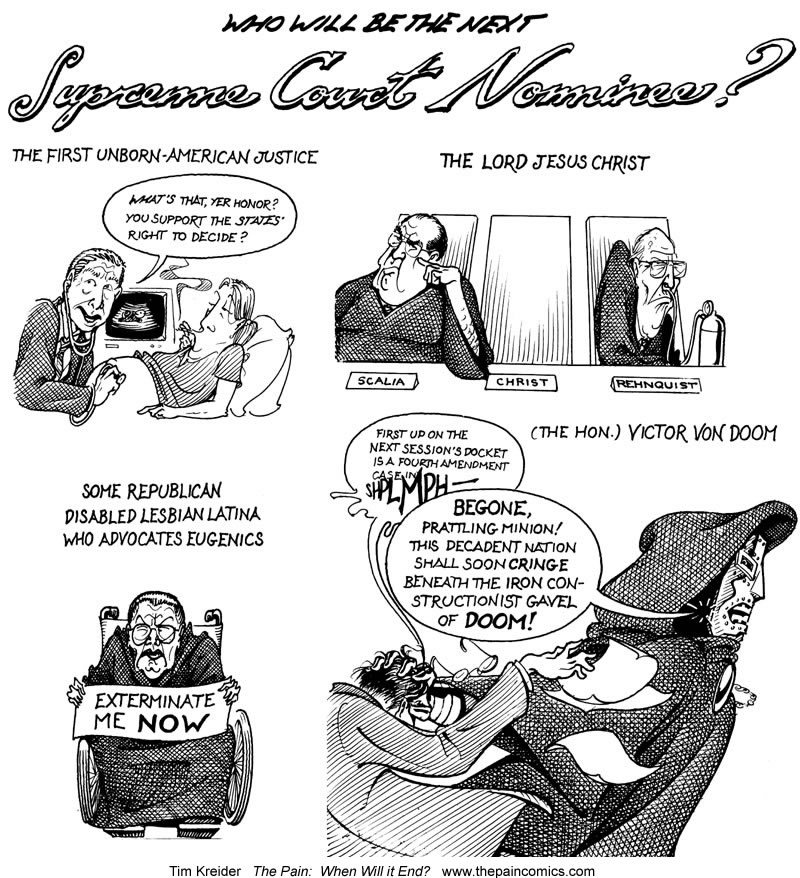
posted by The Whelk at 10:40 AM on April 12, 2010
I miss Kreider.
posted by klangklangston at 10:50 AM on April 12, 2010 [2 favorites]
posted by klangklangston at 10:50 AM on April 12, 2010 [2 favorites]
his old comic payed 20 bucks a shot. Lets poor our resources and enter into a Year-Long Kreider Subscription Plan. 50 cents a week (LESS. THAN. COFFEE.) and we get new fresh Kreider in our lap (naked, with a cat, crying )
posted by The Whelk at 11:04 AM on April 12, 2010 [1 favorite]
posted by The Whelk at 11:04 AM on April 12, 2010 [1 favorite]
I think Obama could do a lot worse than Judge Wood. IM[legally-insignificant]O she is well-suited to stepping in to Steven's role as consensus builder. I'd also like to see her get the nod because, once upon a time, I hired on at the 7th Circuit clerk's office as a case processor right about the time she was confirmed to the judgeship, and it would be way awesome to see her get the nod over Judge Posner. It would be come my best brush with greatness yet.
posted by Fezboy! at 3:17 PM on April 12, 2010
posted by Fezboy! at 3:17 PM on April 12, 2010
CNN is showing Elizabeth Warren as a possibility. awesome!
posted by fallacy of the beard at 10:38 PM on April 12, 2010
posted by fallacy of the beard at 10:38 PM on April 12, 2010
CNN is showing Elizabeth Warren as a possibility. awesome!
I think it's a safe bet that Warren will not be the nominee. In fact, I'd wager a pretty decent sum that the nominee will not be someone born before 1950. The networks buzzing about Hillary Clinton were just being foolish; Clinton is almost 63 years old. That's not going to happen. John Roberts was 50 when he joined the court. 50!
Naming Supreme Court justices is a President's chance to directly influence the course of the nation for decades after he leaves office. He's not going to name somebody who is in his or her 60s.
posted by Justinian at 12:13 AM on April 13, 2010
I think it's a safe bet that Warren will not be the nominee. In fact, I'd wager a pretty decent sum that the nominee will not be someone born before 1950. The networks buzzing about Hillary Clinton were just being foolish; Clinton is almost 63 years old. That's not going to happen. John Roberts was 50 when he joined the court. 50!
Naming Supreme Court justices is a President's chance to directly influence the course of the nation for decades after he leaves office. He's not going to name somebody who is in his or her 60s.
posted by Justinian at 12:13 AM on April 13, 2010
Oh, that's one reason I would take Elena Kagan seriously as a potential nominee. She was born in 1960 and so, like Roberts, would be 50 when she (theoretically) joined the Court.
posted by Justinian at 12:17 AM on April 13, 2010
posted by Justinian at 12:17 AM on April 13, 2010
Defining Radical Down: Are Judge Diane Wood's abortion rulings truly indefensible?
posted by homunculus at 2:56 PM on April 13, 2010
posted by homunculus at 2:56 PM on April 13, 2010
honestly, i didn't know elizabeth warren was over 50, much less over 60.
posted by fallacy of the beard at 8:30 PM on April 13, 2010
posted by fallacy of the beard at 8:30 PM on April 13, 2010
John Paul Stevens: Assessing the Departing Justice's IP Legacy
posted by homunculus at 12:48 PM on April 18, 2010
posted by homunculus at 12:48 PM on April 18, 2010
Glenn Greenwald: The long, clear, inspiring record of Diane Wood
posted by homunculus at 7:12 PM on April 19, 2010
posted by homunculus at 7:12 PM on April 19, 2010
The Surrendered Court: Maybe America doesn't want an immobilized judicial branch after all.
posted by homunculus at 10:53 PM on April 23, 2010 [1 favorite]
posted by homunculus at 10:53 PM on April 23, 2010 [1 favorite]
Obama's criticisms of the Warren and Burger courts
posted by homunculus at 11:24 PM on April 30, 2010
posted by homunculus at 11:24 PM on April 30, 2010
The Limits of Influence: Asking "Who can sway Kennedy?" is no way to pick a justice.
posted by homunculus at 10:23 PM on May 7, 2010
posted by homunculus at 10:23 PM on May 7, 2010
« Older Hevisaurus | the countries of old men drift like the waters Newer »
This thread has been archived and is closed to new comments
posted by dances_with_sneetches at 10:09 AM on April 9, 2010 [3 favorites]