There's something in the water... How crude!
May 13, 2010 6:06 AM Subscribe
The BP / Gulf of Mexico Oil Spill (previously): The Big Picture presents it. The New York Times is tracking it day-by-day. BBC places it in context of the 10 worst offshore oil spills on record. Visual Economics presents it in an infographic. Alternet covers the 7 stupidest statements made about it.
How big is the Deepwater Horizon oil spill? (requires Google Earth plugin)
posted by shakespeherian at 6:17 AM on May 13, 2010
posted by shakespeherian at 6:17 AM on May 13, 2010
the 7 stupidest statements made about it.
Gonna have to change that to eight, I reckon, with this one vying for the top spot.
posted by flapjax at midnite at 6:23 AM on May 13, 2010 [2 favorites]
Gonna have to change that to eight, I reckon, with this one vying for the top spot.
posted by flapjax at midnite at 6:23 AM on May 13, 2010 [2 favorites]
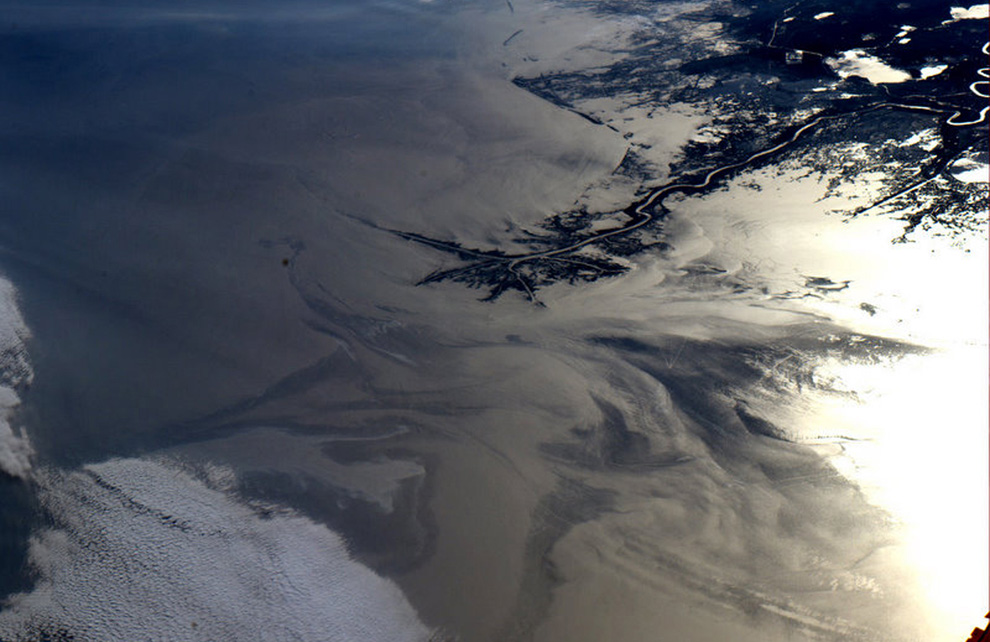
This image provided by NASA shows the Mississippi Delta (top right) and the growing oil slick in the Gulf of Mexico on May 5, 2010. Photo was taken by International Space Station Expedition 23 flight engineer Soichi Noguchi.
posted by KokuRyu at 6:32 AM on May 13, 2010
posted by KokuRyu at 6:32 AM on May 13, 2010
Gonna have to change that to eight, I reckon, with this one vying for the top spot.
If it's an act of God, maybe God is saying "Quit fucking drilling off my shorelines!"
posted by Pirate-Bartender-Zombie-Monkey at 6:33 AM on May 13, 2010 [3 favorites]
If it's an act of God, maybe God is saying "Quit fucking drilling off my shorelines!"
posted by Pirate-Bartender-Zombie-Monkey at 6:33 AM on May 13, 2010 [3 favorites]
I don't want to sound like I'm underplaying this, but it's a lot smaller than I gathered (second-hand) from the media frenzy.
posted by DU at 6:35 AM on May 13, 2010 [1 favorite]
posted by DU at 6:35 AM on May 13, 2010 [1 favorite]
More infographics:
* large overview of news stats, made by O&G and linked by Fast Company
* Information is Beautiful puts it in perspective, comparing the spill size to Jamaica, consumption, and potential environmental recovery time
* BP infographic, depicting the progress and depth of relief wells
* The Times-Picayune show what's going on down there
... and seven more, including an animation on CNN, and more displays of scale.
posted by filthy light thief at 6:36 AM on May 13, 2010 [1 favorite]
* large overview of news stats, made by O&G and linked by Fast Company
* Information is Beautiful puts it in perspective, comparing the spill size to Jamaica, consumption, and potential environmental recovery time
* BP infographic, depicting the progress and depth of relief wells
* The Times-Picayune show what's going on down there
... and seven more, including an animation on CNN, and more displays of scale.
posted by filthy light thief at 6:36 AM on May 13, 2010 [1 favorite]
10 Biggest Oil Spills in History (via Popular Mechanics)
Wow, so much for nostalgia over the summer of '79.
posted by shakespeherian at 6:39 AM on May 13, 2010
Wow, so much for nostalgia over the summer of '79.
posted by shakespeherian at 6:39 AM on May 13, 2010
Wow I've never heard of a Top 7 list. They seriously couldn't come up with 3 more stupid things?
posted by spicynuts at 6:41 AM on May 13, 2010 [1 favorite]
posted by spicynuts at 6:41 AM on May 13, 2010 [1 favorite]
The Boston.com photographs are incredible, terrifying and upsetting.
posted by Theta States at 6:41 AM on May 13, 2010
posted by Theta States at 6:41 AM on May 13, 2010
Big Ups to the Big Picture and its magnificent curator, kokogiak. I know he often takes the modest route when this is linked but I'll say time and time again that that is just an awesome "blog" you got there, mate. Thousands and thousands of words!
posted by cavalier at 6:46 AM on May 13, 2010 [2 favorites]
posted by cavalier at 6:46 AM on May 13, 2010 [2 favorites]
Not an infographic but BP has a handy conversion table to go between barrels, tonnes and gallons, etc.
posted by plastic_animals at 6:52 AM on May 13, 2010
posted by plastic_animals at 6:52 AM on May 13, 2010
PATH is taking donations to aid in wildlife rescue. If you live in Portland, OR, you can drop off items at Food Fight. In NYC, you can drop off at Moo Shoes.
posted by sleepy pete at 6:54 AM on May 13, 2010
posted by sleepy pete at 6:54 AM on May 13, 2010
I want to comment on the statement: If it's an act of God, maybe God is saying "Quit fucking drilling off my shorelines!". God places the Tree of Knowledge in the Garden of Eden but he doesn't want Adam and Eve to eat its fruit. God places large oil deposits underneath the ocean but doesn't want oil companies to drill there. God always seems to be devising traps for the human race to fall into. This seems very perverse.
posted by grizzled at 7:05 AM on May 13, 2010 [1 favorite]
posted by grizzled at 7:05 AM on May 13, 2010 [1 favorite]
"The safety of its entire operations rested on the performance of a leaking, modified, defective blowout preventer," said Rep. Bart Stupak (D-MI).
Rep. Jan Schakowsky (D-IL) repeatedly asked Transocean CEO Steve Newman if anyone made a mistake regarding the condition of the blowout preventer.
"It would be a mistake to rely on that in a well-controlled situation, yes," Newman acknowledged.
posted by East Manitoba Regional Junior Kabaddi Champion '94 at 7:10 AM on May 13, 2010
Rep. Jan Schakowsky (D-IL) repeatedly asked Transocean CEO Steve Newman if anyone made a mistake regarding the condition of the blowout preventer.
"It would be a mistake to rely on that in a well-controlled situation, yes," Newman acknowledged.
posted by East Manitoba Regional Junior Kabaddi Champion '94 at 7:10 AM on May 13, 2010
And MetaFilter is making some beautiful threads about it.
Grazi mille for the FPP, tybeet
posted by infini at 7:11 AM on May 13, 2010
Grazi mille for the FPP, tybeet
posted by infini at 7:11 AM on May 13, 2010
The picture of Jeebus in the comments of the gawker article is priceless.
posted by HumanComplex at 7:13 AM on May 13, 2010 [1 favorite]

posted by HumanComplex at 7:13 AM on May 13, 2010 [1 favorite]
The coining of the term "spill", as in "just a little spill" and "there's no point crying over it" wasn't a bad PR job, either. I'm not worried about oil spills, but I am worried about oil floods.
One pint of oil can produce a slick of approximately one acre on the surface of water. Films of oil on the surface of water prevent the replenishment of dissolved oxygen, impair photosynthetic processes, and block sunlight. (This is in reference to motor oil, but I don't think unrefined stuff is any better.)
Running score of how much oil has leaked (project by MeFi's own kuatto.)
posted by filthy light thief at 7:26 AM on May 13, 2010 [3 favorites]
One pint of oil can produce a slick of approximately one acre on the surface of water. Films of oil on the surface of water prevent the replenishment of dissolved oxygen, impair photosynthetic processes, and block sunlight. (This is in reference to motor oil, but I don't think unrefined stuff is any better.)
Running score of how much oil has leaked (project by MeFi's own kuatto.)
posted by filthy light thief at 7:26 AM on May 13, 2010 [3 favorites]
How Quickly We Forget - Our addiction to cheap energy has a way of clouding memories of even the most vivid disasters.
The legacy of environmental catastrophes is, instead, a hybrid of amnesia and habituation. That is, the public forgets more quickly now than in the past, and understands that no source of energy is risk-free. Coal kills miners, including the 29 in West Virginia last month. Natural-gas pipelines sometimes explode and occasionally kill, as in a 2000 accident that left 12 people dead in New Mexico. Nuclear reactors, despite industry assurances, will never be risk-free; no technology is. The "risks" of renewables such as wind and solar are higher energy prices, which to many people are less acceptable than the environmental and human costs of fossil fuel. "There has been a generational change in risk tolerance," says engineering professor Henry Petroski of Duke University, author of the 2010 book The Essential Engineer.
posted by infini at 7:30 AM on May 13, 2010 [5 favorites]
The legacy of environmental catastrophes is, instead, a hybrid of amnesia and habituation. That is, the public forgets more quickly now than in the past, and understands that no source of energy is risk-free. Coal kills miners, including the 29 in West Virginia last month. Natural-gas pipelines sometimes explode and occasionally kill, as in a 2000 accident that left 12 people dead in New Mexico. Nuclear reactors, despite industry assurances, will never be risk-free; no technology is. The "risks" of renewables such as wind and solar are higher energy prices, which to many people are less acceptable than the environmental and human costs of fossil fuel. "There has been a generational change in risk tolerance," says engineering professor Henry Petroski of Duke University, author of the 2010 book The Essential Engineer.
posted by infini at 7:30 AM on May 13, 2010 [5 favorites]
Running score of how much oil has leaked (project by MeFi's own kuatto.)
I don't trust any site about oil run by kuatto, who is obviously trying to discredit oil in favor of massive subterranean generators of unclear origin and operation.
posted by Pope Guilty at 7:40 AM on May 13, 2010 [3 favorites]
I don't trust any site about oil run by kuatto, who is obviously trying to discredit oil in favor of massive subterranean generators of unclear origin and operation.
posted by Pope Guilty at 7:40 AM on May 13, 2010 [3 favorites]
Is cleaning up an oil spill impossible?
Gahhh! That article is misleading in many ways. The following is way too long, but jeeze, I can't let this go.
BP's cleanup tactics are still pretty similar to what Exxon was doing back in the 1980s.
That's very oversimplified. Prince William Sound is a much different place than the Gulf of Mexico. PWS has a very much more low flushing rate that the open ocean, and a much more sensitive cold-water ecology compared with the rapid-recoveries seen in (sub-)tropical ecosystems. Options for response are rather different.
...the big difference is that BP is using far more chemical dispersants to try to break up the crude and sink it to the bottom.
Dispersant use is much higher on this spill, true. It could not be used in PWS because of operational considerations, it wasn't available, and given the slow-moving water and sensitive ecology, it wasn't appropriate to use anyway.
Furthermore: break up the crude and sink it to the bottom. misunderstands what a dispersant is supposed to do. A dispersant does exactly that, it breaks up oil and moves it into the water. It does not cause the oil to sink to the bottom. "Sinking agents" are illegal in the US, BP would be heavily fined for using them.
Dispersed oil breaks into small droplets (<100µm). These small droplets are more readily broken down by the oil-eating micro-organisms in the water than crude oil slicks on the surface. Dispersant is used to accelerate the natural attenuation of the oil.
But, as in Alaska, those dispersants can be toxic in their own right, and the oil that settles on the seafloor can cause havoc on shellfish and other small-but-key-to-the-food-chain organisms there.
As above, this completely misses the point of dispersants. Dispersants are used to move the oil from the surface into the water, not to the sea floor.
The benefits are: increasing the oil degredation rate; removing the oil from the surface of the water, reducing bird and other surface dabbler (otter, dolphin) impacts; reducing the amount of floating oil which can come ashore. These benefits must be balance with the negatives: increased toxcicity of the water to swimming organisms, fish and shrimp, but most especially to stationary water-dwellers like oysters and mussels.
If done right, dispersant application actually prevents many of the processes (weathering, water-uptake, sedimentation) which cause oil to sink to the sea floor.
So, lets talk about some of the other short-cuts in the article:
The truth is that when large amounts of oil go into the ocean, it’s a huge success to recover as much as 10 percent.
This is true on it's face, but misses the point. He's talking about using skimmers to collect oil on the surface of the water. This is correct; skimmers are a poor way to remove oil on the open ocean. That's why dispersants and in situ bruning have been much of the focus of the response so far. Rather than recovering oil, the responders are attempting to disperse the oil, by air and at the blow-out site underwater and to remove the oil by burning. Neither of these options were viable in PWS; dispersants could not be used and the technology for fire booms was not very well developed or even available in 1989.
The major advance since the Valdez, however, is on the remote sensing/modelling side. During the Valdez, the state of the art was to send planes up to do visual observation. That's still an important tool today, but it's supplemented by SAR radar and satellite imagery, which were much more primitive in 1989. Models, also, are hugely better now than in 1989. This allows prediction of how much and where the oil is going to go. Modelling and remote sensing data was what told NOAA that BP's inital guesses of the release rate was wrong (5,000 bbl/day rather than 1,000 as we thought in the first few days) and was what prompted the finding of the additional leaks. It's hard to emphasise how much of a difference this makes.
The major problem with dispersant application, skimmer use or burning is just knowing where the oil is. Any technique is useless if done on open, clean water. It can be very hard to see oil in the water, especially by boat. There are many pictures of skimmers merrily skimming away a couple of hundred yards to the side of a slick. This is one of the main reasons the technique is so ineffective.
It's wrong to think that this is just like the Exxon Valdez spill. In many ways, they could not be more different, especially in the options for response and the techniques being used. It's also wrong to look to the Valdez for persistance of the oil. It's much more useful to consider the Ixtoc blowout of 1979, which is much more similar to the present spill. As large as it was, the Ixtoc oil was largely gone within 3 years of the event. Exxon Valdez oil is still just below the surfaces of the beaches of PWS today.
It is frustrating to see oil continue to spout up and to see sensitive ecologies and the lives of people who depend on the sea ruined. This just points to the best response strategy of all: stopping the leak. Until that is done, even the best repsonse and mitigation is just treading water.
posted by Anonymous 5$ Sockpuppet at 7:59 AM on May 13, 2010 [32 favorites]
Gahhh! That article is misleading in many ways. The following is way too long, but jeeze, I can't let this go.
BP's cleanup tactics are still pretty similar to what Exxon was doing back in the 1980s.
That's very oversimplified. Prince William Sound is a much different place than the Gulf of Mexico. PWS has a very much more low flushing rate that the open ocean, and a much more sensitive cold-water ecology compared with the rapid-recoveries seen in (sub-)tropical ecosystems. Options for response are rather different.
...the big difference is that BP is using far more chemical dispersants to try to break up the crude and sink it to the bottom.
Dispersant use is much higher on this spill, true. It could not be used in PWS because of operational considerations, it wasn't available, and given the slow-moving water and sensitive ecology, it wasn't appropriate to use anyway.
Furthermore: break up the crude and sink it to the bottom. misunderstands what a dispersant is supposed to do. A dispersant does exactly that, it breaks up oil and moves it into the water. It does not cause the oil to sink to the bottom. "Sinking agents" are illegal in the US, BP would be heavily fined for using them.
Dispersed oil breaks into small droplets (<100µm). These small droplets are more readily broken down by the oil-eating micro-organisms in the water than crude oil slicks on the surface. Dispersant is used to accelerate the natural attenuation of the oil.
But, as in Alaska, those dispersants can be toxic in their own right, and the oil that settles on the seafloor can cause havoc on shellfish and other small-but-key-to-the-food-chain organisms there.
As above, this completely misses the point of dispersants. Dispersants are used to move the oil from the surface into the water, not to the sea floor.
The benefits are: increasing the oil degredation rate; removing the oil from the surface of the water, reducing bird and other surface dabbler (otter, dolphin) impacts; reducing the amount of floating oil which can come ashore. These benefits must be balance with the negatives: increased toxcicity of the water to swimming organisms, fish and shrimp, but most especially to stationary water-dwellers like oysters and mussels.
If done right, dispersant application actually prevents many of the processes (weathering, water-uptake, sedimentation) which cause oil to sink to the sea floor.
So, lets talk about some of the other short-cuts in the article:
The truth is that when large amounts of oil go into the ocean, it’s a huge success to recover as much as 10 percent.
This is true on it's face, but misses the point. He's talking about using skimmers to collect oil on the surface of the water. This is correct; skimmers are a poor way to remove oil on the open ocean. That's why dispersants and in situ bruning have been much of the focus of the response so far. Rather than recovering oil, the responders are attempting to disperse the oil, by air and at the blow-out site underwater and to remove the oil by burning. Neither of these options were viable in PWS; dispersants could not be used and the technology for fire booms was not very well developed or even available in 1989.
The major advance since the Valdez, however, is on the remote sensing/modelling side. During the Valdez, the state of the art was to send planes up to do visual observation. That's still an important tool today, but it's supplemented by SAR radar and satellite imagery, which were much more primitive in 1989. Models, also, are hugely better now than in 1989. This allows prediction of how much and where the oil is going to go. Modelling and remote sensing data was what told NOAA that BP's inital guesses of the release rate was wrong (5,000 bbl/day rather than 1,000 as we thought in the first few days) and was what prompted the finding of the additional leaks. It's hard to emphasise how much of a difference this makes.
The major problem with dispersant application, skimmer use or burning is just knowing where the oil is. Any technique is useless if done on open, clean water. It can be very hard to see oil in the water, especially by boat. There are many pictures of skimmers merrily skimming away a couple of hundred yards to the side of a slick. This is one of the main reasons the technique is so ineffective.
It's wrong to think that this is just like the Exxon Valdez spill. In many ways, they could not be more different, especially in the options for response and the techniques being used. It's also wrong to look to the Valdez for persistance of the oil. It's much more useful to consider the Ixtoc blowout of 1979, which is much more similar to the present spill. As large as it was, the Ixtoc oil was largely gone within 3 years of the event. Exxon Valdez oil is still just below the surfaces of the beaches of PWS today.
It is frustrating to see oil continue to spout up and to see sensitive ecologies and the lives of people who depend on the sea ruined. This just points to the best response strategy of all: stopping the leak. Until that is done, even the best repsonse and mitigation is just treading water.
posted by Anonymous 5$ Sockpuppet at 7:59 AM on May 13, 2010 [32 favorites]
"Sinking agents" are illegal in the US, BP would be heavily fined for using them.
I would like to hear more about this.
posted by Pope Guilty at 8:00 AM on May 13, 2010
I would like to hear more about this.
posted by Pope Guilty at 8:00 AM on May 13, 2010
I'm all for polluter pays. Obama would be doing the same thing if it'd been an American oil company, right? Right?
posted by nthdegx at 8:04 AM on May 13, 2010
posted by nthdegx at 8:04 AM on May 13, 2010
As a lifelong Gulf Coast resident, this TPM story in particular ticked me off and should be read and processed by everyone feeling persuaded by all the "optimism" in the media about the prospect of the Gulf's rapid recovery:
'Conservation Group' Quoted In NYT Frontpager On Oil Spill Has Ties To Transocean
The NY Times followed up with an apologetic editorial after the story above broke, but somehow, they still avoided disclosing that the Gulf of Mexico Foundation "conservation group" in question not only has "close ties to the oil industry," but has especially close ties to Transocean in particular, the company running the rig that blew. As TPM notes, the NY times apology '... does not mention the specific ties to Transocean (the Gulf of Mexico Foundation's most recent board meeting was hosted by the company).'
I'm more and more convinced it's a safe bet that any expert cited by the media on virtually any issue is a paid flack for some industry or another.
posted by saulgoodman at 8:09 AM on May 13, 2010
'Conservation Group' Quoted In NYT Frontpager On Oil Spill Has Ties To Transocean
The NY Times followed up with an apologetic editorial after the story above broke, but somehow, they still avoided disclosing that the Gulf of Mexico Foundation "conservation group" in question not only has "close ties to the oil industry," but has especially close ties to Transocean in particular, the company running the rig that blew. As TPM notes, the NY times apology '... does not mention the specific ties to Transocean (the Gulf of Mexico Foundation's most recent board meeting was hosted by the company).'
I'm more and more convinced it's a safe bet that any expert cited by the media on virtually any issue is a paid flack for some industry or another.
posted by saulgoodman at 8:09 AM on May 13, 2010
That red sheen the oil takes on is pretty unsettling.
That's not a sheen, that's an emulsion forming. Crude oil mayonnaise. They're often called chocolate mousse. Those water-in-oil emulsions are the source of the characteristic red/orange colors in those pictures.
posted by Anonymous 5$ Sockpuppet at 8:09 AM on May 13, 2010 [3 favorites]
That's not a sheen, that's an emulsion forming. Crude oil mayonnaise. They're often called chocolate mousse. Those water-in-oil emulsions are the source of the characteristic red/orange colors in those pictures.
posted by Anonymous 5$ Sockpuppet at 8:09 AM on May 13, 2010 [3 favorites]
I'm all for polluter pays. Obama would be doing the same thing if it'd been an American oil company, right? Right?
BP has a gigantic US presence in every aspect of its business. The fact that BP is British is basically irrelevent, unless you're Sarah Palin.
Note that Todd Palin worked for BP for 18 years and only quit last year.
posted by East Manitoba Regional Junior Kabaddi Champion '94 at 8:18 AM on May 13, 2010 [3 favorites]
BP has a gigantic US presence in every aspect of its business. The fact that BP is British is basically irrelevent, unless you're Sarah Palin.
Note that Todd Palin worked for BP for 18 years and only quit last year.
posted by East Manitoba Regional Junior Kabaddi Champion '94 at 8:18 AM on May 13, 2010 [3 favorites]
Sinking agents (SA) are materials added to oil to increase it's density and cause it to sink. They are normally rock dust or other inorganic materials like chalk or talc. Most oil needs only a 2% to 5% addition of SA to cause sinking, less if it's weathered or emulsified, more if it's fresher.
Sinking is bad because oil on the sea floor, the benthic environment, is persistant. The benthos is cold (~4°C) and oxygen-poor. Oil does not break-down quickly in those conditions. What it does do is continue to leach low levels of toxins, polycyclic aromatic hydrocabons, PAHs, as it sits on the sea-floor. The PAHs are bioaccumulative and can mess up the organisms which live and spawn on the sea-floor.
Submerged oil is generally only removed from the bethos by being covered by the slow rain of sediment from the surface. It can take years or even decades to encapsulate the oil.
That's why SAs are not used. They do remove oil from the surface and from view, but they just move the problem elsewhere and extend the spill's impact to years or decades. Dispersants, by contrast, just spread oil into the mixing layer, the first 3 to 5 metres of the surface water. The intent is to speed up the natural attenuation of the oil, reducing the spill's time of effect and removing the problem permanently, rather than just displacing it as SAs do.
posted by Anonymous 5$ Sockpuppet at 8:55 AM on May 13, 2010 [9 favorites]
Sinking is bad because oil on the sea floor, the benthic environment, is persistant. The benthos is cold (~4°C) and oxygen-poor. Oil does not break-down quickly in those conditions. What it does do is continue to leach low levels of toxins, polycyclic aromatic hydrocabons, PAHs, as it sits on the sea-floor. The PAHs are bioaccumulative and can mess up the organisms which live and spawn on the sea-floor.
Submerged oil is generally only removed from the bethos by being covered by the slow rain of sediment from the surface. It can take years or even decades to encapsulate the oil.
That's why SAs are not used. They do remove oil from the surface and from view, but they just move the problem elsewhere and extend the spill's impact to years or decades. Dispersants, by contrast, just spread oil into the mixing layer, the first 3 to 5 metres of the surface water. The intent is to speed up the natural attenuation of the oil, reducing the spill's time of effect and removing the problem permanently, rather than just displacing it as SAs do.
posted by Anonymous 5$ Sockpuppet at 8:55 AM on May 13, 2010 [9 favorites]
You seem to be saying that a British company having presence in the States occupies the same status in the mind of the American government as an American company. I don't buy that at all, I'm afraid. But if you're saying it's irrelevant that BP is British, I'll take your word for it.
posted by nthdegx at 8:56 AM on May 13, 2010
posted by nthdegx at 8:56 AM on May 13, 2010
More reading on suken oil: NRC's Spills of non-floating oils, 1999.
posted by Anonymous 5$ Sockpuppet at 8:59 AM on May 13, 2010 [1 favorite]
posted by Anonymous 5$ Sockpuppet at 8:59 AM on May 13, 2010 [1 favorite]
I am disappointed that something called "the benthic environment" has nothing to do with Jeremy Bentham.
posted by Pope Guilty at 9:01 AM on May 13, 2010 [1 favorite]
posted by Pope Guilty at 9:01 AM on May 13, 2010 [1 favorite]
7 stupidest statements made about it
"Oil rigs today generally don't cause spills" -- Barack Obama, 4/2/10
posted by 7-7 at 9:03 AM on May 13, 2010
"Oil rigs today generally don't cause spills" -- Barack Obama, 4/2/10
posted by 7-7 at 9:03 AM on May 13, 2010
Actual video of the oil flowing out of the leak
posted by hippybear at 9:05 AM on May 13, 2010 [1 favorite]
posted by hippybear at 9:05 AM on May 13, 2010 [1 favorite]
I was sitting with Jefu last night having fish and chips for dinner, and we were commenting that we'd best have seafood again for meals a few times this month before the impact of this whole thing drives up prices. Shrimp, oysters, quite a few kinds of fish...
I heard some woman on the news last night being interviewed and she said that bluefin tuna only have two spawning grounds on the entire planet, and the Gulf of Mexico is one of them.
This is a fuckup in SOOOO many ways.
posted by hippybear at 9:09 AM on May 13, 2010
I heard some woman on the news last night being interviewed and she said that bluefin tuna only have two spawning grounds on the entire planet, and the Gulf of Mexico is one of them.
This is a fuckup in SOOOO many ways.
posted by hippybear at 9:09 AM on May 13, 2010
I don't want to sound like I'm underplaying this, but it's a lot smaller than I gathered (second-hand) from the media frenzy.
I thought the same thing. I really worry that this kind of ZOMG OIL-POCALYPSE!! news coverage simply works to the advantage of the Palins and the Limbaughs, who can simply dismiss legitimate environmental concerns as librul-media agenda-pushing and over-reaction. When the world ends up not coming to an end, they'll simply say: "See? Environmentalist wackos librul media hurf durf etc."
posted by Bummus at 9:16 AM on May 13, 2010
I thought the same thing. I really worry that this kind of ZOMG OIL-POCALYPSE!! news coverage simply works to the advantage of the Palins and the Limbaughs, who can simply dismiss legitimate environmental concerns as librul-media agenda-pushing and over-reaction. When the world ends up not coming to an end, they'll simply say: "See? Environmentalist wackos librul media hurf durf etc."
posted by Bummus at 9:16 AM on May 13, 2010
7 stupidest statements made about it
"Oil rigs today generally don't cause spills" -- Barack Obama, 4/2/10
What's stupid about that? 1 rig out of... how many rigs are out there? I'd say that statement is pretty spot on.
posted by inigo2 at 9:28 AM on May 13, 2010
"Oil rigs today generally don't cause spills" -- Barack Obama, 4/2/10
What's stupid about that? 1 rig out of... how many rigs are out there? I'd say that statement is pretty spot on.
posted by inigo2 at 9:28 AM on May 13, 2010
7 stupidest statements made about it
"Oil rigs today generally don't cause spills" -- Barack Obama, 4/2/10
Well, I hate to be the defender of the oil industry here (because I hate our dependence on fossil fuels with every fiber of my being that isn't reserved for hating Dick Cheney and Glenn Beck), but in 2006 there were 3,359 active oil platforms in the Gulf of Mexico alone. Here's a helpful map.
Since I don't recall having heard too many stories about all those rigs popping off every couple of days in the four years since this map was current, I'm going to have to say that the statement "Oil rigs today generally don't cause spills" is too factually accurate to be called stupid, even despite the unfortunate timing.
The problem with oil rigs isn't that they generally cause spills. It's that when that 1 out of 3,500th rig does blow, the harm caused is so potentially devastating.
posted by saulgoodman at 9:29 AM on May 13, 2010 [1 favorite]
"Oil rigs today generally don't cause spills" -- Barack Obama, 4/2/10
Well, I hate to be the defender of the oil industry here (because I hate our dependence on fossil fuels with every fiber of my being that isn't reserved for hating Dick Cheney and Glenn Beck), but in 2006 there were 3,359 active oil platforms in the Gulf of Mexico alone. Here's a helpful map.

Since I don't recall having heard too many stories about all those rigs popping off every couple of days in the four years since this map was current, I'm going to have to say that the statement "Oil rigs today generally don't cause spills" is too factually accurate to be called stupid, even despite the unfortunate timing.
The problem with oil rigs isn't that they generally cause spills. It's that when that 1 out of 3,500th rig does blow, the harm caused is so potentially devastating.
posted by saulgoodman at 9:29 AM on May 13, 2010 [1 favorite]
I don't want to sound like I'm underplaying this, but it's a lot smaller than I gathered (second-hand) from the media frenzy.
Someone created a Google Earth widget to help visualize the size of the visible spill.
posted by hippybear at 9:38 AM on May 13, 2010
Someone created a Google Earth widget to help visualize the size of the visible spill.
posted by hippybear at 9:38 AM on May 13, 2010
@saulgoodman, inigo2
"Obama’s claim that oil rigs did not cause any spills during Hurricane Katrina is simply false, as the Wonk Room reported in June, 2008, when Sen. John McCain (R-AZ) and other conservatives made the same false claim:"posted by 7-7 at 9:39 AM on May 13, 2010Unsurprisingly, this devastation caused significant spillage, according to the official report prepared for the MMS by a Norwegian firm:
Hurricanes Katrina and Rita Caused 124 Offshore Spills For A Total Of 743,700 Gallons. 554,400 gallons were crude oil and condensate from platforms, rigs and pipelines, and 189,000 gallons were refined products from platforms and rigs. [MMS, 1/22/07]
Hurricanes Katrina and Rita Caused Six Offshore Spills Of 42,000 Gallons Or Greater. The largest of these was 152,250 gallons, well over the 100,000 gallon threshhold considered a “major spill.” [MMS, 5/1/06]
British Petroleum is British in origin but is now a publicly owned multinational corporation; it has the same nationality as Exxon, Chevron, Total, Royal Dutch Shell and Apple computers.
posted by bukvich at 9:53 AM on May 13, 2010 [1 favorite]
posted by bukvich at 9:53 AM on May 13, 2010 [1 favorite]
I don't want to sound like I'm underplaying this, but it's a lot smaller than I gathered (second-hand) from the media frenzy.
Really? It's the size of Delaware. That's huge! And oil is seriously toxic stuff. If there's even a couple of barrels spilled in a residential area it can be a major issue (not that that stops people from dumping their oil pans in ditches anyway).
Here's another site that lets you compare the size of the spill to various locations using Google Maps (don't have the Google Maps plug in installed on this machine, so I can't vouch for it, but it looks interesting).
posted by saulgoodman at 9:54 AM on May 13, 2010
Really? It's the size of Delaware. That's huge! And oil is seriously toxic stuff. If there's even a couple of barrels spilled in a residential area it can be a major issue (not that that stops people from dumping their oil pans in ditches anyway).
Here's another site that lets you compare the size of the spill to various locations using Google Maps (don't have the Google Maps plug in installed on this machine, so I can't vouch for it, but it looks interesting).
posted by saulgoodman at 9:54 AM on May 13, 2010
Actual video of the oil flowing out of the leak
The MetLife ad I had to watch in front of that video was delicious in its perfect irony.
posted by spicynuts at 9:55 AM on May 13, 2010
Also, Newman took the job as CEO of Transocean only this March. What a way to get broken in.
posted by digitalprimate at 9:55 AM on May 13, 2010
posted by digitalprimate at 9:55 AM on May 13, 2010
Obama’s claim that oil rigs did not cause any spills during Hurricane Katrina
Didn't know about that claim, so sure, on that specific claim he was wrong. But the claim that oil platforms generally don't cause spills is still accurate. They generally don't.
Still, I wish we could get rid of all the rigs, personally, because even when they work the way they're supposed to, the stuff they pump up causes ludicrous amounts of environmental harm. But that's not going to happen for many, many years, unfortunately.
posted by saulgoodman at 10:01 AM on May 13, 2010
Didn't know about that claim, so sure, on that specific claim he was wrong. But the claim that oil platforms generally don't cause spills is still accurate. They generally don't.
Still, I wish we could get rid of all the rigs, personally, because even when they work the way they're supposed to, the stuff they pump up causes ludicrous amounts of environmental harm. But that's not going to happen for many, many years, unfortunately.
posted by saulgoodman at 10:01 AM on May 13, 2010
"Oil rigs don't generally cause oil spills, but oil spills are generally caused by oil rigs." is a perfectly coherent statement.
posted by Pope Guilty at 10:13 AM on May 13, 2010
posted by Pope Guilty at 10:13 AM on May 13, 2010
Obama’s claim that oil rigs did not cause any spills during Hurricane Katrina
What does that claim have to do with your earlier statement?
posted by inigo2 at 10:36 AM on May 13, 2010
What does that claim have to do with your earlier statement?
posted by inigo2 at 10:36 AM on May 13, 2010
Anonymous $5 Sockpuppet: Thanks for being an intelligent (and patient) voice of reason in the oil spill threads. I've learned a lot.
posted by iamkimiam at 10:37 AM on May 13, 2010 [5 favorites]
posted by iamkimiam at 10:37 AM on May 13, 2010 [5 favorites]
Anonymous $5 Sockpuppet: Thanks for being an intelligent (and patient) voice of reason in the oil spill threads. I've learned a lot.
Ditto.
posted by rollbiz at 10:49 AM on May 13, 2010
Ditto.
posted by rollbiz at 10:49 AM on May 13, 2010
So, what's up with this statement in the commentary portion of the "7 stupidest things" article?
Experts have said that they'll be "lucky" if 15% of the spill gets cleaned up -- most of it simply will not. Secondly, there have not been others like this, as bad as this -- not in US history.
Given the comparisons here, is this an 8th stupid statement? Or is there some way in which this spill is really unprecedented "in US history"?
(Not snark. I'm confused, and really want to know.)
posted by mmoncur at 11:20 AM on May 13, 2010
Experts have said that they'll be "lucky" if 15% of the spill gets cleaned up -- most of it simply will not. Secondly, there have not been others like this, as bad as this -- not in US history.
Given the comparisons here, is this an 8th stupid statement? Or is there some way in which this spill is really unprecedented "in US history"?
(Not snark. I'm confused, and really want to know.)
posted by mmoncur at 11:20 AM on May 13, 2010
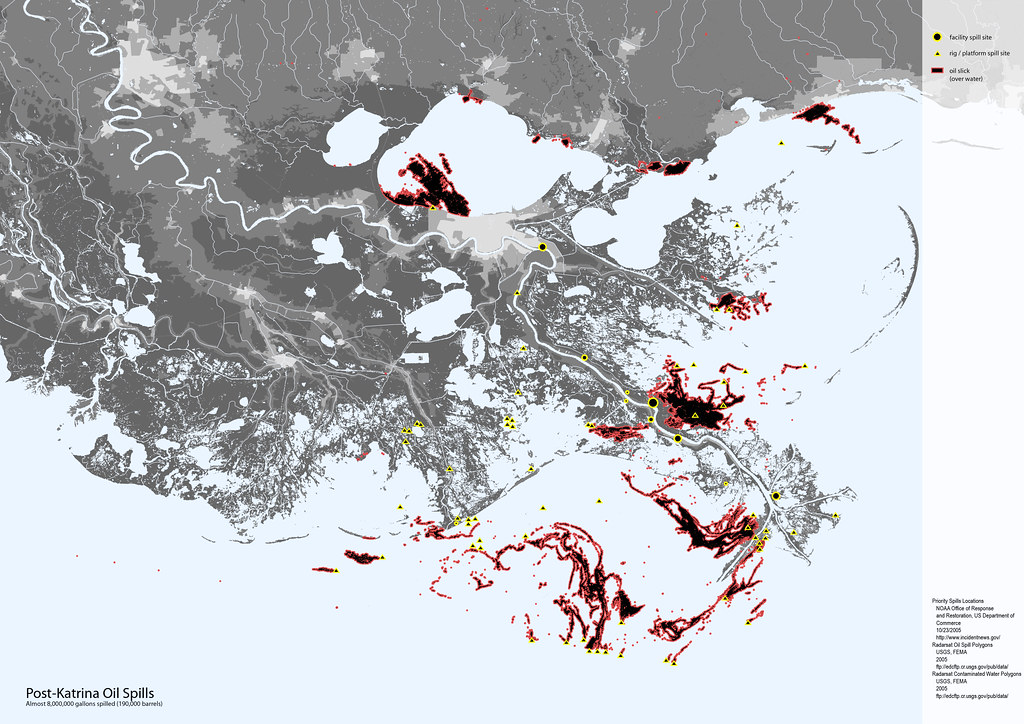
by comparison, here is a map of oil sheen from spills caused by Katrina and Rita.
From the Exposed New Orleans project:
http://farm4.static.flickr.com/3120/4565290161_2b64b53350_b.jpg
this doesn't include polygons from spills onto land, like the Murphy oil spill in Chalmette, near New Orleans.
The Bucket Brigade has done a lot of work recently, DEQ's work that DEQ is not doing, to make the case that companies use storms as an excuse to dump their waste cheaply, given that they can file the release under the legal cover of "accidents."
http://www.labucketbrigade.org/section.php?id=169
I have heard that the business model of refineries, much like the extraction rigs, is moving from "extract as much oil / make as much product as possible" to "extract as much oil / make as much product as fast as possible."
I don't know why this is, beyond "time is money"; but you'd think there would be more economic benefit to keeping the oil in a tanker or product in the pipeline, rather than having it spill into everyone's water / give your workers a better shot at cancer.
the emphasis on speed of production means that companies will allow a leak to spill rather than shut down refinery production to replace the pipe; or, i guess in this case, take extreme risks to push a well into production faster than safety would warrant.
posted by eustatic at 11:37 AM on May 13, 2010
From the Exposed New Orleans project:
http://farm4.static.flickr.com/3120/4565290161_2b64b53350_b.jpg
this doesn't include polygons from spills onto land, like the Murphy oil spill in Chalmette, near New Orleans.
The Bucket Brigade has done a lot of work recently, DEQ's work that DEQ is not doing, to make the case that companies use storms as an excuse to dump their waste cheaply, given that they can file the release under the legal cover of "accidents."
http://www.labucketbrigade.org/section.php?id=169
I have heard that the business model of refineries, much like the extraction rigs, is moving from "extract as much oil / make as much product as possible" to "extract as much oil / make as much product as fast as possible."
I don't know why this is, beyond "time is money"; but you'd think there would be more economic benefit to keeping the oil in a tanker or product in the pipeline, rather than having it spill into everyone's water / give your workers a better shot at cancer.
the emphasis on speed of production means that companies will allow a leak to spill rather than shut down refinery production to replace the pipe; or, i guess in this case, take extreme risks to push a well into production faster than safety would warrant.
posted by eustatic at 11:37 AM on May 13, 2010
Experts have said that they'll be "lucky" if 15% of the spill gets cleaned up
This figure usually refers to oil picked up and put in buckets or whatnot. It does not refer to oil dispersed naturally or otherwise at sea, in typical reports. It may refer to oil burned. We'll have to see, burning has not really been an alternative that's been used before. In any case, the 15% normally refers to oil collected by skimmers and the oil and oily waste collected off of beaches. And yes, it is often that low. Nature usually gets most of the cleanup. Microbes are much better at it than we are anyway.
posted by Anonymous 5$ Sockpuppet at 11:39 AM on May 13, 2010
This figure usually refers to oil picked up and put in buckets or whatnot. It does not refer to oil dispersed naturally or otherwise at sea, in typical reports. It may refer to oil burned. We'll have to see, burning has not really been an alternative that's been used before. In any case, the 15% normally refers to oil collected by skimmers and the oil and oily waste collected off of beaches. And yes, it is often that low. Nature usually gets most of the cleanup. Microbes are much better at it than we are anyway.
posted by Anonymous 5$ Sockpuppet at 11:39 AM on May 13, 2010
for some reason, i feel compelled to say that I remember Bhopal
perhaps its the discussion upthread about the putative citizenship of today's mega multi trans nationals
posted by infini at 11:41 AM on May 13, 2010 [1 favorite]
perhaps its the discussion upthread about the putative citizenship of today's mega multi trans nationals
posted by infini at 11:41 AM on May 13, 2010 [1 favorite]
oh, right, metafilter's html rules.
Map of post-Storm oil spills
LA bucket brigade
Anyway, we in louisiana have got good reason to distrust Oil company claims of remuneration, given that oil and gas pipeline canals have caused 30%-50% of Louisiana wetlands loss, and they are avoiding all legal culpability. They blame the nutria! (.07% in that same report).
They also own the LA legislature, which is pushing to cripple pro-bono legal clinics that would sue polluting companies.
Adley said he offered his proposal after chemical and oil industry lobbyists complained to him about lawsuits brought by the Tulane environmental clinic, including a suit against the U.S. Environmental Protection Agency and state regulators that would require them to enforce clean air regulations in the Baton Rouge area.
posted by eustatic at 11:47 AM on May 13, 2010
Map of post-Storm oil spills
LA bucket brigade
Anyway, we in louisiana have got good reason to distrust Oil company claims of remuneration, given that oil and gas pipeline canals have caused 30%-50% of Louisiana wetlands loss, and they are avoiding all legal culpability. They blame the nutria! (.07% in that same report).
They also own the LA legislature, which is pushing to cripple pro-bono legal clinics that would sue polluting companies.
Adley said he offered his proposal after chemical and oil industry lobbyists complained to him about lawsuits brought by the Tulane environmental clinic, including a suit against the U.S. Environmental Protection Agency and state regulators that would require them to enforce clean air regulations in the Baton Rouge area.
posted by eustatic at 11:47 AM on May 13, 2010
Microbes are much better at it than we are anyway.
So why aren't we using them on the Chandeleurs? apparently, Texas does. We can't do "beach clean up" out in the marsh...
posted by eustatic at 11:51 AM on May 13, 2010
So why aren't we using them on the Chandeleurs? apparently, Texas does. We can't do "beach clean up" out in the marsh...
posted by eustatic at 11:51 AM on May 13, 2010
Anonymous 5$ Sockpuppet -
With regard to the burning, do you know if they are having to use some kind of accelerant? Or will the emulsified material alone combust when given an ignition source? Just curious.
posted by Big_B at 12:07 PM on May 13, 2010
With regard to the burning, do you know if they are having to use some kind of accelerant? Or will the emulsified material alone combust when given an ignition source? Just curious.
posted by Big_B at 12:07 PM on May 13, 2010
I have no specific knowledge of that. I assume they're using the NOBE (PDF) protocols, ignition by helitorch or gellied gasoline. Accelerants aren't needed to burn most oil. Emulsions too.
posted by Anonymous 5$ Sockpuppet at 12:17 PM on May 13, 2010
posted by Anonymous 5$ Sockpuppet at 12:17 PM on May 13, 2010
Something we whipped up, mathematically displaying the total amount of oil spilled based on a conservative rate of 2.43 gallons per second: http://www.thebigoilspill.com (which is, 4.7 mil as of now) and about 43.7% as much as the exxon valdez spill.
posted by edman at 12:53 PM on May 13, 2010
posted by edman at 12:53 PM on May 13, 2010
Criminal charges likely from Gulf oil spill, legal experts say
posted by homunculus at 1:08 PM on May 13, 2010
posted by homunculus at 1:08 PM on May 13, 2010
Or will the emulsified material alone combust when given an ignition source? Just curious.
So much for not burning fossil fuels. I guess the odds of cooking our grandkids just shot up another couple of points.
posted by saulgoodman at 1:24 PM on May 13, 2010
So much for not burning fossil fuels. I guess the odds of cooking our grandkids just shot up another couple of points.
posted by saulgoodman at 1:24 PM on May 13, 2010
Halliburton may be Culprit in Oil Rig Explosion
According to a lawsuit filed in federal court by Natalie Roshto, whose husband Shane, a deck floor hand, was thrown overboard by the force of the explosion and whose body has not yet been located, Halliburton is culpable for its actions prior to the incident.posted by heathkit at 1:29 PM on May 13, 2010
The suit claims that the company "prior to the explosion, was engaged in cementing operations of the well and well cap and, upon information and belief, improperly and negligently performed these duties, which was a cause of the explosion."
So why aren't we using [microbes] on the Chandeleurs? apparently, Texas does.
Sorry, missed this comment the first time round. This is often called bioremediation. In a place as "rich" in natural oil seeps as the Gulf coast, it generally isn't necessary to add more bugs. The native ones are more than enough.
What can often help is fertilizer. Studies have shown that oil-degrading microbes often deplete nitrogen in the receiving environment. Phosporus can also be necessary. You don't generally need to add bugs, but sometimes they can benefit from a little extra help.
We can't do "beach clean up" out in the marsh...
Wetlands are tough. Heavy equipment, even foot traffic can damage them for years, even destroy them. Good options include flooding with water to flush the marsh, cutting reeds or grasses or even burning the marsh (if a seasonal reed or grass marsh) to the waterline. Migratory needs also have to be taken into account.
Burning looks horrible, but if done at the right time of year, and with sufficient water over the roots to protect them can be remarkably effective. Recovery can happen in about a single growing season, with much lower oil levels than leaving the marsh alone.
posted by Anonymous 5$ Sockpuppet at 2:00 PM on May 13, 2010 [1 favorite]
Sorry, missed this comment the first time round. This is often called bioremediation. In a place as "rich" in natural oil seeps as the Gulf coast, it generally isn't necessary to add more bugs. The native ones are more than enough.
What can often help is fertilizer. Studies have shown that oil-degrading microbes often deplete nitrogen in the receiving environment. Phosporus can also be necessary. You don't generally need to add bugs, but sometimes they can benefit from a little extra help.
We can't do "beach clean up" out in the marsh...
Wetlands are tough. Heavy equipment, even foot traffic can damage them for years, even destroy them. Good options include flooding with water to flush the marsh, cutting reeds or grasses or even burning the marsh (if a seasonal reed or grass marsh) to the waterline. Migratory needs also have to be taken into account.
Burning looks horrible, but if done at the right time of year, and with sufficient water over the roots to protect them can be remarkably effective. Recovery can happen in about a single growing season, with much lower oil levels than leaving the marsh alone.
posted by Anonymous 5$ Sockpuppet at 2:00 PM on May 13, 2010 [1 favorite]
can we somehow give Anonymous 5$ Sockpuppet an award please?
posted by infini at 2:09 PM on May 13, 2010
posted by infini at 2:09 PM on May 13, 2010
What oil spill?
posted by Smedleyman at 3:15 PM on May 13, 2010
posted by Smedleyman at 3:15 PM on May 13, 2010
Yeah, we need to sidebar Anonymous 5$ Sockpuppet's comments here. So informative.
posted by snwod at 4:26 PM on May 13, 2010
posted by snwod at 4:26 PM on May 13, 2010
what would happen if a hurricane hit the Gulf at this point? Would stoppage efforts have to stop for a while?
posted by angrycat at 7:30 PM on May 13, 2010
posted by angrycat at 7:30 PM on May 13, 2010
you guys remember christie todd whitman and rudy guiliani saying 'the air is safe to breathe' just 3 days after 9/11?
today, instead, we have anonymous sock puppet reassuring us in calm tones about how the marshland is tough! like, george w, we say, 'bring it on!'.
wanna be the one to tell the mom to send her children out in the yard to play after the first hurricane passes thru and coats the coast with oil and dispersant?
so sure the dispersant is safe? why not spray some on your lawn, tough guys?
this is our chernobyl, face it, the gulf coast is dead.
70,000 barrels per day is one valdez (juan valdez? not that this is a time for humor) every 4 days. many bp apologistas bring up ixtoc. some key differences: deepwater horizon/mississippi canyon is 60 miles off the coast, unlike ixtoc, which was 600 miles, and in only 150 ft of water. and that still took them 10 months to plug.
it is already in the loop current, on its way to the florida keys. it has already shut down production at 5 other platforms. as ocean going vessels require 'clean' seawater to cool their engines, this leak/gusher/gomgomgom monster stands to also restrict vessel traffic into the mississippi river.
posted by kimyo at 7:39 PM on May 13, 2010
today, instead, we have anonymous sock puppet reassuring us in calm tones about how the marshland is tough! like, george w, we say, 'bring it on!'.
wanna be the one to tell the mom to send her children out in the yard to play after the first hurricane passes thru and coats the coast with oil and dispersant?
so sure the dispersant is safe? why not spray some on your lawn, tough guys?
this is our chernobyl, face it, the gulf coast is dead.
70,000 barrels per day is one valdez (juan valdez? not that this is a time for humor) every 4 days. many bp apologistas bring up ixtoc. some key differences: deepwater horizon/mississippi canyon is 60 miles off the coast, unlike ixtoc, which was 600 miles, and in only 150 ft of water. and that still took them 10 months to plug.
it is already in the loop current, on its way to the florida keys. it has already shut down production at 5 other platforms. as ocean going vessels require 'clean' seawater to cool their engines, this leak/gusher/gomgomgom monster stands to also restrict vessel traffic into the mississippi river.
posted by kimyo at 7:39 PM on May 13, 2010
anonymous sock puppet reassuring us in calm tones about how the marshland is tough! like, george w, we say, 'bring it on!'.
Sorry, I skip words sometimes. I meant "wetlands are tough", as in tough to clean up. They are generally considered some of the more sensitive and delicate ecosystems on any shoreline---it's easy to get oil hung up in a marsh, but very hard to get it out. There is some resilience in wetlands, perhaps more than most people think, but if the root mass is damaged or poisoned, the wetland, marsh or mangrove is in real trouble.
My mistake. I should have been more clear.
posted by Anonymous 5$ Sockpuppet at 9:36 PM on May 13, 2010
Sorry, I skip words sometimes. I meant "wetlands are tough", as in tough to clean up. They are generally considered some of the more sensitive and delicate ecosystems on any shoreline---it's easy to get oil hung up in a marsh, but very hard to get it out. There is some resilience in wetlands, perhaps more than most people think, but if the root mass is damaged or poisoned, the wetland, marsh or mangrove is in real trouble.
My mistake. I should have been more clear.
posted by Anonymous 5$ Sockpuppet at 9:36 PM on May 13, 2010
I worry that folks in this country are about to lose something they didn't even know they had.
posted by gordie at 9:58 PM on May 13, 2010 [1 favorite]
posted by gordie at 9:58 PM on May 13, 2010 [1 favorite]
Just How Much Oil Is Spilling into Gulf of Mexico? Perhaps 10 Times Estimated by Coast Guard.
posted by mlis at 10:11 PM on May 13, 2010
posted by mlis at 10:11 PM on May 13, 2010
i'm sorry, i re-read and it is clear that you meant 'tough to clean up'. i also apologize to the people of mexico, south america, and the rest of the world for the u.s.-centric nature of my rant.
Anonymous 5$ Sockpuppet - what is your position on corexit? should we be using it?
and how about oil-slicked birds & fishes? kill, don't clean is the most humane option according to this article. after all, what are you going to release the cleaned birds back into?
let's forget about blame, leave that to our children. this is about trust.
do you trust bp to fix this? at first they said 1,000 barrels a day. yesterday they were still sticking to 5,000 a day, although a week ago, in front of congress, they said 60,000. they said 'containment dome'. they said 'top hat'. these are not people who know what they are doing. these are people who are in over their depth.
there are probably 100 bp engineers who said the containment dome can't work. those are the guys who should be running this show, not the managers who cut the corners and caused this slow motion chernobyl. (and killed 11 brave workers)
the video is of the 'primary' leak, does 'primary' mean 'largest' here? or is the the first they found? if this leak is 70,000 bbl/day (two separate teams arrived at ranges including that number), how much is coming out of the secondary?
lastly, what about the cleanup workers, coming home every day coated in crude and dispersant, what about the exposure to toxins their children will accumulate? i suggest we stop pretending that booms and cleanup are going to have any meaningful effect.
posted by kimyo at 10:14 PM on May 13, 2010 [1 favorite]
Anonymous 5$ Sockpuppet - what is your position on corexit? should we be using it?
and how about oil-slicked birds & fishes? kill, don't clean is the most humane option according to this article. after all, what are you going to release the cleaned birds back into?
let's forget about blame, leave that to our children. this is about trust.
do you trust bp to fix this? at first they said 1,000 barrels a day. yesterday they were still sticking to 5,000 a day, although a week ago, in front of congress, they said 60,000. they said 'containment dome'. they said 'top hat'. these are not people who know what they are doing. these are people who are in over their depth.
there are probably 100 bp engineers who said the containment dome can't work. those are the guys who should be running this show, not the managers who cut the corners and caused this slow motion chernobyl. (and killed 11 brave workers)
the video is of the 'primary' leak, does 'primary' mean 'largest' here? or is the the first they found? if this leak is 70,000 bbl/day (two separate teams arrived at ranges including that number), how much is coming out of the secondary?
lastly, what about the cleanup workers, coming home every day coated in crude and dispersant, what about the exposure to toxins their children will accumulate? i suggest we stop pretending that booms and cleanup are going to have any meaningful effect.
posted by kimyo at 10:14 PM on May 13, 2010 [1 favorite]
One analysis suggests gusher is 70,000 barrels daily, or an Exxon Valdez every four days, and 12 times more powerful than estimates by Coast Guard or BP
**
And meanwhile: A federal appeals court on Thursday rejected an effort by environmental and Native American groups to stop exploratory oil drilling off the coast of Alaska that could begin this summer.
posted by HP LaserJet P10006 at 10:24 PM on May 13, 2010
**
And meanwhile: A federal appeals court on Thursday rejected an effort by environmental and Native American groups to stop exploratory oil drilling off the coast of Alaska that could begin this summer.
posted by HP LaserJet P10006 at 10:24 PM on May 13, 2010
I should have been more clear.
posted by Anonymous 5$ Sockpuppet
Any clearer and I'd be weeping. Thank you for the clarity of your explanations to those of us outside the region, the industry and the ability to really comprehend the magnitude and complexity of this disaster. Regardless of where and how, it will affect our collective future. Perhaps we should raise global disaster relief services? (for our planet)
posted by infini at 10:25 PM on May 13, 2010
posted by Anonymous 5$ Sockpuppet
Any clearer and I'd be weeping. Thank you for the clarity of your explanations to those of us outside the region, the industry and the ability to really comprehend the magnitude and complexity of this disaster. Regardless of where and how, it will affect our collective future. Perhaps we should raise global disaster relief services? (for our planet)
posted by infini at 10:25 PM on May 13, 2010
Invoking a little-known maritime law passed in 1851, the company said it should not have to pay any more than the salvage value of the charred oil rig and its freight. Transocean, the Rig's Owner, Seeks to Limit Its Liability.
posted by adamvasco at 11:08 PM on May 13, 2010
posted by adamvasco at 11:08 PM on May 13, 2010
do you trust bp to fix this? at first they said 1,000 barrels a day. yesterday they were still sticking to 5,000 a day, although a week ago, in front of congress, they said 60,000. they said 'containment dome'. they said 'top hat'. these are not people who know what they are doing. these are people who are in over their depth.
The leak is getting worse. At first there was no leak whatsoever then it was small and now it's big. Nobody is quite sure how big, although BP probably has a better idea than they're letting on and I would guess the number bigger than they admit publicly.
there are probably 100 bp engineers who said the containment dome can't work. those are the guys who should be running this show,
Pretty much everyone knew the containment dome can't work. Besides drilling a relief well, there is almost no chance of stopping the leak. BP is trying even the most unlikely options because of Public Relations and they are showing a good face but they pretty much know that this is only going to end when the relief wells are done.
posted by Authorized User at 11:21 PM on May 13, 2010
The leak is getting worse. At first there was no leak whatsoever then it was small and now it's big. Nobody is quite sure how big, although BP probably has a better idea than they're letting on and I would guess the number bigger than they admit publicly.
there are probably 100 bp engineers who said the containment dome can't work. those are the guys who should be running this show,
Pretty much everyone knew the containment dome can't work. Besides drilling a relief well, there is almost no chance of stopping the leak. BP is trying even the most unlikely options because of Public Relations and they are showing a good face but they pretty much know that this is only going to end when the relief wells are done.
posted by Authorized User at 11:21 PM on May 13, 2010
what is your position on corexit?
As I've said before, any choice to use dispersant (or any other method) is about trade-offs, the choice of two evils. In an ideal world, you wouldn't use dispersant, but this is a spill, so we're not in an ideal world.
You have to balance potential deaths of surface life, birds, mammals, and oil coming ashore with increased water toxicity. You need to really understand things like migration patterns, fish spawning timetables, have good maps of sensitive areas and good weather predictions to figure this out.
There have been comparatively few bird kills reported so far, but a few sea turtle deaths, which may or may not be spill-related. Compared to the Prestige or Erika or Hebei Spirit spills (all smaller), animal deaths appear to me to be low so far.
They're using Corexit 9500A because that's what's stockpiled in the area. It's made at Nalco in near Huston, TX. It is one of the better studied dispersant products. Its toxicity and effects are better understood than any other product out there. As dispersants go, it is one of the least toxic. There was not a better choice available for this spill, certainly not in the volume they need.
posted by Anonymous 5$ Sockpuppet at 6:35 AM on May 14, 2010
As I've said before, any choice to use dispersant (or any other method) is about trade-offs, the choice of two evils. In an ideal world, you wouldn't use dispersant, but this is a spill, so we're not in an ideal world.
You have to balance potential deaths of surface life, birds, mammals, and oil coming ashore with increased water toxicity. You need to really understand things like migration patterns, fish spawning timetables, have good maps of sensitive areas and good weather predictions to figure this out.
There have been comparatively few bird kills reported so far, but a few sea turtle deaths, which may or may not be spill-related. Compared to the Prestige or Erika or Hebei Spirit spills (all smaller), animal deaths appear to me to be low so far.
They're using Corexit 9500A because that's what's stockpiled in the area. It's made at Nalco in near Huston, TX. It is one of the better studied dispersant products. Its toxicity and effects are better understood than any other product out there. As dispersants go, it is one of the least toxic. There was not a better choice available for this spill, certainly not in the volume they need.
posted by Anonymous 5$ Sockpuppet at 6:35 AM on May 14, 2010
Scientists: Rate of Spill May Be Far Worse Than Thought
He made a few simple calculations and came up with an astonishing value for the rate of the oil spill: 70,000 barrels a day -- much higher than the official estimate of 5,000 barrels a day.
The method is accurate to a degree of plus or minus 20 percent.
posted by saulgoodman at 6:43 AM on May 14, 2010
He made a few simple calculations and came up with an astonishing value for the rate of the oil spill: 70,000 barrels a day -- much higher than the official estimate of 5,000 barrels a day.
The method is accurate to a degree of plus or minus 20 percent.
posted by saulgoodman at 6:43 AM on May 14, 2010
Man is anyone else sick of 'infographics'. Here's to hoping they crawl into a hole and die in the next year or so.
posted by Joe Chip at 8:27 AM on May 14, 2010
posted by Joe Chip at 8:27 AM on May 14, 2010
Now ProPublica is reporting the leak is probably far worse than BP has acknowledged as well:
Gulf Oil Spill Update: Way Worse Than They Told Us
Gulf Oil Spill Update: Way Worse Than They Told Us
When estimates of the size of BP’s oil spill in the Gulf quickly shifted from no leak to 1,000 barrels a day to 5,000 barrels a day—with BP telling members of Congress the daily flow could rise up to 60,000 barrels—it was pretty obvious the estimates weren’t entirely reliable.posted by saulgoodman at 9:23 AM on May 14, 2010
As it turns out, after BP finally released 30 seconds of video footage of the spill on Wednesday, one expert told NPR that crude was gushing out at a rate of 70,000 barrels a day, which is even worse than the worst-case estimate BP gave lawmakers. According to the experts cited by NPR, the spill is “already far larger than the 1989 Exxon Valdez accident in Alaska, which spilled at least 250,000 barrels of oil.”
If the leak isn't plugged, it could go on "spilling" for years:
"You're talking about a reservoir that could have tens of millions of barrels in it," Resink said. At the current spill rate, it "would take years to deplete," he added.posted by tybeet at 9:57 AM on May 14, 2010
*doesn't know whether to weep, suck it up and keep a stiff upper lip or slam the screen down over the keyboard and run away screaming*
posted by infini at 9:58 AM on May 14, 2010
posted by infini at 9:58 AM on May 14, 2010
Six west-coast Senators propose a bill to permanently ban Pacific drilling.
posted by tybeet at 10:01 AM on May 14, 2010 [2 favorites]
posted by tybeet at 10:01 AM on May 14, 2010 [2 favorites]
Where is the oil?
Good discussion of where the oil has gone so far, with several viewpoints.
posted by Anonymous 5$ Sockpuppet at 10:53 AM on May 14, 2010
Good discussion of where the oil has gone so far, with several viewpoints.
posted by Anonymous 5$ Sockpuppet at 10:53 AM on May 14, 2010
You have to balance potential deaths of surface life, birds, mammals, and oil coming ashore with increased water toxicity. You need to really understand things like migration patterns, fish spawning timetables, have good maps of sensitive areas and good weather predictions to figure this out.
since we do not know these things, wouldn't it be safer NOT to use corexit?
you didn't answer the question, so i repeat, do you think we should be using corexit in the gulf?
posted by kimyo at 10:54 AM on May 14, 2010
since we do not know these things, wouldn't it be safer NOT to use corexit?
you didn't answer the question, so i repeat, do you think we should be using corexit in the gulf?
posted by kimyo at 10:54 AM on May 14, 2010
My purpose here to provide information so that people can make their own minds up. I am not here as an advocate or an activist. I have a viewpoint, sure, but I'm trying to be as unfiltered as I can be.
I'm not going to answer your question directly. I try provide data to the best of my ability if you want it, but I'm not going to tell you what to think.
posted by Anonymous 5$ Sockpuppet at 11:15 AM on May 14, 2010 [4 favorites]
I'm not going to answer your question directly. I try provide data to the best of my ability if you want it, but I'm not going to tell you what to think.
posted by Anonymous 5$ Sockpuppet at 11:15 AM on May 14, 2010 [4 favorites]
Its toxicity and effects are better understood than any other product out there.
links please? i would also like to know all about corexit's toxicity.
posted by kimyo at 11:31 AM on May 14, 2010
links please? i would also like to know all about corexit's toxicity.
posted by kimyo at 11:31 AM on May 14, 2010
EPA page on dispersants here.
National Contigency Plan approved agents here. NCP effectiveness and tox summaries here. (Remember when looking at LC/EC 50 numbers higher is less toxic)
NOAA dispersant page here.
Those are all general public-level resources. The following short list (out of several thousands) are much more specific and focussed and reflect a diversity of the on-going research of the past five years. some of these authors are very pro-dispersant, some are against it's use, some are trying to provide good data. C'est la vie d'un scientifique. You'll need access to an academic library for most of these. The International Oil Spill Conference papers can be had on-line here.
Rowe, C.L., Mitchelmore, C.L., Baker, J.E. Lack of biological effects of water accommodated fractions of chemically- and physically-dispersed oil on molecular, physiological, and behavioral traits of juvenile snapping turtles following embryonic exposure (2009) Science of the Total Environment, 407 (20), pp. 5344-5355.
Jung, J.H., Yim, U.H., Han, G.M., Shim, W.J. Biochemical changes in rockfish, Sebastes schlegeli, exposed to dispersed crude oil (2009) Comparative Biochemistry and Physiology - C Toxicology and Pharmacology, 150 (2), pp. 218-223.
Anderson, B.S., Arenella-Parkerson, D., Phillips, B.M., Tjeerdema, R.S., Crane, D. Preliminary investigation of the effects of dispersed Prudhoe Bay Crude Oil on developing topsmelt embryos, Atherinops affinis (2009) Environmental Pollution, 157 (3), pp. 1058-1061.
Ramachandran, S.D., Sweezey, M.J., Hodson, P.V., Boudreau, M., Courtenay, S.C., Lee, K., King, T., Dixon, J.A. Influence of salinity and fish species on PAH uptake from dispersed crude oil (2006) Marine Pollution Bulletin, 52 (10), pp. 1182-1189. Cited 17 times.
Liu, B., Romaire, R.P., Delaune, R.D., Lindau, C.W. Field investigation on the toxicity of Alaska North Slope crude oil (ANSC) and dispersed ANSC crude to Gulf killifish, Eastern oyster and white shrimp (2006) Chemosphere, 62 (4), pp. 520-526. Cited 3 times.
George-Ares, A., Clark, J.R. Acute aquatic toxicity of three corexit products: An overview (2005) 2005 International Oil Spill Conference, IOSC 2005, p. 109.
Gulec, I., Holdway, D.A. Toxicity of dispersant, oil, and dispersed oil to two marine organisms (2005) 2005 International Oil Spill Conference, IOSC 2005, pp. 8483-8484.
Anderson, J.W., Kiesser, S.L., McQuerry, D.L., Fellingham, G.W. Effects of oil and chemically dispersed oil in sediments on clams (2005) 2005 International Oil Spill Conference, IOSC 2005, p. 2327.
LeGore, S., Marszalek, D.S., Danek, L.J., Tomlinson, M.S., Hofmann, J.E., Cuddeback, J.E. Effect of chemically dispersed oil on arabian gulf corals: A field experiment (2005) 2005 International Oil Spill Conference, IOSC 2005, p. 2176.
Clark, J.R., Bragin, G.E., Febbo, E.J., Letinski, D.J. Toxicity of physically and chemically dispersed oils under continuous and environmentally realistic exposure conditions: Applicability to dispersant use decisions in spill response planning (2005) 2005 International Oil Spill Conference, IOSC 2005, pp. 8497-8503.
Thorhaug, A., Marcus, J. Effects of dispersant and oil on subtropical and tropical seagrasses (2005) 2005 International Oil Spill Conference, IOSC 2005, p. 2313.
Couillard, C.M., Lee, K., Légaré, B., King, T.L. Effect of dispersant on the composition of the water-accommodated fraction of crude oil and its toxicity to larval marine fish (2005) Environmental Toxicology and Chemistry, 24 (6), pp. 1496-1504. Cited 14 times.
Mielbrecht, E.E., Wolfe, M.F., Tjeerdema, R.S., Sowby, M.L. Influence of a dispersant on the bioaccumulation of phenanthrene by topsmelt (Atherinops affinis) (2005) Ecotoxicology and Environmental Safety, 61 (1), pp. 44-52. Cited 3 times.
Fuller, C., Bonner, J., Page, C., Ernest, A., McDonald, T., McDonald, S. Comparative toxicity of oil, dispersant, and oil plus dispersant to several marine species (2004) Environmental Toxicology and Chemistry, 23 (12), pp. 2941-2949. Cited 7 times.
Ramachandran, S.D., Hodson, P.V., Khan, C.W., Lee, K. Oil dispersant increases PAH uptake by fish exposed to crude oil (2004) Ecotoxicology and Environmental Safety, 59 (3), pp. 300-308. Cited 24 times.
Hamoutene, D., Payne, J.F., Rahimtula, A., Lee, K. Effect of water soluble fractions of diesel and an oil spill dispersant (Corexit 9527) on immune responses in mussels (2004) Bulletin of Environmental Contamination and Toxicology, 72 (6), pp. 1260-1267.
posted by Anonymous 5$ Sockpuppet at 12:20 PM on May 14, 2010 [2 favorites]
National Contigency Plan approved agents here. NCP effectiveness and tox summaries here. (Remember when looking at LC/EC 50 numbers higher is less toxic)
NOAA dispersant page here.
Those are all general public-level resources. The following short list (out of several thousands) are much more specific and focussed and reflect a diversity of the on-going research of the past five years. some of these authors are very pro-dispersant, some are against it's use, some are trying to provide good data. C'est la vie d'un scientifique. You'll need access to an academic library for most of these. The International Oil Spill Conference papers can be had on-line here.
Rowe, C.L., Mitchelmore, C.L., Baker, J.E. Lack of biological effects of water accommodated fractions of chemically- and physically-dispersed oil on molecular, physiological, and behavioral traits of juvenile snapping turtles following embryonic exposure (2009) Science of the Total Environment, 407 (20), pp. 5344-5355.
Jung, J.H., Yim, U.H., Han, G.M., Shim, W.J. Biochemical changes in rockfish, Sebastes schlegeli, exposed to dispersed crude oil (2009) Comparative Biochemistry and Physiology - C Toxicology and Pharmacology, 150 (2), pp. 218-223.
Anderson, B.S., Arenella-Parkerson, D., Phillips, B.M., Tjeerdema, R.S., Crane, D. Preliminary investigation of the effects of dispersed Prudhoe Bay Crude Oil on developing topsmelt embryos, Atherinops affinis (2009) Environmental Pollution, 157 (3), pp. 1058-1061.
Ramachandran, S.D., Sweezey, M.J., Hodson, P.V., Boudreau, M., Courtenay, S.C., Lee, K., King, T., Dixon, J.A. Influence of salinity and fish species on PAH uptake from dispersed crude oil (2006) Marine Pollution Bulletin, 52 (10), pp. 1182-1189. Cited 17 times.
Liu, B., Romaire, R.P., Delaune, R.D., Lindau, C.W. Field investigation on the toxicity of Alaska North Slope crude oil (ANSC) and dispersed ANSC crude to Gulf killifish, Eastern oyster and white shrimp (2006) Chemosphere, 62 (4), pp. 520-526. Cited 3 times.
George-Ares, A., Clark, J.R. Acute aquatic toxicity of three corexit products: An overview (2005) 2005 International Oil Spill Conference, IOSC 2005, p. 109.
Gulec, I., Holdway, D.A. Toxicity of dispersant, oil, and dispersed oil to two marine organisms (2005) 2005 International Oil Spill Conference, IOSC 2005, pp. 8483-8484.
Anderson, J.W., Kiesser, S.L., McQuerry, D.L., Fellingham, G.W. Effects of oil and chemically dispersed oil in sediments on clams (2005) 2005 International Oil Spill Conference, IOSC 2005, p. 2327.
LeGore, S., Marszalek, D.S., Danek, L.J., Tomlinson, M.S., Hofmann, J.E., Cuddeback, J.E. Effect of chemically dispersed oil on arabian gulf corals: A field experiment (2005) 2005 International Oil Spill Conference, IOSC 2005, p. 2176.
Clark, J.R., Bragin, G.E., Febbo, E.J., Letinski, D.J. Toxicity of physically and chemically dispersed oils under continuous and environmentally realistic exposure conditions: Applicability to dispersant use decisions in spill response planning (2005) 2005 International Oil Spill Conference, IOSC 2005, pp. 8497-8503.
Thorhaug, A., Marcus, J. Effects of dispersant and oil on subtropical and tropical seagrasses (2005) 2005 International Oil Spill Conference, IOSC 2005, p. 2313.
Couillard, C.M., Lee, K., Légaré, B., King, T.L. Effect of dispersant on the composition of the water-accommodated fraction of crude oil and its toxicity to larval marine fish (2005) Environmental Toxicology and Chemistry, 24 (6), pp. 1496-1504. Cited 14 times.
Mielbrecht, E.E., Wolfe, M.F., Tjeerdema, R.S., Sowby, M.L. Influence of a dispersant on the bioaccumulation of phenanthrene by topsmelt (Atherinops affinis) (2005) Ecotoxicology and Environmental Safety, 61 (1), pp. 44-52. Cited 3 times.
Fuller, C., Bonner, J., Page, C., Ernest, A., McDonald, T., McDonald, S. Comparative toxicity of oil, dispersant, and oil plus dispersant to several marine species (2004) Environmental Toxicology and Chemistry, 23 (12), pp. 2941-2949. Cited 7 times.
Ramachandran, S.D., Hodson, P.V., Khan, C.W., Lee, K. Oil dispersant increases PAH uptake by fish exposed to crude oil (2004) Ecotoxicology and Environmental Safety, 59 (3), pp. 300-308. Cited 24 times.
Hamoutene, D., Payne, J.F., Rahimtula, A., Lee, K. Effect of water soluble fractions of diesel and an oil spill dispersant (Corexit 9527) on immune responses in mussels (2004) Bulletin of Environmental Contamination and Toxicology, 72 (6), pp. 1260-1267.
posted by Anonymous 5$ Sockpuppet at 12:20 PM on May 14, 2010 [2 favorites]
from a comment (so this is not verifiable news yet) at the oil drum. (fwiw, i have read many comments by this poster, for more than 2 years now, he is biased on the side of the people and the enviroment, i will admit, but he's not messing with us.
BP contracted Schlumberger (SLB) to run the Cement Bond Log (CBL) test that was the final test on the plug that was skipped. The people testifying have been very coy about mentioning this, and you'll see why.
SLB is an extremely highly regarded (and incredibly expensive) service company. They place a high standard on safety and train their workers to shut down unsafe operations.
SLB gets out to the Deepwater Horizon to run the CBL, and they find the well still kicking heavily, which it should not be that late in the operation. SLB orders the "company man" (BP's man on the scene that runs the operation) to dump kill fluid down the well and shut-in the well. The company man refuses. SLB in the very next sentence asks for a helo to take all SLB personel back to shore. The company man says there are no more helo's scheduled for the rest of the week (translation: you're here to do a job, now do it). SLB gets on the horn to shore, calls SLB's corporate HQ, and gets a helo flown out there at SLB's expense and takes all SLB personel to shore.
6 hours later, the platform explodes.
Pick your jaw up off the floor now. No CBL was run after the pressure tests because the
contractor high-tailed it out of there. If this story is true, the company man (who
survived) should go to jail for 11 counts of negligent homicide.[/quote]
do we trust bp to fix this?
how much is leaking from the secondary leak?
do you believe that our government has not known this for weeks already?
posted by kimyo at 1:02 PM on May 14, 2010
BP contracted Schlumberger (SLB) to run the Cement Bond Log (CBL) test that was the final test on the plug that was skipped. The people testifying have been very coy about mentioning this, and you'll see why.
SLB is an extremely highly regarded (and incredibly expensive) service company. They place a high standard on safety and train their workers to shut down unsafe operations.
SLB gets out to the Deepwater Horizon to run the CBL, and they find the well still kicking heavily, which it should not be that late in the operation. SLB orders the "company man" (BP's man on the scene that runs the operation) to dump kill fluid down the well and shut-in the well. The company man refuses. SLB in the very next sentence asks for a helo to take all SLB personel back to shore. The company man says there are no more helo's scheduled for the rest of the week (translation: you're here to do a job, now do it). SLB gets on the horn to shore, calls SLB's corporate HQ, and gets a helo flown out there at SLB's expense and takes all SLB personel to shore.
6 hours later, the platform explodes.
Pick your jaw up off the floor now. No CBL was run after the pressure tests because the
contractor high-tailed it out of there. If this story is true, the company man (who
survived) should go to jail for 11 counts of negligent homicide.[/quote]
do we trust bp to fix this?
how much is leaking from the secondary leak?
do you believe that our government has not known this for weeks already?
posted by kimyo at 1:02 PM on May 14, 2010
what's happening with the "top hat?" Wasn't that supposed to be today?
posted by angrycat at 2:28 PM on May 14, 2010
posted by angrycat at 2:28 PM on May 14, 2010
It appears that they've delayed that in favor of trying the siphon first.
Here's a Business Week report and a picture from Reuters.
posted by Anonymous 5$ Sockpuppet at 2:57 PM on May 14, 2010
Here's a Business Week report and a picture from Reuters.
posted by Anonymous 5$ Sockpuppet at 2:57 PM on May 14, 2010
EPA page on dispersants here.......NOAA dispersant page here.
i took the time to follow all 5 of the links you posted. none provide information of the effects of corexit on humans, aside from giving 'toxicity/lc50' numbers.
on the last link, i searched first for 'corexit' and then for 'corexit human'. i scanned 10+ results without finding any useful information.
if you have 'access to a scientific library', would you mind pasting in a quote or two? specifically as it applies to humans, please. if there is no data on the effects of corexit on humans, i suggest that that in itself is sufficient reason to demand that bp stop using it.
if either the 'top hat' or the siphon are 90% effective, at most they will capture 25,000bbl of liquid, or something like 15,000bbl of oil per day.
if, as rumors have it, they're ditching both the 'top hat' and the 'siphon' and instead going with the 'junk shot' let's hope that they're not going to make things worse.
posted by kimyo at 4:39 PM on May 14, 2010
i took the time to follow all 5 of the links you posted. none provide information of the effects of corexit on humans, aside from giving 'toxicity/lc50' numbers.
on the last link, i searched first for 'corexit' and then for 'corexit human'. i scanned 10+ results without finding any useful information.
if you have 'access to a scientific library', would you mind pasting in a quote or two? specifically as it applies to humans, please. if there is no data on the effects of corexit on humans, i suggest that that in itself is sufficient reason to demand that bp stop using it.
if either the 'top hat' or the siphon are 90% effective, at most they will capture 25,000bbl of liquid, or something like 15,000bbl of oil per day.
if, as rumors have it, they're ditching both the 'top hat' and the 'siphon' and instead going with the 'junk shot' let's hope that they're not going to make things worse.
posted by kimyo at 4:39 PM on May 14, 2010
The MSDS for the product is here. It's rated as "low" toxicity for humans.
Ok, so here I have to give you some info you'll just have to take on faith as it's not available in the literature: Corexit is made of food-grade surfactants in mineral oil. The surfactants are judged by the FDA as safe for human consumption---one of the non-oil spill uses of these components is ice cream. Mineral oil is frequently used as a laxative. It's sold in almost every drug store.
Make of that what you will. That's the limit of my ability to provide info on this subject.
posted by Anonymous 5$ Sockpuppet at 5:15 PM on May 14, 2010
Ok, so here I have to give you some info you'll just have to take on faith as it's not available in the literature: Corexit is made of food-grade surfactants in mineral oil. The surfactants are judged by the FDA as safe for human consumption---one of the non-oil spill uses of these components is ice cream. Mineral oil is frequently used as a laxative. It's sold in almost every drug store.
Make of that what you will. That's the limit of my ability to provide info on this subject.
posted by Anonymous 5$ Sockpuppet at 5:15 PM on May 14, 2010
as it's not available in the literature
wouldn't FDA approval be in the literature?
posted by angrycat at 5:37 PM on May 14, 2010
wouldn't FDA approval be in the literature?
posted by angrycat at 5:37 PM on May 14, 2010
It's rated as "low" toxicity for humans..........The surfactants are judged by the FDA as safe for human consumption---one of the non-oil spill uses of these components is ice cream.
i haven't had any 'low toxicity' ice cream lately. shall we get together and share a bowl? are they carrying it over at coldstone?
do you have personal knowledge of every ingredient contained in corexit? is that what you are saying? (as this information is not publicly available)
posted by kimyo at 5:40 PM on May 14, 2010
i haven't had any 'low toxicity' ice cream lately. shall we get together and share a bowl? are they carrying it over at coldstone?
do you have personal knowledge of every ingredient contained in corexit? is that what you are saying? (as this information is not publicly available)
posted by kimyo at 5:40 PM on May 14, 2010
Nalco does not disclose the formulation of any of the Corexit products.
posted by Anonymous 5$ Sockpuppet at 5:57 PM on May 14, 2010
posted by Anonymous 5$ Sockpuppet at 5:57 PM on May 14, 2010
Nalco does not disclose the formulation of any of the Corexit products
Wouldn't they have to for purposes of agency review?
posted by angrycat at 6:26 PM on May 14, 2010
Wouldn't they have to for purposes of agency review?
posted by angrycat at 6:26 PM on May 14, 2010
you'll just have to take on faith as it's not available in the literature: Corexit is made of food-grade surfactants in mineral oil.
Nalco does not disclose the formulation of any of the Corexit products.
if you don't work for nalco, how can you support your claim that 'corexit is made of food-grade surfactants'? this is the internet, we like sources here.
if you work for nalco, perhaps you have a vested interest in posting here?
from this article:
And just how toxic is this stuff? The data sheets for both products contain this shocker: "No toxicity studies have been conducted on this product" -- meaning testing their safety for humans.
(snip)
They do appear to have toxic properties. Both data sheets include the warning "human health hazards: acute." The MSDS for Corexit 9527A states that "excessive exposure may cause central nervous system effects, nausea, vomiting, anesthetic or narcotic effects," and "repeated or excessive exposure to butoxyethanol [an active ingredient] may cause injury to red blood cells (hemolysis), kidney or the liver."
the last pint of ben and jerry's that i bought didn't say anything about damage to my rbc's, kidneys or liver.
the next pound of shrimp i buy, now that might have to carry a warning label.
posted by kimyo at 6:50 PM on May 14, 2010
Nalco does not disclose the formulation of any of the Corexit products.
if you don't work for nalco, how can you support your claim that 'corexit is made of food-grade surfactants'? this is the internet, we like sources here.
if you work for nalco, perhaps you have a vested interest in posting here?
from this article:
And just how toxic is this stuff? The data sheets for both products contain this shocker: "No toxicity studies have been conducted on this product" -- meaning testing their safety for humans.
(snip)
They do appear to have toxic properties. Both data sheets include the warning "human health hazards: acute." The MSDS for Corexit 9527A states that "excessive exposure may cause central nervous system effects, nausea, vomiting, anesthetic or narcotic effects," and "repeated or excessive exposure to butoxyethanol [an active ingredient] may cause injury to red blood cells (hemolysis), kidney or the liver."
the last pint of ben and jerry's that i bought didn't say anything about damage to my rbc's, kidneys or liver.
the next pound of shrimp i buy, now that might have to carry a warning label.
posted by kimyo at 6:50 PM on May 14, 2010
Manufacturers of dispersants and other spill treating agents are not required to disclose contents under US regulation. In the US, a product has to pass the effectiveness and (aqueous) ecotoxicity test requirements of the NCP, subpart J, linked to above. That's it.
I'm not going to show my bonafides, but I will say that I don't work for Nalco or have any affiliation with them or their related companies.
If you wish to know more about Corexit 9500 or 9527, I note that there is a phone number on the MSDS.
posted by Anonymous 5$ Sockpuppet at 7:40 PM on May 14, 2010
I'm not going to show my bonafides, but I will say that I don't work for Nalco or have any affiliation with them or their related companies.
If you wish to know more about Corexit 9500 or 9527, I note that there is a phone number on the MSDS.
posted by Anonymous 5$ Sockpuppet at 7:40 PM on May 14, 2010
One more point: dispersant formulations are usually trade secrets. The manufacturers rarely disclose their composition, only their properties.
posted by Anonymous 5$ Sockpuppet at 7:45 PM on May 14, 2010
posted by Anonymous 5$ Sockpuppet at 7:45 PM on May 14, 2010
Oh, I see what the problem is. You're reading "HUMAN HEALTH HAZARDS - ACUTE" on the MSDS as a warning. That's not correct. That's a section heading, for acute human health hazards. Look under sections 11 for the toxicological information. The line you're looking for is "HUMAN HAZARD CHARACTERIZATION."
posted by Anonymous 5$ Sockpuppet at 8:12 PM on May 14, 2010
posted by Anonymous 5$ Sockpuppet at 8:12 PM on May 14, 2010
no, i don't think you see what the problem is.
you said: Its toxicity and effects are better understood than any other product out there.
the corexit 9527a msds says: "No toxicity studies have been conducted on this product."
posted by kimyo at 9:35 PM on May 14, 2010
you said: Its toxicity and effects are better understood than any other product out there.
the corexit 9527a msds says: "No toxicity studies have been conducted on this product."
posted by kimyo at 9:35 PM on May 14, 2010
maybe the ice cream thing was unfortunate as my mind is stuck on it, but are you really saying it's safe as a lot of melted Hagen Das? And whose word we're taking for this? The company, the government, or both?
posted by angrycat at 11:04 PM on May 14, 2010
posted by angrycat at 11:04 PM on May 14, 2010
John Wathen, a resident of Alabama and a general aviation pilot, records video of his fly-over of the "oil spill".
posted by tybeet at 6:46 AM on May 15, 2010
posted by tybeet at 6:46 AM on May 15, 2010
Obama sends in the Chu-Team (a.k.a. the A-Team).
Members of the Chu team are credited with accomplishments including designing the first hydrogen bomb, inventing techniques for mining on Mars and finding a way to precisely position biomedical needles...posted by tybeet at 8:29 AM on May 15, 2010
BP’s effort to use robots on the seafloor to close off the well failed, and a 40-foot steel structure meant to cap the leak was scuttled when the containment box became clogged with an icy slush of seawater and gas. BP now is deliberating between using a smaller containment chamber to control the well or inserting a tube directly into the leaking pipe to channel the oil.
Chu said he’s tasked his team to develop “plan B, C, D, E and F” in addition to finding a way to stop the oil leak.
“Things are looking up, and things are getting much more optimistic,” the Nobel-prize winning physicist said after meeting with the scientists and BP in Houston Wednesday.
On Corexit toxicity: there are hundreds of studies of Corexit's effects on organisms, including arthropods, fish, and plants. There are not, however, any ready direct studies on human models that I'm able to find.
There are ways around this, but you need to understand how the coded language of MSD sheets works.
First, human toxicity of a product can be estimated by plugging in the ingredients (by CAS#, a unique ID number for chemicals) into toxicology databases. eChemPortal is a metaindex provided by the OECD compiling all the regulatory government data from 15 developed countries.
Secondly, for proprietary ingredients, you need to look at the regulatory information section (#15). For example, the proprietary ingredient of C9500A is listed as an irritant under the OSHA 29 CFR 1910.120 rules (if you read the regs, there's a formal definition of what that means). These are the rules for human occupational exposure. Furthermore, by seeing which listing the ingredients are on and what is excluded (State, Canadian, Australian, etc...) it's possible to rule out toxic industrial chemicals (TIC) or other items of concern.
It's complicated, but that's how evaluations of mixtures are done. For proprietary ingredients, a manufacturer certifies that their ingredients are not on various controlled lists (in the US the list of Extremely Hazardous Substances, Toxic Chemicals/TSCA, in Canada, the N/DSL, in Australia, NICNAS, and so on. Some, like the Canadian and Australian lists explicitly include non-hazards as well; by claiming to be on those lists, the manufacturer certifies that their product meets the criteria for having been judged at low risk levels.
Nalco states that the Corexit products have not been directly evaluated on humans. Their components have, however, for several independent regulatory regimes. This doesn't mean that these mixtures are "safe" or "non-toxic", but that they can be used as long as certain precautions, listed in the MSDS, are followed.
posted by Anonymous 5$ Sockpuppet at 9:27 AM on May 15, 2010
There are ways around this, but you need to understand how the coded language of MSD sheets works.
First, human toxicity of a product can be estimated by plugging in the ingredients (by CAS#, a unique ID number for chemicals) into toxicology databases. eChemPortal is a metaindex provided by the OECD compiling all the regulatory government data from 15 developed countries.
Secondly, for proprietary ingredients, you need to look at the regulatory information section (#15). For example, the proprietary ingredient of C9500A is listed as an irritant under the OSHA 29 CFR 1910.120 rules (if you read the regs, there's a formal definition of what that means). These are the rules for human occupational exposure. Furthermore, by seeing which listing the ingredients are on and what is excluded (State, Canadian, Australian, etc...) it's possible to rule out toxic industrial chemicals (TIC) or other items of concern.
It's complicated, but that's how evaluations of mixtures are done. For proprietary ingredients, a manufacturer certifies that their ingredients are not on various controlled lists (in the US the list of Extremely Hazardous Substances, Toxic Chemicals/TSCA, in Canada, the N/DSL, in Australia, NICNAS, and so on. Some, like the Canadian and Australian lists explicitly include non-hazards as well; by claiming to be on those lists, the manufacturer certifies that their product meets the criteria for having been judged at low risk levels.
Nalco states that the Corexit products have not been directly evaluated on humans. Their components have, however, for several independent regulatory regimes. This doesn't mean that these mixtures are "safe" or "non-toxic", but that they can be used as long as certain precautions, listed in the MSDS, are followed.
posted by Anonymous 5$ Sockpuppet at 9:27 AM on May 15, 2010
Two new significant developments:
The siphon tube attempt didn't work. It's unclear if they're going to try again.
BP now has been granted conditional clearance to use dispersants at the leak point to "pre-disperse" the oil. They've been doing trial runs of this for the past week or so, on an off, but it looks like they will be injecting dispersant into the plume continuously, at source. This is important because it mean that the oil coming up will be less likely to emulsify and remain on the surface, but wil dramatically increase the loading of oil in the water column.
posted by Anonymous 5$ Sockpuppet at 10:27 AM on May 15, 2010
The siphon tube attempt didn't work. It's unclear if they're going to try again.
BP now has been granted conditional clearance to use dispersants at the leak point to "pre-disperse" the oil. They've been doing trial runs of this for the past week or so, on an off, but it looks like they will be injecting dispersant into the plume continuously, at source. This is important because it mean that the oil coming up will be less likely to emulsify and remain on the surface, but wil dramatically increase the loading of oil in the water column.
posted by Anonymous 5$ Sockpuppet at 10:27 AM on May 15, 2010
Using dispersants at the source is not a serious attempt to solve the problem; it just shifts the problem to a potentially more vulnerable place. Actually, what I said isn't strictly true. It isn't an attempt to solve the problem of the oil plume. It is, however, a serious attempt to address a public relations problem. Less surface oil means fewer ugly photographs riling up the public. Happily (for BP) it also makes estimating the scale of the leak more difficult.
It may well be worse for everyone involved, though. Except BP.
posted by Justinian at 10:46 AM on May 15, 2010 [1 favorite]
It may well be worse for everyone involved, though. Except BP.
posted by Justinian at 10:46 AM on May 15, 2010 [1 favorite]
Justinian: Why would it make things worse?
Anoymous 5$ Sockpuppet: What do you mean by loading of oil in the water column?
posted by angrycat at 1:03 PM on May 15, 2010
Anoymous 5$ Sockpuppet: What do you mean by loading of oil in the water column?
posted by angrycat at 1:03 PM on May 15, 2010
Sorry, that's jargon.
Dispersant increases the oil in the water and prevents it from forming a slick on the water. It spreads the oil out like a mixture of oil in vinegar, as a cloud of small droplets in the water. This is not so good for things that live in the water, like fish or shrimp. Dispersants increase the concentrations of toxic oil compounds in the water.
Dispersing oil, however, does keep the animals at the surface from being coated with oil like birds or dolphins. Dolphins and turtles breathe at the surface and they can be very badly affected by slicks. Dispersing the oil into the water can reduce their exposure.
Dispersing the oil also prevent it from stranding on land and hitting the marsh and mangrove areas. Dispersed oil is much easier on a marsh, a transient impact, than an oil slick, which goes into a marsh, but doesn't come out. Dispersed oil also doesn't form tarballs or the emulsified oil glob nearly as easily.
posted by Anonymous 5$ Sockpuppet at 1:19 PM on May 15, 2010
Dispersant increases the oil in the water and prevents it from forming a slick on the water. It spreads the oil out like a mixture of oil in vinegar, as a cloud of small droplets in the water. This is not so good for things that live in the water, like fish or shrimp. Dispersants increase the concentrations of toxic oil compounds in the water.
Dispersing oil, however, does keep the animals at the surface from being coated with oil like birds or dolphins. Dolphins and turtles breathe at the surface and they can be very badly affected by slicks. Dispersing the oil into the water can reduce their exposure.
Dispersing the oil also prevent it from stranding on land and hitting the marsh and mangrove areas. Dispersed oil is much easier on a marsh, a transient impact, than an oil slick, which goes into a marsh, but doesn't come out. Dispersed oil also doesn't form tarballs or the emulsified oil glob nearly as easily.
posted by Anonymous 5$ Sockpuppet at 1:19 PM on May 15, 2010
One more thing, dispersant use is very controversial. Many researchers think that it's bad to use, especially near shore and around sensitive species. Many others think that the advantages listed above out-weigh considerations of increased damage to water-living species.
posted by Anonymous 5$ Sockpuppet at 1:22 PM on May 15, 2010
posted by Anonymous 5$ Sockpuppet at 1:22 PM on May 15, 2010
There are ways around this, but you need to understand how the coded language of MSD sheets works.
no, A5$S hat, you need to understand that a failure to back up any of your previous statements means that no one here trusts you anymore.
shall we refresh?
Its toxicity and effects are better understood than any other product out there.
I'm not going to show my bonafides
you'll just have to take on faith as it's not available in the literature
Corexit is made of food-grade surfactants in mineral oil.
I am not here as an advocate or an activist.
one of the non-oil spill uses of these components is ice cream
Crude oil mayonnaise. They're often called chocolate mousse.
it's all about food with you. yummy dispersant, mom, can i please have a second helping?
in other news, the first siphon attempt has failed.
posted by kimyo at 1:41 PM on May 15, 2010
no, A5$S hat, you need to understand that a failure to back up any of your previous statements means that no one here trusts you anymore.
shall we refresh?
Its toxicity and effects are better understood than any other product out there.
I'm not going to show my bonafides
you'll just have to take on faith as it's not available in the literature
Corexit is made of food-grade surfactants in mineral oil.
I am not here as an advocate or an activist.
one of the non-oil spill uses of these components is ice cream
Crude oil mayonnaise. They're often called chocolate mousse.
it's all about food with you. yummy dispersant, mom, can i please have a second helping?
in other news, the first siphon attempt has failed.
posted by kimyo at 1:41 PM on May 15, 2010
I don't know what you want from me kimyo. I've shown you a sampling of the 30-year literature on ecotoxicity of dispersants. A search on google scholar will find a lot more. I've explained the way the regulatory regime works for MSDS and product registration for dispersant mixtures. You are welcome to regard my statements on dispersant composition as wild, unfounded speculation, as I can't offer any substantiation for that. I sincerely regret even mentioning that now.
Anyway, "chocolate mousse", that orange water-in-oil emulsion, is actually really disgusting up close. It looks alarmingly like excrement.
posted by Anonymous 5$ Sockpuppet at 1:56 PM on May 15, 2010
Anyway, "chocolate mousse", that orange water-in-oil emulsion, is actually really disgusting up close. It looks alarmingly like excrement.
posted by Anonymous 5$ Sockpuppet at 1:56 PM on May 15, 2010
I don't know what you want from me kimyo
here's what i want - support these statements:
Corexit is made of food-grade surfactants in mineral oil.
one of the non-oil spill uses of these components is ice cream
or retract them.
previously, the gist of your reply was, trust me, i know, i can't tell you how i know, but, be assured, i know.
posted by kimyo at 2:11 PM on May 15, 2010
here's what i want - support these statements:
Corexit is made of food-grade surfactants in mineral oil.
one of the non-oil spill uses of these components is ice cream
or retract them.
previously, the gist of your reply was, trust me, i know, i can't tell you how i know, but, be assured, i know.
posted by kimyo at 2:11 PM on May 15, 2010
Ok. I withdraw those remarks then. I cannot support them. Please regard them as speculation. Independent analysis of Corexit products has never been published as far as I'm aware, and probably never will be. Corexit's composition is protected as a Trade Secret.
posted by Anonymous 5$ Sockpuppet at 2:22 PM on May 15, 2010
posted by Anonymous 5$ Sockpuppet at 2:22 PM on May 15, 2010
You know, I was a bit suspicious about anonymous 5$ sockpuppet for a while, but parsing his statements i don't get the vibe that he's being an advocate for the oil industry, more just that he knows some trade secrets and is skirting the lines of infringement
posted by angrycat at 5:05 PM on May 15, 2010
posted by angrycat at 5:05 PM on May 15, 2010
i admit i have one single minded goal, i want bp to stop using dispersant, most especially corexit.
bp cannot guarantee us that it will not end up in our drinking water or on our farms.
some believe, as i do, that the only benefit bp derives from using the dispersants is political.
i think that the people of the gulf coast should get to choose, and i hope that they make an informed decision.
i don't think, as this article reports, that local state governments should have no say in the matter. bp has not proved themselves to be trustworthy. why should we trust them when they say that corexit is safe?
"Louisiana officials have accused BP of turning the Gulf of Mexico into a toxic testing-ground after winning permission for experimental chemical methods of fighting the oil slick
Despite registering concerns about the potential implications for the environment, marine life and human health, Governor Bobby Jindal's administration was cut out of deliberations over the use of dispersants that break up the oil, as the Environmental Protection Agency granted BP permission to release large quantities underwater. "
posted by kimyo at 5:27 PM on May 15, 2010
bp cannot guarantee us that it will not end up in our drinking water or on our farms.
some believe, as i do, that the only benefit bp derives from using the dispersants is political.
i think that the people of the gulf coast should get to choose, and i hope that they make an informed decision.
i don't think, as this article reports, that local state governments should have no say in the matter. bp has not proved themselves to be trustworthy. why should we trust them when they say that corexit is safe?
"Louisiana officials have accused BP of turning the Gulf of Mexico into a toxic testing-ground after winning permission for experimental chemical methods of fighting the oil slick
Despite registering concerns about the potential implications for the environment, marine life and human health, Governor Bobby Jindal's administration was cut out of deliberations over the use of dispersants that break up the oil, as the Environmental Protection Agency granted BP permission to release large quantities underwater. "
posted by kimyo at 5:27 PM on May 15, 2010
kimyo: "i admit i have one single minded goal, i want bp to stop using dispersant, most especially corexit."
Well then please quit trying to make someone who is obviously very knowledgeable AND pretty forthcoming with information out to be the bad guy.
A5$S hat
Please don't do this. See above.
posted by Big_B at 7:24 PM on May 15, 2010 [1 favorite]
Well then please quit trying to make someone who is obviously very knowledgeable AND pretty forthcoming with information out to be the bad guy.
A5$S hat
Please don't do this. See above.
posted by Big_B at 7:24 PM on May 15, 2010 [1 favorite]
NY Times: Giant Plumes of Oil Found Forming Under Gulf of Mexico.
posted by flapjax at midnite at 5:24 AM on May 16, 2010
posted by flapjax at midnite at 5:24 AM on May 16, 2010
Thanks so much for posting that, flapjax. That's one of the most important articles about the spill yet.
This is the other shoe dropping. This is why, when asked about volumes, the experts get constipated looks on their faces and start hedging. It's extraordinary luck that the Pelican was out there at this time, otherwise we might never have had real evidence for where the oil was going.
There have been suspicions that not all the oil was surfacing, that some of it was being sliced away from the cloud of oil droplets and blobs as it rose to the surface.
As oil makes it's mile-long rise through the ocean, it has to pass through many layers in the sea. These layers have currents of different speeds going in all kinds of directions. These currents are not well-mapped. This is hard to do. It appears, from this report, that some, perhaps even most of the oil from the leak is being swept sideways rather than up and is not making it to the surface (yet, perhaps never).
This is very important information, not just for this spill, but for future planning as well. Without this evidence, arguments could be made that the spill was not having much effect on the deep-water environment, mostly affecting the surface. We now have positive evidence otherwise.
posted by Anonymous 5$ Sockpuppet at 7:06 AM on May 16, 2010
This is the other shoe dropping. This is why, when asked about volumes, the experts get constipated looks on their faces and start hedging. It's extraordinary luck that the Pelican was out there at this time, otherwise we might never have had real evidence for where the oil was going.
There have been suspicions that not all the oil was surfacing, that some of it was being sliced away from the cloud of oil droplets and blobs as it rose to the surface.
As oil makes it's mile-long rise through the ocean, it has to pass through many layers in the sea. These layers have currents of different speeds going in all kinds of directions. These currents are not well-mapped. This is hard to do. It appears, from this report, that some, perhaps even most of the oil from the leak is being swept sideways rather than up and is not making it to the surface (yet, perhaps never).
This is very important information, not just for this spill, but for future planning as well. Without this evidence, arguments could be made that the spill was not having much effect on the deep-water environment, mostly affecting the surface. We now have positive evidence otherwise.
posted by Anonymous 5$ Sockpuppet at 7:06 AM on May 16, 2010
Quest for oil leaves trail of damage across the globe
posted by homunculus at 9:42 AM on May 16, 2010
posted by homunculus at 9:42 AM on May 16, 2010
In Gulf oil spill, how helpful – or damaging – are dispersants?
Mind you, as I read in another article earlier, Nalco claims that the new and improved Corexit is way, way safer than the old Corexit . . . that's the old Corexit that caused liver and kidney failure as well as nausea, vomiting, and other unspecified "central nervous system effects". I'm sure the new version is totally suitable for use as an ice-cream topping, as was suggested above. I'm sure BP has the best interests of the human race in mind as it buys tons and tons of this toxic shit from itself and then pours it into the Gulf.
posted by chaff at 5:16 PM on May 16, 2010 [1 favorite]
Two dispersants BP has been using to break up the oil spewing from an undersea wellhead in the Gulf of Mexico carry the federal stamp of approval. But they are not rated as effective or as safe for marine life as at least 12 other government-approved dispersants on the market. Environmental groups are asking why this is the case [...]Less Toxic Dispersants Lose Out in BP Oil Spill Cleanup
'You now have a giant chemistry experiment being done in the Gulf of Mexico,' Mr. Charter says."
"Critics say Nalco, a joint partnership with Exxon Chemical that was spun off in the 1990s, boasts oil-industry insiders on its board of directors and among its executives, including an 11-year board member at BP and a top Exxon executive who spent 43 years with the oil giant.At this point I really shouldn't be surprised at this shit anymore. BP is a major multinational energy corporation, their bottom line is profit. That means minimizing PR damage by spreading the oil around so that no one can get an accurate fix on how bad the damage is, by using a shitty, poisonous chemical that should be one of the least appealing alternatives, but since they basically make it in-house they have a ton of it lying around so hey, why not score some inside sales and spew this toxic shit all over the ocean!
"It's a chemical that the oil industry makes to sell to itself, basically," said Richard Charter, a senior policy adviser for Defenders of Wildlife."
Mind you, as I read in another article earlier, Nalco claims that the new and improved Corexit is way, way safer than the old Corexit . . . that's the old Corexit that caused liver and kidney failure as well as nausea, vomiting, and other unspecified "central nervous system effects". I'm sure the new version is totally suitable for use as an ice-cream topping, as was suggested above. I'm sure BP has the best interests of the human race in mind as it buys tons and tons of this toxic shit from itself and then pours it into the Gulf.
posted by chaff at 5:16 PM on May 16, 2010 [1 favorite]
Apparently there is some good (?) news.
From The Times:
posted by tybeet at 6:02 PM on May 16, 2010
From The Times:
The oil giant BP declared success in reducing the Gulf of Mexico oil leak last night, allowing it to siphon some of the flow into floating tankers after a delicate seabed operation.The key word being "some".
Nearly four weeks after an explosion aboard the Deepwater Horizon drilling rig, technicians used underwater robots to insert a 4in pipe into the broken riser — leading out of the well a mile underwater — partially sealing the spill and diverting the oil to the surface.
As scientists revealed potentially devastating new information about the extent of the spill, BP would not say how much oil it was capturing. “The key thing is it’s working and that’s great news,” said Mark Proegler, a spokesman for the company.
posted by tybeet at 6:02 PM on May 16, 2010
Okay, why won't BP say how much? I mean sooner or later the national interest trumps their corporate interests right? I usually don't like getting in to the populist "kill the corporations" mode, but their behavior is continually maddening
Anon 5$ Sockpuppet: Can you run through the part about the dispersants being as toxic as ice cream again? Because I still don't really get it. You said it was FDA approved, right? What was that about?
posted by angrycat at 6:08 PM on May 16, 2010
Anon 5$ Sockpuppet: Can you run through the part about the dispersants being as toxic as ice cream again? Because I still don't really get it. You said it was FDA approved, right? What was that about?
posted by angrycat at 6:08 PM on May 16, 2010
60 Minutes: A Survivor Recalls His Harrowing Escape; Plus, A Former BP Insider Warns Of Another Potential Disaster
posted by homunculus at 6:27 PM on May 16, 2010
posted by homunculus at 6:27 PM on May 16, 2010
i am astonished that the clear bias in anonymous sock puppet's posts is not evident to most here.
i am astonished to find that the mefi hivemind will accept unsupported statements from an account with no history here.
i admit, based on memail i've rec'd and posts above that i am clearly in the minority.
but i'll soldier on. the human health costs are far too high for me to ignore. fire away, bring it on, as they say.
in spite of all the back clapping about the success of the 'siphon', please recall that we have a 21" opening gushing 70,000 barrels a day (that's the one you've seen video of). there is another opening, closer to and above the bop, which we have not see video of. the amazing siphon tube is 4" in diameter. even if it does work as planned, and stays connected 24/7 thru hurricane season, at most it will capture 1/4 of the flow from the known leak.
In Gulf oil spill, how helpful – or damaging – are dispersants?
"The one BP is using to break up the Gulf oil spill has been approved by the EPA. But it's an older mixture that contains toxic ingredients, and it's not among the top tier of recommended dispersants."
Scientists are finding enormous oil plumes in the deep waters
"Scientists are finding enormous oil plumes in the deep waters of the Gulf of Mexico, including one as large as 10 miles long, 3 miles wide and 300 feet thick in spots. The discovery is fresh evidence that the leak from the broken undersea well could be substantially worse than estimates that the government and BP have given. "
we should be preparing to evacuate all pregnant women and children from areas threatened by hurricanes. of course, my many detractors will say that i'm being hysterical. give me a few more days, look how we've gone from 1,000 to 5,000 to 25,000 to 70,000 barrels a day. try to find recent nasa satellite imagery of the gulf.
posted by kimyo at 12:52 AM on May 17, 2010 [3 favorites]
i am astonished to find that the mefi hivemind will accept unsupported statements from an account with no history here.
i admit, based on memail i've rec'd and posts above that i am clearly in the minority.
but i'll soldier on. the human health costs are far too high for me to ignore. fire away, bring it on, as they say.
in spite of all the back clapping about the success of the 'siphon', please recall that we have a 21" opening gushing 70,000 barrels a day (that's the one you've seen video of). there is another opening, closer to and above the bop, which we have not see video of. the amazing siphon tube is 4" in diameter. even if it does work as planned, and stays connected 24/7 thru hurricane season, at most it will capture 1/4 of the flow from the known leak.
In Gulf oil spill, how helpful – or damaging – are dispersants?
"The one BP is using to break up the Gulf oil spill has been approved by the EPA. But it's an older mixture that contains toxic ingredients, and it's not among the top tier of recommended dispersants."
Scientists are finding enormous oil plumes in the deep waters
"Scientists are finding enormous oil plumes in the deep waters of the Gulf of Mexico, including one as large as 10 miles long, 3 miles wide and 300 feet thick in spots. The discovery is fresh evidence that the leak from the broken undersea well could be substantially worse than estimates that the government and BP have given. "
we should be preparing to evacuate all pregnant women and children from areas threatened by hurricanes. of course, my many detractors will say that i'm being hysterical. give me a few more days, look how we've gone from 1,000 to 5,000 to 25,000 to 70,000 barrels a day. try to find recent nasa satellite imagery of the gulf.
posted by kimyo at 12:52 AM on May 17, 2010 [3 favorites]
"The oil giant said it will take days to figure out how much oil its contraption is sucking up."
please consider that statement for a moment. it is astonishing. oil comes out of the siphon tube. it is pumped into a tanker. how can they possibly not know how much they are collecting? (yes yes, there's water mixed in. just give us the total, we'll take it from there)
Worry that Gulf oil spreading into major current
A researcher told The Associated Press that computer models show the oil may have already seeped into a powerful water stream known as the loop current, which could propel it into the Atlantic Ocean.
"This can't be passed off as 'it's not going to be a problem,'" said William Hogarth, dean of the University of South Florida's College of Marine Science. "This is a very sensitive area. We are concerned with what happens in the Florida Keys."
Fed'l Inspections on Rig Not as Claimed
Earlier AP investigations have shown that the doomed rig was allowed to operate without safety documentation required by MMS regulations for the exact disaster scenario that occurred; that the cutoff valve which failed has repeatedly broken down at other wells in the years since regulators weakened testing requirements; and that regulation is so lax that some key safety aspects on rigs are decided almost entirely by the companies doing the work.
posted by kimyo at 2:59 AM on May 17, 2010 [2 favorites]
please consider that statement for a moment. it is astonishing. oil comes out of the siphon tube. it is pumped into a tanker. how can they possibly not know how much they are collecting? (yes yes, there's water mixed in. just give us the total, we'll take it from there)
Worry that Gulf oil spreading into major current
A researcher told The Associated Press that computer models show the oil may have already seeped into a powerful water stream known as the loop current, which could propel it into the Atlantic Ocean.
"This can't be passed off as 'it's not going to be a problem,'" said William Hogarth, dean of the University of South Florida's College of Marine Science. "This is a very sensitive area. We are concerned with what happens in the Florida Keys."
Fed'l Inspections on Rig Not as Claimed
Earlier AP investigations have shown that the doomed rig was allowed to operate without safety documentation required by MMS regulations for the exact disaster scenario that occurred; that the cutoff valve which failed has repeatedly broken down at other wells in the years since regulators weakened testing requirements; and that regulation is so lax that some key safety aspects on rigs are decided almost entirely by the companies doing the work.
posted by kimyo at 2:59 AM on May 17, 2010 [2 favorites]
Air tests from the Louisiana coast reveal human health threats from the oil disaster
"The media coverage of the BP oil disaster to date has focused largely on the threats to wildlife, but the latest evaluation of air monitoring data shows a serious threat to human health from airborne chemicals emitted by the ongoing deepwater gusher.Today the Louisiana Environmental Action Network released its analysis of air monitoring test results by the Environmental Protection Agency. The EPA's air testing data comes from Venice, a coastal community 75 miles south of New Orleans in Louisiana's Plaquemines Parish.
The findings show that levels of airborne chemicals have far exceeded state standards and what's considered safe for human exposure.
For instance, hydrogen sulfide has been detected at concentrations more than 100 times greater than the level known to cause physical reactions in people. Among the health effects of hydrogen sulfide exposure are eye and respiratory irritation as well as nausea, dizziness, confusion and headache.
The concentration threshold for people to experience physical symptoms from hydrogen sulfide is about 5 to 10 parts per billion. But as recently as last Thursday, the EPA measured levels at 1,000 ppb. The highest levels of airborne hydrogen sulfide measured so far were on May 3, at 1,192 ppb.
Testing data also shows levels of volatile organic chemicals that far exceed Louisiana's own ambient air standards. VOCs cause acute physical health symptoms including eye, skin and respiratory irritation as well as headaches, dizziness, weakness, nausea and confusion.
Louisiana's ambient air standard for the VOC benzene, for example, is 3.76 ppb, while its standard for methylene chloride is 61.25 ppb. Long-term exposure to airborne benzene has been linked to cancer, while the EPA considers methylene chloride a probable carcinogen.
Air testing results show VOC concentrations far above these state standards. On May 6, for example, the EPA measured VOCs at levels of 483 ppb. The highest levels detected to date were on April 30, at 3,084 ppb, following by May 2, at 3,416 ppb."
posted by kimyo at 8:51 AM on May 17, 2010 [3 favorites]
"The media coverage of the BP oil disaster to date has focused largely on the threats to wildlife, but the latest evaluation of air monitoring data shows a serious threat to human health from airborne chemicals emitted by the ongoing deepwater gusher.Today the Louisiana Environmental Action Network released its analysis of air monitoring test results by the Environmental Protection Agency. The EPA's air testing data comes from Venice, a coastal community 75 miles south of New Orleans in Louisiana's Plaquemines Parish.
The findings show that levels of airborne chemicals have far exceeded state standards and what's considered safe for human exposure.
For instance, hydrogen sulfide has been detected at concentrations more than 100 times greater than the level known to cause physical reactions in people. Among the health effects of hydrogen sulfide exposure are eye and respiratory irritation as well as nausea, dizziness, confusion and headache.
The concentration threshold for people to experience physical symptoms from hydrogen sulfide is about 5 to 10 parts per billion. But as recently as last Thursday, the EPA measured levels at 1,000 ppb. The highest levels of airborne hydrogen sulfide measured so far were on May 3, at 1,192 ppb.
Testing data also shows levels of volatile organic chemicals that far exceed Louisiana's own ambient air standards. VOCs cause acute physical health symptoms including eye, skin and respiratory irritation as well as headaches, dizziness, weakness, nausea and confusion.
Louisiana's ambient air standard for the VOC benzene, for example, is 3.76 ppb, while its standard for methylene chloride is 61.25 ppb. Long-term exposure to airborne benzene has been linked to cancer, while the EPA considers methylene chloride a probable carcinogen.
Air testing results show VOC concentrations far above these state standards. On May 6, for example, the EPA measured VOCs at levels of 483 ppb. The highest levels detected to date were on April 30, at 3,084 ppb, following by May 2, at 3,416 ppb."
posted by kimyo at 8:51 AM on May 17, 2010 [3 favorites]
Study: BP Refineries Produce 97% of Violations
"Two BP refineries in the U.S. account for 97 percent of "egregious willful" violations given by the Occupational Safety and Health Administration, a Washington-based research group said.
The study by the Center for Public Integrity says the violations were found in the last three years in BP's Texas City refinery and another plant in Toledo, Ohio. In 2005, 15 people were killed in an explosion at the Texas City refinery.
Deputy Assistant Secretary of Labor for OSHA Jordan Barab says BP has a "systemic safety problem." He told The Associated Press BP has not adequately addressed the issues, despite being fined more than $87 million. "
why is bp still in the driver's seat? haven't they done enough damage? why are they just drilling 2 kill wells? because it would be more expensive to drill 3? because their 'top guys' think that 2 is sufficient?
posted by kimyo at 10:23 AM on May 17, 2010 [4 favorites]
"Two BP refineries in the U.S. account for 97 percent of "egregious willful" violations given by the Occupational Safety and Health Administration, a Washington-based research group said.
The study by the Center for Public Integrity says the violations were found in the last three years in BP's Texas City refinery and another plant in Toledo, Ohio. In 2005, 15 people were killed in an explosion at the Texas City refinery.
Deputy Assistant Secretary of Labor for OSHA Jordan Barab says BP has a "systemic safety problem." He told The Associated Press BP has not adequately addressed the issues, despite being fined more than $87 million. "
why is bp still in the driver's seat? haven't they done enough damage? why are they just drilling 2 kill wells? because it would be more expensive to drill 3? because their 'top guys' think that 2 is sufficient?
posted by kimyo at 10:23 AM on May 17, 2010 [4 favorites]
BP Spill Responders Told to Forgo Precautionary Health Measures in Cleanup
"Local fishermen hired to work on BP's uncontrolled oil leak in the Gulf of Mexico are scared and confused. Fishermen here and in other small communities dotting the southern marshes and swamplands of Barataria Bay are getting sick from the working on the cleanup, yet BP is assuring them they don't need respirators or other special protection from the crude oil, strong hydrocarbon vapors, or chemical dispersants being sprayed in massive quantities on the oil slick.
Fishermen have never seen the results from the air-quality monitoring patches some of them wear on their rain gear when they are out booming and skimming the giant oil slick. However, more and more fishermen are suffering from bad headaches, burning eyes, persistent coughs, sore throats, stuffy sinuses, nausea, and dizziness. They are starting to suspect that BP is not telling them the truth. "
3 days post 9/11
christie todd whitman
rudy guiliani
'the air is safe to breathe'
they sent children back to school just a few blocks away.
inhuman monsters.
please, let's not do this again.
posted by kimyo at 10:50 AM on May 17, 2010 [2 favorites]
"Local fishermen hired to work on BP's uncontrolled oil leak in the Gulf of Mexico are scared and confused. Fishermen here and in other small communities dotting the southern marshes and swamplands of Barataria Bay are getting sick from the working on the cleanup, yet BP is assuring them they don't need respirators or other special protection from the crude oil, strong hydrocarbon vapors, or chemical dispersants being sprayed in massive quantities on the oil slick.
Fishermen have never seen the results from the air-quality monitoring patches some of them wear on their rain gear when they are out booming and skimming the giant oil slick. However, more and more fishermen are suffering from bad headaches, burning eyes, persistent coughs, sore throats, stuffy sinuses, nausea, and dizziness. They are starting to suspect that BP is not telling them the truth. "
3 days post 9/11
christie todd whitman
rudy guiliani
'the air is safe to breathe'
they sent children back to school just a few blocks away.
inhuman monsters.
please, let's not do this again.
posted by kimyo at 10:50 AM on May 17, 2010 [2 favorites]
Transocean to give shareholders $1 billion while trying to cap its responsibility for Gulf spill at $27 million.
posted by homunculus at 3:52 PM on May 17, 2010
posted by homunculus at 3:52 PM on May 17, 2010
run through the part about the dispersants being as toxic as ice cream...
I'm sorry if that's the way you interpreted my comment. It was not my intent to minimize it so. I see that there has been a bad miscommunication on my part. Reviewing the MSDS again, I see that I misremembered anyway.
From the MSDS for Corexit 9500A, it's made of three things:
1. the light distillate (hydrotreated light) - that's a light solvent, similar weight to diesel fuel, but without many of the poisons in fuel. It does smell a bit like fuel and will make you sick to you stomach if you swallow it. It hasn't been listed in Toxnet, so I can't show you the toxicology definitively, but it's classed as a skin irritant, and an inhalation irritant, but not much worse than that.
2. the propylene glycol - that's actually polypropylene glycol, commonly called PPG. Human Toxicology data is here. It is used in cosmetics --- I misremembered, it's its cousin, PEG, polyethylene glycol, that's used in food.
3. The unspecified salt of a sulfonic acid, or sulfonate. is actually the one that is of concern: the unspecified sulfonate. This is Corexit's secret sauce. That's a class of "non-ionic detergent", a kind of harsh soap. Some sulfonates are not very dangerous and can be found in your laundry room. Some are not and cause gene damage and worse. Since that is required to be disclosed on an MSDS (carcinogens, teratogens and mutagens must be), we can rule out some of the worst of these compounds.
Corexit 9500A is, in many ways like a strong cleaning product. It irritates the skin, you don't want to breathe in the fumes directly and it does bad things to a body if drunk or injected. The NFPA rates it as mildly toxic; 1 on a scale of 0 to 4, see the MSDS above.
The MSDS for Corexit 9527 is here. The main difference with 9500 is the first ingredient. Instead of using the light distillate, 2-butoxyethanol is used as the carrying solvent. It's toxicolgy information is here. It's quite a bit nastier than the distillates that Corexit 9500 uses in its place. It's a liver toxin and causes the 9527 formulation to be considered by many more toxic than 9500. See the MSDS linked earlier, this is a 2 on the 0-4 scale, because of the butoxyethanol component.
Corexit 9527 is bad of you. As well as being a skin and breathing irritant, it's also a liver toxin.
I didn't bring up C9527 because, originally, I did not think they were using much of it, just the amount that was stockpiled. It appears that I was wrong, they are making more 9527. I find this hard to believe, honestly.
Let's consider the toxicity values listed by the EPA here, which have been widely reported in the NYtimes and else where. Reporting on this has been sloppy, in my opinion. Be careful to compare apples to apples. Note that the toxicology values on that page are for the dispersant mixed at a 10% ratio with diesel fuel (No. 2 fuel oil). The LC50 of diesel fuel for the two test organisms is in the range of 2-10 ppm. So, the Corexit products with diesel are about the same toxicity as diesel itself. It is worth noting that several products have lower LC50s for these two test organism, and even higher effectiveness.
So why are the Corexit products used?
A couple of reasons, I think. This is speculation, but based on more than a decade of being involved with these issues.
1. Nalco (which started life as a division of Exxon and was spun out after 1989) has always been an aggressive marketer. They turn up at every trade show (IOSC, Clean Gulf, etc...), and have strong financial backing from most of the oil producers. Many of the other dispersant makers have not. Most are small companies who are in the market for a few years, but are unable to continue producing product after a few years. Oil spill response organizations (OSROs), the cooperatives that are finded by the big oil companies---like stability. They have to stockpile dispersant for years, decades at a time and want a company that has stability. Nalco's relationship with the oil companies assures that.
2. Exxon has continued to fund development and testing of the Corexit products. There are thousands of Corexit studies. I found over 4000 today in a quick search. There are less than 1% of that for other brands of dispersant. Other companies and public and private funders have not funded dispersant research to anywhere near the same level as Exxon. As a result, regulators and the OSROs understand the abilities, limits and problems of the Corexit products much much better than they do for some of the other products on the NCP. Thus the regulators are happier using Corexit compared with other spill treating agents because they understand it much better.
There has been little innovation in dispersant technology since the early 1990s because the only organization putting money into it is Exxon and they only do enough to promote Corexit's expanded use. It's not more complicated than that.
posted by Anonymous 5$ Sockpuppet at 6:26 PM on May 17, 2010
I'm sorry if that's the way you interpreted my comment. It was not my intent to minimize it so. I see that there has been a bad miscommunication on my part. Reviewing the MSDS again, I see that I misremembered anyway.
From the MSDS for Corexit 9500A, it's made of three things:
1. the light distillate (hydrotreated light) - that's a light solvent, similar weight to diesel fuel, but without many of the poisons in fuel. It does smell a bit like fuel and will make you sick to you stomach if you swallow it. It hasn't been listed in Toxnet, so I can't show you the toxicology definitively, but it's classed as a skin irritant, and an inhalation irritant, but not much worse than that.
2. the propylene glycol - that's actually polypropylene glycol, commonly called PPG. Human Toxicology data is here. It is used in cosmetics --- I misremembered, it's its cousin, PEG, polyethylene glycol, that's used in food.
3. The unspecified salt of a sulfonic acid, or sulfonate. is actually the one that is of concern: the unspecified sulfonate. This is Corexit's secret sauce. That's a class of "non-ionic detergent", a kind of harsh soap. Some sulfonates are not very dangerous and can be found in your laundry room. Some are not and cause gene damage and worse. Since that is required to be disclosed on an MSDS (carcinogens, teratogens and mutagens must be), we can rule out some of the worst of these compounds.
Corexit 9500A is, in many ways like a strong cleaning product. It irritates the skin, you don't want to breathe in the fumes directly and it does bad things to a body if drunk or injected. The NFPA rates it as mildly toxic; 1 on a scale of 0 to 4, see the MSDS above.
The MSDS for Corexit 9527 is here. The main difference with 9500 is the first ingredient. Instead of using the light distillate, 2-butoxyethanol is used as the carrying solvent. It's toxicolgy information is here. It's quite a bit nastier than the distillates that Corexit 9500 uses in its place. It's a liver toxin and causes the 9527 formulation to be considered by many more toxic than 9500. See the MSDS linked earlier, this is a 2 on the 0-4 scale, because of the butoxyethanol component.
Corexit 9527 is bad of you. As well as being a skin and breathing irritant, it's also a liver toxin.
I didn't bring up C9527 because, originally, I did not think they were using much of it, just the amount that was stockpiled. It appears that I was wrong, they are making more 9527. I find this hard to believe, honestly.
Let's consider the toxicity values listed by the EPA here, which have been widely reported in the NYtimes and else where. Reporting on this has been sloppy, in my opinion. Be careful to compare apples to apples. Note that the toxicology values on that page are for the dispersant mixed at a 10% ratio with diesel fuel (No. 2 fuel oil). The LC50 of diesel fuel for the two test organisms is in the range of 2-10 ppm. So, the Corexit products with diesel are about the same toxicity as diesel itself. It is worth noting that several products have lower LC50s for these two test organism, and even higher effectiveness.
So why are the Corexit products used?
A couple of reasons, I think. This is speculation, but based on more than a decade of being involved with these issues.
1. Nalco (which started life as a division of Exxon and was spun out after 1989) has always been an aggressive marketer. They turn up at every trade show (IOSC, Clean Gulf, etc...), and have strong financial backing from most of the oil producers. Many of the other dispersant makers have not. Most are small companies who are in the market for a few years, but are unable to continue producing product after a few years. Oil spill response organizations (OSROs), the cooperatives that are finded by the big oil companies---like stability. They have to stockpile dispersant for years, decades at a time and want a company that has stability. Nalco's relationship with the oil companies assures that.
2. Exxon has continued to fund development and testing of the Corexit products. There are thousands of Corexit studies. I found over 4000 today in a quick search. There are less than 1% of that for other brands of dispersant. Other companies and public and private funders have not funded dispersant research to anywhere near the same level as Exxon. As a result, regulators and the OSROs understand the abilities, limits and problems of the Corexit products much much better than they do for some of the other products on the NCP. Thus the regulators are happier using Corexit compared with other spill treating agents because they understand it much better.
There has been little innovation in dispersant technology since the early 1990s because the only organization putting money into it is Exxon and they only do enough to promote Corexit's expanded use. It's not more complicated than that.
posted by Anonymous 5$ Sockpuppet at 6:26 PM on May 17, 2010
Thanks for the walk-through.
So we don't know which one they're using?
I guess my non-expert feeling about the dispersant is that even if it's only mildly toxic, whatever that means, we're putting so dang much of it into the ocean.
This thing feels like the makings of a disaster movie. Ah, it's used in cosmetics, only a little bit toxic. Cut to: Will Smith chasing deer around an abandoned city with a cute German Shepard as a side kick.
posted by angrycat at 6:40 PM on May 17, 2010
So we don't know which one they're using?
I guess my non-expert feeling about the dispersant is that even if it's only mildly toxic, whatever that means, we're putting so dang much of it into the ocean.
This thing feels like the makings of a disaster movie. Ah, it's used in cosmetics, only a little bit toxic. Cut to: Will Smith chasing deer around an abandoned city with a cute German Shepard as a side kick.
posted by angrycat at 6:40 PM on May 17, 2010
In any case, I think the real story of the past few days have been the following:
1. Large amounts of oil have been found underwater. These "clouds" seem to be sheared out of the rising plume of oil and sequester under water. These are worrying not just because of the direct toxicity of the oil, but mostly because of the oxygen demand of the microbes as they degrade the oil. This reduces the dissolved oxygen in the water and causes eutrophication. Oil, for all that it can be nasty, tends to have a fairly short half-life in biologically active water if dispersed in smallish droplets. Low dissolved oxygen, however, particularly at low ocean depths can be much more longer lasting. This can lead to "dead spots" which last for a long time, months as it says in the NYtimes article.
2. The oil spill is encroching on the deep-water "loop current"which could cause the oil to be moved out of the Gulf and up the eastern seaboard. There are good models of this here.
3. The use of dispersant has been approved at the blowout point at depth. As I have noted earlier, the purpose of dispersant is to break oil up into smaller droplets to move more of it, faster into the water.
Let's put this together. There's more oil deep in the water than thought. The oil has the potential to be swept out of the Gulf and up the Eastern seaboard. Dispersants are being used to cause more oil into the deep water areas. Deep water oil has the potential to cause "dead spots" in the ocean for about a season. This could extend a long way up the Eastern Atlantic coast.
This is what I'm mainly concerned about. Use of dispersants in the surface waters is controversial for all the normal reasons, but I can see the logic for using them, particularly given the high sensitivities of the very vulnerable wetland near by, one that's a major part of of one of the biggest bird migration routes in the world. Those of you advocating no use of dispersants at the surface would do well to consider the costs of not using them: the potential for large numbers of bird and animal deaths lasting for months (which would be horrendous next winter when the flock return), as well as the high price to be paid in the irreversible loss of wetlands on the coast between New Orleans and Mobile.
The deepwater dispersant use I am much more concerned about.
posted by Anonymous 5$ Sockpuppet at 6:53 PM on May 17, 2010 [1 favorite]
1. Large amounts of oil have been found underwater. These "clouds" seem to be sheared out of the rising plume of oil and sequester under water. These are worrying not just because of the direct toxicity of the oil, but mostly because of the oxygen demand of the microbes as they degrade the oil. This reduces the dissolved oxygen in the water and causes eutrophication. Oil, for all that it can be nasty, tends to have a fairly short half-life in biologically active water if dispersed in smallish droplets. Low dissolved oxygen, however, particularly at low ocean depths can be much more longer lasting. This can lead to "dead spots" which last for a long time, months as it says in the NYtimes article.
2. The oil spill is encroching on the deep-water "loop current"which could cause the oil to be moved out of the Gulf and up the eastern seaboard. There are good models of this here.
3. The use of dispersant has been approved at the blowout point at depth. As I have noted earlier, the purpose of dispersant is to break oil up into smaller droplets to move more of it, faster into the water.
Let's put this together. There's more oil deep in the water than thought. The oil has the potential to be swept out of the Gulf and up the Eastern seaboard. Dispersants are being used to cause more oil into the deep water areas. Deep water oil has the potential to cause "dead spots" in the ocean for about a season. This could extend a long way up the Eastern Atlantic coast.
This is what I'm mainly concerned about. Use of dispersants in the surface waters is controversial for all the normal reasons, but I can see the logic for using them, particularly given the high sensitivities of the very vulnerable wetland near by, one that's a major part of of one of the biggest bird migration routes in the world. Those of you advocating no use of dispersants at the surface would do well to consider the costs of not using them: the potential for large numbers of bird and animal deaths lasting for months (which would be horrendous next winter when the flock return), as well as the high price to be paid in the irreversible loss of wetlands on the coast between New Orleans and Mobile.
The deepwater dispersant use I am much more concerned about.
posted by Anonymous 5$ Sockpuppet at 6:53 PM on May 17, 2010 [1 favorite]
I think most of the toxicity of the Corexit products comes from the sulfonate, actually. The PPG has a role to play, but the toxic thing is likely the sulphonate. And the 2-butoxyethaol in the 9527, of course.
posted by Anonymous 5$ Sockpuppet at 6:58 PM on May 17, 2010 [1 favorite]
posted by Anonymous 5$ Sockpuppet at 6:58 PM on May 17, 2010 [1 favorite]
Deep water oil has the potential to cause "dead spots" in the ocean for about a season.
is it possible that we might see dead spots which last more than one season?
shrimp beds, for instance, are probably dead for a decade if infiltrated by oil in the water, as opposed to on the surface.
looks like it might already have hit key west:
Tar balls found on Key West beach
KEY WEST, Fla. – Coast Guard pollution investigators from Sector Key West responded to a report of twenty tar balls found on the beach at Fort Zachary Taylor State Park in Key West Monday.
The Florida Park Service made the discovery around 5:15 p.m. Monday. Twenty tar balls ranging in size from approximately 3 to 8 inches in diameter were found, according to a Coast Guard release.
Park rangers conducted a shoreline survey of Fort Zachary Taylor and the adjacent Navy beach at Truman Annex and recovered nearly three tar balls an hour throughout the day, with the heaviest concentration found at high tide, around 12:30 p.m.
posted by kimyo at 10:43 PM on May 17, 2010
is it possible that we might see dead spots which last more than one season?
shrimp beds, for instance, are probably dead for a decade if infiltrated by oil in the water, as opposed to on the surface.
looks like it might already have hit key west:
Tar balls found on Key West beach
KEY WEST, Fla. – Coast Guard pollution investigators from Sector Key West responded to a report of twenty tar balls found on the beach at Fort Zachary Taylor State Park in Key West Monday.
The Florida Park Service made the discovery around 5:15 p.m. Monday. Twenty tar balls ranging in size from approximately 3 to 8 inches in diameter were found, according to a Coast Guard release.
Park rangers conducted a shoreline survey of Fort Zachary Taylor and the adjacent Navy beach at Truman Annex and recovered nearly three tar balls an hour throughout the day, with the heaviest concentration found at high tide, around 12:30 p.m.
posted by kimyo at 10:43 PM on May 17, 2010
So we don't know which one they're using?
the epa website says that they are using both:
BP is using Corexit 9500A and 9527A. These dispersants perform the same function, but have different formulations.
BP chose more toxic, less effective oil dispersant manufactured by company with ‘close ties’ to oil giant.
"A BP board member who served as an executive at the company for 43 years also sits on Nalco’s board, and critics suggest there may be a conflict of interest in BP’s choice of Corexit (snip)
A Corexit product was used to cleanup the Exxon Valdez spill, and workers suffered health problems “including blood in their urine and assorted kidney and liver disorder.” (snip)
So far, BP has told federal agencies that it has applied more than 400,000 gallons of a dispersant sold under the trade name Corexit and manufactured by Nalco Co., a company that was once part of Exxon Mobil Corp. and whose current leadership includes executives at both BP and Exxon. And another 805,000 gallons of Corexit are on order, the company said, with the possibility that hundreds of thousands of more gallons may be needed if the well continues spewing oil for weeks or months. "
the above makes me somewhat skeptical of this statement:
They're using Corexit 9500A because that's what's stockpiled in the area.
if they're ordering 805,000 gallons, it's not about what is stockpiled, seems to me.
it appears more like they are using corexit because someone at bp benefits financially.
i don't understand why bp gets to decide which toxins gulf coast residents are exposed to.
posted by kimyo at 11:10 PM on May 17, 2010
the epa website says that they are using both:
BP is using Corexit 9500A and 9527A. These dispersants perform the same function, but have different formulations.
BP chose more toxic, less effective oil dispersant manufactured by company with ‘close ties’ to oil giant.
"A BP board member who served as an executive at the company for 43 years also sits on Nalco’s board, and critics suggest there may be a conflict of interest in BP’s choice of Corexit (snip)
A Corexit product was used to cleanup the Exxon Valdez spill, and workers suffered health problems “including blood in their urine and assorted kidney and liver disorder.” (snip)
So far, BP has told federal agencies that it has applied more than 400,000 gallons of a dispersant sold under the trade name Corexit and manufactured by Nalco Co., a company that was once part of Exxon Mobil Corp. and whose current leadership includes executives at both BP and Exxon. And another 805,000 gallons of Corexit are on order, the company said, with the possibility that hundreds of thousands of more gallons may be needed if the well continues spewing oil for weeks or months. "
the above makes me somewhat skeptical of this statement:
They're using Corexit 9500A because that's what's stockpiled in the area.
if they're ordering 805,000 gallons, it's not about what is stockpiled, seems to me.
it appears more like they are using corexit because someone at bp benefits financially.
i don't understand why bp gets to decide which toxins gulf coast residents are exposed to.
posted by kimyo at 11:10 PM on May 17, 2010
Thus the regulators are happier using Corexit compared with other spill treating agents because they understand it much better.
isn't the situation that the epa granted bp a waiver in order to use corexit? that's not what i call 'happier'.
also, i think you're saying that 9527b is 'worse', because it contains a liver toxin in addition to other less bad stuff.
but the article i linked to above ties the older product, 9500, to liver and kidney damage in humans (specifically, exxon valdez recovery workers)
you seem to imply that we are better off using 9500, am i mis-reading your words?
posted by kimyo at 11:32 PM on May 17, 2010
isn't the situation that the epa granted bp a waiver in order to use corexit? that's not what i call 'happier'.
also, i think you're saying that 9527b is 'worse', because it contains a liver toxin in addition to other less bad stuff.
but the article i linked to above ties the older product, 9500, to liver and kidney damage in humans (specifically, exxon valdez recovery workers)
you seem to imply that we are better off using 9500, am i mis-reading your words?
posted by kimyo at 11:32 PM on May 17, 2010
Anonymous 5$ Sockpuppet: "Those of you advocating no use of dispersants at the surface would do well to consider the costs of not using them"
I'm not against dispersants. I'm alarmed at reports that BP is not using "safest for humans" as the primary deciding factor on which dispersant to use. If the stories I quoted above are BS then go ahead and refute them - from here BP's insistence on Corexit just looks like ugly Halliburton-style profiteering with a similar disregard for human life.
posted by chaff at 11:41 PM on May 17, 2010
Latest efforts to limit the environmental damage involve an untried deep-water technique, using a toxic dispersant that [scientists] believe may damage ocean life.
"The dispersants used in the BP clean-up efforts, known as Corexit 9500 and Corexit EC9527A, are also known as deodorized kerosene," he told the group. "With respect to marine toxicity and potential human health risks, studies of kerosene exposures strongly indicate potential health risks to volunteers, workers, sea turtles, dolphins, breathing reptiles and all species which need to surface for air exchanges, as well as birds and all other mammals. Additionally, I have considered marine species which surface for atmospheric inhalation such as sea turtles, dolphins and other species which are especially vulnerable to aspiration toxicity of Corexit 9500 into the lung while surfacing."
you're gonna have to work a lot harder to convince me that surface use is a good idea, m. sock puppet.
posted by kimyo at 11:54 PM on May 17, 2010 [1 favorite]
"The dispersants used in the BP clean-up efforts, known as Corexit 9500 and Corexit EC9527A, are also known as deodorized kerosene," he told the group. "With respect to marine toxicity and potential human health risks, studies of kerosene exposures strongly indicate potential health risks to volunteers, workers, sea turtles, dolphins, breathing reptiles and all species which need to surface for air exchanges, as well as birds and all other mammals. Additionally, I have considered marine species which surface for atmospheric inhalation such as sea turtles, dolphins and other species which are especially vulnerable to aspiration toxicity of Corexit 9500 into the lung while surfacing."
you're gonna have to work a lot harder to convince me that surface use is a good idea, m. sock puppet.
posted by kimyo at 11:54 PM on May 17, 2010 [1 favorite]
It is true that surface dabblers, anything that goes back and forth between air and water, dolphins, turtles, birds, are very vulnerable to vapors. However, their major exposure is oil, not dispersant. Dispersant is applied in a 1 part in 20 to 1 part in 100 ratio, in normal operations. Corexit dispersants are themselves are 1000 to 10,000 times less toxic than the oil (yeah, I know, but I don't have the half-hour it would take me to track down the reference). Oil includes high levels of the very toxic benzene and related compounds (BTEX) and polycyclic aromatic hydrocarbons (PAHs). These are the compounds that I worry about when I hear about surface dabblers. Dolphins and turtles, in particular, surface, inhale a huge amount of air for their size then hold their breath for 15 or 20 minutes before breathing again, magnifying the effects of the BTEX and PAHs. The oil vapor is the threat; corexit has a much lower vapor pressure than oil. By removing those vapors from the oil surface, surface dabbling species are one of the main beneficiaries of dispersant use.
The species at risk during dispersant use are the pelagic ones, those that live in the water and never surface. The quote by Mitchelmore in your article is the one that matters: "these oil droplets tend to be the same size as food particles for filter-feeding organisms." Organisms with gills, fish, shrimp, oysters are all hit very hard by dispersant use. Stationary organisms in the water the small things like diatoms and algae that form the bottom of the foodweb are also very strongly affected.
The big photogenic animals like turtles and dolphins will see some deleterious effects sure, but it's the bottom of the food chain that gets hit hardest. The toxicity of the dispersant itself is hard to even measure when compared to the effect of moving the much more toxic oil compounds from the sea surface to the under-water ecosystem.
posted by Anonymous 5$ Sockpuppet at 5:48 AM on May 18, 2010 [1 favorite]
The species at risk during dispersant use are the pelagic ones, those that live in the water and never surface. The quote by Mitchelmore in your article is the one that matters: "these oil droplets tend to be the same size as food particles for filter-feeding organisms." Organisms with gills, fish, shrimp, oysters are all hit very hard by dispersant use. Stationary organisms in the water the small things like diatoms and algae that form the bottom of the foodweb are also very strongly affected.
The big photogenic animals like turtles and dolphins will see some deleterious effects sure, but it's the bottom of the food chain that gets hit hardest. The toxicity of the dispersant itself is hard to even measure when compared to the effect of moving the much more toxic oil compounds from the sea surface to the under-water ecosystem.
posted by Anonymous 5$ Sockpuppet at 5:48 AM on May 18, 2010 [1 favorite]
FOX: BP Chief Predicts 'Very Modest' Oil Spill Impact
This is why I think the underwater developments are so important. BP, so far, can say that the surface effects have been fairly mild. This is actually true if you compares it to recent spilles like the Prestige, the Erica or the Heibei Spirit. Reports of bird deaths are much lower. Shorline impacts are very low compared to all of those spills.
There's a lot more oil coming out of this blowout though than any of those vessel spills. That's going to have an effect. The submarine oil plumes are the feature of this spill that I think will be it's lasting legacy. Because it's out of view, it's not being reported on. Because it's out of view, BP can claim that the spill wasn't so bad after all.
Thie submerged oil could have long term effects on the biological productivity of the region. The Gulf is very productive in terms of biomass and so rather resilient. This is a big insult though.
posted by Anonymous 5$ Sockpuppet at 9:21 AM on May 18, 2010 [1 favorite]
This is why I think the underwater developments are so important. BP, so far, can say that the surface effects have been fairly mild. This is actually true if you compares it to recent spilles like the Prestige, the Erica or the Heibei Spirit. Reports of bird deaths are much lower. Shorline impacts are very low compared to all of those spills.
There's a lot more oil coming out of this blowout though than any of those vessel spills. That's going to have an effect. The submarine oil plumes are the feature of this spill that I think will be it's lasting legacy. Because it's out of view, it's not being reported on. Because it's out of view, BP can claim that the spill wasn't so bad after all.
Thie submerged oil could have long term effects on the biological productivity of the region. The Gulf is very productive in terms of biomass and so rather resilient. This is a big insult though.
posted by Anonymous 5$ Sockpuppet at 9:21 AM on May 18, 2010 [1 favorite]
So FOX NEWS reports that BP says the impact won't be very large?
Gee, what credibility!
posted by Pope Guilty at 9:53 AM on May 18, 2010
Gee, what credibility!
posted by Pope Guilty at 9:53 AM on May 18, 2010
Anonymous 5$ Sockpuppet - can you give us a breakdown of the toxicity of ingredients in dispersit and nokomis 3f-4?
on one hand they seem a bit safer than corexit, but perhaps you have more illuminating information?
none of this stuff has ever been used on a deep sea well before, is that correct? (ie: applied at the seafloor as opposed to sprayed on the surface)
posted by kimyo at 1:49 PM on May 18, 2010
on one hand they seem a bit safer than corexit, but perhaps you have more illuminating information?
none of this stuff has ever been used on a deep sea well before, is that correct? (ie: applied at the seafloor as opposed to sprayed on the surface)
posted by kimyo at 1:49 PM on May 18, 2010
surface dabbling species are one of the main beneficiaries of dispersant use
your logic is ever so convoluted. are you really prepared to make such a bold statement?
another example: The oil vapor is the threat.
these words leave one with the implication that dispersants are not a threat to dolphins and turtles.
posted by kimyo at 2:03 PM on May 18, 2010
your logic is ever so convoluted. are you really prepared to make such a bold statement?
another example: The oil vapor is the threat.
these words leave one with the implication that dispersants are not a threat to dolphins and turtles.
posted by kimyo at 2:03 PM on May 18, 2010
BP Leaves Immigrants High and Dry: A third of the fishers affected by BP’s catastrophic oil spill are Vietnamese—and they don’t have equal access to restitution payments and other aid.
posted by homunculus at 2:11 PM on May 18, 2010 [1 favorite]
posted by homunculus at 2:11 PM on May 18, 2010 [1 favorite]
As a leftist, I try to stay away from populist rage things. I want to regulate the hell out of Wall Street, but (maybe because I know some nyc bankers) I have no urge to punish them. Just make sure shit doesn't happen again.
But with BP, I dunno. A few minutes ago I had a satisfying daydream of just trashing the fuck out of a BP station. Of throwing rotten eggs at the BP CEO. Of throwing flaming bags of dog poop at Halliburton and Transocean offices.
I don't feel like punishing the workers, but management above a certain level, yes, I think they should be punished, humiliated, and left absolutely and 100% broke
posted by angrycat at 2:37 PM on May 18, 2010
But with BP, I dunno. A few minutes ago I had a satisfying daydream of just trashing the fuck out of a BP station. Of throwing rotten eggs at the BP CEO. Of throwing flaming bags of dog poop at Halliburton and Transocean offices.
I don't feel like punishing the workers, but management above a certain level, yes, I think they should be punished, humiliated, and left absolutely and 100% broke
posted by angrycat at 2:37 PM on May 18, 2010
Government to Oil Plume Discovery Team: Shut Up
"Over the weekend, a research crew from the University of Southern Mississippi found evidence that there are 3 to 5 plumes… About 5 miles wide, 10 miles long and 3 hundred feet in depth.
But after giving that information to the press, the lead researcher now says he has been asked by the federal government… Which funds his research… To quit giving interviews until further testing is done."
in other news, in addition to key west, tar balls are now turning up in ft myers, fl
posted by kimyo at 2:41 PM on May 18, 2010
"Over the weekend, a research crew from the University of Southern Mississippi found evidence that there are 3 to 5 plumes… About 5 miles wide, 10 miles long and 3 hundred feet in depth.
But after giving that information to the press, the lead researcher now says he has been asked by the federal government… Which funds his research… To quit giving interviews until further testing is done."
in other news, in addition to key west, tar balls are now turning up in ft myers, fl
posted by kimyo at 2:41 PM on May 18, 2010
A few minutes ago I had a satisfying daydream of just trashing the fuck out of a BP station
let's go 'yes men' on them: i suggest we protest by BUYING bp gas. every single day. but, only a dollar's worth at a time. preferably paid in pennies or by debit card. lines down the street might get a bit of tv coverage for a news cycle or two.
for immediate release (please print on mock bp letterhead and post at your local station. subtract sarcasm if desired):
"BP requests that all payments at our gleaming enviro-yellowgreen nature stations be made in pennies. unwrapped are fine.
Our attendants will gladly collect your pennies, which we need to plug the Leak in the Gulf of Mexico.
Thank You, We appreciate your business."
posted by kimyo at 2:52 PM on May 18, 2010
let's go 'yes men' on them: i suggest we protest by BUYING bp gas. every single day. but, only a dollar's worth at a time. preferably paid in pennies or by debit card. lines down the street might get a bit of tv coverage for a news cycle or two.
for immediate release (please print on mock bp letterhead and post at your local station. subtract sarcasm if desired):
"BP requests that all payments at our gleaming enviro-yellowgreen nature stations be made in pennies. unwrapped are fine.
Our attendants will gladly collect your pennies, which we need to plug the Leak in the Gulf of Mexico.
Thank You, We appreciate your business."
posted by kimyo at 2:52 PM on May 18, 2010
The big photogenic animals like turtles and dolphins
i can't stand photogenic animals. they get all the breaks. this is really all their fault, you know.
posted by kimyo at 2:57 PM on May 18, 2010
i can't stand photogenic animals. they get all the breaks. this is really all their fault, you know.
posted by kimyo at 2:57 PM on May 18, 2010
In Gulf Spill, BP Using Dispersants Banned in U.K.
"We learned about the U.K. ban from a mention on the New York Times’ website. (The reference was cut from later versions of the article, so we can’t link to the Times, but we found the piece [6] elsewhere.) The Times flagged a letter [7] Rep. Edward Markey, Chairman of the House Subcommittee on Energy and Environment, sent to the EPA yesterday. The letter pointed out that both the Corexit products currently being used in the Gulf were removed from a list of approved treatments for oil spills in the UK more than a decade ago."
posted by kimyo at 3:06 PM on May 18, 2010
"We learned about the U.K. ban from a mention on the New York Times’ website. (The reference was cut from later versions of the article, so we can’t link to the Times, but we found the piece [6] elsewhere.) The Times flagged a letter [7] Rep. Edward Markey, Chairman of the House Subcommittee on Energy and Environment, sent to the EPA yesterday. The letter pointed out that both the Corexit products currently being used in the Gulf were removed from a list of approved treatments for oil spills in the UK more than a decade ago."
posted by kimyo at 3:06 PM on May 18, 2010
I don't feel like punishing the workers, but management above a certain level, yes, I think they should be punished, humiliated, and left absolutely and 100% broke
If we didn't have the oil needle planted so deeply in our national vein, I'd be all for some kind of action which dissolved bp's corporate status in the US and removes them from doing business in the US from now until forever.
I'd actually be in favor of this despite our need for their product, I think.
posted by hippybear at 3:07 PM on May 18, 2010
If we didn't have the oil needle planted so deeply in our national vein, I'd be all for some kind of action which dissolved bp's corporate status in the US and removes them from doing business in the US from now until forever.
I'd actually be in favor of this despite our need for their product, I think.
posted by hippybear at 3:07 PM on May 18, 2010
toxicity of ingredients in dispersit and nokomis 3f-4
No, because I don't know what they are. Neither Polyclean (dispersit) or Nokomis 3 have put a complete MSDS for their products on the web. The majority of the technical information on either product is on the EPA NCP page and that isn't enough. If you can point me to more information, then perhaps.
dispersants are not a threat to dolphins and turtles
Not nearly as much as the oil. Dispersant vapor exposure isn't great, but oil vapor exposure is worse. The poisons in oil are much more volatile than the bad components of the dispersant (the distillates and the 2-butoxyethanol for 9500 and 9527 respectively). When they breathe the polluted air, they get a lung full of BTEX mostly. BTEX is very, very, very nasty.
The real problems with dolphins and turtles is that they're cute. If they were scaly and slimy, like say a fish or ugly like a brine shrimp, they wouldn't get anywhere near the TV exposure they do. During spills, dolphin mortality is typically in the single digits, while the fish die in the tens of thousands and the brine shrimp in uncountable multitudes. The food web, of which the dolphins and turtles are the peak, dies from the bottom up. If you only focus on the top, big predators, which are often smart enough to avoid the spill or big enough to survive a high dose of toxins, you miss the real damage to the ecosystem. When the cameras turn away in a month or two, all the people will remember is the odd big-eyed mammal. Meanwhile the lasting damage is to the ugly, slimy creatures at the bottom of the foodchain. Response and spill planners call mammals "rock star" species. They're not particularly vulnerable or sensitive and they steal attention from the damage done to less sexy commercial or, worse, non-commercial species.
posted by Anonymous 5$ Sockpuppet at 4:22 PM on May 18, 2010 [3 favorites]
No, because I don't know what they are. Neither Polyclean (dispersit) or Nokomis 3 have put a complete MSDS for their products on the web. The majority of the technical information on either product is on the EPA NCP page and that isn't enough. If you can point me to more information, then perhaps.
dispersants are not a threat to dolphins and turtles
Not nearly as much as the oil. Dispersant vapor exposure isn't great, but oil vapor exposure is worse. The poisons in oil are much more volatile than the bad components of the dispersant (the distillates and the 2-butoxyethanol for 9500 and 9527 respectively). When they breathe the polluted air, they get a lung full of BTEX mostly. BTEX is very, very, very nasty.
The real problems with dolphins and turtles is that they're cute. If they were scaly and slimy, like say a fish or ugly like a brine shrimp, they wouldn't get anywhere near the TV exposure they do. During spills, dolphin mortality is typically in the single digits, while the fish die in the tens of thousands and the brine shrimp in uncountable multitudes. The food web, of which the dolphins and turtles are the peak, dies from the bottom up. If you only focus on the top, big predators, which are often smart enough to avoid the spill or big enough to survive a high dose of toxins, you miss the real damage to the ecosystem. When the cameras turn away in a month or two, all the people will remember is the odd big-eyed mammal. Meanwhile the lasting damage is to the ugly, slimy creatures at the bottom of the foodchain. Response and spill planners call mammals "rock star" species. They're not particularly vulnerable or sensitive and they steal attention from the damage done to less sexy commercial or, worse, non-commercial species.
posted by Anonymous 5$ Sockpuppet at 4:22 PM on May 18, 2010 [3 favorites]
dispersants are not a threat to dolphins and turtles
may i phrase this differently? are dispersants a threat to dolphins and turtles? what level of exposure will cause injury? (i am not asking if corexit is less worse than crude)
you seem to know all about corexit, but not so much about the competing products. were you aware that both forms of corexit being used in the gulf have been banned in the UK for more than a decade?
posted by kimyo at 4:47 PM on May 18, 2010
may i phrase this differently? are dispersants a threat to dolphins and turtles? what level of exposure will cause injury? (i am not asking if corexit is less worse than crude)
you seem to know all about corexit, but not so much about the competing products. were you aware that both forms of corexit being used in the gulf have been banned in the UK for more than a decade?
posted by kimyo at 4:47 PM on May 18, 2010
What level of exposure (to corexit) will cause injury (to dolphins or turtles)?
I doubt anyone can answer that to your satisfaction. There's been a tiny bit of testing on dolphin tissues in the lab, but it's almost impossible to translate that into numbers that mean anything. There's an interesting discussion of the effects of spills on sea turtles in this book, with one study referenced (Lutz, 1989), but it's a conference report I don't have access to. I can find no testing at all for any other kind of dispersant on those species.
Corexit banned in the UK: Sure is. The UK has a different set of test organisms than the US. The US tests are on a shrimp and a fish, the UK tests are on shrimp (a different kind) and limpets. Corexit products fail on the limpet test.
posted by Anonymous 5$ Sockpuppet at 9:03 PM on May 18, 2010
I doubt anyone can answer that to your satisfaction. There's been a tiny bit of testing on dolphin tissues in the lab, but it's almost impossible to translate that into numbers that mean anything. There's an interesting discussion of the effects of spills on sea turtles in this book, with one study referenced (Lutz, 1989), but it's a conference report I don't have access to. I can find no testing at all for any other kind of dispersant on those species.
Corexit banned in the UK: Sure is. The UK has a different set of test organisms than the US. The US tests are on a shrimp and a fish, the UK tests are on shrimp (a different kind) and limpets. Corexit products fail on the limpet test.
posted by Anonymous 5$ Sockpuppet at 9:03 PM on May 18, 2010
Corexit banned in the UK: Sure is.
may i ask if you have been aware of this fact during our entire conversation?
posted by kimyo at 11:42 PM on May 18, 2010
may i ask if you have been aware of this fact during our entire conversation?
posted by kimyo at 11:42 PM on May 18, 2010
BP withholds oil spill facts — and government lets it
posted by homunculus at 9:09 AM on May 19, 2010
posted by homunculus at 9:09 AM on May 19, 2010
Yes.
The UK tests include "rocky shore" organisms, the limpet. The UK is the only country that includes shore organisms. Most countries test with free-swimming species like fish and anthropoids, not stationary organisms like gastropods. The UK is unique in this regard.
This is just one example of the patchy regulations on dispersants. Those OECD countries that allow dispersants at all, about half of them, have very different regulations on use. Many industrialized countries rule out their use entirely, Sweden and Germany, for example. Many take a case by case approach, with no pre-approved list: Norway and Canada. Many non-OECD countries have no regulations at all, use is very ad hoc.
Corexit 9500 is on the pre-approval list for many countries (in countries that have them), Australia, France and New Zealand, for example. The UK is one of the exceptions (Italy and Cyprus are others). Corexit 9527 is more restricted than 9500. France doesn't allow it, for example.
Still, it's not really useful to compare registration lists between countries. The US list is dominated by US producers. The UK list by UK companies, France by French manufacturers. Italy has no non-Italian producers on their list. There have been attempts to harmonize regimes, mostly in Europe, but no one has ever been able to agree even on a mechanism to do so.
Is it significant that Corexit fails the UK test? Yes, in the UK. Is it useful to single the UK out? I'm not going to try to guess why the US regs don't match the UK ones. I don't have knowledge of the development of either set of regs and I don't know what the considerations were in picking the US test organisms. These are not used for just dispersants, by the way. Silversides and mysid shrimp are the test speices for all US marine pollution regulation, not just dispersants. The EPA doesn't include any gastropod (clam, mussel, limpet) in it's current regulatory scheme.
If you want more comprehensive information on dispersants, I strongly suggest you get or borrow a copy of Oil Spill Dispersants: Efficacy and Effects by the NRC of the National Academies, 2005. It comprehensively discusses all of the things we've talked about here. It has the best current answers to all of your questions: human safety, regulatory information, what tests are used and why, what toxicology studies have been done, what the research gaps are. If you only read one thing on dispersants, read this one. You can read it for free on-line at the NRC site.
posted by Anonymous 5$ Sockpuppet at 10:06 AM on May 19, 2010 [1 favorite]
The UK tests include "rocky shore" organisms, the limpet. The UK is the only country that includes shore organisms. Most countries test with free-swimming species like fish and anthropoids, not stationary organisms like gastropods. The UK is unique in this regard.
This is just one example of the patchy regulations on dispersants. Those OECD countries that allow dispersants at all, about half of them, have very different regulations on use. Many industrialized countries rule out their use entirely, Sweden and Germany, for example. Many take a case by case approach, with no pre-approved list: Norway and Canada. Many non-OECD countries have no regulations at all, use is very ad hoc.
Corexit 9500 is on the pre-approval list for many countries (in countries that have them), Australia, France and New Zealand, for example. The UK is one of the exceptions (Italy and Cyprus are others). Corexit 9527 is more restricted than 9500. France doesn't allow it, for example.
Still, it's not really useful to compare registration lists between countries. The US list is dominated by US producers. The UK list by UK companies, France by French manufacturers. Italy has no non-Italian producers on their list. There have been attempts to harmonize regimes, mostly in Europe, but no one has ever been able to agree even on a mechanism to do so.
Is it significant that Corexit fails the UK test? Yes, in the UK. Is it useful to single the UK out? I'm not going to try to guess why the US regs don't match the UK ones. I don't have knowledge of the development of either set of regs and I don't know what the considerations were in picking the US test organisms. These are not used for just dispersants, by the way. Silversides and mysid shrimp are the test speices for all US marine pollution regulation, not just dispersants. The EPA doesn't include any gastropod (clam, mussel, limpet) in it's current regulatory scheme.
If you want more comprehensive information on dispersants, I strongly suggest you get or borrow a copy of Oil Spill Dispersants: Efficacy and Effects by the NRC of the National Academies, 2005. It comprehensively discusses all of the things we've talked about here. It has the best current answers to all of your questions: human safety, regulatory information, what tests are used and why, what toxicology studies have been done, what the research gaps are. If you only read one thing on dispersants, read this one. You can read it for free on-line at the NRC site.
posted by Anonymous 5$ Sockpuppet at 10:06 AM on May 19, 2010 [1 favorite]
inconceivable.
in the week we've been 'discussing' this, you chose to share these 'facts':
Its toxicity and effects are better understood than any other product out there.
Corexit is made of food-grade surfactants in mineral oil.
one of the non-oil spill uses of these components is ice cream
but you didn't think the hivemind should know that corexit 9527 has been banned by the UK, Sweden, Germany, and France (and others)?
where's my iocane powder, i feel a drinking contest coming on....
it was not worthy of note that corexit 9527a was banned 10 years ago because of toxicity and ineffectiveness?
inconceivable.
posted by kimyo at 1:38 PM on May 19, 2010
in the week we've been 'discussing' this, you chose to share these 'facts':
Its toxicity and effects are better understood than any other product out there.
Corexit is made of food-grade surfactants in mineral oil.
one of the non-oil spill uses of these components is ice cream
but you didn't think the hivemind should know that corexit 9527 has been banned by the UK, Sweden, Germany, and France (and others)?
where's my iocane powder, i feel a drinking contest coming on....
it was not worthy of note that corexit 9527a was banned 10 years ago because of toxicity and ineffectiveness?
inconceivable.
posted by kimyo at 1:38 PM on May 19, 2010
I think Anonymous 5$ Sockpuppet has made a seemingly informed good faith effort to present information on a subject that is extremely complicated, cited appropriate sources, and has issued prompt corrections when in error. I find A5$S' contributions quite valuable here especially in light of how upset we all are about the oil spill.
kimyo I know it is hard to find someone responsible for the spill and its' aftermath to both communicate your ire and answer your questions, and while you raise good questions, I think your ire is misdirected.
posted by vapidave at 11:33 PM on May 19, 2010 [1 favorite]
kimyo I know it is hard to find someone responsible for the spill and its' aftermath to both communicate your ire and answer your questions, and while you raise good questions, I think your ire is misdirected.
posted by vapidave at 11:33 PM on May 19, 2010 [1 favorite]
The sources I've used above are all public. There is nothing concealed here.
The US National Contigency Plan, Subpart J on spill treating agents. Lists agents, tests, how products are to be used in US water.
The UK Oil Spill Treatment Product Approval Scheme lists the same for the UK
France is here.
Most of the rest of Europe is summarized in the Bonn agreement on counter-pollution at sea.
Australia here.
Approval regimes for Norway (PDF) and New Zealand are in papers. The one for Canada isn't on-line, but is outlined in a couple of papers in the 2008 Proceedings of the AMOP technical seminar, or by contacting Environment Canada.
posted by Anonymous 5$ Sockpuppet at 5:15 AM on May 20, 2010 [1 favorite]
The US National Contigency Plan, Subpart J on spill treating agents. Lists agents, tests, how products are to be used in US water.
The UK Oil Spill Treatment Product Approval Scheme lists the same for the UK
France is here.
Most of the rest of Europe is summarized in the Bonn agreement on counter-pollution at sea.
Australia here.
Approval regimes for Norway (PDF) and New Zealand are in papers. The one for Canada isn't on-line, but is outlined in a couple of papers in the 2008 Proceedings of the AMOP technical seminar, or by contacting Environment Canada.
posted by Anonymous 5$ Sockpuppet at 5:15 AM on May 20, 2010 [1 favorite]
Interesting article that references Corexit:
The depths of the gulf are also a potential answer to a question that has been in the air for weeks now: Where, exactly, has all the oil gone? A partial explanation is that the slick has been bombed with more than half a million gallons of the chemical dispersant Corexit 9500, made by Nalco. More dispersants have been applied at depth, directly on the main leak. Much of the oil sinks to the bottom.
"If you apply the dispersants to the source of the oil down there, you are completely hiding the problem," said Kert Davies, research director for Greenpeace. "It looks like it's gone away, but there is no 'away' in the ocean. It's like sweeping it under the rug."
posted by inigo2 at 6:20 AM on May 20, 2010
The depths of the gulf are also a potential answer to a question that has been in the air for weeks now: Where, exactly, has all the oil gone? A partial explanation is that the slick has been bombed with more than half a million gallons of the chemical dispersant Corexit 9500, made by Nalco. More dispersants have been applied at depth, directly on the main leak. Much of the oil sinks to the bottom.
"If you apply the dispersants to the source of the oil down there, you are completely hiding the problem," said Kert Davies, research director for Greenpeace. "It looks like it's gone away, but there is no 'away' in the ocean. It's like sweeping it under the rug."
posted by inigo2 at 6:20 AM on May 20, 2010
Fmr. EPA Investigator Scott West: US Has Told BP "It Can Do Whatever It Wants and Won’t Be Held Accountable"
posted by homunculus at 9:21 AM on May 20, 2010
posted by homunculus at 9:21 AM on May 20, 2010
BP's "Rules" Prevent Journalists From Touring Gulf Coast Damage
posted by homunculus at 10:28 AM on May 20, 2010
posted by homunculus at 10:28 AM on May 20, 2010
EPA tells BP to use less toxic chemicals to break up oil spill
The Environmental Protection Agency informed BP officials late Wednesday that the company has 24 hours to choose a less toxic form of chemical dispersants to break up its oil spill in the Gulf of Mexico, according to government sources familiar with the decision, and must apply the new form of dispersants within 72 hours of submitting the list of alternatives.
The move is significant, because it suggests federal officials are now concerned that the unprecedented use of chemical dispersants could pose a significant threat to the Gulf of Mexico's marine life. BP has been using two forms of dispersants, Corexit 9500A and Corexit 9527A, and so far has applied 600,000 gallons on the surface and 55,000 underwater.
posted by kimyo at 11:16 AM on May 20, 2010
The Environmental Protection Agency informed BP officials late Wednesday that the company has 24 hours to choose a less toxic form of chemical dispersants to break up its oil spill in the Gulf of Mexico, according to government sources familiar with the decision, and must apply the new form of dispersants within 72 hours of submitting the list of alternatives.
The move is significant, because it suggests federal officials are now concerned that the unprecedented use of chemical dispersants could pose a significant threat to the Gulf of Mexico's marine life. BP has been using two forms of dispersants, Corexit 9500A and Corexit 9527A, and so far has applied 600,000 gallons on the surface and 55,000 underwater.
posted by kimyo at 11:16 AM on May 20, 2010
Video: Live Feed of Oil Leak Released, BP Raises Siphoning Estimate
posted by Artw at 11:20 AM on May 20, 2010
posted by Artw at 11:20 AM on May 20, 2010
There is nothing concealed here.
as you stated, you did conceal the fact that corexit is banned in the uk, sweden, germany, france.
that is pertinent to the discussion, yes?
posted by kimyo at 11:20 AM on May 20, 2010
as you stated, you did conceal the fact that corexit is banned in the uk, sweden, germany, france.
that is pertinent to the discussion, yes?
posted by kimyo at 11:20 AM on May 20, 2010
I think Anonymous 5$ Sockpuppet has made a seemingly informed good faith effort to present information on a subject that is extremely complicated
i think that he has over-complicated a simple issue in order to obfuscate and minimize (ice cream anyone?) the risks presented by corexit.
posted by kimyo at 11:24 AM on May 20, 2010
i think that he has over-complicated a simple issue in order to obfuscate and minimize (ice cream anyone?) the risks presented by corexit.
posted by kimyo at 11:24 AM on May 20, 2010
Okay, here's my question: why is BP cleaning the spill? Why are the criminals being allowed to take the lead here? Why don't we use governmental and/or military resources for this and bill them?
posted by Pope Guilty at 11:35 AM on May 20, 2010
posted by Pope Guilty at 11:35 AM on May 20, 2010
kimyo I know it is hard to find someone responsible for the spill and its' aftermath to both communicate your ire
this is not about blame. you have not seen the barest corner of my ire.
it is about trust.
do we trust bp's management to put the best people in charge of the effort to stop the leak? to use the best solutions, regardless of cost?
Costly, time-consuming test of cement linings in Deepwater Horizon rig was omitted, spokesman says
they keep telling us 'the flow rate doesn't matter'. how can you plan a mitigation effort, design a recovery device without knowing the flow rate?
how can you measure the success of a 'top hat' or a 'kill shot' without before and afters?
we don't need an exact number, a range is fine.
from the conversation at the oil drum, the company 'schlumberger' is praise-worthy, with an unflagging commitment to safety for their people and for us. i don't know anything about kill wells, drilling platforms and mud etc, i doubt anyone in the goverment does either.
maybe schlumberger is, maybe it is not the right company to lead the effort. but can we all agree that bp's management must be removed immediately?
posted by kimyo at 12:53 PM on May 20, 2010
this is not about blame. you have not seen the barest corner of my ire.
it is about trust.
do we trust bp's management to put the best people in charge of the effort to stop the leak? to use the best solutions, regardless of cost?
Costly, time-consuming test of cement linings in Deepwater Horizon rig was omitted, spokesman says
they keep telling us 'the flow rate doesn't matter'. how can you plan a mitigation effort, design a recovery device without knowing the flow rate?
how can you measure the success of a 'top hat' or a 'kill shot' without before and afters?
we don't need an exact number, a range is fine.
from the conversation at the oil drum, the company 'schlumberger' is praise-worthy, with an unflagging commitment to safety for their people and for us. i don't know anything about kill wells, drilling platforms and mud etc, i doubt anyone in the goverment does either.
maybe schlumberger is, maybe it is not the right company to lead the effort. but can we all agree that bp's management must be removed immediately?
posted by kimyo at 12:53 PM on May 20, 2010
Okay, here's my question: why is BP cleaning the spill? Why are the criminals being allowed to take the lead here?
That's the way US law works. Polluter pays, but also polluter leads.
Why don't we use governmental and/or military resources for this and bill them?
The USCG can pull that trigger if they feel that BP isn't doing a good enough job or if that they're not devoting enough resources.
posted by Anonymous 5$ Sockpuppet at 4:03 PM on May 20, 2010
That's the way US law works. Polluter pays, but also polluter leads.
Why don't we use governmental and/or military resources for this and bill them?
The USCG can pull that trigger if they feel that BP isn't doing a good enough job or if that they're not devoting enough resources.
posted by Anonymous 5$ Sockpuppet at 4:03 PM on May 20, 2010
People are going to really panic now oil is hitting the coast and is about to enter the gulf stream. Obama's response better be flawless, or he's going to have plenty of deserved trouble. I wish the government was taking the lead more.
posted by angrycat at 7:51 PM on May 20, 2010
posted by angrycat at 7:51 PM on May 20, 2010
"It looks very scary. It's not good. I really feel... not good about that."
"That's what the International Space Station Commander, cosmonaut Oleg Kotov, says about the Gulf's oil disaster."
please view the image linked above at gizmodo.
as a rough rule, people need 2 gallons of potable water a day. a family of four should have 80 gallons on the shelf. water testing and purification options would also be nice. don't forget about water for the pets, and keep pets indoors after heavy rain passes thru. top up all prescriptions, double up if possible.
craigslist could be tapped to develop a relocation tool to match gulf coast residents with properties donated by the banks. also, as 'we the people' own red roof inns, let's open the doors to those who need to get out first.
this screencap from cnn appears to show methane leaking from the ocean floor. if that is accurate, the 'junk shot' has absolutely no chance of working.
obama doesn't want this cause he knows he'll be holding it for months. his time to act passed weeks ago.
posted by kimyo at 3:04 PM on May 21, 2010
"That's what the International Space Station Commander, cosmonaut Oleg Kotov, says about the Gulf's oil disaster."
please view the image linked above at gizmodo.
as a rough rule, people need 2 gallons of potable water a day. a family of four should have 80 gallons on the shelf. water testing and purification options would also be nice. don't forget about water for the pets, and keep pets indoors after heavy rain passes thru. top up all prescriptions, double up if possible.
craigslist could be tapped to develop a relocation tool to match gulf coast residents with properties donated by the banks. also, as 'we the people' own red roof inns, let's open the doors to those who need to get out first.
this screencap from cnn appears to show methane leaking from the ocean floor. if that is accurate, the 'junk shot' has absolutely no chance of working.
obama doesn't want this cause he knows he'll be holding it for months. his time to act passed weeks ago.
posted by kimyo at 3:04 PM on May 21, 2010
Will Booming stop the oil from entering Nuclear plants?
"Folks, it is the rainy season in Florida and it is getting hot. If the oil gets into the canals and other waterways near these plants they must be shut down. There are a lot of people that are going to suffer when the worst comes to pass, especially if the oily/dispersant froth makes breathing the air dangerous and people are encouraged to stay inside. You can not survive in a house with no air conditioning and or open windows in the Florida heat. It would be like being in a larger version of a locked car in the summer heat."
we don't need terrorists. we've got bp.
posted by kimyo at 3:18 PM on May 21, 2010
"Folks, it is the rainy season in Florida and it is getting hot. If the oil gets into the canals and other waterways near these plants they must be shut down. There are a lot of people that are going to suffer when the worst comes to pass, especially if the oily/dispersant froth makes breathing the air dangerous and people are encouraged to stay inside. You can not survive in a house with no air conditioning and or open windows in the Florida heat. It would be like being in a larger version of a locked car in the summer heat."
we don't need terrorists. we've got bp.
posted by kimyo at 3:18 PM on May 21, 2010
Billy Nungesser: Twenty-four miles of Plaquemines Parish is destroyed. Everything in it is dead.
posted by ignignokt at 8:34 PM on May 21, 2010
posted by ignignokt at 8:34 PM on May 21, 2010
One picture is worth a thousand words.
posted by flapjax at midnite at 9:15 PM on May 21, 2010 [1 favorite]
posted by flapjax at midnite at 9:15 PM on May 21, 2010 [1 favorite]
EPA scolds BP in Gulf oil spill: dispersant is too toxic, change it
The US Environmental Protection Agency reversed course in the Gulf oil spill cleanup effort Thursday, telling BP that had three days to stop using a chemical dispersant that the EPA’s own data suggests is unnecessarily toxic.
As recently as last week, the EPA said it had no power to force BP to use a certain dispersant. All it could do, Administrator Lisa Jackson said, was provide a list of approved dispersants from which BP could choose.
But the EPA essentially overruled itself Thursday by forcing BP’s hand. The company has 24 hours to “identify a less toxic alternative” and 72 hours to begin using it.
BP is sticking with its dispersant choice
BP spokesman Scott Dean said Friday that BP had replied with a letter "that outlines our findings that none of the alternative products on the EPA's National Contingency Plan Product Schedule list meets all three criteria specified in yesterday's directive for availability, toxicity and effectiveness."
Dean noted that "Corexit is an EPA pre-approved, effective, low-toxicity dispersant that is readily available, and we continue to use it."
posted by kimyo at 9:32 PM on May 21, 2010
The US Environmental Protection Agency reversed course in the Gulf oil spill cleanup effort Thursday, telling BP that had three days to stop using a chemical dispersant that the EPA’s own data suggests is unnecessarily toxic.
As recently as last week, the EPA said it had no power to force BP to use a certain dispersant. All it could do, Administrator Lisa Jackson said, was provide a list of approved dispersants from which BP could choose.
But the EPA essentially overruled itself Thursday by forcing BP’s hand. The company has 24 hours to “identify a less toxic alternative” and 72 hours to begin using it.
BP is sticking with its dispersant choice
BP spokesman Scott Dean said Friday that BP had replied with a letter "that outlines our findings that none of the alternative products on the EPA's National Contingency Plan Product Schedule list meets all three criteria specified in yesterday's directive for availability, toxicity and effectiveness."
Dean noted that "Corexit is an EPA pre-approved, effective, low-toxicity dispersant that is readily available, and we continue to use it."
posted by kimyo at 9:32 PM on May 21, 2010
Fishermen Report Illness From BP Chemicals
LAFITTE, La. -- More and more stories about sick fishermen are beginning to surface after the oil spill in the Gulf of Mexico.
The fishermen are working out in the Gulf -- many of them all day, every day -- to clean up the spill. They said they blame their ailments on the chemicals that BP is using.
One fisherman said he felt like he was going to die over the weekend.
"I've been coughing up stuff," Gary Burris said. "Your lungs fill up."
Burris, a longtime fisherman who has worked across the Gulf Coast, said he woke up Sunday night feeling drugged and disoriented.
"It was like sniffing gasoline or something, and my ears are still popping," Burris said. "I'm coughing up stuff. I feel real weak, tingling feelings."
He said a lot of fishermen are working sick, and they're afraid to speak out because it could cost them.
"You've got a woman with a baby in the oven, bills due and fishing's closed down," he said. "You're going to do whatever you have to do to look after your family."
Burris said that when he went to a doctor after feeling ill on Sunday, the doctor told him his lungs looked like those of a three-pack-a-day smoker, and Burris said he has never smoked.
posted by kimyo at 10:04 PM on May 21, 2010 [1 favorite]
LAFITTE, La. -- More and more stories about sick fishermen are beginning to surface after the oil spill in the Gulf of Mexico.
The fishermen are working out in the Gulf -- many of them all day, every day -- to clean up the spill. They said they blame their ailments on the chemicals that BP is using.
One fisherman said he felt like he was going to die over the weekend.
"I've been coughing up stuff," Gary Burris said. "Your lungs fill up."
Burris, a longtime fisherman who has worked across the Gulf Coast, said he woke up Sunday night feeling drugged and disoriented.
"It was like sniffing gasoline or something, and my ears are still popping," Burris said. "I'm coughing up stuff. I feel real weak, tingling feelings."
He said a lot of fishermen are working sick, and they're afraid to speak out because it could cost them.
"You've got a woman with a baby in the oven, bills due and fishing's closed down," he said. "You're going to do whatever you have to do to look after your family."
Burris said that when he went to a doctor after feeling ill on Sunday, the doctor told him his lungs looked like those of a three-pack-a-day smoker, and Burris said he has never smoked.
posted by kimyo at 10:04 PM on May 21, 2010 [1 favorite]
Even by a conservative estimate the oil spill has released 300000 barrels of oil, that is 12 million gallons. The total number of dispersant spread is about 10% of that. We know that oil is much more toxic than the dispersant. Either way it's BP's fault but it seems to me that the effect of the oil is much more important than the effect of the dispersant. If the dispersant can help natural processes get rid of the oil better, it might be a worthy trade-off.
posted by Authorized User at 2:27 AM on May 22, 2010
posted by Authorized User at 2:27 AM on May 22, 2010
Deepwater Horizon survivors allege they were kept in seclusion after rig explosion, coerced into signing legal waivers
"According to two surviving crew members of the Deepwater Horizon, oil workers from the rig were held in seclusion on the open water for up to two days after the April 20 explosion, while attorneys attempted to convince them to sign legal documents stating that they were unharmed by the incident. The men claim that they were forbidden from having any contact with concerned loved ones during that time, and were told they would not be able to go home until they signed the documents they were presented with."
(more details at link)
posted by kimyo at 4:16 PM on May 22, 2010 [1 favorite]
"According to two surviving crew members of the Deepwater Horizon, oil workers from the rig were held in seclusion on the open water for up to two days after the April 20 explosion, while attorneys attempted to convince them to sign legal documents stating that they were unharmed by the incident. The men claim that they were forbidden from having any contact with concerned loved ones during that time, and were told they would not be able to go home until they signed the documents they were presented with."
(more details at link)
posted by kimyo at 4:16 PM on May 22, 2010 [1 favorite]
Strongly recommend following the tweets of Mac McCellan, reporter for mother jones. She's reporting that bp workers are being instructed to not talk to the media.
Here's her twitter feed:
http://twitter.com/MacMcClelland
posted by angrycat at 11:41 PM on May 22, 2010
Here's her twitter feed:
http://twitter.com/MacMcClelland
posted by angrycat at 11:41 PM on May 22, 2010
"this is not about blame. you have not seen the barest corner of my ire.
it is about trust.
do we trust bp's management to put the best people in charge of the effort to stop the leak? to use the best solutions, regardless of cost?"
Exactly my point. Anonymous 5$ Sockpuppet hasn't been proven to be an industry flak and in fact warned about the danger of applying dispersants at the point of emission that in fact proved true as cited in a NYT article that came a day later.
Scattered ire is feckless at best and counterproductive. I get it, you are mad. We all are. You are naive for placing the idea of a corporation and the idea of trust in the same realm. They have nothing to do with one another.
I posted about this last year here. My comment is a bit scattered but unfortunately predictive.
Corporations will evolve to be amoral, they are not immoral. Morality and corporations are discrete. The sooner you divorce yourself from the idea of a corporation as being worthy of trust the sooner you will see things as they actually are.
posted by vapidave at 5:26 AM on May 23, 2010
it is about trust.
do we trust bp's management to put the best people in charge of the effort to stop the leak? to use the best solutions, regardless of cost?"
Exactly my point. Anonymous 5$ Sockpuppet hasn't been proven to be an industry flak and in fact warned about the danger of applying dispersants at the point of emission that in fact proved true as cited in a NYT article that came a day later.
Scattered ire is feckless at best and counterproductive. I get it, you are mad. We all are. You are naive for placing the idea of a corporation and the idea of trust in the same realm. They have nothing to do with one another.
I posted about this last year here. My comment is a bit scattered but unfortunately predictive.
Corporations will evolve to be amoral, they are not immoral. Morality and corporations are discrete. The sooner you divorce yourself from the idea of a corporation as being worthy of trust the sooner you will see things as they actually are.
posted by vapidave at 5:26 AM on May 23, 2010
Shouldn't "small government, less regulation" GOP types be against ANY caps on liability? If a company is liable according to whatever liability method determines it, then make them pay. Let the market decide. If your company doesn't do anything wrong, then you have nothing to fear. If you can't run a company that can keep itself free from liability suits, then you deserve to go out of business.
posted by hippybear at 6:29 PM on May 23, 2010 [1 favorite]
posted by hippybear at 6:29 PM on May 23, 2010 [1 favorite]
Let the market decide.
That's what the GOP* says when it's convenient. When it's inconvenient, when it actually has the potential to eat into the earnings of the wealthy elite, then it's time for the supposedly-hated Big Government to step in and PROTECT corporate earnings, and shield corporations from those pesky laws! Heck, that's the American way!
*and plenty of Dems as well, of course
posted by flapjax at midnite at 6:50 PM on May 23, 2010 [1 favorite]
That's what the GOP* says when it's convenient. When it's inconvenient, when it actually has the potential to eat into the earnings of the wealthy elite, then it's time for the supposedly-hated Big Government to step in and PROTECT corporate earnings, and shield corporations from those pesky laws! Heck, that's the American way!
*and plenty of Dems as well, of course
posted by flapjax at midnite at 6:50 PM on May 23, 2010 [1 favorite]
b1tr0t I agree mostly with that and I've experimented with using apex predators as an analog but I think there is an important difference. The difference is that the corporation is advantaged by evolving a structure that avoids any consideration of morality. My theory is not so much that corporations have weak (cat or spider) morality but that corporations are disadvantaged (negatively selected if you will) when they are moral. The amoral corporation prevails while the moral corporation founders.
This is my argument for a government that reflects its constituents, not the bought one we have now. I'm certain you agree with that goal but what I find is that people are generous, naively so, in expecting a corporation to behave as though it were a person. Corporations are fine and good, I'm able to communicate here because there are corporations, I am able to turn the tap, hand over paper for vodka and fork green Thai Chili paste into the lemongrass stir-fry I'm having for dinner because there are corporations. They are also remorseless. That is ok. My mattress and shoes are easy proof of the absurd luxury I live in. My hope is that people understand corporations for what they are. Our productivity is the crop and they are the reaper. Twice.
posted by vapidave at 7:31 AM on May 24, 2010
This is my argument for a government that reflects its constituents, not the bought one we have now. I'm certain you agree with that goal but what I find is that people are generous, naively so, in expecting a corporation to behave as though it were a person. Corporations are fine and good, I'm able to communicate here because there are corporations, I am able to turn the tap, hand over paper for vodka and fork green Thai Chili paste into the lemongrass stir-fry I'm having for dinner because there are corporations. They are also remorseless. That is ok. My mattress and shoes are easy proof of the absurd luxury I live in. My hope is that people understand corporations for what they are. Our productivity is the crop and they are the reaper. Twice.
posted by vapidave at 7:31 AM on May 24, 2010
Video: Live Feed of Oil Leak Released, BP Raises Siphoning Estimate
Thanks ArtW, Live Oil Spill Cam is certainly depressing.
posted by cashman at 7:41 AM on May 24, 2010
Thanks ArtW, Live Oil Spill Cam is certainly depressing.
posted by cashman at 7:41 AM on May 24, 2010
New Big Picture on the oil hitting Louisiana. That is a lot of goddamned oil.
posted by ignignokt at 9:55 AM on May 24, 2010
posted by ignignokt at 9:55 AM on May 24, 2010
“It’s BP’s Oil”: Running the corporate blockade at Louisiana's crude-covered beaches.
posted by homunculus at 9:35 PM on May 24, 2010
posted by homunculus at 9:35 PM on May 24, 2010
'This Is a Nightmare... a Nightmare': Philippe Cousteau Jr. and Sam Champion take hazmat dive into Gulf's oily waters.
posted by homunculus at 12:53 PM on May 25, 2010
posted by homunculus at 12:53 PM on May 25, 2010
A thread popped up on Reddit today where a guy is claiming that there's been some kind of significant increase in oil flow, that underwater cams are shutting down, etc. The thread links to this small article.
Hyperbole and hysteria, or did something actually occur last night? Does anyone have better info?
posted by chaff at 1:17 PM on May 25, 2010
Hyperbole and hysteria, or did something actually occur last night? Does anyone have better info?
posted by chaff at 1:17 PM on May 25, 2010
This may be related: Gulf oil plume darker; not good news, expert says
posted by chaff at 1:22 PM on May 25, 2010
posted by chaff at 1:22 PM on May 25, 2010
The MonkeyFister blog has a buncha screenshots of what MonkeyFister says is a big bunch of oil going kablooey.
No idea if MonkeyFister knows what he/she is talking about.
posted by angrycat at 2:12 PM on May 25, 2010
No idea if MonkeyFister knows what he/she is talking about.
posted by angrycat at 2:12 PM on May 25, 2010
Don't think this has been posted yet:
BP's significant role in the Exxon Valdez disaster
posted by angrycat at 2:21 PM on May 25, 2010
BP's significant role in the Exxon Valdez disaster
posted by angrycat at 2:21 PM on May 25, 2010
Meth, Porn, Guns, Graft at Agency Overseeing Gulf Oil Companies: Interior Department Report
posted by homunculus at 5:15 PM on May 25, 2010
posted by homunculus at 5:15 PM on May 25, 2010
The "top kill" is underway.
Gonna be an interesting few days: BP Hedges, Then Decides to Allow ‘Top Kill’ Live Feed
posted by chaff at 2:14 AM on May 27, 2010
Gonna be an interesting few days: BP Hedges, Then Decides to Allow ‘Top Kill’ Live Feed
posted by chaff at 2:14 AM on May 27, 2010
I'm trying to get a read on the headlines today but they're kind of all over the place. The gist seems to be that BP doesn't know whether the top kill will be successful, and that it will take another couple of days to know for sure. Nobody is reporting today that the leak is plugged.
I hope this works.
posted by chaff at 7:52 AM on May 28, 2010
I hope this works.
posted by chaff at 7:52 AM on May 28, 2010
« Older FAST and cheap | Sex, Lies, and Splitting Up. Newer »
This thread has been archived and is closed to new comments
posted by Pirate-Bartender-Zombie-Monkey at 6:13 AM on May 13, 2010 [1 favorite]