3D DOA?
March 23, 2011 3:40 PM Subscribe
In the movie business, sometimes a flop is just a flop. Then there are misses so disastrous that they send signals to broad swaths of Hollywood. “Mars Needs Moms” is shaping up as the second type. Is the fact that the Robert Zemeckis animation tanked so badly (A $7m opening weekned against a $150m budget) part of a back-lash against 3D or was Mars Needs Moms just a particularly bad film?
part of a back-lash against 3D or was Mars Needs Moms just a particularly bad film
Yes.
posted by kmz at 3:44 PM on March 23, 2011 [14 favorites]
Yes.
posted by kmz at 3:44 PM on March 23, 2011 [14 favorites]
was Mars Needs Moms just a particularly bad (sexist, homophobic and stuck in the 1950's) film that implied that women who work can't also be good parents.
There, fixed that for you.
posted by FritoKAL at 3:46 PM on March 23, 2011 [7 favorites]
There, fixed that for you.
posted by FritoKAL at 3:46 PM on March 23, 2011 [7 favorites]
My wife refuses to see another 3D movie because apparently Roger Ebert does not like 3D. I am trying to figure out how to impart to her that her opinion may be valid, but how she arrived at this opinion is not necessarily the way I process things.
Be that as it may, maybe Roger is also doing his part to kill 3D
posted by Danf at 3:46 PM on March 23, 2011 [1 favorite]
Be that as it may, maybe Roger is also doing his part to kill 3D
posted by Danf at 3:46 PM on March 23, 2011 [1 favorite]
What kid wants to see a movie about rescuing their mom? Moms aren't cool.
posted by notmydesk at 3:47 PM on March 23, 2011 [14 favorites]
posted by notmydesk at 3:47 PM on March 23, 2011 [14 favorites]
I know nothing about this movie, but I will gladly send my mother to Mars for fifty bucks.
posted by dortmunder at 3:48 PM on March 23, 2011 [6 favorites]
posted by dortmunder at 3:48 PM on March 23, 2011 [6 favorites]
I blame it on the fact that the trailers give you no idea what it's actually about, and then when you go online to read a review, they're all saying it's horrible.
posted by mccarty.tim at 3:48 PM on March 23, 2011 [4 favorites]
posted by mccarty.tim at 3:48 PM on March 23, 2011 [4 favorites]
It's called "Mars Needs Moms." Do we really need to beanplate it?
posted by sonic meat machine at 3:50 PM on March 23, 2011 [7 favorites]
posted by sonic meat machine at 3:50 PM on March 23, 2011 [7 favorites]
are you aware of where you are right now?
posted by The Whelk at 3:51 PM on March 23, 2011 [10 favorites]
posted by The Whelk at 3:51 PM on March 23, 2011 [10 favorites]
Walt Disney Studios spent an estimated $175 million to make and market “Mars Needs Moms,” which sold $6.9 million in tickets at North American theaters in its opening weekend. is saddled with a title that makes it sound like some kind of porno movie you could have watched in Times Square during the 1970s.
posted by The Card Cheat at 3:51 PM on March 23, 2011 [21 favorites]
posted by The Card Cheat at 3:51 PM on March 23, 2011 [21 favorites]
Every ad i saw seemed to feature nothing but the monolithic display of the title. And the title "Mars Needs Moms" just reeks mediocre. They should have at least played up that it was adapted from a Berkeley Breathed book. That could have gotten some parents interested.
posted by rtimmel at 3:51 PM on March 23, 2011 [4 favorites]
posted by rtimmel at 3:51 PM on March 23, 2011 [4 favorites]
Wait - that was a movie? I thought it was an advertisement for the latest Republican outsourcing scheme.
posted by It's Raining Florence Henderson at 3:52 PM on March 23, 2011 [4 favorites]
posted by It's Raining Florence Henderson at 3:52 PM on March 23, 2011 [4 favorites]
Yeah, I didn't realize it was a Berkeley Breathed creation until I read a footnote in one of the new Bloom County collections. Now I'm actually bummed it bombed.
posted by entropicamericana at 3:53 PM on March 23, 2011 [5 favorites]
posted by entropicamericana at 3:53 PM on March 23, 2011 [5 favorites]
also 150 MILLION DOLLARS.
It almost feels like it's a front for money laundering or something.
posted by The Whelk at 3:53 PM on March 23, 2011 [17 favorites]
It almost feels like it's a front for money laundering or something.
posted by The Whelk at 3:53 PM on March 23, 2011 [17 favorites]
3D technology is being rushed to market as a revenue generator; overall its neither technically ready nor have storytellers effectively been able to use it. It's been good for gimmick and there was a novelty to it, but that is wearing off quickly.
Hopefuly Herzog has done something to advance the latter with the new cave movie. Just like animation or anything else, such a leap of tech. requires a change in storytelling.
Besides, Mars Needs Moms looked absolutely terrible. I wanted to invoice the studio for the minutes of my life lost to the preview, to say nothing of actually paying for such a terrible film.
posted by nickrussell at 3:54 PM on March 23, 2011 [1 favorite]
Hopefuly Herzog has done something to advance the latter with the new cave movie. Just like animation or anything else, such a leap of tech. requires a change in storytelling.
Besides, Mars Needs Moms looked absolutely terrible. I wanted to invoice the studio for the minutes of my life lost to the preview, to say nothing of actually paying for such a terrible film.
posted by nickrussell at 3:54 PM on March 23, 2011 [1 favorite]
It almost feels like it's a front for money laundering or something.
Springtime for Hitler?
posted by arcticwoman at 3:54 PM on March 23, 2011 [15 favorites]
Springtime for Hitler?
posted by arcticwoman at 3:54 PM on March 23, 2011 [15 favorites]
If they would only have listened to me, they would have ended up with Mars Needs Malamutes, which is obvious pure gold.
posted by Wolfdog at 3:55 PM on March 23, 2011 [3 favorites]
posted by Wolfdog at 3:55 PM on March 23, 2011 [3 favorites]
But people don't listen to people who can't close tags properly.
posted by Wolfdog at 3:56 PM on March 23, 2011 [17 favorites]
posted by Wolfdog at 3:56 PM on March 23, 2011 [17 favorites]
Who could have predicted that today's kids wouldn't flock to a film cunningly named after a 1967 "so horrible it's good" cult failure?
Can you imagine the pitch meeting for this one? "Mars needs women, right? Y'know? Well the kids these days are wearing trilby hats and trucker hats and who knows what so they are all "hip" to the "lingo" daddy-o! This film is pure bling!"
posted by felix at 3:57 PM on March 23, 2011 [7 favorites]
Can you imagine the pitch meeting for this one? "Mars needs women, right? Y'know? Well the kids these days are wearing trilby hats and trucker hats and who knows what so they are all "hip" to the "lingo" daddy-o! This film is pure bling!"
posted by felix at 3:57 PM on March 23, 2011 [7 favorites]
I bought the books off of Amazon for one of my nieces a few years ago because the reviews were glowing and it was by a talented artist. She said it was "weird, but OK."
posted by Thoughtcrime at 3:59 PM on March 23, 2011 [1 favorite]
posted by Thoughtcrime at 3:59 PM on March 23, 2011 [1 favorite]
> In the movie business, sometimes a flop is just a flop. Then there are misses so disastrous that they send signals to broad swaths of Hollywood.
In a better world, Forrest Gump would have been the second type.
posted by The Card Cheat at 3:59 PM on March 23, 2011 [28 favorites]
In a better world, Forrest Gump would have been the second type.
posted by The Card Cheat at 3:59 PM on March 23, 2011 [28 favorites]
Maybe people don't like tributes to 50s b-movies? i mean, Grindhouse and Machete kinda flopped
posted by Lovecraft In Brooklyn at 3:59 PM on March 23, 2011 [1 favorite]
posted by Lovecraft In Brooklyn at 3:59 PM on March 23, 2011 [1 favorite]
I don't think it's a backlash against 3D so much as it's proof that 3D is no longer a gimmick we can trust to even partially salvage movies. We're used to it. Half the movies we see (probably more if you stick to the actiony or animated megaplex Hollywood movies) are in 3D. It's no longer a spectacle that justifies going to the theater. It's just something we're used to.
Yes, it's not very great to watch, but I don't think it really bothers most people. The poorer colors and dimmer light isn't really ruining the experience so much as just detracting from it a bit. 3D didn't ruin this movie.
What ruined this movie is an uninteresting concept (and trailers that didn't hype it up) and negative reviews.
posted by mccarty.tim at 4:00 PM on March 23, 2011
Yes, it's not very great to watch, but I don't think it really bothers most people. The poorer colors and dimmer light isn't really ruining the experience so much as just detracting from it a bit. 3D didn't ruin this movie.
What ruined this movie is an uninteresting concept (and trailers that didn't hype it up) and negative reviews.
posted by mccarty.tim at 4:00 PM on March 23, 2011
I haven't seen Mars Needs Moms, but Christ, that movie looks creepy. Every time I see an ad for it I have a visceral, uncomfortable reaction. It's the epitome of uncanny valley.
posted by catwash at 4:00 PM on March 23, 2011 [6 favorites]
posted by catwash at 4:00 PM on March 23, 2011 [6 favorites]
The movie failed because of the song in the TV spot. That has to be the reason. (song starts 30 seconds in)
posted by eyeballkid at 4:01 PM on March 23, 2011 [15 favorites]
posted by eyeballkid at 4:01 PM on March 23, 2011 [15 favorites]
While child tickets to traditional screenings run about $8.75 in large cities like New York and Los Angeles, child admission for 3-D screenings is $13. Imax charges $15.50 for children.
Jesus Christ, that's probably more than childcare on an hourly basis. If nothing else, I hope the studios at least take away from this that 3D does not automatically turn a $9 flick into a $13 flick. Maybe for some movies, for some short period after opening day, but not everything.
posted by rkent at 4:02 PM on March 23, 2011 [1 favorite]
Jesus Christ, that's probably more than childcare on an hourly basis. If nothing else, I hope the studios at least take away from this that 3D does not automatically turn a $9 flick into a $13 flick. Maybe for some movies, for some short period after opening day, but not everything.
posted by rkent at 4:02 PM on March 23, 2011 [1 favorite]
oh hey, you can link directly by time in a mefi youtube preview! i <3 pb
posted by eyeballkid at 4:03 PM on March 23, 2011 [2 favorites]
posted by eyeballkid at 4:03 PM on March 23, 2011 [2 favorites]
How in fuck's name did this skidmark on my grape smugglers cost $150 mil to make, and Star Wars only took $40 mil.
posted by phaedon at 4:04 PM on March 23, 2011 [1 favorite]
posted by phaedon at 4:04 PM on March 23, 2011 [1 favorite]
It's because every one of the characters looks like they were dug up, washed in jackal urine, dusted with mystical herbs and reanimated by a necromancer before they wandered the suburbs at night, murdering innocent people in their homes and stealing their clothes.
posted by obiwanwasabi at 4:04 PM on March 23, 2011 [45 favorites]
posted by obiwanwasabi at 4:04 PM on March 23, 2011 [45 favorites]
Not so much uncanny valley as excrement filled Grand Canyon.
posted by fire&wings at 4:05 PM on March 23, 2011 [6 favorites]
posted by fire&wings at 4:05 PM on March 23, 2011 [6 favorites]
Maybe people don't like tributes to 50s b-movies? i mean, Grindhouse and Machete kinda flopped
Those are categorically different. Mars Needs Moms failed because it sucks. Grindhouse and Machete failed because people suck.
posted by Hoopo at 4:06 PM on March 23, 2011 [27 favorites]
Those are categorically different. Mars Needs Moms failed because it sucks. Grindhouse and Machete failed because people suck.
posted by Hoopo at 4:06 PM on March 23, 2011 [27 favorites]
It's because every one of the characters looks like they were dug up, washed in jackal urine, dusted with mystical herbs and reanimated by a necromancer before they wandered the suburbs at night, murdering innocent people in their homes and stealing their clothes.
I'd pay $13 to see this.
posted by chavenet at 4:06 PM on March 23, 2011 [21 favorites]
I'd pay $13 to see this.
posted by chavenet at 4:06 PM on March 23, 2011 [21 favorites]
$150 also being, IIRC both the budget of the Mountains of Madness movie Hollywood declined to make and the Stretch Armstrong movie they consider a sure fire hit.
posted by Artw at 4:08 PM on March 23, 2011 [6 favorites]
posted by Artw at 4:08 PM on March 23, 2011 [6 favorites]
Don't be too bummed that it bombed, It's Raining Florence Henderson. I've read the book to my son countless times and (judging only from the trailers) the film is NOTHING like the book.
(book spoilers)
What happened to the heartfelt tale of a boy, faced with his mother's sacrifice of her life to save his, is able to convince the martians to save her because she's. his. mother.
No fart jokes. No wacky sidekicks. Just a true, unforgettable soul.
The book is a magical creation on par with the sweetest times in Bloom County or A Wish For Wings That Work. The film appears to be generic animated dreck that has only the barest connection to the original story.
posted by m@f at 4:09 PM on March 23, 2011 [5 favorites]
(book spoilers)
What happened to the heartfelt tale of a boy, faced with his mother's sacrifice of her life to save his, is able to convince the martians to save her because she's. his. mother.
No fart jokes. No wacky sidekicks. Just a true, unforgettable soul.
The book is a magical creation on par with the sweetest times in Bloom County or A Wish For Wings That Work. The film appears to be generic animated dreck that has only the barest connection to the original story.
posted by m@f at 4:09 PM on March 23, 2011 [5 favorites]
phaedon: "How in fuck's name did this skidmark on my grape smugglers cost $150 mil to make, and Star Wars only took $40 mil."
Star Wars cost $11 million.
posted by brundlefly at 4:09 PM on March 23, 2011
Star Wars cost $11 million.
posted by brundlefly at 4:09 PM on March 23, 2011
Not so much uncanny valley as excrement filled Grand Canyon.
Or something like that. I do know that a fortune has been sunk into Zemeckis's company and its particular technology for motion capture animation ... and the good news is, live action human's are better. I mean, just viewing that MarsNeedsMoms trailer is unsettling ...
Makes one wonder about the Emperor's New Clothes quotient in Zemeckis's empire. Someone had to have seen this coming.
posted by philip-random at 4:09 PM on March 23, 2011 [1 favorite]
Or something like that. I do know that a fortune has been sunk into Zemeckis's company and its particular technology for motion capture animation ... and the good news is, live action human's are better. I mean, just viewing that MarsNeedsMoms trailer is unsettling ...
Makes one wonder about the Emperor's New Clothes quotient in Zemeckis's empire. Someone had to have seen this coming.
posted by philip-random at 4:09 PM on March 23, 2011 [1 favorite]
In time, you'll all recognize what a masterpiece of cinema it truly was.
posted by TwelveTwo at 4:10 PM on March 23, 2011 [1 favorite]
posted by TwelveTwo at 4:10 PM on March 23, 2011 [1 favorite]
One of the lessons of 3D is that fewer people pay more for tickets, so the overall take remains about the same.
Legend has it that when Disney saw the cut of MNM it was the main reason they axed the deal with Zemeckis' company Imagemovers. So it's not like they didn't know it stunk. Zemeckis himself is now apparently looking to return to live action.
posted by unSane at 4:10 PM on March 23, 2011 [1 favorite]
Legend has it that when Disney saw the cut of MNM it was the main reason they axed the deal with Zemeckis' company Imagemovers. So it's not like they didn't know it stunk. Zemeckis himself is now apparently looking to return to live action.
posted by unSane at 4:10 PM on March 23, 2011 [1 favorite]
The movie failed because of the song in the TV spot.
Oh. my. god.
That's some sort of parody overdub, right? Sort of like Wizard People, Dear Reader? Because if it's not ...
Has anyone checked the water supply in California for brain-eating amoebas lately?
posted by Kadin2048 at 4:11 PM on March 23, 2011 [2 favorites]
Oh. my. god.
That's some sort of parody overdub, right? Sort of like Wizard People, Dear Reader? Because if it's not ...
Has anyone checked the water supply in California for brain-eating amoebas lately?
posted by Kadin2048 at 4:11 PM on March 23, 2011 [2 favorites]
m@f: "The book is a magical creation on par with the sweetest times in Bloom County or A Wish For Wings That Work. The film appears to be generic animated dreck that has only the barest connection to the original story."
Much like Polar Express! I'm detecting a pattern...
posted by brundlefly at 4:11 PM on March 23, 2011
Much like Polar Express! I'm detecting a pattern...
posted by brundlefly at 4:11 PM on March 23, 2011
> Someone had to have seen this coming.
We did. It was called The Polar Express. Creepy humans then, creepy humans now.
posted by m@f at 4:11 PM on March 23, 2011 [6 favorites]
We did. It was called The Polar Express. Creepy humans then, creepy humans now.
posted by m@f at 4:11 PM on March 23, 2011 [6 favorites]
So it's not like they didn't know it stunk.
I'm a little surprised this didn't go straight to DVD. I guess that doesn't make as much sense for a movie shot in 3D.
posted by phaedon at 4:12 PM on March 23, 2011
I'm a little surprised this didn't go straight to DVD. I guess that doesn't make as much sense for a movie shot in 3D.
posted by phaedon at 4:12 PM on March 23, 2011
It will make a fair bit of money on international release. No $140m movie goes straight to DVD as it is already presold to distributors.
posted by unSane at 4:14 PM on March 23, 2011
posted by unSane at 4:14 PM on March 23, 2011
Who greenlights this shit?
posted by tumid dahlia at 4:15 PM on March 23, 2011 [1 favorite]
posted by tumid dahlia at 4:15 PM on March 23, 2011 [1 favorite]
Someone must have said this about color TV, I realize, but 3D just doesn't do anything for me, one way or another*. About 15 minutes into watching a 3D movie, my brain has stopped processing the 3D rigamorole as being anything special, and I'm either enjoying the movie as a movie or - not.
Personally, I think our brains are pretty good at figuring out 3D cues from perspective - so good, that we pretty much fill in the missing information anyway. If we didn't, photographs wouldn't be recognizable.
Wearing the glasses and having the color be more muted is more than enough drawback for me.
*except make the movie cost $12 more for my family of 4.
posted by randomkeystrike at 4:16 PM on March 23, 2011 [1 favorite]
Personally, I think our brains are pretty good at figuring out 3D cues from perspective - so good, that we pretty much fill in the missing information anyway. If we didn't, photographs wouldn't be recognizable.
Wearing the glasses and having the color be more muted is more than enough drawback for me.
*except make the movie cost $12 more for my family of 4.
posted by randomkeystrike at 4:16 PM on March 23, 2011 [1 favorite]
The book is a magical creation on par with the sweetest times in Bloom County or A Wish For Wings That Work. The film appears to be generic animated dreck that has only the barest connection to the original story.
I'd be willing to bet that the book would have worked great as a half-hour television special.
Compare any of the half-hour Dr. Seuss specials (How The Grinch Stole Christmas, The Cat In The Hat, Horton Hears A Who) with the full-length movie versions of those same titles. Sometimes expanding a children's book into a 90 minute (or longer) film completely ruins it.
posted by hippybear at 4:16 PM on March 23, 2011 [10 favorites]
I'd be willing to bet that the book would have worked great as a half-hour television special.
Compare any of the half-hour Dr. Seuss specials (How The Grinch Stole Christmas, The Cat In The Hat, Horton Hears A Who) with the full-length movie versions of those same titles. Sometimes expanding a children's book into a 90 minute (or longer) film completely ruins it.
posted by hippybear at 4:16 PM on March 23, 2011 [10 favorites]
I guess that doesn't make as much sense for a movie shot in 3D.
The movie wasn't shot in 3D. It was motion captured and then computer rendered and then made into 3D. That's a world away from actually using live actors and 3D cameras.
posted by hippybear at 4:17 PM on March 23, 2011 [3 favorites]
The movie wasn't shot in 3D. It was motion captured and then computer rendered and then made into 3D. That's a world away from actually using live actors and 3D cameras.
posted by hippybear at 4:17 PM on March 23, 2011 [3 favorites]
I'm a little surprised this didn't go straight to DVD. I guess that doesn't make as much sense for a movie shot in 3D.
They couldn't send it straight to DVD. They realized it was a turd ahead of time but were already sunk by the time it came to light that they had an unimaginable turd. Most of the straight to DVD garbage (and holy hell is there a lot of it) is usually sub-$1M budget, not $150-175M. They did a bunch of advertising to try to get people in and it didn't help.
Who greenlights this shit?
Per the article, Dick Cook at Disney. Well... formerly of Disney due to this.
posted by Mister Fabulous at 4:18 PM on March 23, 2011
They couldn't send it straight to DVD. They realized it was a turd ahead of time but were already sunk by the time it came to light that they had an unimaginable turd. Most of the straight to DVD garbage (and holy hell is there a lot of it) is usually sub-$1M budget, not $150-175M. They did a bunch of advertising to try to get people in and it didn't help.
Who greenlights this shit?
Per the article, Dick Cook at Disney. Well... formerly of Disney due to this.
posted by Mister Fabulous at 4:18 PM on March 23, 2011
What happened is that it needed more attitude. Also should have been Rastified by 10% or so.
posted by RobotVoodooPower at 4:18 PM on March 23, 2011 [10 favorites]
posted by RobotVoodooPower at 4:18 PM on March 23, 2011 [10 favorites]
> Sometimes expanding a children's book into a 90 minute (or longer) film completely ruins it.
Hey, give Jim Carrey and Mike Myers a little credit; they ruined those films as much as if not more than the extra 60 minutes did.
posted by The Card Cheat at 4:21 PM on March 23, 2011 [14 favorites]
Hey, give Jim Carrey and Mike Myers a little credit; they ruined those films as much as if not more than the extra 60 minutes did.
posted by The Card Cheat at 4:21 PM on March 23, 2011 [14 favorites]
Come on. Shorts was...was...
His puerco pibil recipe is pretty good.
posted by obiwanwasabi at 4:22 PM on March 23, 2011
His puerco pibil recipe is pretty good.
posted by obiwanwasabi at 4:22 PM on March 23, 2011
I mean shit like this in general. Terrible ideas. It just constantly drops my jaw when I hear about the insane amounts of money being spent on absolutely, comprehensively and objectively terrible ideas. They're not good ideas on any kind of human metric, but they get through to this point, because of some asshole. $150M straight down the crapper and they dare blame me for the death of the movies because I won't pay twenty bucks to watch the shit they're shoveling up on screen any more? And Dicky-boy would have got a nice golden parachute handshake thing and...guh!
posted by tumid dahlia at 4:22 PM on March 23, 2011 [16 favorites]
posted by tumid dahlia at 4:22 PM on March 23, 2011 [16 favorites]
It sounded like an abduct-and-impregnate flick, and rapey subtext rarely makes for good kids movies.
posted by klangklangston at 4:22 PM on March 23, 2011 [9 favorites]
posted by klangklangston at 4:22 PM on March 23, 2011 [9 favorites]
Molesters Need MILFs?
posted by tumid dahlia at 4:23 PM on March 23, 2011 [2 favorites]
posted by tumid dahlia at 4:23 PM on March 23, 2011 [2 favorites]
I just re-watched the trailer. It actually says "From the producer of Polar Express." Poor bastard.
posted by phaedon at 4:24 PM on March 23, 2011
posted by phaedon at 4:24 PM on March 23, 2011
I felt bad for Breathed because I love his stuff, and I couldn't see any of his influence in the trailer, excepting that the kid was named Milo. (He wasn't supposed to be Milo Bloom, was he?) But the death of this movie will have been worth it if it spares us all a Robert Zemeckian Yellow Submarine.
posted by Countess Elena at 4:26 PM on March 23, 2011 [13 favorites]
posted by Countess Elena at 4:26 PM on March 23, 2011 [13 favorites]
Moral of the story is there's no shortcut to success.
posted by ZeusHumms at 4:26 PM on March 23, 2011
posted by ZeusHumms at 4:26 PM on March 23, 2011
Compare any of the half-hour Dr. Seuss specials (How The Grinch Stole Christmas, The Cat In The Hat, Horton Hears A Who) with the full-length movie versions of those same titles. Sometimes expanding a children's book into a 90 minute (or longer) film completely ruins it.
You must be SUPER excited for the forthcoming Lorax movie (starring Taylor Swift, Zac Efron and Betty White!!!)
posted by to sir with millipedes at 4:28 PM on March 23, 2011
You must be SUPER excited for the forthcoming Lorax movie (starring Taylor Swift, Zac Efron and Betty White!!!)
posted by to sir with millipedes at 4:28 PM on March 23, 2011
Y'know, watching the trailer, it wouldn't be all that bad if it were live action. I might actually look forward to taking my daughter to it. But that uncanny valley thing kills it dead. I can't imagine sitting through 90 minutes of that.
And I second that that rap song is unutterable crap.
posted by SPUTNIK at 4:28 PM on March 23, 2011
And I second that that rap song is unutterable crap.
posted by SPUTNIK at 4:28 PM on March 23, 2011
Am I the only person that thought it looked like the most racist kid's movie ever?
posted by anigbrowl at 4:31 PM on March 23, 2011
posted by anigbrowl at 4:31 PM on March 23, 2011
Hollywood studios do not greenlight ideas because they are good. They greenlight them because they have said no to everything that could possibly offend anyone, have theatrical slots to fill, and are forced to choose from what is left.
posted by unSane at 4:32 PM on March 23, 2011 [4 favorites]
posted by unSane at 4:32 PM on March 23, 2011 [4 favorites]
The same Dick Cook who told Henry Selick he was finished? ;)
posted by effluvia at 4:32 PM on March 23, 2011
posted by effluvia at 4:32 PM on March 23, 2011
You must be SUPER excited for the forthcoming Lorax movie (starring Taylor Swift, Zac Efron and Betty White!!!)
UNLESS
posted by gubo at 4:33 PM on March 23, 2011 [7 favorites]
UNLESS
posted by gubo at 4:33 PM on March 23, 2011 [7 favorites]
Danf: I am trying to figure out how to impart to her that her opinion may be valid, but how she arrived at this opinion is not necessarily the way I process things.
This. Ever so much, this. About everything.
But I love her to death.
posted by Brackish at 4:35 PM on March 23, 2011
This. Ever so much, this. About everything.
But I love her to death.
posted by Brackish at 4:35 PM on March 23, 2011
Berke Breathed on selling out, in his own words.
posted by RobotVoodooPower at 4:37 PM on March 23, 2011 [7 favorites]
posted by RobotVoodooPower at 4:37 PM on March 23, 2011 [7 favorites]
Before this even came out, I figured it would be a minor and completely expected flop -- as someone said above, there's nothing less cool to a kid than a movie about moms -- and dumping it in the winter graveyard implied low expectations. But what I didn't realize and still cannot comprehend is that this fucking movie cost 150 MILLION DOLLARS TO MAKE. That does change everything considerably. Remember when everyone thought Titanic was going to bankrupt two studios because of its whopping 200 million-dollar price tag? I heard that figure quoted so many times I can't forget it. Obscene! Two hundred million bucks! But think what you will of Cameron's film; in it, he built the goddamn Titanic. And broke it in half. And sank it! He didn't make a cartoon on his iMac. I mean, really.
posted by kittens for breakfast at 4:38 PM on March 23, 2011 [20 favorites]
posted by kittens for breakfast at 4:38 PM on March 23, 2011 [20 favorites]
Gonna go out on a limb here, but maybe the movie flopped because not everyone is a frothing-at-the mouth conservative. Sane people would recognize the deeply offensive anti-feminist and hetro-normative... well, I hesitate to call them "over tones" because when you come right out and say that a woman's place is in the home and the only way a kid can feel loved is in a heterosexual nuclear household, they're less over tones and more overt messages.
Way to push a moral agenda SO HARD there, Disney. *clapclap*
I am so, so happy this movie also sucks on technical levels and is failing miserably for a multitude of reasons.
posted by RampantFerret at 4:41 PM on March 23, 2011 [7 favorites]
Way to push a moral agenda SO HARD there, Disney. *clapclap*
I am so, so happy this movie also sucks on technical levels and is failing miserably for a multitude of reasons.
posted by RampantFerret at 4:41 PM on March 23, 2011 [7 favorites]
But think what you will of Cameron's film; in it, he built the goddamn Titanic. And broke it in half. And sank it!
And raised it, leading one to figure a real opportunity was lost to make another movie on the cheap.
posted by localroger at 4:42 PM on March 23, 2011
And raised it, leading one to figure a real opportunity was lost to make another movie on the cheap.
posted by localroger at 4:42 PM on March 23, 2011
I put that on my Netflix queue because it was Berke Breathed. I'm about to take it off because I'd seen that trailer before (without connecting it to Breathed) and forgotten how fucking creepy it was to see motion-capture John Candy staring out of the screen all these years after his death.
posted by immlass at 4:46 PM on March 23, 2011
posted by immlass at 4:46 PM on March 23, 2011
Wow, that Breathed article makes me want to track down the book. (Have I mentioned that I love Breathed's picture books?)
But think what you will of Cameron's film; in it, he built the goddamn Titanic. And broke it in half. And sank it!
And raised it,
No, Raise The Titanic was directed by Jerry Jameson (whose name sounds like it comes out of a Spiderman comic).
posted by hippybear at 4:47 PM on March 23, 2011
But think what you will of Cameron's film; in it, he built the goddamn Titanic. And broke it in half. And sank it!
And raised it,
No, Raise The Titanic was directed by Jerry Jameson (whose name sounds like it comes out of a Spiderman comic).
posted by hippybear at 4:47 PM on March 23, 2011
One of the people in my undergrad film program interned at Sony Imageworks slightly after the Polar Express. He said the crew called it "The Bi-Polar Express," due to the lack of expressiveness in the performance-captured faces. I remember that the performance capture tech had difficulty capturing eye-blinks, and for some reason the way they were added wasn't particularly realistic. Could be remembering bits of this wrong, because it was a single conversation years ago, but it stuck with me.
Seems like this film is likely to have the same problems. Plus, yanno, the lack of a story worth caring about. That.
posted by Alterscape at 4:49 PM on March 23, 2011 [1 favorite]
Seems like this film is likely to have the same problems. Plus, yanno, the lack of a story worth caring about. That.
posted by Alterscape at 4:49 PM on March 23, 2011 [1 favorite]
Interesting, Mars Needs Moms was a product of the Disney digital effects studio that was started as sort of a creative go forth and make it so operation for Zemeckis and crew. The studio was called IMD (image movers digital), I say was because they shuttered the joint the second they finished Mars Needs Moms (technically they shuttered it about 6 months before they finished it and kept the bare minimum around to wrap it up).
The studio was originally supposed to do three films initially from what I can tell. The first was the Christmas Carol remake that went...erm..yeah. After that effort I think Disney decided to shut down the studio and make this film the last one. Basically the film was finished up while spinning down a couple hundred million dollar business. Haven't seen it yet, and I know a lot of the people who worked at the place so I'll reserve comment on the quality, because I know a ton of people who worked their tail off on this movie and the one before it.
Great technology doesn't equate to great stories, which appears to be a rather painful lesson. 3D is just one more dimension for people to hate on your product in if your story line and overall presentation just plain isn't compelling to your audience.
posted by iamabot at 4:54 PM on March 23, 2011 [1 favorite]
The studio was originally supposed to do three films initially from what I can tell. The first was the Christmas Carol remake that went...erm..yeah. After that effort I think Disney decided to shut down the studio and make this film the last one. Basically the film was finished up while spinning down a couple hundred million dollar business. Haven't seen it yet, and I know a lot of the people who worked at the place so I'll reserve comment on the quality, because I know a ton of people who worked their tail off on this movie and the one before it.
Great technology doesn't equate to great stories, which appears to be a rather painful lesson. 3D is just one more dimension for people to hate on your product in if your story line and overall presentation just plain isn't compelling to your audience.
posted by iamabot at 4:54 PM on March 23, 2011 [1 favorite]
Danf: My wife refuses to see another 3D movie because apparently Roger Ebert does not like 3D. I am trying to figure out how to impart to her that her opinion may be valid, but how she arrived at this opinion is not necessarily the way I process things.
Brackish: This. Ever so much, this. About everything
But I love her to death.
Wait, why do you love Danf's wife so much?
posted by vidur at 4:54 PM on March 23, 2011 [5 favorites]
Brackish: This. Ever so much, this. About everything
But I love her to death.
Wait, why do you love Danf's wife so much?
posted by vidur at 4:54 PM on March 23, 2011 [5 favorites]
For heaven's sake, if they made a kids' movie out of, say, something like The Giving Tree these days, they'd turn the tree into a Transformer, add a quirky sidekick and write a Mom into it just so that they could then kill her the fuck off. And it would cost $50 billion dollars to make (of course in 3-D!), with a lovely voiceover by Sir Ian McKellan that would be cut before the movie ever hit theaters.
posted by misha at 4:55 PM on March 23, 2011 [8 favorites]
posted by misha at 4:55 PM on March 23, 2011 [8 favorites]
A "backlash against 3D" implies there was previously some forelash for 3D.
I dispute this implication.
posted by DU at 4:55 PM on March 23, 2011 [1 favorite]
I dispute this implication.
posted by DU at 4:55 PM on March 23, 2011 [1 favorite]
Polar Express: production budget, $165 million. Domestic gross: $162 million. Creepy-looking.
Beowulf: $150 million budget, $82 million domestic gross. Super creepy looking.
Christmas Carol: $200 milion budget, $137 million domestic gross. Unbelievably creepy-looking.
Mars Needs Moms: $150 million budget, $16 million earnings so far. Based on the preview, only a little bit creepy-looking, but very very stupid-looking.
Maybe it's time for Zemeckis to accept the fact that his motion-capture animation technique is way too expensive and not actually a very good way to make movies?
Seriously, how many times can this guy fail before they stop giving him hundreds of millions of dollars to play with?
Yeah, sure, they all ended up making some profit if you include worldwide gross, but apparently you can throw any old shit into the worldwide market and still make money.
posted by ook at 4:55 PM on March 23, 2011 [12 favorites]
Beowulf: $150 million budget, $82 million domestic gross. Super creepy looking.
Christmas Carol: $200 milion budget, $137 million domestic gross. Unbelievably creepy-looking.
Mars Needs Moms: $150 million budget, $16 million earnings so far. Based on the preview, only a little bit creepy-looking, but very very stupid-looking.
Maybe it's time for Zemeckis to accept the fact that his motion-capture animation technique is way too expensive and not actually a very good way to make movies?
Seriously, how many times can this guy fail before they stop giving him hundreds of millions of dollars to play with?
Yeah, sure, they all ended up making some profit if you include worldwide gross, but apparently you can throw any old shit into the worldwide market and still make money.
posted by ook at 4:55 PM on March 23, 2011 [12 favorites]
dortmunder: "I know nothing about this movie, but I will gladly send my mother to Mars for fifty bucks"
Same as on... nevermind...
posted by Splunge at 4:56 PM on March 23, 2011 [1 favorite]
Same as on... nevermind...
posted by Splunge at 4:56 PM on March 23, 2011 [1 favorite]
My all-around suprise on this movie is that the reviews, while not good, aren't awful. Metacritic has it at 49. Not good by any means. Hell, Onion AV Club gave it a B.
While it's a different genre and audience entirely, the pile of poo that was Sex and the City 2 managed a mere 27 at Metacritic. The difference? That pile of poo got $31M opening weekend, $95M domestic, $193M foreign, totalling over $288M.
posted by Mister Fabulous at 4:58 PM on March 23, 2011 [1 favorite]
While it's a different genre and audience entirely, the pile of poo that was Sex and the City 2 managed a mere 27 at Metacritic. The difference? That pile of poo got $31M opening weekend, $95M domestic, $193M foreign, totalling over $288M.
posted by Mister Fabulous at 4:58 PM on March 23, 2011 [1 favorite]
Same as on... nevermind...
Venus?
posted by It's Raining Florence Henderson at 5:00 PM on March 23, 2011
Venus?
posted by It's Raining Florence Henderson at 5:00 PM on March 23, 2011
Polar Express: production budget, $165 million. Domestic gross: $162 million. Creepy-looking.
Beowulf: $150 million budget, $82 million domestic gross. Super creepy looking.
Christmas Carol: $200 milion budget, $137 million domestic gross. Unbelievably creepy-looking.
Mars Needs Moms: $150 million budget, $16 million earnings so far. Based on the preview, only a little bit creepy-looking, but very very stupid-looking.
Seriously. Zemeckis has consumed nearly a billion dollars to make this shit? My brain is about to Scanners-explode.
posted by basicchannel at 5:02 PM on March 23, 2011 [14 favorites]
Beowulf: $150 million budget, $82 million domestic gross. Super creepy looking.
Christmas Carol: $200 milion budget, $137 million domestic gross. Unbelievably creepy-looking.
Mars Needs Moms: $150 million budget, $16 million earnings so far. Based on the preview, only a little bit creepy-looking, but very very stupid-looking.
Seriously. Zemeckis has consumed nearly a billion dollars to make this shit? My brain is about to Scanners-explode.
posted by basicchannel at 5:02 PM on March 23, 2011 [14 favorites]
Well, I'm sure Rick Santorum will be happy to buy the DVD.
posted by mccarty.tim at 5:04 PM on March 23, 2011 [1 favorite]
posted by mccarty.tim at 5:04 PM on March 23, 2011 [1 favorite]
Wait.
They're making a Stretch Armstrong movie? And they expect it to be a hit? That's crazy.
That's seriously crazy.
I know FUCK ALL about the movie business, and I will bet my house that a Stretch Armstrong movie won't do boffo box office. Are guys REALLY that nostalgic over a toy that was never that much fun in the first place? Is there a new (and presumably non-toxic) Stretch Armstrong that's all the rage with kids? Am I missing something? Who in their right mind thought that was a good idea?
posted by BitterOldPunk at 5:06 PM on March 23, 2011 [18 favorites]
They're making a Stretch Armstrong movie? And they expect it to be a hit? That's crazy.
That's seriously crazy.
I know FUCK ALL about the movie business, and I will bet my house that a Stretch Armstrong movie won't do boffo box office. Are guys REALLY that nostalgic over a toy that was never that much fun in the first place? Is there a new (and presumably non-toxic) Stretch Armstrong that's all the rage with kids? Am I missing something? Who in their right mind thought that was a good idea?
posted by BitterOldPunk at 5:06 PM on March 23, 2011 [18 favorites]
I'd like to echo what KlangKlangston said upthread. As a comic this may have worked and probably was brilliant, since nearly everything BB does is. As a movie it was a terrible idea precisely because of the existence of Mars Needs Women and the entire genre it represents. It really doesn't matter how good a movie it might have been, even had it been live action I don't think it would have fared well; parents don't take their kids to rapey flicks, and fans of rapey flicks don't go to kids' movies.
posted by localroger at 5:07 PM on March 23, 2011
posted by localroger at 5:07 PM on March 23, 2011
Who greenlights this shit?
Per the article, Dick Cook at Disney. Well... formerly of Disney due to this.
Actually, he was out way before this. He greenlighted these gems as well:
"Confessions of a Shopaholic"
"Race to Witch Mountain"
"The Sorcerer's Apprentice"
On the other hand, he also greenlighted "Gnomeo and Juliet," which was something of a hit.
posted by blucevalo at 5:10 PM on March 23, 2011
Per the article, Dick Cook at Disney. Well... formerly of Disney due to this.
Actually, he was out way before this. He greenlighted these gems as well:
"Confessions of a Shopaholic"
"Race to Witch Mountain"
"The Sorcerer's Apprentice"
On the other hand, he also greenlighted "Gnomeo and Juliet," which was something of a hit.
posted by blucevalo at 5:10 PM on March 23, 2011
Hell, even the dreck that is Yogi Bear made its nut. Which surprised me.
posted by Splunge at 5:12 PM on March 23, 2011 [1 favorite]
posted by Splunge at 5:12 PM on March 23, 2011 [1 favorite]
On Amazon.com, the source material, Berkeley Breathed's book got near unanimous praise (of 62 reviews, 58 5-star, nothing lower than 3-star with zero objections to the should've-been-obvious agenda). As a person who once wrote about Opus and got Berke to email me back, I feel that he could sell any concept he wanted... in other words, if he'd written Swift's "Modest Proposal", McDonalds would have a McIrishOrphanBurger today. But even he cannot withstand the combined crapificating power of Zemeckis and Disney Studios.
Who in their right mind thought a Stretch Armstrong movie was a good idea?
Possibly, a movie exec who thought Plasticman was the coolest superhero ever but works for a studio that doesn't own the character (Universal's making it; TimeWarner owns DC) and probably could get a much better deal from Mattel (and considering Plasticman fans are such a rare and weird breed - who, me? - the toy movie wouldn't be much harder a sell, once they show off a trailer with lots of wacky strechy effects). Just speculation.
posted by oneswellfoop at 5:16 PM on March 23, 2011 [4 favorites]
Who in their right mind thought a Stretch Armstrong movie was a good idea?
Possibly, a movie exec who thought Plasticman was the coolest superhero ever but works for a studio that doesn't own the character (Universal's making it; TimeWarner owns DC) and probably could get a much better deal from Mattel (and considering Plasticman fans are such a rare and weird breed - who, me? - the toy movie wouldn't be much harder a sell, once they show off a trailer with lots of wacky strechy effects). Just speculation.
posted by oneswellfoop at 5:16 PM on March 23, 2011 [4 favorites]
I always thought Stretch Armstrong: The Movie was a joke, like an Onion article or something.
But I always get reminded they're putting real money on that film, and then I block it out again.
posted by mccarty.tim at 5:19 PM on March 23, 2011 [1 favorite]
But I always get reminded they're putting real money on that film, and then I block it out again.
posted by mccarty.tim at 5:19 PM on March 23, 2011 [1 favorite]
I saw the poster for this yesterday in BART. I knew nothing about the film and imagined a couple of quick plot scenarios (I used to read a lot of science fiction), but never in a million years would have imagined the actual story is about a kid rescuing his Mom who's been kidnapped to Mars.
posted by telstar at 5:25 PM on March 23, 2011
posted by telstar at 5:25 PM on March 23, 2011
And raised it, leading one to figure a real opportunity was lost to make another movie on the cheap.
Ti2nic?
I read during the preamble to Mars Needs Moms that an Internet protest about Seth Green being taken off the movie was calmed when Green explained the process - that he was never slated to provide the voice of Milo, but instead provided the motion capture for Milo, and to do a full, directed read of the script, as if he were voicing Milo. His line readings were then used as the basis for the performance by the child actor who actually voiced Milo.
All of that makes perfect sense - Andy Serkis was originally not going to be the voice of Gollum, the motion capture is probably best done with an experienced actor who can adjust to wearing the suit, Seth Green's quite recognisable voice coming out of an animated child would be odd. And no doubt everyone involved was a model professional. Nonetheless, it does seem like a lot of layers.
posted by running order squabble fest at 5:30 PM on March 23, 2011
Ti2nic?
I read during the preamble to Mars Needs Moms that an Internet protest about Seth Green being taken off the movie was calmed when Green explained the process - that he was never slated to provide the voice of Milo, but instead provided the motion capture for Milo, and to do a full, directed read of the script, as if he were voicing Milo. His line readings were then used as the basis for the performance by the child actor who actually voiced Milo.
All of that makes perfect sense - Andy Serkis was originally not going to be the voice of Gollum, the motion capture is probably best done with an experienced actor who can adjust to wearing the suit, Seth Green's quite recognisable voice coming out of an animated child would be odd. And no doubt everyone involved was a model professional. Nonetheless, it does seem like a lot of layers.
posted by running order squabble fest at 5:30 PM on March 23, 2011
Telstar: Ditto (except it was on a bus shelter on 4th avenue). It looked vaguely cute. I guess it's not.
posted by jonmc at 5:31 PM on March 23, 2011
posted by jonmc at 5:31 PM on March 23, 2011
Stretch Armstrong will never get made: it's purely a product of the necessity to service the deal with Mattel and a bidding frenzy about who gets Taylor Lautner's big tentpole movie. Even people in Hollywood know it's a stupid idea, put together at a time when it seemed that just throwing money at a 3D movie would generate revenue. However no-one can kill it without losing face, so it will languish in development until all the execs involved are dead or have been fired.
posted by unSane at 5:31 PM on March 23, 2011 [3 favorites]
posted by unSane at 5:31 PM on March 23, 2011 [3 favorites]
Hey, Zemeckis should totally do a movie based on Silly Bandz! Quick, give that fucker $176 million to crank it out ... in 3D!
posted by edgeways at 5:32 PM on March 23, 2011 [2 favorites]
posted by edgeways at 5:32 PM on March 23, 2011 [2 favorites]
You ever hear of people freezing their Stretch Armstrong then throwing him off a roof and watching him shatter? Freinds have said they did it, but I've never actually seen it. Sounds cool, though.
posted by jonmc at 5:33 PM on March 23, 2011 [1 favorite]
posted by jonmc at 5:33 PM on March 23, 2011 [1 favorite]
anddd... perhaps this will kill 3d off for another 20 years. Christ on a crutch, has there ever been a technology hat gets rejected so many times, but keeps arising from the grave?
"I know.. this time 3d will be brilliant, and not at all gimmicky, this time!"
posted by edgeways at 5:33 PM on March 23, 2011
"I know.. this time 3d will be brilliant, and not at all gimmicky, this time!"
posted by edgeways at 5:33 PM on March 23, 2011
Did I hear someone impugning Rodriguez?
Because I have my codpiece mounted dueling pistols right here...
posted by quin at 5:42 PM on March 23, 2011 [3 favorites]
Because I have my codpiece mounted dueling pistols right here...
posted by quin at 5:42 PM on March 23, 2011 [3 favorites]
I toured Imagemovers (the Marina Del Rey facility) just before the new regime at Disney (Rich Ross & Sean Bailey) canned them. They were in production on YELLOW SUBMARINE and there was a terrific energy there. They really did believe in the technology they had on hand to do anything you could imagine and it was an inspiring place. I had a long conversation with the animation lead about the uncanny valley and although it was something they thought about it clearly did not really concern them that much. He did say that they had problems when they tried to edit human performances -- that made the problem much worse.
posted by unSane at 5:48 PM on March 23, 2011 [2 favorites]
posted by unSane at 5:48 PM on March 23, 2011 [2 favorites]
From the comments on the third link:
posted by Legomancer at 5:50 PM on March 23, 2011 [4 favorites]
The only time I check a review is for a movie I already know I’m going to see. Not for one second do I believe that a reviewer, like, say Roger Ebert as an example, who watches movies professionally has the same taste in movies as I do. Please don’t take this as a slam. First, a reviewer sees probably ten times more movies than I will in a year. I go to see a movie for the full, complete experience, from the ticket window, to the popcorn and soda, to what shows up on the screen.There's your answer.
What drives my choices is finances. Pure and simple. This year, I may see maybe FIVE movies. Thor, Green Lantern, Captain America, Harry Potter and Twilight. As much as I might WANT to see more movies…as GOOD as those movies might be…I just might have to wait for eveything else to hit DVD or Netflix. That’s my reality.
There’s one other thing you touched on: Mars Needs Moms is an adaptation. It is very rare that an adaptation is done the justice it deserves. Whether live action or animated. Toy Story – and The Incredibles – were pretty original stories. Of the number of super-hero or comic book properties that have been made into film, how many of them have been successful as well as true to the original source material?
posted by Legomancer at 5:50 PM on March 23, 2011 [4 favorites]
/pours digital 40 in 3-D for Mr. Zemeckis.
You'll note, above, the reason he got all that green light for the past few years is because, well, he's god damned Robert Zemeckis. Back to the Future? Who Framed Roger Rabbit? Forrest (#!%() Gump? He's made the studios a shit ton of money, and he's a documented filmmaker. I imagine the pitch meetings went "This time.. it'll work!" Or something.
/pours digital 40 in 3-D for Mr. Zemeckis, again.
And I truly wonder how much advertising is in that $150m. It sure seems like they threw a lot of gas at it and boxes of matches to make it work.
posted by cavalier at 5:55 PM on March 23, 2011
You'll note, above, the reason he got all that green light for the past few years is because, well, he's god damned Robert Zemeckis. Back to the Future? Who Framed Roger Rabbit? Forrest (#!%() Gump? He's made the studios a shit ton of money, and he's a documented filmmaker. I imagine the pitch meetings went "This time.. it'll work!" Or something.
/pours digital 40 in 3-D for Mr. Zemeckis, again.
And I truly wonder how much advertising is in that $150m. It sure seems like they threw a lot of gas at it and boxes of matches to make it work.
posted by cavalier at 5:55 PM on March 23, 2011
"I had a long conversation with the animation lead about the uncanny valley and although it was something they thought about it clearly did not really concern them that much."
Really? Whose kool-aid were they drinking?
posted by stratastar at 5:58 PM on March 23, 2011
Really? Whose kool-aid were they drinking?
posted by stratastar at 5:58 PM on March 23, 2011
In a better world, Forrest Gump would have been the second type.
I thought I was the only one!
This piece of crap just screamed "crap!" from the first crappy trailers to the crappy opening. That's a lot of crap.
The one good thing it might bring about is a hilarious comic strip from Breathed about the experience of seeing your lovely children's book turned into a visual poo chunk. I hope he made serious bucks by selling the rights, at least.
posted by emjaybee at 6:03 PM on March 23, 2011 [2 favorites]
I thought I was the only one!
This piece of crap just screamed "crap!" from the first crappy trailers to the crappy opening. That's a lot of crap.
The one good thing it might bring about is a hilarious comic strip from Breathed about the experience of seeing your lovely children's book turned into a visual poo chunk. I hope he made serious bucks by selling the rights, at least.
posted by emjaybee at 6:03 PM on March 23, 2011 [2 favorites]
To be fair, "Stretch Armstrong" is a pretty rad name for a movie character.
posted by straight at 6:03 PM on March 23, 2011
posted by straight at 6:03 PM on March 23, 2011
Hey, Zemeckis should totally do a movie based on Silly Bandz! Quick, give that fucker $176 million to crank it out ... in 3D!
Oh God, no. My daughter might want to see this and I would have to plan events for the next four weekends until it disappeared from theaters and we added it to our Netflix que.
posted by The Hamms Bear at 6:03 PM on March 23, 2011
Oh God, no. My daughter might want to see this and I would have to plan events for the next four weekends until it disappeared from theaters and we added it to our Netflix que.
posted by The Hamms Bear at 6:03 PM on March 23, 2011
I'm waiting for Nathin Rabin to weigh in on My Year Of Flops. You might say it's too new but he just did Drive Angry 3D
posted by Lovecraft In Brooklyn at 6:05 PM on March 23, 2011
posted by Lovecraft In Brooklyn at 6:05 PM on March 23, 2011
Speaking of flops, I was amused to read about the latest Aussie flop - A Heartbeat Away.
Apparently funded for a relatively high budget (by local standards) of $7M by a design-by-committee bunch of arts grant bodies, it features the awesome combined talents of a first-time ex-stockbroker scriptwriter (part of a regional initiative for first-time writers) & a first-time director (who made her name as a stage director, and stage & screen are so easily interchangeable, right?)
The movie has a rare 0% Tomatometer rating. Here are a couple of samples from the reviews:
"I'm describing it as being like the pilot for a cheesy 90s sitcom that no television network wanted to buy."
"Seriously: you have no idea how badly you need to make sure you and your loved ones stay away from this."
posted by UbuRoivas at 6:09 PM on March 23, 2011 [1 favorite]
Apparently funded for a relatively high budget (by local standards) of $7M by a design-by-committee bunch of arts grant bodies, it features the awesome combined talents of a first-time ex-stockbroker scriptwriter (part of a regional initiative for first-time writers) & a first-time director (who made her name as a stage director, and stage & screen are so easily interchangeable, right?)
The movie has a rare 0% Tomatometer rating. Here are a couple of samples from the reviews:
"I'm describing it as being like the pilot for a cheesy 90s sitcom that no television network wanted to buy."
"Seriously: you have no idea how badly you need to make sure you and your loved ones stay away from this."
posted by UbuRoivas at 6:09 PM on March 23, 2011 [1 favorite]
Hmmm... i like Berkley Breathed. I like the 60s. I like B-Movies. I LOVED LOVED LOVED LOVED LOVED Speed Racer....
posted by Lovecraft In Brooklyn at 6:10 PM on March 23, 2011 [1 favorite]
posted by Lovecraft In Brooklyn at 6:10 PM on March 23, 2011 [1 favorite]
Speaking of flops, I was amused to read about the latest Aussie flop - A Heartbeat Away.
that might be worth a post... i was thinking about it. that and the recent spate of Aussie flops (i still want to see The Reef and Griff The Invisible)
posted by Lovecraft In Brooklyn at 6:11 PM on March 23, 2011
that might be worth a post... i was thinking about it. that and the recent spate of Aussie flops (i still want to see The Reef and Griff The Invisible)
posted by Lovecraft In Brooklyn at 6:11 PM on March 23, 2011
"Seriously: you have no idea how badly you need to make sure you and your loved ones stay away from this."
Sold!
posted by Countess Elena at 6:11 PM on March 23, 2011 [2 favorites]
Sold!
posted by Countess Elena at 6:11 PM on March 23, 2011 [2 favorites]
Really? Whose kool-aid were they drinking?
Well, that was pretty much my reaction too. But they were drinking their own kool-aid. Their deal ended, literally, a week later and my impression is they were totally blindsided. But they were the only people in town who were. Sean Bailey, who is now Prez of Prod at Disney is about the smartest guy you will ever meet. He and Rich Ross have yet to really have anything come down the pipes so the jury is out on how they are really doing.
I think what most people don't understand is that running a studio is stupendously difficult. Everybody thinks they could do it better -- until they try. I know three people quite well who either are now running or have run studios, and they are all wonderfully gifted. One lasted six months, one lasted ten years and the third is still in place. And they ended up making all the same dumb mistakes that studio heads always do.
It's possibly the worst job in the world, although staggeringly well paid.
posted by unSane at 6:13 PM on March 23, 2011 [2 favorites]
Well, that was pretty much my reaction too. But they were drinking their own kool-aid. Their deal ended, literally, a week later and my impression is they were totally blindsided. But they were the only people in town who were. Sean Bailey, who is now Prez of Prod at Disney is about the smartest guy you will ever meet. He and Rich Ross have yet to really have anything come down the pipes so the jury is out on how they are really doing.
I think what most people don't understand is that running a studio is stupendously difficult. Everybody thinks they could do it better -- until they try. I know three people quite well who either are now running or have run studios, and they are all wonderfully gifted. One lasted six months, one lasted ten years and the third is still in place. And they ended up making all the same dumb mistakes that studio heads always do.
It's possibly the worst job in the world, although staggeringly well paid.
posted by unSane at 6:13 PM on March 23, 2011 [2 favorites]
Most of the parents I know aren't taking their kids to see MNM because we are under the impression that the child's mother is abducted by aliens after she and the kid have a fight. That's traumatic for a young kid and not really great messaging. Also, most of us are sick of shelling out for 3D flicks, especially if we wear glasses or if our kids hate wearing the 3D glasses. That's just my set, though.
posted by acoutu at 6:15 PM on March 23, 2011
posted by acoutu at 6:15 PM on March 23, 2011
unSane, despite what they said, I'd have liked to have seen their Yellow Submarine concept art. Someone could design a Heinz Edelmann update; it just would never get made.
posted by Countess Elena at 6:16 PM on March 23, 2011
posted by Countess Elena at 6:16 PM on March 23, 2011
Because I defend everything that is terrible, I'll now express some sadness that Yellow Submarine isn't getting made. I have to admit, I would be interested to see this (creepy, yes) animation style at work on recognizable, real people. It would probably be a disaster, it's bordering on grave-robbing even, but...but...but what if it was neat? What if it almost made you feel like these guys were real, alive and young? I mean, it probably wouldn't, and it would just be awful and lead to years of articles wondering what the hell Zemeckis was thinking. But at least it's an intriguing probably horrific idea.
posted by kittens for breakfast at 6:24 PM on March 23, 2011 [3 favorites]
posted by kittens for breakfast at 6:24 PM on March 23, 2011 [3 favorites]
Back to the Future? Who Framed Roger Rabbit? Forrest (#!%() Gump? He's made the studios a shit ton of money
True, but it's been 14 years since his last hit, and what's amazing is that he somehow keeps getting barges of money delivered to him. Out of curiosity is there any other film maker out there who has had such a long grace period with the money folks?
posted by Phlegmco(tm) at 6:34 PM on March 23, 2011
True, but it's been 14 years since his last hit, and what's amazing is that he somehow keeps getting barges of money delivered to him. Out of curiosity is there any other film maker out there who has had such a long grace period with the money folks?
posted by Phlegmco(tm) at 6:34 PM on March 23, 2011
It would probably be a disaster, it's bordering on grave-robbing even, but...but...but what if it was neat?
Nicolas Cage is that you?!
posted by stratastar at 6:35 PM on March 23, 2011 [8 favorites]
Nicolas Cage is that you?!
posted by stratastar at 6:35 PM on March 23, 2011 [8 favorites]
Yes, it's not very great to watch, but I don't think it really bothers most people. The poorer colors and dimmer light isn't really ruining the experience so much as just detracting from it a bit. 3D didn't ruin this movie.
Maybe not entirely, but I'm sure it didn't hurt. I wonder if it would have fared better without the 4 dollar surcharge.
I love watching movies in the theater, but 3D is forcing me to skip stuff I want to see. I would have totally seen Drive Angry opening weekend, and was planning on it, until I found out that it was only available in 3D. I'm not paying extra for a shitty Nic Cage flick.
Hear that, Hollywood? Your money-making gimmick is driving people away from theaters. Congratulations!
posted by graventy at 6:39 PM on March 23, 2011
Maybe not entirely, but I'm sure it didn't hurt. I wonder if it would have fared better without the 4 dollar surcharge.
I love watching movies in the theater, but 3D is forcing me to skip stuff I want to see. I would have totally seen Drive Angry opening weekend, and was planning on it, until I found out that it was only available in 3D. I'm not paying extra for a shitty Nic Cage flick.
Hear that, Hollywood? Your money-making gimmick is driving people away from theaters. Congratulations!
posted by graventy at 6:39 PM on March 23, 2011
True, but it's been 14 years since his last hit
Not true. WHAT LIES BENEATH and CASTAWAY both made money (the latter, lots) and both BEOWULF and POLAR EXPRESS probably broke even when you pull in international sales and DVD.
posted by unSane at 6:41 PM on March 23, 2011
Not true. WHAT LIES BENEATH and CASTAWAY both made money (the latter, lots) and both BEOWULF and POLAR EXPRESS probably broke even when you pull in international sales and DVD.
posted by unSane at 6:41 PM on March 23, 2011
> $150[M] also being, IIRC both the budget of the 'Mountains of Madness' movie Hollywood declined to make...
Ooohh, SNAP!! Fact of the matter is that DelToro's movie was going to be a hard-'R' rated, horror film paid for by Universal and 'Mars Needs Moms' is a PG-rated 3D movie made by Disney.
(I, myself wish that Zemeckis would stop making expensive motion-capture films and reboot Disney/Marvel's Fantastic Four franchise. If there was any ever low-hanging fruit in the world, a thinking-person's FF (sans Jessica Alba) would be it. An Ultimate Fantastic Four adaptation could be made for $100M and do Iron Man, if not LotR-type business.)
But is Disney wants to invest this kind of money into 3D adaptations of Berkeley Breathed, hippie shit, it's surely their money to lose. (Majority shareholder Steve Jobs, please take note.)
posted by vhsiv at 6:57 PM on March 23, 2011
Ooohh, SNAP!! Fact of the matter is that DelToro's movie was going to be a hard-'R' rated, horror film paid for by Universal and 'Mars Needs Moms' is a PG-rated 3D movie made by Disney.
(I, myself wish that Zemeckis would stop making expensive motion-capture films and reboot Disney/Marvel's Fantastic Four franchise. If there was any ever low-hanging fruit in the world, a thinking-person's FF (sans Jessica Alba) would be it. An Ultimate Fantastic Four adaptation could be made for $100M and do Iron Man, if not LotR-type business.)
But is Disney wants to invest this kind of money into 3D adaptations of Berkeley Breathed, hippie shit, it's surely their money to lose. (Majority shareholder Steve Jobs, please take note.)
posted by vhsiv at 6:57 PM on March 23, 2011
The Lorax... starring Taylor Swift, Zac Efron and Betty White!!!
You must be shitting the shit outta me!
*Checks Link*
"Starring DANNY DEVITO as DA LORAX."
SHIT YOU WERE NOT SHITTING ME AT ALL. FUCK YOU MOVIES!!
posted by Mister_A at 7:03 PM on March 23, 2011 [29 favorites]
You must be shitting the shit outta me!
*Checks Link*
"Starring DANNY DEVITO as DA LORAX."
SHIT YOU WERE NOT SHITTING ME AT ALL. FUCK YOU MOVIES!!
posted by Mister_A at 7:03 PM on March 23, 2011 [29 favorites]
Not true. WHAT LIES BENEATH and CASTAWAY both made money (the latter, lots) and both BEOWULF and POLAR EXPRESS probably broke even when you pull in international sales and DVD.
I stand corrected. And, will this slow him down finally?
posted by Phlegmco(tm) at 7:22 PM on March 23, 2011
I stand corrected. And, will this slow him down finally?
posted by Phlegmco(tm) at 7:22 PM on March 23, 2011
Computer animated movies make total sense in 3D. It's a 3D model already, you just have to render it in 2D and then again in 3D. Done. Way cheaper, and better looking, than live-action 3D (especially, of course, the horrid "2D->3D conversion" stuff).
This just looked like a bad movie.
"Justin Bieber: Never Say Never" was in 3D, cost $13M, and has already grossed $70M. 3D is not the problem here.
(note I'm not saying "Justin Bieber: Never Say Never" is a good movie or anything)
posted by wildcrdj at 7:23 PM on March 23, 2011
This just looked like a bad movie.
"Justin Bieber: Never Say Never" was in 3D, cost $13M, and has already grossed $70M. 3D is not the problem here.
(note I'm not saying "Justin Bieber: Never Say Never" is a good movie or anything)
posted by wildcrdj at 7:23 PM on March 23, 2011
And, will this slow him down finally?
I doubt it. The next film Zemeckis will do will be live action and in the mold of FORREST GUMP and will probably make a boatload of money. I suspect that having lost the Imagemovers facility will free him up enormously. There was nothing really wrong with Polar Express or Beowulf except the animation. Beowulf in particular would probably have been a huge smash if done in the style of LOTR.
posted by unSane at 7:29 PM on March 23, 2011
I doubt it. The next film Zemeckis will do will be live action and in the mold of FORREST GUMP and will probably make a boatload of money. I suspect that having lost the Imagemovers facility will free him up enormously. There was nothing really wrong with Polar Express or Beowulf except the animation. Beowulf in particular would probably have been a huge smash if done in the style of LOTR.
posted by unSane at 7:29 PM on March 23, 2011
Speaking of silly. I predict:
Silly Putty The Movie.
It will happen and you heard it here first. I will sue the bastards that don't give me a cut. I also call dibs on The Pet Rock Movie.
You HAVE BEEN WARNED!
posted by Splunge at 7:31 PM on March 23, 2011
Silly Putty The Movie.
It will happen and you heard it here first. I will sue the bastards that don't give me a cut. I also call dibs on The Pet Rock Movie.
You HAVE BEEN WARNED!
posted by Splunge at 7:31 PM on March 23, 2011
Speaking of flops, I was amused to read about the latest Aussie flop - A Heartbeat Away.
Hey, Ubu, here's a tip, stop bad-mouthing stuff all over the place like some kind of scorn-powered clockwork machine and just clam up and SUPPORT AUSSIE FILM* AND AUSSIE FILMMAKERS!
*Aussie film tends to fall under two categories: hardened crime capers, or heroin junkie love stories. My guess is this film failed because it was not either. MOAR HEROIN JUNKIE LOVE STORIES!
Sample dialogue:
Male lead: "We must rob this chemist for heroin!"
Female lead: "But I love you Barry I don't want you to go to jail."
Male lead: "I love you too, you bitch."
Female lead: "I haven't loved anybody since I ran away from home when I was five."
Male lead: "Yeah well I haven't loved anybody since I was three and I had a dog named Rex and I stabbed it to death."
Female leads "Is that why you are now a heroin junkie?"
Male lead: "I still feel bad about stabbing that dog, it haunts me forever, that's why I became a junkie when I was four."
Female lead: "Yesterday I got [terrible sex disease] because I was sleeping with a [terrible sex disease] person, out of revenge."
Male lead: "I will still share your needle and fuck you because I hate myself so badly."
Female lead: "Unf, unf. Also how is it that we are both heroin junkies but can afford this large house in St Kilda?"
Male lead: "Now I have [terrible sex disease] too. Oh look I've killed myself from too much heroin!"
Female lead: "The death of my boyfriend has made me see things in a different way, I will become a filmmaker."
posted by tumid dahlia at 7:43 PM on March 23, 2011 [44 favorites]
Hey, Ubu, here's a tip, stop bad-mouthing stuff all over the place like some kind of scorn-powered clockwork machine and just clam up and SUPPORT AUSSIE FILM* AND AUSSIE FILMMAKERS!
*Aussie film tends to fall under two categories: hardened crime capers, or heroin junkie love stories. My guess is this film failed because it was not either. MOAR HEROIN JUNKIE LOVE STORIES!
Sample dialogue:
Male lead: "We must rob this chemist for heroin!"
Female lead: "But I love you Barry I don't want you to go to jail."
Male lead: "I love you too, you bitch."
Female lead: "I haven't loved anybody since I ran away from home when I was five."
Male lead: "Yeah well I haven't loved anybody since I was three and I had a dog named Rex and I stabbed it to death."
Female leads "Is that why you are now a heroin junkie?"
Male lead: "I still feel bad about stabbing that dog, it haunts me forever, that's why I became a junkie when I was four."
Female lead: "Yesterday I got [terrible sex disease] because I was sleeping with a [terrible sex disease] person, out of revenge."
Male lead: "I will still share your needle and fuck you because I hate myself so badly."
Female lead: "Unf, unf. Also how is it that we are both heroin junkies but can afford this large house in St Kilda?"
Male lead: "Now I have [terrible sex disease] too. Oh look I've killed myself from too much heroin!"
Female lead: "The death of my boyfriend has made me see things in a different way, I will become a filmmaker."
posted by tumid dahlia at 7:43 PM on March 23, 2011 [44 favorites]
It will all be worth the $750M if the death of motion-capture animation also takes down the creepy Charles Schwab Commericals.
I mean, I don't have to go to the movies to see a creepy-ass, bad movie. I can stay away. But I see those things all the fucking time.
posted by Curious Artificer at 7:47 PM on March 23, 2011 [2 favorites]
I mean, I don't have to go to the movies to see a creepy-ass, bad movie. I can stay away. But I see those things all the fucking time.
posted by Curious Artificer at 7:47 PM on March 23, 2011 [2 favorites]
I even worked as a game animator for many years but...why go to the lengths it takes to realistically animate a perfectly ordinary, garden variety boy doing, for the most part, completely ordinary things?
Miyazaki does this a lot.
But then again, Miyazaki films are like Renoir, N. C. Wyeth, and Sendak in motion, so it pays off for him. I'll gladly watch a kid scrub floors or water a magical fish for the painterly detail.
posted by KirkJobSluder at 7:49 PM on March 23, 2011 [6 favorites]
Miyazaki does this a lot.
But then again, Miyazaki films are like Renoir, N. C. Wyeth, and Sendak in motion, so it pays off for him. I'll gladly watch a kid scrub floors or water a magical fish for the painterly detail.
posted by KirkJobSluder at 7:49 PM on March 23, 2011 [6 favorites]
It's possibly the worst job in the world, although staggeringly well paid.
And thus not the worst job in the world. Q.E.D.
posted by joe lisboa at 7:53 PM on March 23, 2011 [3 favorites]
And thus not the worst job in the world. Q.E.D.
posted by joe lisboa at 7:53 PM on March 23, 2011 [3 favorites]
The one good thing it might bring about is a hilarious comic strip from Breathed about the experience of seeing your lovely children's book turned into a visual poo chunk. I hope he made serious bucks by selling the rights, at least.
"I can't remember the name of the film, but it was a heist movie about a bunch of guys digging their way through a sewer into a bank vault. At the moment they broke through, the lead character says, "Through the shit, to the stars." The experiences that Jamie and I had in Hollywood were almost the antithesis of that movie; it was like digging our way out of a loaded bank vault and into a shitty sewer." -Alan Martin on the film version of Tank Girl
posted by KirkJobSluder at 7:58 PM on March 23, 2011 [1 favorite]
"I can't remember the name of the film, but it was a heist movie about a bunch of guys digging their way through a sewer into a bank vault. At the moment they broke through, the lead character says, "Through the shit, to the stars." The experiences that Jamie and I had in Hollywood were almost the antithesis of that movie; it was like digging our way out of a loaded bank vault and into a shitty sewer." -Alan Martin on the film version of Tank Girl
posted by KirkJobSluder at 7:58 PM on March 23, 2011 [1 favorite]
Everything to say about this crap movie has pretty much been said so instead I'm going to tell my Stretch Monster story.
When I was in fifth grade my friend Nick had a Stretch Monster. Nemesis or friend of Armstrong, I don't know. Because we were bored and boys we decided to put Stretch Monster through a sort of crucible. Nick's driveway had a wood bit embedded in the cement at the point where the garage door met the ground. We crucified Stretch Monster by nailing his feet to that wood, stretched his arms up and out a bit, and then nailed his hands to the garage door. We took an orange extension cord work light and removed the plastic grill and lightbulb and shoved the socket onto Stretch's head. (Plugged in but switched to the off position of course). Finally we duct taped four M80s around his torso.
Nick hit the clicker for the garage door opener and Stretch Monster was stretched from the driveway to the top of the garage. Then I flipped the switch on the work light. His head smoked and sizzled for a few seconds until suddenly the socket popped and flashed and the circuit blew. Finally Nick lit the braided fuse on the M80s. That did ol' Stretch Monster in. He tore in half. His upper body sprang up to the top of the garage and his lower half slapped down onto the driveway. Goopy stretch filling trickled out on the driveway. There was a greenish stain there for several days after.
Good times.
posted by Babblesort at 8:00 PM on March 23, 2011 [16 favorites]
When I was in fifth grade my friend Nick had a Stretch Monster. Nemesis or friend of Armstrong, I don't know. Because we were bored and boys we decided to put Stretch Monster through a sort of crucible. Nick's driveway had a wood bit embedded in the cement at the point where the garage door met the ground. We crucified Stretch Monster by nailing his feet to that wood, stretched his arms up and out a bit, and then nailed his hands to the garage door. We took an orange extension cord work light and removed the plastic grill and lightbulb and shoved the socket onto Stretch's head. (Plugged in but switched to the off position of course). Finally we duct taped four M80s around his torso.
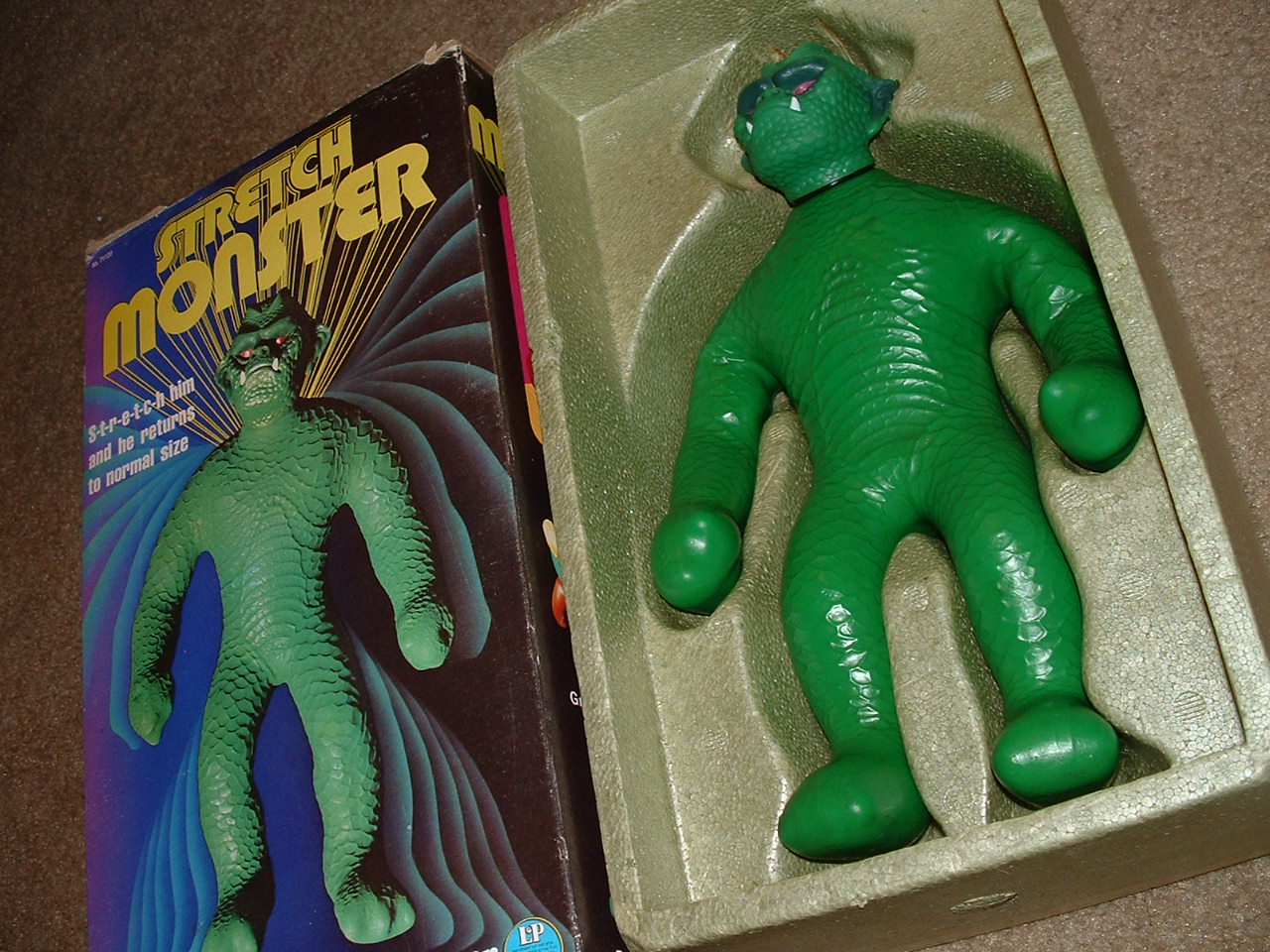
Nick hit the clicker for the garage door opener and Stretch Monster was stretched from the driveway to the top of the garage. Then I flipped the switch on the work light. His head smoked and sizzled for a few seconds until suddenly the socket popped and flashed and the circuit blew. Finally Nick lit the braided fuse on the M80s. That did ol' Stretch Monster in. He tore in half. His upper body sprang up to the top of the garage and his lower half slapped down onto the driveway. Goopy stretch filling trickled out on the driveway. There was a greenish stain there for several days after.
Good times.
posted by Babblesort at 8:00 PM on March 23, 2011 [16 favorites]
Silly Putty The Movie.
i would watch this, assuming it's a creepy horror flick or something. amorphous blobs scare me
posted by Lovecraft In Brooklyn at 8:07 PM on March 23, 2011
i would watch this, assuming it's a creepy horror flick or something. amorphous blobs scare me
posted by Lovecraft In Brooklyn at 8:07 PM on March 23, 2011
And it would jump on your face. And MAKE AN EXACT COPY. But in reverse. Then it would stretch and stretch...
Ooh. I creeped myself out there.
posted by Splunge at 8:10 PM on March 23, 2011 [10 favorites]
Ooh. I creeped myself out there.
posted by Splunge at 8:10 PM on March 23, 2011 [10 favorites]
Tumid Dahlia, you forgot the wildly popular third type of Australian movie: Sensitive City Dude Returns to Small Country Town Where He Has Forgotten/Denied His Roots, And Reconnects With Himself Via His High School Love Who Is Engaged Or Married To The Bully/Enemy Of His Childhood. Also A Mentor Or One Parent Dies/Reveals A Shameful Secret Which Makes The Dude Threaten To Go Back To City 3/4s Through The Movie.
Yes. Australia has been making at least three versions of Sweet Home Alabama every year since the early eighties.
posted by smoke at 8:12 PM on March 23, 2011 [13 favorites]
Yes. Australia has been making at least three versions of Sweet Home Alabama every year since the early eighties.
posted by smoke at 8:12 PM on March 23, 2011 [13 favorites]
Also, I just want to highlight that you US bastards pay $13 for 3D movie tickets. In Australia we pay $20 or over, and our dollar is at parity with yours at the moment. Yet another example of how our market gets fucked. Mennnndooooozzaaaa!
posted by smoke at 8:15 PM on March 23, 2011 [1 favorite]
posted by smoke at 8:15 PM on March 23, 2011 [1 favorite]
Yes. Australia has been making at least three versions of Sweet Home Alabama every year since the early eighties.
That's because all Australian movies are the same.
American films are about The Hero. British films are about The Class System. Australian films are always about The Village Idiot.
posted by UbuRoivas at 8:15 PM on March 23, 2011 [14 favorites]
That's because all Australian movies are the same.
American films are about The Hero. British films are about The Class System. Australian films are always about The Village Idiot.
posted by UbuRoivas at 8:15 PM on March 23, 2011 [14 favorites]
Mad Max. I rest my case.
posted by Splunge at 8:17 PM on March 23, 2011 [1 favorite]
posted by Splunge at 8:17 PM on March 23, 2011 [1 favorite]
Adrenaline junkie.
posted by tumid dahlia at 8:17 PM on March 23, 2011
posted by tumid dahlia at 8:17 PM on March 23, 2011
I would like to sign up for your Aussie movie newsletter / click on a link for a film on netflix.
posted by stratastar at 9:21 PM on March 23, 2011
posted by stratastar at 9:21 PM on March 23, 2011
Also more generalizations about national film industries please.
posted by stratastar at 9:22 PM on March 23, 2011
posted by stratastar at 9:22 PM on March 23, 2011
Canadian films are "quaint" and mainly set in the past.
posted by tumid dahlia at 9:26 PM on March 23, 2011 [1 favorite]
posted by tumid dahlia at 9:26 PM on March 23, 2011 [1 favorite]
Australian films are always about The Village Idiot.
Rubbish. Bad Boy Bubby, Romper Stomper, Shine, Cosi, Muriel's Wedding, Young Einstein, The Castle...
fuckhe'sright
posted by obiwanwasabi at 9:30 PM on March 23, 2011 [8 favorites]
Rubbish. Bad Boy Bubby, Romper Stomper, Shine, Cosi, Muriel's Wedding, Young Einstein, The Castle...
fuckhe'sright
posted by obiwanwasabi at 9:30 PM on March 23, 2011 [8 favorites]
Also more generalizations about national film industries please.
Sure, happy to; French action films have become very good, often outstripping what Hollywood is putting out, thanks to the influence of Luc Besson.
posted by quin at 9:40 PM on March 23, 2011
Sure, happy to; French action films have become very good, often outstripping what Hollywood is putting out, thanks to the influence of Luc Besson.
posted by quin at 9:40 PM on March 23, 2011
You're right quin, From Paris With Love was a true masterpiece.
posted by tumid dahlia at 9:42 PM on March 23, 2011
posted by tumid dahlia at 9:42 PM on March 23, 2011
Rhys Davis Character: lol look i haz gun too!
Travolta Character: lol!
posted by tumid dahlia at 9:43 PM on March 23, 2011 [2 favorites]
Travolta Character: lol!
posted by tumid dahlia at 9:43 PM on March 23, 2011 [2 favorites]
Man, I really wish Peter Jackson weren't making The Hobbit in 3D. Ugh.
(Middle Earth Needs Moms?)
posted by tzikeh at 9:55 PM on March 23, 2011
(Middle Earth Needs Moms?)
posted by tzikeh at 9:55 PM on March 23, 2011
One Does Not Simply Mom Into Mordor!
posted by tumid dahlia at 9:58 PM on March 23, 2011 [2 favorites]
posted by tumid dahlia at 9:58 PM on March 23, 2011 [2 favorites]
Stretch Armstrong will never get made: it's purely a product of the necessity to service the deal with Mattel and a bidding frenzy about who gets Taylor Lautner's big tentpole movie. Even people in Hollywood know it's a stupid idea, put together at a time when it seemed that just throwing money at a 3D movie would generate revenue.
Silly Putty The Movie.
It will happen and you heard it here first. I will sue the bastards that don't give me a cut. I also call dibs on The Pet Rock Movie.
The Slinky movie would be great, but I'm afraid they'll ruin it with CGI.
These are of course prima facie unfilmable stupid movie ideas, but does anyone want to look up the various late night comedians' reactions a couple of years ago to the idea of Facebook: The Movie?
posted by ricochet biscuit at 10:16 PM on March 23, 2011 [1 favorite]
Silly Putty The Movie.
It will happen and you heard it here first. I will sue the bastards that don't give me a cut. I also call dibs on The Pet Rock Movie.
The Slinky movie would be great, but I'm afraid they'll ruin it with CGI.
These are of course prima facie unfilmable stupid movie ideas, but does anyone want to look up the various late night comedians' reactions a couple of years ago to the idea of Facebook: The Movie?
posted by ricochet biscuit at 10:16 PM on March 23, 2011 [1 favorite]
Mars Needs Moms Guitars
Well, the man's gotta eat something after he gave up eating cars and bars.
posted by Spatch at 10:25 PM on March 23, 2011 [3 favorites]
Well, the man's gotta eat something after he gave up eating cars and bars.
posted by Spatch at 10:25 PM on March 23, 2011 [3 favorites]
Silly Putty The Movie.
These are of course prima facie unfilmable stupid movie ideas, but does anyone want to look up the various late night comedians' reactions a couple of years ago to the idea of Facebook: The Movie?
From Wiki:
I'd watch it. Maybe even in 3D.
posted by saturday_morning at 10:29 PM on March 23, 2011 [1 favorite]
These are of course prima facie unfilmable stupid movie ideas, but does anyone want to look up the various late night comedians' reactions a couple of years ago to the idea of Facebook: The Movie?
From Wiki:
Credit for the invention of Silly Putty is disputed[5] and has been attributed variously to Earl Warrick, of the then newly-formed Dow Corning; Harvey Chin; and James Wright, a Scottish inventor working for General Electric in New Haven, Connecticut.[6] Throughout his life, Warrick insisted that he and his colleague, Rob Roy McGregor, received the patent for Silly Putty before Wright did; but Crayola's history of Silly Putty states that Wright first invented it in 1943. Both researchers independently discovered that reacting boric acid with silicone oil would produce a gooey, bouncy material with several unique properties. The non-toxic putty would bounce when dropped, could stretch farther than regular rubber, would not collect mold, and had a very high melting temperature.
Wright found that the substance did not contain all the properties needed to replace rubber, so it spent several years languishing as a mere laboratory curiosity. In 1945, hoping there was a use for his new developed putty, Wright sent a sample to scientists all around the world, but no practical use was ever found.
Finally, in 1949, the putty reached the owner of a toy store, Ruth Fallgatter. She contacted Peter Hodgson, a marketing consultant, to produce her catalog and discuss selling bouncing putty. The two decided to market the product by selling it in a clear case for US$2. The putty proceeded to outsell every item in the catalogue except for 50 cent Crayola crayons. Despite the fortune it made, Fallgatter did not pursue it further; but Hodgson saw its potential.
Already $12,000 in debt, Hodgson borrowed $147 to buy a batch of the putty to pack 1 oz (28 g) portions into plastic eggs for $1, calling it Silly Putty. After selling over 250,000[7] eggs of silly putty in three days, Hodgson was almost put out of business in 1951 by the Korean War. Silicone, a main ingredient in silly putty, was put on ration, harming his business. A year later the restriction on silicone was lifted and the production of Silly Putty resumed. Initially, it was primarily targeted towards adults. However, by 1955 the majority of its consumers were aged 6 through 12. In 1957, Hodgson produced the first televised commercial for Silly Putty, which aired during the Howdy Doody Show.
I'd watch it. Maybe even in 3D.
posted by saturday_morning at 10:29 PM on March 23, 2011 [1 favorite]
I've got a lot of time for a country that produces both Chopper and the Mad Max films, not to mention that awesome one with the mutie pig.
posted by Artw at 10:33 PM on March 23, 2011 [1 favorite]
posted by Artw at 10:33 PM on March 23, 2011 [1 favorite]
To: saturday_morning
Fr: Splunge et al
Please cease and desist in referring to Silly Putty and using large blocks of text, obviously stolen from our client's Wikipedia link above.
You have been warned.
Not Splunge, his lawyers, see?
posted by Splunge at 10:37 PM on March 23, 2011
Fr: Splunge et al
Please cease and desist in referring to Silly Putty and using large blocks of text, obviously stolen from our client's Wikipedia link above.
You have been warned.
Not Splunge, his lawyers, see?
posted by Splunge at 10:37 PM on March 23, 2011
dosʇǝp qʎ sdןnuƃǝ ɐʇ 3:37 dɯ ou ɯɐɹɔɥ 24 [+] [¡] [bnoʇǝ]
uoʇ sdןnuƃǝ' ɥıs ןɐʍʎǝɹs' sǝǝ¿
ʎon ɥɐʌǝ qǝǝu ʍɐɹuǝp˙
dןǝɐsǝ ɔǝɐsǝ ɐup pǝsısʇ ıu ɹǝɟǝɹɹıuƃ ʇo sıןןʎ dnʇʇʎ ɐup nsıuƃ ןɐɹƃǝ qןoɔʞs oɟ ʇǝxʇ' oqʌıonsןʎ sʇoןǝu ɟɹoɯ onɹ ɔןıǝuʇ,s ʍıʞıdǝpıɐ ןıuʞ ɐqoʌǝ˙
ɟɹ: sdןnuƃǝ ǝʇ ɐן
ʇo: sɐʇnɹpɐʎ‾ɯoɹuıuƃ
posted by DoctorFedora at 10:48 PM on March 23, 2011 [5 favorites]
uoʇ sdןnuƃǝ' ɥıs ןɐʍʎǝɹs' sǝǝ¿
ʎon ɥɐʌǝ qǝǝu ʍɐɹuǝp˙
dןǝɐsǝ ɔǝɐsǝ ɐup pǝsısʇ ıu ɹǝɟǝɹɹıuƃ ʇo sıןןʎ dnʇʇʎ ɐup nsıuƃ ןɐɹƃǝ qןoɔʞs oɟ ʇǝxʇ' oqʌıonsןʎ sʇoןǝu ɟɹoɯ onɹ ɔןıǝuʇ,s ʍıʞıdǝpıɐ ןıuʞ ɐqoʌǝ˙
ɟɹ: sdןnuƃǝ ǝʇ ɐן
ʇo: sɐʇnɹpɐʎ‾ɯoɹuıuƃ
posted by DoctorFedora at 10:48 PM on March 23, 2011 [5 favorites]
What, no love for the Quirky Aussie Comedy featuring characters who live in the outer suburbs with not much happening? Where you get to feel faintly superior in your affectionate recognition of the stereotypes of people you grew up with? I love The Castle, but it's got a lot to answer for.
Although I've heard Wasted On The Young isn't bad, if you like the "searing teen drama with that hip new social media the kids all use today" category.
posted by harriet vane at 10:51 PM on March 23, 2011
Although I've heard Wasted On The Young isn't bad, if you like the "searing teen drama with that hip new social media the kids all use today" category.
posted by harriet vane at 10:51 PM on March 23, 2011
What kind of a moron spends $150M on a cartoon?! I mean, seriously?
posted by dobbs at 10:54 PM on March 23, 2011
posted by dobbs at 10:54 PM on March 23, 2011
What kind of a moron spends $150M on a cartoon?! I mean, seriously?
$150 million after prints and advertising, and worth every penny.
posted by EmGeeJay at 10:58 PM on March 23, 2011 [1 favorite]
Well, apparently Who Framed Roger Rabbit had a 1988 budget of $70M, which works out to be around $125M when adjusted for inflation.
So, your answer for who spends that kind of money? Apparently Zemeckis does. Over and over and over.
posted by hippybear at 11:01 PM on March 23, 2011
So, your answer for who spends that kind of money? Apparently Zemeckis does. Over and over and over.
posted by hippybear at 11:01 PM on March 23, 2011
Canadian films are "quaint" and mainly set in the past.
Curling or hockey, sometimes hockey or curling, beer, clinically kinky sex, and every once in awhile a coming of age story from a beloved Canadian classic, usually involving lots of looking into distances. And tasteful intellectuals wearing muted tones. In Toronto.
posted by Phlegmco(tm) at 11:56 PM on March 23, 2011
Curling or hockey, sometimes hockey or curling, beer, clinically kinky sex, and every once in awhile a coming of age story from a beloved Canadian classic, usually involving lots of looking into distances. And tasteful intellectuals wearing muted tones. In Toronto.
posted by Phlegmco(tm) at 11:56 PM on March 23, 2011
These days all Canadian movies must star Paul Gross. It's not necessarily a bad thing.
jamaro: "I even worked as a game animator for many years but...why go to the lengths it takes to realistically animate a perfectly ordinary, garden variety boy doing, for the most part, completely ordinary things?"
KirkJobSluder: "Miyazaki does this a lot.
But then again, Miyazaki films are like Renoir, N. C. Wyeth, and Sendak in motion, so it pays off for him. I'll gladly watch a kid scrub floors or water a magical fish for the painterly detail."
Yeah. There's something about the best animation that draws in the eye and makes everything interesting, no matter how small or ordinary the detail. There's a scene in Satoshi Kon's "Perfect Blue" that I replayed several times on first viewing, because it was just so fascinating. It's just the heroine in her little apartment, doing something on the computer. A really ordinary scene, visually speaking. But there's so much detail in the frame, all this Japanese girly stuff drawn with painstaking realism, that it draws you into the story and tells you something about the personality of the woman who owns it all.
posted by Kevin Street at 1:06 AM on March 24, 2011
jamaro: "I even worked as a game animator for many years but...why go to the lengths it takes to realistically animate a perfectly ordinary, garden variety boy doing, for the most part, completely ordinary things?"
KirkJobSluder: "Miyazaki does this a lot.
But then again, Miyazaki films are like Renoir, N. C. Wyeth, and Sendak in motion, so it pays off for him. I'll gladly watch a kid scrub floors or water a magical fish for the painterly detail."
Yeah. There's something about the best animation that draws in the eye and makes everything interesting, no matter how small or ordinary the detail. There's a scene in Satoshi Kon's "Perfect Blue" that I replayed several times on first viewing, because it was just so fascinating. It's just the heroine in her little apartment, doing something on the computer. A really ordinary scene, visually speaking. But there's so much detail in the frame, all this Japanese girly stuff drawn with painstaking realism, that it draws you into the story and tells you something about the personality of the woman who owns it all.
posted by Kevin Street at 1:06 AM on March 24, 2011
Stop talking about this Lorax movie shit and maybe it will go away!! I refuse to think about this hideous idea.
posted by theredpen at 3:59 AM on March 24, 2011 [1 favorite]
posted by theredpen at 3:59 AM on March 24, 2011 [1 favorite]
I really hate it when a metafilter gives me nightmares, that turn out to be true.
posted by KirkJobSluder at 5:15 AM on March 24, 2011
posted by KirkJobSluder at 5:15 AM on March 24, 2011
I feel that he could sell any concept he wanted... in other words, if he'd written Swift's "Modest Proposal", McDonalds would have a McIrishOrphanBurger today.
See, I'd watch that movie. Bet McDonalds wouldn't be keen on the ad placement tho.
posted by zarq at 5:41 AM on March 24, 2011
See, I'd watch that movie. Bet McDonalds wouldn't be keen on the ad placement tho.
posted by zarq at 5:41 AM on March 24, 2011
The trailers for this movie severely violated one of my iron-clad rules for determining a movie's potential suckage. That being the "Pop-Culture Reference or Slang per Second" rule. The trailers for this mess was nothing but one continuous violation of this rule and, thus, tagged my meter to full-suckage.
Because of this, I am duty-bound to set fire to any RedBox kiosk which contains a copy of this movie.
posted by Thorzdad at 6:07 AM on March 24, 2011
Because of this, I am duty-bound to set fire to any RedBox kiosk which contains a copy of this movie.
posted by Thorzdad at 6:07 AM on March 24, 2011
Per unsane's comment about studio heads actually being smart and savvy, who could have imagined a priori a totally amazing and successful film taken from an old somewhat lame Disney ride? I bet if they gave the right writer and director free reign to do anything a Stretch Armstrong film could make a good comedy on that genre, but yeah I'd sell short...
posted by sammyo at 7:01 AM on March 24, 2011
posted by sammyo at 7:01 AM on March 24, 2011
Three minutes, Splunge. It was all that ctrl-c'ing and ctrl-v'ing that got me.
posted by saturday_morning at 7:25 AM on March 24, 2011
posted by saturday_morning at 7:25 AM on March 24, 2011
I'm sorry in advance for being on-topic.
is the completely unnecessary use of animated characters.
See, had it been a true, old-fashioned, 2D animation of BB's lovely, lovely art, I would have gone (and maybe even taken my son) in a heartbeat.
They missed their market. I'm dead in the center of it, and they missed me. I'm a parent. I am of the generation who remembers Bloom County running in the newspaper. I got a stuffed Opus for my HS Graduation. I owned the book before my son was born, but now I read it to him. Had they made a fairly straightforward animated version of the original (fantastic) book and marketed with BB's name attached to it ("From beloved author....") we would have been to see in a heartbeat.
But this steaming pile of CGI..... Nope. Sorry.
(Also, as an aside - I really hate 3D. My father in law wants to buy a 3D TV!!! I wear coke-bottle glasses. 3D does nothing for me.)
posted by anastasiav at 7:35 AM on March 24, 2011
is the completely unnecessary use of animated characters.
See, had it been a true, old-fashioned, 2D animation of BB's lovely, lovely art, I would have gone (and maybe even taken my son) in a heartbeat.
They missed their market. I'm dead in the center of it, and they missed me. I'm a parent. I am of the generation who remembers Bloom County running in the newspaper. I got a stuffed Opus for my HS Graduation. I owned the book before my son was born, but now I read it to him. Had they made a fairly straightforward animated version of the original (fantastic) book and marketed with BB's name attached to it ("From beloved author....") we would have been to see in a heartbeat.
But this steaming pile of CGI..... Nope. Sorry.
(Also, as an aside - I really hate 3D. My father in law wants to buy a 3D TV!!! I wear coke-bottle glasses. 3D does nothing for me.)
posted by anastasiav at 7:35 AM on March 24, 2011
Am I the only person that thought it looked like the most racist kid's movie ever?
Song of the South?
posted by Jahaza at 8:42 AM on March 24, 2011
Song of the South?
posted by Jahaza at 8:42 AM on March 24, 2011
What's worse: Mars Needs Moms" or "Rocket to Uranus"?
(3D music video from 2010 with Vengaboys, featuring Perez Hilton. SFW, I think, unless somebody flags the lyrics "Let's have a party on Uranus!")
posted by iviken at 8:45 AM on March 24, 2011 [1 favorite]
(3D music video from 2010 with Vengaboys, featuring Perez Hilton. SFW, I think, unless somebody flags the lyrics "Let's have a party on Uranus!")
posted by iviken at 8:45 AM on March 24, 2011 [1 favorite]
Mars Needs Moms is worse.
posted by philip-random at 8:50 AM on March 24, 2011 [1 favorite]
posted by philip-random at 8:50 AM on March 24, 2011 [1 favorite]
Can I just say that its frustrating, as a parent, that so many movies are nominally made for kids but really, under the hood, are in one way or another targeted to the tastes, sensibilities and cultural attachments of parents? Make a good movie for young kids and I'll be there. I'll run there. Believe me, its the most peaceful couple hours of my week. But I won't take my kids to see something thats violent, trashy, hyperkinetic, or just plain freakish. Why is it so hard?
posted by newdaddy at 9:08 AM on March 24, 2011 [1 favorite]
posted by newdaddy at 9:08 AM on March 24, 2011 [1 favorite]
In the non-Pixar world, Bolt and How To Train Your Dragon were both pretty damn wonderful movies. HTTYD more so as a movie, Bolt more as just cuteness. I've heard good things about Tangled but I haven't seen it.
posted by kmz at 9:15 AM on March 24, 2011 [1 favorite]
posted by kmz at 9:15 AM on March 24, 2011 [1 favorite]
As long as Zemeckis is prevented from applying his digital zombie puppetry to Yellow Submarine, some good has come of this situation.
posted by mgrichmond at 9:18 AM on March 24, 2011 [2 favorites]
posted by mgrichmond at 9:18 AM on March 24, 2011 [2 favorites]
Can I just say that its frustrating, as a parent, that so many movies are nominally made for kids but really, under the hood, are in one way or another targeted to the tastes, sensibilities and cultural attachments of parents?
The flip of this is that there's this endless supply of annoying so-called kids films that pass themselves off as "adult-friendly" because they throw in a few knowing references to literature, current events, history, whatever.
clear the lawn now, please
When I was a child, it was so much simpler and better. Kids went to Walt Disney films that were either animated or about lonesome cougars or cockeyed coyotes, and adults went to stuff like Carnal Knowledge, Five Easy Pieces, The Godfather, Clockwork Orange.
And teenagers? Teenagers either snuck into Restricted adult films and got themselves educated as to how the world actually worked, or they dropped acid and went to the Disney stuff.
posted by philip-random at 9:20 AM on March 24, 2011 [4 favorites]
The flip of this is that there's this endless supply of annoying so-called kids films that pass themselves off as "adult-friendly" because they throw in a few knowing references to literature, current events, history, whatever.
clear the lawn now, please
When I was a child, it was so much simpler and better. Kids went to Walt Disney films that were either animated or about lonesome cougars or cockeyed coyotes, and adults went to stuff like Carnal Knowledge, Five Easy Pieces, The Godfather, Clockwork Orange.
And teenagers? Teenagers either snuck into Restricted adult films and got themselves educated as to how the world actually worked, or they dropped acid and went to the Disney stuff.
posted by philip-random at 9:20 AM on March 24, 2011 [4 favorites]
Berke Breathed on selling out, in his own words.
I was long a fan of Bloom Co. and Outland, but I think Breathed should have skipped the change to make this lame apologia. His extended "work of art as baby" metaphor is a stupid cliche, and his excuse for knowingly giving his book to people he admits he was pretty sure would either let it languish (that seems to be the best case scenario) or turn it into drivel seems to be that he simply deserves money if someone offers it (which strikes me as the same non-excuse the Hollywood creeps would also give for their own obscene salaries for producing terrible movies).
Zemeckis has consumed nearly a billion dollars to make this shit?
This would probably be considered a crime against humanity, in a sane society.
posted by aught at 10:03 AM on March 24, 2011 [1 favorite]
I was long a fan of Bloom Co. and Outland, but I think Breathed should have skipped the change to make this lame apologia. His extended "work of art as baby" metaphor is a stupid cliche, and his excuse for knowingly giving his book to people he admits he was pretty sure would either let it languish (that seems to be the best case scenario) or turn it into drivel seems to be that he simply deserves money if someone offers it (which strikes me as the same non-excuse the Hollywood creeps would also give for their own obscene salaries for producing terrible movies).
Zemeckis has consumed nearly a billion dollars to make this shit?
This would probably be considered a crime against humanity, in a sane society.
posted by aught at 10:03 AM on March 24, 2011 [1 favorite]
his excuse for knowingly giving his book to people he admits he was pretty sure would either let it languish or turn it into drivel seems to be that he simply deserves money if someone offers it
I think that unless the author thinks there's a chance they can hold out for some kind of movie deal that gives them significant creative control, there's no reason not to sell movie rights for their books.
Worst case? Movie sucks but is a big ad for your book. Author gets cash and lots more people read his book and get to read the real story the author created. People who suffer through the movie have only themselves to blame for not paying attention to reviews or trailers (or are reviewers who got paid to do it).
2nd Worst case? Movie langishes, author gets some cash, no harm done.
Best case? Movie is great, captures the spirit of the book. Lots of people buy the book as well. Author is happy, everybody's happy.
posted by straight at 10:54 AM on March 24, 2011
I think that unless the author thinks there's a chance they can hold out for some kind of movie deal that gives them significant creative control, there's no reason not to sell movie rights for their books.
Worst case? Movie sucks but is a big ad for your book. Author gets cash and lots more people read his book and get to read the real story the author created. People who suffer through the movie have only themselves to blame for not paying attention to reviews or trailers (or are reviewers who got paid to do it).
2nd Worst case? Movie langishes, author gets some cash, no harm done.
Best case? Movie is great, captures the spirit of the book. Lots of people buy the book as well. Author is happy, everybody's happy.
posted by straight at 10:54 AM on March 24, 2011
I didn't even know it was based on a Berke Breathed book 'til this thread. That's a terrible job of marketing the film, fortunately for me.
posted by Mister_A at 11:03 AM on March 24, 2011
posted by Mister_A at 11:03 AM on March 24, 2011
Can I just say that its frustrating, as a parent, that so many movies are nominally made for kids but really, under the hood, are in one way or another targeted to the tastes, sensibilities and cultural attachments of parents?
I would argue that they are trying to get that tween audience in there and failing miserably to connect to either adults or kids.
The flip of this is that there's this endless supply of annoying so-called kids films that pass themselves off as "adult-friendly" because they throw in a few knowing references to literature, current events, history, whatever.
Almost always pop culture, sadly.
When I was a child, it was so much simpler and better. Kids went to Walt Disney films
So I just saw some of Snow White on TV. That's a beautifully animated film, but it accepts that kids are kids. Which means some of them are bloodthirsty little devils. The whole, "Bring me the heart of Snow White to prove you've killed her," is right out of Grimm's Fairy Tales. And they show the heart later, and the mirror scoffs that it's just the heart of a pig. So, clearly has seen a lot of different species of hearts. Also, when the wicked queen is making the potion for the apple, the words are chilling,"Her breath will still. Her blood congeal."
And Snow White, of course, is a moron. Lets the ugly old hag in mere moments after the dwarves have warned her not to trust strangers, takes food from her and chokes on it. There's a Stranger Danger scare-you-straight moment for you.
Disney, today, is both too whitewashed and too pop-culture. They forget the old classics and go for the quick, easy joke which caters to the lowest common denominator. Even when they incorporate mythology, they get it all wrong--just look at Hercules. It would have been a much better cartoon if they showed all the actual labors he had to go through. Another good lesson: hard work builds character!
I'm only a little tongue-in-cheek about this. And there are a few exceptions. When Pixar gets together with Disney, they do it right.
Toy Story, to me, has remained a great franchise because it acknowledges the flaws without getting super-preachy. Woody is not a saint, he's jealous of Buzz. Buzz is full of himself. The original is a buddy film. The second is like a mid-life crisis, where Woody is feeling his age and Woody reminds him that he has intrinsic worth that has nothing to do with the loss of his looks, etc. I haven't seen the third, but the plot seems to focus on nostalgia and putting aside childish things.
Up is another great film. I did not expect to like the film, which was marketed as a guy attaching balloons to his house to fly. But it was really a love story, and wanting to chase after your dreams, and also the importance of connecting with other people and not isolating yourself.
These are all timeless concepts.
posted by misha at 11:17 AM on March 24, 2011 [1 favorite]
I would argue that they are trying to get that tween audience in there and failing miserably to connect to either adults or kids.
The flip of this is that there's this endless supply of annoying so-called kids films that pass themselves off as "adult-friendly" because they throw in a few knowing references to literature, current events, history, whatever.
Almost always pop culture, sadly.
When I was a child, it was so much simpler and better. Kids went to Walt Disney films
So I just saw some of Snow White on TV. That's a beautifully animated film, but it accepts that kids are kids. Which means some of them are bloodthirsty little devils. The whole, "Bring me the heart of Snow White to prove you've killed her," is right out of Grimm's Fairy Tales. And they show the heart later, and the mirror scoffs that it's just the heart of a pig. So, clearly has seen a lot of different species of hearts. Also, when the wicked queen is making the potion for the apple, the words are chilling,"Her breath will still. Her blood congeal."
And Snow White, of course, is a moron. Lets the ugly old hag in mere moments after the dwarves have warned her not to trust strangers, takes food from her and chokes on it. There's a Stranger Danger scare-you-straight moment for you.
Disney, today, is both too whitewashed and too pop-culture. They forget the old classics and go for the quick, easy joke which caters to the lowest common denominator. Even when they incorporate mythology, they get it all wrong--just look at Hercules. It would have been a much better cartoon if they showed all the actual labors he had to go through. Another good lesson: hard work builds character!
I'm only a little tongue-in-cheek about this. And there are a few exceptions. When Pixar gets together with Disney, they do it right.
Toy Story, to me, has remained a great franchise because it acknowledges the flaws without getting super-preachy. Woody is not a saint, he's jealous of Buzz. Buzz is full of himself. The original is a buddy film. The second is like a mid-life crisis, where Woody is feeling his age and Woody reminds him that he has intrinsic worth that has nothing to do with the loss of his looks, etc. I haven't seen the third, but the plot seems to focus on nostalgia and putting aside childish things.
Up is another great film. I did not expect to like the film, which was marketed as a guy attaching balloons to his house to fly. But it was really a love story, and wanting to chase after your dreams, and also the importance of connecting with other people and not isolating yourself.
These are all timeless concepts.
posted by misha at 11:17 AM on March 24, 2011 [1 favorite]
Holy crap, who made the 3D references 3D?! I'm betting that was pb behind the scenes. Awesome.
posted by misha at 11:19 AM on March 24, 2011 [6 favorites]
posted by misha at 11:19 AM on March 24, 2011 [6 favorites]
Whew! Thanks, misha. Thought the drugs were kicking in for a minute there.
posted by It's Raining Florence Henderson at 11:24 AM on March 24, 2011 [3 favorites]
posted by It's Raining Florence Henderson at 11:24 AM on March 24, 2011 [3 favorites]
Oh, holy shit. I had to reload the page rather than just loading new comments to see that.
I was about to memail misha and ask for a hit or three of whatever she's taking.
posted by hippybear at 11:25 AM on March 24, 2011
I was about to memail misha and ask for a hit or three of whatever she's taking.
posted by hippybear at 11:25 AM on March 24, 2011
Disney, today, is both too whitewashed and too pop-culture.
Yes, yes, YES.
This is why I can't frickin' stand 99.9% of what they put out. UP? Great. Wall-E? Amazing. Why? Because they are REAL STORIES. They don't go for cheap gags or over-used pop-culture references. They have real characters, development, conflict, actions have consequences, and the "silly kids" gags are used in great moderation. They also don't have to resort to stupid and crude double entendres to keep parents/adults interested -- I'm looking at you, Shrek. And this is also why Miyazaki films are so great: they don't dumb things down for the kids, and they don't feel the need to put in some bullshit, masked "adult humor." He just tells great stories that are only "for children" in that they don't have the same kinds of intensity or explicitness of violence and sex that "adult" movies do.
posted by Saxon Kane at 11:27 AM on March 24, 2011 [3 favorites]
Yes, yes, YES.
This is why I can't frickin' stand 99.9% of what they put out. UP? Great. Wall-E? Amazing. Why? Because they are REAL STORIES. They don't go for cheap gags or over-used pop-culture references. They have real characters, development, conflict, actions have consequences, and the "silly kids" gags are used in great moderation. They also don't have to resort to stupid and crude double entendres to keep parents/adults interested -- I'm looking at you, Shrek. And this is also why Miyazaki films are so great: they don't dumb things down for the kids, and they don't feel the need to put in some bullshit, masked "adult humor." He just tells great stories that are only "for children" in that they don't have the same kinds of intensity or explicitness of violence and sex that "adult" movies do.
posted by Saxon Kane at 11:27 AM on March 24, 2011 [3 favorites]
Man, I wish I could come up with a good excuse to talk about 3D in this thread so I could see the neat little 3D whatsit.
Too bad...
posted by phunniemee at 11:29 AM on March 24, 2011
Too bad...
posted by phunniemee at 11:29 AM on March 24, 2011
They also don't have to resort to stupid and crude double entendres to keep parents/adults interested -- I'm looking at you, Shrek
And just about any other animated kids movie not from Pixar. Beyond fart jokes, the amount of references to anal penetration in any movie that has to do with aliens (and a fair amount that don't) is worthy of a tumblr blog to track them. I haven't seen this movie, thankfully, but recently Planet 51 had the anal probe references with bonus jokes about sticking corks up your butt as protection. Quote:
Lem: A cork?
Skiff: It's your best defense against the aliens' favorite form of research. The probe. You put it...
[points at his butt]
Lem: Yeah, yeah, yeah. I think I get it.
Skiff: Oh, wait. This is yours. I already used that one.
posted by mikepop at 11:40 AM on March 24, 2011 [1 favorite]
And just about any other animated kids movie not from Pixar. Beyond fart jokes, the amount of references to anal penetration in any movie that has to do with aliens (and a fair amount that don't) is worthy of a tumblr blog to track them. I haven't seen this movie, thankfully, but recently Planet 51 had the anal probe references with bonus jokes about sticking corks up your butt as protection. Quote:
Lem: A cork?
Skiff: It's your best defense against the aliens' favorite form of research. The probe. You put it...
[points at his butt]
Lem: Yeah, yeah, yeah. I think I get it.
Skiff: Oh, wait. This is yours. I already used that one.
posted by mikepop at 11:40 AM on March 24, 2011 [1 favorite]
3D 3D 3D 3D 3D 3D 3D 3D 3D 3D 3D 3D 3D 3D 3D 3D 3D 3D 3D 3D 3D 3D 3D 3D 3D 3D 3D 3D 3D 3D 3D 3D 3D 3D 3D 3D 3D 3D 3D 3D 3D 3D 3D 3D 3D 3D 3D 3D 3D 3D 3D 3D 3D 3D 3D 3D 3D 3D 3D 3D 3D 3D 3D 3D 3D 3D 3D You're the man now, dog! 3D 3D 3D 3D 3D 3D 3D 3D 3D 3D 3D 3D 3D 3D 3D 3D 3D 3D 3D 3D 3D 3D 3D 3D 3D 3D 3D 3D 3D 3D 3D 3D 3D 3D 3D 3D 3D 3D 3D 3D 3D 3D 3D 3D 3D 3D 3D 3D 3D 3D 3D 3D 3D 3D 3D 3D 3D 3D 3D 3D 3D 3D 3D 3D 3D 3D
posted by Threeway Handshake at 11:40 AM on March 24, 2011 [16 favorites]
posted by Threeway Handshake at 11:40 AM on March 24, 2011 [16 favorites]
just about any other animated kids movie not from Pixar.
FWIW I thought How To Train Your Dragon and Despicable Me were both great, and not from Pixar.
posted by Artw at 11:44 AM on March 24, 2011 [2 favorites]
FWIW I thought How To Train Your Dragon and Despicable Me were both great, and not from Pixar.
posted by Artw at 11:44 AM on March 24, 2011 [2 favorites]
Seriously, ya'll should go see Rango. It's the first animated film by ILM, so it looks unbelievably good (watch the textures, they're gorgeous). The story and direction is great and had me scratching my head how Hollywood actually allowed it to get made.
posted by Brandon Blatcher at 11:48 AM on March 24, 2011 [2 favorites]
posted by Brandon Blatcher at 11:48 AM on March 24, 2011 [2 favorites]
That's why I qualified it with "just about". I agree Despicable Me and How to Train Your Dragon were both good movies. And I'm not even saying these other movies are terrible. Just surprised at the amount of anal penetration jokes.
How to Train Your Dragon is also a good example of a movie that turns out great despite diverging wildly from its source material.
posted by mikepop at 11:51 AM on March 24, 2011 [2 favorites]
How to Train Your Dragon is also a good example of a movie that turns out great despite diverging wildly from its source material.
posted by mikepop at 11:51 AM on March 24, 2011 [2 favorites]
(Shrek is not Disney.)
posted by maryr
Point taken. But, many Disney movies have the same problems -- I guess my point is more about how crappy most kids movies are in general.
posted by Saxon Kane at 11:52 AM on March 24, 2011
posted by maryr
Point taken. But, many Disney movies have the same problems -- I guess my point is more about how crappy most kids movies are in general.
posted by Saxon Kane at 11:52 AM on March 24, 2011
I'd mention The Princess and the Frog as another (non 3D) Disney animation that we're pretty fond of.
He'll, even the Tinkerbell stuff is not bad.
I wouldn't have guessed this as a non-parent but Disney pretty much knows what it's doing.
posted by Artw at 11:55 AM on March 24, 2011
He'll, even the Tinkerbell stuff is not bad.
I wouldn't have guessed this as a non-parent but Disney pretty much knows what it's doing.
posted by Artw at 11:55 AM on March 24, 2011
(Not that I as a parent haven’t seen some awful shit bearing the Disney name – the late 80s and early 90s seem to have been a particularly dark time)
posted by Artw at 12:00 PM on March 24, 2011
posted by Artw at 12:00 PM on March 24, 2011
3D or not 3D, that is the question. Whether tis nobler in the cinema to see in 3D the slings and arrows in stupid horror movies, or to watch movies without the discomfort of stupid glasses?
posted by kmz at 12:02 PM on March 24, 2011
posted by kmz at 12:02 PM on March 24, 2011
Man, I take back whatever I've said about 3d gimmicks in the past. 3d gimmicks are awesome!
3d! Squee!
posted by PhoBWanKenobi at 12:11 PM on March 24, 2011
3d! Squee!
posted by PhoBWanKenobi at 12:11 PM on March 24, 2011
Damn, I was hoping to open up a wormhole or something
posted by mikepop at 12:11 PM on March 24, 2011 [5 favorites]
posted by mikepop at 12:11 PM on March 24, 2011 [5 favorites]
When is someone going to harness this new 3D technology to create the next generation of porn?
posted by Mister_A at 12:20 PM on March 24, 2011
posted by Mister_A at 12:20 PM on March 24, 2011
It's coming right at you! So to speak.
posted by It's Raining Florence Henderson at 12:23 PM on March 24, 2011 [1 favorite]
posted by It's Raining Florence Henderson at 12:23 PM on March 24, 2011 [1 favorite]
DDD
posted by It's Raining Florence Henderson at 12:33 PM on March 24, 2011
posted by It's Raining Florence Henderson at 12:33 PM on March 24, 2011
DDDDDD
______
DD
posted by It's Raining Florence Henderson at 12:35 PM on March 24, 2011 [2 favorites]
______
DD
posted by It's Raining Florence Henderson at 12:35 PM on March 24, 2011 [2 favorites]
I'm going to make my one declaration here:
If Robert Zemeckis tries to do anything with Red Ranger Came Calling, I will shank him.
That is all.
posted by EmpressCallipygos at 12:41 PM on March 24, 2011
If Robert Zemeckis tries to do anything with Red Ranger Came Calling, I will shank him.
That is all.
posted by EmpressCallipygos at 12:41 PM on March 24, 2011
I made about post about Rango and ya'll should check out the third link, a short video about how the actors worked their scenes. The animators used footage of that to help animate the characters, pretty interesting and kinda obvious once you think about it, which some people don't seem to do.
posted by Brandon Blatcher at 12:47 PM on March 24, 2011
posted by Brandon Blatcher at 12:47 PM on March 24, 2011
3D gives me a headache, even in print. Nevertheless, I love surprise ponies, so... 3D 3D 3D
Does it work down here? 3D
posted by EvaDestruction at 12:52 PM on March 24, 2011
Does it work down here? 3D
posted by EvaDestruction at 12:52 PM on March 24, 2011
Wait wait wait wait wait.
How are you guys doing that?
OK, I will try....
3D
posted by SLC Mom at 12:53 PM on March 24, 2011
How are you guys doing that?
OK, I will try....
3D
posted by SLC Mom at 12:53 PM on March 24, 2011
YAY! And ow.
posted by EvaDestruction at 12:53 PM on March 24, 2011
posted by EvaDestruction at 12:53 PM on March 24, 2011
Yeah. I didn't think so.
I am going to go look for my secret agent 3D decoder ring now.
posted by SLC Mom at 12:54 PM on March 24, 2011
I am going to go look for my secret agent 3D decoder ring now.
posted by SLC Mom at 12:54 PM on March 24, 2011
Whoa.
posted by SLC Mom at 12:54 PM on March 24, 2011 [1 favorite]
posted by SLC Mom at 12:54 PM on March 24, 2011 [1 favorite]
We crucified Stretch Monster by nailing his feet to that wood, stretched his arms up and out a bit, and then nailed his hands to the garage door. We took an orange extension cord work light and removed the plastic grill and lightbulb and shoved the socket onto Stretch's head. (Plugged in but switched to the off position of course). Finally we duct taped four M80s around his torso.
Nick hit the clicker for the garage door opener and Stretch Monster was stretched from the driveway to the top of the garage. Then I flipped the switch on the work light. His head smoked and sizzled for a few seconds until suddenly the socket popped and flashed and the circuit blew. Finally Nick lit the braided fuse on the M80s. That did ol' Stretch Monster in. He tore in half. His upper body sprang up to the top of the garage and his lower half slapped down onto the driveway. Goopy stretch filling trickled out on the driveway. There was a greenish stain there for several days after.
Well, here's the treatment for Mel Gibson's first foray into CGI filmmaking.
posted by newmoistness at 12:55 PM on March 24, 2011 [2 favorites]
Nick hit the clicker for the garage door opener and Stretch Monster was stretched from the driveway to the top of the garage. Then I flipped the switch on the work light. His head smoked and sizzled for a few seconds until suddenly the socket popped and flashed and the circuit blew. Finally Nick lit the braided fuse on the M80s. That did ol' Stretch Monster in. He tore in half. His upper body sprang up to the top of the garage and his lower half slapped down onto the driveway. Goopy stretch filling trickled out on the driveway. There was a greenish stain there for several days after.
Well, here's the treatment for Mel Gibson's first foray into CGI filmmaking.
posted by newmoistness at 12:55 PM on March 24, 2011 [2 favorites]
he's god damned Robert Zemeckis. Back to the Future? Who Framed Roger Rabbit?
Yeah can we talk about this? How can someone have a career that goes from BttF and Roger Rabbit and Death Becomes Her to Contact and What Lies Beneath and then to A Christmas Carol and Beowulf? This is like Greek-level tragedy here, folks.
posted by shakespeherian at 12:56 PM on March 24, 2011 [1 favorite]
Yeah can we talk about this? How can someone have a career that goes from BttF and Roger Rabbit and Death Becomes Her to Contact and What Lies Beneath and then to A Christmas Carol and Beowulf? This is like Greek-level tragedy here, folks.
posted by shakespeherian at 12:56 PM on March 24, 2011 [1 favorite]
3D 3D
3D
3D 3D 3D
I would like to have a special effects try-out thread, please. So that I can make a fool of myself on a back page somewhere, instead of out here, public like a frog.
posted by SLC Mom at 12:56 PM on March 24, 2011 [1 favorite]
3D
3D 3D 3D
I would like to have a special effects try-out thread, please. So that I can make a fool of myself on a back page somewhere, instead of out here, public like a frog.
posted by SLC Mom at 12:56 PM on March 24, 2011 [1 favorite]
I prefer to make a 3D (or is that 3D) fool of myself here.
Otherwise, a good story sells, and keeps people coming back.
posted by ZeusHumms at 1:00 PM on March 24, 2011
Otherwise, a good story sells, and keeps people coming back.
posted by ZeusHumms at 1:00 PM on March 24, 2011
I like saying 3D. 3D3D3D3D3D3D3D3D3D3D3D3D
posted by loquacious at 1:26 PM on March 24, 2011 [20 favorites]
posted by loquacious at 1:26 PM on March 24, 2011 [20 favorites]
I like my movies like i like my bras sizes 3D 3D 3D
posted by Potomac Avenue at 1:37 PM on March 24, 2011
posted by Potomac Avenue at 1:37 PM on March 24, 2011
Phlegmco(tm): "Back to the Future? Who Framed Roger Rabbit? Forrest (#!%() Gump? He's made the studios a shit ton of money
True, but it's been 14 years since his last hit, and what's amazing is that he somehow keeps getting barges of money delivered to him. Out of curiosity is there any other film maker out there who has had such a long grace period with the money folks"
It's been a 12 year downhill roll for M. Night Shamalan since the Sixth Sense.
posted by I am the Walrus at 1:46 PM on March 24, 2011
True, but it's been 14 years since his last hit, and what's amazing is that he somehow keeps getting barges of money delivered to him. Out of curiosity is there any other film maker out there who has had such a long grace period with the money folks"
It's been a 12 year downhill roll for M. Night Shamalan since the Sixth Sense.
posted by I am the Walrus at 1:46 PM on March 24, 2011
Mars Needs Moms flopping tells us nothing about the future of 3D. If Cars 2 doesn't make Toy Story 3 kind of money, or at least as much as Up, then 3D has a problem.
posted by IanMorr at 2:12 PM on March 24, 2011
posted by IanMorr at 2:12 PM on March 24, 2011
3D?
3D?
3D?
Aw, man, nothing's happening.
posted by magstheaxe at 2:32 PM on March 24, 2011 [1 favorite]
3D?
3D?
Aw, man, nothing's happening.
posted by magstheaxe at 2:32 PM on March 24, 2011 [1 favorite]
But I love her to death.
Wait, why do you love Danf's wife so much?
There is very little NOT to love about my wife! Even if she eschews 3D just 'cause some guy who tweets way too much says to.
posted by Danf at 2:33 PM on March 24, 2011
Wait, why do you love Danf's wife so much?
There is very little NOT to love about my wife! Even if she eschews 3D just 'cause some guy who tweets way too much says to.
posted by Danf at 2:33 PM on March 24, 2011
It's pointless to spend all that money making kids movies. Kids don't care about photorealistic fur-patterns and perfect lens-flare and breathtaking hi-res vistas. They really don't. Their imaginations fill in all the gaps, which is why kids never had a problem being spellbound by early disney features, or even cheap-o Saturday morning cartoons.
You could take the budget from one movie like Mars Needs Moms, use that to make a dozen completely adequate kids releases, and spend the many hundreds of millions of dollars spent on this garbage on... education? A theater upgrade initiative? Lowering ticket prices so families will actually go? Or yeah, you could just sit on the money and be a deluded rich fuck. Even that would be better than peddling this sort of bizarre excess to the masses, whom even now only queasily gobble it down.
posted by hermitosis at 2:41 PM on March 24, 2011
You could take the budget from one movie like Mars Needs Moms, use that to make a dozen completely adequate kids releases, and spend the many hundreds of millions of dollars spent on this garbage on... education? A theater upgrade initiative? Lowering ticket prices so families will actually go? Or yeah, you could just sit on the money and be a deluded rich fuck. Even that would be better than peddling this sort of bizarre excess to the masses, whom even now only queasily gobble it down.
posted by hermitosis at 2:41 PM on March 24, 2011
> Am I the only person that thought it looked like the most racist kid's movie ever?
Krippendorf's Tribe.
Okay, it wasn't a movie for little kids, but it was PG-13 and released by a Disney subsidiary and it was so god damn racist I can't believe there weren't protests at the U.N. against it.
posted by The Card Cheat at 3:19 PM on March 24, 2011
Krippendorf's Tribe.
Okay, it wasn't a movie for little kids, but it was PG-13 and released by a Disney subsidiary and it was so god damn racist I can't believe there weren't protests at the U.N. against it.
posted by The Card Cheat at 3:19 PM on March 24, 2011
My vote goes to Biker Mice from Mars Need Moms 3D
posted by owtytrof at 3:27 PM on March 24, 2011 [1 favorite]
posted by owtytrof at 3:27 PM on March 24, 2011 [1 favorite]
I had my eyes dilated today and the 3D stuff is really messing with them. But wow, fun!
posted by deborah at 3:36 PM on March 24, 2011
posted by deborah at 3:36 PM on March 24, 2011
Looks like I picked the wrong week to quit 3D. Time to OD on the 3D, but keep that on the DL.
posted by Blazecock Pileon at 3:36 PM on March 24, 2011
posted by Blazecock Pileon at 3:36 PM on March 24, 2011
Review of Krippendorf's Tribe
posted by zarq at 3:40 PM on March 24, 2011 [2 favorites]
"One person doubts him, though. This is Ruth Allen, a rival professor played by Lily Tomlin, who possesses in her left buttock more class and talent than the rest of this movie combined. (The same goes for David Ogden Stiers, of whom Disney must have incriminating photos, perhaps involving livestock, in order for him to appear in this film. It also goes for Broadway legend Elaine Stritch, who plays Krippendorf's mother-in-law and who subsequently appeared in Norm Macdonald's "Screwed," which makes me wonder if maybe she actually died several years ago and is merely being propped up in strategic locations, "Weekend at Bernie's"-style.)"But it wasn't in 3D!
posted by zarq at 3:40 PM on March 24, 2011 [2 favorites]
I had my eyes dilated today and the 3D stuff is really messing with them. But wow, fun!
posted by deborah
I haven't had anything dilated today and the 3D stuff is messing with me.
posted by merelyglib at 4:13 PM on March 24, 2011
Man, all those 3D letters in the post title are such a tease!
(I *know* I wasn't the only one who tried copy/paste there.)
posted by iamkimiam at 4:23 PM on March 24, 2011
(I *know* I wasn't the only one who tried copy/paste there.)
posted by iamkimiam at 4:23 PM on March 24, 2011
I had my eyes dilated today...
Huh? Isn't dilation a thing that eyes just do naturally? How does one have them dilated? Is it with a machine? I mean I've heard of dialysis but this is news to me.
posted by tumid dahlia at 4:23 PM on March 24, 2011
Huh? Isn't dilation a thing that eyes just do naturally? How does one have them dilated? Is it with a machine? I mean I've heard of dialysis but this is news to me.
posted by tumid dahlia at 4:23 PM on March 24, 2011
They put these tingly drops on your eyeballs, your pupils dilate, then they give you silly glasses to wander back into public with because everything is BRIGHT AS FUCK. (but not 3D)
posted by iamkimiam at 4:25 PM on March 24, 2011
posted by iamkimiam at 4:25 PM on March 24, 2011
Interesting! Why is this a thing that is done? Do some people have like, non-dilating eyes or something?
posted by tumid dahlia at 4:27 PM on March 24, 2011
posted by tumid dahlia at 4:27 PM on March 24, 2011
Oh it's for examinations. For some reason I had this idea in my head of people with, uh, paralysed eyes, who have to go into the clinic for a dilation before the sun goes down. "Going out tonight dear, just have to get my hair done and my eyes dilated."
posted by tumid dahlia at 4:35 PM on March 24, 2011
posted by tumid dahlia at 4:35 PM on March 24, 2011
> In the movie business, sometimes a flop is just a flop. Then there are misses so disastrous that they send signals to broad swaths of Hollywood.
In a better world, Forrest Gump would have been the second type.
posted by The Card Cheat at 6:59 PM on March 23 [26 favorites +] [!]
Hear Hear!! (One time a long time ago, I made a snarky comment on MeFi about Forrest Gump and it was deleted! Tipping point?)
posted by thinkpiece at 4:45 PM on March 24, 2011
In a better world, Forrest Gump would have been the second type.
posted by The Card Cheat at 6:59 PM on March 23 [26 favorites +] [!]
Hear Hear!! (One time a long time ago, I made a snarky comment on MeFi about Forrest Gump and it was deleted! Tipping point?)
posted by thinkpiece at 4:45 PM on March 24, 2011
I've often been found with dilated eyes. Usually at a party or maybe at a ren faire. But it certainly wasn't because of having my eyes examined.
posted by hippybear at 4:45 PM on March 24, 2011
posted by hippybear at 4:45 PM on March 24, 2011
> Hear Hear!! (One time a long time ago, I made a snarky comment on MeFi about Forrest Gump and it was deleted! Tipping point?)
"...the list goes on and on until you just wish Robert Zemeckis was dead."
posted by The Card Cheat at 5:00 PM on March 24, 2011
"...the list goes on and on until you just wish Robert Zemeckis was dead."
posted by The Card Cheat at 5:00 PM on March 24, 2011
Well, Forrest Gump clearly shows that people who say those kinds of things about the movie Forrest Gump will catch AIDs and die, so who's the clever one now?
posted by Artw at 5:05 PM on March 24, 2011 [2 favorites]
posted by Artw at 5:05 PM on March 24, 2011 [2 favorites]
Forrest Gump... perhaps the most egregious amount of cultural masturbation packaged into one film.
posted by edgeways at 5:32 PM on March 24, 2011 [3 favorites]
posted by edgeways at 5:32 PM on March 24, 2011 [3 favorites]
I don't want to read this whole thread, can somebody explain what the fuck
posted by tehloki at 5:33 PM on March 24, 2011
posted by tehloki at 5:33 PM on March 24, 2011
tehloki: "266I don't want to read this whole thread, can somebody explain what the fuck"
Sure!
The guy who penned Bloom County sold one of his sweet childrens' stories to a movie studio who turned it into an abominable, 3D mess for a mere $150 million. Would you like an McIrishOrphan Burger? They're now available in 3D! :)
posted by zarq at 8:09 PM on March 24, 2011 [2 favorites]
Sure!
The guy who penned Bloom County sold one of his sweet childrens' stories to a movie studio who turned it into an abominable, 3D mess for a mere $150 million. Would you like an McIrishOrphan Burger? They're now available in 3D! :)
posted by zarq at 8:09 PM on March 24, 2011 [2 favorites]
Ha ha ha, I'm like the only person in this thread who successfully resisted the urge to say 3D!
posted by tumid dahlia at 8:15 PM on March 24, 2011
posted by tumid dahlia at 8:15 PM on March 24, 2011
...dammit
posted by tumid dahlia at 8:15 PM on March 24, 2011 [3 favorites]
posted by tumid dahlia at 8:15 PM on March 24, 2011 [3 favorites]
Is this something I would need a special pair of glasses to understand?
posted by jph at 8:51 PM on March 24, 2011 [3 favorites]
posted by jph at 8:51 PM on March 24, 2011 [3 favorites]
"One of the lessons of 3D is that fewer people pay more for tickets, so the overall take remains about the same."
So a largely undifferentiated product... and higher prices... reduces quantity demanded. Got it. So supply and demand checks out.
I mean where do you find these suits, and where can I sign up to become one?!
Never mind the cost of retrofitting theatres across America at.. (wikipedia: While a theater can purchase a film projector for US$50000 ... a 3d system including server/media block/and projector can cost 3–4 times as much); I'm assuming this reduces cost of transportation of film... doubt that reduction gets passed on to operators
Ok so 150k per theatre....
Awesome. I bet theatre operators are loving Hollywood right now.
posted by stratastar at 10:22 PM on March 24, 2011
So a largely undifferentiated product... and higher prices... reduces quantity demanded. Got it. So supply and demand checks out.
I mean where do you find these suits, and where can I sign up to become one?!
Never mind the cost of retrofitting theatres across America at.. (wikipedia: While a theater can purchase a film projector for US$50000 ... a 3d system including server/media block/and projector can cost 3–4 times as much); I'm assuming this reduces cost of transportation of film... doubt that reduction gets passed on to operators
Ok so 150k per theatre....
Awesome. I bet theatre operators are loving Hollywood right now.
posted by stratastar at 10:22 PM on March 24, 2011
About two months ago, Disney quietly pulled the plug on what was to be Mr. Zemeckis’s next directing project there: : “Yellow Submarine,” a 3D adaptation of the 1968 Beatles cartoon. (from the first link)
'Yellow Submarine' is the movie that inspired me to go into the animation business. It is a wonderful example of the joy of moving drawings - stylish, quirky, and insane. The idea of Zemeckis getting his mo-cap fingers all over this made me cringe every time it came up.
I am delighted that this is now not going to happen.
posted by egypturnash at 10:45 PM on March 24, 2011
'Yellow Submarine' is the movie that inspired me to go into the animation business. It is a wonderful example of the joy of moving drawings - stylish, quirky, and insane. The idea of Zemeckis getting his mo-cap fingers all over this made me cringe every time it came up.
I am delighted that this is now not going to happen.
posted by egypturnash at 10:45 PM on March 24, 2011
It's not going away that easily. Some portion of all movies shown in theaters will likely be 3D for years to come, but the question is how big that portion will be. I think it's way overboard right now, but cut the 3D down to one two dedicated screens in the multiplex and the trend would be a lot easier to take.
posted by Kevin Street at 10:48 PM on March 24, 2011
posted by Kevin Street at 10:48 PM on March 24, 2011
Okay, how did we have a 270-ish comment thread about 3D movies that mentions James Cameron several times and nobody even mentioned Avatar? I still maintain that Avatar is the Citizen Kane of the 21st century because Avatar elevated the state of the art in movie-making, same as Citizen Kane. The story and the acting may not be all that fantastic, but how it was made and its use of 3D is utterly brilliant.
I think the real problem with the way 3D is being used in pretty much every movie except Avatar is that people throw in analogs of the same gimmicky shots they've been using since the '50s, e.g. pool cues being poked towards the audience, bladed weapons being thrown towards the audience, etc. If more movies took advantage of 3D to show depth-of-field instead of the usual cliches, I think less people would automatically assume that 3D = crap.
That being said, Mars Needs Moms looks terrible. Then again, I go to the movies so rarely I think the last ten movies other than Avatar I've seen in the theater were either Harry Potter or Lord of the Rings movies.
posted by ob1quixote at 11:33 PM on March 24, 2011
I think the real problem with the way 3D is being used in pretty much every movie except Avatar is that people throw in analogs of the same gimmicky shots they've been using since the '50s, e.g. pool cues being poked towards the audience, bladed weapons being thrown towards the audience, etc. If more movies took advantage of 3D to show depth-of-field instead of the usual cliches, I think less people would automatically assume that 3D = crap.
That being said, Mars Needs Moms looks terrible. Then again, I go to the movies so rarely I think the last ten movies other than Avatar I've seen in the theater were either Harry Potter or Lord of the Rings movies.
posted by ob1quixote at 11:33 PM on March 24, 2011
Dude, Citizen Kane on Blu-Ray is the Citizen Kane of the 21st century.
posted by tumid dahlia at 1:28 AM on March 25, 2011 [5 favorites]
posted by tumid dahlia at 1:28 AM on March 25, 2011 [5 favorites]
I think Avatar was maybe the Arrival of a Train at La Ciotat of the 21st century? I know that means skipping a century, but it feels right.
posted by running order squabble fest at 4:54 AM on March 25, 2011 [1 favorite]
posted by running order squabble fest at 4:54 AM on March 25, 2011 [1 favorite]
Did the original book have the creepy thing where Mars needs to steal Earth moms because the eeevil Martian women were too busy having careers to parent, and, besides, wanted to get rid of all men?
posted by Karmakaze at 5:38 AM on March 25, 2011
posted by Karmakaze at 5:38 AM on March 25, 2011
I still maintain that Avatar is the Citizen Kane of the 21st century because Avatar elevated the state of the art in movie-making, same as Citizen Kane. The story and the acting may not be all that fantastic, but how it was made and its use of 3D is utterly brilliant.
Citizen Kane didn't gain its fame just because of the cinematography and art, though. It used that technology to support a good story and good acting.
Avatar is no more like Citizen Kane than the Backstreet Boys are like The Beatles.
* Disclaimer: I really, really didn't like Avatar.
posted by EmpressCallipygos at 6:20 AM on March 25, 2011 [2 favorites]
Citizen Kane didn't gain its fame just because of the cinematography and art, though. It used that technology to support a good story and good acting.
Avatar is no more like Citizen Kane than the Backstreet Boys are like The Beatles.
* Disclaimer: I really, really didn't like Avatar.
posted by EmpressCallipygos at 6:20 AM on March 25, 2011 [2 favorites]
I still maintain that Avatar is the Citizen Kane of the 21st century
Admit it: you've never actually watched Citizen Kane, have you?
I think the last ten movies other than Avatar I've seen in the theater were either Harry Potter or Lord of the Rings movies
Uh huh. Everyone in the thread who's been wondering why Hollywood spends all its time on big franchises based on special effects and technical gimmickry instead of acting or storytelling, here's your answer. It's all ob1quixote's fault.
posted by ook at 7:52 AM on March 25, 2011 [1 favorite]
Admit it: you've never actually watched Citizen Kane, have you?
I think the last ten movies other than Avatar I've seen in the theater were either Harry Potter or Lord of the Rings movies
Uh huh. Everyone in the thread who's been wondering why Hollywood spends all its time on big franchises based on special effects and technical gimmickry instead of acting or storytelling, here's your answer. It's all ob1quixote's fault.
posted by ook at 7:52 AM on March 25, 2011 [1 favorite]
And here, I thought that Citizen Kane was praised for its non-linear biographical frame narrative, brilliant acting performances, using veiled references to current events to explore deeper human themes, and a tragic narrative where the main characters don't get what they really want.
posted by KirkJobSluder at 8:11 AM on March 25, 2011 [2 favorites]
posted by KirkJobSluder at 8:11 AM on March 25, 2011 [2 favorites]
Citizen Kane is famed because it had great writing, great acting, and groundbreaking technical feats. Avatar at best fills one of those three slots.
posted by kmz at 8:16 AM on March 25, 2011
posted by kmz at 8:16 AM on March 25, 2011
Citizen Kane was praised because Welles was fucking twenty-fucking-six when he made it, that stupid fucking slut.
posted by shakespeherian at 8:53 AM on March 25, 2011
posted by shakespeherian at 8:53 AM on March 25, 2011
I still maintain that Avatar is the Citizen Kane of the 21st century because Avatar elevated the state of the art in movie-making, same as Citizen Kane. The story and the acting may not be all that fantastic, but how it was made and its use of 3D is utterly brilliant.
I think a stronger comparison would be something along the lines of Birth Of A Nation, which in spite of its freakishly WRONG politics did establish cinema as a medium capable of realizing epic ambition. Before Birth Of A Nation, movies were generally short, cheap and about as "important" as any passing episode of a half-popular TV sitcom is these days. After Birth Of A Nation, everybody in the moviemaking biz suddenly knew, holy shit, we've got the power of gods now ...
posted by philip-random at 10:05 AM on March 25, 2011 [1 favorite]
I think a stronger comparison would be something along the lines of Birth Of A Nation, which in spite of its freakishly WRONG politics did establish cinema as a medium capable of realizing epic ambition. Before Birth Of A Nation, movies were generally short, cheap and about as "important" as any passing episode of a half-popular TV sitcom is these days. After Birth Of A Nation, everybody in the moviemaking biz suddenly knew, holy shit, we've got the power of gods now ...
posted by philip-random at 10:05 AM on March 25, 2011 [1 favorite]
Birth of a Nation is also pretty much where we get the idea of cross-cutting so as to have two scenes happen at the same time. It is, basically, the first example of film as something other than a documentary of a stage play.
posted by shakespeherian at 10:07 AM on March 25, 2011
posted by shakespeherian at 10:07 AM on March 25, 2011
edgeways: "Forrest Gump... perhaps the most egregious amount of cultural masturbation packaged into one film."
In fairness, I remember the book being not half-bad.
posted by Chrysostom at 10:19 AM on March 25, 2011
In fairness, I remember the book being not half-bad.
posted by Chrysostom at 10:19 AM on March 25, 2011
I am possibly enjoying the critical flaying of Suckerpunch and the general disinterest in it from it's intended audience seem to have far more than I should. Being a cynic I suspect it will make a bajillion dollars anyway, but there's every possibility it might tank spectacularly.
posted by Artw at 10:36 AM on March 25, 2011
posted by Artw at 10:36 AM on March 25, 2011
Yeah, I've been reading some of the reviews, and they've been pretty stunning. Even reviewers not really known for their snark skills have been truly inspired by Suckerpunch.
posted by hippybear at 10:39 AM on March 25, 2011 [1 favorite]
posted by hippybear at 10:39 AM on March 25, 2011 [1 favorite]
I like Patton Oswalts tweet the best: Should I go see SUCKER PUNCH or jerk off to Sailor Moon while reading Mein Kampf and save $15?
posted by Artw at 10:44 AM on March 25, 2011 [2 favorites]
posted by Artw at 10:44 AM on March 25, 2011 [2 favorites]
the critical flaying of Suckerpunch
The fact that some of my friends find that movie relevant to their interests depresses me mightily. I was beginning to think I was the only person who wasn't enthused by it until the backlash started.
posted by immlass at 10:45 AM on March 25, 2011
The fact that some of my friends find that movie relevant to their interests depresses me mightily. I was beginning to think I was the only person who wasn't enthused by it until the backlash started.
posted by immlass at 10:45 AM on March 25, 2011
The real proof that Sucker Punch is terrible is in the PG-13 rating. Like, really, you're going to make school-uniformed be-pigtailed girls kill Nazi robots with swords and totally just be That Guy but you're still going to go for the studio-approved Moneymaking Rating Bracket? Fuck you, That Guy.
posted by shakespeherian at 10:49 AM on March 25, 2011 [2 favorites]
posted by shakespeherian at 10:49 AM on March 25, 2011 [2 favorites]
It's a soulless golem constructed from 100% cynical nerd bait.
posted by Artw at 10:49 AM on March 25, 2011 [1 favorite]
posted by Artw at 10:49 AM on March 25, 2011 [1 favorite]
It's faliure will of course be used as evidence why actual good stuff should not be made.
posted by Artw at 10:50 AM on March 25, 2011 [1 favorite]
posted by Artw at 10:50 AM on March 25, 2011 [1 favorite]
I thought Coraline was a case of 3D used tastefully, but maybe I just like the idea of sewing buttons into kids eyes as a cool way to make the bad witch look really bad!
posted by Redhush at 4:40 PM on March 25, 2011
posted by Redhush at 4:40 PM on March 25, 2011
shakespeherian: "The real proof that Sucker Punch is terrible is in the PG-13 rating. Like, really, you're going to make school-uniformed be-pigtailed girls kill Nazi robots with swords and totally just be That Guy but you're still going to go for the studio-approved Moneymaking Rating Bracket? Fuck you, That Guy"
You realize that At the Mountains of Madness was shelved because these days any rating stronger than PG13 is essentially the kiss of death to the movie bigshots? I would have dearly loved to have seen that movie.
posted by Splunge at 4:51 PM on March 25, 2011
You realize that At the Mountains of Madness was shelved because these days any rating stronger than PG13 is essentially the kiss of death to the movie bigshots? I would have dearly loved to have seen that movie.
posted by Splunge at 4:51 PM on March 25, 2011
You realize that At the Mountains of Madness was shelved because these days any rating stronger than PG13 is essentially the kiss of death to the movie bigshots?
Except for The King's Speech, which has done quite well for itself at the box office despite having the R rating.
Despite that fact, they're going to be replacing the film in theaters with a new version... One which takes a scene where the king exclaims "fuck" repeatedly and substituting silence instead.
Because the difference between a PG-13 and an R is that one word. And somehow, kids under 18 are suddenly going to be interested in a WWII costume drama about overcoming a stutter (without explosions or robots or special effects) simply because that one word canNOT be abided in our culture. Not in any ears that belong to someone 17 or younger. They've never heard it before and it will scar them for life.
On the other hand, you can pretty much eviscerate someone on-screen and still not get an R.
Parker and Stone were ever so right on target with their movie, and that was 12 years ago at this point. We've only gotten stupider with our movie ratings over that time.
posted by hippybear at 6:33 PM on March 25, 2011 [1 favorite]
Except for The King's Speech, which has done quite well for itself at the box office despite having the R rating.
Despite that fact, they're going to be replacing the film in theaters with a new version... One which takes a scene where the king exclaims "fuck" repeatedly and substituting silence instead.
Because the difference between a PG-13 and an R is that one word. And somehow, kids under 18 are suddenly going to be interested in a WWII costume drama about overcoming a stutter (without explosions or robots or special effects) simply because that one word canNOT be abided in our culture. Not in any ears that belong to someone 17 or younger. They've never heard it before and it will scar them for life.
On the other hand, you can pretty much eviscerate someone on-screen and still not get an R.
Parker and Stone were ever so right on target with their movie, and that was 12 years ago at this point. We've only gotten stupider with our movie ratings over that time.
posted by hippybear at 6:33 PM on March 25, 2011 [1 favorite]
Gaaa. And reading that SFGate article again... "the producers argue that the recut version will encourage families to see it together."
Because... kids can't get into rated R movies? Oh, no, wait. They can, if they're with someone over 18. How many parents, really, bar their teenage children from seeing rated R DVDs at home? Or even "unrated" versions of films? And who would take their under 13-year-old to see a WWII costume drama if that child wasn't already mature enough to deal with the word "fuck"?
posted by hippybear at 7:00 PM on March 25, 2011 [1 favorite]
Because... kids can't get into rated R movies? Oh, no, wait. They can, if they're with someone over 18. How many parents, really, bar their teenage children from seeing rated R DVDs at home? Or even "unrated" versions of films? And who would take their under 13-year-old to see a WWII costume drama if that child wasn't already mature enough to deal with the word "fuck"?
posted by hippybear at 7:00 PM on March 25, 2011 [1 favorite]
> Fuck you, That Guy
Suckerpunch looks like 300 with female breasts.
posted by The Card Cheat at 10:05 AM on March 26, 2011
Suckerpunch looks like 300 with female breasts.
posted by The Card Cheat at 10:05 AM on March 26, 2011
Also, all this fucking shit about the new version of The King's Speech is the stupidest fucking bullshit I've heard all fucking goddamn day. The late, lamented (at least by me; it was awesome when he wasn't leaning on mother-in-law and women-can't-drive jokes) Herman summed up this sort of hypocrisy in a strip I can't find where two kids are watching a cowboys and Indians-style television show and one says to the other (paraphrasing here): "I can watch all the violence I want as long as everyone keeps their clothes on."
posted by The Card Cheat at 10:11 AM on March 26, 2011
posted by The Card Cheat at 10:11 AM on March 26, 2011
« Older Play Me | Segaga... ga? Newer »
This thread has been archived and is closed to new comments
posted by The Whelk at 3:43 PM on March 23, 2011 [50 favorites]