Compliance
September 8, 2012 1:36 AM Subscribe
"If people walk out are they abandoning Becky? If they stay are they symbolically complicit in the awful events Becky endures?" Craig Zobel's (Great World of Sound (previously), Homestar Runner (previously)) new film Compliance explores a notorious string of disturbing prank calls (previously). The film has enjoyed almost universal acclaim from critics, but its audience reception has been... complicated.
One of the most popular responses [...] was, "I would never do something so stupid," or, "I couldn't believe how stupid those people were." That common post-"Compliance" audience response may be a visceral one but it may also be one uttered as a defense mechanism or a distancing technique or as a buffer against their own very uncomfortable reaction to what they have just seen.
Yes it may have been many things. But the one person I know who has seen it was pretty convincing on not believing how stupid the characters in the film were.
Her review: "Good directing, good acting, good start...and then something happened to the script somewhere along the line."
posted by Tell Me No Lies at 2:03 AM on September 8, 2012
Yes it may have been many things. But the one person I know who has seen it was pretty convincing on not believing how stupid the characters in the film were.
Her review: "Good directing, good acting, good start...and then something happened to the script somewhere along the line."
posted by Tell Me No Lies at 2:03 AM on September 8, 2012
If people walk out are they abandoning Becky? If they stay are they symbolically complicit in the awful events Becky endures?
No, it's a movie, it's not real.
posted by MartinWisse at 2:28 AM on September 8, 2012 [7 favorites]
No, it's a movie, it's not real.
posted by MartinWisse at 2:28 AM on September 8, 2012 [7 favorites]
If people walk out are they abandoning Becky? If they stay are they symbolically complicit in the awful events Becky endures?
Yeah, that is a question of almost enraging stupidity. Maybe they just didn't like the fucking movie, eh? That possible, ya think?
posted by Decani at 2:38 AM on September 8, 2012 [1 favorite]
Yeah, that is a question of almost enraging stupidity. Maybe they just didn't like the fucking movie, eh? That possible, ya think?
posted by Decani at 2:38 AM on September 8, 2012 [1 favorite]
No, it's a movie, it's not real.
I hate to break it to you, but this did in fact happen in real life. 18-year old McDonald's employee is strip searched in a back room after she is accused of stealing a purse by a man on the phone claiming to be a police officer.
posted by fraula at 2:41 AM on September 8, 2012 [1 favorite]
I hate to break it to you, but this did in fact happen in real life. 18-year old McDonald's employee is strip searched in a back room after she is accused of stealing a purse by a man on the phone claiming to be a police officer.
posted by fraula at 2:41 AM on September 8, 2012 [1 favorite]
Bwithh: " if you want to watch the highly talented Dreama Walker play an innocent and wholesome Midwestern girl dealing with - indeed living with - a crazed sociopath in a wacky light-hearted cheerful comedy kind of way, I recommend the sitcom Don't Trust the B---- in Apartment 23. "
Oh wow -- knowing the subject matter and hearing the reviews and interviews with the director, I've been very interested in Compliance, but now realizing who the victim is, I'm even less sure I can handle it. I find Dreama Walker such a charismatically sweet presence I don't even like the cartoonish abuse from her B. of a TV roommate in some of what I've seen (even though I'm also a huge fan of Kristen Ritter as well.
That said, I found Zobel's interview on last week's Filmspotting podcast very interesting - especially on the matter of exploitation in movies like this.
MartinWisse: " No, it's a movie, it's not real."
Except that it is based on true events AND the whole thing is shot in such a way to make you deal with that. Zobel talks about how he considered just how much to show nudity-wise of the events and felt that if he didn't show some of it, he'd be letting them off the hook. Whether or not you consider film in this way, it's still a pretty valid type of criticism that's been around for about as long as film has.
Zobel also speaks on how many people who have come back to the movie now that it's been released after seeing it in earlier festivals are absolutely convinced that he'd re-cut it and toned it down because they feel like they remember it as more graphic than it actually is. (He didn't change it at all.)
Because of that, and because a lot of people seem to be having strong reactions "I'd never do that" or "Those characters are acting so stupid" but much of it is based on events that have taken place, I'm really curious how what people are reacting to relates to what has really happened. (I don't necessarily think that lets the movie off the hook if the characters don't work for them, but I'm still curious.) Zobel actually said that was one of the reasons that he made the movie -- when he originally heard the story on which it was based, he dismissed the people involved as stupid, but the more he thought about it, the more he realized that it was probably a lot more complicated than that.
posted by MCMikeNamara at 2:42 AM on September 8, 2012 [3 favorites]
Oh wow -- knowing the subject matter and hearing the reviews and interviews with the director, I've been very interested in Compliance, but now realizing who the victim is, I'm even less sure I can handle it. I find Dreama Walker such a charismatically sweet presence I don't even like the cartoonish abuse from her B. of a TV roommate in some of what I've seen (even though I'm also a huge fan of Kristen Ritter as well.
That said, I found Zobel's interview on last week's Filmspotting podcast very interesting - especially on the matter of exploitation in movies like this.
MartinWisse: " No, it's a movie, it's not real."
Except that it is based on true events AND the whole thing is shot in such a way to make you deal with that. Zobel talks about how he considered just how much to show nudity-wise of the events and felt that if he didn't show some of it, he'd be letting them off the hook. Whether or not you consider film in this way, it's still a pretty valid type of criticism that's been around for about as long as film has.
Zobel also speaks on how many people who have come back to the movie now that it's been released after seeing it in earlier festivals are absolutely convinced that he'd re-cut it and toned it down because they feel like they remember it as more graphic than it actually is. (He didn't change it at all.)
Because of that, and because a lot of people seem to be having strong reactions "I'd never do that" or "Those characters are acting so stupid" but much of it is based on events that have taken place, I'm really curious how what people are reacting to relates to what has really happened. (I don't necessarily think that lets the movie off the hook if the characters don't work for them, but I'm still curious.) Zobel actually said that was one of the reasons that he made the movie -- when he originally heard the story on which it was based, he dismissed the people involved as stupid, but the more he thought about it, the more he realized that it was probably a lot more complicated than that.
posted by MCMikeNamara at 2:42 AM on September 8, 2012 [3 favorites]
Several—including one woman who yelled out “Give me a fucking break!”—walked out before the movie’s most disturbing moments had even occurred.
COULD SHE HAVE SEEN THE FUTURE?
posted by dubold at 2:43 AM on September 8, 2012 [2 favorites]
COULD SHE HAVE SEEN THE FUTURE?
posted by dubold at 2:43 AM on September 8, 2012 [2 favorites]
Yes. Assistant managers at fast food restaurants could never be stupid people.
posted by Jeff Mangum's Penny-farthing at 2:46 AM on September 8, 2012 [12 favorites]
posted by Jeff Mangum's Penny-farthing at 2:46 AM on September 8, 2012 [12 favorites]
Well, that's disturbing. I can't believe people actually went along with that. "OK stranger on the phone, undressing someone sounds like a reasonable request". That kind of sheep mentality scares the crap out of me. Time to go build my cabin in the woods now.
Also, did anyone else think that the police officers voice (in the trailer) sound like Tom Haverford from Parks & Rec? Kind of lessened the impact of the trailer for me a little. Just a little though - still creepy as hell.
posted by littlesq at 2:56 AM on September 8, 2012 [2 favorites]
Also, did anyone else think that the police officers voice (in the trailer) sound like Tom Haverford from Parks & Rec? Kind of lessened the impact of the trailer for me a little. Just a little though - still creepy as hell.
posted by littlesq at 2:56 AM on September 8, 2012 [2 favorites]
Time to go build my cabin in the woods now.
Yeah. Because that always works out.
posted by valkyryn at 2:57 AM on September 8, 2012 [8 favorites]
Yeah. Because that always works out.
posted by valkyryn at 2:57 AM on September 8, 2012 [8 favorites]
I saw this movie recently, and overall I was pleased, with one small exception:
In the beginning of the film, Becky is talking to a co-worker about some new random dude who's texting her now. Their middle-aged boss strolls into the conversation and, trying to impress the kids with her coolness, casually tells them that her fiance "sexts" her from time to time. After the boss strolls away, pleased with herself, she eavesdrops and hears Becky laughing at her lame attempt to seem cool and sexual.
This, to me, was a contrived projection on the part of the film-maker. He's putting forward to idea that the reason why this store manager went along with the demands of the stranger on the phone is that she was, in part, jealous of Becky's youth and vitality. That may have been true, but we have zero evidence for this speculation, and it's a bit clumsy, too.
Overall the movie stays quite true to the actual facts of what really happened - even down to the exact words the manager would use to defend her complicity. I recommend that anyone wanting to see this film read up on the real, actual case that it's based on first, and remind yourself that this really happened as you watch it. Because as a work of "fiction", it would be incredibly difficult to believe. But this happened alright.
posted by Marisa Stole the Precious Thing at 3:03 AM on September 8, 2012 [4 favorites]
In the beginning of the film, Becky is talking to a co-worker about some new random dude who's texting her now. Their middle-aged boss strolls into the conversation and, trying to impress the kids with her coolness, casually tells them that her fiance "sexts" her from time to time. After the boss strolls away, pleased with herself, she eavesdrops and hears Becky laughing at her lame attempt to seem cool and sexual.
This, to me, was a contrived projection on the part of the film-maker. He's putting forward to idea that the reason why this store manager went along with the demands of the stranger on the phone is that she was, in part, jealous of Becky's youth and vitality. That may have been true, but we have zero evidence for this speculation, and it's a bit clumsy, too.
Overall the movie stays quite true to the actual facts of what really happened - even down to the exact words the manager would use to defend her complicity. I recommend that anyone wanting to see this film read up on the real, actual case that it's based on first, and remind yourself that this really happened as you watch it. Because as a work of "fiction", it would be incredibly difficult to believe. But this happened alright.
posted by Marisa Stole the Precious Thing at 3:03 AM on September 8, 2012 [4 favorites]
"OK stranger on the phone, undressing someone sounds like a reasonable request"
It builds up to that, it's not like the first thing. People will do what they're told by authority figures - or people they *think* are authority figures - without much questioning - they start with reasonable orders, and as the unreasonableness steps up, people might hesitate, but the vast majority comply. It also ties into 'us vs them'. You can take a group of people, split them in two, and they will very quickly 'other' the opposite group when placed in conflict, allowing some truly disturbing events - see the stanford prison experiment.
One interesting factoid though, is that if you know about the stanford and milgram experiments, you're less susceptible to such behaviour. Not entirely immune, by any means, but more likely to revolt sooner against unreasonable demands.
posted by ArkhanJG at 3:05 AM on September 8, 2012 [10 favorites]
It builds up to that, it's not like the first thing. People will do what they're told by authority figures - or people they *think* are authority figures - without much questioning - they start with reasonable orders, and as the unreasonableness steps up, people might hesitate, but the vast majority comply. It also ties into 'us vs them'. You can take a group of people, split them in two, and they will very quickly 'other' the opposite group when placed in conflict, allowing some truly disturbing events - see the stanford prison experiment.
One interesting factoid though, is that if you know about the stanford and milgram experiments, you're less susceptible to such behaviour. Not entirely immune, by any means, but more likely to revolt sooner against unreasonable demands.
posted by ArkhanJG at 3:05 AM on September 8, 2012 [10 favorites]
Consider also the fact that the man who was eventually arrested for the infamous McDonald's phone call - upon which the movie is based - may have been involved in as many as 70 similar calls over the course of the years.
Mostly, he targeted fast food restaurants in rural areas (the McDonald incident was in Kentucky), and was himself a corrections officer. So here we have someone who knows police terminology, calling people who live in a setting where deference to authority is not only a part of the work structure, but apart of the surrounding culture in which they live. And this is on top of the Milgram-underlined tendency in human beings to comply with the authority.
He most likely struck out and got hung up on many, many more times than he was successful, but it's really not that much of a stretch to imagine someone being able to get away with this.
posted by Marisa Stole the Precious Thing at 3:13 AM on September 8, 2012 [4 favorites]
Mostly, he targeted fast food restaurants in rural areas (the McDonald incident was in Kentucky), and was himself a corrections officer. So here we have someone who knows police terminology, calling people who live in a setting where deference to authority is not only a part of the work structure, but apart of the surrounding culture in which they live. And this is on top of the Milgram-underlined tendency in human beings to comply with the authority.
He most likely struck out and got hung up on many, many more times than he was successful, but it's really not that much of a stretch to imagine someone being able to get away with this.
posted by Marisa Stole the Precious Thing at 3:13 AM on September 8, 2012 [4 favorites]
He's putting forward to idea that the reason why this store manager went along with the demands of the stranger on the phone is that she was, in part, jealous of Becky's youth and vitality.
I didn't think that was it. I think it was meant to demonstrate the lengths to which this woman will go to try to fit in, to gain acceptance by whoever her audience of the moment might be - whether that's a (hyper-sexualized, in her mind) teenager or a stern, authoritarian "police officer" on the telephone. She wants to be one of those older women who can maintain cred with a variety of audiences - male, female, young, old, powerful, disenfranchised - only to discover in every case that she's still a failure. I think that's the meaning of her look between the food racks in that scene, as well as the final shot of the movie.
posted by mykescipark at 3:14 AM on September 8, 2012 [3 favorites]
I didn't think that was it. I think it was meant to demonstrate the lengths to which this woman will go to try to fit in, to gain acceptance by whoever her audience of the moment might be - whether that's a (hyper-sexualized, in her mind) teenager or a stern, authoritarian "police officer" on the telephone. She wants to be one of those older women who can maintain cred with a variety of audiences - male, female, young, old, powerful, disenfranchised - only to discover in every case that she's still a failure. I think that's the meaning of her look between the food racks in that scene, as well as the final shot of the movie.
posted by mykescipark at 3:14 AM on September 8, 2012 [3 favorites]
Hm. Well, she wanted to be accepted by the kids, alright, and when they laughed at her, she had little issue with seeing this young girl humiliated (albeit with some hestitation) until things went entirely too far. Whether this was out of jealousy or the need for acceptance, I thought it was an unnecessary contrivance; a needless scene in an otherwise fantastic film.
posted by Marisa Stole the Precious Thing at 3:20 AM on September 8, 2012
posted by Marisa Stole the Precious Thing at 3:20 AM on September 8, 2012
In addition to the event this film is based upon - where real waitress Ogborn was stripped naked, held in a back room and physically and mentally abused for hours by Nix, the manager's fiance - there were other similar successful calls; at a McDonald's in Hinesville, Ga., a caller convinced a 55-year-old janitor to do a cavity search of a 19-year-old cashier, while in Fargo, N.D., a manager at a local Burger King strip-searched a 17-year-old female employee.
In Phoenix, a caller had a Taco Bell manager pick out a customer and then strip-search her.
In Ogborn's case, two people refused to do what the 'police officer' ordered them to do - neither called the police themselves, neither stopped Summers (the manager) from holding Ogborn.
posted by ArkhanJG at 3:31 AM on September 8, 2012
In Phoenix, a caller had a Taco Bell manager pick out a customer and then strip-search her.
In Ogborn's case, two people refused to do what the 'police officer' ordered them to do - neither called the police themselves, neither stopped Summers (the manager) from holding Ogborn.
posted by ArkhanJG at 3:31 AM on September 8, 2012
I wonder what the rape victim thinks of the feature-length film version of her rape.
posted by Jeff Mangum's Penny-farthing at 3:40 AM on September 8, 2012 [17 favorites]
posted by Jeff Mangum's Penny-farthing at 3:40 AM on September 8, 2012 [17 favorites]
I wonder what the rape victim thinks of the feature-length film version of her rape.
Ogborn, who lives in Taylorsville, Ky., declined to respond to a request for her comments on the movie.posted by Marisa Stole the Precious Thing at 3:48 AM on September 8, 2012 [19 favorites]
Her lawyer, Ann Oldfather, said she didn't have time to watch it Friday. But she said watching a two-minute preview was "extremely upsetting."
"I know what Louise went through, and to see it played out on the big screen for commercial exploitation is profoundly unsettling," Oldfather said. "Louise, (McDonald's Assistant Manager) Donna Summers and indeed all of the McDonald's employees were manipulated once by this caller, and are now being exploited by a director who wants to make his name, and a movie company selling 'entertainment.' " *
No one should go to this movie thinking it's going to be anything the fuck like Homestar
Actually, the movie exactly describes the experience of watching an episode of Homestar Runner.
posted by clarknova at 4:02 AM on September 8, 2012 [1 favorite]
Actually, the movie exactly describes the experience of watching an episode of Homestar Runner.
posted by clarknova at 4:02 AM on September 8, 2012 [1 favorite]
I hate to break it to you, but this did in fact happen in real life.
Yeah, I know. But this isn't that. This is a movie made about that event, where the people watching still aren't part of.
There are no moral choices to be made when watching it for the audience. What happens on the screen will always happen the same way, whether they walk out or not.
posted by MartinWisse at 4:12 AM on September 8, 2012 [10 favorites]
Yeah, I know. But this isn't that. This is a movie made about that event, where the people watching still aren't part of.
There are no moral choices to be made when watching it for the audience. What happens on the screen will always happen the same way, whether they walk out or not.
posted by MartinWisse at 4:12 AM on September 8, 2012 [10 favorites]
Ogborn, who lives in Taylorsville, Ky., declined to respond to a request for her comments on the movie.That sounds like another lawsuit waiting to happen.
Her lawyer, Ann Oldfather, said she didn't have time to watch it Friday. But she said watching a two-minute preview was "extremely upsetting."
posted by Berend at 4:52 AM on September 8, 2012
I thought the preview was kind of creepy, actually. Haven't figured exactly out why yet, but I felt icky after watching it.
posted by carter at 5:37 AM on September 8, 2012
posted by carter at 5:37 AM on September 8, 2012
Does anyone else remember a dramatized version of the Milgram experiment starring William Shatner?
As a kid, that fucked me up as bad as it sounds like this is fucking people up now.
posted by Egg Shen at 5:39 AM on September 8, 2012
As a kid, that fucked me up as bad as it sounds like this is fucking people up now.
posted by Egg Shen at 5:39 AM on September 8, 2012
Not sure why someone would pay to see this movie. It won't be enjoyable and it's already known that humans can dumb and cruel.
posted by Brandon Blatcher at 5:53 AM on September 8, 2012 [3 favorites]
posted by Brandon Blatcher at 5:53 AM on September 8, 2012 [3 favorites]
it's already known that humans can dumb and cruel
Man, I don't know how many movies would be filtered out of viewing if this was the criteria by which you decide not to watch something. Tons of movies examine things we know to be true about human beings; it's the examination of the dynamics that make them enjoyable. In this case, it goes far beyond "people can be dumb and cruel, the end". The title alone should tell you that much.
posted by Marisa Stole the Precious Thing at 5:56 AM on September 8, 2012 [4 favorites]
Man, I don't know how many movies would be filtered out of viewing if this was the criteria by which you decide not to watch something. Tons of movies examine things we know to be true about human beings; it's the examination of the dynamics that make them enjoyable. In this case, it goes far beyond "people can be dumb and cruel, the end". The title alone should tell you that much.
posted by Marisa Stole the Precious Thing at 5:56 AM on September 8, 2012 [4 favorites]
And - the creepiness is not because of the subject matter (I'm familiar with Milgram, etc.), but from the way the director has designed, framed, and presented the narrative.
posted by carter at 6:04 AM on September 8, 2012
posted by carter at 6:04 AM on September 8, 2012
I for one have no trouble believing this happened. People respond to authority and charisma in all sorts of terrible ways - from Milgram to cults to the Nazis. And once they've bought into a situation, it gets harder and harder to pull them out of it (see: any attempt to try to change someone's mind on the internet). People don't want to be proven wrong or see that they've been duped, until the evidence is just overwhelming.
This movie might have been more powerful if they made it a two-parter: Part one would be the shocking fast food story, part two would be the same sort of thing happening to PhD graduates. I'm sure it's not that hard to find another true story like that. I remember recently reading about a technology security expert getting duped by a Nigerian scammer, and getting pulled in deeper and deeper despite himself. (of course I have no idea if that's true, maybe I'm being scammed. D'oh.)
posted by fungible at 6:04 AM on September 8, 2012
This movie might have been more powerful if they made it a two-parter: Part one would be the shocking fast food story, part two would be the same sort of thing happening to PhD graduates. I'm sure it's not that hard to find another true story like that. I remember recently reading about a technology security expert getting duped by a Nigerian scammer, and getting pulled in deeper and deeper despite himself. (of course I have no idea if that's true, maybe I'm being scammed. D'oh.)
posted by fungible at 6:04 AM on September 8, 2012
In this case, it goes far beyond "people can be dumb and cruel, the end"
How about "people can be dumb and cruel and affected by social pressure"?
And yah, lots of bad art out there. Oh well!
posted by emmet at 6:07 AM on September 8, 2012
How about "people can be dumb and cruel and affected by social pressure"?
And yah, lots of bad art out there. Oh well!
posted by emmet at 6:07 AM on September 8, 2012
I saw the trailer for this when I went to see Ai Wei Wei: Never Sorry and neither I nor the people I was with could figure out who would pay to see something so creepy and disturbing. Women are abused every day. It is not entertainment, and I'm sick of everything from cop shows to this film thinking my idea of fun is watching yet another rape. Why would I pay you to bring me down and amp that fear even higher?
Ai Wei Wei, on the other hand, was controversial and funny and gave me hope for this world. Definitely see it if you have a chance. That's a true story too, but one that makes you want to get up in the morning and do something awesome for democracy.
posted by heatherann at 6:11 AM on September 8, 2012 [3 favorites]
Ai Wei Wei, on the other hand, was controversial and funny and gave me hope for this world. Definitely see it if you have a chance. That's a true story too, but one that makes you want to get up in the morning and do something awesome for democracy.
posted by heatherann at 6:11 AM on September 8, 2012 [3 favorites]
Don't really think "come have fun and be entertained" was that they were trying to get across with this movie, to be honest. Having actually seen the film, my take on it was they were really trying to examine how people can be manipulated into a situation that, from the outside, seems patently absurd. I didn't find it exploitative in the least.
posted by Marisa Stole the Precious Thing at 6:24 AM on September 8, 2012 [1 favorite]
posted by Marisa Stole the Precious Thing at 6:24 AM on September 8, 2012 [1 favorite]
Man, I don't know how many movies would be filtered out of viewing if this was the criteria by which you decide not to watch something.
That criteria isn't being applied to every movie, just this movie. My current favorite series is Hell on Wheels, where racism, sexism and casual murder and everyday acts of cruelty are quite normal. So cruelty in fiction isn't a complete deal killer, but there's a heightened aspect of it in Compliance that I personally find distasteful to such a degree that there is no desire to see the film at all.
In this case, it goes far beyond "people can be dumb and cruel, the end".
There may be different reasons why this person did this fucked up cruel thing or why that person did it. But it boils down to same action: people can be cruel, enjoy using power and will allow themselves to be abused by power. There is little need to sit through two hours of that.
posted by Brandon Blatcher at 6:28 AM on September 8, 2012 [1 favorite]
That criteria isn't being applied to every movie, just this movie. My current favorite series is Hell on Wheels, where racism, sexism and casual murder and everyday acts of cruelty are quite normal. So cruelty in fiction isn't a complete deal killer, but there's a heightened aspect of it in Compliance that I personally find distasteful to such a degree that there is no desire to see the film at all.
In this case, it goes far beyond "people can be dumb and cruel, the end".
There may be different reasons why this person did this fucked up cruel thing or why that person did it. But it boils down to same action: people can be cruel, enjoy using power and will allow themselves to be abused by power. There is little need to sit through two hours of that.
posted by Brandon Blatcher at 6:28 AM on September 8, 2012 [1 favorite]
The people-walking-out is a bug, not a feature.
The script has failed if it can't make you understand why people would behave in the way they actually did.
posted by unSane at 6:36 AM on September 8, 2012 [1 favorite]
The script has failed if it can't make you understand why people would behave in the way they actually did.
posted by unSane at 6:36 AM on September 8, 2012 [1 favorite]
there's a heightened aspect of it in Compliance that I personally find distasteful to such a degree that there is no desire to see the film at all.
Perhaps it's the "heightened aspect" that it was real and it's realistically depicted? And the implied moral of the story: that people like you or me are perfectly capable of cruelty just like this, even when we know it's wrong?
This movie may not be entertaining, but it sounds a lot more informative and debate-stirring than "Hell on Wheels".
posted by fungible at 6:37 AM on September 8, 2012 [1 favorite]
Perhaps it's the "heightened aspect" that it was real and it's realistically depicted? And the implied moral of the story: that people like you or me are perfectly capable of cruelty just like this, even when we know it's wrong?
This movie may not be entertaining, but it sounds a lot more informative and debate-stirring than "Hell on Wheels".
posted by fungible at 6:37 AM on September 8, 2012 [1 favorite]
And the implied moral of the story: that people like you or me are perfectly capable of cruelty just like this, even when we know it's wrong?
I thought upthread someone mentioned that this person called 70 stores, and a great majority of people hung up on him. Only in this one store did it go to such an extreme. So it's not a grand treatise on the human condition; instead it is the story of this one woman, who performed this horrible act. And perhaps part of that story was simply this woman using any excuse to humiliate another human being because of a range of factors - her own unique upbringing, relation to authority, and personal feelings toward the victim. I haven't seen the film, nor have I researched the case, so I don't know what her motivations were, but the "giggling behind my back" story hints at a wounded pride from loss of sexual power.
I think that's why people are walking out. Not because it's pulling back the curtain on a seedy side of human behavior, but because it's showcasing a specific, retributive, and hateful act performed on a young woman. No thanks.
posted by (Arsenio) Hall and (Warren) Oates at 6:47 AM on September 8, 2012 [2 favorites]
I thought upthread someone mentioned that this person called 70 stores, and a great majority of people hung up on him. Only in this one store did it go to such an extreme. So it's not a grand treatise on the human condition; instead it is the story of this one woman, who performed this horrible act. And perhaps part of that story was simply this woman using any excuse to humiliate another human being because of a range of factors - her own unique upbringing, relation to authority, and personal feelings toward the victim. I haven't seen the film, nor have I researched the case, so I don't know what her motivations were, but the "giggling behind my back" story hints at a wounded pride from loss of sexual power.
I think that's why people are walking out. Not because it's pulling back the curtain on a seedy side of human behavior, but because it's showcasing a specific, retributive, and hateful act performed on a young woman. No thanks.
posted by (Arsenio) Hall and (Warren) Oates at 6:47 AM on September 8, 2012 [2 favorites]
Perhaps it's the "heightened aspect" that it was real and it's realistically depicted? And the implied moral of the story: that people like you or me are perfectly capable of cruelty just like this, even when we know it's wrong?
Got that from an ABC News feature about one of these incidents . It covers the utter horror of what happened, with an astonishing questions put up in the air. The woman who went through the ordeal and was subject to the abuse is interviewed, as is the women who allowed this to happened. It is, to me, a mind blowing look at the incident because it lays tons issues on the table with the actual people. That was done in 10 minutes and its powerful. 2 hours feels like a slow drag through hell.
The movie, you know its fake, you know someone could yell cut at any time and it fact did, then the director did something and various people wandered over the the crafts table to snack on something, while technicians fiddled with something and wished the damn director would finish the take so they could get home. It's a facade, artfully presented an IMO almost impossible to lurid voyeurism in its production.
This movie may not be entertaining, but it sounds a lot more informative and debate-stirring than "Hell on Wheels".
Nah, it's one of best new shows out now, with a stunning degree of moral complexity in its ensemble cast. Highly recommended.
posted by Brandon Blatcher at 6:49 AM on September 8, 2012 [1 favorite]
Got that from an ABC News feature about one of these incidents . It covers the utter horror of what happened, with an astonishing questions put up in the air. The woman who went through the ordeal and was subject to the abuse is interviewed, as is the women who allowed this to happened. It is, to me, a mind blowing look at the incident because it lays tons issues on the table with the actual people. That was done in 10 minutes and its powerful. 2 hours feels like a slow drag through hell.
The movie, you know its fake, you know someone could yell cut at any time and it fact did, then the director did something and various people wandered over the the crafts table to snack on something, while technicians fiddled with something and wished the damn director would finish the take so they could get home. It's a facade, artfully presented an IMO almost impossible to lurid voyeurism in its production.
This movie may not be entertaining, but it sounds a lot more informative and debate-stirring than "Hell on Wheels".
Nah, it's one of best new shows out now, with a stunning degree of moral complexity in its ensemble cast. Highly recommended.
posted by Brandon Blatcher at 6:49 AM on September 8, 2012 [1 favorite]
That criteria isn't being applied to every movie, just this movie. My current favorite series is Hell on Wheels, where racism, sexism and casual murder and everyday acts of cruelty are quite normal. So cruelty in fiction isn't a complete deal killer ... There may be different reasons why this person did this fucked up cruel thing or why that person did it. But it boils down to same action: people can be cruel, enjoy using power and will allow themselves to be abused by power. There is little need to sit through two hours of that.
I'm having a hard time understanding your point. On the one hand, you can accept cruelty in fiction. On the other hand, you dismiss out of hand that a movie that seeks to examine motivations for cruelty and provoke self-examination and dialogue is worth watching, because hey, we already know people can be cruel and dumb, so why bother.
Maybe this misunderstanding arises from why someone would want to see this movie. The movie is not trying to be entertaining and enjoyable the way "Hell On Wheels" might be. If you watch Compliance for the purpose of being entertained, yeah, you're going to be let down.
I can understand having a visceral reaction to the subject matter and therefore wanting to avoid the movie, totally. I'm just not getting the vague dismissiveness here.
I thought upthread someone mentioned that this person called 70 stores, and a great majority of people hung up on him. Only in this one store did it go to such an extreme.
No, as was also mentioned upthread, he was able to pull of similar stunts at numerous locations, and its comparisons to Milgram are many.
posted by Marisa Stole the Precious Thing at 6:50 AM on September 8, 2012 [3 favorites]
I'm having a hard time understanding your point. On the one hand, you can accept cruelty in fiction. On the other hand, you dismiss out of hand that a movie that seeks to examine motivations for cruelty and provoke self-examination and dialogue is worth watching, because hey, we already know people can be cruel and dumb, so why bother.
Maybe this misunderstanding arises from why someone would want to see this movie. The movie is not trying to be entertaining and enjoyable the way "Hell On Wheels" might be. If you watch Compliance for the purpose of being entertained, yeah, you're going to be let down.
I can understand having a visceral reaction to the subject matter and therefore wanting to avoid the movie, totally. I'm just not getting the vague dismissiveness here.
I thought upthread someone mentioned that this person called 70 stores, and a great majority of people hung up on him. Only in this one store did it go to such an extreme.
No, as was also mentioned upthread, he was able to pull of similar stunts at numerous locations, and its comparisons to Milgram are many.
posted by Marisa Stole the Precious Thing at 6:50 AM on September 8, 2012 [3 favorites]
Numerous times, people were sexually assaulted? I'm sorry I missed that.
posted by (Arsenio) Hall and (Warren) Oates at 6:50 AM on September 8, 2012
posted by (Arsenio) Hall and (Warren) Oates at 6:50 AM on September 8, 2012
Marisa, see my comment that was made just before yours.
posted by Brandon Blatcher at 6:52 AM on September 8, 2012
posted by Brandon Blatcher at 6:52 AM on September 8, 2012
Previously and similarly, and on wiki. Don't kid yourself that this was an isolated incident or that most people are immune. The movie is probably so disturbing precisely because of its realism.
posted by localroger at 6:53 AM on September 8, 2012 [2 favorites]
posted by localroger at 6:53 AM on September 8, 2012 [2 favorites]
Numerous times, people were sexually assaulted? I'm sorry I missed that.
Yeah, and like, just so I'm clear here - I'm not saying that Compliance is a must-watch or one of the most important movies of our time. I'm just saying that it isn't exploitation, as hard as it can be to watch, but is rather a pretty stark examination of how we relate to authority figures. I totally get wanting to avoid such a film for emotional reasons, believe me I do. I just have a hard time with the dismissive "shit happens every day, we know people are monsters, nothing new to see here" attitude is all.
posted by Marisa Stole the Precious Thing at 6:54 AM on September 8, 2012 [5 favorites]
Yeah, and like, just so I'm clear here - I'm not saying that Compliance is a must-watch or one of the most important movies of our time. I'm just saying that it isn't exploitation, as hard as it can be to watch, but is rather a pretty stark examination of how we relate to authority figures. I totally get wanting to avoid such a film for emotional reasons, believe me I do. I just have a hard time with the dismissive "shit happens every day, we know people are monsters, nothing new to see here" attitude is all.
posted by Marisa Stole the Precious Thing at 6:54 AM on September 8, 2012 [5 favorites]
Here's my issue. We don't know how many people this person called. Someone said upwards of 70 times. Could have been more, if people were just hanging up immediately. Indeed, it's probably surely more. And if I'm reading things correctly, there are two cases of cavity searching (assault) and possibly another one or two cases of strip-searching. So, first, the success rate here is very low. The response to this person is overwhelmingly to reject the caller's demands. Overwhelmingly. Secondly, people are too quickly ascribing the assault to obedience and nothing else. I find that odd. Yes, I understand the Milgram experiment but to me that's quite different. I think you could just as easily say that a small percentage of people will, when given the opportunity, use a position of power to sexually abuse or assault another person. It's not obedience, it's a cover and an excuse to exert power and humiliate for myriad possible reasons. So, sorry. I do think that most people are immune. The film is disturbing not because people secretly think they might be duped into checking the rectums of their coworkers; rather, it's because there are people out there who, when given the right excuse, would happily check the rectums of their coworkers. If they get asked about it later, they can simply say they were following orders.
posted by (Arsenio) Hall and (Warren) Oates at 7:04 AM on September 8, 2012 [7 favorites]
posted by (Arsenio) Hall and (Warren) Oates at 7:04 AM on September 8, 2012 [7 favorites]
See, what confuses me about this kind of narrative is that it gets made over and over again. Yes, we know - unprepared people in new circumstances will obey "authority" even if the authority tells them to do bad stuff and isn't really authority. Just like how if there's an accident, no one will call 911 because they're all standing around in shock and it's a crowd of strangers.
So all right, we're there. That's where I get confused. If this is some unavoidable indictment of human nature we don't need to bother telling the story multiple times, right? If power will always be abused in various tawdry, pointless ways - if we are all always-already complicit - why not be the Bret Easton Ellis in this little Ellis-versus-Wallace scenario (to point back to the thread from the other day) and just accept it and get whatever pleasure and power we can out of this awful world? Take care not to be abused and accept that you will probably abuse others in the right situation, eh?
If it's not inevitable, then we have to look at what can be done - which no one seems to do since it's more fun to reel in shock at the humanity of it all. In an accident, you respond by giving specific instructions, like telling one person "you, call 911" so that people get snapped out of their crowd identity. You scaffold in advance - "what do I remember? The A-B-C of airway/breathing circulation". You study CPR.
What if there's scaffolding that can be done to prepare you for dealing with authority in shocking situations? What if people can do mental exercises or role-plays? What if you can have a plan? We don't even know, right? But if you can have a plan, than it becomes a practical problem - human beings are inclined to panic and make the wrong choices, how can we use our human brains to prepare for this? How can we put policies in places that make it less likely that a random voice on the phone leads to something bad?
But that's not as fun - much better to tell another version of Ain't It Awful and pretend that the movie audience is "complicit" for sitting through a film. (I mean, I think there are films about audience that require complicity - it's just that this doesn't seem like one of them.)
posted by Frowner at 7:04 AM on September 8, 2012 [3 favorites]
So all right, we're there. That's where I get confused. If this is some unavoidable indictment of human nature we don't need to bother telling the story multiple times, right? If power will always be abused in various tawdry, pointless ways - if we are all always-already complicit - why not be the Bret Easton Ellis in this little Ellis-versus-Wallace scenario (to point back to the thread from the other day) and just accept it and get whatever pleasure and power we can out of this awful world? Take care not to be abused and accept that you will probably abuse others in the right situation, eh?
If it's not inevitable, then we have to look at what can be done - which no one seems to do since it's more fun to reel in shock at the humanity of it all. In an accident, you respond by giving specific instructions, like telling one person "you, call 911" so that people get snapped out of their crowd identity. You scaffold in advance - "what do I remember? The A-B-C of airway/breathing circulation". You study CPR.
What if there's scaffolding that can be done to prepare you for dealing with authority in shocking situations? What if people can do mental exercises or role-plays? What if you can have a plan? We don't even know, right? But if you can have a plan, than it becomes a practical problem - human beings are inclined to panic and make the wrong choices, how can we use our human brains to prepare for this? How can we put policies in places that make it less likely that a random voice on the phone leads to something bad?
But that's not as fun - much better to tell another version of Ain't It Awful and pretend that the movie audience is "complicit" for sitting through a film. (I mean, I think there are films about audience that require complicity - it's just that this doesn't seem like one of them.)
posted by Frowner at 7:04 AM on September 8, 2012 [3 favorites]
From the point of view of the victim, the original incident was against her will, and the creation of a public film of the incident is (as much as I can gather from the news links posted above) is at least deeply disturbing to her. Complicity rather than Compliance might be a better title for the directors .
posted by carter at 7:04 AM on September 8, 2012 [3 favorites]
posted by carter at 7:04 AM on September 8, 2012 [3 favorites]
I used to watch movies like this long ago (Henry, Portrait of a Serial Killer, The Good Woman of Bangkok), but not anymore.
And I will never set foot in a fast food place, so why would I believe that the assistant manager here is (or in real life) is supposed to represent an everyman?
posted by KokuRyu at 7:13 AM on September 8, 2012
And I will never set foot in a fast food place, so why would I believe that the assistant manager here is (or in real life) is supposed to represent an everyman?
posted by KokuRyu at 7:13 AM on September 8, 2012
Or, to piggyback off of what carter said - the shock here is not in realizing that we could be manipulated like the Assistant Manager. The shock here is in realizing that we could be the victim of a person who is being manipulated. Since the film focuses so intently on the actual assault, it does seem to be more about the latter than the former, so I'm leaning "hmmm, sounds exploitative."
Imagine another film where the first third is a reconstruction of the incident. The second and third acts then explore the Assistant Manager's effort to come to grips with and understand her compliance. That sounds like a more interesting film, and I'd bet you have fewer walk-outs.
posted by (Arsenio) Hall and (Warren) Oates at 7:14 AM on September 8, 2012 [1 favorite]
Imagine another film where the first third is a reconstruction of the incident. The second and third acts then explore the Assistant Manager's effort to come to grips with and understand her compliance. That sounds like a more interesting film, and I'd bet you have fewer walk-outs.
posted by (Arsenio) Hall and (Warren) Oates at 7:14 AM on September 8, 2012 [1 favorite]
I just have a hard time with the dismissive "shit happens every day, we know people are monsters, nothing new to see here" attitude is all.
That is not what I wrote.
posted by Brandon Blatcher at 7:16 AM on September 8, 2012
That is not what I wrote.
posted by Brandon Blatcher at 7:16 AM on September 8, 2012
What if there's scaffolding that can be done to prepare you for dealing with authority in shocking situations? What if people can do mental exercises or role-plays? What if you can have a plan? We don't even know, right? But if you can have a plan, than it becomes a practical problem - human beings are inclined to panic and make the wrong choices, how can we use our human brains to prepare for this? How can we put policies in places that make it less likely that a random voice on the phone leads to something bad?
This is an interesting point, because that was part of Ogborn's lawsuit against McDonald's - this had happened at a number of different McDonald's, corporate knew this, but they didn't send out guidelines to managers and employees on how to deal with this.
That is not what I wrote.
"it's already known that humans can be dumb and cruel" does sound a lot like you're saying the movie isn't worth watching because there's nothing new to see here. Sorry if I misunderstood you.
posted by Marisa Stole the Precious Thing at 7:19 AM on September 8, 2012
This is an interesting point, because that was part of Ogborn's lawsuit against McDonald's - this had happened at a number of different McDonald's, corporate knew this, but they didn't send out guidelines to managers and employees on how to deal with this.
That is not what I wrote.
"it's already known that humans can be dumb and cruel" does sound a lot like you're saying the movie isn't worth watching because there's nothing new to see here. Sorry if I misunderstood you.
posted by Marisa Stole the Precious Thing at 7:19 AM on September 8, 2012
So, sorry. I do think that most people are immune
Not to get all Godwin on you, but come on. An entire country was at one point induced by authority figures into doing acts that make this movie's events look like a day at the beach.
The power of authority and charisma is certainly effected by the circumstances of a situation; not everyone will immediately bow to immoral demands without question. But the truly frightening thing about most of humanity is how quickly even people like you or I can go from "I would never eat my own baby!" to "Yum! Good baby!" if the circumstances make us that way.
Don't think of this as a controversial indie flick, I think it's more like a horror film.
If this is some unavoidable indictment of human nature we don't need to bother telling the story multiple times, right?
a) where have you seen this story before
b) I would argue that this is the kind of story that cannot be told enough. People need to learn to think for themselves, and not just "follow orders". (double Godwin!)
posted by fungible at 7:23 AM on September 8, 2012 [2 favorites]
Not to get all Godwin on you, but come on. An entire country was at one point induced by authority figures into doing acts that make this movie's events look like a day at the beach.
The power of authority and charisma is certainly effected by the circumstances of a situation; not everyone will immediately bow to immoral demands without question. But the truly frightening thing about most of humanity is how quickly even people like you or I can go from "I would never eat my own baby!" to "Yum! Good baby!" if the circumstances make us that way.
Don't think of this as a controversial indie flick, I think it's more like a horror film.
If this is some unavoidable indictment of human nature we don't need to bother telling the story multiple times, right?
a) where have you seen this story before
b) I would argue that this is the kind of story that cannot be told enough. People need to learn to think for themselves, and not just "follow orders". (double Godwin!)
posted by fungible at 7:23 AM on September 8, 2012 [2 favorites]
No one should go to this movie thinking it's going to be anything the fuck like Homestar.
Voice: "Coach Z, I willy need you to tewl Stwong Bad to kiss The Cheat."
Coach Z: "Hey, is that you, Homestar?"
Voice: "Uhhhh... No... Of couwse not. Now make them kiss so Fwee Countwy will wemain safe!"
Coach Z: "Um, okay, mysterious voice!"
posted by bpm140 at 7:24 AM on September 8, 2012 [7 favorites]
Voice: "Coach Z, I willy need you to tewl Stwong Bad to kiss The Cheat."
Coach Z: "Hey, is that you, Homestar?"
Voice: "Uhhhh... No... Of couwse not. Now make them kiss so Fwee Countwy will wemain safe!"
Coach Z: "Um, okay, mysterious voice!"
posted by bpm140 at 7:24 AM on September 8, 2012 [7 favorites]
An entire country was at one point induced by authority figures into doing acts that make this movie's events look like a day at the beach.
Yes, and that's vastly more interesting. It took decades (or longer, if you want to think of terms of racial history) to develop a society in which Nazism could flourish. The circumstances which fostered that society helped aid such mind-boggling compliance, and a great many "good" people bought in. But that is not the same thing as a 21st century American getting a phone call from a supposed police officer and then checking the rectum of a co-worker.
posted by (Arsenio) Hall and (Warren) Oates at 7:29 AM on September 8, 2012
Yes, and that's vastly more interesting. It took decades (or longer, if you want to think of terms of racial history) to develop a society in which Nazism could flourish. The circumstances which fostered that society helped aid such mind-boggling compliance, and a great many "good" people bought in. But that is not the same thing as a 21st century American getting a phone call from a supposed police officer and then checking the rectum of a co-worker.
posted by (Arsenio) Hall and (Warren) Oates at 7:29 AM on September 8, 2012
Or, to clarify: I don't think people are immune from being manipulated by societal trends, people in position of authority, or even, like in the Milgram experiment, the desire to help further an abstract goal as broad as "SCIENCE". What I do think a majority of people are immune to is receiving a call from a stranger claiming to be a police officer and then taking it to the point that an extremely small proportion of people took it to.
posted by (Arsenio) Hall and (Warren) Oates at 7:32 AM on September 8, 2012
posted by (Arsenio) Hall and (Warren) Oates at 7:32 AM on September 8, 2012
"it's already known that humans can be dumb and cruel" does sound a lot like you're saying the movie isn't worth watching because there's nothing new to see here.
There isn't, for me. That may sound flippant, but it is true. People can not only be cruel, but in the right conditions, some of them will enjoy it. Most people understand that.
The technique the film seems to use, of trying to mimic events or the original source material doesn't sound that appealing. I know people are capable of these things, the more interesting question is why. This particular story is a good mine of that, from the victims compliance and reasoning to comply, to the guy who made the phone calls, to manager who followed these instructions, to the people who refused to participate but still did nothing.
The film, based on this post, seems like nothing more than "look at this awful thing". I had enough of that recently with the French film Polisse (which was excellent, but Jesus) and see zero reason to partake in more of it
posted by Brandon Blatcher at 7:35 AM on September 8, 2012
There isn't, for me. That may sound flippant, but it is true. People can not only be cruel, but in the right conditions, some of them will enjoy it. Most people understand that.
The technique the film seems to use, of trying to mimic events or the original source material doesn't sound that appealing. I know people are capable of these things, the more interesting question is why. This particular story is a good mine of that, from the victims compliance and reasoning to comply, to the guy who made the phone calls, to manager who followed these instructions, to the people who refused to participate but still did nothing.
The film, based on this post, seems like nothing more than "look at this awful thing". I had enough of that recently with the French film Polisse (which was excellent, but Jesus) and see zero reason to partake in more of it
posted by Brandon Blatcher at 7:35 AM on September 8, 2012
I would argue that this is the kind of story that cannot be told enough.
This. The surest way to be more immune to this kind of thing is to be aware of what's possible. Several hotel chains implemented policy changes and issued guidelines because of pranknet; McDonald's had several prior incidents and swept them under the rug instead of doing the same, which is why Ogborn prevailed in her lawsuit.
Hall & Oates -- please run the word "pranknet" through your favorite search engine. While this incident was particularly horrific, neither pranksters nor compliant victims are rare.
posted by localroger at 7:36 AM on September 8, 2012
This. The surest way to be more immune to this kind of thing is to be aware of what's possible. Several hotel chains implemented policy changes and issued guidelines because of pranknet; McDonald's had several prior incidents and swept them under the rug instead of doing the same, which is why Ogborn prevailed in her lawsuit.
Hall & Oates -- please run the word "pranknet" through your favorite search engine. While this incident was particularly horrific, neither pranksters nor compliant victims are rare.
posted by localroger at 7:36 AM on September 8, 2012
Here is a very good and detailed article on the hoaxes:
A Hoax Most Cruel
I haven't seen the movie, but the article is plenty disturbing.
posted by Bokmakierie at 7:37 AM on September 8, 2012 [2 favorites]
A Hoax Most Cruel
I haven't seen the movie, but the article is plenty disturbing.
posted by Bokmakierie at 7:37 AM on September 8, 2012 [2 favorites]
Imagine another film where the first third is a reconstruction of the incident. The second and third acts then explore the Assistant Manager's effort to come to grips with and understand her compliance. That sounds like a more interesting film, and I'd bet you have fewer walk-outs.
That does sound good. Of course, neither you nor I have seen the movie, so I withhold judgment. Maybe Zobel totally screwed it up, or maybe it's filled with reflective moments like this. All I know is that I have no problem watching it, and I will.
But that is not the same thing as a 21st century American getting a phone call from a supposed police officer and then checking the rectum of a co-worker.
Okay, how about a 21st Century American being convinced that a Kenyan Socialist Muslim is running the country and that tax breaks for the richest Americans is the only way to save the country? Crazy, right? (Sorry. Couldn't help myself.)
posted by fungible at 7:38 AM on September 8, 2012 [3 favorites]
That does sound good. Of course, neither you nor I have seen the movie, so I withhold judgment. Maybe Zobel totally screwed it up, or maybe it's filled with reflective moments like this. All I know is that I have no problem watching it, and I will.
But that is not the same thing as a 21st century American getting a phone call from a supposed police officer and then checking the rectum of a co-worker.
Okay, how about a 21st Century American being convinced that a Kenyan Socialist Muslim is running the country and that tax breaks for the richest Americans is the only way to save the country? Crazy, right? (Sorry. Couldn't help myself.)
posted by fungible at 7:38 AM on September 8, 2012 [3 favorites]
I didn't find it exploitative in the least.
I'm just saying that it isn't exploitation
It's a film that caters to the audience's most base rubbernecking tendencies, and it's based on a real case involving real people whose victimization is being used for profit.
That's exploitative by pretty much every measure.
How is it not?
posted by Sys Rq at 7:40 AM on September 8, 2012 [4 favorites]
I'm just saying that it isn't exploitation
It's a film that caters to the audience's most base rubbernecking tendencies, and it's based on a real case involving real people whose victimization is being used for profit.
That's exploitative by pretty much every measure.
How is it not?
posted by Sys Rq at 7:40 AM on September 8, 2012 [4 favorites]
If you look into the Milgram experiments a little deeper, you will see they actually showed that compliance greatly decreased as the "learner" was physically closer and the authority figure was more remote. The kind of behavior that took place in this incident is actually not the prevalent "human nature" response to this situation. The Milgram experiments demonstrate that most of us wouldn't go along with a voice on the phone and physically assault a live person in front of us. Although there are a few who would.
posted by buriednexttoyou at 7:44 AM on September 8, 2012 [2 favorites]
posted by buriednexttoyou at 7:44 AM on September 8, 2012 [2 favorites]
unSane: "The people-walking-out is a bug, not a feature.
The script has failed if it can't make you understand why people would behave in the way they actually did."
Or people are just complying to the pressure of those around them.
posted by Samizdata at 7:48 AM on September 8, 2012
The script has failed if it can't make you understand why people would behave in the way they actually did."
Or people are just complying to the pressure of those around them.
posted by Samizdata at 7:48 AM on September 8, 2012
Only in this one store did it go to such an extreme.
What happened to Ogborn was the worst case, because Nix went as far as raping her; she was stripped, forced to jump up and down bent over naked on a chair, then spanked for 10 minutes by Nix, culminating eventually in him forcing her to give him oral sex - all at the orders of the voice on the end of the line.
However; there were a number of other serious incidents, thought to be by the same caller - they matched the same MO. One manager was convinced to undress in front of a customer, because she thought the customer was a sex offender and she was bait to entrap him.
Another call lead to a female manager strip searching a 19 year old female employee, and then an older male employee gave her a cavity search.
A manager stripped a 14 year old female customer and made her perform 'lewd acts' as part of a supposed drug investigation.
There were other incidents of customers or staff getting strip searched by managers in the belief that they were under instructions from a police officer.
They've since repeated the milgram experiment a few times, under more stringent modern ethical standards, and have got very similar results - that around 70% of people are prepared to do what an authority figure tells them to do, even when part-way through someone tells them to stop, even when they believe what they're doing is harmful or even lethal. Though they always screen out people who've previously heard of Milgram.
And in case you think people are just assuming they're not hurting anyone, or it was an actor, they also did the same experiment with a puppy.
1) The person under control needs to accept the authority figure as one. A uniform, sounding like one, or merely having context knowledge that a normal person wouldn't about the situation can be enough. In the phone incidents, the fake police officer claimed he'd seen video footage, and would describe the store and the victim.
2) The authority figure needs to take responsibility for what's happening. "I'm in charge, I'm the one that's going to take any heat for this." was the sort of thing the caller used. In milgram, the scientists will insist that the experiment has to continue, or the whole experiment will have to be started from scratch - that the volunteer must do what they're told, it's the scientist's experiment.
3) the steps are gradual. You start with merely holding someone until the police arrive. Then you offer them the choice of a strip search to prove their innocence, and then they can leave. Or they'll be helld until the police arrive, then arrested, sent to a jail cell until they can be dealt with. The victim is as much a subject of the authority commands as the jailor - they believe the authority figure, and do what they're told. In milgram, it's a lot easier to go from 60 volts to 75 volts when you've just already administered 60 volts.
4) people can end in up in a bubble, or trance, where they end up just stopping questioning what they're doing - even when told to stop by an outsider, as long as the original authority figure tells them to keep going, they will.
5) Over 60% of people who've not heard of milgram will deliver what they think are lethal electric shocks to a victim who has stopped screaming. Up to 80% will go to the point where they think they're inflicting serious pain.
6) If they have been taught about Milgram, they are very hard to convince to deliver electric shocks in a similar experiment at all, and all will stop much sooner.
7) It should come as no surprise. "I was just following orders" has been used as justification for military atrocities for a very long time indeed, The horrors of WW2 and vietnam were only two of many, many examples.
The best way to stop people obeying authority figures without question, from doing horrible things they would not otherwise do unless coached into it, is to teach them about it, to show how easy it is to end up lulled into that situation, and they will then be wary for it in future - both as jailor and prisoner. Whether this film does that or not, I don't know, I've not seen it. Given Ogborn didn't know about it, or was involved in it, and sounds distressed by it, that does push me more towards the film being exploitative rather than a good examination of what causes this sort of thing to happen.
posted by ArkhanJG at 7:49 AM on September 8, 2012 [23 favorites]
What happened to Ogborn was the worst case, because Nix went as far as raping her; she was stripped, forced to jump up and down bent over naked on a chair, then spanked for 10 minutes by Nix, culminating eventually in him forcing her to give him oral sex - all at the orders of the voice on the end of the line.
However; there were a number of other serious incidents, thought to be by the same caller - they matched the same MO. One manager was convinced to undress in front of a customer, because she thought the customer was a sex offender and she was bait to entrap him.
Another call lead to a female manager strip searching a 19 year old female employee, and then an older male employee gave her a cavity search.
A manager stripped a 14 year old female customer and made her perform 'lewd acts' as part of a supposed drug investigation.
There were other incidents of customers or staff getting strip searched by managers in the belief that they were under instructions from a police officer.
They've since repeated the milgram experiment a few times, under more stringent modern ethical standards, and have got very similar results - that around 70% of people are prepared to do what an authority figure tells them to do, even when part-way through someone tells them to stop, even when they believe what they're doing is harmful or even lethal. Though they always screen out people who've previously heard of Milgram.
And in case you think people are just assuming they're not hurting anyone, or it was an actor, they also did the same experiment with a puppy.
"Sheridan and King told their subjects — volunteers from an undergraduate psychology course — that the puppy was being trained to distinguish between a flickering and a steady light. It had to stand either to the right or the left depending on the cue from the light. If the animal failed to stand in the correct place, the subjects had to press a switch to shock it. As in the Milgram experiment, the shock level increased 15 volts for every wrong answer. But unlike the Milgram experiment, the puppy really was getting zapped.There are a few things that we've learned from Milgram, and similar experiments
As the voltage increased, the puppy first barked, then jumped up and down, and finally started howling with pain. The volunteers were horrified. They paced back and forth, hyperventilated, and gestured with their hands to show the puppy where to stand. Many openly wept. Yet the majority of them, twenty out of twenty-six, kept pushing the shock button right up to the maximum voltage.
Intriguingly, the six students who refused to go on were all men. All thirteen women who participated in the experiment obeyed right up until the end."
1) The person under control needs to accept the authority figure as one. A uniform, sounding like one, or merely having context knowledge that a normal person wouldn't about the situation can be enough. In the phone incidents, the fake police officer claimed he'd seen video footage, and would describe the store and the victim.
2) The authority figure needs to take responsibility for what's happening. "I'm in charge, I'm the one that's going to take any heat for this." was the sort of thing the caller used. In milgram, the scientists will insist that the experiment has to continue, or the whole experiment will have to be started from scratch - that the volunteer must do what they're told, it's the scientist's experiment.
3) the steps are gradual. You start with merely holding someone until the police arrive. Then you offer them the choice of a strip search to prove their innocence, and then they can leave. Or they'll be helld until the police arrive, then arrested, sent to a jail cell until they can be dealt with. The victim is as much a subject of the authority commands as the jailor - they believe the authority figure, and do what they're told. In milgram, it's a lot easier to go from 60 volts to 75 volts when you've just already administered 60 volts.
4) people can end in up in a bubble, or trance, where they end up just stopping questioning what they're doing - even when told to stop by an outsider, as long as the original authority figure tells them to keep going, they will.
5) Over 60% of people who've not heard of milgram will deliver what they think are lethal electric shocks to a victim who has stopped screaming. Up to 80% will go to the point where they think they're inflicting serious pain.
6) If they have been taught about Milgram, they are very hard to convince to deliver electric shocks in a similar experiment at all, and all will stop much sooner.
7) It should come as no surprise. "I was just following orders" has been used as justification for military atrocities for a very long time indeed, The horrors of WW2 and vietnam were only two of many, many examples.
The best way to stop people obeying authority figures without question, from doing horrible things they would not otherwise do unless coached into it, is to teach them about it, to show how easy it is to end up lulled into that situation, and they will then be wary for it in future - both as jailor and prisoner. Whether this film does that or not, I don't know, I've not seen it. Given Ogborn didn't know about it, or was involved in it, and sounds distressed by it, that does push me more towards the film being exploitative rather than a good examination of what causes this sort of thing to happen.
posted by ArkhanJG at 7:49 AM on September 8, 2012 [23 favorites]
That's exploitative by pretty much every measure. How is it not?
You're right! We should never again make films based on real events where people were killed, hurt, or did bad things.
Sorry to be a dick about it, but come on.
posted by fungible at 7:56 AM on September 8, 2012 [1 favorite]
You're right! We should never again make films based on real events where people were killed, hurt, or did bad things.
Sorry to be a dick about it, but come on.
posted by fungible at 7:56 AM on September 8, 2012 [1 favorite]
(Sorry. Couldn't help myself.)
posted by fungible at 9:38 AM
Sorry to be a dick about it, but come on.
posted by fungible at 9:56 AM
Maybe try harder.
posted by Sailormom at 8:09 AM on September 8, 2012 [10 favorites]
posted by fungible at 9:38 AM
Sorry to be a dick about it, but come on.
posted by fungible at 9:56 AM
Maybe try harder.
posted by Sailormom at 8:09 AM on September 8, 2012 [10 favorites]
What if there's scaffolding that can be done to prepare you for dealing with authority in shocking situations? What if people can do mental exercises or role-plays? What if you can have a plan? We don't even know, right? But if you can have a plan, than it becomes a practical problem - human beings are inclined to panic and make the wrong choices, how can we use our human brains to prepare for this? How can we put policies in places that make it less likely that a random voice on the phone leads to something bad?
Well, there are two ways i can think of to help prevent something like this. One, if you're the manager, say to the guy on the phone. "I am the manager. I am not a cop. If you suspect my employee of a crime, get a car down here and take her away and deal with her." Another is, if you are the employee in this situation, you say, "i am innocent. You are just my manager. You are not a cop. I quit. You are no longer my manager. I am walking out of this restaurant right now. If you lay hands on me to stop me, it is assault. I already have reason to sue you and McDonalds. Don't make it worse." Know your rights, basically is what I am saying.
posted by vibrotronica at 8:10 AM on September 8, 2012 [3 favorites]
Well, there are two ways i can think of to help prevent something like this. One, if you're the manager, say to the guy on the phone. "I am the manager. I am not a cop. If you suspect my employee of a crime, get a car down here and take her away and deal with her." Another is, if you are the employee in this situation, you say, "i am innocent. You are just my manager. You are not a cop. I quit. You are no longer my manager. I am walking out of this restaurant right now. If you lay hands on me to stop me, it is assault. I already have reason to sue you and McDonalds. Don't make it worse." Know your rights, basically is what I am saying.
posted by vibrotronica at 8:10 AM on September 8, 2012 [3 favorites]
ArkhanJG, I'd be interested to hear your response to buriednexttoyou's comment. My understanding of the Milgram experiment was not simply that in a situation in which a person is asked to do something by an authority figure, he or she would do it. Rather, that in certain situations, people are either more or less likely to obey authority. In the Milgram experiment (and subsequent similar experiments), the rate of compliance was over 70%. However, in these fast-food cases, the rate of compliance was, by all accounts, less that 5% and probably even lower. What explains that difference? Personally, I think buriednexttoyou is on the right track.
fungible, I don't think that's what Sys Rq is saying. If we go back to the example of WWII, imagine a film that is simply a two hour reconstruction of the following scene: a Jewish woman is repeatedly raped by a German guard, gassed in the showers, then shoveled into an oven. That's the entire film. Now, that would definitely seem to verge on exploitation, even though that certainly happened at least once and presumably many times during the war. Ultimately, it's a matter of scope. In this film, to what end does the recreation of the actual assault serve? If the entire film is simply a retelling of the event, then I'm leaning "exploitation". If instead it's there to serve as a jumping off point to discuss larger themes, then I'd say it's not.
posted by (Arsenio) Hall and (Warren) Oates at 8:13 AM on September 8, 2012
fungible, I don't think that's what Sys Rq is saying. If we go back to the example of WWII, imagine a film that is simply a two hour reconstruction of the following scene: a Jewish woman is repeatedly raped by a German guard, gassed in the showers, then shoveled into an oven. That's the entire film. Now, that would definitely seem to verge on exploitation, even though that certainly happened at least once and presumably many times during the war. Ultimately, it's a matter of scope. In this film, to what end does the recreation of the actual assault serve? If the entire film is simply a retelling of the event, then I'm leaning "exploitation". If instead it's there to serve as a jumping off point to discuss larger themes, then I'd say it's not.
posted by (Arsenio) Hall and (Warren) Oates at 8:13 AM on September 8, 2012
You're right! We should never again make films based on real events where people were killed, hurt, or did bad things.
If you mean for this statement to be an argument that the film is not exploitative, it fails spectacularly.
posted by Sys Rq at 8:17 AM on September 8, 2012 [2 favorites]
If you mean for this statement to be an argument that the film is not exploitative, it fails spectacularly.
posted by Sys Rq at 8:17 AM on September 8, 2012 [2 favorites]
I have no doubt that something like this could happen - I think it still could again, even with everyone "knowing" about the McDonald's incident, even with a freakin' movie made about it.
I also have no doubt that well over half of the population would fall for some slightly less absurdly framed scenario (if you take the nudity out, you pretty much have every "detention" by private store security guards, ever).
But for all those saying that the movie makes you question whether or not you would behave similarly? No. I have no doubt whatsoever that I personally would not fall for this - Not as a statement of ego or confidence in my intelligence, but simply because I do not respect authority figures by default (quite the opposite, I place a higher burden of proof on them than I would a random guy off the street).
As something of a side note - Can someone explain to me the appeal of this cringe-worthy trend in movies and TV? I recall it starting with the likes of Jackass, which I never "got" or found funny (though make no mistake, I do enjoy physical comedy, such as the Stooges). And it has only gotten worse (in the sense of "more refined") over time. I have zero interest in watching two hours of people awkwardly making making poor decision after poor decision, of people getting hurt through their own stupidity, even people in situations they can't control such as the torture-porn likes of Saw. So what do people get out of tripe like Compliance? You can't sympathize with the characters, you can't really call the content "entertaining", you can't even call this particular example "funny". So what does it do for people that they would voluntarily watch it?
posted by pla at 8:18 AM on September 8, 2012 [1 favorite]
I also have no doubt that well over half of the population would fall for some slightly less absurdly framed scenario (if you take the nudity out, you pretty much have every "detention" by private store security guards, ever).
But for all those saying that the movie makes you question whether or not you would behave similarly? No. I have no doubt whatsoever that I personally would not fall for this - Not as a statement of ego or confidence in my intelligence, but simply because I do not respect authority figures by default (quite the opposite, I place a higher burden of proof on them than I would a random guy off the street).
As something of a side note - Can someone explain to me the appeal of this cringe-worthy trend in movies and TV? I recall it starting with the likes of Jackass, which I never "got" or found funny (though make no mistake, I do enjoy physical comedy, such as the Stooges). And it has only gotten worse (in the sense of "more refined") over time. I have zero interest in watching two hours of people awkwardly making making poor decision after poor decision, of people getting hurt through their own stupidity, even people in situations they can't control such as the torture-porn likes of Saw. So what do people get out of tripe like Compliance? You can't sympathize with the characters, you can't really call the content "entertaining", you can't even call this particular example "funny". So what does it do for people that they would voluntarily watch it?
posted by pla at 8:18 AM on September 8, 2012 [1 favorite]
fungible,
"An entire country was at one point induced by authority figures into doing acts that make this movie's events look like a day at the beach."
At one point? What about Cambodia and Rwanda, never mind Sudan and the former Yugoslavia?
Neither the McDonald's incident nor Nazi Germany were isolated cases.
posted by McCoy Pauley at 8:18 AM on September 8, 2012
"An entire country was at one point induced by authority figures into doing acts that make this movie's events look like a day at the beach."
At one point? What about Cambodia and Rwanda, never mind Sudan and the former Yugoslavia?
Neither the McDonald's incident nor Nazi Germany were isolated cases.
posted by McCoy Pauley at 8:18 AM on September 8, 2012
Sorry to be a dick about it, but come on.
Choosing to be a dick is a choice and one you don't have to make. It just heightens tensionz for no reason. Could you please refrain from doing so and respond to the points with more nuance? Thanks.
Anyway, part f the point of the post is audience reaction to it. so the exploitative angle is one worth bringing up and discussing.
What does this film bring to the table, what is the point of it? Does it need a point? Is that point hobbled by the fact this is being made for some financial gain? Do the victims receive any of that profit? The trailer and poster for the movie note that it was 'inspired by true events'. What does this mean, what's true and what isn't and does it matter?
Googling around, you can find stills from the scene where Dream Walker'ss character is forced to strip. Its presented full on, with blatant nudity, artfully direction with lighting, composition and the actresses hair carefully done. That's vastly different from the grainy and awkward and blurred out security cameras. So is the movie's presentation salacious and leering or powerful example of vulnerability?
posted by Brandon Blatcher at 8:18 AM on September 8, 2012 [1 favorite]
Choosing to be a dick is a choice and one you don't have to make. It just heightens tensionz for no reason. Could you please refrain from doing so and respond to the points with more nuance? Thanks.
Anyway, part f the point of the post is audience reaction to it. so the exploitative angle is one worth bringing up and discussing.
What does this film bring to the table, what is the point of it? Does it need a point? Is that point hobbled by the fact this is being made for some financial gain? Do the victims receive any of that profit? The trailer and poster for the movie note that it was 'inspired by true events'. What does this mean, what's true and what isn't and does it matter?
Googling around, you can find stills from the scene where Dream Walker'ss character is forced to strip. Its presented full on, with blatant nudity, artfully direction with lighting, composition and the actresses hair carefully done. That's vastly different from the grainy and awkward and blurred out security cameras. So is the movie's presentation salacious and leering or powerful example of vulnerability?
posted by Brandon Blatcher at 8:18 AM on September 8, 2012 [1 favorite]
Kinda weird how many people in this thread haven't even seen the movie.
I saw it. I got yelled at for staying by strangers who walked out before the worst parts even happened. No big deal.
posted by dogwalker at 8:28 AM on September 8, 2012
I saw it. I got yelled at for staying by strangers who walked out before the worst parts even happened. No big deal.
posted by dogwalker at 8:28 AM on September 8, 2012
From what I've read here and in the links, I think I'm with Brandon on this: not going to see it. For me, it seems like it falls into my Holocaust movies test - will it tell me something I don't already know? If not, will it tell it to me in a new way that will give me insight I didn't already have? Seems not.
This doesn't mean that I don't think it should be seen by anyone - it will surely have some value for some people. But I don't feel a need to see it, and I don't feel like I'm somehow a bad person for skipping it.
posted by rtha at 8:29 AM on September 8, 2012 [1 favorite]
This doesn't mean that I don't think it should be seen by anyone - it will surely have some value for some people. But I don't feel a need to see it, and I don't feel like I'm somehow a bad person for skipping it.
posted by rtha at 8:29 AM on September 8, 2012 [1 favorite]
It's a film that caters to the audience's most base rubbernecking tendencies, and it's based on a real case involving real people whose victimization is being used for profit.
That's exploitative by pretty much every measure.
How is it not?
You're starting with a presumption about the movie's intent, which happens to be false. Here's Zoebel talking about what he was trying to do:
So yeah, that's why I think it's not exploitative.
posted by Marisa Stole the Precious Thing at 8:45 AM on September 8, 2012 [3 favorites]
That's exploitative by pretty much every measure.
How is it not?
You're starting with a presumption about the movie's intent, which happens to be false. Here's Zoebel talking about what he was trying to do:
It was weird, because I totally didn't make this movie for career strategy reasons. I really didn't. I know that sounds maybe bullshitty. But I was like, well, I'm really scared of doing a movie like this, and it will bomb and fail in 4 or 5 ways I can think of off the top of my head, or it won't. And I was like, I should be doing that because you should be pushing yourself and making cool stuff. Being scared of a project is the reason to do it.And so forth. He was not trying to play to people's rubbernecking tendencies, but trying to start a conversation about the dynamics that were at work in this situation. The fact that it was lifted from real life is precisely why such a conversation is important, too, because it has, is, and will continue to happen.
You made the movie because you wanted to start a conversation, but then it resulted in these kind of hostile Q&As at Sundance. You've been taking it to other festivals since then-- has it been more of a conversation since then?
Absolutely. I would be lying if i said that there aren't some people that have a negative reaction to the film. The decisions we were making, we kind of knew that some people were not going to be into that kind of movie. It's been totally different. I think there's some acknowledgement that "I feel disturbed by your movie, but I think it's really fascinating, can we talk more about it." Then there are a lot of people who want to put it context of the true stories, understand that kind of thing.
So yeah, that's why I think it's not exploitative.
posted by Marisa Stole the Precious Thing at 8:45 AM on September 8, 2012 [3 favorites]
Anyone here seen this one and Das Experiment (the German version, not the US remake)? How do they compare? Das Experiment is also pure psychoterror, but it was surprisingly catharctic in the end.
posted by Pyrogenesis at 8:53 AM on September 8, 2012
posted by Pyrogenesis at 8:53 AM on September 8, 2012
Compliance to authority is wired into us. It is not an exception, it is the norm; it is pla's suspicion of authority (no doubt created by seeing too much authority being abused) which is the exception. We are tribal, not solitary by nature, and in evolutionary terms this tendency to accept guided groupthink is a feature, not a bug.
Unfortunately, it doesn't work so well in a modern industrial society where there is no room for 1 in 20 people to have leadership roles.
There are enough people susceptible to this kind of pranking that people tempted by the power trip can make an ongoing hobby of it. Nobody thinks they would be the person to max out the shocker in the Milgram experiment, but I would bet that nearly all the people who maxed out the shocker would have said the same thing about themselves.
Make no mistake, the clearest way to become such a victim is to think it's impossible. This is why it is important and necessary to tell these stories, to emphasize that they are not weird edge cases but examples of cruel people exploiting flaws which are all too common. These pranksters, con artists, people who build casinos are all of a similar cloth; they may not look the same to the law or work from the same motivations, but they all know something about their victims that their victims do not know themselves, and they know how to use that to coerce self-damaging behavior.
Remain in ignorance of them and their techniques at your peril.
posted by localroger at 8:54 AM on September 8, 2012 [3 favorites]
Unfortunately, it doesn't work so well in a modern industrial society where there is no room for 1 in 20 people to have leadership roles.
There are enough people susceptible to this kind of pranking that people tempted by the power trip can make an ongoing hobby of it. Nobody thinks they would be the person to max out the shocker in the Milgram experiment, but I would bet that nearly all the people who maxed out the shocker would have said the same thing about themselves.
Make no mistake, the clearest way to become such a victim is to think it's impossible. This is why it is important and necessary to tell these stories, to emphasize that they are not weird edge cases but examples of cruel people exploiting flaws which are all too common. These pranksters, con artists, people who build casinos are all of a similar cloth; they may not look the same to the law or work from the same motivations, but they all know something about their victims that their victims do not know themselves, and they know how to use that to coerce self-damaging behavior.
Remain in ignorance of them and their techniques at your peril.
posted by localroger at 8:54 AM on September 8, 2012 [3 favorites]
If you look into the Milgram experiments a little deeper, you will see they actually showed that compliance greatly decreased as the "learner" was physically closer and the authority figure was more remote.
That is certainly true. If the 'teacher' i.e. the person giving the shock had to physically force the 'learner's hand down onto the shock plate, the teacher stopped sooner.
If the authority figure left the room half way through, and stopped giving instructions, compliance fell. If they carried on giving instructions, but from an adjacent room, compliance fell, but not by much. If multiple other 'teachers' refused to continue, then a teacher was more likely to stop.
In many cases in milgram-type experiments, people would cry, break down, ask why, want to check the learner was ok. They would press the button for shorter and shorter periods. But many would still press the button when told to. Although compliance fell, it was still high.
Would 70% of uninformed people fall for this type of con-trick? No, I agree, they wouldn't. Distance from the authority figure being the main one. Note, one trick he used was when one person would start to get reluctant to go further, he would tell them to bring in someone else. That someone else was then only 'following on' from what had already been done, and the diffusion of responsibility - assuming they didn't outright refuse in the first place. If the guy had come into the restaurants, wearing a police uniform though? I suspect he would have had scarily high compliance rates.
The thing I find interesting about Milgram and similar experiments is that we do seem to have a built in 'obedience mode'. When coaxed into it in stages under the right circumstances, many people, a significant majority, will inflict pain and suffering, punishment or outright torture on someone else, especially if they've successfully been 'othered' into a bad person, or a criminal. Whether it's God, the police, politicians, celebrities, we look up to those we consider our superiors and default to doing what we're told, even when we have misgivings about doing it, especially if others around us do the same.
It's probably no surprise, given how much we're trained to obey our parents, our teachers, our bosses, the police, in church.
But it does raise interesting questions about how pliable most of us are in the right circumstances. How resistant are we to being told to sign a confession after hours and hours in an interrogation room? How often do 'we' accept that terrorists in Abu Graib had to be tortured? How hard was it to get soldiers to torture in the name of national security? Or that drone strikes on civilian targets are necessary to get bad men?
While I agree that most of us probably wouldn't fall for the phone trick, especially once you learn about it, I'm much less confident that most of us, including myself are not still vulnerable in other ways - other methods of tricking us into accepting or even doing unacceptable things in the name of authority.
posted by ArkhanJG at 8:58 AM on September 8, 2012 [1 favorite]
That is certainly true. If the 'teacher' i.e. the person giving the shock had to physically force the 'learner's hand down onto the shock plate, the teacher stopped sooner.
If the authority figure left the room half way through, and stopped giving instructions, compliance fell. If they carried on giving instructions, but from an adjacent room, compliance fell, but not by much. If multiple other 'teachers' refused to continue, then a teacher was more likely to stop.
In many cases in milgram-type experiments, people would cry, break down, ask why, want to check the learner was ok. They would press the button for shorter and shorter periods. But many would still press the button when told to. Although compliance fell, it was still high.
Would 70% of uninformed people fall for this type of con-trick? No, I agree, they wouldn't. Distance from the authority figure being the main one. Note, one trick he used was when one person would start to get reluctant to go further, he would tell them to bring in someone else. That someone else was then only 'following on' from what had already been done, and the diffusion of responsibility - assuming they didn't outright refuse in the first place. If the guy had come into the restaurants, wearing a police uniform though? I suspect he would have had scarily high compliance rates.
The thing I find interesting about Milgram and similar experiments is that we do seem to have a built in 'obedience mode'. When coaxed into it in stages under the right circumstances, many people, a significant majority, will inflict pain and suffering, punishment or outright torture on someone else, especially if they've successfully been 'othered' into a bad person, or a criminal. Whether it's God, the police, politicians, celebrities, we look up to those we consider our superiors and default to doing what we're told, even when we have misgivings about doing it, especially if others around us do the same.
It's probably no surprise, given how much we're trained to obey our parents, our teachers, our bosses, the police, in church.
But it does raise interesting questions about how pliable most of us are in the right circumstances. How resistant are we to being told to sign a confession after hours and hours in an interrogation room? How often do 'we' accept that terrorists in Abu Graib had to be tortured? How hard was it to get soldiers to torture in the name of national security? Or that drone strikes on civilian targets are necessary to get bad men?
While I agree that most of us probably wouldn't fall for the phone trick, especially once you learn about it, I'm much less confident that most of us, including myself are not still vulnerable in other ways - other methods of tricking us into accepting or even doing unacceptable things in the name of authority.
posted by ArkhanJG at 8:58 AM on September 8, 2012 [1 favorite]
The problem for me with the movie is that there's no attempt to frame it for the audience. The director thinks it's enough that "this actually happened." Just turning a camera on and filming "real events" with no point of view about them does not make for a good, interesting or thought-provoking movie.
posted by OolooKitty at 9:02 AM on September 8, 2012 [1 favorite]
posted by OolooKitty at 9:02 AM on September 8, 2012 [1 favorite]
Jeff Mangum's Penny-farthing: "Yes. Assistant managers at fast food restaurants could never be stupid people."
You're completely proving the point.
posted by symbioid at 9:03 AM on September 8, 2012
You're completely proving the point.
posted by symbioid at 9:03 AM on September 8, 2012
I feel like I’ve already seen the whole movie from the previews, I’m going to assume there is more to it because that just doesn’t look like 2 hours worth of film. I’m already familiar with the real life story, so I’m going to agree with those that can’t imagine why I’d go see this. I haven’t seen it so maybe I’m wrong. I can live with that.
Frankly it looks similar to torture porn. Are you watching something unpleasant because it’s part of a bigger narrative, or because it’s titillating? There’s a world of difference for me, and whether you pretend or aspire to have a deeper meaning doesn’t matter to me, only if you accomplish it.
posted by bongo_x at 9:04 AM on September 8, 2012
Frankly it looks similar to torture porn. Are you watching something unpleasant because it’s part of a bigger narrative, or because it’s titillating? There’s a world of difference for me, and whether you pretend or aspire to have a deeper meaning doesn’t matter to me, only if you accomplish it.
posted by bongo_x at 9:04 AM on September 8, 2012
The real life incident that this film is based on happened not ten miles from my house. I've driven past that McDonald's. When the story hit the local press here, it was all anyone could talk about for days. The whole of Kentuckiana was appalled.
I feel badly for Ms. Ogborn. Knowing this film about her experience is out there must be extremely upsetting. But that said, I am eager to see it. I hope it gets the story about there of how, given the right circumstances, this sort of awful manipulation can happen to anyone. More people need to know about it, so they can learn how to avoid it.
posted by magstheaxe at 9:22 AM on September 8, 2012
I feel badly for Ms. Ogborn. Knowing this film about her experience is out there must be extremely upsetting. But that said, I am eager to see it. I hope it gets the story about there of how, given the right circumstances, this sort of awful manipulation can happen to anyone. More people need to know about it, so they can learn how to avoid it.
posted by magstheaxe at 9:22 AM on September 8, 2012
There's a good episode of Radiolab about the bad side of human nature with a bit about Milgram, if anybody's interested.
posted by buriednexttoyou at 9:22 AM on September 8, 2012
posted by buriednexttoyou at 9:22 AM on September 8, 2012
I feel like I’ve already seen the whole movie from the previews
Seems to be a lot of that going around.
posted by Marisa Stole the Precious Thing at 9:23 AM on September 8, 2012 [4 favorites]
Seems to be a lot of that going around.
posted by Marisa Stole the Precious Thing at 9:23 AM on September 8, 2012 [4 favorites]
He was not trying to play to people's rubbernecking tendencies, but trying to start a conversation about the dynamics that were at work in this situation.
Didn't very news organizations already start that conversation?
Marisa, as someone who has seen the film, what do you think it adds to the conversation?
posted by Brandon Blatcher at 9:33 AM on September 8, 2012
Didn't very news organizations already start that conversation?
Marisa, as someone who has seen the film, what do you think it adds to the conversation?
posted by Brandon Blatcher at 9:33 AM on September 8, 2012
Didn't very news organizations already start that conversation?
In a way, yes, but just because someone starts a conversation doesn't mean we should all just never try to approach the subject with another creative effort ever again. Also, I think journalism and art make separate contributions to the discussion of any aspect of the human condition. Journalism usually reports through the WWWWWH and quotes from those involved. Art, approaching the same event, can try to put us in the place of one or more characters involved, bring out the more emotional aspects of the situation, and in so doing help us understand the situation on a more visceral level.
Personally, I think Compliance achieved this. Not perfectly, mind you, and like I said, I totally get people seeing the preview or even just hearing what it's about and saying, "Yeah, no way I'm watching this." I mean, all I needed to know about the movie Kids was one of the MCs had a thing for deflowering preteens to make me decide I probably could not handle watching that movie.
posted by Marisa Stole the Precious Thing at 9:50 AM on September 8, 2012 [2 favorites]
In a way, yes, but just because someone starts a conversation doesn't mean we should all just never try to approach the subject with another creative effort ever again. Also, I think journalism and art make separate contributions to the discussion of any aspect of the human condition. Journalism usually reports through the WWWWWH and quotes from those involved. Art, approaching the same event, can try to put us in the place of one or more characters involved, bring out the more emotional aspects of the situation, and in so doing help us understand the situation on a more visceral level.
Personally, I think Compliance achieved this. Not perfectly, mind you, and like I said, I totally get people seeing the preview or even just hearing what it's about and saying, "Yeah, no way I'm watching this." I mean, all I needed to know about the movie Kids was one of the MCs had a thing for deflowering preteens to make me decide I probably could not handle watching that movie.
posted by Marisa Stole the Precious Thing at 9:50 AM on September 8, 2012 [2 favorites]
Kinda weird how many people in this thread haven't even seen the movie.
Yes, so I'll admit, if this movie is just pure torture porn without any character interaction or reflection at all - okay, that's exploitative. But just by the nature of the conversation here I'd say it's already accomplished way more than that. So that's why I'm dismissive of the "why should I waste my beautiful mind on this?" soap boxing.
posted by fungible at 9:51 AM on September 8, 2012 [1 favorite]
Yes, so I'll admit, if this movie is just pure torture porn without any character interaction or reflection at all - okay, that's exploitative. But just by the nature of the conversation here I'd say it's already accomplished way more than that. So that's why I'm dismissive of the "why should I waste my beautiful mind on this?" soap boxing.
posted by fungible at 9:51 AM on September 8, 2012 [1 favorite]
Holy Crap I go to movies to be disturbed. Old Boy and Melancholia are two examples off the top of my head where my love for them has a direct relationship to how disturbing they are.
I mean, I couldn't sit through Irreversible so granted, everybody has different levels, but still, it seems an odd thing to shout, that a movie is disturbing.
posted by angrycat at 10:18 AM on September 8, 2012 [1 favorite]
I mean, I couldn't sit through Irreversible so granted, everybody has different levels, but still, it seems an odd thing to shout, that a movie is disturbing.
posted by angrycat at 10:18 AM on September 8, 2012 [1 favorite]
I intentionally posted this right before I went to bed, so I wouldn't be tempted to thread-guard. I have a lot to say about this movie.
OolooKitty: The problem for me with the movie is that there's no attempt to frame it for the audience. The director thinks it's enough that "this actually happened." Just turning a camera on and filming "real events" with no point of view about them does not make for a good, interesting or thought-provoking movie.
bongo_x: I feel like I’ve already seen the whole movie from the previews, I’m going to assume there is more to it because that just doesn’t look like 2 hours worth of film.
Here's what's really fascinating about the movie - for me, anyway. When you look at the events in aggregate, it's difficult to empathize because it's all so improbable. How did they fall for it? Even if you can imagine someone carrying out the strip search, how in the world did it go from that to jumping jacks to sex? Sure, you can watch the security camera footage, but that doesn't illuminate much because you can't actually hear what the caller is saying. It's sad, sure, but it's so hard to identify with anyone involved.
So Zobel put together a narrative of three characters, their relationships with each other, their desires, their fears, and especially their insecurities. He imagined what the caller would tell them -- most importantly, what he'd tell each of them that he wouldn't tell the other two -- and amazingly, every stop along the way starts to make a kind of sense. And by the end of the movie, it's harder to assume that you wouldn't fall for it. It was for me, anyway.
There's a very interesting moment at the end -- and this part is true, it's basically verbatim from the 20/20 interview -- where a reporter points out to Sandra (the manager) that she's dead wrong about an extremely important detail, and then proceeds to show her the security camera footage. As I watched it, even though I'd just seen all of the events unfold onscreen exactly as they do in the footage, I realized that I was wrong too. The movie didn't just show me that I could be manipulated in the same way the characters in the movie were; it did manipulate me that way.
posted by roll truck roll at 10:22 AM on September 8, 2012 [6 favorites]
OolooKitty: The problem for me with the movie is that there's no attempt to frame it for the audience. The director thinks it's enough that "this actually happened." Just turning a camera on and filming "real events" with no point of view about them does not make for a good, interesting or thought-provoking movie.
bongo_x: I feel like I’ve already seen the whole movie from the previews, I’m going to assume there is more to it because that just doesn’t look like 2 hours worth of film.
Here's what's really fascinating about the movie - for me, anyway. When you look at the events in aggregate, it's difficult to empathize because it's all so improbable. How did they fall for it? Even if you can imagine someone carrying out the strip search, how in the world did it go from that to jumping jacks to sex? Sure, you can watch the security camera footage, but that doesn't illuminate much because you can't actually hear what the caller is saying. It's sad, sure, but it's so hard to identify with anyone involved.
So Zobel put together a narrative of three characters, their relationships with each other, their desires, their fears, and especially their insecurities. He imagined what the caller would tell them -- most importantly, what he'd tell each of them that he wouldn't tell the other two -- and amazingly, every stop along the way starts to make a kind of sense. And by the end of the movie, it's harder to assume that you wouldn't fall for it. It was for me, anyway.
There's a very interesting moment at the end -- and this part is true, it's basically verbatim from the 20/20 interview -- where a reporter points out to Sandra (the manager) that she's dead wrong about an extremely important detail, and then proceeds to show her the security camera footage. As I watched it, even though I'd just seen all of the events unfold onscreen exactly as they do in the footage, I realized that I was wrong too. The movie didn't just show me that I could be manipulated in the same way the characters in the movie were; it did manipulate me that way.
posted by roll truck roll at 10:22 AM on September 8, 2012 [6 favorites]
I've not seen the film as it's not out in the UK, AFAICT. It may well not see general release outside say, London. I don't know if I'll watch it or not if the opportunity presents.
I did come across this interesting article in the guardian which I don't think has been linked yet; it uses the film as a jumping off point to examine general compliance with authority, and the repercussions of that:
Climate change acceptance or denial, evolution or creationism, vaccination and autism...
So while we might scoff and think ourselves immune to 'acceptance of authority' and think we'd never fall for a fake police officer on the phone in the middle of an insanely busy shift... lots of people aren't, and you're a fool if you don't think you've ever ignored and dismissed information you found uncomfortable and at odds with what you've previously been told by those in power.
Which is not to say that all authority is not to be trusted, that working alone is the only sensible choice. We have to trust people around us, most of the time, to believe that people are generally telling us the truth, or you can't function in modern society, or you can end up believing some really oddball stuff from different, but kooky, authorities.
But listening to your inner sceptic, the one going 'really??' is sometimes the right thing to do. Not taking things on faith - standing up to being told what to do, what to think; to question, to ask more; to step forward from the crowd when no-one else will.
posted by ArkhanJG at 10:42 AM on September 8, 2012 [1 favorite]
I did come across this interesting article in the guardian which I don't think has been linked yet; it uses the film as a jumping off point to examine general compliance with authority, and the repercussions of that:
There is virtually no counter-weight to the human desire to follow and obey authority because the institutions designed to provide that counter-weight – media outlets, academia, courts – do the opposite: they are the most faithful servants of those centers of authority.Rather puts a different spin on it. On the general silence around sexual abuse of women by men, or domestic violence. On police brutality against the 'underclass' - poor and black people. What happens to whistleblowers. Believing lies by politicians that align with your own 'tribe', while disbelieving or dismissing truths spoken by those who you don't respect.
Second, it is very easy to get people to see oppression and tyranny in faraway places, but very difficult to get them to see it in their own lives ("How dare you compare my country to Tyranny X; we're free and they aren't")... Thinking that way also relieves one of the obligation to act: one who believes they are free of oppression will feel no pressure to take a difficult or risky stand against it.
But the more significant factor is that one can easily remain free of even the most intense political oppression simply by placing one's faith and trust in institutions of authority. People who get themselves to be satisfied with the behavior of their institutions of power, or who at least largely acquiesce to the legitimacy of prevailing authority, are almost never subjected to any oppression, even in the worst of tyrannies.
...
But the fact that good, obedient citizens do not themselves perceive oppression does not mean that oppression does not exist. Whether a society is free is determined not by the treatment of its complacent, acquiescent citizens – such people are always unmolested by authority – but rather by the treatment of its dissidents and its marginalized minorities.
Climate change acceptance or denial, evolution or creationism, vaccination and autism...
So while we might scoff and think ourselves immune to 'acceptance of authority' and think we'd never fall for a fake police officer on the phone in the middle of an insanely busy shift... lots of people aren't, and you're a fool if you don't think you've ever ignored and dismissed information you found uncomfortable and at odds with what you've previously been told by those in power.
Which is not to say that all authority is not to be trusted, that working alone is the only sensible choice. We have to trust people around us, most of the time, to believe that people are generally telling us the truth, or you can't function in modern society, or you can end up believing some really oddball stuff from different, but kooky, authorities.
But listening to your inner sceptic, the one going 'really??' is sometimes the right thing to do. Not taking things on faith - standing up to being told what to do, what to think; to question, to ask more; to step forward from the crowd when no-one else will.
posted by ArkhanJG at 10:42 AM on September 8, 2012 [1 favorite]
Frankly, I doubt this movie has any basis in reality. Movies like this, "inspired by true events," that try to play around with serious taboos like children and sex, inevitably end up being cartoons. The reality behind all of these situations, for anybody who actually wants to know, is so much more banal and boring that nobody would ever actually want to watch it for two hours. And that preview made me laugh out loud. Really? Fast food employers in the middle of nowhere are that self-aware and have that much gravitas?
After the boss strolls away, pleased with herself, she eavesdrops and hears Becky laughing at her lame attempt to seem cool and sexual.
This is exactly the kind of silliness that "artists" have to throw into stories like this because there is no story here. There is no larger arc or unifying theme. And it's why, I suspect the rest of the movie can be safely dismissed the rest of the movie as a similarly empty cartoon. And while people may get much enjoyment out of reacting to the movie this is just titillation.
And by the end of the movie, it's harder to assume that you wouldn't fall for it. It was for me, anyway.
If anybody seriously think that this is real, that the truth was anything like some comedically exaggerated drama by some pretend-serious artist then this is nothing but a symbol of their own ignorance, of their own naivete, and the fact that they are so sheltered that they've never met such people or been close to such a situation and so they fall easily for something "plausible." Either that or they simply want to believe in such nonsense.
posted by nixerman at 10:47 AM on September 8, 2012 [1 favorite]
After the boss strolls away, pleased with herself, she eavesdrops and hears Becky laughing at her lame attempt to seem cool and sexual.
This is exactly the kind of silliness that "artists" have to throw into stories like this because there is no story here. There is no larger arc or unifying theme. And it's why, I suspect the rest of the movie can be safely dismissed the rest of the movie as a similarly empty cartoon. And while people may get much enjoyment out of reacting to the movie this is just titillation.
And by the end of the movie, it's harder to assume that you wouldn't fall for it. It was for me, anyway.
If anybody seriously think that this is real, that the truth was anything like some comedically exaggerated drama by some pretend-serious artist then this is nothing but a symbol of their own ignorance, of their own naivete, and the fact that they are so sheltered that they've never met such people or been close to such a situation and so they fall easily for something "plausible." Either that or they simply want to believe in such nonsense.
posted by nixerman at 10:47 AM on September 8, 2012 [1 favorite]
Frankly, I doubt this movie has any basis in reality.
You mean, even after all these people have said that it matches, detail by detail, with what actually did happen, in reality?
posted by Marisa Stole the Precious Thing at 10:51 AM on September 8, 2012 [5 favorites]
You mean, even after all these people have said that it matches, detail by detail, with what actually did happen, in reality?
posted by Marisa Stole the Precious Thing at 10:51 AM on September 8, 2012 [5 favorites]
And I will never set foot in a fast food place, so why would I believe that the assistant manager here is (or in real life) is supposed to represent an everyman?
Because you're likely the exception. Most people will set foot in fast food places. Many people have worked in a fast food place at some point in their life.
Not to get too far away from the main thrust of the thread but, just because an Everyman doesn't represent you specifically doesn't mean that they're not an effective Everyman character.
posted by asnider at 10:54 AM on September 8, 2012 [4 favorites]
Because you're likely the exception. Most people will set foot in fast food places. Many people have worked in a fast food place at some point in their life.
Not to get too far away from the main thrust of the thread but, just because an Everyman doesn't represent you specifically doesn't mean that they're not an effective Everyman character.
posted by asnider at 10:54 AM on September 8, 2012 [4 favorites]
So while we might scoff and think ourselves immune to 'acceptance of authority' and think we'd never fall for a fake police officer on the phone in the middle of an insanely busy shift... lots of people aren't, and you're a fool if you don't think you've ever ignored and dismissed information you found uncomfortable and at odds with what you've previously been told by those in power.
Authority is a cognitive tool evolved explicitly for this purpose. It's a way for people to get fed without thinking so hard by outsourcing their thinking to others. And look, this is why it's important to understand a movie like this is a cartoon because I seriously doubt that what happened in this room had anything to do with authority. If you take such a clinical, psychological view of this then the story is completely absurd. Nobody is going to have oral sex because a voice on a phone told them to no matter how much people want to leap to abuse the results of the Milgram experiment.
It is almost never "bourgeoisie values" (including the duty to obey authority) that leads to what are essentially mob actions. Instead what seems to happen in these group situations (and see, it's almost always a group) is that the group actually comes up with their own values and this displaces norms with surprising ease. There is a kind of revolution that takes place where participants can rapidly modify their own individual values in accordance with the group dynamic. Authority figures can accelerate this process -- especially in the military which is probably the most relevant "adult" institution where mobs occur -- but they are in no way necessary because those most vulnerable to such events are in fact kids. I would doubt that simple authority has anything to do with what happened here and this is what the movie suggests it just demonstrates how shallow and stupid the artist probably is. There is something much more interesting going on in such situations that have nothing to do with our dear old friend Milgram.
But look, if people really want to understand how stuff like this happens there's plenty of literature. No need to rely on wide-eyed fast food workers and overly dramatic jump cuts.
posted by nixerman at 11:02 AM on September 8, 2012
Authority is a cognitive tool evolved explicitly for this purpose. It's a way for people to get fed without thinking so hard by outsourcing their thinking to others. And look, this is why it's important to understand a movie like this is a cartoon because I seriously doubt that what happened in this room had anything to do with authority. If you take such a clinical, psychological view of this then the story is completely absurd. Nobody is going to have oral sex because a voice on a phone told them to no matter how much people want to leap to abuse the results of the Milgram experiment.
It is almost never "bourgeoisie values" (including the duty to obey authority) that leads to what are essentially mob actions. Instead what seems to happen in these group situations (and see, it's almost always a group) is that the group actually comes up with their own values and this displaces norms with surprising ease. There is a kind of revolution that takes place where participants can rapidly modify their own individual values in accordance with the group dynamic. Authority figures can accelerate this process -- especially in the military which is probably the most relevant "adult" institution where mobs occur -- but they are in no way necessary because those most vulnerable to such events are in fact kids. I would doubt that simple authority has anything to do with what happened here and this is what the movie suggests it just demonstrates how shallow and stupid the artist probably is. There is something much more interesting going on in such situations that have nothing to do with our dear old friend Milgram.
But look, if people really want to understand how stuff like this happens there's plenty of literature. No need to rely on wide-eyed fast food workers and overly dramatic jump cuts.
posted by nixerman at 11:02 AM on September 8, 2012
Eponysterically, nixerman rips apart a film he has never seen. "Art. Pfft."
posted by fungible at 11:05 AM on September 8, 2012
posted by fungible at 11:05 AM on September 8, 2012
The problem with the everyman argument here is that there was such a low rate of compliance. In the Milgram and similar experiments, it was much, much higher. Therefore, when circumstances similar to those present in those experiments are replicated, we might expect an "Everyman" to participate. Thus it would be helpful, perhaps instructive to look at those who didn't participate. What was it about them that allowed them to refuse to participate? In this example, the vast, vast, vast majority of people did not comply, so it would be silly to look at those who did and make an assumption about shared human nature. It would be much more instructive to say, "okay, in this situation, a great majority of people will not comply. What makes those who do different from the rest?"
posted by (Arsenio) Hall and (Warren) Oates at 11:06 AM on September 8, 2012 [2 favorites]
posted by (Arsenio) Hall and (Warren) Oates at 11:06 AM on September 8, 2012 [2 favorites]
Frankly, I doubt this movie has any basis in reality.
Franky, who cares? We are numerous links and 100 comments into a discussion where everybody except you knows that it is entirely based on reality. There is even a wikipedia link and footage from the actual surveillance camera recording the incident, FFS.
posted by Pyrogenesis at 11:07 AM on September 8, 2012
Franky, who cares? We are numerous links and 100 comments into a discussion where everybody except you knows that it is entirely based on reality. There is even a wikipedia link and footage from the actual surveillance camera recording the incident, FFS.
posted by Pyrogenesis at 11:07 AM on September 8, 2012
You mean, even after all these people have said that it matches, detail by detail, with what actually did happen, in reality?
All which people?
And, seriously, do you imagine that, presented with an artistic narrative, especially one as dramatic as this movie looks to be, such people could not be made to remember such events?
Again, I haven't seen the movie. Who knows, perhaps this movie really is a faithful rendering of what transpired and the artist didn't need to fill any gaps with speculative elements designed to manipulate unsophisticated audiences who are inclined to project their own logic and assumptions into the story. I can safely say that if that's the case then this movie would really be a first.
posted by nixerman at 11:07 AM on September 8, 2012
All which people?
And, seriously, do you imagine that, presented with an artistic narrative, especially one as dramatic as this movie looks to be, such people could not be made to remember such events?
Again, I haven't seen the movie. Who knows, perhaps this movie really is a faithful rendering of what transpired and the artist didn't need to fill any gaps with speculative elements designed to manipulate unsophisticated audiences who are inclined to project their own logic and assumptions into the story. I can safely say that if that's the case then this movie would really be a first.
posted by nixerman at 11:07 AM on September 8, 2012
Looks like Blue is de color of de Nile today.
posted by localroger at 11:10 AM on September 8, 2012 [1 favorite]
posted by localroger at 11:10 AM on September 8, 2012 [1 favorite]
Oh my gods. I remember learning about the Milgram Experiment and the Stanford Prison Study in high school - it added to the general education on cults and their practices that I investigated during the same time because I figured I was more succeptable than most (I'm pretty credulous). I remember when these incidents broke, too - I think the thing I was most horrified by was that I didn't know if I'd fall for that or not. How can you know until it happens? The cost of disobeying authority when it is present can be so high (think of all of the inroads into undermining the fourth amendment there are now, people threatened with arrest for refusing to show their licence and that held up in court, etc...) and rewards for going against authority so sparse.
It makes me really grateful that my mom raised me to question authority - even hers. I know it made my teenage years a lot more difficult for her, but as an adult I can appreciate the importance of rewarding thoughtful disobedience. I'd like it if people looked at movies like this (or the actual events) and did mental roadmaps of what to do instead - it's what I try to do, so that if I'm incircumstances like this, compliance isn't my main focus of attention. Even in situations where compliance is highly regarded and non-compliance met with humiliation (yay flying on planes and public gropes) I try to keep thinking (and I went through the public grope because I felt like someone should, to show that we could, and well... I think I lost a few points on my purity test).
I'd love it if we could form a culture where non-conformity and non-compliance is actually rewarded, rather than held up as an ideal and then ruthlessly punished (see: whisleblowers); the only way to create that, though, is if people really do value non-compliance even when they are the authority.
Nobody is going to have oral sex because a voice on a phone told them to no matter how much people want to leap to abuse the results of the Milgram experiment.
Um.... that was something that actually happened in reality. Maybe read up on the actual events; they're pretty horrifying. The Kitty Genovese incident is overstated, but these ones really are not.
And, seriously, do you imagine that, presented with an artistic narrative, especially one as dramatic as this movie looks to be, such people could not be made to remember such events?
They have security camera footage.
posted by Deoridhe at 11:11 AM on September 8, 2012
It makes me really grateful that my mom raised me to question authority - even hers. I know it made my teenage years a lot more difficult for her, but as an adult I can appreciate the importance of rewarding thoughtful disobedience. I'd like it if people looked at movies like this (or the actual events) and did mental roadmaps of what to do instead - it's what I try to do, so that if I'm incircumstances like this, compliance isn't my main focus of attention. Even in situations where compliance is highly regarded and non-compliance met with humiliation (yay flying on planes and public gropes) I try to keep thinking (and I went through the public grope because I felt like someone should, to show that we could, and well... I think I lost a few points on my purity test).
I'd love it if we could form a culture where non-conformity and non-compliance is actually rewarded, rather than held up as an ideal and then ruthlessly punished (see: whisleblowers); the only way to create that, though, is if people really do value non-compliance even when they are the authority.
Nobody is going to have oral sex because a voice on a phone told them to no matter how much people want to leap to abuse the results of the Milgram experiment.
Um.... that was something that actually happened in reality. Maybe read up on the actual events; they're pretty horrifying. The Kitty Genovese incident is overstated, but these ones really are not.
And, seriously, do you imagine that, presented with an artistic narrative, especially one as dramatic as this movie looks to be, such people could not be made to remember such events?
They have security camera footage.
posted by Deoridhe at 11:11 AM on September 8, 2012
Who knows, perhaps this movie really is a faithful rendering of what transpired and the artist didn't need to fill any gaps with speculative elements designed to manipulate unsophisticated audiences who are inclined to project their own logic and assumptions into the story.
You said you doubted the movie had "any basis in reality". This is untrue. If you're now moving the goalposts to say that what you meant was the director likely filled in some blanks, well, I don't know what to tell you beyond scroll up and read the thread again, I guess.
posted by Marisa Stole the Precious Thing at 11:13 AM on September 8, 2012
You said you doubted the movie had "any basis in reality". This is untrue. If you're now moving the goalposts to say that what you meant was the director likely filled in some blanks, well, I don't know what to tell you beyond scroll up and read the thread again, I guess.
posted by Marisa Stole the Precious Thing at 11:13 AM on September 8, 2012
There is actually a wiki page on the particular strip search scam. They list eight other specific incidents and imply that these are merely representative.
Ogborn settled with McDonald's for USD$1.1 million after the jury decided McDonald's had been aware of the scam and should have warned its managers more fully about it.
Several hotel chains had already done training and changed policies because of a related prank where the victim is lured to do thousands of dollars worth of property damage.
We can debate whether making the movie was necessary or a good idea, or just how many people out there are susceptible, but the fact that it happened multiple times really cannot be disputed.
posted by localroger at 11:20 AM on September 8, 2012 [1 favorite]
Ogborn settled with McDonald's for USD$1.1 million after the jury decided McDonald's had been aware of the scam and should have warned its managers more fully about it.
Several hotel chains had already done training and changed policies because of a related prank where the victim is lured to do thousands of dollars worth of property damage.
We can debate whether making the movie was necessary or a good idea, or just how many people out there are susceptible, but the fact that it happened multiple times really cannot be disputed.
posted by localroger at 11:20 AM on September 8, 2012 [1 favorite]
Um.... that was something that actually happened in reality. Maybe read up on the actual events; they're pretty horrifying.
I have no doubt that the events actually happened. I simply doubt that they happened the way the movie implies. I find it very difficult to believe that the operating logic here was simply a desire to obey. This reeks of a kind of reductive nonsense designed to prey upon middle class audiences.
Instead this looks like the classic mob torture scenario. The guy on the phone might've been the trigger but once it got going a certain kind of individual needs no further encouragement to hurt the designated sacrifice. And this happens far, far more than people realize but the artist lacks the courage to explore this. Instead it looks like another nice and neat lesson about the danger of authority figures gets served up.
Then again, I wouldn't want to speculate too much. I'm not a director. And nobody can blame Hollywood for giving people what they want. Such movies about horrible events always dramatize those events and this lets people move past such events having "understood" and "learned" from them. People need such things even if it's a lie.
posted by nixerman at 11:24 AM on September 8, 2012
I have no doubt that the events actually happened. I simply doubt that they happened the way the movie implies. I find it very difficult to believe that the operating logic here was simply a desire to obey. This reeks of a kind of reductive nonsense designed to prey upon middle class audiences.
Instead this looks like the classic mob torture scenario. The guy on the phone might've been the trigger but once it got going a certain kind of individual needs no further encouragement to hurt the designated sacrifice. And this happens far, far more than people realize but the artist lacks the courage to explore this. Instead it looks like another nice and neat lesson about the danger of authority figures gets served up.
Then again, I wouldn't want to speculate too much. I'm not a director. And nobody can blame Hollywood for giving people what they want. Such movies about horrible events always dramatize those events and this lets people move past such events having "understood" and "learned" from them. People need such things even if it's a lie.
posted by nixerman at 11:24 AM on September 8, 2012
I have no doubt that the events actually happened. I simply doubt that they happened the way the movie implies. I find it very difficult to believe that the operating logic here was simply a desire to obey. This reeks of a kind of reductive nonsense designed to prey upon middle class audiences.
Except the movie does portray it as it happened, based on security footage, court records and interviews. But don't let that stop your non-viewing fury.
posted by Marisa Stole the Precious Thing at 11:27 AM on September 8, 2012 [2 favorites]
Except the movie does portray it as it happened, based on security footage, court records and interviews. But don't let that stop your non-viewing fury.
posted by Marisa Stole the Precious Thing at 11:27 AM on September 8, 2012 [2 favorites]
I've never been less convinced by an obviously uninformed person than by nixerman today. And this is after having watched the RNC.
posted by shen1138 at 11:31 AM on September 8, 2012 [5 favorites]
posted by shen1138 at 11:31 AM on September 8, 2012 [5 favorites]
Except the movie does portray it as it happened, based on security footage, court records and interviews. But don't let that stop your non-viewing fury.
Yes, I'm sure this movie is totally accurate and Zobel took no liberties. Zobel has done us a brave and wonderful thing by reminding us to remember to question authority. That sort of message wouldn't normally go over well in America at all but looks like audiences surprised us again.
posted by nixerman at 11:34 AM on September 8, 2012 [1 favorite]
Yes, I'm sure this movie is totally accurate and Zobel took no liberties. Zobel has done us a brave and wonderful thing by reminding us to remember to question authority. That sort of message wouldn't normally go over well in America at all but looks like audiences surprised us again.
posted by nixerman at 11:34 AM on September 8, 2012 [1 favorite]
Such movies about horrible events always dramatize those events and this lets people move past such events having "understood" and "learned" from them. People need such things even if it's a lie.
Yes, "ordinary people can be easily cowed into doing terrible things" is such a comforting Hollywood moral. What.
posted by fungible at 11:35 AM on September 8, 2012 [1 favorite]
Yes, "ordinary people can be easily cowed into doing terrible things" is such a comforting Hollywood moral. What.
posted by fungible at 11:35 AM on September 8, 2012 [1 favorite]
There are people in the thread who have actually seen the movie:
posted by localroger at 11:40 AM on September 8, 2012 [1 favorite]
There's a very interesting moment at the end -- and this part is true, it's basically verbatim from the 20/20 interview -- where a reporter points out to Sandra (the manager) that she's dead wrong about an extremely important detail, and then proceeds to show her the security camera footage. As I watched it, even though I'd just seen all of the events unfold onscreen exactly as they do in the footage, I realized that I was wrong too. The movie didn't just show me that I could be manipulated in the same way the characters in the movie were; it did manipulate me that way.That bit alone sounds like a pretty compelling reason for the movie to exist and an argument for its fealty realism.
posted by localroger at 11:40 AM on September 8, 2012 [1 favorite]
Yes, I'm sure this movie is totally accurate and Zobel took no liberties.
I have an idea: how about reading up on what happened and then watching the movie? That might quell this sorely misinformed speculation of how the movie actually plays out. I mean I know speculating is fun and all, but you seem to be really, really convinced you know exactly what happens, what the director intended, and what the reality was, without having seen any of it, and you've proven yourself wrong on several counts.
Feel free to keep digging if you want, though. Guess no one can stop you from divining from afar.
posted by Marisa Stole the Precious Thing at 11:42 AM on September 8, 2012 [2 favorites]
I have an idea: how about reading up on what happened and then watching the movie? That might quell this sorely misinformed speculation of how the movie actually plays out. I mean I know speculating is fun and all, but you seem to be really, really convinced you know exactly what happens, what the director intended, and what the reality was, without having seen any of it, and you've proven yourself wrong on several counts.
Feel free to keep digging if you want, though. Guess no one can stop you from divining from afar.
posted by Marisa Stole the Precious Thing at 11:42 AM on September 8, 2012 [2 favorites]
Personally, I think Compliance achieved this.
Serious note, I'm thinking it might be worth seeing, based on Marisa's replies. So hey!
posted by Brandon Blatcher at 11:50 AM on September 8, 2012
Serious note, I'm thinking it might be worth seeing, based on Marisa's replies. So hey!
posted by Brandon Blatcher at 11:50 AM on September 8, 2012
Boy, am I going to be embarrassed if you end up hating it. I just hope it won't affect our marital status.
posted by Marisa Stole the Precious Thing at 11:52 AM on September 8, 2012 [1 favorite]
posted by Marisa Stole the Precious Thing at 11:52 AM on September 8, 2012 [1 favorite]
Yes, I'm sure this movie is totally accurate and Zobel took no liberties.
You're just plain wrong about this, and all the snark in the world won't change that. We know what happened. There is security camera footage and both the victim and (some of) the perpetrators have cooperated with police extensively.
In case anyone is wondering, the guy who made the phone calls was acquitted. The woman who originally detained Ogborn received 1 year probation. The dude who did the majority of the abuse received 5 years. McDonalds was forced to pay something like $5million in a civil suit after having been found 50% liable.
posted by Justinian at 12:31 PM on September 8, 2012
You're just plain wrong about this, and all the snark in the world won't change that. We know what happened. There is security camera footage and both the victim and (some of) the perpetrators have cooperated with police extensively.
In case anyone is wondering, the guy who made the phone calls was acquitted. The woman who originally detained Ogborn received 1 year probation. The dude who did the majority of the abuse received 5 years. McDonalds was forced to pay something like $5million in a civil suit after having been found 50% liable.
posted by Justinian at 12:31 PM on September 8, 2012
quibble -- Ogborn was awarded $5 million in punitive damages and $1.1 million in compensatory damages. McDonald's appealed and the verdict was upheld but the punitive damages reduced to $400K. While McDonalds' appeal to the Kentucky Supreme Court was pending Ogborn settled for the $1.1 million, dropping her claim for punitive damages.
posted by localroger at 12:38 PM on September 8, 2012
posted by localroger at 12:38 PM on September 8, 2012
I didn't know the punitive damages were cut! Thanks, localroger.
posted by Justinian at 1:10 PM on September 8, 2012
posted by Justinian at 1:10 PM on September 8, 2012
I completely buy that this happened.
Back when I worked at the grocery store, sometimes for a larf our manager would call the night cashier at another store, and tell him he's watching him on the camera, and describe what the person was wearing. Now, most people knew this guy was a prankster, so most people would recognize him and be like "you see me grabbing my dick pal? take a good look", but every now and again he'd get some new kid who'd snap to attention, and freeze up, convinced he was being watched. The noteworthy thing being, pointing out the color of someone's shirt combined with the threat of authority made it so immediate that had they thought a second more (or to question it at all) they'd note that everyone wears the same color uniform. (and most of the time, one's shirt came untucked, so it was an easy bet that barking "Tuck in your shirt!" would strike fear into them)
But he never made them do anything, he'd usually just spook em and then be like "Ha just fucking with you. etc".
Given the trailer, I don't think I'd seek out this movie myself, but I'm not troubled by its existence, least of all, not nearly as much as I am troubled by the comedy they made out of that pizza delivery guy with the bomb on his neck.
posted by Uther Bentrazor at 1:23 PM on September 8, 2012 [2 favorites]
Back when I worked at the grocery store, sometimes for a larf our manager would call the night cashier at another store, and tell him he's watching him on the camera, and describe what the person was wearing. Now, most people knew this guy was a prankster, so most people would recognize him and be like "you see me grabbing my dick pal? take a good look", but every now and again he'd get some new kid who'd snap to attention, and freeze up, convinced he was being watched. The noteworthy thing being, pointing out the color of someone's shirt combined with the threat of authority made it so immediate that had they thought a second more (or to question it at all) they'd note that everyone wears the same color uniform. (and most of the time, one's shirt came untucked, so it was an easy bet that barking "Tuck in your shirt!" would strike fear into them)
But he never made them do anything, he'd usually just spook em and then be like "Ha just fucking with you. etc".
Given the trailer, I don't think I'd seek out this movie myself, but I'm not troubled by its existence, least of all, not nearly as much as I am troubled by the comedy they made out of that pizza delivery guy with the bomb on his neck.
posted by Uther Bentrazor at 1:23 PM on September 8, 2012 [2 favorites]
MetaFilter: "artists"
posted by vibrotronica at 1:31 PM on September 8, 2012
posted by vibrotronica at 1:31 PM on September 8, 2012
The most galling aspect of the incident, to me, is that the asswipe who actually made the fucking call skated:
The police used this footage to produce a front-and-back composite image of the suspect, and subsequent queries to the private correctional company's human resources department led to the identification of the buyer as David R. Stewart, a married father of five children.posted by localroger at 1:39 PM on September 8, 2012
During his questioning by police, Stewart insisted he'd never bought a calling card, but detectives found one in his house that had been used to call nine restaurants in the past year, including a Burger King in Idaho Falls, on the day its manager was reportedly duped. Police also found dozens of applications for police department jobs, hundreds of police magazines, and police-type uniforms, guns and holsters, indicating that being or becoming a police officer was possibly a fantasy of the suspect.[2]
After his arrest, Stewart was extradited to Kentucky to face charges of impersonating a police officer, and solicitation of sodomy. He was not convicted, with both the defense and prosecution attorneys saying that a lack of direct evidence may have affected the jury's decision
...
Since Stewart's arrest, police reported that the calls have stopped. Stewart remains a suspect in similar cases throughout the USA.
As long as we're piling on a rape victim by making graphic films about her rape, why not just watch the real video of her rape? It's been leaked and it's uncensored. Have nice day, rapefans!
posted by Jeff Mangum's Penny-farthing at 2:40 PM on September 8, 2012 [1 favorite]
posted by Jeff Mangum's Penny-farthing at 2:40 PM on September 8, 2012 [1 favorite]
why not just watch the real video of her rape?
People nowadays have 1080p 72-inch TV sets and Blu-Ray players, you think they should watch monochrome VHS security camera footage?
posted by localroger at 2:59 PM on September 8, 2012
People nowadays have 1080p 72-inch TV sets and Blu-Ray players, you think they should watch monochrome VHS security camera footage?
posted by localroger at 2:59 PM on September 8, 2012
you think they should watch monochrome VHS security camera footage?
Why watch a simulated rape movie when you could watch the real rape
DEHUMANIZE YOURSELF AND FACE TO BLOODSHED.
posted by Jeff Mangum's Penny-farthing at 3:12 PM on September 8, 2012
Why watch a simulated rape movie when you could watch the real rape
DEHUMANIZE YOURSELF AND FACE TO BLOODSHED.
posted by Jeff Mangum's Penny-farthing at 3:12 PM on September 8, 2012
I don't believe the film is pro-rape, people. Should we say the same thing about, say, The Accused?
posted by fungible at 3:13 PM on September 8, 2012
posted by fungible at 3:13 PM on September 8, 2012
fungible
The film itself is probably not pro-rape. I haven't seen it, nor am I going to see it.
However, the fact that it takes a rape victim's real-life story, and the fact that the impossibly beautiful Dreama Walker was selected for the role of the naked and trembling rape victim, pushes this firmly into exploitation territory.
posted by Jeff Mangum's Penny-farthing at 3:35 PM on September 8, 2012 [1 favorite]
The film itself is probably not pro-rape. I haven't seen it, nor am I going to see it.
However, the fact that it takes a rape victim's real-life story, and the fact that the impossibly beautiful Dreama Walker was selected for the role of the naked and trembling rape victim, pushes this firmly into exploitation territory.
posted by Jeff Mangum's Penny-farthing at 3:35 PM on September 8, 2012 [1 favorite]
Have nice day, rapefans!
This is unbelievably shitty and I can't believe this was even said in good faith. I also have a hard time understanding how depicting a real event is exploitative in itself, nor how - even more bizarrely - Dreama being "impossibly beautiful" (she was chosen for her looks? a less attractive actress would have been more OK?) really crosses the line and makes the film you never saw clearly exploitation.
posted by Marisa Stole the Precious Thing at 4:28 PM on September 8, 2012 [2 favorites]
This is unbelievably shitty and I can't believe this was even said in good faith. I also have a hard time understanding how depicting a real event is exploitative in itself, nor how - even more bizarrely - Dreama being "impossibly beautiful" (she was chosen for her looks? a less attractive actress would have been more OK?) really crosses the line and makes the film you never saw clearly exploitation.
posted by Marisa Stole the Precious Thing at 4:28 PM on September 8, 2012 [2 favorites]
However, the fact that it takes a rape victim's real-life story, and the fact that the impossibly beautiful Dreama Walker was selected for the role of the naked and trembling rape victim, pushes this firmly into exploitation territory.
I don't know if anyone made it through all the links, but the last one is a video of the infamous Sundance Q&A. A guy interrupts the Q&A to make a similar argument, but unfortunately he chooses to make it in the skeeziest way possible.
posted by roll truck roll at 4:42 PM on September 8, 2012
I don't know if anyone made it through all the links, but the last one is a video of the infamous Sundance Q&A. A guy interrupts the Q&A to make a similar argument, but unfortunately he chooses to make it in the skeeziest way possible.
posted by roll truck roll at 4:42 PM on September 8, 2012
Marisa, you seem to be getting very very defensive about someone else's disgusting idea for a movie.
The film seems carefully researched. Maybe the director googled the name of the victim, Louise Ogborn? If he had done that, he'd see that the third link from the top is a lulzy article from EncyclopediaDramatica about how they had accessed the full, uncensored footage from Louise Ogborn's rape. If he had clicked on images, he might also see that literally every page of the results contains depictions of hardcore pornography.
Maybe he also contacted Ms. Ogborn for her take on things? Based on the fact that she refused to comment on the film and that her lawyer expressed extreme disgust after watching the trailer, one would assume that Louise Ogborn, the rape victim, did not want this movie to be made at all.
Now, after 1) knowing that a woman was raped, 2) seeing the widespread and gleeful dissemination of a video of her rape, 3) learning that the rape victim did not want a movie to be made about her life, I would pause and think, "This human being, who never wanted any of this and never did anything wrong, has gone through enough. I'll make a movie about something else." Craig Zobel disagrees.
The lesson I take from everything is this: If you get raped in an interesting enough way, thousands of people will watch large screen dramatizations of your rape, featuring better looking actors (but it's not meant to titillate, no no no!), while they eat Twizzlers.
But do not dare call it exploitation!
posted by Jeff Mangum's Penny-farthing at 4:56 PM on September 8, 2012 [4 favorites]
The film seems carefully researched. Maybe the director googled the name of the victim, Louise Ogborn? If he had done that, he'd see that the third link from the top is a lulzy article from EncyclopediaDramatica about how they had accessed the full, uncensored footage from Louise Ogborn's rape. If he had clicked on images, he might also see that literally every page of the results contains depictions of hardcore pornography.
Maybe he also contacted Ms. Ogborn for her take on things? Based on the fact that she refused to comment on the film and that her lawyer expressed extreme disgust after watching the trailer, one would assume that Louise Ogborn, the rape victim, did not want this movie to be made at all.
Now, after 1) knowing that a woman was raped, 2) seeing the widespread and gleeful dissemination of a video of her rape, 3) learning that the rape victim did not want a movie to be made about her life, I would pause and think, "This human being, who never wanted any of this and never did anything wrong, has gone through enough. I'll make a movie about something else." Craig Zobel disagrees.
The lesson I take from everything is this: If you get raped in an interesting enough way, thousands of people will watch large screen dramatizations of your rape, featuring better looking actors (but it's not meant to titillate, no no no!), while they eat Twizzlers.
But do not dare call it exploitation!
posted by Jeff Mangum's Penny-farthing at 4:56 PM on September 8, 2012 [4 favorites]
The impossibly beautiful Dreama Walker checks in:
posted by localroger at 4:59 PM on September 8, 2012
I think everyone’s reaction is always that they’re superior and that they’re smarter and that they wouldn’t do that and they wouldn’t put themselves in that situation. But the thing that drew me to it is that I think a lot of people aren’t being honest with themselves. I think my character was put in a situation where she thought the world was falling down around her and she was going to lose everything, her job, what freedom she had, she felt she was going to be sent off to jail and I think there’s a lot of despicable, horrible things that people would to do stop that from happening if they think the walls are closing in on them.BREAKING Dreama Walker volunteered for this role because, unlike some people here, she thought it was a story that needed to be told.
posted by localroger at 4:59 PM on September 8, 2012
Except for the gross and overwhelming majority of people who didn't fall for this prank.
Notice how the prankster (and proxy rapist) never tried this on any white collar worker/boss combos?
posted by Jeff Mangum's Penny-farthing at 5:02 PM on September 8, 2012
Notice how the prankster (and proxy rapist) never tried this on any white collar worker/boss combos?
posted by Jeff Mangum's Penny-farthing at 5:02 PM on September 8, 2012
BREAKING Dreama Walker volunteered for this role
You mean she wasn't stripped nude and filmed against her will? Good. For her.
posted by Jeff Mangum's Penny-farthing at 5:08 PM on September 8, 2012 [1 favorite]
You mean she wasn't stripped nude and filmed against her will? Good. For her.
posted by Jeff Mangum's Penny-farthing at 5:08 PM on September 8, 2012 [1 favorite]
Mod note: Jeff Mangum's Penny-farthing, I recognize that this is a sensitive subject, but you're being hyper-responsive here in a way that is taking over the thread. Please step back a bit. Thanks.
posted by restless_nomad (staff) at 5:14 PM on September 8, 2012
posted by restless_nomad (staff) at 5:14 PM on September 8, 2012
Except for the gross and overwhelming majority of people who didn't fall for this prank.
It is entirely speculation what fraction of people would be vulnerable to DAVID R. STEWART's manipulations. But it's known that plenty of people did fall for him, and the pranknetters, and for unknown numbers of others many of whose numbers are unknown because the businesses affected have good incentives to sweep this kind of thing under the rug. Which is what got McDonald's sued; had they been out the kind of property damage the hotels were they might have been more proactive.
It is not speculation that people in nontrivial numberse fall for confidence scams, and that some of those people are intelligent and affluent. It is not speculation that otherwise intelligent people fall into the trap of gambling uncontrollably. it is not speculation that entire countries (note the S, it's plural) have been guided into mania by similar shysters.
We are not computers or supermen; we have wired-in vulnerabilities and those of us who aren't aware of the problem, even those of us who might be very intelligent and wary, can be vulnerable if we don't know what the attack vector is.
The only defense against this is to be aware of the possibility, and of your own possible vulnerability. Here de Nile is just a river to ruin. The conversation here, which the producer wanted to start, should be about not just phone pranksters but confidence men, Nigerian scammers, casinos, casinos, DID I MENTION CASINOS, and all the other little tricks that evil people use to coerce the vulnerable to act self-destructively.
P.S. The casino industry paid off my house, but this is not the normal expectation, and for everyone like me a hundred are ruined. And that's actually legal.
posted by localroger at 5:17 PM on September 8, 2012
It is entirely speculation what fraction of people would be vulnerable to DAVID R. STEWART's manipulations. But it's known that plenty of people did fall for him, and the pranknetters, and for unknown numbers of others many of whose numbers are unknown because the businesses affected have good incentives to sweep this kind of thing under the rug. Which is what got McDonald's sued; had they been out the kind of property damage the hotels were they might have been more proactive.
It is not speculation that people in nontrivial numberse fall for confidence scams, and that some of those people are intelligent and affluent. It is not speculation that otherwise intelligent people fall into the trap of gambling uncontrollably. it is not speculation that entire countries (note the S, it's plural) have been guided into mania by similar shysters.
We are not computers or supermen; we have wired-in vulnerabilities and those of us who aren't aware of the problem, even those of us who might be very intelligent and wary, can be vulnerable if we don't know what the attack vector is.
The only defense against this is to be aware of the possibility, and of your own possible vulnerability. Here de Nile is just a river to ruin. The conversation here, which the producer wanted to start, should be about not just phone pranksters but confidence men, Nigerian scammers, casinos, casinos, DID I MENTION CASINOS, and all the other little tricks that evil people use to coerce the vulnerable to act self-destructively.
P.S. The casino industry paid off my house, but this is not the normal expectation, and for everyone like me a hundred are ruined. And that's actually legal.
posted by localroger at 5:17 PM on September 8, 2012
BREAKING Dreama Walker volunteered for this role because, unlike some people here, she thought it was a story that needed to be told.
I would have guessed money, fame, and attention, but I guess anything’s possible.
posted by bongo_x at 5:19 PM on September 8, 2012
I would have guessed money, fame, and attention, but I guess anything’s possible.
posted by bongo_x at 5:19 PM on September 8, 2012
I would have guessed money, fame, and attention
There was a link, you should follow it.
posted by localroger at 5:21 PM on September 8, 2012 [2 favorites]
There was a link, you should follow it.
posted by localroger at 5:21 PM on September 8, 2012 [2 favorites]
The lesson I take from everything is this: If you get raped in an interesting enough way, thousands of people will watch large screen dramatizations of your rape, featuring better looking actors (but it's not meant to titillate, no no no!), while they eat Twizzlers.
It's a lot worse than exploitation. See, the film has something for everybody: titillation, a chance to look down on others, plenty of truthiness, all wrapped up in a nice little lesson about the Dangers of Authority (tm). Good people who'd never be caught dead searching for the unedited, raw footage thus get to have their cake and eat it too while enjoying the muted color palette. The only thing missing might be a call to eat healthier. Exploitation doesn't pretend to be so true and very rarely takes itself so seriously.
posted by nixerman at 5:34 PM on September 8, 2012 [2 favorites]
It's a lot worse than exploitation. See, the film has something for everybody: titillation, a chance to look down on others, plenty of truthiness, all wrapped up in a nice little lesson about the Dangers of Authority (tm). Good people who'd never be caught dead searching for the unedited, raw footage thus get to have their cake and eat it too while enjoying the muted color palette. The only thing missing might be a call to eat healthier. Exploitation doesn't pretend to be so true and very rarely takes itself so seriously.
posted by nixerman at 5:34 PM on September 8, 2012 [2 favorites]
fungible: "I don't believe the film is pro-rape, people."
I'm sure it wasn't intended as such but it's kind of an eye of the beholder situation. In the same way that many anti-war films serve as war porn for those so inclined. That doesn't mean that I think the film shouldn't be made but the fact that the original victim was not consulted and the film was made without her agreement seems exploitative to me.
posted by the_artificer at 5:34 PM on September 8, 2012 [1 favorite]
I'm sure it wasn't intended as such but it's kind of an eye of the beholder situation. In the same way that many anti-war films serve as war porn for those so inclined. That doesn't mean that I think the film shouldn't be made but the fact that the original victim was not consulted and the film was made without her agreement seems exploitative to me.
posted by the_artificer at 5:34 PM on September 8, 2012 [1 favorite]
The post-incident court battle could probably make a better movie than the one about the incident.
posted by localroger at 5:50 PM on September 8, 2012
posted by localroger at 5:50 PM on September 8, 2012
See, the film has something for everybody: titillation, a chance to look down on others, plenty of truthiness, all wrapped up in a nice little lesson about the Dangers of Authority (tm). Good people who'd never be caught dead searching for the unedited, raw footage thus get to have their cake and eat it too while enjoying the muted color palette.
Just wanted to emphasize, in the midst of this bundle of inaccuracies, this little bit of irony. "A chance to look down on others" is a pretty rich motivation to ascribe to people who actually have seen the film, considering the effort you've made here throw whatever you can in the hopes that something will stick.
posted by Marisa Stole the Precious Thing at 10:42 PM on September 8, 2012 [4 favorites]
Just wanted to emphasize, in the midst of this bundle of inaccuracies, this little bit of irony. "A chance to look down on others" is a pretty rich motivation to ascribe to people who actually have seen the film, considering the effort you've made here throw whatever you can in the hopes that something will stick.
posted by Marisa Stole the Precious Thing at 10:42 PM on September 8, 2012 [4 favorites]
This post reminds me of this one about the school for the developmentally disabled. A former student calls school employees, posing as a supervisor, and tells them to restrain a student and shock him 70 times.
They questioned Arthur’s motives, but none dared tell Arthur as much. The staffers were later interviewed by the Disabled Persons Protection Commission; one of them said they "needed jobs" and so did nothing more than what they were told.posted by desjardins at 9:23 AM on September 9, 2012
Arthur had told the first staffer that 60 shocks were to be given, "and the [student] is heard saying ‘thirteen left.’" In the end, he got 12 more: 10 for yelling, the last two for no reason. Including the shocks in his bedroom, the machine had punished the student at least 70 times and as many as 77. [source article]
If Zobel wanted to convince people he cared about what actually happened (to Louise Ogborn, that is) he would have tried a little harder than Dreama Walker, heaps of eyeliner, and the "omg this is such a sad indie movie about a suffering pedophile" washed-out palette. He's using the tools of horror movie exploitation right in front of your face. Great choice for the blonde, blue-eyed, delicately pure lead actress though, to ensure maximum audience identification and sympathy. I wonder what he would have done if Ogborn were non-white instead of just, you know, brunette.
The story of sexual sadism being committed against an attractive young woman fits the cultural appetite (and the horror movie template) so well that it would be frankly incredible if Zobel pulled this off without broadcasting any unconscious messages about purity (i.e. who deserves what) or titillation. I mean, if the movie is about fucking "compliance," why do the promotional materials look like this? Should they have pictures of the perpetrators looking ethically tortured instead of the victim looking victimized? What's the draw, here?
Plus, if Zobel were conscious in any way about the sensitivities of rape and how to handle it on film better than Law & Order or a fucking comic book, he probably wouldn't have made the fucking movie without Louise Ogborn's approval. But whatever, she's just the real world consequence of this fabulous and challenging moral lesson and Craig Zobel's personal journey in film-making.
posted by stoneandstar at 11:18 AM on September 9, 2012 [2 favorites]
The story of sexual sadism being committed against an attractive young woman fits the cultural appetite (and the horror movie template) so well that it would be frankly incredible if Zobel pulled this off without broadcasting any unconscious messages about purity (i.e. who deserves what) or titillation. I mean, if the movie is about fucking "compliance," why do the promotional materials look like this? Should they have pictures of the perpetrators looking ethically tortured instead of the victim looking victimized? What's the draw, here?
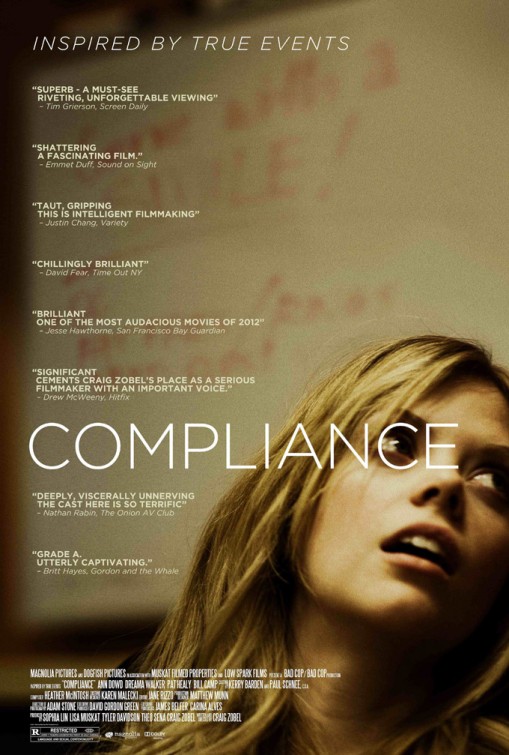
Plus, if Zobel were conscious in any way about the sensitivities of rape and how to handle it on film better than Law & Order or a fucking comic book, he probably wouldn't have made the fucking movie without Louise Ogborn's approval. But whatever, she's just the real world consequence of this fabulous and challenging moral lesson and Craig Zobel's personal journey in film-making.
posted by stoneandstar at 11:18 AM on September 9, 2012 [2 favorites]
The degree of projection elicited by this movie is genuinely impressive.
posted by localroger at 12:49 PM on September 9, 2012 [4 favorites]
posted by localroger at 12:49 PM on September 9, 2012 [4 favorites]
« Older "No to brainwashing!" | Take U everywhere Newer »
This thread has been archived and is closed to new comments
posted by roll truck roll at 1:42 AM on September 8, 2012 [4 favorites]